Works › The Book on the Sacrament of the Eucharist
Volume 38 · pp. 446–447
Index of Things, G-Rite
A marker with ≈ is an approximate page boundary, placed by measure of the text; the page photographs remain the authority. In the paired views, clicking a page marker brings that page into view.
G.
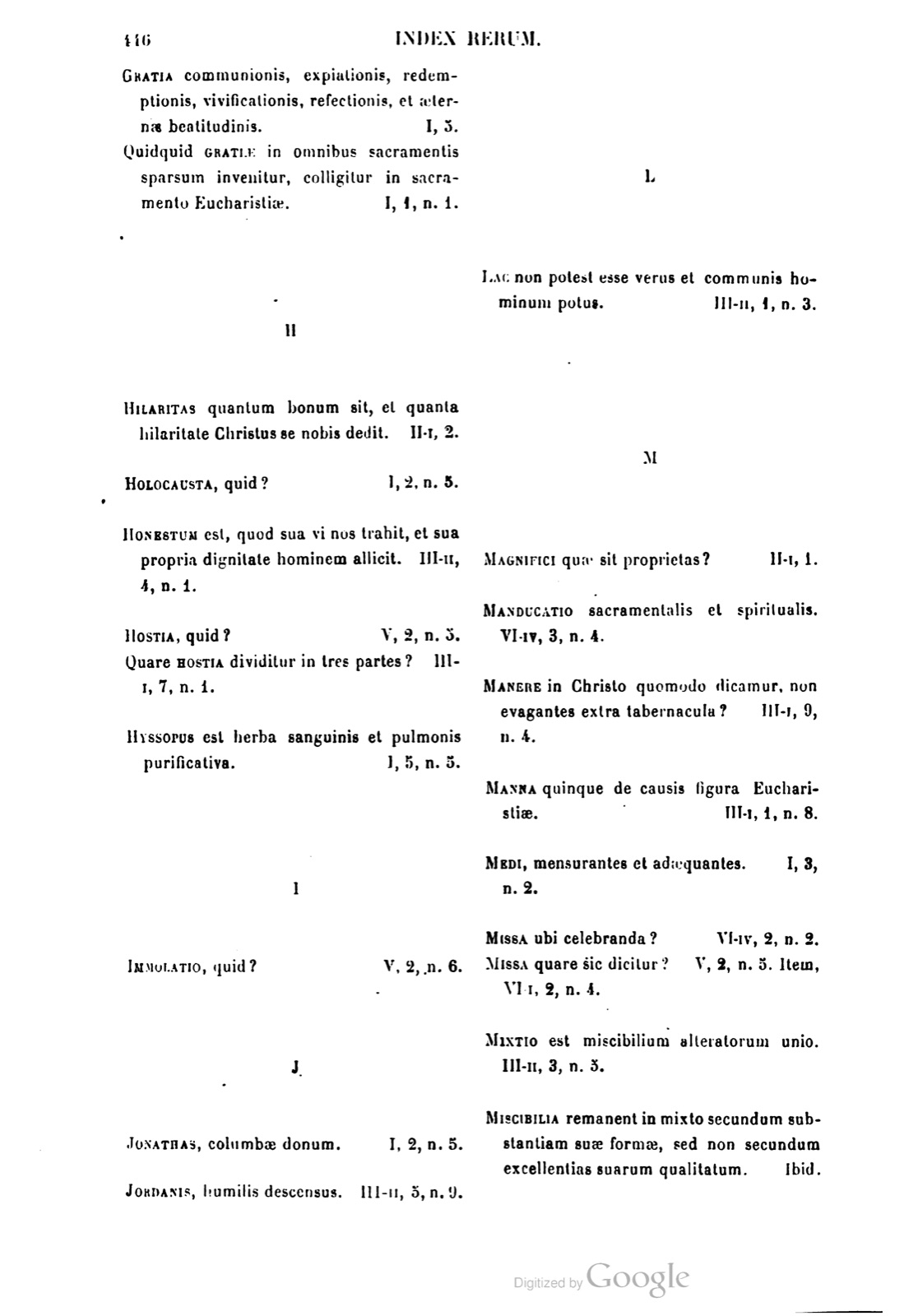
Generatio divina qua homo in corpus et membrum Christi generatur. III-I, 8, n. 2.
GRATIA communionis, expiationis, redemptionis, vivificationis, refectionis, et aeternae beatitudinis. I, 5.
Quidquid GRATIAE in omnibus sacramentis sparsum invenitur, colligitur in sacramento Eucharistiae. I, 1, n. 1.
H.
HILARITAS quantum bonum sit, et quanta hilaritate Christus se nobis dedit. II-I, 2.
HOLOCAUSTA, quid? V, 2, n. 5.
HONESTUM est, quod sua vi nos trahit, et sua propria dignitate hominem allicit. III-II, 4, n. 1.
HOSTIA, quid? V, 2, n. 3.
Quare HOSTIA dividitur in tres partes? III-I, 7, n. 1.
HYSSOPUS est herba sanguinis et pulmonis purificativa. I, 5, n. 5.
I.
IMMOLATIO, quid? V, 2, n. 6.
J.
JONATHAS, columbae donum. I, 2, n. 5.
JORDANIS, humilis descensus. III-II, 5, n. 9.
L.
LAC non potest esse verus et communis hominum potus. III-I, 1, n. 3.
M.
MAGNIFICI quae sit proprietas? II-I, 1.
MANDUCATIO sacramentalis et spiritualis. VI-IV, 3, n. 4.
MANERE in Christo quomodo dicamur, non evagantes extra tabernacula? III-I, 9, n. 4.
MANNA quinque de causis figura Eucharistiae. III-I, 1, n. 8.
MEDI, mensurantes et adaequantes. I, 3, n. 2.
MISSA ubi celebranda? VI-IV, 2, n. 2.
MISSA quare sic dicitur? V, 2, n. 5. Item, VII, 2, n. 4.
MIXTIO est miscibilium alteratorum unio. III-II, 3, n. 5.
MISCIBILIA remanent in mixto secundum substantiam suae formae, sed non secundum excellentias suarum qualitatum. Ibid.
Modus quo Christus continetur sub formis sacramentalibus. III-I, 1, n. 14.
In natura non sunt in genere nisi duae MUTATIONES: quarum una vocatur de subjecto in subjectum, altera vero vocatur de non subjecto ad subjectum, aut de subjecto ad non subjectum. VI-II, 1, n. 5.
MUTATIONES supernaturales non sunt in nunc temporis, nec in tempore de quo Philosophi loquuntur. VI-II, 1, n. 11.
N.
NATURA humana in Christo non est materialis ad divinam, nec divina formalis ad humanam. VI-II, 1, n. 9.
G.
Divine GENERATION by which man is generated into the body and member of Christ. III-I, 8, n. 2.
GRACE of communion, expiation, redemption, vivification, refreshment, and eternal beatitude. I, 5.
Whatever of GRACE is found scattered in all the sacraments is gathered together in the sacrament of the Eucharist. I, 1, n. 1.
H.
CHEERFULNESS, how great a good it is, and with how great cheerfulness Christ gave himself to us. II-I, 2.
WHOLE BURNT OFFERINGS, what? V, 2, n. 5.
The HONORABLE is what draws us by its own force and entices man by its own proper dignity. III-II, 4, n. 1.
HOST, what? V, 2, n. 3.
Why is the HOST divided into three parts? III-I, 7, n. 1.
HYSSOP is an herb purifying of blood and lung. I, 5, n. 5.
I.
IMMOLATION, what? V, 2, n. 6.
J.
JONATHAN, gift of the dove. I, 2, n. 5.
JORDAN, humble descent. III-II, 5, n. 9.
L.
MILK cannot be the true and common drink of men. III-I, 1, n. 3.
M.
What is the property of the MAGNIFICENT? II-I, 1.
SACRAMENTAL and spiritual EATING. VI-IV, 3, n. 4.
How are we said to REMAIN in Christ, not wandering outside the tabernacles? III-I, 9, n. 4.
MANNA, for five causes a figure of the Eucharist. III-I, 1, n. 8.
MEDES, measuring and equalizing. I, 3, n. 2.
Where must MASS be celebrated? VI-IV, 2, n. 2.
Why is MASS so called? V, 2, n. 5. Likewise, VII, 2, n. 4.
MIXTURE is the union of mixable altered things. III-II, 3, n. 5.
MIXABLE THINGS remain in the mixed thing according to the substance of their form, but not according to the excellences of their qualities. In the same place.
The mode by which Christ is contained under sacramental forms. III-I, 1, n. 14.
In nature generally there are only two CHANGES: one of which is called from subject into subject, but the other is called from non-subject to subject, or from subject to non-subject. VI-II, 1, n. 5.
SUPERNATURAL CHANGES are not in the now of time, nor in the time about which the Philosophers speak. VI-II, 1, n. 11.
N.
Human NATURE in Christ is not material to the divine, nor is the divine formal to the human. VI-II, 1, n. 9.
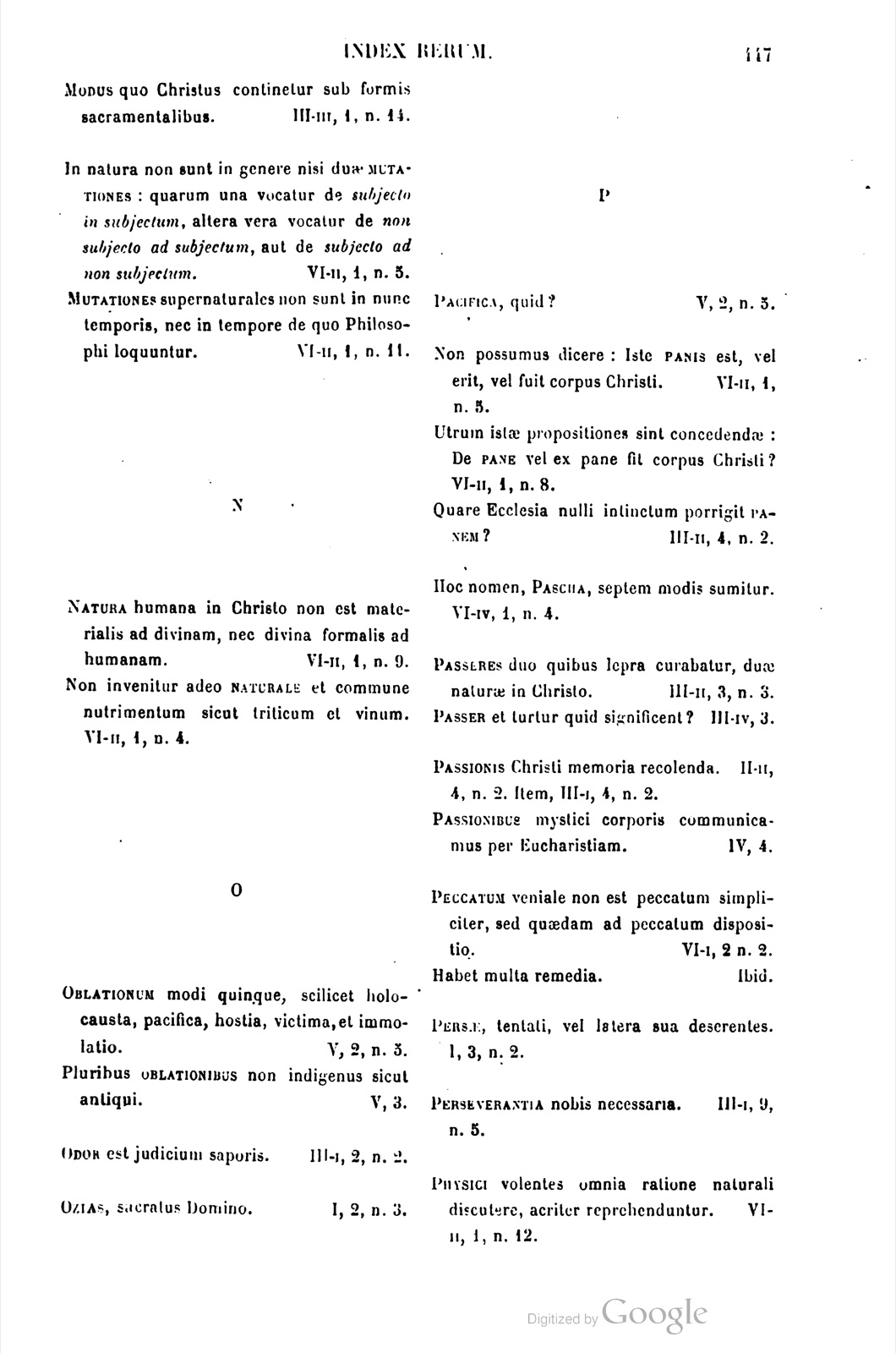
Non invenitur adeo NATURALE et commune nutrimentum sicut triticum et vinum. VI-I, 1, n. 4.
O.
OBLATIONUM modi quinque, scilicet holocausta, pacifica, hostia, victima, et immolatio. V, 2, n. 5.
Pluribus OBLATIONIBUS non indigemus sicut antiqui. V, 3.
ODOR est judicium saporis. III-I, 2, n. 2.
OZIAS, sacratus Domino. I, 2, n. 3.
P.
PACIFICA, quid? V, 2, n. 5.
Non possumus dicere: Iste PANIS est, vel erit, vel fuit corpus Christi. VI-II, 1, n. 5.
Utrum istae propositiones sint concedendae: De PANE vel ex pane fit corpus Christi? VI-II, 1, n. 8.
Quare Ecclesia nulli intinctum porrigit PANEM? III-II, 4, n. 2.
Hoc nomen, PASCHA, septem modis sumitur. VI-IV, 1, n. 4.
PASSERES duo quibus lepra curabatur, duae naturae in Christo. III-II, 3, n. 3.
PASSER et turtur quid significent? III-IV, 3.
PASSIONIS Christi memoria recolenda. II-II, 4, n. 2. Item, III-I, 4, n. 2.
PASSIONIBUS mystici corporis communicamus per Eucharistiam. IV, 4.
PECCATUM veniale non est peccatum simpliciter, sed quaedam ad peccatum dispositio. VI-I, 2, n. 2.
Habet multa remedia. Ibid.
PERSE, tentati, vel latera sua deserentes. I, 3, n. 2.
PERSEVERANTIA nobis necessaria. III-I, 9, n. 5.
PHYSICI volentes omnia ratione naturali discutere, acriter reprehenduntur. VI-II, 1, n. 12.
PIETAS Christum induxit ut nobis Eucharistiae sacramentum daret. I, 2, n. 4.
Potus sacramentalis qualis sit in genere et specie? III-II, 1.
Potus naturalis est naturae juvativus et influxivus, cibi lativus, subtiliativus et unitivus membris. III-II, 1, n. 7.
Potus sacramentalis habet unam operationem essentialem, et quinque adjunctas. III-II, 5, n. 5.
PTISANA non competit sanis. III-II, 1, n. 4.
R.
RAGUEL, aegrotans Deo. VI-I, 1, n. 1.
RAPHAEL, medicina Dei. VI-I, 1, n. 1.
RITUS sacramenti Eucharistiae ex parte Christi. VI-IV, 1.
RITUS ex parte ministri. VI-IV, 2.
Ritus ex parte sumentis. VI-IV, 3.
No NOURISHMENT is found so NATURAL and common as wheat and wine. VI-I, 1, n. 4.
O.
Five modes of OBLATIONS, namely whole burnt offerings, peace offerings, host, victim, and immolation. V, 2, n. 5.
We do not need several OBLATIONS as the ancients did. V, 3.
ODOR is the judgment of savor. III-I, 2, n. 2.
OZIAS, consecrated to the Lord. I, 2, n. 3.
P.
PEACE OFFERINGS, what? V, 2, n. 5.
We cannot say: This BREAD is, or will be, or was the body of Christ. VI-II, 1, n. 5.
Whether these propositions are to be conceded: From BREAD or out of bread the body of Christ is made? VI-II, 1, n. 8.
Why does the Church offer BREAD dipped to no one? III-II, 4, n. 2.
This name, PASSOVER, is taken in seven ways. VI-IV, 1, n. 4.
The two SPARROWS by which leprosy was cured: the two natures in Christ. III-II, 3, n. 3.
The SPARROW and the turtledove, what do they signify? III-IV, 3.
The memory of Christ's PASSION is to be recalled. II-II, 4, n. 2. Likewise, III-I, 4, n. 2.
We communicate in the PASSIONS of the mystical body through the Eucharist. IV, 4.
VENIAL SIN is not sin simply, but a certain disposition toward sin. VI-I, 2, n. 2.
It has many remedies. In the same place.
PERSIANS, the tempted, or those deserting their own sides. I, 3, n. 2.
PERSEVERANCE necessary for us. III-I, 9, n. 5.
PHYSICIANS wishing to discuss all things by natural reason are sharply rebuked. VI-II, 1, n. 12.
PIETY led Christ to give us the sacrament of the Eucharist. I, 2, n. 4.
What is sacramental drink in genus and species? III-II, 1.
Natural drink is helping and flowing-in of nature, carrying of food, refining and uniting it to the members. III-II, 1, n. 7.
Sacramental drink has one essential operation and five adjunct operations. III-II, 5, n. 5.
BARLEY WATER does not suit the healthy. III-II, 1, n. 4.
R.
RAGUEL, sick with God. VI-I, 1, n. 1.
RAPHAEL, medicine of God. VI-I, 1, n. 1.
The RITE of the sacrament of the Eucharist on the part of Christ. VI-IV, 1.
The RITE on the part of the minister. VI-IV, 2.
The rite on the part of the one receiving. VI-IV, 3.
If a page does not appear, its photograph has not been uploaded yet.