Works › The Book on the Sacrament of the Eucharist
Volume 38 · pp. 194–195
Chapter I, Conclusion; Chapter II, Beginning. This Sacrament Is Given to Us Only by the Most Gracious One.
A marker with ≈ is an approximate page boundary, placed by measure of the text; the page photographs remain the authority. In the paired views, clicking a page marker brings that page into view.
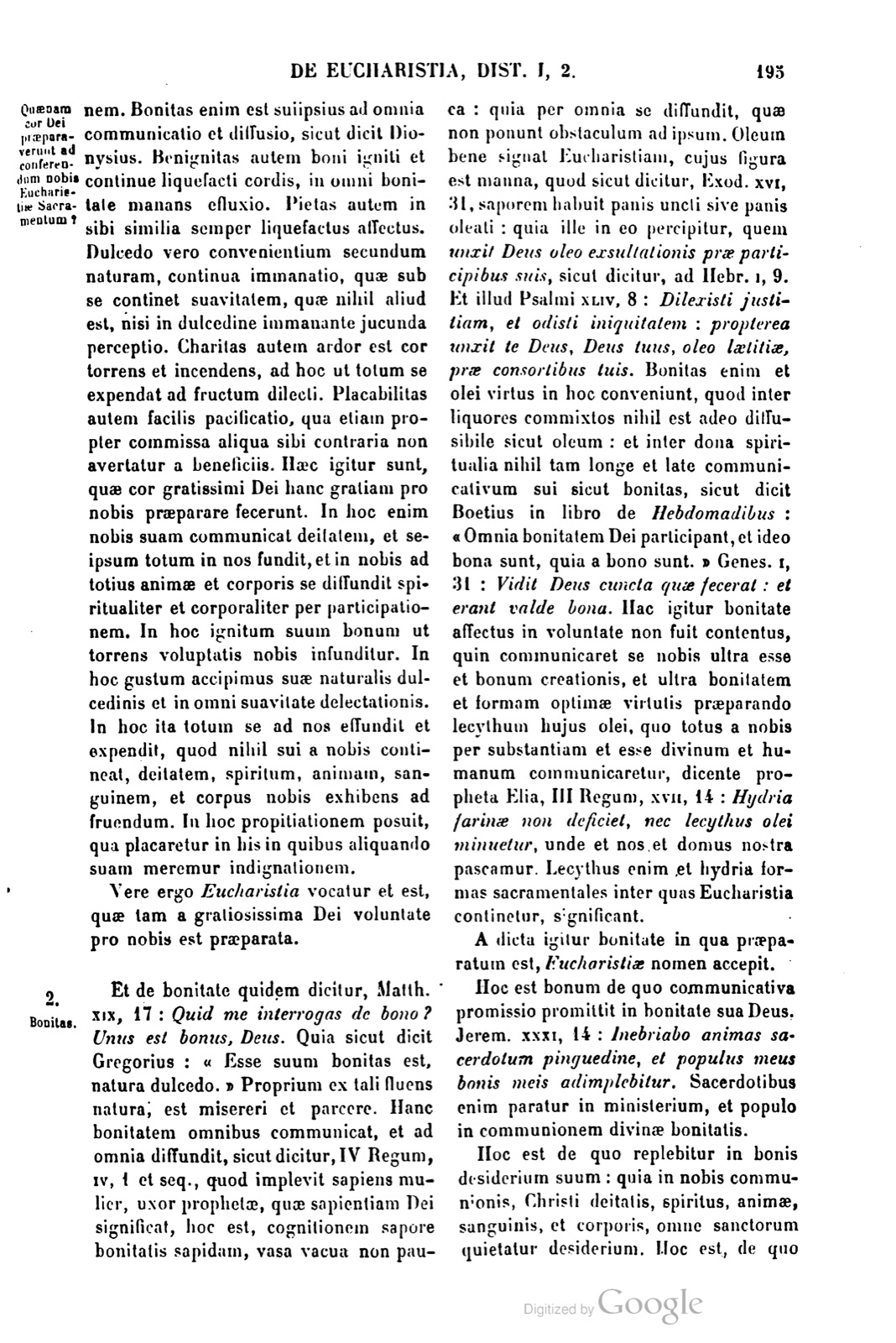
Marginal label (printed p. 195): Quaenam cor Dei praeparaverunt ad conferendum nobis Eucharistiae Sacramentum?
Marginal label (printed p. 195): Bonitas.
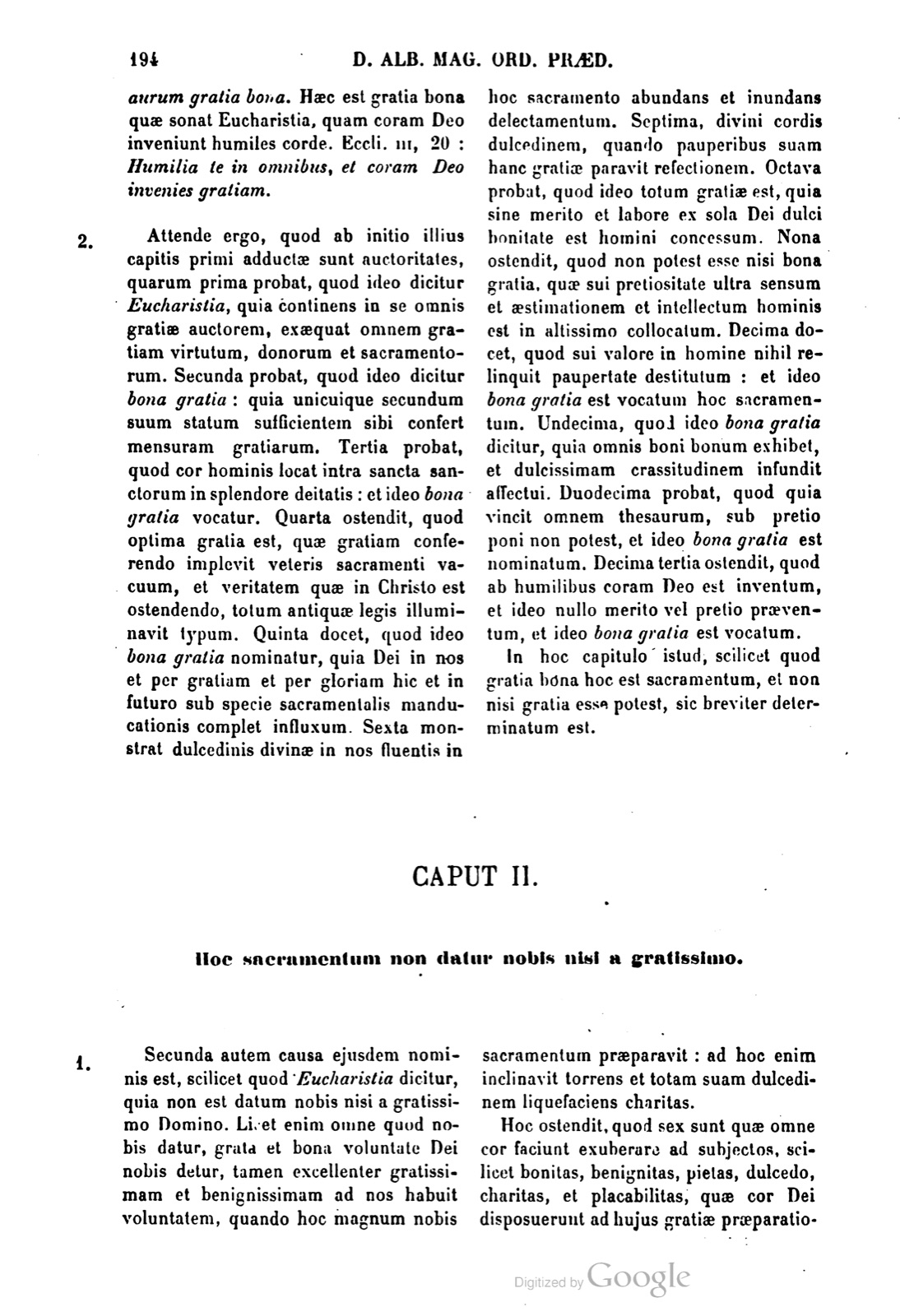
aurum gratia bona. Haec est gratia bona quae sonat Eucharistia, quam coram Deo inveniunt humiles corde. Eccli. iii, 20: Humilia te in omnibus, et coram Deo invenies gratiam.
2. Attende ergo, quod ab initio illius capitis primi adductae sunt auctoritates, quarum prima probat, quod ideo dicitur Eucharistia, quia continens in se omnis gratiae auctorem, exaequat omnem gratiam virtutum, donorum et sacramentorum. Secunda probat, quod ideo dicitur bona gratia: quia unicuique secundum suum statum sufficientem sibi confert mensuram gratiarum. Tertia probat, quod cor hominis locat intra sancta sanctorum in splendore deitatis: et ideo bona gratia vocatur. Quarta ostendit, quod optima gratia est, quae gratiam conferendo implevit veteris sacramenti vacuum, et veritatem quae in Christo est ostendendo, totum antiquae legis illuminavit typum. Quinta docet, quod ideo bona gratia nominatur, quia Dei in nos et per gratiam et per gloriam hic et in futuro sub specie sacramentalis manducationis complet influxum. Sexta monstrat dulcedinis divinae in nos fluentis in hoc sacramento abundans et inundans delectamentum. Septima, divini cordis dulcedinem, quando pauperibus suam hanc gratiae paravit refectionem. Octava probat, quod ideo totum gratiae est, quia sine merito et labore ex sola Dei dulci bonitate est homini concessum. Nona ostendit, quod non potest esse nisi bona gratia, quae sui pretiositate ultra sensum et aestimationem et intellectum hominis est in altissimo collocatum. Decima docet, quod sui valore in homine nihil relinquit paupertate destitutum: et ideo bona gratia est vocatum hoc sacramentum. Undecima, quod ideo bona gratia dicitur, quia omnis boni bonum exhibet, et dulcissimam crassitudinem infundit affectui. Duodecima probat, quod quia vincit omnem thesaurum, sub pretio poni non potest, et ideo bona gratia est nominatum. Decima tertia ostendit, quod ab humilibus coram Deo est inventum, et ideo nullo merito vel pretio praeventum, et ideo bona gratia est vocatum.
In hoc capitulo istud, scilicet quod gratia bona hoc est sacramentum, et non nisi gratia esse potest, sic breviter determinatum est.
Caput II. Hoc sacramentum non datur nobis nisi a gratissimo.
1. Secunda autem causa ejusdem nominis est, scilicet quod Eucharistia dicitur, quia non est datum nobis nisi a gratissimo Domino. Licet enim omne quod nobis datur, grata et bona voluntate Dei nobis detur, tamen excellenter gratissimam et benignissimam ad nos habuit voluntatem, quando hoc magnum nobis sacramentum praeparavit: ad hoc enim inclinavit torrens et totam suam dulcedinem liquefaciens charitas.
Hoc ostendit, quod sex sunt quae omne cor faciunt exuberare ad subjectos, scilicet bonitas, benignitas, pietas, dulcedo, charitas, et placabilitas, quae cor Dei disposuerunt ad hujus gratiae praeparationem. Bonitas enim est suiipsius ad omnia communicatio et diffusio, sicut dicit Dionysius. Benignitas autem boni igniti et continue liquefacti cordis, in omni bonitate manans effluxio. Pietas autem in sibi similia semper liquefactus affectus. Dulcedo vero convenientium secundum naturam, continua immanatio, quae sub se continet suavitatem, quae nihil aliud est, nisi in dulcedine immanante jucunda perceptio. Charitas autem ardor est cor torrens et incendens, ad hoc ut totum se expendat ad fructum dilecti. Placabilitas autem facilis pacificatio, qua etiam propter commissa aliqua sibi contraria non avertatur a beneficiis. Haec igitur sunt, quae cor gratissimi Dei hanc gratiam pro nobis praeparare fecerunt. In hoc enim ipsum totum in nos fundit, et in nobis ad totius animae et corporis se diffundit spiritualiter et corporaliter per participationem. In hoc ignitum suum bonum ut torrens voluptatis nobis infunditur. In hoc gustum accipimus suae naturalis dulcedinis et in omni suavitate delectationis. In hoc ita totum se ad nos effundit et expendit, quod nihil sui a nobis contineat, deitatem, spiritum, animam, sanguinem, et corpus nobis exhibens ad fruendum. In hoc propitiationem posuit, qua placaretur in his in quibus aliquando suam meremur indignationem.
Marginal label (printed p. 195): What things prepared the heart of God for conferring on us the Sacrament of the Eucharist?
Marginal label (printed p. 195): Goodness.
gold, good grace. This is the good grace that Eucharistia sounds out, which the humble in heart find before God. Ecclesiasticus 3:20: Humble yourself in all things, and before God you will find grace.
2. Therefore attend, that from the beginning of that first chapter authorities have been brought forward, of which the first proves that it is therefore called Eucharist because, containing in itself the author of every grace, it equals every grace of virtues, gifts, and sacraments. The second proves that it is therefore called good grace because it confers on each one, according to his state, a measure of graces sufficient for him. The third proves that it places the heart of man within the holy of holies in the splendor of deity, and therefore it is called good grace. The fourth shows that it is the best grace, which, by conferring grace, filled the emptiness of the old sacrament, and, by showing the truth which is in Christ, illumined the whole type of the old law. The fifth teaches that it is therefore named good grace because, here and in the future, under the species of sacramental eating, it completes the inflowing of God into us both through grace and through glory. The sixth shows the abundant and overflowing delight of divine sweetness flowing into us in this sacrament. The seventh shows the sweetness of the divine heart, when he prepared for the poor this refreshment of his grace. The eighth proves that therefore the whole is of grace because it has been granted to man without merit and labor from the sweet goodness of God alone. The ninth shows that it can be nothing but good grace, which by its preciousness is placed in the highest beyond the sense and estimation and understanding of man. The tenth teaches that by its value it leaves nothing destitute by poverty in man; and therefore this sacrament has been called good grace. The eleventh teaches that it is therefore called good grace because it offers the good of every good and pours the sweetest fatness into the affection. The twelfth proves that, because it surpasses every treasure, it cannot be placed under a price, and therefore it has been named good grace. The thirteenth shows that it has been found by the humble before God and therefore was anticipated by no merit or price, and therefore has been called good grace.
In this chapter, then, this point, namely that this sacrament is good grace and can be nothing but grace, has thus been briefly determined.
Chapter II. This sacrament is given to us only by the most gracious one.
1. The second cause of the same name, however, is namely that it is called Eucharist because it has been given to us only by the most gracious Lord. For although everything that is given to us is given to us by the gracious and good will of God, nevertheless he had toward us an excellently most gracious and most kindly will when he prepared this great sacrament for us; for to this charity inclined the torrent and liquefied all its sweetness.
This shows that there are six things which make every heart overflow toward those subject to it, namely goodness, kindliness, piety, sweetness, charity, and placability, which disposed the heart of God for the preparation of this grace. For goodness is the communication and diffusion of itself to all things, as Dionysius says. Kindliness, however, is the outflow flowing in all goodness from a good heart that is enkindled and continually melted. Piety, however, is an affection always melted toward things similar to itself. Sweetness truly is the continual indwelling of things agreeing according to nature, which contains under itself suavity, which is nothing other than a joyous perception in an indwelling sweetness. Charity, however, is the ardor torrenting and setting the heart on fire, so that it spends its whole self for the fruit of the beloved. Placability, however, is an easy pacification by which, even on account of some acts committed contrary to itself, it is not turned away from benefits. These, therefore, are the things which made the heart of the most gracious God prepare this grace for us. For in this he pours his whole self into us, and in us he diffuses himself to the whole of soul and body, spiritually and bodily by participation. In this his enkindled good is poured into us like a torrent of pleasure. In this we receive a taste of his natural sweetness and in every suavity of delight. In this he so pours out and spends his whole self toward us that he holds back nothing of himself from us, offering to us deity, spirit, soul, blood, and body for enjoyment. In this he placed a propitiation by which he might be placated in those things in which we sometimes deserve his indignation.
2. Vere ergo Eucharistia vocatur et est, quae tam a gratiosissima Dei voluntate pro nobis est praeparata.
Et de bonitate quidem dicitur, Matth. xix, 17: Quid me interrogas de bono? Unus est bonus, Deus. Quia sicut dicit Gregorius: Esse suum bonitas est, natura dulcedo. Proprium ex tali fluens natura, est misereri et parcere. Hanc bonitatem omnibus communicat, et ad omnia diffundit, sicut dicitur, IV Regum, iv, 1 et seq., quod implevit sapiens mulier, uxor prophetae, quae sapientiam Dei significat, hoc est, cognitionem sapore bonitatis sapidam, vasa vacua non pauca: quia per omnia se diffundit, quae non ponunt obstaculum ad ipsum. Oleum bene signat Eucharistiam, cujus figura est manna, quod sicut dicitur, Exod. xvi, 31, saporem habuit panis uncti sive panis oleati: quia ille in eo percipitur, quem unxit Deus oleo exsultationis prae participibus suis, sicut dicitur, ad Hebr. i, 9. Et illud Psalmi xliv, 8: Dilexisti justitiam, et odisti iniquitatem: propterea unxit te Deus, Deus tuus, oleo laetitiae, prae consortibus tuis. Bonitas enim et olei virtus in hoc conveniunt, quod inter liquores commixtos nihil est adeo diffusibile sicut oleum: et inter dona spiritualia nihil tam longe et late communicativum sui sicut bonitas, sicut dicit Boetius in libro de Hebdomadibus: Omnia bonitatem Dei participant, et ideo bona sunt, quia a bono sunt. Genes. i, 31: Vidit Deus cuncta quae fecerat: et erant valde bona. Hac igitur bonitate nobis suam communicat deitatem, et se affectus in voluntate non fuit contentus, quin communicaret se nobis ultra esse et bonum creationis, et ultra bonitatem et formam optimae virtutis praeparando lecythum hujus olei, quo totus a nobis per substantiam et esse divinum et humanum communicaretur, dicente propheta Elia, III Regum, xvii, 14: Hydria farinae non deficiet, nec lecythus olei minuetur, unde et nos et domus nostra pascamur. Lecythus enim et hydria formas sacramentales inter quas Eucharistia continetur, significant.
A dicta igitur bonitate in qua praeparatum est, Eucharistiae nomen accepit. Hoc est bonum de quo communicativa promissio promittit in bonitate sua Deus. Jerem. xxxi, 14: Inebriabo animas sacerdotum pinguedine, et populus meus bonis meis adimplebitur. Sacerdotibus enim paratur in ministerium, et populo in communionem divinae bonitatis.
Hoc est de quo replebitur in bonis desiderium suum: quia in nobis communionis, Christi deitatis, spiritus, animae, sanguinis, et corporis, omne sanctorum quietatur desiderium.
2. Therefore that is truly called and is Eucharist which has been prepared for us by so gracious a will of God.
And indeed concerning goodness it is said in Matthew 19:17: Why do you ask me about the good? One is good, God. Because, as Gregory says: His very being is goodness, his nature sweetness. What flows properly from such a nature is to have mercy and to spare. He communicates this goodness to all things and diffuses it to all things, as it is said in 4 Kings 4:1 and following, that the wise woman, the wife of the prophet, who signifies the wisdom of God, that is, knowledge made savory by the taste of goodness, filled not a few empty vessels, because it diffuses itself through all things which place no obstacle to it. Oil well signifies the Eucharist, whose figure is the manna, which, as is said in Exodus 16:31, had the taste of an anointed bread or oiled bread, because he is perceived in it whom God anointed with the oil of exultation before his companions, as is said in Hebrews 1:9. And that passage of Psalm 44:8: You have loved justice and hated iniquity; therefore God, your God, has anointed you with the oil of gladness before your fellows. For goodness and the power of oil agree in this, that among mixed liquids nothing is so diffusible as oil, and among spiritual gifts nothing communicates itself so far and so broadly as goodness, as Boethius says in the book On the Hebdomads: All things participate in the goodness of God, and therefore they are good because they are from the good. Genesis 1:31: God saw all the things which he had made, and they were very good. Therefore by this goodness he communicates his deity to us, and his affection in will was not content unless he communicated himself to us beyond the being and good of creation, and beyond the goodness and form of the best virtue, by preparing the little jar of this oil, by which he as a whole would be communicated by us through divine and human substance and being, as the prophet Elijah says in 3 Kings 17:14: The jar of meal shall not fail, nor shall the little jar of oil be diminished, whence both we and our house may be fed. For the little jar and the water-pot signify the sacramental forms between which the Eucharist is contained.
Therefore from the aforesaid goodness in which it was prepared, it received the name Eucharist. This is the good concerning which God in his goodness promises the communicative promise. Jeremiah 31:14: I will intoxicate the souls of the priests with fatness, and my people shall be filled with my goods. For it is prepared for priests unto ministry, and for the people unto communion of divine goodness.
This is that concerning which his desire will be filled with goods, because in us, by the communion of Christ's deity, spirit, soul, blood, and body, every desire of the saints is quieted.
If a page does not appear, its photograph has not been uploaded yet.