Works › The Book on the Sacrament of the Eucharist
Volume 38 · pp. 244–247
Chapter III. On the Richness of This Food from Preparation.
A marker with ≈ is an approximate page boundary, placed by measure of the text; the page photographs remain the authority. In the paired views, clicking a page marker brings that page into view.
Marginal label (printed p. 244): Cibus potentia Patris praeparatus.
Caput III. De cibi hujus laucitate ex praeparatione.
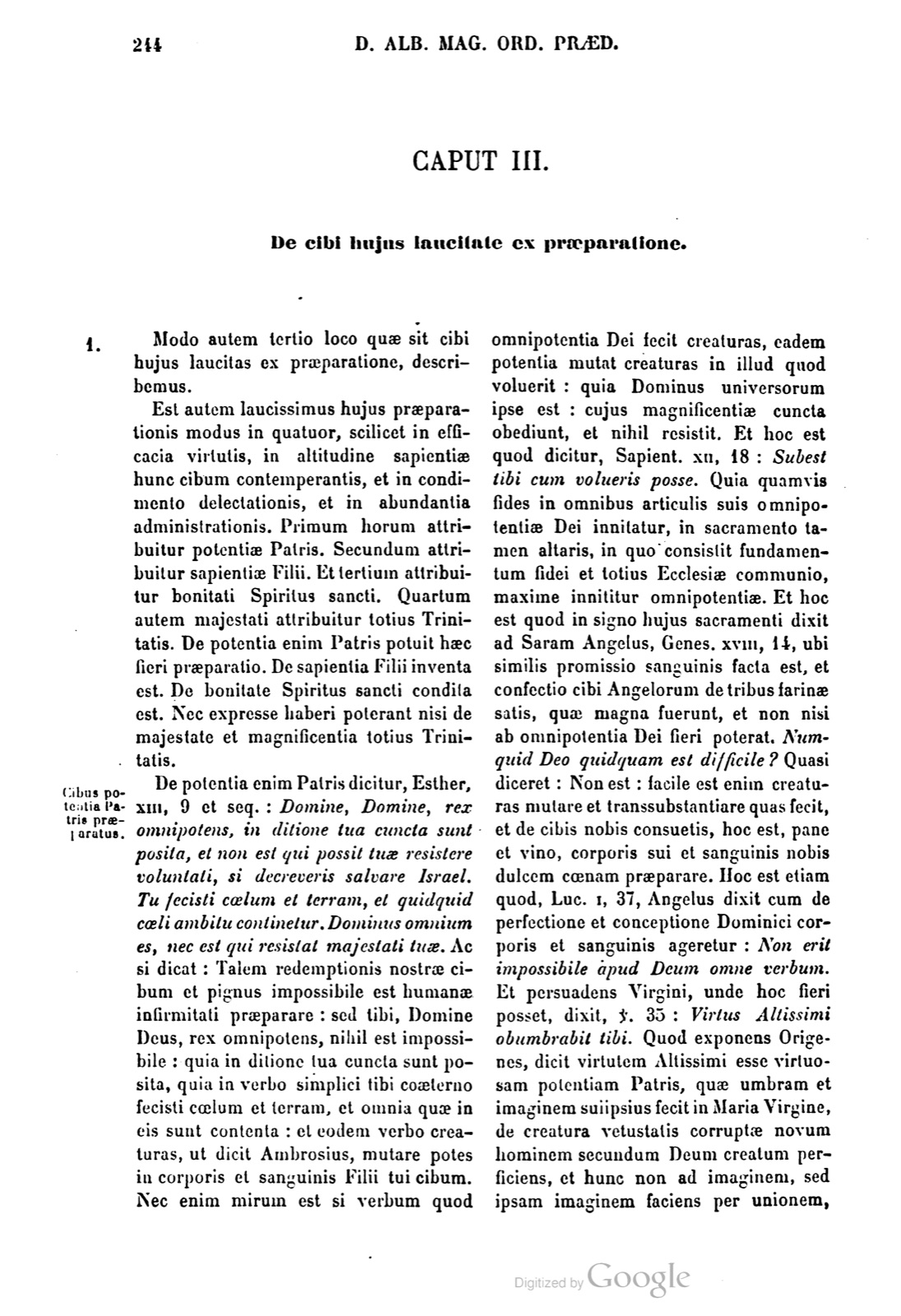
1. Modo autem tertio loco quae sit cibi hujus laucitas ex praeparatione, describemus.
Est autem laucissimus hujus praeparationis modus in quatuor, scilicet in efficacia virtutis, in altitudine sapientiae hunc cibum contemperantis, et in condimento delectationis, et in abundantia administrationis. Primum horum attribuitur potentiae Patris. Secundum attribuitur sapientiae Filii. Et tertium attribuitur bonitati Spiritus sancti. Quartum autem majestati attribuitur totius Trinitatis. De potentia enim Patris potuit haec fieri praeparatio. De sapientia Filii inventa est. De bonitate Spiritus sancti condita est. Nec expresse haberi poterant nisi de majestate et magnificentia totius Trinitatis.
De potentia enim Patris dicitur, Esther, xiii, 9 et seq.: Domine, Domine, rex omnipotens, in ditione tua cuncta sunt posita, et non est qui possit tuae resistere voluntati, si decreveris salvare Israel. Tu fecisti caelum et terram, et quidquid caeli ambitu continetur. Dominus omnium es, nec est qui resistat majestati tuae. Ac si dicat: Talem redemptionis nostrae cibum et pignus impossibile est humanae infirmitati praeparare: sed tibi, Domine Deus, rex omnipotens, nihil est impossibile: quia in ditione tua cuncta sunt posita, quia in verbo simplici tibi coaeterno fecisti caelum et terram, et omnia quae in eis sunt contenta: et eodem verbo creaturas, ut dicit Ambrosius, mutare potes in corporis et sanguinis Filii tui cibum. Nec enim mirum est si verbum quod omnipotentia Dei fecit creaturas, eadem potentia mutat creaturas in illud quod voluerit: quia Dominus universorum ipse est: cujus magnificentiae cuncta obediunt, et nihil resistit. Et hoc est quod dicitur, Sapient. xii, 18: Subest tibi cum volueris posse. Quia quamvis fides in omnibus articulis suis omnipotentiae Dei innitatur, in sacramento tamen altaris, in quo consistit fundamentum fidei et totius Ecclesiae communio, maxime innititur omnipotentiae. Et hoc est quod in signo hujus sacramenti dixit ad Saram Angelus, Genes. xviii, 14, ubi similis promissio sanguinis facta est, et confectio cibi Angelorum de tribus farinae satis, quae magna fuerunt, et non nisi ab omnipotentia Dei fieri poterat. Numquid Deo quidquam est difficile? Quasi diceret: Non est: facile est enim creaturas mutare et transsubstantiare quas fecit, et de cibis nobis consuetis, hoc est, pane et vino, corporis sui et sanguinis nobis dulcem coenam praeparare. Hoc est etiam quod, Luc. i, 37, Angelus dixit cum de perfectione et conceptione Dominici corporis et sanguinis ageretur: Non erit impossibile apud Deum omne verbum. Et persuadens Virgini, unde hoc fieri posset, dixit, v. 35: Virtus Altissimi obumbrabit tibi. Quod exponens Origenes, dicit virtutem Altissimi esse virtuosam potentiam Patris, quae umbram et imaginem suiipsius fecit in Maria Virgine, de creatura vetustatis corruptae novum hominem secundum Deum creatum perficiens, et hunc non ad imaginem, sed ipsam imaginem faciens per unionem, in quo perfecta resultaret potentia Patris.
Marginal label (printed p. 244): Food prepared by the power of the Father.
Chapter III. On the richness of this food from preparation.
1. Now, in the third place, we shall describe what is the richness of this food from preparation.
But the manner of this preparation is most rich in four things, namely in the efficacy of virtue, in the height of wisdom blending this food, in the seasoning of delight, and in the abundance of administration. The first of these is attributed to the power of the Father. The second is attributed to the wisdom of the Son. And the third is attributed to the goodness of the Holy Spirit. But the fourth is attributed to the majesty of the whole Trinity. For by the power of the Father this preparation could be made. By the wisdom of the Son it was invented. By the goodness of the Holy Spirit it was seasoned. Nor could these things be had expressly except from the majesty and magnificence of the whole Trinity.
For concerning the power of the Father it is said in Esther 13:9 and following: Lord, Lord, almighty king, all things are placed in your dominion, and there is no one who can resist your will, if you have decreed to save Israel. You made heaven and earth and whatever is contained by the circuit of heaven. You are Lord of all, nor is there anyone who resists your majesty. As if he were saying: It is impossible for human weakness to prepare such a food and pledge of our redemption; but to you, Lord God, almighty king, nothing is impossible, because all things are placed in your dominion, because in the simple Word coeternal with you you made heaven and earth and all things contained in them; and by the same Word, as Ambrose says, you can change creatures into the food of the body and blood of your Son. Nor is it wonderful if the Word by whose omnipotence God made creatures changes creatures by the same power into whatever he shall have willed, because he himself is the Lord of all things; all things obey his magnificence, and nothing resists. And this is what is said in Wisdom 12:18: To you, when you will, power is subject. Because although faith in all its articles rests upon the omnipotence of God, nevertheless in the sacrament of the altar, in which the foundation of faith and the communion of the whole Church consists, it rests most of all upon omnipotence. And this is what the angel said to Sarah in the sign of this sacrament, Genesis 18:14, where a similar promise of blood was made and the making of the food of angels from three measures of flour, which were great things and could be made only by the omnipotence of God. Is anything difficult for God? As if he were saying: It is not. For it is easy to change and transubstantiate the creatures which he made, and from foods customary to us, that is, bread and wine, to prepare for us the sweet supper of his body and blood. This also is what the angel said in Luke 1:37, when the perfection and conception of the Lord's body and blood were being treated: No word will be impossible with God. And persuading the Virgin whence this could happen, he said, verse 35: The virtue of the Most High will overshadow you. Origen, explaining this, says that the virtue of the Most High is the virtuous power of the Father, which made a shadow and image of itself in the Virgin Mary, from the creature of corrupted oldness perfecting the new man created according to God, and making this one not according to the image, but the image itself through union, in whom the perfect power of the Father would shine forth.
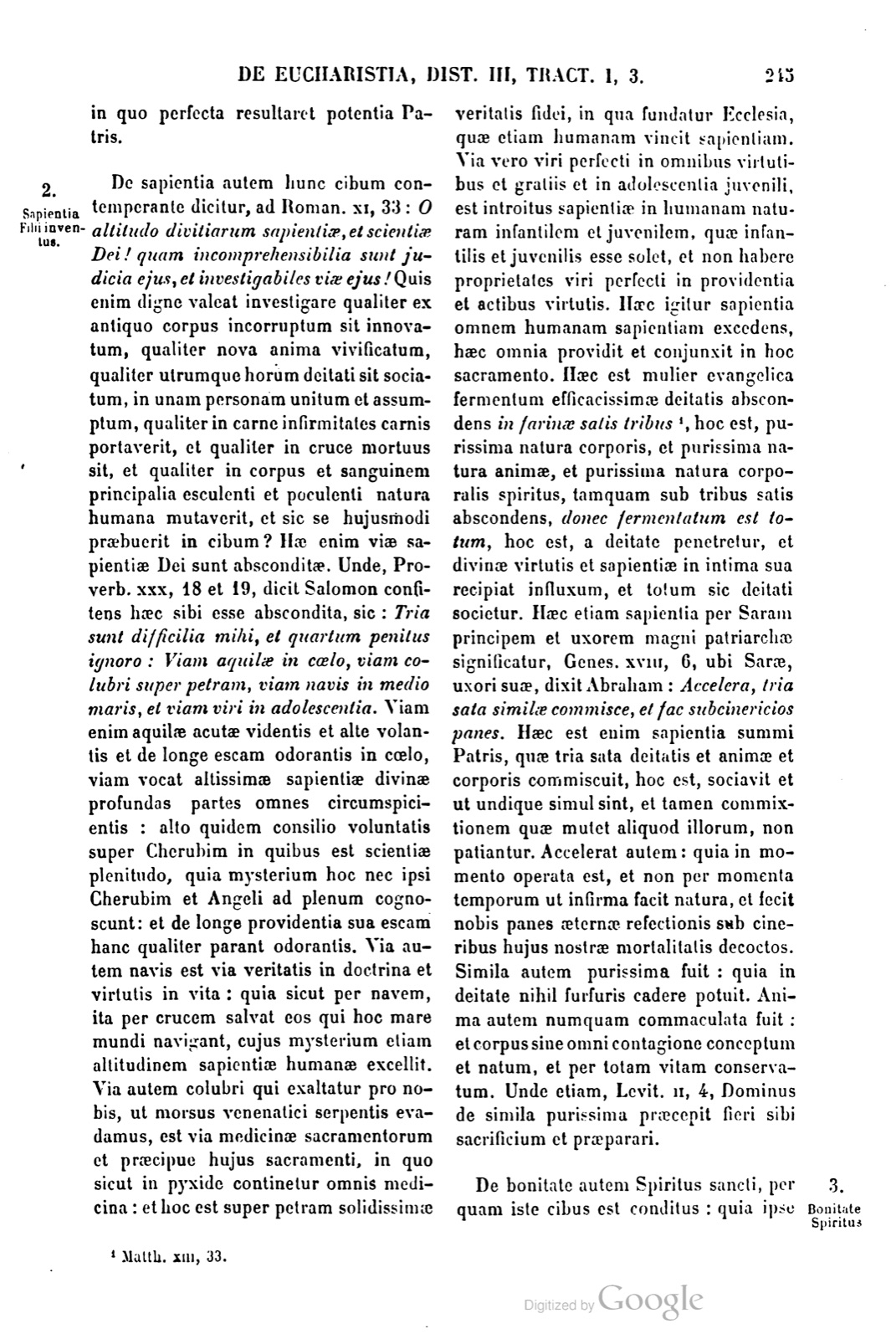
2. De sapientia autem hunc cibum contemperante dicitur, ad Roman. xi, 33: O altitudo divitiarum sapientiae, et scientiae Dei! quam incomprehensibilia sunt judicia ejus, et investigabiles viae ejus! Quis enim digne valeat investigare qualiter ex antiquo corpus incorruptum sit innovatum, qualiter nova anima vivificatum, qualiter utrumque horum deitati sit sociatum, in unam personam unitum et assumptum, qualiter in carne infirmitates carnis portaverit, et qualiter in cruce mortuus sit, et qualiter in corpus et sanguinem principalia esculenti et poculenti natura humana mutaverit, et sic se hujusmodi praebuerit in cibum? Hae enim viae sapientiae Dei sunt absconditae. Unde, Proverb. xxx, 18 et 19, dicit Salomon confitens haec sibi esse abscondita, sic: Tria sunt difficilia mihi, et quartum penitus ignoro: Viam aquilae in caelo, viam colubri super petram, viam navis in medio maris, et viam viri in adolescentia. Viam enim aquilae acutae videntis et alte volantis et de longe escam odorantis in coelo, viam vocat altissimae sapientiae divinae profundas partes omnes circumspicientis: alto quidem consilio voluntatis super Cherubim in quibus est scientiae plenitudo, quia mysterium hoc nec ipsi Cherubim et Angeli ad plenum cognoscunt: et de longe providentia sua escam hanc qualiter parant odorantis. Via autem navis est via veritatis in doctrina et virtutis in vita: quia sicut per navem, ita per crucem salvat eos qui hoc mare mundi navigant, cujus mysterium etiam altitudinem sapientiae humanae excellit. Via autem colubri qui exaltatur pro nobis, ut morsus venenatici serpentis evadamus, est via medicinae sacramentorum et praecipue hujus sacramenti, in quo sicut in pyxide continetur omnis medicina: et hoc est super petram solidissimae veritatis fidei, in qua fundatur Ecclesia, quae etiam humanam vincit sapientiam. Via vero viri perfecti in omnibus virtutibus et gratiis et in adolescentia juvenili, est introitus sapientiae in humanam naturam infantilem et juvenilem, quae infantilis et juvenilis esse solet, et non habere proprietates viri perfecti in providentia et actibus virtutis. Haec igitur sapientia omnem humanam sapientiam excedens, haec omnia providit et conjunxit in hoc sacramento. Haec est mulier evangelica fermentum efficacissimae deitatis abscondens in farinae satis tribus1, hoc est, purissima natura corporis, et purissima natura animae, et purissima natura corporalis spiritus, tamquam sub tribus satis abscondens, donec fermentatum est totum, hoc est, a deitate penetretur, et divinae virtutis et sapientiae in intima sua recipiat influxum, et totum sic deitati societur. Haec etiam sapientia per Saram principem et uxorem magni patriarchae significatur, Genes. xviii, 6, ubi Sarae, uxori suae, dixit Abraham: Accelera, tria sata similae commisce, et fac subcinericios panes. Haec est enim sapientia summi Patris, quae tria sata deitatis et animae et corporis commiscuit, hoc est, sociavit et ut undique simul sint, et tamen commixtionem quae mutet aliquod illorum, non patiantur. Accelerat autem: quia in momento operata est, et non per momenta temporum ut infirma facit natura, et fecit nobis panes aeternae refectionis sub cineribus hujus nostrae mortalitatis decoctos. Simila autem purissima fuit: quia in deitate nihil furfuris cadere potuit. Anima autem numquam commaculata fuit: et corpus sine omni contagione conceptum et natum, et per totam vitam conservatum. Unde etiam, Levit. ii, 4, Dominus de simila purissima praecepit fieri sibi sacrificium et praeparari.
2. But concerning the wisdom blending this food, Romans 11:33 says: O height of the riches of the wisdom and knowledge of God! How incomprehensible are his judgments, and his ways past finding out! For who could worthily investigate how from the old the incorrupt body was renewed, how it was vivified by a new soul, how both of these were joined to deity, united and assumed into one person, how he bore the weaknesses of flesh in the flesh, how he died on the cross, and how he changed into body and blood the principal things of edible and drinkable human nature, and thus offered himself in this kind as food? For these are the hidden ways of the wisdom of God. Hence in Proverbs 30:18 and 19 Solomon, confessing that these things are hidden from him, says thus: Three things are difficult for me, and the fourth I utterly do not know: the way of the eagle in heaven, the way of the serpent upon the rock, the way of a ship in the midst of the sea, and the way of a man in youth. For by the way of the eagle, sharply seeing and flying high and scenting food from afar in heaven, he calls the way of the most high divine wisdom looking around all deep parts; by the high counsel of the will above the Cherubim, in whom is fullness of knowledge, because neither the Cherubim themselves nor the angels fully know this mystery; and from afar, by its providence, scenting how they prepare this food. But the way of the ship is the way of truth in doctrine and of virtue in life, because as through a ship, so through the cross, he saves those who navigate this sea of the world, whose mystery also exceeds the height of human wisdom. But the way of the serpent who is exalted for us, so that we may escape the bites of the venomous serpent, is the way of the medicine of the sacraments and especially of this sacrament, in which as in a pyx every medicine is contained; and this is upon the rock of most solid truth of faith, in which the Church is founded, which also conquers human wisdom. But the way of the man perfect in all virtues and graces and in youthful adolescence is the entrance of wisdom into infant and youthful human nature, which is accustomed to be infantile and youthful and not to have the properties of a perfect man in providence and acts of virtue. Therefore this wisdom, exceeding every human wisdom, provided and joined all these things in this sacrament. This is the evangelical woman hiding the leaven of most efficacious deity in three measures of flour1, that is, in the most pure nature of body, the most pure nature of soul, and the most pure nature of bodily spirit, hiding as it were under three measures until the whole was leavened, that is, until it was penetrated by deity, and received into its innermost parts the influx of divine virtue and wisdom, and thus the whole was joined to deity. This wisdom is also signified by Sarah, princess and wife of the great patriarch, in Genesis 18:6, where Abraham said to Sarah his wife: Hurry, mix three measures of fine flour, and make hearth cakes. For this is the wisdom of the highest Father, which mixed the three measures of deity and soul and body, that is, associated them and made them be together from every side, and yet not suffer a mixture which changes any of them. But it hurries, because it worked in a moment and not through moments of time as weak nature does; and it made for us breads of eternal refreshment baked under the ashes of this our mortality. But the fine flour was most pure, because nothing of bran could fall in deity. The soul was never defiled, and the body was conceived and born without every contagion and preserved through its whole life. Hence also in Leviticus 2:4 the Lord commanded a sacrifice to be made and prepared for himself from most pure fine flour.
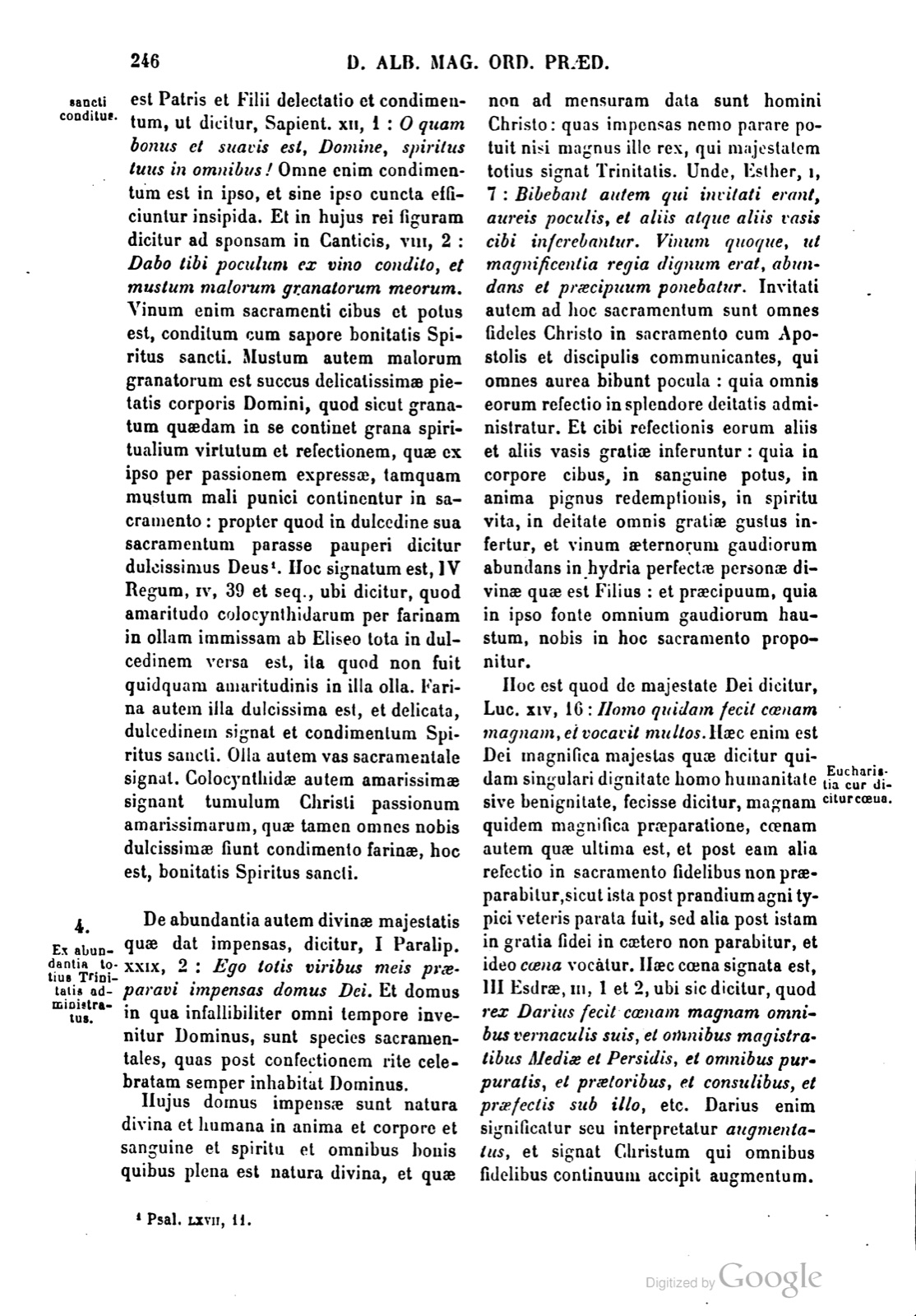
3. De bonitate autem Spiritus sancti, per quam iste cibus est conditus: quia ipse est Patris et Filii delectatio et condimentum, ut dicitur, Sapient. xi, 1: O quam bonus et suavis est, Domine, spiritus tuus in omnibus! Omne enim condimentum est in ipso, et sine ipso cuncta efficiuntur insipida. Et in hujus rei figuram dicitur ad sponsam in Canticis, viii, 2: Dabo tibi poculum ex vino condito, et mustum malorum granatorum meorum. Vinum enim sacramenti cibus et potus est, conditum cum sapore bonitatis Spiritus sancti. Mustum autem malorum granatorum est succus delicatissimae pietatis corporis Domini, quod sicut granatum quaedam in se continet grana spiritualium virtutum et refectionem, quae ex ipso per passionem expressae, tamquam mustum mali punici continentur in sacramento: propter quod in dulcedine sua sacramentum parasse pauperi dicitur dulcissimus Deus. Hoc signatum est, IV Regum, iv, 39 et seq., ubi dicitur, quod amaritudo colocynthidarum per farinam in ollam immissam ab Eliseo tota in dulcedinem versa est, ita quod non fuit quidquam amaritudinis in illa olla. Farina autem illa dulcissima est, et delicata, dulcedinem signat et condimentum Spiritus sancti. Olla autem vas sacramentale signat. Colocynthidae autem amarissimae signant tumulum Christi passionum amarissimarum, quae tamen omnes nobis dulcissimae fiunt condimento farinae, hoc est, bonitatis Spiritus sancti.
4. De abundantia autem divinae majestatis quae dat impensas, dicitur, I Paralip. xxix, 2: Ego totis viribus meis praeparavi impensas domus Dei. Et domus in qua infallibiliter omni tempore invenitur Dominus, sunt species sacramentales, quas post confectionem rite celebratam semper inhabitat Dominus. Hujus domus impensae sunt natura divina et humana in anima et corpore et sanguine et spiritu et omnibus bonis quibus plena est natura divina, et quae non ad mensuram data sunt homini Christo: quas impensas nemo parare potuit nisi magnus ille rex, qui majestatem totius signat Trinitatis. Unde, Esther, i, 7: Bibebant autem qui invitati erant, aureis poculis, et aliis atque aliis vasis cibi inferebantur. Vinum quoque, ut magnificentia regia dignum erat, abundans et praecipuum ponebatur. Invitati autem ad hoc sacramentum sunt omnes fideles Christo in sacramento cum Apostolis et discipulis communicantes, qui omnes aurea bibunt pocula: quia omnis eorum refectio in splendore deitatis administratur. Et cibi refectionis eorum aliis et aliis vasis gratiae inferuntur: quia in corpore cibus, in sanguine potus, in anima pignus redemptionis, in spiritu vita, in deitate omnis gratiae gustus infertur, et vinum aeternorum gaudiorum abundans in hydria perfectae personae divinae quae est Filius: et praecipuum, quia in ipso fonte omnium gaudiorum haustum, nobis in hoc sacramento proponitur.
3. But concerning the goodness of the Holy Spirit, by which this food is seasoned, because he himself is the delight and seasoning of the Father and the Son, Wisdom 11:1 says: O how good and sweet is your spirit in all things, Lord! For every seasoning is in him, and without him all things are made tasteless. And in figure of this thing it is said to the bride in Canticles 8:2: I shall give you a cup from seasoned wine and the new wine of my pomegranates. For the wine of the sacrament is food and drink, seasoned with the taste of the goodness of the Holy Spirit. But the new wine of the pomegranates is the juice of the most delicate piety of the Lord's body, which like a pomegranate contains in itself certain grains of spiritual virtues and refreshment; expressed from him through the passion, they are contained in the sacrament like the new wine of a pomegranate. On account of this, in his sweetness the sweetest God is said to have prepared the sacrament for the poor. This was signified in 4 Kings 4:39 and following, where it is said that the bitterness of the wild gourds, through flour sent into the pot by Elisha, was wholly turned into sweetness, so that there was no bitterness at all in that pot. But that flour is most sweet and delicate; it signifies the sweetness and seasoning of the Holy Spirit. But the pot signifies the sacramental vessel. The very bitter gourds signify the heap of Christ's most bitter passions, which nevertheless all become most sweet to us by the seasoning of the flour, that is, of the goodness of the Holy Spirit.
4. But concerning the abundance of divine majesty which gives the expenses, 1 Paralipomenon 29:2 says: I with all my strength have prepared the expenses of the house of God. And the house in which the Lord is infallibly found at every time is the sacramental species, which, after the confection has been duly celebrated, the Lord always inhabits. The expenses of this house are the divine and human nature in soul and body and blood and spirit and all goods with which the divine nature is full and which were given without measure to the man Christ. No one could prepare these expenses except that great king who signifies the majesty of the whole Trinity. Hence Esther 1:7: But those who were invited drank from golden cups, and foods were brought in different vessels, one after another. Wine also, as was worthy of royal magnificence, was set out abundant and chief. But those invited to this sacrament are all the faithful communicating with Christ in the sacrament together with the Apostles and disciples; all these drink golden cups, because all their refreshment is administered in the splendor of deity. And the foods of their refreshment are brought in one vessel of grace and another, because in the body food is brought, in the blood drink, in the soul the pledge of redemption, in the spirit life, in deity the taste of every grace; and the abundant wine of eternal joys is in the water jar of the perfect divine person which is the Son; and it is chief, because drawn from the very fountain of all joys, it is set before us in this sacrament.
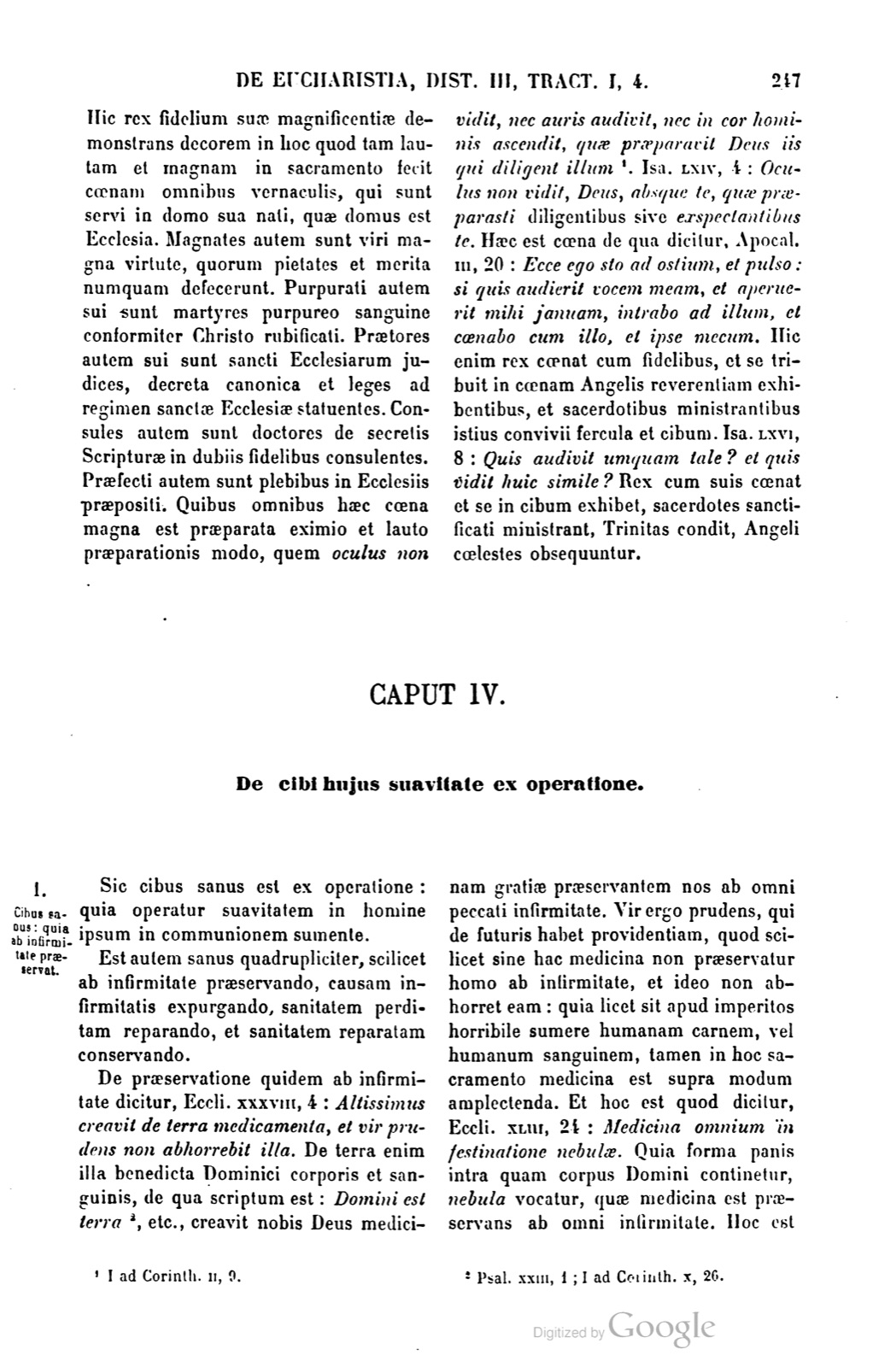
Hoc est quod de majestate Dei dicitur, Luc. xiv, 16: Homo quidam fecit coenam magnam, et vocavit multos. Haec enim est Dei magnifica majestas quae dicitur quidam singulari dignitate homo humanitate sive benignitate, fecisse dicitur, magnam quidem magnifica praeparatione, coenam autem quae ultima est, et post eam alia refectio in sacramento fidelibus non praeparabitur, sicut ista post prandium agni typici veteris parata fuit, sed alia post istam in gratia fidei in caetero non parabitur, et ideo coena vocatur. Haec coena signata est, III Esdrae, iii, 1 et 2, ubi sic dicitur, quod rex Darius fecit coenam magnam omnibus vernaculis suis, et omnibus magistratibus Mediae et Persidis, et omnibus purpuratis, et praetoribus, et consulibus, et praefectis sub illo, etc. Darius enim significatur seu interpretatur augmentatus, et signat Christum qui omnibus fidelibus continuum accipit augmentum. Hic rex fidelium suae magnificentiae demonstrans decorem in hoc quod tam lautam et magnam in sacramento fecit coenam omnibus vernaculis, qui sunt servi in domo sua nati, quae domus est Ecclesia. Magnates autem sunt viri magna virtute, quorum pietates et merita numquam defecerunt. Purpurati autem sui sunt martyres purpureo sanguine conformiter Christo rubificati. Praetores autem sui sunt sancti Ecclesiarum judices, decreta canonica et leges ad regimen sanctae Ecclesiae statuentes. Consules autem sunt doctores de secretis Scripturae in dubiis fidelibus consulentes. Praefecti autem sunt plebibus in Ecclesiis praepositi. Quibus omnibus haec coena magna est praeparata eximio et lauto praeparationis modo, quem oculus non vidit, nec auris audivit, nec in cor hominis ascendit, quae praeparavit Deus iis qui diligent illum2. Isa. lxiv, 4: Oculus non vidit, Deus, absque te, quae praeparasti diligentibus sive exspectantibus te3. Haec est coena de qua dicitur, Apocal. iii, 20: Ecce ego sto ad ostium, et pulso: si quis audierit vocem meam, et aperuerit mihi januam, intrabo ad illum, et coenabo cum illo, et ipse mecum. Hic enim rex cenat cum fidelibus, et se tribuit in coenam Angelis reverentiam exhibentibus, et sacerdotibus ministrantibus istius convivii fercula et cibum. Isa. lxvi, 8: Quis audivit umquam tale? et quis vidit huic simile? Rex cum suis coenat et se in cibum exhibet, sacerdotes sanctificant, Trinitas condit, Angeli coelestes obsequuntur.
This is what is said concerning the majesty of God in Luke 14:16: A certain man made a great supper and called many. For this is God's magnificent majesty, which is called a certain man by singular dignity, humanity, or kindness; it is said to have made it great by magnificent preparation, and a supper because it is the last, and after it no other refreshment in the sacrament will be prepared for the faithful, just as this one was prepared after the meal of the old typical lamb, but another after this one in the grace of faith will not be prepared thereafter; and therefore it is called supper. This supper was signified in 3 Esdras 3:1 and 2, where it is said thus that King Darius made a great supper for all his household servants, and for all the magistrates of Media and Persia, and for all the purple-clad, and praetors, and consuls, and prefects under him, and so forth. For Darius is signified or interpreted increased, and signifies Christ, who receives continual increase in all the faithful. This king, showing the beauty of his magnificence to the faithful in this, that he made so rich and great a supper in the sacrament for all the household servants, who are servants born in his house, which house is the Church. But the magnates are men great in virtue, whose pieties and merits have never failed. His purple-clad are the martyrs reddened with purple blood conformably to Christ. His praetors are the holy judges of the Churches, establishing canonical decrees and laws for the governance of holy Church. But the consuls are the doctors consulting for the faithful in doubts from the secrets of Scripture. But the prefects are those set over peoples in the Churches. For all these this great supper has been prepared by an excellent and rich manner of preparation, which eye has not seen, nor ear heard, nor has it ascended into the heart of man, the things which God has prepared for those who love him2. Isaiah 64:4: Eye has not seen, O God, besides you, the things which you have prepared for those who love or await you3. This is the supper of which Apocalypse 3:20 says: Behold, I stand at the door and knock; if anyone hears my voice and opens the gate to me, I shall enter to him and sup with him, and he with me. For this king sups with the faithful, and he gives himself as supper, with the angels showing reverence and the priests ministering the dishes and food of this banquet. Isaiah 66:8: Who has ever heard such a thing? And who has seen the like of this? The king sups with his own and offers himself as food; the priests sanctify, the Trinity seasons, the heavenly angels serve.
If a page does not appear, its photograph has not been uploaded yet.