Works › The Book on the Sacrament of the Eucharist
Volume 38 · pp. 448–450
Index of Things, S-Calf
A marker with ≈ is an approximate page boundary, placed by measure of the text; the page photographs remain the authority. In the paired views, clicking a page marker brings that page into view.
S.
Plures SACERDOTES nec debent nec possunt unam et eamdem hostiam consecrare. VI-IV, 2, n. 16.
SACERDOTES ordinati ab haereticis vel schismaticis an consecrare possunt? VI-IV, 2, n. 6.
Causa institutionis SACRAMENTI Eucharistiae quadruplex. VI-I, 1.
Omne SACRAMENTUM contra peccatum in medicinam institutum est. VI-I, 1, n. 1. Item, VI-I, 2.
SACRAMENTUM Eucharistiae est principalis dignitatis inter sacramenta. VI-I, 2, n. 2.
Triplex causa cur SACRAMENTUM Eucharistiae in lege gratiae debuit institui. VI-I, 3.
Modus institutionis SACRAMENTI Eucharistiae. VI-I, 4.
Potestas collata conficiendi SACRAMENTUM Eucharistiae. Ibid.
In SACRAMENTO est corporalis materia propter tres causas. VI-II, 1, n. 1.
SACRAMENTUM est invisibilis gratiae visibile signum. Ibid.
SACRAMENTUM est visibile et corporale elementum ex institutione divina signans, ex similitudine repraesentans, ex sanctificatione invisibilem gratiam conferens. Ibidem.
Quae sit materia SACRAMENTI Eucharistiae? VI-II, n. 4.
Deus SACRAMENTIS gratiam non alligavit. Ibidem.
Causa institutionis SACRAMENTORUM triplex, scilicet eruditio, humilitas et exercitium. VI-II, 1, n. 13.
SACRIFICIA nostra antiquiora sunt quam sacrificia Veteris Testamenti. V, 1.
SACRIFICIUM Missae antiquitate veneratum, auctoritate divina sancitum, juramento confirmatum, et sua perfectione perpetuatum. Ibid.
S.
Several PRIESTS neither ought nor can consecrate one and the same host. VI-IV, 2, n. 16.
Can PRIESTS ordained by heretics or schismatics consecrate? VI-IV, 2, n. 6.
The fourfold cause of the institution of the SACRAMENT of the Eucharist. VI-I, 1.
Every SACRAMENT has been instituted against sin as medicine. VI-I, 1, n. 1. Likewise, VI-I, 2.
The SACRAMENT of the Eucharist is of principal dignity among the sacraments. VI-I, 2, n. 2.
The threefold cause why the SACRAMENT of the Eucharist had to be instituted in the law of grace. VI-I, 3.
The mode of institution of the SACRAMENT of the Eucharist. VI-I, 4.
The conferred power of confecting the SACRAMENT of the Eucharist. In the same place.
In the SACRAMENT there is bodily matter because of three causes. VI-II, 1, n. 1.
A SACRAMENT is the visible sign of invisible grace. In the same place.
A SACRAMENT is a visible and corporeal element, signifying from divine institution, representing from likeness, conferring invisible grace from sanctification. In the same place.
What is the matter of the SACRAMENT of the Eucharist? VI-II, n. 4.
God has not bound grace to the SACRAMENTS. In the same place.
The threefold cause of the institution of the SACRAMENTS, namely instruction, humility, and exercise. VI-II, 1, n. 13.
Our SACRIFICES are more ancient than the sacrifices of the Old Testament. V, 1.
The SACRIFICE of the Mass, venerated by antiquity, sanctioned by divine authority, confirmed by oath, and perpetuated by its perfection. In the same place.
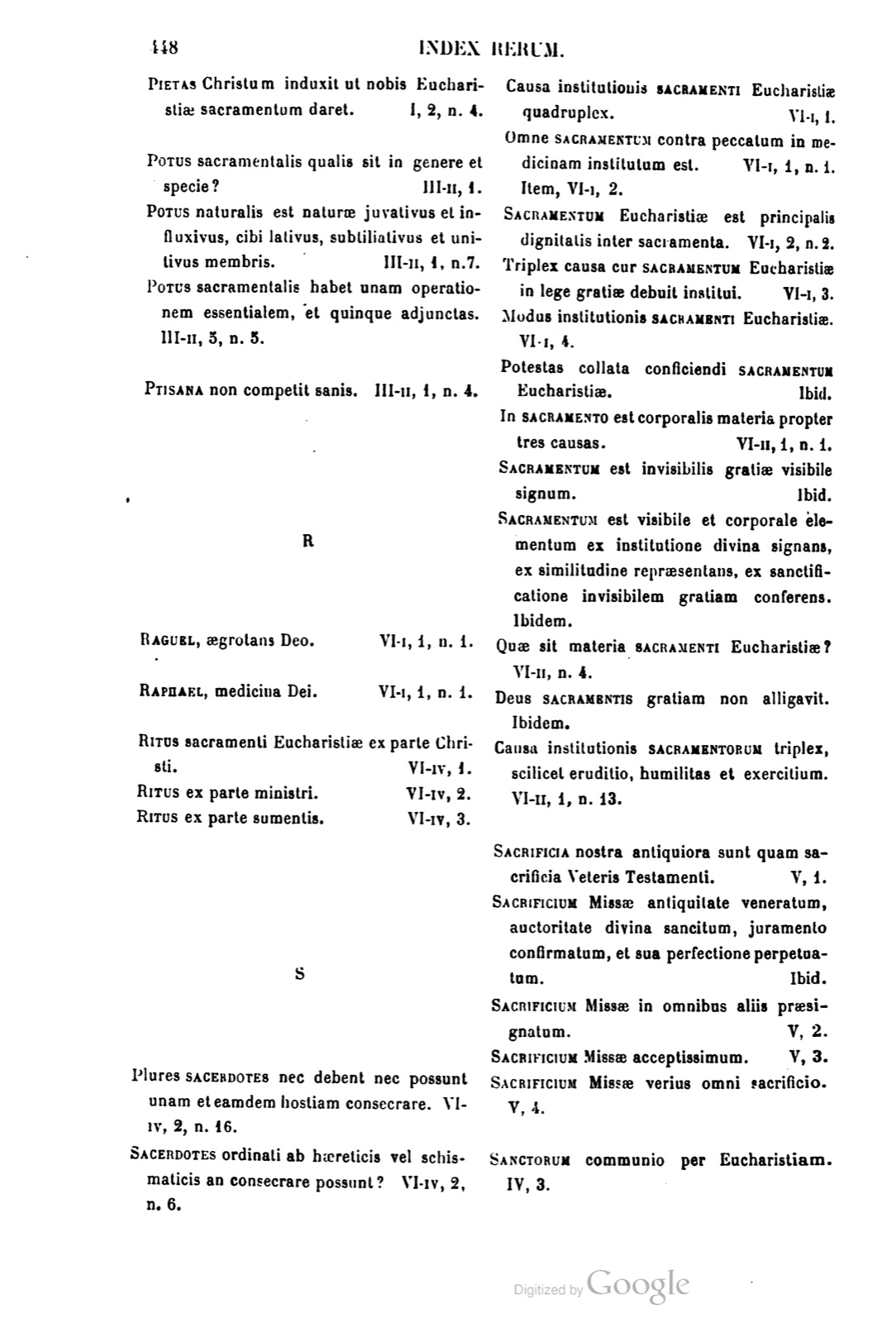
SACRIFICIUM Missae in omnibus aliis praesignatum. V, 2.
SACRIFICIUM Missae acceptissimum. V, 3.
SACRIFICIUM Missae verius omni sacrificio. V, 4.
SANCTORUM communio per Eucharistiam. IV, 3.
Nihil ita humectat et rigat ad fructum et virorem sicut SANGUIS humanus. III-II, 5, n. 10.
SANGUIS Christi vino comparatus. III-II, 2, n. 2.
SANGUINIS Christi operationes: redimere a peccato et reliquiis peccati, lavare, rigare arida et infundere, tingere, et signare. III-II, 5, n. 8.
SANGUIS Christi coccus quo vestes sacrae tingi debent. III-II, 5, n. 10.
SANGUIS Christi, hyssopus. I, 5, n. 2.
SANGUIS Christi non potest confici nisi ex vino. III-II, 1.
SAPOR puritatis ex corpore Christi. III-I, 2, n. 1.
SAPOR dulcedinis valde amabilis ex sanguine. III-I, 2, n. 2.
SAPOR aromaticus omni virtute fragrans ex anima. III-I, 2, n. 3.
SAPOR subtilitatis ex spiritu humano. III-I, 2, n. 4.
SAPOR omnis gratiae ex deitate. III-I, 2, n. 5.
SAPOR coelestium gaudiorum ex unione humanorum cum deitate. III-I, 2, n. 6.
SAPORES naturales novem, scilicet dulcis, pinguis, ponticus, stipticus, acutus, acetosus, salsus, amarus, aquosus. III-I, 2, n. 1.
SARA, princeps, vel carbo, vel velamen, vel angustia. VI-I, 1, n. 1.
SITIS est appetitus frigidi et humidi. III-II, 1, n. 2.
Quadruplex causa SITIS. III-II, 1, n. 6.
SPECIES sacramentales ad quid remanent post transsubstantiationem? VI-II, 1, n. 13.
The SACRIFICE of the Mass pre-signified in all other things. V, 2.
The SACRIFICE of the Mass most acceptable. V, 3.
The SACRIFICE of the Mass truer than every sacrifice. V, 4.
The communion of SAINTS through the Eucharist. IV, 3.
Nothing so moistens and waters unto fruit and greenness as human BLOOD. III-II, 5, n. 10.
The BLOOD of Christ compared to wine. III-II, 2, n. 2.
The operations of Christ's BLOOD: to redeem from sin and the remnants of sin, to wash, to water dry things and infuse, to dye, and to sign. III-II, 5, n. 8.
The BLOOD of Christ, the scarlet by which sacred vestments ought to be dyed. III-II, 5, n. 10.
The BLOOD of Christ, hyssop. I, 5, n. 2.
The BLOOD of Christ cannot be confected except from wine. III-II, 1.
The SAVOR of purity from the body of Christ. III-I, 2, n. 1.
The SAVOR of very lovable sweetness from the blood. III-I, 2, n. 2.
Aromatic SAVOR fragrant with every virtue from the soul. III-I, 2, n. 3.
The SAVOR of subtlety from the human spirit. III-I, 2, n. 4.
The SAVOR of every grace from deity. III-I, 2, n. 5.
The SAVOR of heavenly joys from the union of human things with deity. III-I, 2, n. 6.
Nine natural SAVORS, namely sweet, fatty, pontic, styptic, sharp, vinegary, salty, bitter, watery. III-I, 2, n. 1.
SARA, princess, or coal, or veil, or anguish. VI-I, 1, n. 1.
THIRST is the appetite of the cold and moist. III-II, 1, n. 2.
The fourfold cause of THIRST. III-II, 1, n. 6.
For what do the sacramental SPECIES remain after transubstantiation? VI-II, 1, n. 13.
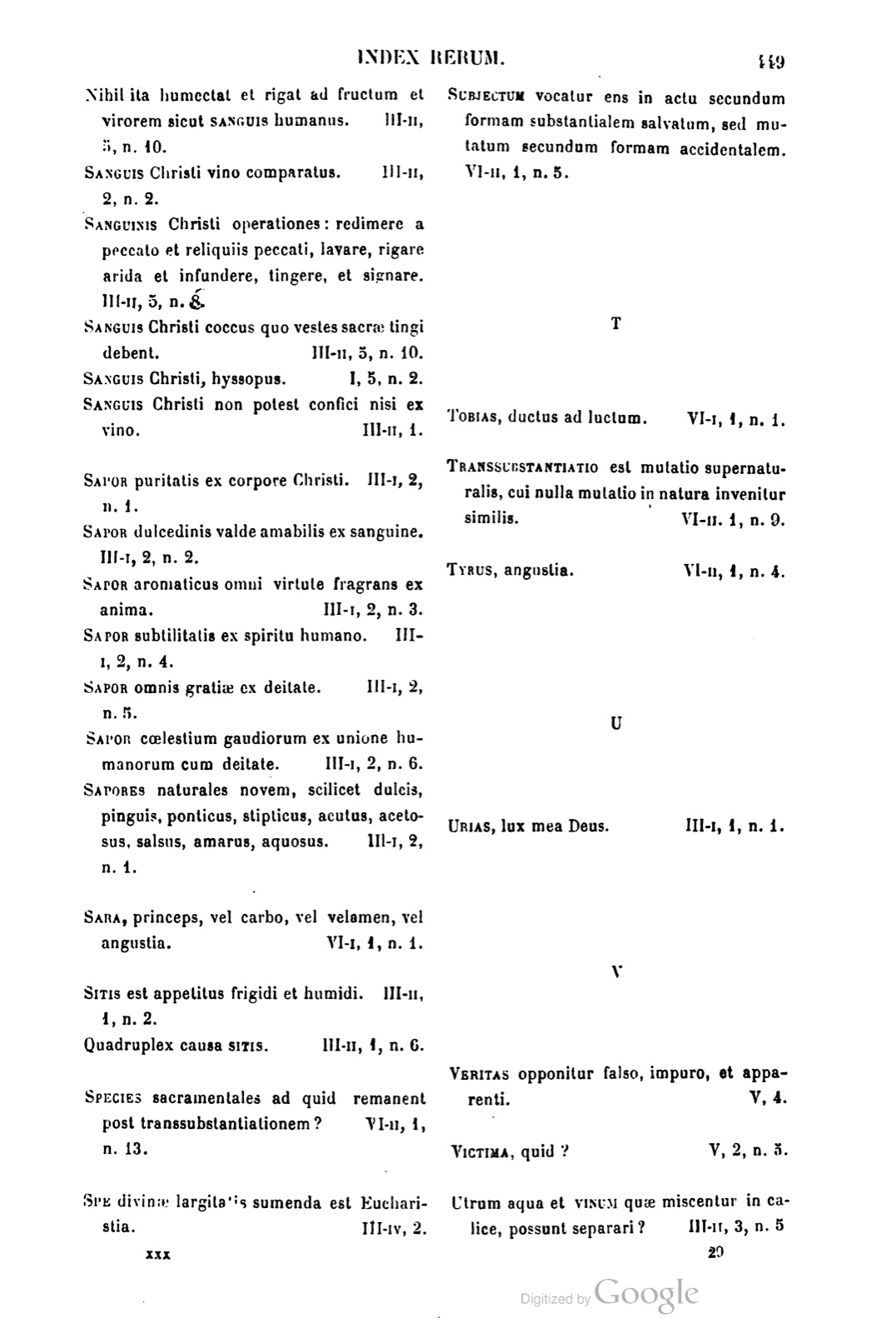
SPE divinae largitatis sumenda est Eucharistia. III-IV, 2.
SUBJECTUM vocatur ens in actu secundum formam substantialem salvatum, sed mutatum secundum formam accidentalem. VI-I, 1, n. 5.
T.
TOBIAS, ductus ad luctum. VI-I, 1, n. 1.
TRANSSUBSTANTIATIO est mutatio supernaturalis, cui nulla mutatio in natura invenitur similis. VI-II, 1, n. 9.
TYRUS, angustia. VI-II, 1, n. 4.
U.
URIAS, lux mea Deus. III-I, 1, n. 1.
V.
VERITAS opponitur falso, impuro, et apparenti. V, 4.
VICTIMA, quid? V, 2, n. 5.
Utrum aqua et VINUM quae miscentur in calice, possunt separari? III-II, 3, n. 5.
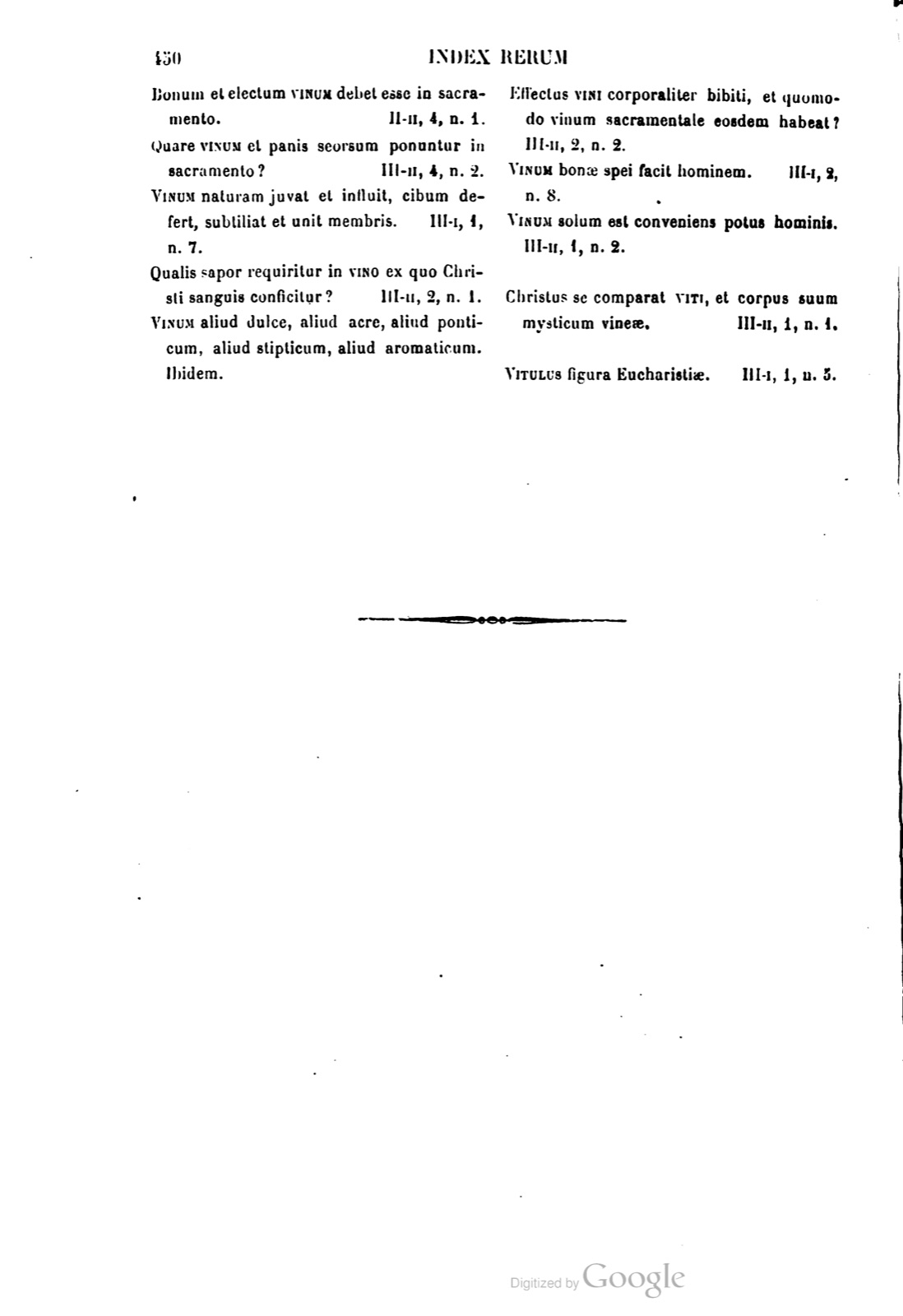
Donum et electum VINUM debet esse in sacramento. II-II, 4, n. 1.
Quare VINUM et panis seorsum ponuntur in sacramento? III-II, 4, n. 2.
VINUM naturam juvat et influit, cibum defert, subtiliat et unit membris. III-II, 1, n. 7.
Qualis sapor requiritur in VINO ex quo Christi sanguis conficitur? III-II, 2, n. 1.
VINUM aliud dulce, aliud acre, aliud ponticum, aliud stipticum, aliud aromaticum. Ibidem.
Effectus VINI corporaliter bibiti, et quomodo vinum sacramentale eosdem habeat? III-II, 2, n. 2.
VINUM bonae spei facit hominem. II-I, 2, n. 8.
VINUM solum est conveniens potus hominis. III-II, 1, n. 2.
Christus se comparat VITI, et corpus suum mysticum vineae. III-II, 1, n. 1.
VITULUS figura Eucharistiae. III-I, 1, n. 5.
The Eucharist is to be received in HOPE of divine largess. III-IV, 2.
SUBJECT is called a being preserved in act according to substantial form, but changed according to accidental form. VI-I, 1, n. 5.
T.
TOBIAS, led to mourning. VI-I, 1, n. 1.
TRANSUBSTANTIATION is a supernatural change to which no change in nature is found similar. VI-II, 1, n. 9.
TYRE, anguish. VI-II, 1, n. 4.
U.
URIAS, God my light. III-I, 1, n. 1.
V.
TRUTH is opposed to the false, the impure, and the apparent. V, 4.
VICTIM, what? V, 2, n. 5.
Whether the water and WINE which are mixed in the chalice can be separated? III-II, 3, n. 5.
Gifted and chosen WINE ought to be in the sacrament. II-II, 4, n. 1.
Why are WINE and bread placed separately in the sacrament? III-II, 4, n. 2.
WINE helps and flows into nature, carries food, refines it, and unites it to the members. III-II, 1, n. 7.
What savor is required in the WINE from which Christ's blood is confected? III-II, 2, n. 1.
WINE, one kind sweet, another sharp, another pontic, another styptic, another aromatic. In the same place.
The effects of WINE bodily drunk, and how sacramental wine has the same ones. III-II, 2, n. 2.
WINE makes a man of good hope. II-I, 2, n. 8.
WINE alone is the fitting drink of man. III-II, 1, n. 2.
Christ compares himself to the VINE and his mystical body to the vineyard. III-II, 1, n. 1.
The CALF, a figure of the Eucharist. III-I, 1, n. 5.
If a page does not appear, its photograph has not been uploaded yet.