Works › The Book on the Sacrament of the Eucharist
Volume 38 · pp. 263–264
Chapter VI, nos. 5-6 conclusion.
A marker with ≈ is an approximate page boundary, placed by measure of the text; the page photographs remain the authority. In the paired views, clicking a page marker brings that page into view.
Marginal label (printed p. 263): Quaestio, utrum Christus in sacramento passibilis?
Marginal label (printed p. 263): Christo conveniunt quaedam secundum deitatem, quaedam secundum humanitatem, et quaedam secundum formam sacramenti.
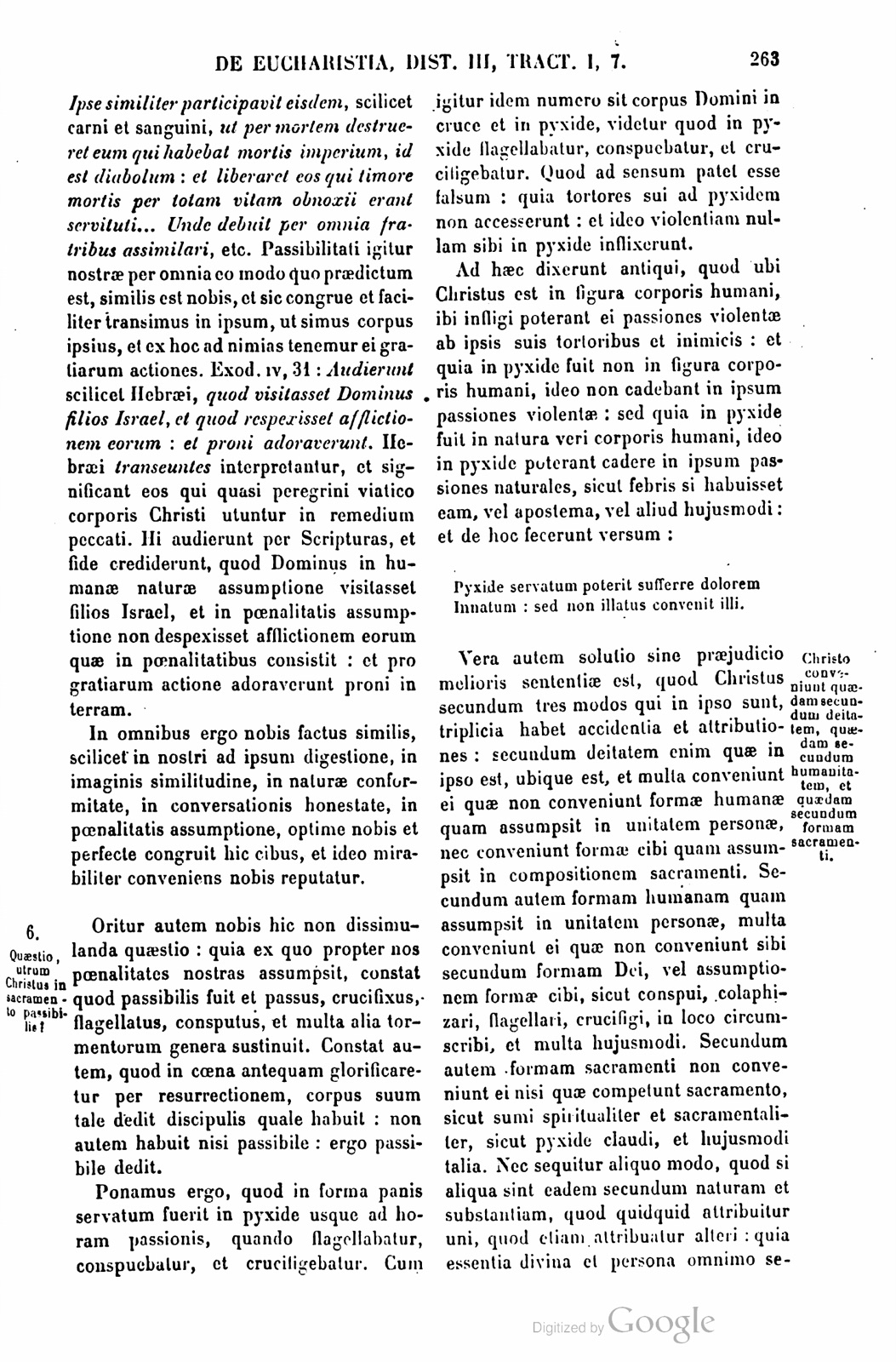
Ipse similiter participavit eisdem, scilicet carni et sanguini, ut per mortem destrueret eum qui habebat mortis imperium, id est diabolum: et liberaret eos qui timore mortis per totam vitam obnoxii erant servituti... Unde debuit per omnia fratribus assimilari, etc. Passibilitati igitur nostrae per omnia eo modo quo praedictum est, similis est nobis, et sic congrue et faciliter transimus in ipsum, ut simus corpus ipsius, et ex hoc ad nimias tenemur ei gratiarum actiones. Exod. iv, 31: Audierunt scilicet Hebraei, quod visitasset Dominus filios Israel, et quod respexisset afflictionem eorum: et proni adoraverunt. Hebraei transeuntes interpretantur, et significant eos qui quasi peregrini viatico corporis Christi utuntur in remedium peccati. Hi audierunt per Scripturas, et fide crediderunt, quod Dominus in humanae naturae assumptione visitasset filios Israel, et in poenalitatis assumptione non despexisset afflictionem eorum quae in poenalitatibus consistit: et pro gratiarum actione adoraverunt proni in terram.
In omnibus ergo nobis factus similis, scilicet in nostri ad ipsum digestione, in imaginis similitudine, in naturae conformitate, in conversationis honestate, in poenalitatis assumptione, optime nobis et perfecte congruit hic cibus, et ideo mirabiliter conveniens nobis reputatur.
6. Oritur autem nobis hic non dissimulanda quaestio: quia ex quo propter nos poenalitates nostras assumpsit, constat quod passibilis fuit et passus, crucifixus, flagellatus, consputus, et multa alia tormentorum genera sustinuit. Constat autem, quod in coena antequam glorificaretur per resurrectionem, corpus suum tale dedit discipulis quale habuit: non autem habuit nisi passibile: ergo passibile dedit.
Ponamus ergo, quod in forma panis servatum fuerit in pyxide usque ad horam passionis, quando flagellabatur, conspuebatur, et crucifigebatur. Cum igitur idem numero sit corpus Domini in cruce et in pyxide, videtur quod in pyxide flagellabatur, conspuebatur, et crucifigebatur. Quod ad sensum patet esse falsum: quia tortores sui ad pyxidem non accesserunt: et ideo violentiam nullam sibi in pyxide inflixerunt.
Ad haec dixerunt antiqui, quod ubi Christus est in figura corporis humani, ibi infligi poterant ei passiones violentae ab ipsis suis tortoribus et inimicis: et quia in pyxide fuit non in figura corporis humani, ideo non cadebant in ipsum passiones violentae: sed quia in pyxide fuit in natura veri corporis humani, ideo in pyxide poterant cadere in ipsum passiones naturales, sicut febris si habuisset eam, vel apostema, vel aliud hujusmodi: et de hoc fecerunt versum:
Pyxide servatum poterit sufferre dolorem Innatum: sed non illatus convenit illi.
Vera autem solutio sine praejudicio melioris sententiae est, quod Christus secundum tres modos qui in ipso sunt, triplicia habet accidentia et attributiones: secundum deitatem enim quae in ipso est, ubique est, et multa conveniunt ei quae non conveniunt formae humanae quam assumpsit in unitatem personae, nec conveniunt formae cibi quam assumpsit in compositionem sacramenti. Secundum autem formam humanam quam assumpsit in unitatem personae, multa conveniunt ei quae non conveniunt sibi secundum formam Dei, vel assumptionem formae cibi, sicut conspui, colaphizari, flagellari, crucifigi, in loco circumscribi, et multa hujusmodi. Secundum autem formam sacramenti non conveniunt ei nisi quae competunt sacramento, sicut sumi spiritualiter et sacramentaliter, sicut pyxide claudi, et hujusmodi talia. Nec sequitur aliquo modo, quod si aliqua sint eadem secundum naturam et substantiam, quod quidquid attribuitur uni, quod etiam attribuatur alteri: quia essentia divina et persona omnino secundum rem et substantiam sunt idem, non tamen sequitur, quod quidquid convenit uni, vel attribuitur, quod hoc attribuatur alii, vel conveniat. Et ideo dicimus, quod in pyxide servato ut cibo non conveniunt nisi ea quae Christo attribuuntur secundum quod est sub assumpta forma cibi, et non alia: et ea quae in forma et figura humana assumpta a Christo, Christo conveniunt, sicut ambulare, dormire, lanceari, flagellari, crucifigi, non conveniunt corpori Christi in quantum est in forma cibi. Et illa quae conveniunt ipsi Christo secundum naturam divinam, non conveniunt ei nisi secundum naturam divinam et non secundum formam humanam, vel secundum formam cibi assumptam in sacramento: quia Christus est multarum facierum, sicut multiplicia sunt ea quae pro nobis assumpsit. Et haec solutio verior videtur: quia ad hoc assumpsit formam sacramenti, ut sacramentalia et non alia convenirent sibi.
Marginal label (printed p. 263): Question, whether Christ is passible in the sacrament?
Marginal label (printed p. 263): Certain things belong to Christ according to deity, certain things according to humanity, and certain things according to the form of the sacrament.
He himself likewise participated in the same things, namely flesh and blood, so that through death he might destroy him who had the empire of death, that is, the devil, and might free those who through fear of death were subject to servitude through their whole life... Hence he had to be assimilated to his brothers through all things, and so forth. Therefore he is like us in our passibility through all things in the mode that has been stated before, and thus suitably and easily we pass into him, so that we may be his body; and from this we are bound to give him exceeding thanksgivings. Exodus 4:31: Namely, the Hebrews heard that the Lord had visited the children of Israel, and that he had regarded their affliction; and bowed down, they adored. Hebrews is interpreted those passing over, and they signify those who, as pilgrims, use the viaticum of the body of Christ as a remedy for sin. These heard through the Scriptures and believed by faith that the Lord, in the assumption of human nature, had visited the children of Israel, and in the assumption of penality had not despised their affliction, which consists in penalities; and for thanksgiving they adored bowed down upon the earth.
Therefore, made like us in all things, namely in the digestion of us to him, in the likeness of image, in conformity of nature, in nobility of conversation, in the assumption of penality, this food fits us most excellently and perfectly, and therefore it is reckoned wonderfully fitting for us.
6. But here there arises for us a question not to be passed over: because from the fact that for our sake he assumed our penalities, it is established that he was passible and suffered, was crucified, scourged, spat upon, and sustained many other kinds of torments. But it is established that at the supper, before he was glorified through resurrection, he gave his body to the disciples such as he had it; but he had it only as passible; therefore he gave it as passible.
Let us suppose, therefore, that it had been kept in the form of bread in a pyx until the hour of the passion, when he was being scourged, spat upon, and crucified. Therefore, since the body of the Lord on the cross and in the pyx is the same in number, it seems that in the pyx he was being scourged, spat upon, and crucified. This is plainly false to sense, because his torturers did not approach the pyx, and therefore they inflicted no violence upon him in the pyx.
To these things the ancients said that where Christ is in the figure of a human body, there violent passions could be inflicted upon him by his own torturers and enemies; and because in the pyx he was not in the figure of a human body, therefore violent passions did not fall upon him. But because in the pyx he was in the nature of a true human body, therefore in the pyx natural passions could fall upon him, such as fever if he had had it, or an abscess, or something else of this sort. And concerning this they made a verse:
What is kept in the pyx will be able to suffer an innate pain; but an inflicted pain does not fit it.
But the true solution, without prejudice to a better opinion, is that Christ, according to three modes which are in him, has threefold accidents and attributions. For according to the deity which is in him, he is everywhere, and many things fit him which do not fit the human form which he assumed into the unity of person, nor fit the form of food which he assumed into the composition of the sacrament. But according to the human form which he assumed into the unity of person, many things fit him which do not fit him according to the form of God or the assumption of the form of food, such as to be spat upon, to be struck with fists, to be scourged, to be crucified, to be circumscribed in place, and many things of this sort. But according to the form of the sacrament, nothing fits him except what belongs to the sacrament, such as to be received spiritually and sacramentally, such as to be enclosed in a pyx, and such things of this sort. Nor does it follow in any way that if some things are the same according to nature and substance, whatever is attributed to one is also attributed to the other; because the divine essence and person are entirely the same according to reality and substance, yet it does not follow that whatever fits one or is attributed to one is attributed to the other or fits it. And therefore we say that to Christ kept in the pyx as food nothing fits except those things which are attributed to Christ according as he is under the assumed form of food, and not other things; and those things which fit Christ in the human form and figure assumed by Christ, such as to walk, to sleep, to be pierced by a lance, to be scourged, to be crucified, do not fit the body of Christ insofar as it is in the form of food. And those things which fit Christ himself according to the divine nature do not fit him except according to the divine nature and not according to the human form or according to the form of food assumed in the sacrament, because Christ is of many faces, just as the things which he assumed for us are multiple. And this solution seems truer, because for this he assumed the form of the sacrament, so that sacramental things and not other things would fit him.
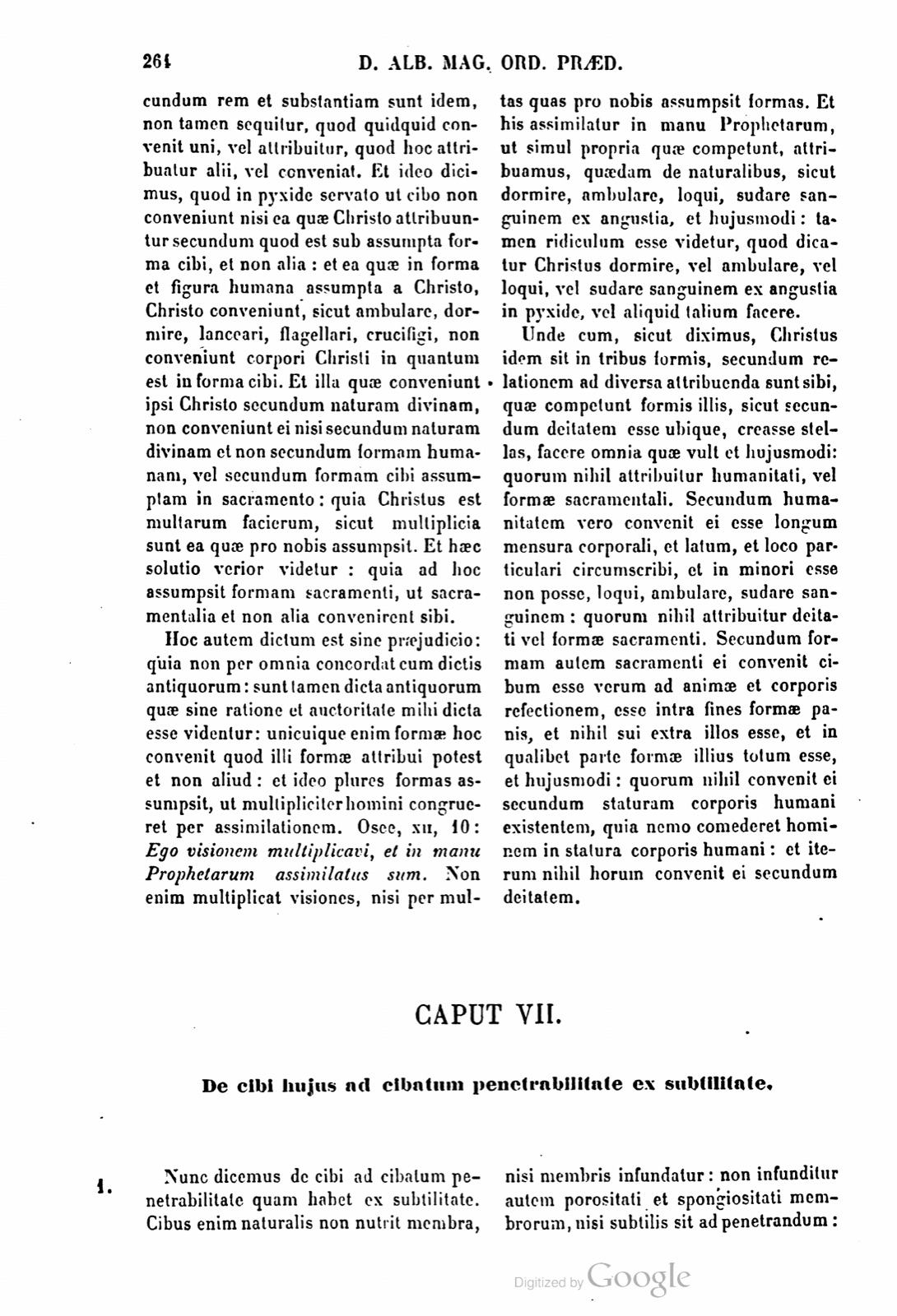
Hoc autem dictum est sine praejudicio: quia non per omnia concordat cum dictis antiquorum: sunt tamen dicta antiquorum quae sine ratione et auctoritate mihi dicta esse videntur: unicuique enim formae hoc convenit quod illi formae attribui potest et non aliud: et ideo plures formas assumpsit, ut multipliciter homini congrueret per assimilationem. Osee, xii, 10: Ego visionem multiplicavi, et in manu Prophetarum assimilatus sum. Non enim multiplicat visiones, nisi per multas quas pro nobis assumpsit formas. Et his assimilatur in manu Prophetarum, ut simul propria quae competunt, attribuamus, quaedam de naturalibus, sicut dormire, ambulare, loqui, sudare sanguinem ex angustia, et hujusmodi: tamen ridiculum esse videtur, quod dicatur Christus dormire, vel ambulare, vel loqui, vel sudare sanguinem ex angustia in pyxide, vel aliquid talium facere.
Unde cum, sicut diximus, Christus idem sit in tribus formis, secundum relationem ad diversa attribuenda sunt sibi, quae competunt formis illis, sicut secundum deitatem esse ubique, creasse stellas, facere omnia quae vult et hujusmodi: quorum nihil attribuitur humanitati, vel formae sacramentali. Secundum humanitatem vero convenit ei esse longum mensura corporali, et latum, et loco particulari circumscribi, et in minori esse non posse, loqui, ambulare, sudare sanguinem: quorum nihil attribuitur deitati vel formae sacramenti. Secundum formam autem sacramenti ei convenit cibum esse verum ad animae et corporis refectionem, esse intra fines formae panis, et nihil sui extra illos esse, et in qualibet parte formae illius totum esse, et hujusmodi: quorum nihil convenit ei secundum staturam corporis humani existentem, quia nemo comederet hominem in statura corporis humani: et iterum nihil horum convenit ei secundum deitatem.
But this has been said without prejudice, because it does not agree in every respect with the sayings of the ancients. Yet there are sayings of the ancients which seem to me to have been said without reason and authority. For to each form that fits which can be attributed to that form, and not something else. And therefore he assumed several forms, so that by assimilation he might fit man in many ways. Hosea 12:10: I multiplied vision, and in the hand of the Prophets I was assimilated. For he does not multiply visions except through the many forms which he assumed for us. And in these he is assimilated in the hand of the Prophets, so that at the same time we may attribute the proper things that fit: certain things from natural things, such as to sleep, to walk, to speak, to sweat blood from anguish, and things of this sort. Nevertheless it seems ridiculous that Christ should be said to sleep, or walk, or speak, or sweat blood from anguish in the pyx, or to do something of such things.
Hence, since, as we have said, Christ is the same in three forms, according to relation to diverse things those things must be attributed to him which fit those forms, such as, according to deity, to be everywhere, to have created the stars, to do all things he wills, and things of this sort; none of these is attributed to the humanity or to the sacramental form. But according to humanity it fits him to be long with bodily measure, and broad, and to be circumscribed by a particular place, and not to be able to be in a smaller place, to speak, to walk, to sweat blood; none of these is attributed to deity or to the form of the sacrament. But according to the form of the sacrament it fits him to be true food for the refreshment of soul and body, to be within the boundaries of the form of bread, and for nothing of himself to be outside those boundaries, and to be whole in any part of that form, and things of this sort. None of these fits him according to the existing stature of the human body, because no one would eat a man in the stature of a human body; and again none of these fits him according to deity.
If a page does not appear, its photograph has not been uploaded yet.