Works › The Book on the Sacrament of the Eucharist
Volume 38 · pp. 352–353
Chapter I. On the Cause of the Institution of This Sacrament
Marginal label (printed p. 352): Prima causa institutionis.
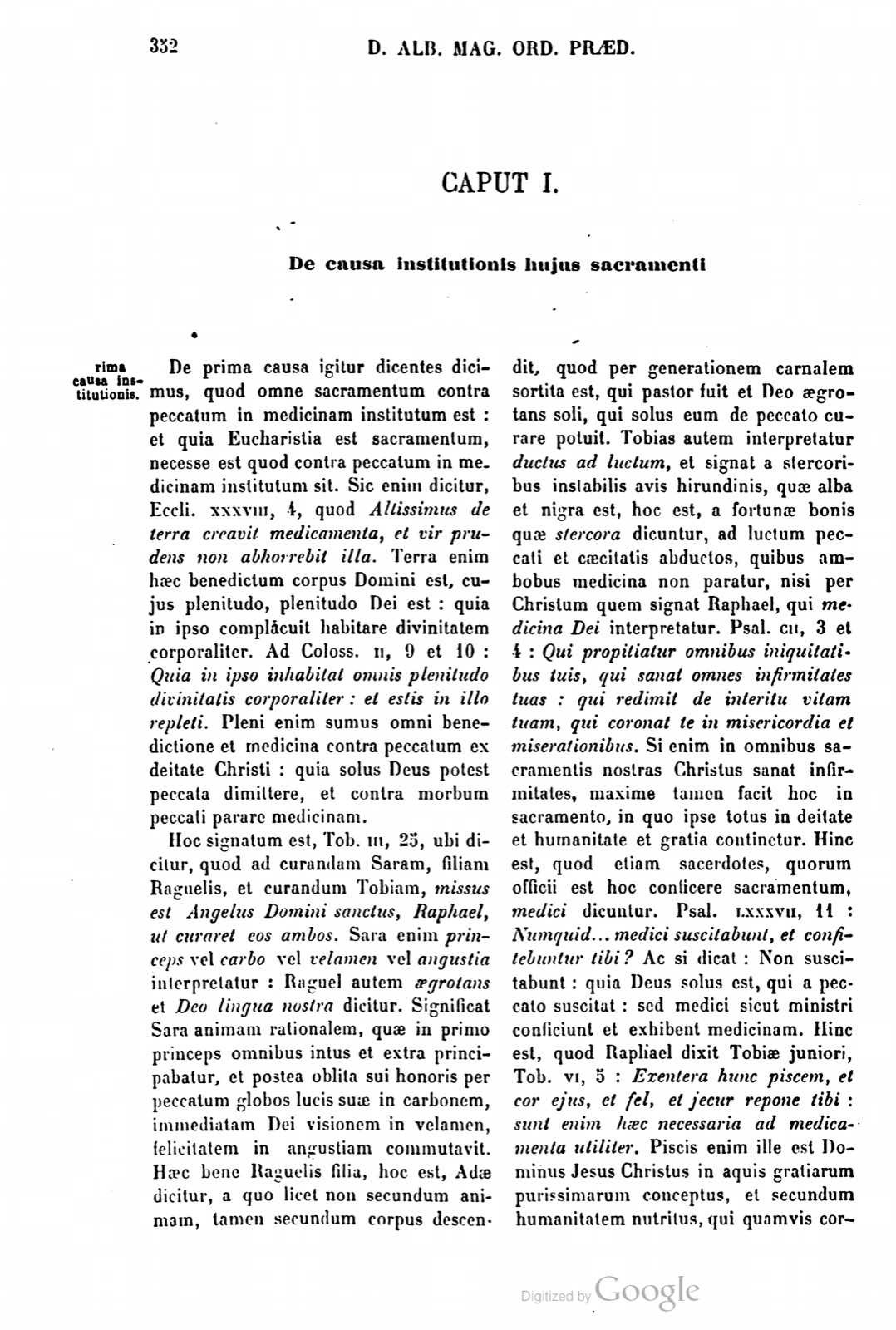
CAPUT I. De causa institutionis hujus sacramenti.
De prima causa igitur dicentes dicimus, quod omne sacramentum contra peccatum in medicinam institutum est: et quia Eucharistia est sacramentum, necesse est quod contra peccatum in medicinam institutum sit. Sic enim dicitur, Eccli. XXXVIII, 4, quod Altissimus de terra creavit medicamenta, et vir prudens non abhorrebit illa. Terra enim haec benedictum corpus Domini est, cujus plenitudo, plenitudo Dei est: quia in ipso complacuit habitare divinitatem corporaliter. Ad Coloss. II, 9 et 10: Quia in ipso inhabitat omnis plenitudo divinitatis corporaliter: et estis in illo repleti. Pleni enim sumus omni benedictione et medicina contra peccatum ex deitate Christi: quia solus Deus potest peccata dimittere, et contra morbum peccati parare medicinam.
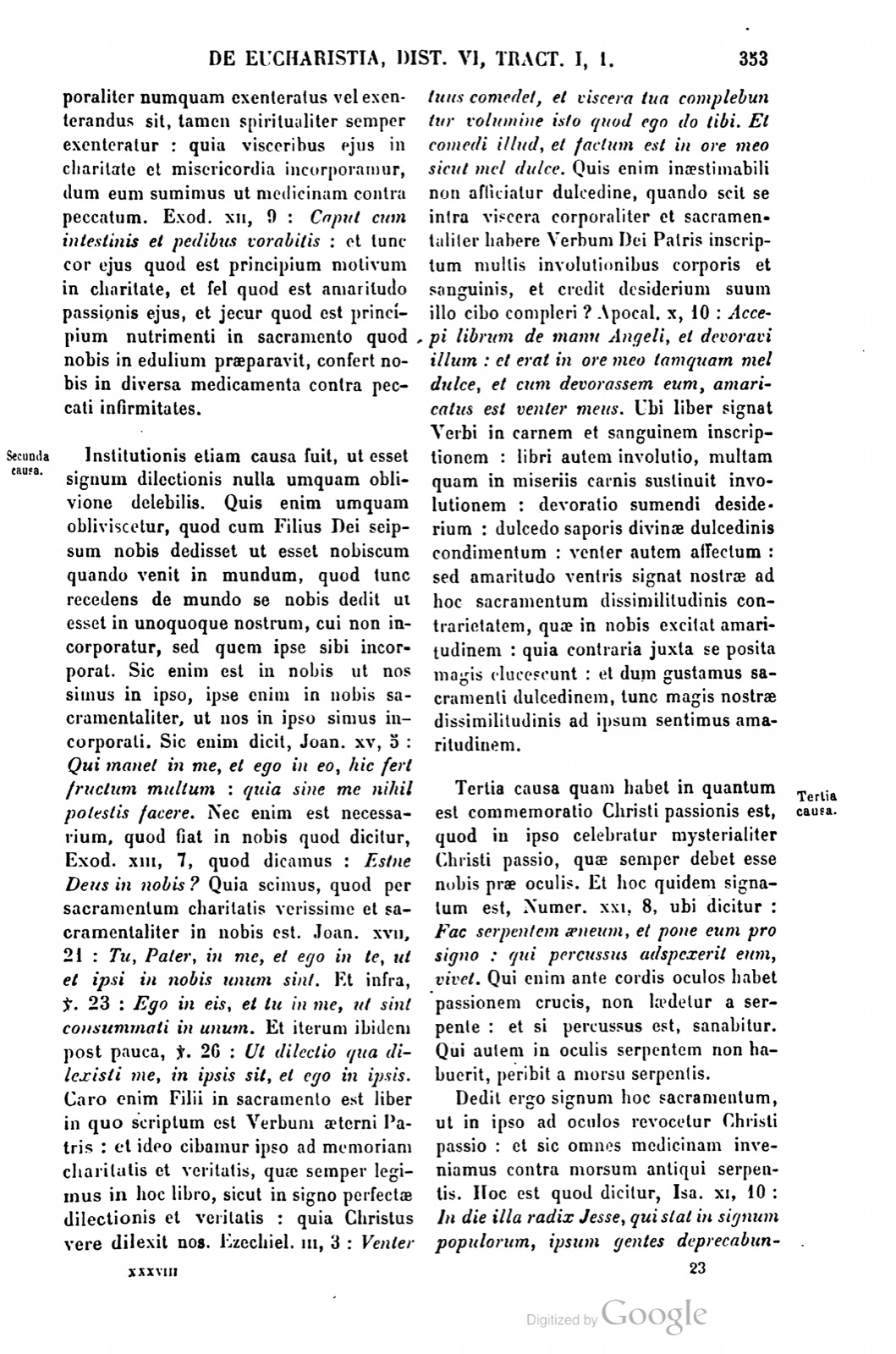
Hoc signatum est, Tob. III, 25, ubi dicitur, quod ad curandam Saram, filiam Raguelis, et curandum Tobiam, missus est Angelus Domini sanctus, Raphael, ut curaret eos ambos. Sara enim princeps vel carbo vel velamen vel angustia interpretatur: Raguel autem aegrotans et Deo lingua nostra dicitur. Significat Sara animam rationalem, quae in primo princeps omnibus intus et extra principabatur, et postea oblita sui honoris per peccatum globos lucis suae in carbonem, immediatam Dei visionem in velamen, felicitatem in angustiam commutavit. Haec bene Raguelis filia, hoc est, Adae dicitur, a quo licet non secundum animam, tamen secundum corpus descendit, quod per generationem carnalem sortita est, qui pastor fuit et Deo aegrotans soli, qui solus eum de peccato curare potuit. Tobias autem interpretatur ductus ad luctum, et signat a stercoribus instabilis avis hirundinis, quae alba et nigra est, hoc est, a fortunae bonis quae stercora dicuntur, ad luctum peccati et caecitatis abductos, quibus ambobus medicina non paratur, nisi per Christum quem signat Raphael, qui medicina Dei interpretatur. Psal. CII, 3 et 4: Qui propitiatur omnibus iniquitatibus tuis, qui sanat omnes infirmitates tuas: qui redimit de interitu vitam tuam, qui coronat te in misericordia et miserationibus. Si enim in omnibus sacramentis nostras Christus sanat infirmitates, maxime tamen facit hoc in sacramento, in quo ipse totus in deitate et humanitate et gratia continetur. Hinc est, quod etiam sacerdotes, quorum officii est hoc conficere sacramentum, medici dicuntur. Psal. LXXXVI, 11: Numquid... medici suscitabunt, et confitebuntur tibi? Ac si dicat: Non suscitabunt: quia Deus solus est, qui a peccato suscitat: sed medici sicut ministri conficiunt et exhibent medicinam. Hinc est, quod Raphael dixit Tobiae juniori, Tob. VI, 5: Exentera hunc piscem, et cor ejus, et fel, et jecur repone tibi: sunt enim haec necessaria ad medicamenta utiliter. Piscis enim ille est Dominus Jesus Christus in aquis gratiarum purissimarum conceptus, et secundum humanitatem nutritus, qui quamvis corporaliter numquam exenteratus vel exenterandus sit, tamen spiritualiter semper exenteratur: quia visceribus ejus in charitate et misericordia incorporamur, dum eum sumimus ut medicinam contra peccatum. Exod. XII, 9: Caput cum intestinis et pedibus vorabitis: et tunc cor ejus quod est principium motivum in charitate, et fel quod est amaritudo passionis ejus, et jecur quod est principium nutrimenti in sacramento quod nobis in edulium praeparavit, confert nobis in diversa medicamenta contra peccati infirmitates.
Marginal label (printed p. 352): The first cause of institution.
CHAPTER I. On the cause of the institution of this sacrament.
Therefore, speaking of the first cause, we say that every sacrament has been instituted as a medicine against sin; and because the Eucharist is a sacrament, it is necessary that it has been instituted as a medicine against sin. For thus it is said, Ecclesiasticus 38:4, that "the Most High created medicines from the earth, and a prudent man will not abhor them." For this earth is the blessed body of the Lord, whose fullness is the fullness of God, because it pleased the deity to dwell in him bodily. Colossians 2:9 and 10: "Because in him all the fullness of deity dwells bodily; and you have been filled in him." For we are full of every blessing and medicine against sin from the deity of Christ, because God alone can dismiss sins and prepare a medicine against the disease of sin.
This was signified, Tobit 3:25, where it is said that for curing Sarah, daughter of Raguel, and curing Tobias, the holy Angel of the Lord, Raphael, was sent, that he might cure them both. For Sarah is interpreted "princess" or "coal" or "veil" or "anguish"; but Raguel is said in our tongue as "falling sick" and "unto God." Sarah signifies the rational soul, which in the beginning as princess ruled over all things within and without, and afterwards, forgetful of her honor through sin, changed the globes of her light into coal, immediate vision of God into a veil, felicity into anguish. She is rightly called daughter of Raguel, that is, of Adam, from whom, although not according to the soul, nevertheless according to the body she descends, which she obtained through carnal generation; he was a shepherd and one falling sick unto God alone, who alone could cure him from sin. But Tobias is interpreted "led to mourning," and signifies those led away from the droppings of the unstable bird the swallow, which is white and black, that is, from the goods of fortune, which are called droppings, to the mourning of sin and blindness. For both of these a medicine is not prepared except through Christ, whom Raphael signifies, who is interpreted "medicine of God." Psalm 102:3 and 4: "Who is propitiated toward all your iniquities, who heals all your infirmities; who redeems your life from destruction, who crowns you in mercy and compassion." For if Christ heals our infirmities in all the sacraments, nevertheless he does this especially in the sacrament in which he himself is wholly contained in deity and humanity and grace. Hence it is that even priests, whose office it is to confect this sacrament, are called physicians. Psalm 86:11: "Will physicians raise up... and confess to you?" As if he said: They will not raise up, because God alone is he who raises from sin; but physicians, as ministers, confect and display the medicine. Hence it is that Raphael said to the younger Tobias, Tobit 6:5: "Disembowel this fish, and keep for yourself its heart, and gall, and liver; for these are necessary usefully for medicines." For that fish is the Lord Jesus Christ, conceived in the waters of most pure graces and nourished according to humanity; although corporally he was never disemboweled, nor is to be disemboweled, nevertheless spiritually he is always disemboweled, because we are incorporated into his inward parts in charity and mercy, when we receive him as medicine against sin. Exodus 12:9: "You shall eat the head with the intestines and feet"; and then his heart, which is the moving principle in charity, and the gall, which is the bitterness of his Passion, and the liver, which is the principle of nourishment in the sacrament which he prepared for us as food, confer on us diverse medicines against the infirmities of sin.
If a page does not appear, its photograph has not been uploaded yet.