Works › The Book on the Sacrament of the Eucharist
Volume 38 · pp. 216–219
Distinction II. Tractate I. On the Property of the Giver.
A marker with ≈ is an approximate page boundary, placed by measure of the text; the page photographs remain the authority. In the paired views, clicking a page marker brings that page into view.
Marginal label (printed p. 216): Magnifici sive liberalis quae sit proprietas?
Marginal label (printed p. 218): Quanto affectu Christus suum corpus donavit.
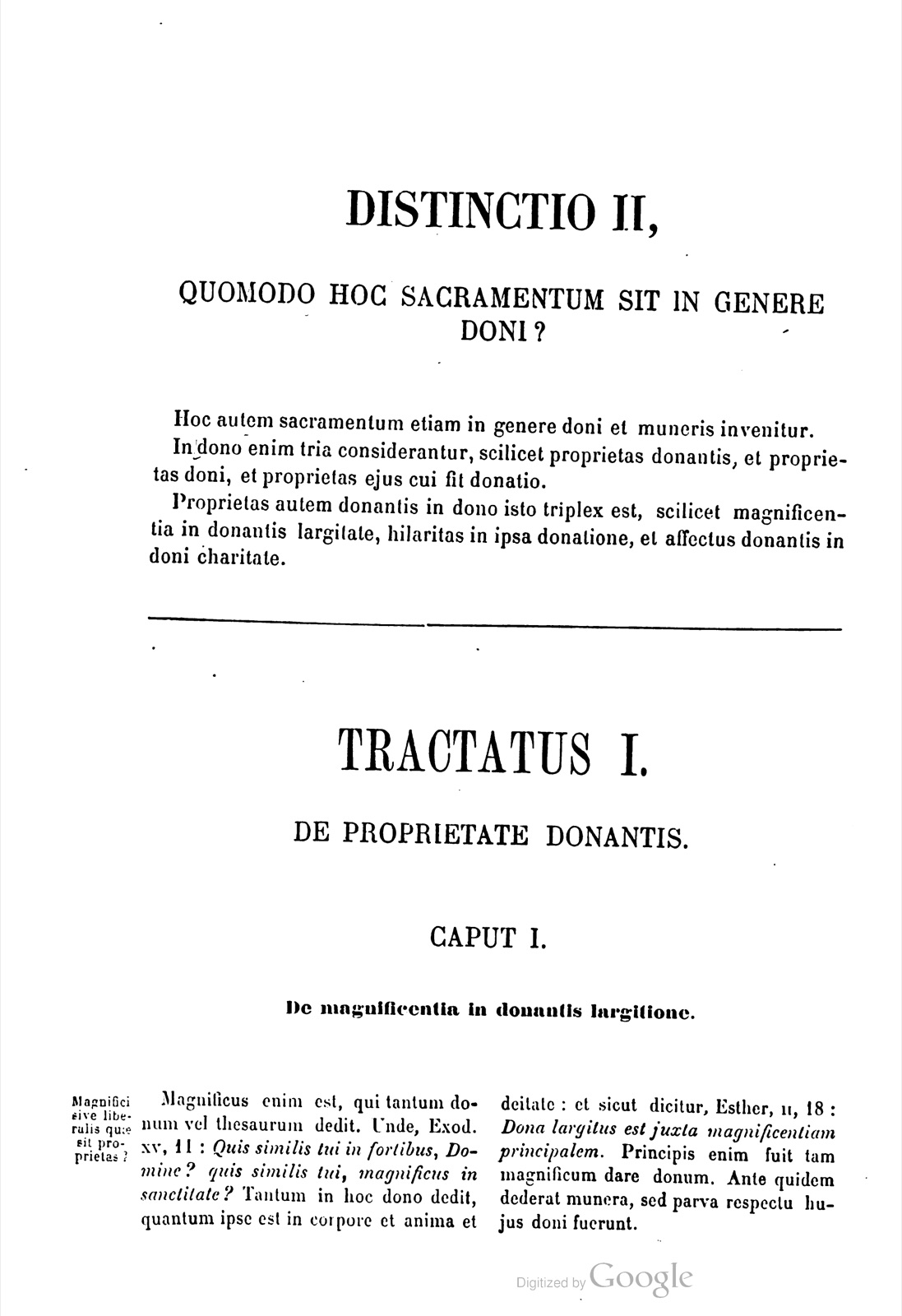
Distinctio II. Quomodo hoc sacramentum sit in genere doni?
Hoc autem sacramentum etiam in genere doni et muneris invenitur.
In dono enim tria considerantur, scilicet proprietas donantis, et proprietas doni, et proprietas ejus cui fit donatio.
Proprietas autem donantis in dono isto triplex est, scilicet magnificentia in donantis largitate, hilaritas in ipsa donatione, et affectus donantis in doni charitate.
Tractatus I. De proprietate donantis.
Caput I. De magnificentia in donantis largitione.
Magnificus enim est, qui tantum donum vel thesaurum dedit. Unde, Exod. xv, 11: Quis similis tui in fortibus, Domine? quis similis tui, magnificus in sanctitate? Tantum in hoc dono dedit, quantum ipse est in corpore et anima et deitate: et sicut dicitur, Esther, ii, 18: Dona largitus est juxta magnificentiam principalem. Principis enim fuit tam magnificum dare donum. Ante quidem dederat munera, sed parva respectu hujus doni fuerunt.
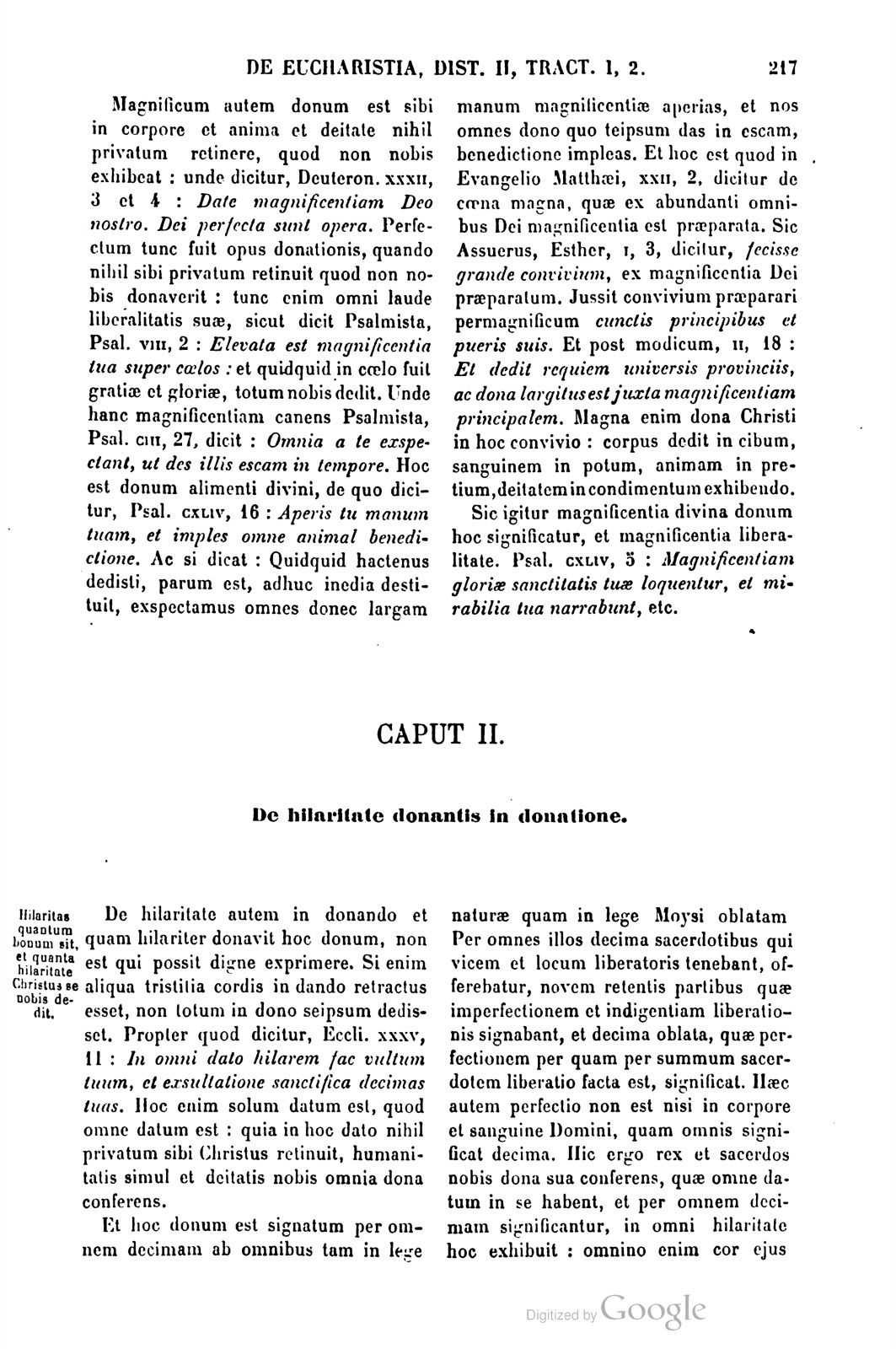
Magnificum autem donum est sibi in corpore et anima et deitate nihil privatum retinere, quod non nobis exhibeat: unde dicitur, Deuteron. xxxii, 3 et 4: Date magnificentiam Deo nostro. Dei perfecta sunt opera. Perfectum tunc fuit opus donationis, quando nihil sibi privatum retinuit quod non nobis donaverit: tunc enim omni laude liberalitatis suae, sicut dicit Psalmista, Psal. viii, 2: Elevata est magnificentia tua super caelos: et quidquid in caelo fuit gratiae et gloriae, totum nobis dedit. Unde hanc magnificentiam canens Psalmista, Psal. ciii, 27, dicit: Omnia a te exspectant, ut des illis escam in tempore. Hoc est donum alimenti divini, de quo dicitur, Psal. cxliv, 16: Aperis tu manum tuam, et imples omne animal benedictione. Ac si dicat: Quidquid hactenus dedisti, parum est, adhuc inedia destituit, exspectamus omnes donec largam manum magnificentiae aperias, et nos omnes dono quo teipsum das in escam, benedictione impleas. Et hoc est quod in Evangelio Matthaei, xxii, 2, dicitur de cena magna, quae ex abundanti omnibus Dei magnificentia est praeparata. Sic Assuerus, Esther, i, 3, dicitur, fecisse grande convivium, ex magnificentia Dei praeparatum. Jussit convivium praeparari permagnificum cunctis principibus et pueris suis. Et post modicum, ii, 18: Et dedit requiem universis provinciis, ac dona largitus est juxta magnificentiam principalem. Magna enim dona Christi in hoc convivio: corpus dedit in cibum, sanguinem in potum, animam in pretium, deitatem in condimentum exhibendo.
Marginal label (printed p. 216): What is the property of one who is magnificent or liberal?
Marginal label (printed p. 218): With how great affection Christ gave his body.
Distinction II. How is this sacrament in the genus of gift?
This sacrament is also found in the genus of gift and present.
For in a gift three things are considered, namely the property of the giver, the property of the gift, and the property of the one to whom the donation is made.
But the property of the giver in this gift is threefold, namely magnificence in the liberality of the giver, cheerfulness in the donation itself, and the affection of the giver in the charity of the gift.
Tractate I. On the property of the giver.
Chapter I. On magnificence in the giver's bestowal.
For magnificent is the one who has given so great a gift or treasure. Hence Exodus 15:11: Who is like you among the strong, O Lord? Who is like you, magnificent in holiness? In this gift he gave as much as he himself is in body and soul and deity; and as is said in Esther 2:18: He bestowed gifts according to princely magnificence. For it belonged to the prince to give so magnificent a gift. Before this indeed he had given presents, but they were small in comparison with this gift.
But a magnificent gift is to retain nothing private to himself in body and soul and deity which he does not offer to us. Hence it is said in Deuteronomy 32:3 and 4: Give magnificence to our God. The works of God are perfect. The work of donation was perfect when he retained nothing private to himself which he did not give to us. For then, with every praise of his liberality, as the Psalmist says in Psalm 8:2: Your magnificence has been lifted above the heavens; and whatever of grace and glory was in heaven, he gave it wholly to us. Hence, singing this magnificence, the Psalmist says in Psalm 103:27: All things wait upon you, that you may give them food in due time. This is the gift of divine nourishment, concerning which Psalm 144:16 says: You open your hand and fill every living thing with blessing. As if he were saying: Whatever you have given up to now is little; still destitution by hunger remains; we all wait until you open the generous hand of magnificence and fill all of us with blessing by the gift in which you give yourself as food. And this is what is said in Matthew 22:2 in the Gospel concerning the great supper, which has been prepared for all things from the abundant magnificence of God. Thus Ahasuerus in Esther 1:3 is said to have made a great banquet, prepared from the magnificence of God. He commanded a very magnificent banquet to be prepared for all his princes and servants. And a little later, 2:18: And he gave rest to all the provinces, and bestowed gifts according to princely magnificence. For the gifts of Christ are great in this banquet: he gave his body as food, his blood as drink, his soul as price, offering his deity as seasoning.
Sic igitur magnificentia divina donum hoc significatur, et magnificentia liberalitate. Psal. cxliv, 5: Magnificentiam gloriae sanctitatis tuae loquentur, et mirabilia tua narrabunt, etc.
Caput II. De hilaritate donantis in donatione.
De hilaritate autem in donando et quam hilariter donavit hoc donum, non est qui possit digne exprimere. Si enim aliqua tristitia cordis in dando retractus esset, non totum in dono seipsum dedisset. Propter quod dicitur, Eccli. xxxv, 11: In omni dato hilarem fac vultum tuum, et exsultatione sanctifica decimas tuas. Hoc enim solum datum est, quod omne datum est: quia in hoc dato nihil privatum sibi Christus retinuit, humanitatis simul et deitatis nobis omnia dona conferens.
Et hoc donum est signatum per omnem decimam ab omnibus tam in lege naturae quam in lege Moysi oblatam. Per omnes illos decima sacerdotibus qui vicem et locum liberatoris tenebant, offerebatur, novem retentis partibus quae imperfectionem et indigentiam liberationis signabant, et decima oblata, quae perfectionem per quam per summum sacerdotem liberatio facta est, significat. Haec autem perfectio non est nisi in corpore et sanguine Domini, quam omnis significat decima. Hic ergo rex et sacerdos nobis dona sua conferens, quae omne datum in se habent, et per omnem decimam significantur, in omni hilaritate hoc exhibuit: omnino enim cor ejus exhilaratum est, quando nimia charitas ejus se sensit a membris communicari ad perfectam membrorum incorporationem sibi factam in communionis dono.
Adhuc autem, in omni hilaritate perrusus est ille magnificus in liberalitate rerum, quando a se vidit tantum donum procedere. De proprietate enim magnifici est delectari et hilarescere in magna donando, et contristari si magna donare non poterit. Hoc autem optime significatum est, II Paralip. xxx, 1 et seq., ubi loquitur Scriptura de Phase quod celebravit Ezechias rex, qui regem Christum significat, et Phase ejus significat donum pretiosi corporis et sanguinis Christi, ubi sic dicitur, v. 24 et 25: Sanctificata est ergo sacerdotum plurima multitudo. Et hilaritate perfusa omnis turba Juda, tam sacerdotum et levitarum, quam universae frequentiae quae venerat ex Israel, etc. In hac enim hilaritate ad quam quidem sanctificantur sacerdotes et inferiorum ordinum ministri, sanctificatur tota frequentia populi communicans huic dono Domini nostri Jesu Christi. Et hoc est quod dicitur, Eccli. xxvi, 4: Divitis et pauperis cor bonum, omni tempore vultus eorum hilaris. Largitoris enim et eorum quibus largitur hoc donum, necesse est cor hilarescere in jucunditate mutuae communionis: quamvis tristitia fuerit de passione imminente, tamen maxima fuit hilaritas in istius communionis collatione. Unde, Esther, ix, 22, dicitur: Luctus atque tristitia in hilaritatem gaudiumque conversa sunt. Quis enim non hilaresceret in tantorum bonorum collatione, sciens quod scriptum est, Proverb. xvi, 15: In hilaritate vultus regis vita, et clementia ejus quasi imber serotinus? Omnis enim vita et omnis clementia et omnis imber gratiae ab ipso procedit sacramento: dicitur enim, Proverb. xix, 12: Sicut ros super herbam, ita et hilaritas regis: quia hilaritas ejus omnes perfundit gratia suae largitatis: qui enim semper per Apostolum suum dixit, II ad Corinth. ix, 7: Hilarem datorem diligit Deus, non potuit in tantis suis donis non esse hilaris. Et iterum, ad Roman. xii, 8: Qui miseretur in hilaritate. Unde et ipse in tot misericordiae indiciis nobis exhibitis non nisi hilaris esse poterat. Et hoc optime significatur, Ruth, iii, 7, ubi dicitur: Cum comedisset Booz et bibisset, et factus esset hilarior, issetque ad dormiendum, ubi notatur, quod Booz noster, qui in quo robur interpretatur, eo quod sic robustus omnia perfecit nostrae redemptionis et sanctificationis opera, in cena cum suis sua donans in cibo et potu, factus est hilarior. Et sic ivit dormitum in crucem et sepulcrum. Unde etiam perfecto omni negotio dixit, Psal. iv, 9: In pace in idipsum dormiam, et requiescam.
Thus therefore the divine magnificence and the magnificence in liberality are signified by this gift. Psalm 144:5: They shall speak of the magnificence of the glory of your holiness, and they shall tell your wonderful works, and so forth.
Chapter II. On the cheerfulness of the giver in donation.
Concerning cheerfulness in giving, and how cheerfully he gave this gift, there is no one who can express it worthily. For if he had been drawn back in giving by some sadness of heart, he would not have given himself wholly in the gift. On account of this Ecclesiasticus 35:11 says: In every gift make your face cheerful, and with exultation sanctify your tithes. For this alone was given which is every given thing, because in this gift Christ retained nothing private for himself, conferring on us all the gifts of humanity together with deity.
And this gift was signified by every tithe offered by all, both in the law of nature and in the law of Moses. Through all those tithes it was offered to the priests who held the place and office of the liberator, with the nine parts retained which signified the imperfection and need of liberation, and the tenth offered which signifies the perfection through which liberation was made by the highest priest. But this perfection is only in the body and blood of the Lord, which every tithe signifies. Therefore this king and priest, conferring on us his gifts, which contain in themselves every given thing and are signified through every tithe, offered this in every cheerfulness. For his heart was wholly made cheerful when his excessive charity felt itself being communicated by the members unto the perfect incorporation of the members made to himself in the gift of communion.
Further, that magnificent one was suffused with every cheerfulness in liberality of things when he saw so great a gift proceed from himself. For it belongs to the property of the magnificent man to be delighted and made cheerful in giving great things, and to be saddened if he cannot give great things. This was very well signified in 2 Chronicles 30:1 and following, where Scripture speaks of the Passover which King Hezekiah celebrated, who signifies Christ the king, and his Passover signifies the gift of the precious body and blood of Christ. There it is said in verses 24 and 25: Therefore a very great multitude of priests was sanctified. And all the crowd of Judah was suffused with cheerfulness, both of priests and Levites and of the whole multitude that had come from Israel, and so forth. For in this cheerfulness, for which indeed priests and ministers of lower orders are sanctified, the whole multitude of the people communicating in this gift of our Lord Jesus Christ is sanctified. And this is what is said in Ecclesiasticus 26:4: The good heart of rich and poor, their face cheerful at every time. For the heart of the giver and of those to whom he gives this gift must grow cheerful in the joy of mutual communion. Although there was sadness concerning the approaching passion, nevertheless there was the greatest cheerfulness in the conferral of that communion. Hence in Esther 9:22 it is said: Mourning and sadness were turned into cheerfulness and joy. For who would not grow cheerful in the conferral of such great goods, knowing that it is written in Proverbs 16:15: In the cheerfulness of the king's face is life, and his clemency is like the late rain? For every life and every clemency and every shower of grace proceeds from that sacrament. For Proverbs 19:12 says: As dew upon the grass, so also is the cheerfulness of the king, because his cheerfulness floods all with the grace of his largesse. For he who always said through his Apostle, 2 Corinthians 9:7: God loves a cheerful giver, could not fail to be cheerful in such great gifts of his. And again in Romans 12:8: He who shows mercy, in cheerfulness. Hence he himself, in so many indications of mercy shown to us, could only be cheerful. And this is very well signified in Ruth 3:7, where it is said: When Boaz had eaten and drunk and had become more cheerful and had gone to sleep. There it is noted that our Boaz, who is interpreted in whom there is strength, because being so strong he accomplished all the works of our redemption and sanctification, giving his own things to his own at supper in food and drink, was made more cheerful. And thus he went to sleep on the cross and in the sepulcher. Hence also, when every business was completed, he said in Psalm 4:9: In peace, in the selfsame, I shall sleep and rest.
Sic ergo magnificus est in largitate, et hilaris in donatione.
Thus therefore he is magnificent in liberality and cheerful in donation.
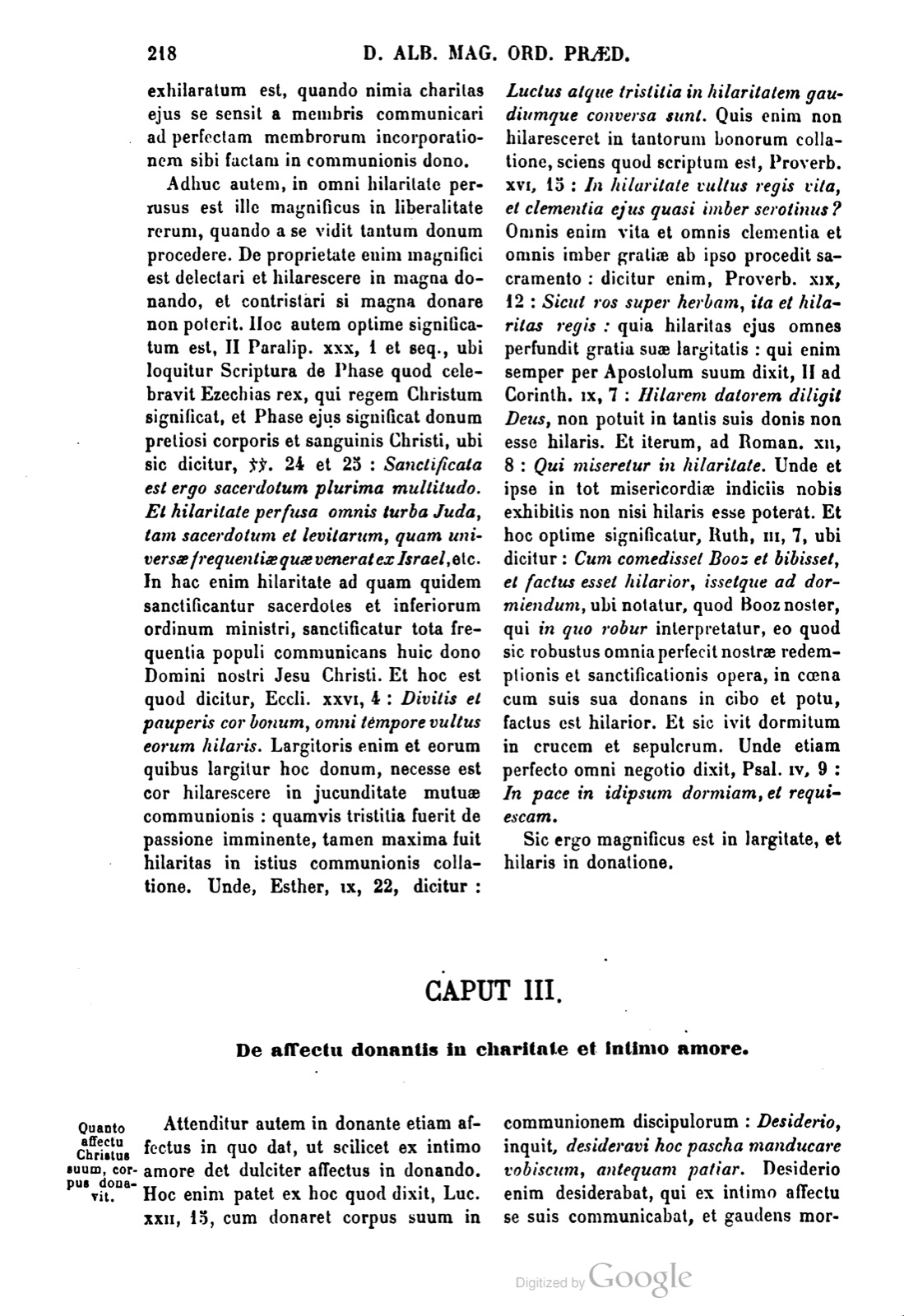
Caput III. De affectu donantis in charitate et intimo amore.
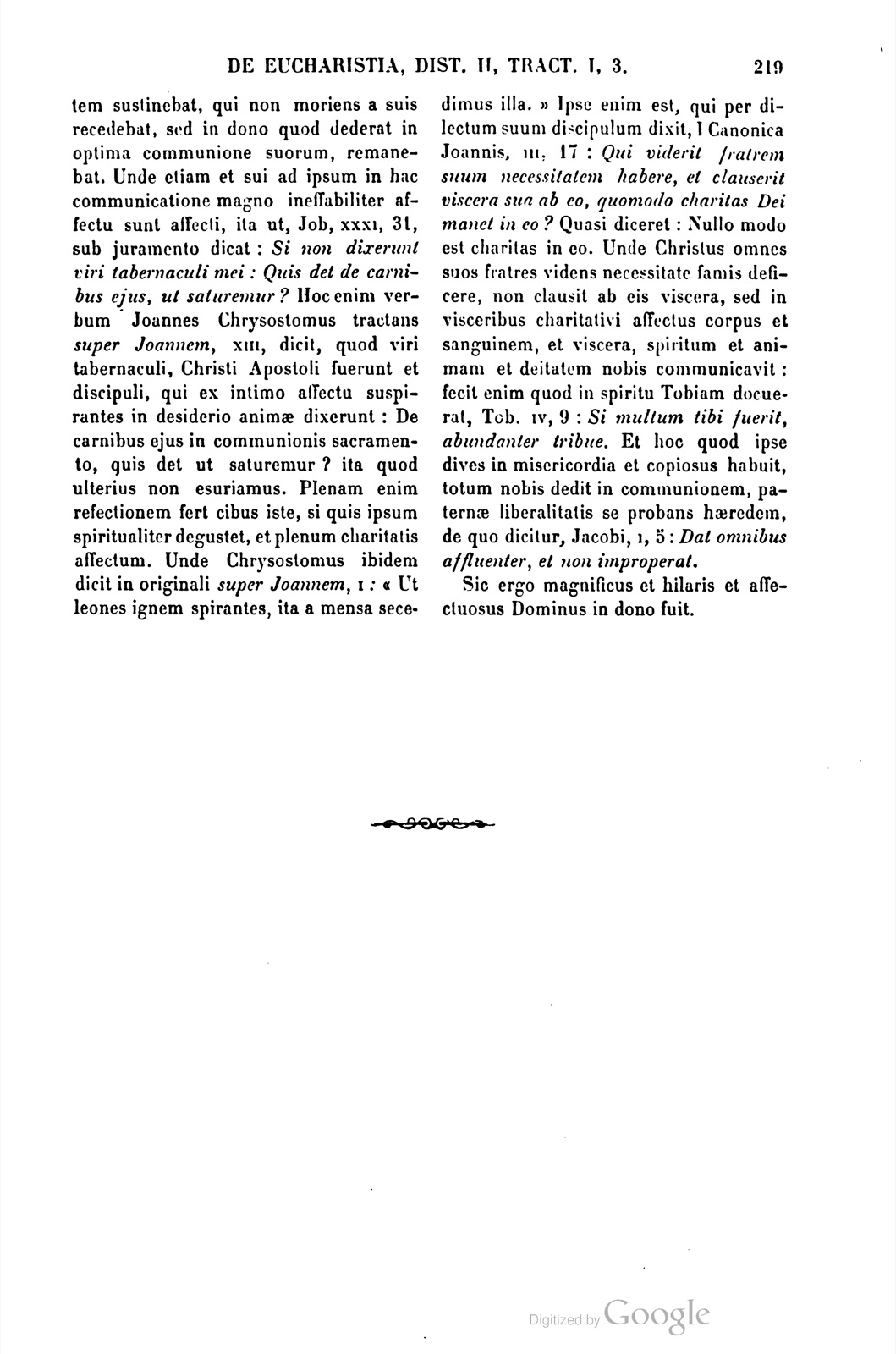
Attenditur autem in donante etiam affectus in quo dat, ut scilicet ex intimo amore det dulciter affectus in donando. Hoc enim patet ex hoc quod dixit, Luc. xxii, 15, cum donaret corpus suum in communionem discipulorum: Desiderio, inquit, desideravi hoc pascha manducare vobiscum, antequam patiar. Desiderio enim desiderabat, qui ex intimo affectu se suis communicabat, et gaudens mortem sustinebat, qui non moriens a suis recedebat, sed in dono quod dederat in optima communione suorum, remanebat. Unde etiam et sui ad ipsum in hac communicatione magno ineffabiliter affectu sunt affecti, ita ut, Job, xxxi, 31, sub juramento dicat: Si non dixerunt viri tabernaculi mei: Quis det de carnibus ejus, ut saturemur? Hoc enim verbum Joannes Chrysostomus tractans super Joannem, xiii, dicit, quod viri tabernaculi, Christi Apostoli fuerunt et discipuli, qui ex intimo affectu suspirantes in desiderio animae dixerunt: De carnibus ejus in communionis sacramento, quis det ut saturemur? ita quod ulterius non esuriamus. Plenam enim refectionem fert cibus iste, si quis ipsum spiritualiter degustet, et plenum charitatis affectum. Unde Chrysostomus ibidem dicit in originali super Joannem, i: Ut leones ignem spirantes, ita a mensa secedimus illa. Ipse enim est, qui per dilectum suum discipulum dixit, I Canonica Joannis, iii, 17: Qui viderit fratrem suum necessitatem habere, et clauserit viscera sua ab eo, quomodo charitas Dei manet in eo? Quasi diceret: Nullo modo est charitas in eo. Unde Christus omnes suos fratres videns necessitate famis deficere, non clausit ab eis viscera, sed in visceribus charitativi affectus corpus et sanguinem, et viscera, spiritum et animam et deitatem nobis communicavit: fecit enim quod in spiritu Tobiam docuerat, Tob. iv, 9: Si multum tibi fuerit, abundanter tribue. Et hoc quod ipse dives in misericordia et copiosus habuit, totum nobis dedit in communionem, paternae liberalitatis se probans heredem, de quo dicitur, Jacobi, i, 5: Dat omnibus affluenter, et non improperat.
Sic ergo magnificus et hilaris et affectuosus Dominus in dono fuit.
Chapter III. On the affection of the giver in charity and inward love.
In the giver there is also considered the affection in which he gives, namely that from inward love he gives sweetly, affected in giving. For this is clear from what he said in Luke 22:15, when he gave his body into the communion of the disciples: With desire, he says, I have desired to eat this Passover with you before I suffer. For he desired with desire who from inward affection communicated himself to his own, and joyfully endured death; by dying he did not withdraw from his own, but remained in the gift which he had given in the best communion of his own. Hence also his own were affected toward him in this communication with an ineffably great affection, so that Job 31:31 says under oath: If the men of my tabernacle did not say, Who will give us of his flesh, that we may be filled? For John Chrysostom, treating this word on John 13, says that the men of the tabernacle were Christ's Apostles and disciples, who, sighing from inward affection in the desire of the soul, said: Of his flesh in the sacrament of communion, who will give that we may be filled, so that we may hunger no more? For this food brings full refreshment, if one tastes it spiritually, and the full affection of charity. Hence Chrysostom says there in the original on John 1: Like lions breathing fire, so we depart from that table. For he is the one who through his beloved disciple said in 1 John 3:17: Whoever sees his brother having need and closes his inward parts from him, how does the charity of God remain in him? As if he were saying: In no way is charity in him. Hence Christ, seeing all his brothers failing from the need of hunger, did not close his inward parts from them, but in the inward parts of charitable affection communicated to us body and blood, and inward parts, spirit and soul and deity. For he did what in spirit he had taught Tobias in Tobit 4:9: If you have much, give abundantly. And what he himself, rich in mercy and copious, had, he gave wholly to us in communion, proving himself heir of paternal liberality; of him it is said in James 1:5: He gives to all abundantly and does not reproach.
Thus therefore the Lord was magnificent, cheerful, and affectionate in the gift.
If a page does not appear, its photograph has not been uploaded yet.