Works › The Book on the Sacrament of the Eucharist
Volume 38 · pp. 192–193
Distinction I. How Is This Sacrament in the Genus of Grace? Chapter I. This Sacrament Is Nothing but Grace.
A marker with ≈ is an approximate page boundary, placed by measure of the text; the page photographs remain the authority. In the paired views, clicking a page marker brings that page into view.
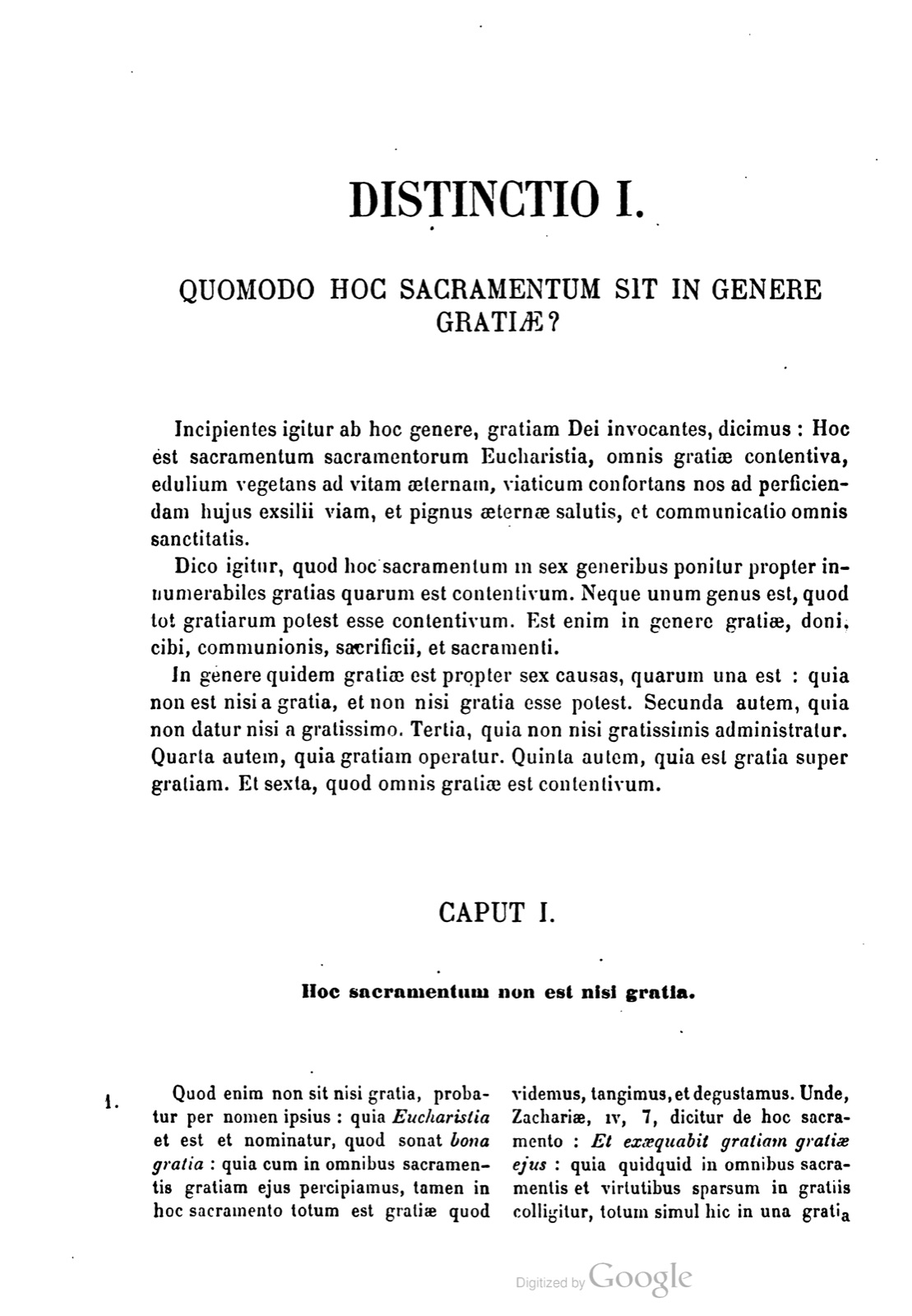
Distinctio I. Quomodo hoc sacramentum sit in genere gratiae?
Incipientes igitur ab hoc genere, gratiam Dei invocantes, dicimus: Hoc est sacramentum sacramentorum Eucharistia, omnis gratiae contentiva, edulium vegetans ad vitam aeternam, viaticum confortans nos ad perficiendam hujus exsilii viam, et pignus aeternae salutis, et communicatio omnis sanctitatis.
Dico igitur, quod hoc sacramentum in sex generibus ponitur propter innumerabiles gratias quarum est contentivum. Neque unum genus est, quod tot gratiarum potest esse contentivum. Est enim in genere gratiae, doni, cibi, communionis, sacrificii, et sacramenti.
In genere quidem gratiae est propter sex causas, quarum una est: quia non est nisi a gratia, et non nisi gratia esse potest. Secunda autem, quia non datur nisi a gratissimo. Tertia, quia non nisi gratissimis administratur. Quarta autem, quia gratiam operatur. Quinta autem, quia est gratia super gratiam. Et sexta, quod omnis gratiae est contentivum.
Caput I. Hoc sacramentum non est nisi gratia.
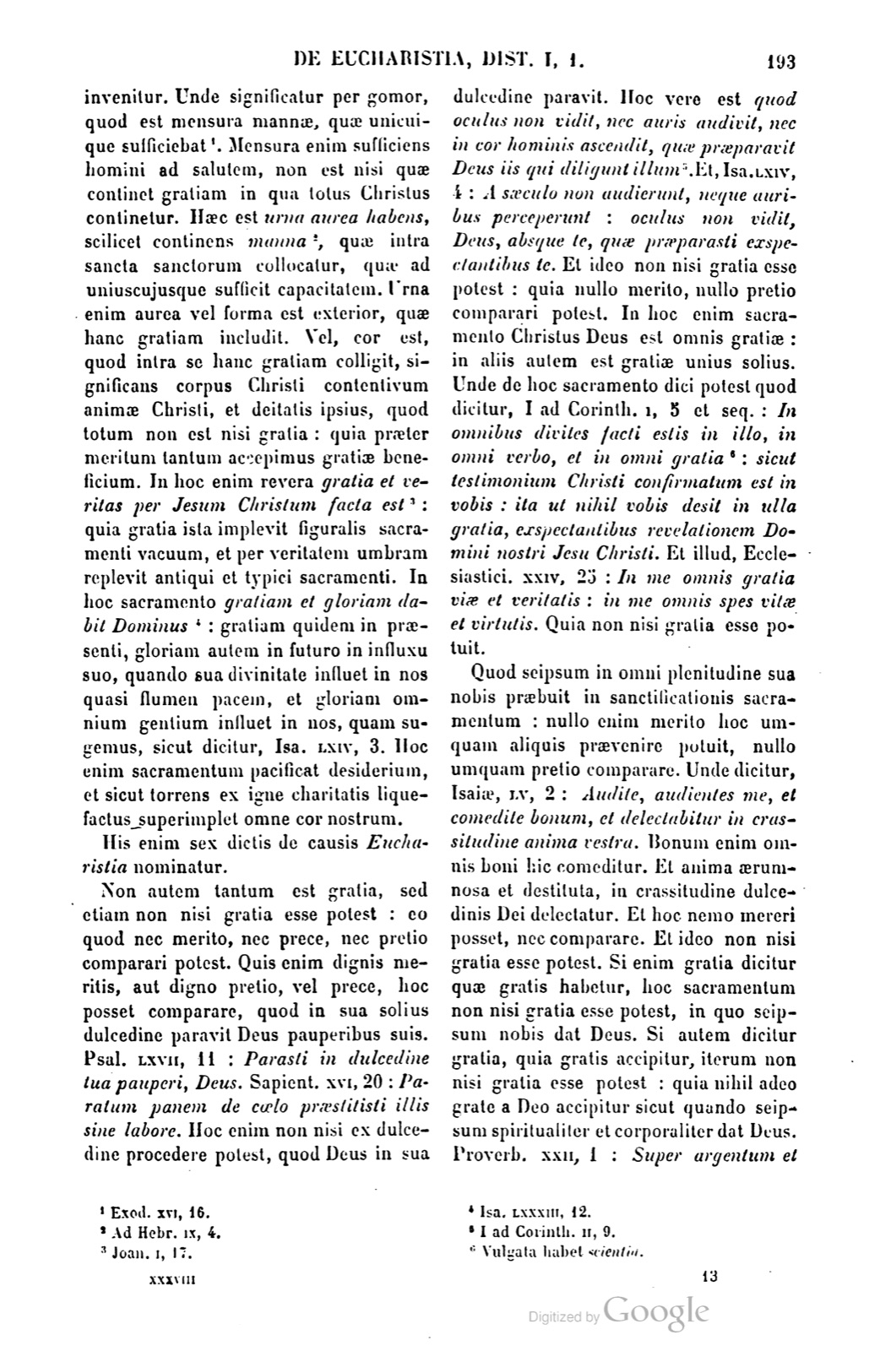
1. Quod enim non sit nisi gratia, probatur per nomen ipsius: quia Eucharistia et est et nominatur, quod sonat bona gratia: quia cum in omnibus sacramentis gratiam ejus percipiamus, tamen in hoc sacramento totum est gratiae quod videmus, tangimus, et degustamus. Unde, Zachariae, iv, 7, dicitur de hoc sacramento: Et exaequabit gratiam gratiae ejus: quia quidquid in omnibus sacramentis et virtutibus sparsum in gratiis colligitur, totum simul hic in una gratia invenitur. Unde significatur per gomor, quod est mensura mannae, quae unicuique sufficiebat1. Mensura enim sufficiens homini ad salutem, non est nisi quae continet gratiam in qua totus Christus continetur. Haec est urna aurea habens, scilicet continens manna2, quae intra sancta sanctorum collocatur, quae ad uniuscujusque sufficit capacitatem. Urna enim aurea vel forma est exterior, quae hanc gratiam includit. Vel, cor est, quod intra se hanc gratiam colligit, significans corpus Christi contentivum animae Christi, et deitatis ipsius, quod totum non est nisi gratia: quia praeter meritum tantum accepimus gratiae beneficium. In hoc enim revera gratia et veritas per Jesum Christum facta est3: quia gratia ista implevit figuralis sacramenti vacuum, et per veritatem umbram replevit antiqui et typici sacramenti. In hoc sacramento gratiam et gloriam dabit Dominus4: gratiam quidem in praesenti, gloriam autem in futuro in influxu suo, quando sua divinitate influet in nos quasi flumen pacem, et gloriam omnium gentium influet in nos, quam sugemus, sicut dicitur, Isa. lxiv, 3. Hoc enim sacramentum pacificat desiderium, et sicut torrens ex igne charitatis liquefactus superimplet omne cor nostrum.
Distinction I. How is this sacrament in the genus of grace?
Therefore, beginning from this genus and invoking the grace of God, we say: This is the sacrament of sacraments, the Eucharist, containing every grace, food nourishing unto eternal life, a viaticum strengthening us for completing the way of this exile, and a pledge of eternal salvation, and a communication of every holiness.
Therefore I say that this sacrament is placed in six genera because of the innumerable graces of which it is the container. Nor is there one genus which can be the container of so many graces. For it is in the genus of grace, of gift, of food, of communion, of sacrifice, and of sacrament.
Indeed it is in the genus of grace for six causes, of which one is that it is only from grace, and can be only grace. The second, however, is that it is given only by the most gracious one. The third, that it is administered only to those most beloved in grace. The fourth, that it works grace. The fifth, that it is grace upon grace. And the sixth, that it contains every grace.
Chapter I. This sacrament is nothing but grace.
1. That it is nothing but grace is proved from its own name, because it both is and is named Eucharistia, which sounds as good grace; because, although in all the sacraments we receive his grace, nevertheless in this sacrament the whole of what we see, touch, and taste is of grace. Hence, in Zechariah 4:7, it is said of this sacrament: And he shall equal grace to its grace, because whatever is scattered in graces in all sacraments and virtues is gathered together here wholly at once in one grace. Hence it is signified by the gomor, which is the measure of manna that was sufficient for each one1. For a measure sufficient for man unto salvation is nothing except that which contains the grace in which the whole Christ is contained. This is the golden urn having, that is, containing, the manna2, which is placed within the holy of holies, and which suffices for the capacity of each one. For the golden urn either is the exterior form which encloses this grace; or it is the heart, which gathers this grace within itself, signifying the body of Christ containing the soul of Christ and his deity, the whole of which is nothing but grace, because beyond merit we have received so great a benefit of grace. For in this sacrament truly grace and truth was made through Jesus Christ3, because that grace filled the emptiness of the figurative sacrament, and through truth it filled up the shadow of the old and typical sacrament. In this sacrament the Lord will give grace and glory4: grace indeed in the present, but glory in the future in his inflowing, when by his divinity he will flow into us like a river, peace, and the glory of all nations will flow into us, which we shall suck, as is said in Isaiah 64:3. For this sacrament pacifies desire, and like a torrent melted from the fire of charity it more than fills our whole heart.
His enim sex dictis de causis Eucharistia nominatur.
Non autem tantum est gratia, sed etiam non nisi gratia esse potest: eo quod nec merito, nec prece, nec pretio comparari potest. Quis enim dignis meritis, aut digno pretio, vel prece, hoc posset comparare, quod in sua solius dulcedine paravit Deus pauperibus suis. Psal. lxvii, 11: Parasti in dulcedine tua pauperi, Deus. Sapient. xvi, 20: Paratum panem de caelo praestitisti illis sine labore. Hoc enim non nisi ex dulcedine procedere potest, quod Deus in sua dulcedine paravit. Hoc vere est quod oculus non vidit, nec auris audivit, nec in cor hominis ascendit, quae praeparavit Deus iis qui diligunt illum5. Et, Isa. lxiv, 4: A saeculo non audierunt, neque auribus perceperunt: oculus non vidit, Deus, absque te, quae praeparasti exspectantibus te. Et ideo non nisi gratia esse potest: quia nullo merito, nullo pretio comparari potest. In hoc enim sacramento Christus Deus est omnis gratiae: in aliis autem est gratiae unius solius. Unde de hoc sacramento dici potest quod dicitur, I ad Corinth. i, 5 et seq.: In omnibus divites facti estis in illo, in omni verbo, et in omni gratia6: sicut testimonium Christi confirmatum est in vobis: ita ut nihil vobis desit in ulla gratia, exspectantibus revelationem Domini nostri Jesu Christi. Et illud, Ecclesiastici, xxiv, 25: In me omnis gratia viae et veritatis: in me omnis spes vitae et virtutis. Quia non nisi gratia esse potuit.
Quod seipsum in omni plenitudine sua nobis praebuit in sanctificationis sacramentum: nullo enim merito hoc umquam aliquis praevenire potuit, nullo umquam pretio comparare. Unde dicitur, Isaiae, lv, 2: Audite, audientes me, et comedite bonum, et delectabitur in crassitudine anima vestra. Bonum enim omnis boni hic comeditur. Et anima aerumnosa et destituta, in crassitudine dulcedinis Dei delectatur. Et hoc nemo mereri posset, nec comparare. Et ideo non nisi gratia esse potest. Si enim gratia dicitur quae gratis habetur, hoc sacramentum non nisi gratia esse potest, in quo seipsum nobis dat Deus. Si autem dicitur gratia, quia gratis accipitur, iterum non nisi gratia esse potest: quia nihil adeo grate a Deo accipitur sicut quando seipsum spiritualiter et corporaliter dat Deus. Proverb. xxii, 1: Super argentum et
For these six stated causes, then, it is named Eucharist.
But not only is it grace, but it also can be nothing but grace, because it cannot be obtained by merit, by prayer, or by price. For who by worthy merits, or by a worthy price, or by prayer, could obtain this, which God prepared for his poor in the sweetness of himself alone? Psalm 67:11: In your sweetness, O God, you prepared for the poor. Wisdom 16:20: You furnished them bread prepared from heaven without labor. For this can proceed only from sweetness, what God has prepared in his sweetness. This truly is what eye has not seen, nor ear heard, nor has it ascended into the heart of man, the things which God has prepared for those who love him5. And Isaiah 64:4: From ages past they have not heard, nor perceived with the ears: eye has not seen, O God, besides you, the things which you have prepared for those who await you. And therefore it can be nothing but grace, because it can be obtained by no merit, by no price. For in this sacrament Christ God is every grace; but in the others he is the grace of one grace only. Hence concerning this sacrament can be said what is said in 1 Corinthians 1:5 and following: In all things you have been made rich in him, in every word and in every grace6, as the testimony of Christ has been confirmed in you, so that nothing is lacking to you in any grace as you await the revelation of our Lord Jesus Christ. And that passage of Ecclesiasticus 24:25: In me is every grace of the way and of truth; in me is every hope of life and of virtue. Because it could be nothing but grace.
Because he has given himself to us in all his fullness as the sacrament of sanctification; for no one could ever have anticipated this by any merit, nor ever have purchased it by any price. Hence it is said in Isaiah 55:2: Hear, hearing me, and eat the good, and your soul shall delight in fatness. For here the good of every good is eaten. And the soul, miserable and destitute, is delighted in the fatness of the sweetness of God. And no one could merit or purchase this. And therefore it can be nothing but grace. For if grace is called that which is possessed gratis, this sacrament can be nothing but grace, in which God gives himself to us. But if it is called grace because it is received gratis, again it can be nothing but grace, because nothing is received so gratefully from God as when God gives himself spiritually and bodily. Proverbs 22:1: Above silver and
Notes
If a page does not appear, its photograph has not been uploaded yet.