Works › The Book on the Sacrament of the Eucharist
Volume 38 · pp. 205–208
Chapter IV. This Sacrament of the Eucharist Works Nothing but Good Grace.
A marker with ≈ is an approximate page boundary, placed by measure of the text; the page photographs remain the authority. In the paired views, clicking a page marker brings that page into view.
Caput IV. Hoc sacramentum Eucharistiae non nisi bonam gratiam operatur.
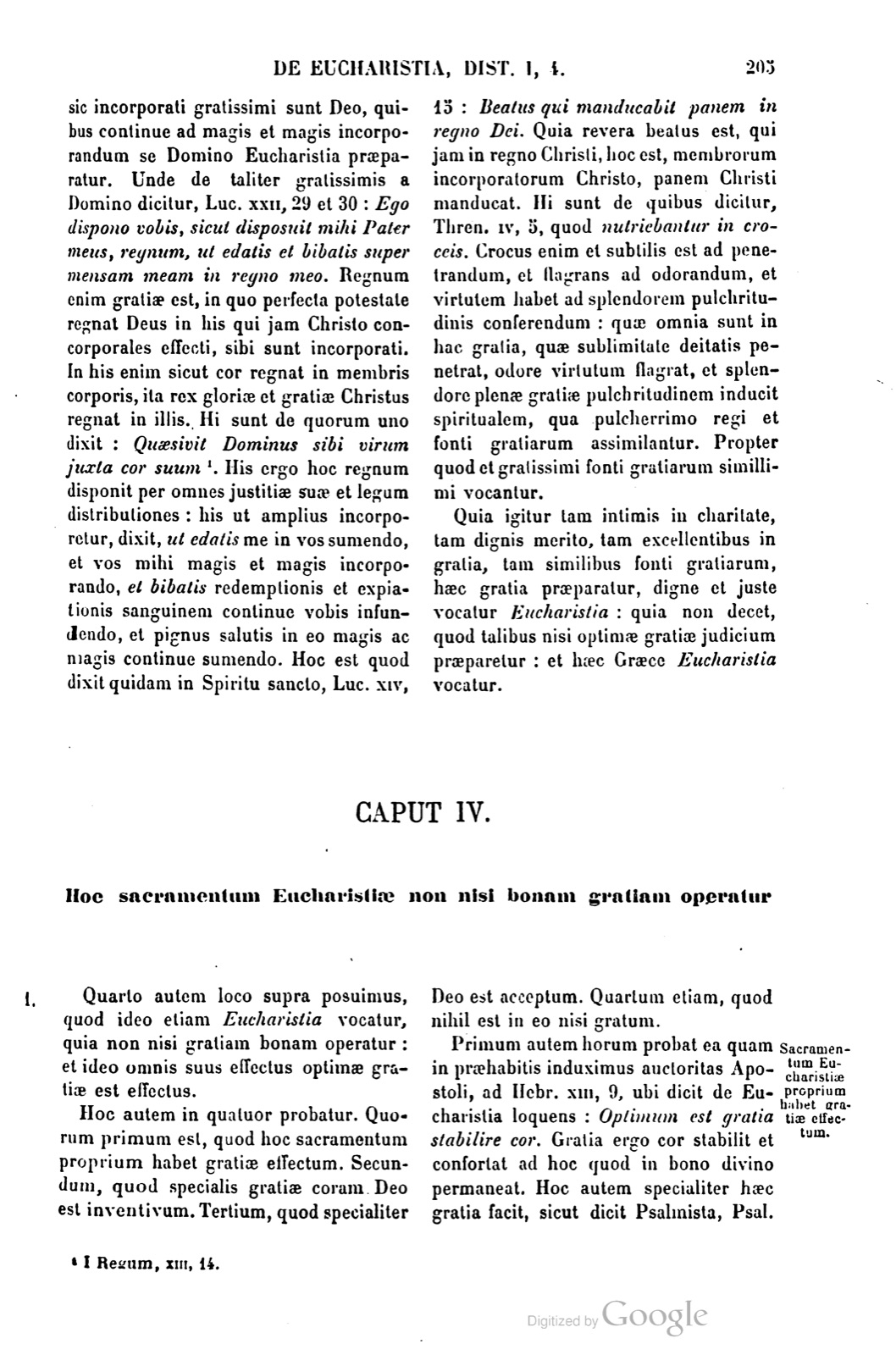
1. Quarto autem loco supra posuimus, quod ideo etiam Eucharistia vocatur, quia non nisi gratiam bonam operatur: et ideo omnis suus effectus optimae gratiae est effectus.
Hoc autem in quatuor probatur. Quorum primum est, quod hoc sacramentum proprium habet gratiae effectum. Secundum, quod specialis gratiae coram Deo est inventivum. Tertium, quod specialiter Deo est acceptum. Quartum etiam, quod nihil est in eo nisi gratum.
Primum autem horum probat ea quam in praehabitis induximus auctoritas Apostoli, ad Hebr. xiii, 9, ubi dicit de Eucharistia loquens: Optimum est gratia stabilire cor. Gratia ergo cor stabilit et confortat ad hoc quod in bono divino permaneat. Hoc autem specialiter haec gratia facit, sicut dicit Psalmista, Psal. ciii, 15: Panis cor hominis confirmat. Ex debilitate enim hominis homo hac gratia destitutus, nutat et vacillat, seipsum in bono tenere non valens, hujus gratiae medicina destitutus. Et diu nutaverat Paulus, et sicut dicitur, Act. ix, 19: Cum accepisset, scilicet gratiae hujus cibum, confortatus est. Haec vera gratia cibus animae vegetans ad saturitatem et confortationem, cum alia omnia nec saturitatem offerant, nec cordis confortationem, dicente Anna, quae gratia interpretatur, I Regum, ii, 5: Repleti prius pro panibus se locaverunt, et famelici saturati sunt. Qui enim prius ingluvie ventris repleti sunt, et pro panibus se locant, temporalem quaerentes saturitatem, nihil penitus gratiae saturantis et confortantis accipiunt. Famelici autem cibum Domini desiderantes saturantur et confortantur. Et hoc idem dicit nostra illuminatrix Maria, filia Annae, hoc est, gratiae, Luc. i, 53: Esurientes implevit bonis, et divites, scilicet sufficientiam in temporali refectione quaerentes, dimisit inanes. Qui enim aliam quam gratiae quaerunt refectionem, de hac gratia edendi non habent potestatem, dicente Apostolo, I ad Corinth. xi, 20 et 21: Convenientibus vobis in unum, jam non est Dominicam cenam manducare: unusquisque enim cenam suam praesumit ad manducandum. Et alius quidem esurit, alius autem ebrius est. Ac si dicat: Si aliam quam gratiae refectionem quaeritis, hanc gratiam percipere non potestis. Alius enim jam concupiscentia illectus, temporalem refectionem esurit. Alius autem delectatione carnali repletus, insanus et ebrius est. Et ideo istis talem gratiam non quaerentibus non contingit Dominicam cenam manducare. Hoc est quod dicitur, Proverb. xiii, 23: Justus comedit, et replet animam suam: venter autem impiorum insaturabilis. Quia igitur gratia satiat, et proprium habet hunc effectum hoc sacramentum in cibo acceptum, proprie bonae gratiae nomen accepit.
Chapter IV. This sacrament of the Eucharist works nothing but good grace.
1. In the fourth place above we set down that it is also called Eucharist because it works nothing except good grace; and therefore every effect of it is an effect of the best grace.
This is proved in four ways. The first is that this sacrament has the proper effect of grace. The second, that it finds special grace before God. The third, that it is specially accepted by God. The fourth, that nothing is in it except what is pleasing.
The first of these is proved by the authority of the Apostle which we introduced above, Hebrews 13:9, where, speaking of the Eucharist, he says: It is best for the heart to be established by grace. Grace therefore establishes and strengthens the heart so that it may remain in the divine good. This grace does this specially, as the Psalmist says in Psalm 103:15: Bread strengthens the heart of man. For from the weakness of man, man, destitute of this grace, totters and wavers, unable to hold himself in the good, deprived of the medicine of this grace. Paul had wavered for a long time, and as Acts 9:19 says: When he had received, namely the food of this grace, he was strengthened. This true grace is food of the soul nourishing unto satiety and strengthening, while all other things offer neither satiety nor strengthening of heart. Anna, whose name is interpreted grace, says in 1 Kings 2:5: Those formerly filled have hired themselves out for breads, and the hungry have been filled. For those who were first filled with gluttony of belly and hire themselves out for breads, seeking temporal satiety, receive absolutely nothing of the grace that satiates and strengthens. But the hungry, desiring the food of the Lord, are satiated and strengthened. And our illuminatrix Mary, daughter of Anna, that is, of grace, says this same thing in Luke 1:53: He has filled the hungry with good things, and the rich, namely those seeking sufficiency in temporal refreshment, he has sent away empty. For those who seek a refreshment other than that of grace do not have power to eat of this grace, as the Apostle says in 1 Corinthians 11:20 and 21: When you come together into one, it is now not to eat the Lord's supper; for each one presumes to eat his own supper. And one indeed is hungry, but another is drunk. As if he were saying: If you seek another refreshment than that of grace, you cannot receive this grace. For one, already enticed by concupiscence, hungers for temporal refreshment. But another, filled with carnal delight, is mad and drunk. And therefore it does not happen to such persons, who do not seek this grace, to eat the Lord's supper. This is what Proverbs 13:23 says: The just man eats and fills his soul, but the belly of the impious is insatiable. Therefore, because grace satiates, and this sacrament received in food has this proper effect, it properly received the name of good grace.
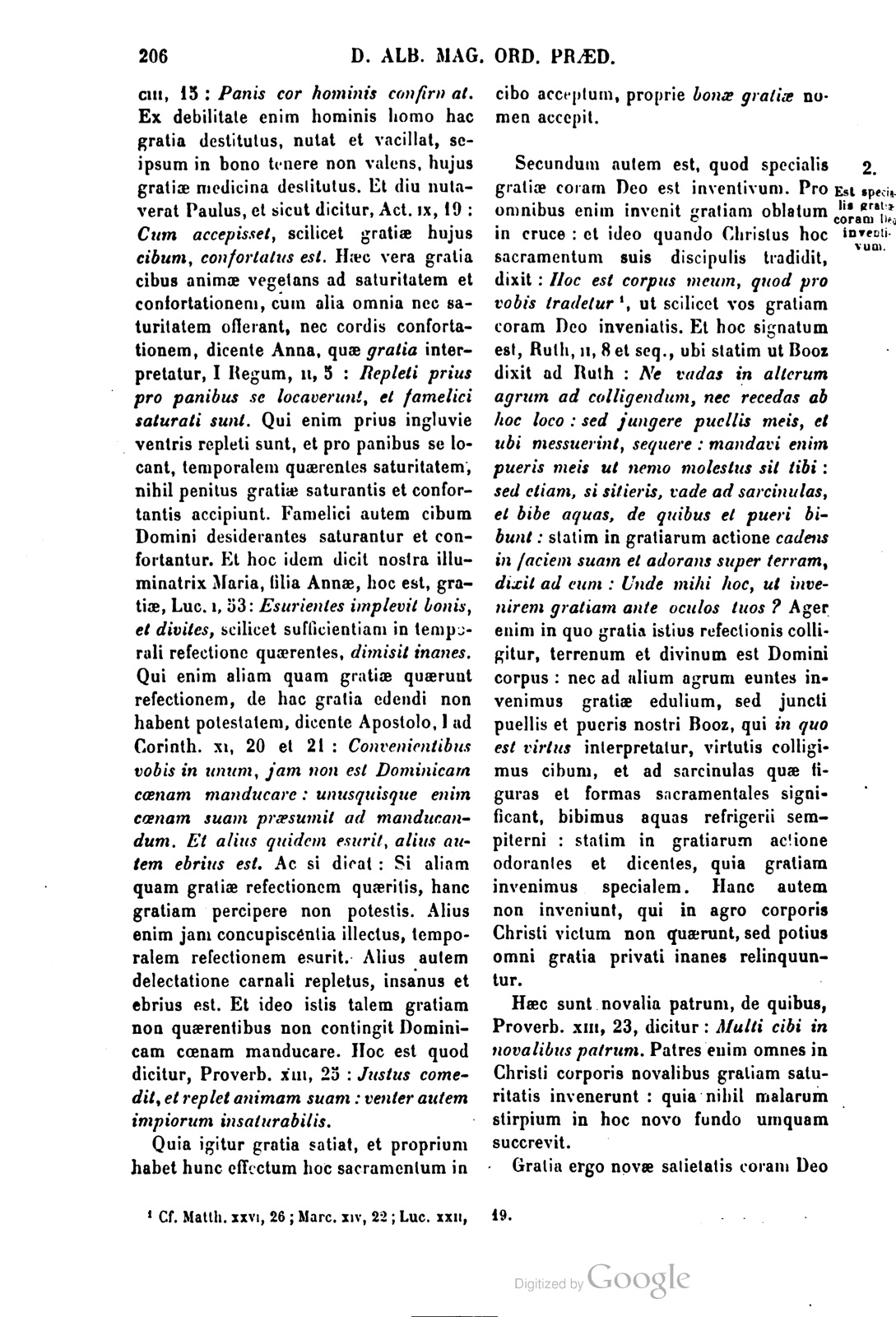
2. Secundum autem est, quod specialis gratiae coram Deo est inventivum. Pro omnibus enim invenit gratiam oblatum in cruce: et ideo quando Christus hoc sacramentum suis discipulis tradidit, dixit: Hoc est corpus meum, quod pro vobis tradetur1, ut scilicet vos gratiam coram Deo inveniatis. Et hoc signatum est, Ruth, ii, 8 et seq., ubi statim ut Booz dixit ad Ruth: Ne vadas in alterum agrum ad colligendum, nec recedas ab hoc loco: sed jungere puellis meis, et ubi messuerint, sequere: mandavi enim pueris meis ut nemo molestus sit tibi: sed etiam, si sitieris, vade ad sarcinulas, et bibe aquas, de quibus et pueri bibunt: statim in gratiarum actione cadens in faciem suam et adorans super terram, dixit ad eum: Unde mihi hoc, ut invenirem gratiam ante oculos tuos? Ager enim in quo gratia istius refectionis colligitur, terrenum et divinum est Domini corpus: nec ad alium agrum euntes invenimus gratiae edulium, sed juncti puellis et pueris nostri Booz, qui in quo est virtus interpretatur, virtutis colligimus cibum, et ad sarcinulas quae figuras et formas sacramentales significant, bibimus aquas refrigerii sempiterni: statim in gratiarum actione odorantes et dicentes, quia gratiam invenimus specialem. Hanc autem non inveniunt, qui in agro corporis Christi victum non quaerunt, sed potius omni gratia privati inanes relinquuntur. Haec sunt novalia patrum, de quibus, Proverb. xiii, 23, dicitur: Multi cibi in novalibus patrum. Patres enim omnes in Christi corporis novalibus gratiam saturitatis invenerunt: quia nihil malarum stirpium in hoc novo fundo umquam succrevit. Gratia ergo novae satietatis coram Deo specialiter in sacramento hoc invenitur: et ideo Eucharistia vocatur.
3. Tertio etiam constat, quod specialiter Deo est acceptum: quia specialis gratiae specialiter est ostensivum. Unde, Matth. xxvi, 20, et Marc. xiv, 22, et Luc. ix, 16, et Joan. xxii, 19 et vi, 11, ubi haec gratia sacramentalis significatur in panibus quibus Dominus turbas satiavit, semper praemittitur: Accepit Jesus panes, et benedixit, ac fregit. Ubi Glossa dicit, quod accepit, quoniam specialiter hoc sacramentum acceptavit inter omnes gratias quas hominibus exhibuit. Oportet autem specialiter gratiae nomen habere, quod in gratia ipsi fonti gratiae est acceptissimum. Unde, Psal. l, 21: Acceptabis sacrificium justitiae, oblationes et holocausta: tunc imponent super altare tuum vitulos. Sacrificium enim justitiae est, quod omnem pro nobis perfecit justitiam, et quod specialiter in gratia Deo est acceptum, sacramentum est Eucharistiae, in quo oblationes sunt corporis et sanguinis animae et spiritus et deitatis Christi, et holocausta Agni omni tempore immolandi κατὰ mane et κατὰ vespere, sicut dicitur, Levit. vi, 12: qui Agnus totum in igne charitatis se incendit in odorem suavissimae gratiae apud Deum: et tunc illa gratia potientes etiam nostros vitulos, hoc est, omnem carnalem petulantiam mactantes, imponimus super altare sacramenti in igne charitatis, nostra sibi offerentes, ut accepta sint in tanti sacramenti acceptatione. De his autem qui huic gratiae non communicant, dicitur, Malach. i, 10: Non est mihi voluntas in vobis, dicit Dominus exercituum, et munus non suscipiam de manu vestra, hoc est, quidquid offertis, non acceptabo: quia sine hujus oblationis gratia nihil est acceptum. Et hoc est quod subdit, v. 11: Ab ortu enim solis usque ad occasum, magnum est nomen meum in Gentibus: et in omni loco sacrificatur, et offertur nomini meo oblatio munda. Munda autem digna Deo est et accepta.
2. The second is that it finds special grace before God. For, offered on the cross for all, it found grace; and therefore when Christ handed this sacrament over to his disciples, he said: This is my body, which will be handed over for you1, namely so that you may find grace before God. This was signified in Ruth 2:8 and following, where, immediately when Boaz said to Ruth: Do not go into another field to gather, nor depart from this place, but join yourself to my maidens, and where they reap, follow; for I have commanded my young men that no one trouble you; but also, if you thirst, go to the bundles and drink the waters of which the young men also drink; immediately, falling on her face in thanksgiving and adoring upon the earth, she said to him: Whence is this to me, that I should find grace before your eyes? For the field in which the grace of this refreshment is gathered is the earthly and divine body of the Lord. Going to another field we do not find the food of grace, but joined to the maidens and boys of our Boaz, who is interpreted in whom there is strength, we gather the food of strength; and at the bundles, which signify sacramental figures and forms, we drink the waters of everlasting refreshment, immediately smelling in thanksgiving and saying that we have found special grace. But those do not find this who do not seek sustenance in the field of Christ's body, but rather, deprived of every grace, are left empty. These are the new fields of the fathers, concerning which Proverbs 13:23 says: There are many foods in the new fields of the fathers. For all the fathers found the grace of satiety in the new fields of Christ's body, because no shoots of evil plants ever grew up in this new ground. Therefore the grace of new satiety is found before God specially in this sacrament, and therefore it is called Eucharist.
3. Third, it is also clear that it is specially accepted by God, because it is specially demonstrative of special grace. Hence in Matthew 26:20, Mark 14:22, Luke 9:16, John 22:19 and 6:11, where this sacramental grace is signified in the loaves by which the Lord fed the crowds, it is always put first: Jesus received the loaves, blessed them, and broke them. There the Gloss says that he received them because he specially accepted this sacrament among all graces which he offered to men. But that must specially have the name of grace which in grace is most acceptable to the very fountain of grace. Hence Psalm 50:21: You will accept the sacrifice of justice, oblations and holocausts; then they will place calves upon your altar. For the sacrifice of justice, which perfected every justice for us and which is specially accepted by God in grace, is the sacrament of the Eucharist, in which there are oblations of the body and blood, soul and spirit and deity of Christ, and holocausts of the Lamb to be immolated at every time, morning and evening, as is said in Leviticus 6:12; this Lamb wholly kindled himself in the fire of charity into the odor of sweetest grace before God. And then, possessing that grace, we also, slaying our calves, that is, every carnal wantonness, place them upon the altar of the sacrament in the fire of charity, offering our things to him so that they may be accepted in the acceptance of so great a sacrament. Concerning those who do not communicate in this grace, Malachi 1:10 says: I have no will in you, says the Lord of hosts, and I will not receive a gift from your hand, that is, whatever you offer, I will not accept, because without the grace of this oblation nothing is accepted. And this is what he adds in verse 11: From the rising of the sun even to its setting, my name is great among the Gentiles, and in every place a clean oblation is sacrificed and offered to my name. A clean oblation, however, is worthy of God and accepted.
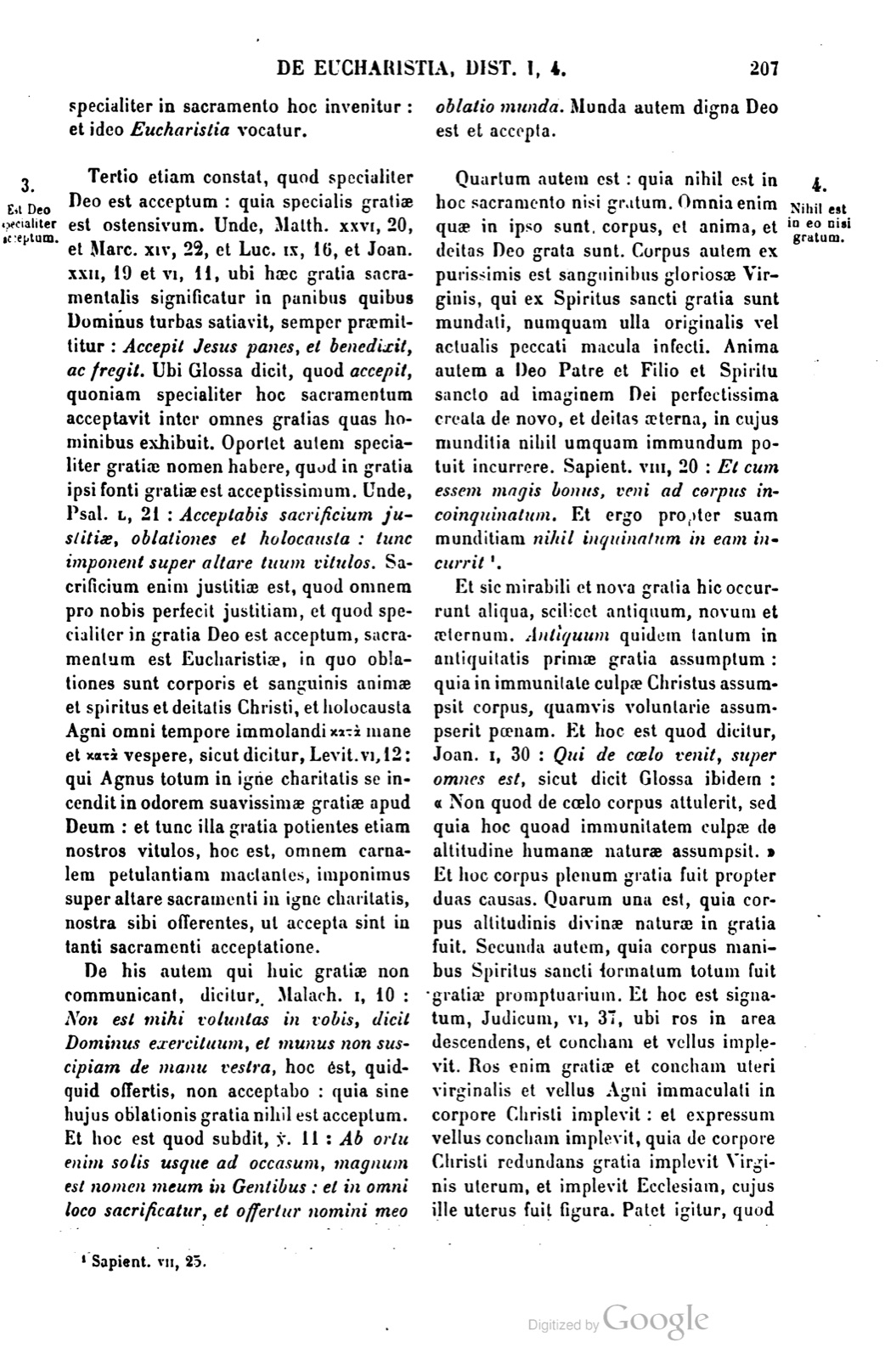
4. Quartum autem est: quia nihil est in hoc sacramento nisi gratum. Omnia enim quae in ipso sunt, corpus, et anima, et deitas Deo grata sunt. Corpus autem ex purissimis est sanguinibus gloriosae Virginis, qui ex Spiritus sancti gratia sunt mundati, numquam ulla originalis vel actualis peccati macula infecti. Anima autem a Deo Patre et Filio et Spiritu sancto ad imaginem Dei perfectissima creata de novo, et deitas aeterna, in cujus munditia nihil umquam immundum potuit incurrere. Sapient. viii, 20: Et cum essem magis bonus, veni ad corpus incoinquinatum. Et ergo propter suam munditiam nihil inquinatum in eam incurrit2. Et sic mirabili et nova gratia hic occurrunt aliqua, scilicet antiquum, novum et aeternum. Antiquum quidem tantum in antiquitatis primae gratia assumptum: quia in immunitate culpae Christus assumpsit corpus, quamvis voluntarie assumpserit poenam. Et hoc est quod dicitur, Joan. i, 30: Qui de caelo venit, super omnes est, sicut dicit Glossa ibidem: Non quod de caelo corpus attulerit, sed quia hoc quoad immunitatem culpae de altitudine humanae naturae assumpsit. Et hoc corpus plenum gratia fuit propter duas causas. Quarum una est, quia corpus altitudinis divinae naturae in gratia fuit. Secunda autem, quia corpus manibus Spiritus sancti formatum totum fuit gratiae promptuarium. Et hoc est signatum, Judicum, vi, 37, ubi ros in area descendens, et concham et vellus implevit. Ros enim gratiae et concham uteri virginalis et vellus Agni immaculati in corpore Christi implevit: et expressum vellus concham implevit, quia de corpore Christi redundans gratia implevit Virginis uterum, et implevit Ecclesiam, cujus ille uterus fuit figura. Patet igitur, quod nihil nisi gratia fuit in eo quod fuit antiquum.
4. The fourth is that nothing is in this sacrament except what is pleasing. For all things which are in it, body, soul, and deity, are pleasing to God. The body is from the purest bloods of the glorious Virgin, which were cleansed by the grace of the Holy Spirit, never infected by any stain of original or actual sin. The soul, however, was newly created by God the Father and the Son and the Holy Spirit as a most perfect image of God; and the eternal deity is that in whose cleanness nothing unclean could ever incur. Wisdom 8:20: And when I was more good, I came to an undefiled body. And therefore because of its cleanness nothing stained incurs into it2. And thus by a wonderful and new grace certain things meet here, namely the ancient, the new, and the eternal. The ancient indeed was assumed only in the grace of its first antiquity, because Christ assumed the body in immunity from fault, although he voluntarily assumed punishment. This is what is said in John 1:30: He who comes from heaven is above all, as the Gloss says there: not that he brought his body from heaven, but because as regards immunity from fault he assumed this from the height of human nature. And this body was full of grace for two causes. One is that the body of the height of divine nature was in grace. The second is that the body, formed by the hands of the Holy Spirit, was wholly the storehouse of grace. And this was signified in Judges 6:37, where the dew descending on the threshing floor filled both the vessel and the fleece. For the dew of grace filled both the vessel of the virginal womb and the fleece of the immaculate Lamb in the body of Christ; and the squeezed fleece filled the vessel, because grace overflowing from the body of Christ filled the womb of the Virgin and filled the Church, of which that womb was a figure. It is clear, therefore, that nothing except grace was in that which was ancient.
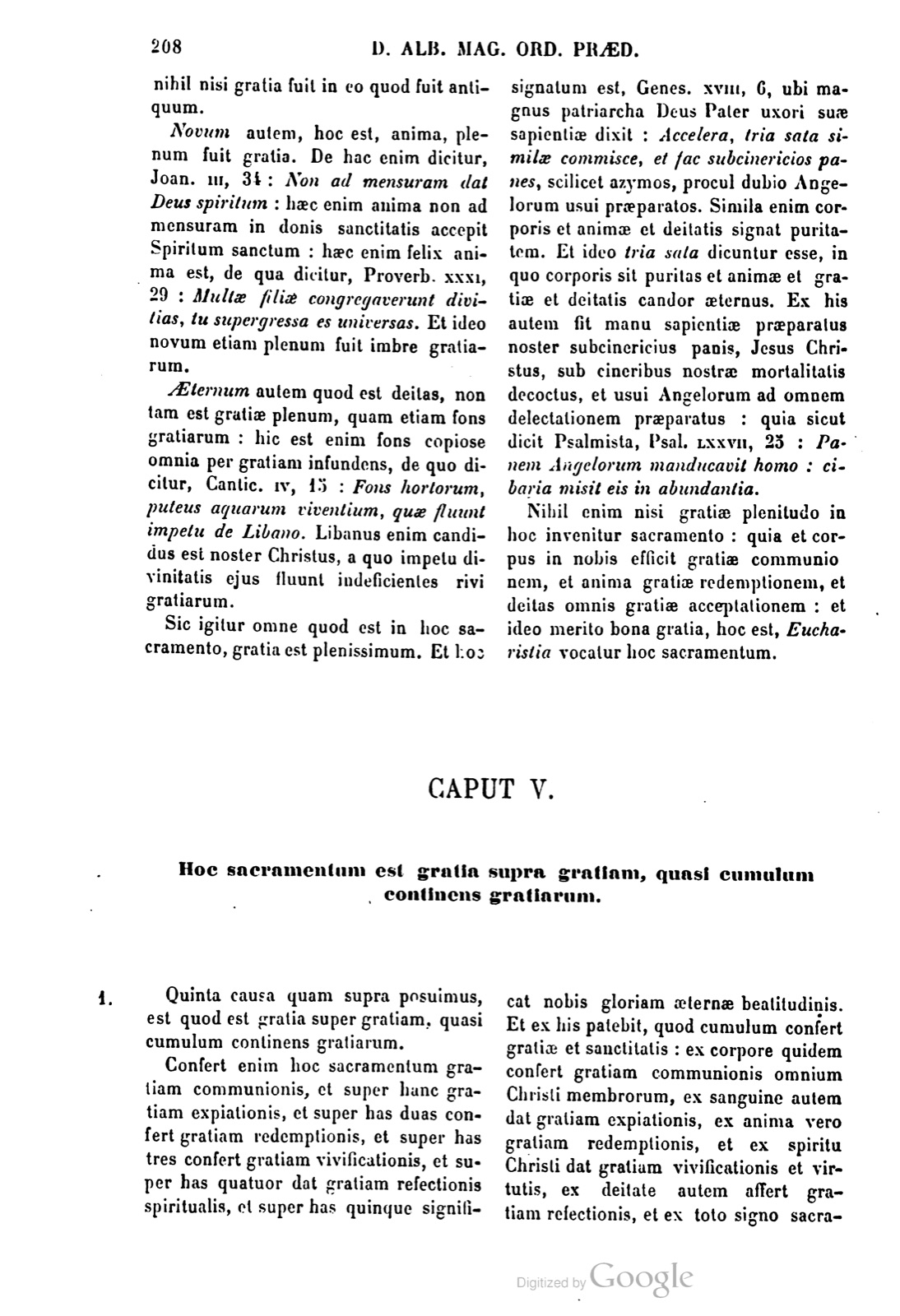
Novum autem, hoc est, anima, plenum fuit gratia. De hac enim dicitur, Joan. i, 34: Non ad mensuram dat Deus spiritum: haec enim anima non ad mensuram in donis sanctitatis accepit Spiritum sanctum: haec enim felix anima est, de qua dicitur, Proverb. xxxi, 29: Multae filiae congregaverunt divitias, tu supergressa es universas. Et ideo novum etiam plenum fuit imbre gratiarum.
Aeternum autem quod est deitas, non tam est gratiae plenum, quam etiam fons gratiarum: hic est enim fons copiose omnia per gratiam infundens, de quo dicitur, Cantic. iv, 15: Fons hortorum, puteus aquarum viventium, quae fluunt impetu de Libano. Libanus enim candidus est noster Christus, a quo impetu divinitatis ejus fluunt indeficientes rivi gratiarum.
Sic igitur omne quod est in hoc sacramento, gratia est plenissimum. Et hoc signatum est, Genes. xviii, 6, ubi magnus patriarcha Deus Pater uxori suae sapientiae dixit: Accelera, tria sata similae commisce, et fac subcinericios panes, scilicet azymos, procul dubio Angelorum usui praeparatos. Simila enim corporis et animae et deitatis signat puritatem. Et ideo tria sata dicuntur esse, in quo corporis sit puritas et animae et gratiae et deitatis candor aeternus. Ex his autem fit manu sapientiae praeparatus noster subcinericius panis, Jesus Christus, sub cineribus nostrae mortalitatis decoctus, et usui Angelorum ad omnem delectationem praeparatus: quia sicut dicit Psalmista, Psal. lxxvii, 25: Panem Angelorum manducavit homo: cibaria misit eis in abundantia.
Nihil enim nisi gratiae plenitudo in hoc invenitur sacramento: quia et corpus in nobis efficit gratiae communionem, et anima gratiae redemptionem, et deitas omnis gratiae acceptationem: et ideo merito bona gratia, hoc est, Eucharistia vocatur hoc sacramentum.
The new, however, that is, the soul, was full of grace. For concerning this it is said in John 1:34: God does not give the Spirit by measure. For this soul did not receive the Holy Spirit by measure in the gifts of holiness. This is the happy soul concerning which Proverbs 31:29 says: Many daughters have gathered riches; you have surpassed them all. And therefore the new also was full with the shower of graces.
But the eternal, which is deity, is not so much full of grace as also the fountain of graces; for this is the fountain copiously pouring all things by grace, concerning which Canticles 4:15 says: A fountain of gardens, a well of living waters, which flow with force from Lebanon. For Lebanon is our white Christ, from whom, by the force of his divinity, unfailing streams of graces flow.
Thus therefore everything that is in this sacrament is most full of grace. And this was signified in Genesis 18:6, where the great patriarch God the Father said to his wife Wisdom: Hasten, mix three measures of fine flour, and make hearth-cakes, namely unleavened breads, without doubt prepared for the use of angels. For fine flour signifies the purity of body and soul and deity. Therefore three measures are said to be there, in which there is the purity of body and soul and grace and the eternal brightness of deity. From these, prepared by the hand of wisdom, is made our hearth-baked bread, Jesus Christ, baked beneath the ashes of our mortality and prepared for the use of angels unto every delight, because, as the Psalmist says in Psalm 77:25: Man ate the bread of angels; he sent them foods in abundance.
For nothing except the fullness of grace is found in this sacrament, because the body effects in us the communion of grace, the soul the redemption of grace, and deity the acceptance of every grace; and therefore deservedly this sacrament is called good grace, that is, Eucharist.
If a page does not appear, its photograph has not been uploaded yet.