Works › The Book on the Sacrament of the Eucharist
Volume 38 · pp. 416–418
Tractate IV. Chapter I, 1-3
A marker with ≈ is an approximate page boundary, placed by measure of the text; the page photographs remain the authority. In the paired views, clicking a page marker brings that page into view.
Marginal label (printed p. 416): Utrum Christus in azymo corpus suum tradiderit?
TRACTATUS IV.
IN QUO AGITUR DE RITU HUJUS SACRAMENTI.
CAPUT I.
De ritu hujus sacramenti ex parte Christi.
1. TANDEM de ritu sacramenti dicendum esse videtur: de quo tria sunt notanda, scilicet de ritu ex parte Christi, de ritu ex parte ministri, et de ritu ex parte sumentis.
De ritu ex parte Christi tria quaeremus: in quo sicut in materia Christus hoc sacramentum primo tradiderit, utrum scilicet vel in azymo, vel fermentato corpus suum tradiderit, et qua forma in conficiendo usus sit, et quando, et quibus dederit.
Utrum autem Christus in azymo vel fermentato corpus suum tradiderit, magna est diversitas inter Doctores Graecos et Latinos. Graeci enim qui sacramenta a Joanne Evangelista dicuntur accepisse, dicunt quod consecrandum est in fermentato: quia in fermentato Christus corpus suum, ut dicunt, tradidit. Hoc autem probant auctoritatibus et rationibus.
Auctoritates praecipue inducunt quatuor ex quibus arguunt probationem suae assertionis.
Prima est, Joan. XVIII, 28, ubi dicitur: Ipsi non introierunt in praetorium, ut non contaminarentur, sed ut manducarent pascha. Sed cum comedebatur pascha, ut dicunt, erat luna decima quarta, sicut dicitur, Exod. XII, 18: Primo mense, quartadecima die mensis, ad vesperam, comedetis azyma, quia Pascha Domini est. Et idem dicitur, Levit. XXIII, 5 et 6: Mense primo, quartadecima die mensis ad vesperum, Phase Domini est: et quintadecima die mensis hujus, solemnitas azymorum Domini est. Decimaquarta ergo erat luna in Parasceve, et ante Parasceven praecedenti nocte Dominus coenavit cum discipulis, et corpus suum dedit eis. Ergo dedit corpus suum luna existente tredecima: tunc autem non erat nisi fermentatum in domibus Judaeorum: ergo ipse dedit in fermentato: quia alium panem in domibus Judaeorum non invenit nisi fermentatum. Quod autem in domibus Judaeorum non fuerit nisi fermentatum, probant ex hoc quod dicitur, Levit. XXIII, 6: Septem diebus azyma comedetis 1. Et, Exod. XII, 18: Quartadecima die mensis, ad vesperam, comedetis azyma 2. Ante hoc igitur azyma in domibus non habuerunt: et sic sequitur, quod tredecima luna fermentatum comedebant: et sic tunc, ut probant, Dominus dedit corpus suum, dicunt, quod oportuit ut daret in fermentato.
Secunda autem auctoritas est Joannis, XIII, 1, ubi dicitur: Ante diem festum Paschae, sciens Jesus quia venit hora ejus ut transeat ex hoc mundo ad Patrem. Et post pauca, v. 4: Surgit a coena, et ponit vestimenta sua. Ergo coenam fecit ante diem festum Paschae. Cum autem festum duraret septem diebus, et primus dies esset celeberrimus, et ultimus aequali solemnitate venerabilis, et medii quinque non adeo solemnes, sicut dicitur, Levit. XXIII, 7 et seq., si coenavit ante diem festum Paschae, tunc oportuit quod coenaret ante primum diem Paschae. Sicut autem dicitur, Levit. XXIII, 5: Quartadecima die mensis ad vesperum, Phase Domini est. Ergo decimaquarta die mensis lunaris fuit prima dies Paschae. Et ante illam diem coenavit ut dicitur, Joan. XIII, 5, in praedicta auctoritate: ergo coenavit cum discipulis luna existente tredecima die mensis lunaris: tunc autem non erat nisi fermentatum in domibus Judaeorum: et Christus non confecit nisi de pane quem in domibus Judaeorum invenit: ergo confecit in fermentato.
Marginal label (printed p. 416): Whether Christ handed down his body in unleavened bread?
TRACTATE IV.
IN WHICH THE RITE OF THIS SACRAMENT IS TREATED.
CHAPTER I.
On the rite of this sacrament on the part of Christ.
1. FINALLY it seems that one must speak about the rite of the sacrament; concerning this three things must be noted, namely concerning the rite on the part of Christ, concerning the rite on the part of the minister, and concerning the rite on the part of the one receiving.
Concerning the rite on the part of Christ we shall ask three things: in what, as in matter, Christ first handed down this sacrament, namely whether he handed down his body in unleavened or leavened bread, and what form he used in confecting, and when, and to whom he gave it.
But whether Christ handed down his body in unleavened or leavened bread, there is great diversity between the Greek and Latin Doctors. For the Greeks, who are said to have received the sacraments from John the Evangelist, say that consecration must be done in leavened bread, because, as they say, Christ handed down his body in leavened bread. But they prove this by authorities and reasons.
They principally bring forward four authorities from which they argue proof of their assertion.
The first is John 18:28, where it is said: They did not enter into the praetorium, so that they might not be contaminated, but so that they might eat the Passover. But when the Passover was eaten, as they say, the moon was the fourteenth, as is said in Exodus 12:18: In the first month, on the fourteenth day of the month, at evening, you shall eat unleavened bread, because it is the Passover of the Lord. And the same is said in Leviticus 23:5 and 6: In the first month, on the fourteenth day of the month at evening, is the Phase of the Lord; and on the fifteenth day of this month is the solemnity of the unleavened breads of the Lord. Therefore the moon was the fourteenth on Parasceve, and before Parasceve on the preceding night the Lord supped with the disciples and gave them his body. Therefore he gave his body when the moon was the thirteenth; but then there was only leavened bread in the houses of the Jews; therefore he himself gave it in leavened bread, because he found no other bread in the houses of the Jews except leavened bread. But that there was only leavened bread in the houses of the Jews, they prove from what is said in Leviticus 23:6: For seven days you shall eat unleavened bread 1. And Exodus 12:18: On the fourteenth day of the month, at evening, you shall eat unleavened bread 2. Therefore before this they did not have unleavened bread in the houses; and thus it follows that on the thirteenth moon they were eating leavened bread; and thus then, as they prove, the Lord gave his body, and they say that he necessarily gave it in leavened bread.
But the second authority is from John 13:1, where it is said: Before the feast day of Passover, Jesus knowing that his hour had come that he should pass from this world to the Father. And after a few words, verse 4: He rises from supper and lays aside his garments. Therefore he made supper before the feast day of Passover. But since the feast lasted seven days, and the first day was most celebrated, and the last venerable with equal solemnity, and the middle five not so solemn, as is said in Leviticus 23:7 and following, if he supped before the feast day of Passover, then he had to sup before the first day of Passover. But as is said in Leviticus 23:5: On the fourteenth day of the month at evening is the Phase of the Lord. Therefore the fourteenth day of the lunar month was the first day of Passover. And before that day he supped, as is said in John 13:5 in the aforesaid authority; therefore he supped with the disciples when the moon was on the thirteenth day of the lunar month. But then there was only leavened bread in the houses of the Jews; and Christ confected only from the bread which he found in the houses of the Jews; therefore he confected in leavened bread.
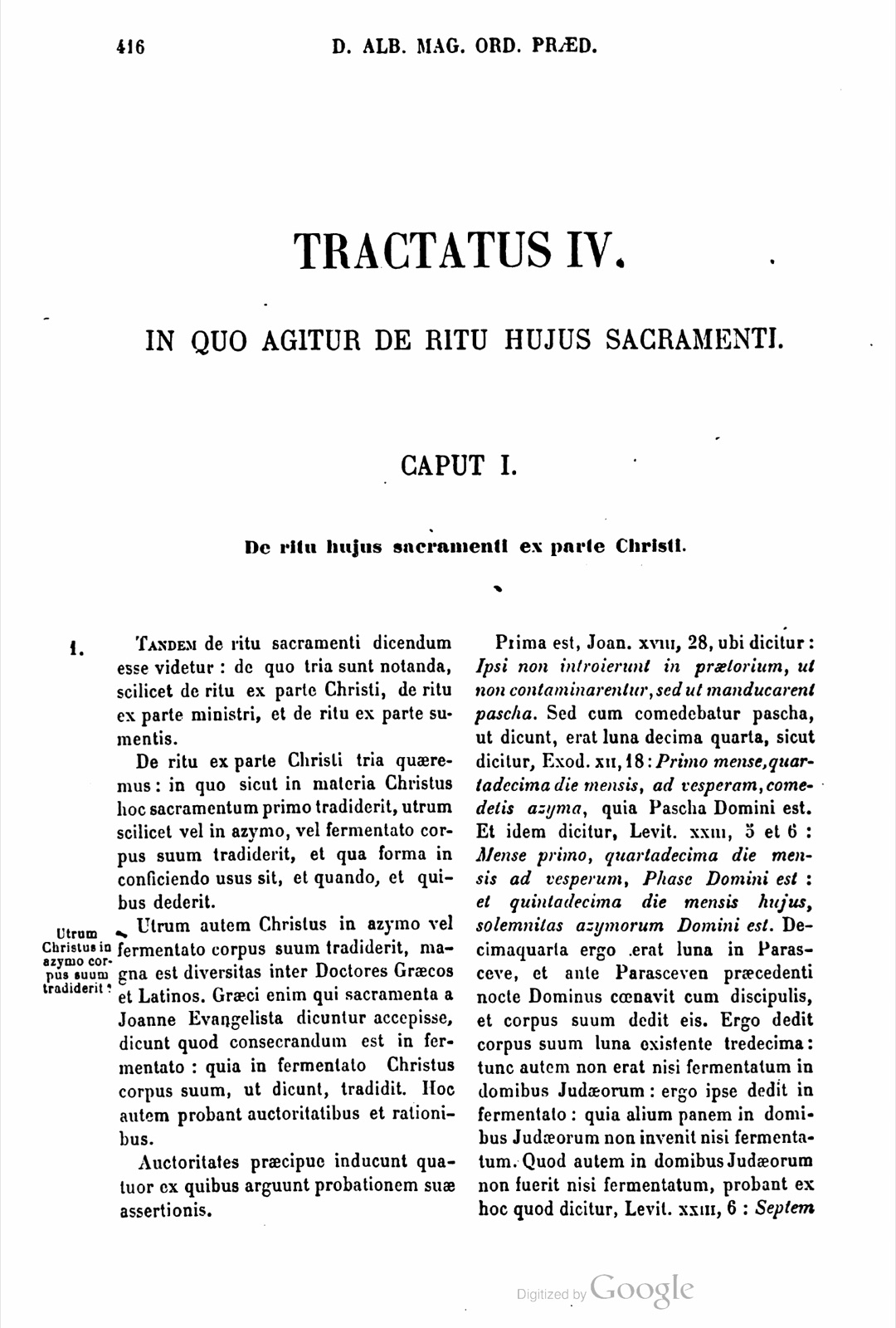
Tertia auctoritas est, Luc. XXIII, 55 et 56, ubi sic dicitur: Subsecutae autem mulieres, quae cum eo venerant de Galilaea, viderunt monumentum, et quemadmodum positum erat corpus ejus. Et revertentes paraverunt aromata et unguenta. Ex quo accipitur, quod in Parasceve paraverunt aromata. Hoc autem non licuisset si in Parasceve luna decima quinta fuisset: quia, Levit. XXIII, 6 et 7, dicitur: Quintadecima die mensis hujus, solemnitas azymorum Domini est: ... omne opus servile non facietis in eo. Et ideo illa die non parassent, si luna quintadecima fuisset.
Et si dicatur, quod mulieres illae non erant sub littera, sed sub spiritu: et ideo legis mandatum non curaverunt, hoc non potest stare: quia etiam illae mulieres si voluissent unguenta praeparare in tanto festo, nemo eis tunc aromata vendidisset, et pro certo a populo lapidatae fuissent. Adhuc autem, quia ritus cucurrit Veteris Testamenti, donec mater synagoga cum honore deferretur ad tumulum.
Patet igitur, quod in Parasceve, ut dicunt, non fuit luna decima quinta: fuit igitur decima quarta: ante autem praecedenti die Christus dedit corpus suum discipulis: ergo dedit quando luna fuit tredecima. Tredecima autem luna non erat azyma in domibus Judaeorum, sed fermentatum tantum: et Christus dedit corpus suum in pane quem in domibus Judaeorum invenit: ergo, ut videtur, dedit in fermentato.
Quarta auctoritas est Joannis, XIX, 31, ubi dicitur: Erat enim magnus dies ille sabbati. Et, ibidem: Judaei ergo, quoniam Parasceve erat, ut non remanerent in cruce corpora sabbato, erat enim magnus dies ille sabbati, rogaverunt Pilatum ut frangerentur eorum crura, et tollerentur. Magnus autem dies sabbati secundum consuetudinem Scripturae non dicitur, nisi cum sabbato concurrat solemnitas alia. Ergo cum sabbato tunc concurrit solemnitas Paschae: solemnitas autem Paschae fuit luna decima quinta: ergo in sabbato praecedenti luna fuit decima quinta: ergo Parasceve fuit luna decima quarta. Et ante Parasceven Christus coenavit cum discipulis, et corpus suum dedit eis: ergo coenavit cum discipulis et corpus suum tradidit illis luna existente tredecima: tunc autem non erat nisi fermentatum in domibus Judaeorum: et non dedit corpus suum nisi in pane quem invenit in domibus Judaeorum: ergo dedit in fermentato.
Haec sunt fortiora quae Graeci pro se possunt inducere.
3. Inducunt etiam rationes quibus persuadere nituntur quia dicunt, et illae sunt quinque, quas potissime inducunt.
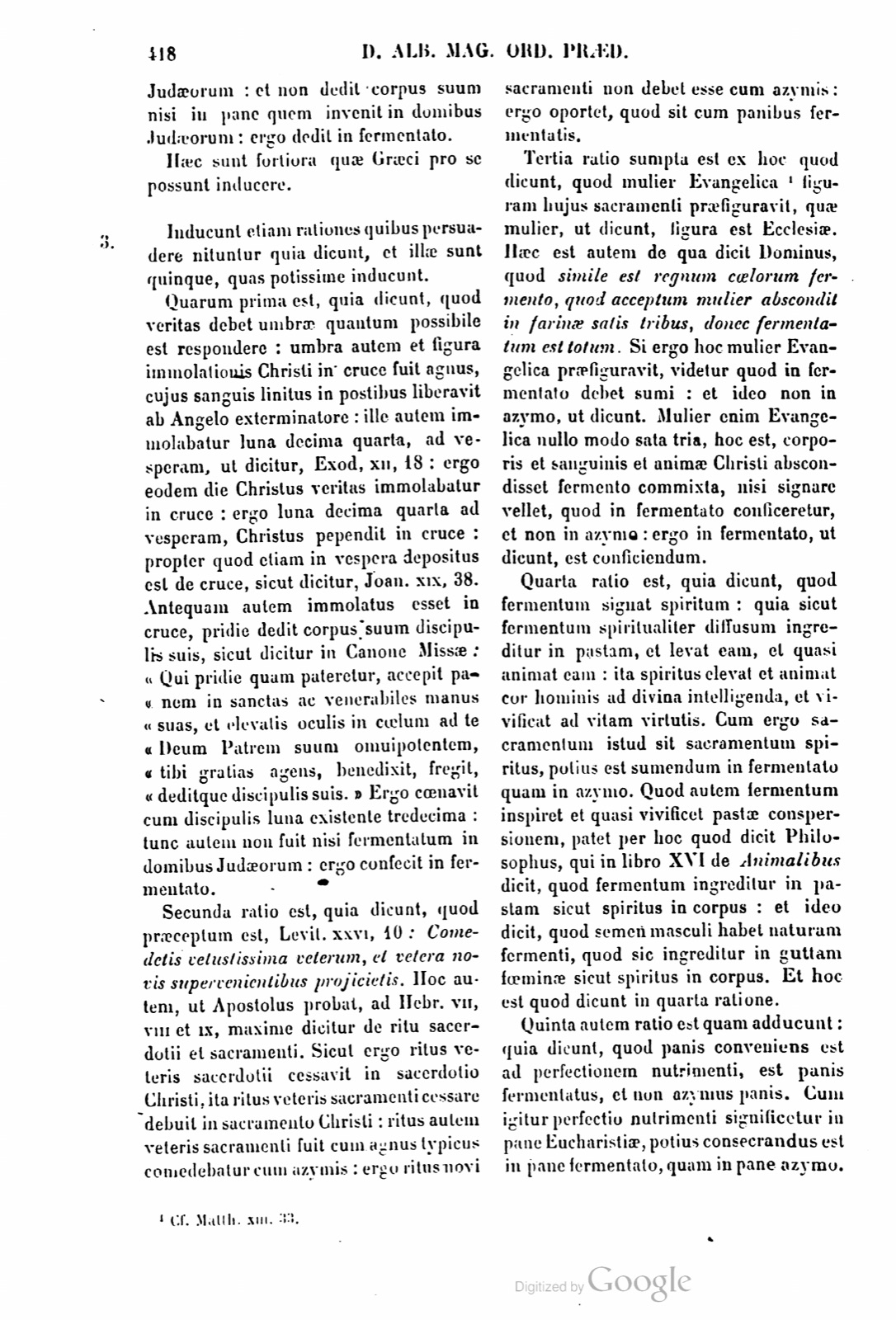
Quarum prima est, quia dicunt, quod veritas debet umbrae quantum possibile est respondere: umbra autem et figura immolationis Christi in cruce fuit agnus, cujus sanguis linitus in postibus liberavit ab Angelo exterminatore: ille autem immolabatur luna decima quarta, ad vesperam, ut dicitur, Exod. XII, 18: ergo eodem die Christus veritas immolabatur in cruce: ergo luna decima quarta ad vesperam, Christus pependit in cruce: et propter quod etiam in vespera depositus est de cruce, sicut dicitur, Joan. XIX, 38. Antequam autem immolatus esset in cruce, pridie dedit corpus suum discipulis suis, sicut dicitur in Canone Missae: « Qui pridie quam pateretur, accepit panem in sanctas ac venerabiles manus suas, et elevatis oculis in caelum ad te Deum Patrem suum omnipotentem, tibi gratias agens, benedixit, fregit, deditque discipulis suis. » Ergo coenavit cum discipulis luna existente tredecima: tunc autem non fuit nisi fermentatum in domibus Judaeorum: ergo confecit in fermentato.
The third authority is Luke 23:55 and 56, where it is said thus: But the women who had come with him from Galilee followed after, saw the tomb, and how his body was placed. And returning they prepared spices and ointments. From this it is taken that on Parasceve they prepared spices. But this would not have been permitted if on Parasceve the moon had been the fifteenth, because in Leviticus 23:6 and 7 it is said: On the fifteenth day of this month is the solemnity of the unleavened breads of the Lord: ... you shall do no servile work on it. And therefore they would not have prepared on that day, if the moon had been the fifteenth.
And if it is said that those women were not under the letter but under the spirit, and therefore they did not care for the command of the law, this cannot stand, because even if those women had wished to prepare ointments on so great a feast, no one would then have sold aromatics to them, and certainly they would have been stoned by the people. Moreover, because the rite of the Old Testament ran on until mother synagogue was borne with honor to the tomb.
Therefore it is clear that on Parasceve, as they say, the moon was not the fifteenth; therefore it was the fourteenth. But on the preceding day before, Christ gave his body to the disciples; therefore he gave it when the moon was the thirteenth. But on the thirteenth moon there were not unleavened breads in the houses of the Jews, but only leavened bread; and Christ gave his body in the bread which he found in the houses of the Jews; therefore, as it seems, he gave it in leavened bread.
The fourth authority is John 19:31, where it is said: For that day of the Sabbath was great. And in the same place: Therefore the Jews, because it was Parasceve, so that the bodies would not remain on the cross on the Sabbath, for that day of the Sabbath was great, asked Pilate that their legs be broken and that they be taken away. But according to the custom of Scripture a day of the Sabbath is not called great except when another solemnity concurs with the Sabbath. Therefore the solemnity of Passover then concurred with the Sabbath; but the solemnity of Passover was the fifteenth moon; therefore on the preceding Sabbath the moon was the fifteenth; therefore Parasceve was the fourteenth moon. And before Parasceve Christ supped with the disciples and gave them his body; therefore he supped with the disciples and handed down his body to them when the moon was the thirteenth; but then there was only leavened bread in the houses of the Jews, and he gave his body only in the bread which he found in the houses of the Jews; therefore he gave it in leavened bread.
These are the stronger things which the Greeks can introduce for themselves.
3. They also introduce reasons by which they strive to persuade, as they say; and there are five which they chiefly introduce.
The first of these is because they say that truth ought to correspond to shadow as much as possible; but the shadow and figure of Christ's immolation on the cross was the lamb, whose blood smeared on the doorposts freed from the destroying Angel; but that lamb was immolated on the fourteenth moon at evening, as is said in Exodus 12:18; therefore on the same day Christ, the truth, was immolated on the cross; therefore on the fourteenth moon at evening Christ hung on the cross; and because of this he was also taken down from the cross in the evening, as is said in John 19:38. But before he was immolated on the cross, on the previous day, he gave his body to his disciples, as is said in the Canon of the Mass: "Who on the day before he suffered, took bread into his holy and venerable hands, and with eyes lifted to heaven to you, God his almighty Father, giving thanks to you, blessed, broke, and gave to his disciples." Therefore he supped with the disciples when the moon was the thirteenth; but then there was only leavened bread in the houses of the Jews; therefore he confected in leavened bread.
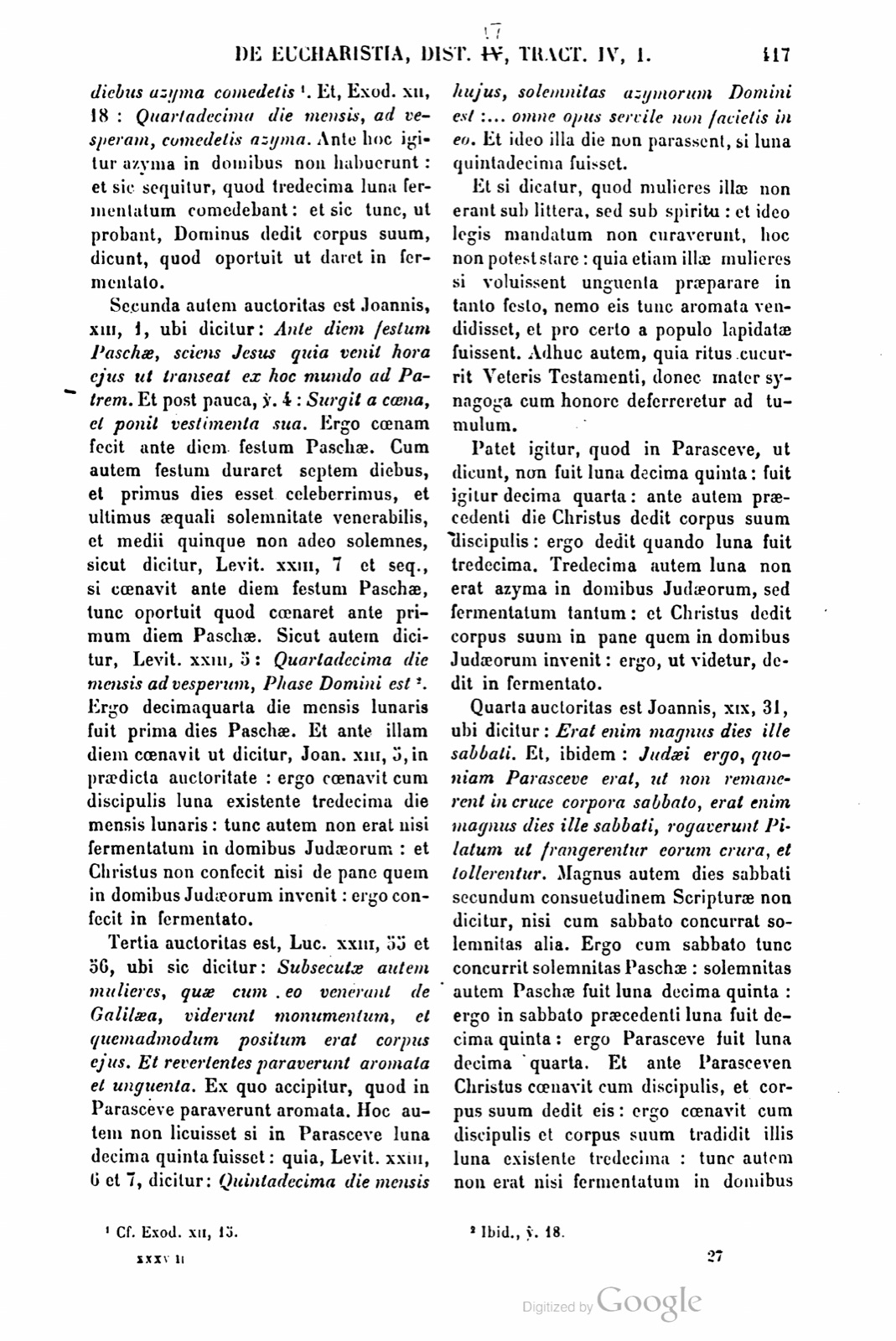
Secunda ratio est, quia dicunt, quod praeceptum est, Levit. XXVI, 10: Comedetis vetustissima veterum, et vetera novis supervenientibus projicietis. Hoc autem, ut Apostolus probat, ad Hebr. VIII, VIII et IX, maxime dicitur de ritu sacerdotii et sacramenti. Sicut ergo ritus veteris sacerdotii cessavit in sacerdotio Christi, ita ritus veteris sacramenti cessare debuit in sacramento Christi: ritus autem veteris sacramenti fuit cum agnus typicus comedebatur cum azymis: ergo ritus novi sacramenti non debet esse cum azymis: ergo oportet, quod sit cum panibus fermentatis.
Tertia ratio sumpta est ex hoc quod dicunt, quod mulier Evangelica 3 figuram hujus sacramenti praefiguravit, quae mulier, ut dicunt, figura est Ecclesiae. Haec est autem de qua dicit Dominus, quod simile est regnum caelorum fermento, quod acceptum mulier abscondit in farinae satis tribus, donec fermentatum est totum. Si ergo hoc mulier Evangelica praefiguravit, videtur quod in fermentato debet sumi: et ideo non in azymo, ut dicunt. Mulier enim Evangelica nullo modo sata tria, hoc est, corporis et sanguinis et animae Christi abscondisset fermento commixta, nisi signare vellet, quod in fermentato conficeretur, et non in azymo: ergo in fermentato, ut dicunt, est conficiendum.
Quarta ratio est, quia dicunt, quod fermentum signat spiritum: quia sicut fermentum spiritualiter diffusum ingreditur in pastam, et levat eam, et quasi animat eam: ita spiritus elevat et animat cor hominis ad divina intelligenda, et vivificat ad vitam virtutis. Cum ergo sacramentum istud sit sacramentum spiritus, potius est sumendum in fermentato quam in azymo. Quod autem fermentum inspiret et quasi vivificet pastae conspersionem, patet per hoc quod dicit Philosophus, qui in libro XVI de Animalibus dicit, quod fermentum ingreditur in pastam sicut spiritus in corpus: et ideo dicit, quod semen masculi habet naturam fermenti, quod sic ingreditur in guttam foeminae sicut spiritus in corpus. Et hoc est quod dicunt in quarta ratione.
Quinta autem ratio est quam adducunt: quia dicunt, quod panis conveniens est ad perfectionem nutrimenti, est panis fermentatus, et non azymus panis. Cum igitur perfectio nutrimenti significetur in pane Eucharistiae, potius consecrandus est in pane fermentato, quam in pane azymo.
The second reason is because they say that it was commanded in Leviticus 26:10: You shall eat the oldest of the old things, and with new things coming on you shall throw away the old. But this, as the Apostle proves in Hebrews 8, 8 and 9, is said especially of the rite of the priesthood and sacrament. Therefore, just as the rite of the old priesthood ceased in the priesthood of Christ, so the rite of the old sacrament ought to have ceased in the sacrament of Christ. But the rite of the old sacrament was with the typical lamb being eaten with unleavened breads; therefore the rite of the new sacrament ought not to be with unleavened breads; therefore it must be with leavened breads.
The third reason is taken from this, that they say the Gospel woman 3 prefigured the figure of this sacrament, which woman, as they say, is the figure of the Church. But this is the one of whom the Lord says that the kingdom of heaven is like leaven which a woman took and hid in three measures of flour until the whole was leavened. Therefore, if this Gospel woman prefigured this, it seems that it ought to be received in leavened bread; and therefore not in unleavened bread, as they say. For the Gospel woman would in no way have hidden the three measures, that is, of Christ's body and blood and soul, mixed with leaven, unless she wished to signify that it would be confected in leavened bread and not in unleavened bread; therefore, as they say, it must be confected in leavened bread.
The fourth reason is because they say that leaven signifies spirit, because just as leaven, spiritually diffused, enters into the dough and lifts it and as it were animates it, so the spirit lifts and animates the heart of man for understanding divine things and vivifies it for the life of virtue. Since therefore this sacrament is a sacrament of spirit, it is rather to be received in leavened bread than in unleavened bread. But that leaven inspires and as it were vivifies the sprinkling of dough is clear through what the Philosopher says, who in book XVI On Animals says that leaven enters into dough as spirit into a body; and therefore he says that the male seed has the nature of leaven, which enters into the female drop as spirit into a body. And this is what they say in the fourth reason.
But the fifth reason which they bring forward is that they say that the bread fitting for the perfection of nourishment is leavened bread and not unleavened bread. Since therefore the perfection of nourishment is signified in the bread of the Eucharist, it ought rather to be consecrated in leavened bread than in unleavened bread.
If a page does not appear, its photograph has not been uploaded yet.