Works › The Book on the Sacrament of the Eucharist
Volume 38 · pp. 280–286
Tractate II. On the quality of the drink. Chapter I, nos. 1-2
A marker with ≈ is an approximate page boundary, placed by measure of the text; the page photographs remain the authority. In the paired views, clicking a page marker brings that page into view.
Tractatus II. De qualitate potus.
His itaque habitis secundum convenientem modum, convenit videre qualis sit potus cum cibo, de quo dictum est, propinatus.
Quinque igitur circa hunc potum sunt consideranda, scilicet qualis debeat esse in genere et specie, et qualis debeat esse in saporis qualitate, qualis in mixtione, et qualis in usu istius gratiae, et qualis in proprii effectus operatione.
Caput I. Qualis debeat esse potus sacramentalis in genere et specie?
1. Sanguis Domini non potest consecrari nisi de vino. Qualis autem sit in genere et specie, sic determinamus:
Sicut enim confici non potest nisi de pane de frumento corpus Domini: eo quod se Christus grano frumenti comparavit, et quod panis frumentinus solus conveniens est cibus hominis inter panes qui fiunt de grano, ita dicimus, quod sanguis Domini non potest consecrari nisi de vino: quia se Christus vino comparari fecit, et vino seipsum comparavit, et quia vinum solum naturalis et conveniens est potus hominis.
Quod vino se comparari fecit, patet in Prophetis. Osee, XIV, 8, ubi dicitur: Memoriale ejus sicut vinum Libani. Cum autem istud convivium sit, quod Christus toti Ecclesiae reliquit pro suo memoriali, patet quod in hoc cibo non debet nisi vinum propinari. Hoc etiam modo non praefertur sacramento novo sacramentum vetus: quia coena agni typici cum vino sumebatur: et ut respondeat veritas figurae, oportet quod et caro agni immaculati Christi cum vino sumatur. Matth. XXVI, 29: Dico vobis, non bibam amodo de hoc genimine vitis, usque in diem illum cum bibam illud vobiscum novum in regno Patris mei. Novum enim in sacramento novae gratiae bibitur, et vetus abjicitur in usu, quamvis Scriptura ejus servetur in testimonium. Hoc est quod dicitur, Cantic. VII, 9: Guttur tuum sicut vinum optimum, dignum dilecto meo ad potandum, labiisque et dentibus illius ad ruminandum. Quia diu per cordis mentis iterationem debet ruminari sacramentum saepe ad mentem revocando et considerando et degustando infinitas dulcedines et bonitates ipsius. Unde, Levit. XI, 7, dicitur, quod animal quod non ruminat, immundum erit. Hinc est, quod de duobus quae sunt in hoc sacramento, materia cibi, et potus, dicitur, Osee, VII, 14: Super vinum et triticum ruminabant. Haec enim duo ab omnium fidelium ore ruminanda frequentata memoria sunt in sacramento: quia hoc est maximum fidelium bonum. Zachar. IX, 17: Quid bonum ejus est, et quid pulchrum ejus, nisi frumentum electorum, et vinum germinans virgines? hoc est, virgineas mentes.
Tractate II. On the quality of the drink.
With these things therefore held according to the fitting mode, it is suitable to see what sort the drink is which is offered with the food of which we have spoken.
Therefore five things concerning this drink must be considered, namely what it ought to be in genus and species, and what it ought to be in quality of taste, what it ought to be in mixing, and what it ought to be in the use of this grace, and what it ought to be in the operation of its proper effect.
Chapter I. What sort the sacramental drink ought to be in genus and species.
1. The Lord's blood cannot be consecrated except from wine. But what sort it is in genus and species, we determine thus:
For just as the Lord's body cannot be consecrated except from bread made of wheat, because Christ compared himself to a grain of wheat, and because wheaten bread alone is the fitting food of man among breads which are made from grain, so we say that the Lord's blood cannot be consecrated except from wine, because Christ made himself be compared to wine, and compared himself to wine, and because wine alone is the natural and fitting drink of man.
That he made himself be compared to wine is clear in the Prophets. Hosea 14:8, where it is said: "His memorial is like the wine of Lebanon." But since this banquet is what Christ left to the whole Church for his memorial, it is clear that in this food nothing ought to be offered except wine. In this way also the old sacrament is not preferred to the new sacrament, because the supper of the typical lamb was taken with wine; and so that truth may correspond to figure, it is necessary that the flesh of Christ the immaculate lamb also be taken with wine. Matthew 26:29: "I say to you, I will not drink henceforth of this fruit of the vine until that day when I drink it new with you in the kingdom of my Father." For the new is drunk in the sacrament of new grace, and the old is cast aside in use, although its Scripture is preserved for testimony. This is what is said, Canticles 7:9: "Your throat is like the best wine, worthy for my beloved to drink, and for his lips and teeth to ruminate." For the sacrament ought to be ruminated for a long time through repetition of the heart and mind, by often calling it back to mind and considering and tasting its infinite sweetnesses and goodnesses. Hence, Leviticus 11:7, it is said that the animal which does not ruminate will be unclean. Hence it is that of the two things which are in this sacrament, the matter of food and of drink, it is said, Hosea 7:14: "They ruminated over wine and wheat." For these two things, to be ruminated by the mouth of all the faithful with frequent memory, are in the sacrament, because this is the greatest good of the faithful. Zechariah 9:17: "What is his good, and what is his beautiful thing, except the wheat of the elect, and wine germinating virgins?" that is, virginal minds.
Sic igitur patet, quod ex comparatione nectareae dulcedinis Christi sanguinis ad vinum, non debet in sacramenti cibo nisi vinum esse.
Quare Christus se comparat viti, et corpus suum mysticum vineae? Comparat se etiam Christus viti, et corpus suum mysticum totum vineae comparat. Et de sui quidem ad vitem comparatione dicitur, Joan. XV, 5: Ego sum vitis, vos palmites. Quia sicut fructus in quo tota natura gaudet, crescit in vite, ita omnis gaudii gustus crevit in Christo et in liquore sanguinis ejus. Unde in hac parabola dicit de se vitis, Judicum, IX, 13: Numquid possum deserere vinum meum, quod laetificat Deum et homines, et inter ligna caetera promoveri? Ecclesia autem cui in communione datur sanguis Christi, vocatur vinea. Jerem. II, 21: Ego plantavi te vineam electam, omne semen verum. Isa. V, 7: Vinea Domini exercituum domus Israel est: et vir Juda germen ejus delectabile. Vitis enim Christus succum suum diffundit in totam Ecclesiam, ut sanguine suo plantetur et faciat fructum aeternorum gaudiorum. Marc. XII, 1: Vineam pastinavit homo, et locavit eam agricolis. Matth. XX, 1: Simile est regnum caelorum homini patrifamilias, qui exiit primo mane conducere operarios in vineam suam.
Propter has igitur operationes non potest confici sanguis Christi, nisi de vino vitis.
2. Vinum solum est conveniens potus hominis. Est autem vinum solum conveniens potus hominis secundum naturam generaliter loquendo. Hoc autem in sex consideratur. Potus enim hominis est, qui est a natura desideratus, qui naturae est juvativus, qui naturae est influxivus, qui cibi est lativus, qui cibi est subtiliativus, et tandem qui cibi est cum membris unitivus et tentivus. Et hoc habet vinum et non alius potus.
Cujus probatio est: quia aqua quae a quibusdam sumitur in potum, sicut dicit Isaac in Dietis, est insipida. Insipidum autem a natura non desideratur: quia omne quod desideratur a natura, sub sapore convenienti desideratur: quia sapor est sequela complexionis, et conveniens sapor indicat complexionem convenientem ad naturae et desiderii naturalis satisfactionem. Ideo, Joan. II, 8, in nuptiis quibus significatur conjunctio Christi et Ecclesiae, Christus mutavit aquam in vinum, ne propter insipiditatem esset abjicienda. Sic dicitur, Proverb. XXXI, 16, de Ecclesia, quae de fructu manuum suarum plantavit vineam. Et infra, v. 18, quia gustavit, et vidit quia bona est negotiatio ejus, quia potus desideratus est a natura.
Thus therefore it is clear that, from the comparison of the nectareous sweetness of Christ's blood to wine, there ought to be nothing in the food of the sacrament except wine.
Why Christ compares himself to the vine, and his mystical body to a vineyard. Christ also compares himself to the vine, and he compares his whole mystical body to a vineyard. And concerning his comparison to the vine it is said, John 15:5: "I am the vine, you the branches." For just as the fruit in which the whole nature rejoices grows on the vine, so every taste of joy grew in Christ and in the liquor of his blood. Hence in this parable the vine says of itself, Judges 9:13: "Can I leave my wine, which gladdens God and men, and be promoted among the other trees?" But the Church to whom the blood of Christ is given in communion is called a vineyard. Jeremiah 2:21: "I planted you an elect vineyard, every true seed." Isaiah 5:7: "The vineyard of the Lord of hosts is the house of Israel, and the man of Judah is his delightful shoot." For Christ the vine diffuses his juice into the whole Church, so that by his blood it may be planted and may bear the fruit of eternal joys. Mark 12:1: "A man planted a vineyard, and leased it to husbandmen." Matthew 20:1: "The kingdom of heaven is like a householder who went out early in the morning to hire workers into his vineyard."
Therefore, on account of these operations, the blood of Christ cannot be consecrated except from wine of the vine.
2. Wine alone is the fitting drink of man. Now wine alone is the fitting drink of man according to nature, speaking generally. This is considered in six things. For the drink of man is that which is desired by nature, which is helpful to nature, which flows into nature, which carries food, which subtilizes food, and finally which unites and holds food with the members. And wine has this, and no other drink.
The proof of this is that water, which is taken as drink by some, as Isaac says in the Diets, is tasteless. But the tasteless is not desired by nature, because everything that is desired by nature is desired under a fitting taste, because taste is a consequence of complexion, and a fitting taste indicates a complexion fitting for the satisfaction of nature and natural desire. Therefore, John 2:8, at the wedding by which the conjunction of Christ and the Church is signified, Christ changed water into wine, lest because of tastelessness it should be rejected. Thus it is said, Proverbs 31:16, concerning the Church, that from the fruit of her hands she planted a vineyard. And below, v. 18, because she tasted and saw that her trading was good, because drink is desired by nature.
Si autem quis objiciat, quod ut dicit Aristoteles in libro de Anima, duo sunt naturalia desideria, fames scilicet, et sitis: et dicit, quod sitis est appetitus frigidi et humidi, fames autem est appetitus calidi et sicci. Ille nescit quid dicit, et verba Philosophi non intelligit: quia cum dicit, quod sitis est appetitus frigidi et humidi, non intelligit de frigido et humido in potentia, sed secundum actum: frigidum enim et humidum in potentia naturali non desideratur: quia frigidum in potentia naturali impeditivum et mortificativum est naturae hominis in omnibus operibus suis. Et ideo aqua nullo modo desideratur in potu, nisi a natura corrupta et nimis incensa, sicut desideratur a febricitante. Et ideo dictum Philosophi intelligitur de frigido et humido in actu, quod valet ad calidorum refrigerationem, et tamen incorporatum reficit naturale desiderium. Adhuc autem quomodo posset esse secundum naturam, quod id quod mixtum est et compositum ex valde diversis, simplicem et elementalem potum desideraret secundum naturam? Unde etiam opera rusticorum probant quod dicitur: quia cum plantas potant et rigant, hoc faciunt de aquis paludalibus mixtis, et pluviis quas Deus pluit super eas, et calore solis de terris et aquis commixtis elevat, et virtutem caeli immiscet, et ex multis virtutibus mixtis guttis pluviae et roris convenienter pascit eas, quae commixtae sunt plantae. Quod et Dominus ostendit, Isa. LV, 10, dicens: Quomodo descendit imber et nix de caelo, et illuc ultra non revertitur, sed inebriat terram, et infundit eam, et germinare eam facit, et dat semen serenti, et panem comedenti vel manducanti. Sic ergo commixtus per naturam potus vini a natura desideratur. Unde, I ad Timoth. V, 23, Timotheo dixit Apostolus: Noli adhuc aquam bibere: sed modico vino utere, propter stomachum tuum et frequentes tuas infirmitates. Quia stomachus continuo potu aquae destruitur propter aquae mortificativam frigiditatem.
Patet igitur cum Christi sanguis refectivus sit per gratiam quam confert, quod aqua nullam ad Christi sanguinem potatum habet similitudinem, et ideo de aqua confici non potest.
But if someone should object that, as Aristotle says in the book On the Soul, there are two natural desires, namely hunger and thirst, and he says that thirst is an appetite for the cold and moist, but hunger is an appetite for the hot and dry, that person does not know what he says, and does not understand the words of the Philosopher; because when he says that thirst is an appetite for the cold and moist, he does not understand it of the cold and moist in potency, but according to act. For the cold and moist in natural potency is not desired, because the cold in natural potency is hindering and mortifying to man's nature in all its works. And therefore water is in no way desired as drink except by a corrupted and too inflamed nature, as it is desired by one feverish. And therefore the saying of the Philosopher is understood of the cold and moist in act, which avails for the cooling of hot things, and yet, once incorporated, refreshes natural desire. Moreover, how could it be according to nature that that which is mixed and composed from very diverse things would desire a simple and elemental drink according to nature? Hence even the works of countrymen prove what is said; because when they water and irrigate plants, they do this with mixed marsh waters and rains which God rains over them, and with the heat of the sun he raises them from earths and waters mixed together, and mixes in the power of heaven, and from many powers mixed into drops of rain and dew he fittingly feeds those things which are mixed plants. And the Lord shows this, Isaiah 55:10, saying: "As rain and snow descend from heaven, and do not return there any more, but make the earth drunk and pour into it and make it sprout, and give seed to the sower and bread to the one eating or consuming." Thus therefore the drink of wine, mixed by nature, is desired by nature. Hence, 1 Timothy 5:23, the Apostle said to Timothy: "Do not still drink water, but use a little wine, because of your stomach and your frequent infirmities." For the stomach is destroyed by continuous drinking of water because of the mortifying coldness of water.
Therefore, since Christ's blood is refreshing through the grace which it confers, it is clear that water has no likeness to Christ's blood as drunk, and therefore it cannot be consecrated from water.
3. Quare ex aliis liquoribus a vino non potest confici sanguis Christi? Sunt autem alii liquores tam naturales et artificiales, ex quibus per eamdem rationem sanguis Christi confici non potest, sicut est palus, lixivia, claretum, cervisia, medo, moretum, etiam liquor pomorum diversis generibus expressus, quem quidam vocant pomatium, et sicut sunt ea quae subtiliatione florum vel foliorum diversorum exprimuntur, sicut est aqua rosacea, aqua violacea, et aqua genestae, et hujusmodi, quae omnia habent unam determinationem. Quia palus quamquam sufficiat potationi plantarum, tamen nec munda est, nec a natura desiderata ad refectionem hominum. Lixivia autem in quam egit calor cineris, exsiccativa est et corrosiva viscerum hominis, et ideo non desideratur a natura hominum ad bibendum. Cervisia autem et medo sunt valde inflativa et oppilativa, et ideo appetitui naturali non concordant. Claretum autem et moretum extra modum sunt calida, et potius libidinem provocantia, quam satisfacientia appetitui naturali. Pomatia autem et ipsa poma cruda et inflativa sunt et magis putrefacientia complexionem, quam satisfacientia naturae. Aqua autem rosacea et caeterae aquae omnes quae arte alchimistarum fiunt, omnes secundum diversas complexiones quas habent, possunt aliquando juvare infirmos, sed communi naturali appetitui naturae hominum non conveniunt: ideo de illis sanguis Christi confici non potest. Et una ratio communis ad omnes hujusmodi liquores est: quia in sacramento hoc solum est materia quod ex significatione naturali ponit similitudinem ad effectum sacramenti. Et ideo cum naturalis similitudo ad satisfaciendum siti naturali, non sit in aliquo liquore simpliciter nisi in vino, ideo non potest confici potus spiritualis sanguinis Jesu Christi nisi de vino. Ipse enim dicit, Joan. VI, 56: Caro mea vere est cibus, et sanguis meus vere est potus. Et ideo quod vere et secundum naturam propriam potus non est, materia sanguinis Christi esse non potest.
Idem autem sentiendum est et de lacte, quod quidem infantulis est potus naturam reficiens, sed tamen carnem laxam et mollem generans, et ideo communem et perfectam naturam hominum non reficit, sed potius perfectam hominum naturam inficit et corrumpit: et ideo verus et communis hominum potus esse non potest. Et hoc est quod dicitur, Eccli. XXXI, 33: Vinum in jucunditatem creatum est, et non in ebrietatem, ab initio: quia tota natura hominis perfecta et sana jucundatur in ipso. Unde ibidem dicitur, v. 37: Sanitas est animae et corpori sobrius potus. Et supra, v. 36: Exsultatio animae et cordis vinum moderate potatum.
Sic ergo patet, quod alius liquor similitudinem non ponit ad refectionem sitis communem et naturalem, et ideo alius potus non congruit.
4. Objectio. Objiciet autem adhuc fortassis aliquis de ptisana, de qua dicit Constantinus in Pantechne, quod nullus est inventus similis illi potus, propter quatuor quas ibidem inducit rationes, scilicet quia exstinguit incensa, et humefacit arefacta, et lavat sordida, et reficit defecta, et ideo videtur magis ponere similitudinem ad satisfactionem sitis naturalis quam vinum. Hoc enim, quia calidum est naturaliter, non exstinguit incensa: et quia siccum est secundum naturam, non humefacit arida.
3. Why the blood of Christ cannot be consecrated from other liquids apart from wine. But there are other liquids, both natural and artificial, from which by the same reasoning the blood of Christ cannot be consecrated, such as marsh-water, lye, claret, beer, mead, mulberry wine, also the liquid expressed from diverse kinds of apples, which some call apple-drink, and such things as are expressed by subtilization of diverse flowers or leaves, such as rose-water, violet-water, and broom-water, and things of this sort, all of which have one determination. For marsh-water, although it suffices for the watering of plants, nevertheless is neither clean nor desired by nature for the refreshment of men. But lye, into which the heat of ash has acted, is drying and corrosive of the entrails of man, and therefore it is not desired by the nature of men for drinking. But beer and mead are very inflating and obstructing, and therefore they do not agree with the natural appetite. But claret and mulberry wine are hot beyond measure, and rather provoke lust than satisfy the natural appetite. But apple-drinks, and apples themselves, are raw and inflating and more putrefying of the complexion than satisfying to nature. But rose-water and all the other waters which are made by the art of alchemists, according to the diverse complexions which they have, can sometimes help the sick, but they do not fit the common natural appetite of the nature of men; therefore the blood of Christ cannot be consecrated from them. And one reason common to all liquids of this sort is that in this sacrament only that is matter which, from natural signification, sets down a likeness to the effect of the sacrament. And therefore, since the natural likeness for satisfying natural thirst is not in any liquid simply except in wine, therefore the spiritual drink of the blood of Jesus Christ cannot be consecrated except from wine. For he himself says, John 6:56: "My flesh truly is food, and my blood truly is drink." And therefore what truly and according to its proper nature is not drink cannot be the matter of the blood of Christ.
The same must be thought also of milk, which indeed is a drink refreshing nature for little infants, but nevertheless generates loose and soft flesh, and therefore does not refresh the common and perfect nature of men, but rather infects and corrupts the perfect nature of men; and therefore it cannot be the true and common drink of men. And this is what is said, Ecclesiasticus 31:33: "Wine was created for gladness, and not for drunkenness, from the beginning," because the whole perfect and healthy nature of man is gladdened in it. Hence it is said in the same place, v. 37: "Sober drink is health to soul and body." And above, v. 36: "Wine drunk moderately is exultation of soul and heart."
Thus therefore it is clear that another liquid does not set down a likeness to the refreshment of common and natural thirst, and therefore another drink is not fitting.
4. Objection. But perhaps someone will still object concerning ptisan, about which Constantine says in the Pantechne that no drink has been found similar to it, on account of the four reasons which he introduces there, namely because it extinguishes inflamed things, moistens dried things, washes dirty things, and refreshes deficient things; and therefore it seems more to set down a likeness to the satisfaction of natural thirst than wine. For wine, because it is naturally hot, does not extinguish inflamed things; and because it is dry according to nature, it does not moisten dry things.
Solutio. Sed ad hoc dicendum est, quod ptisana potus est infirmorum incensorum ex febre: et verum est, quod febricitantibus non est inventus potus similis ptisanae, sed sanis non competit, quia nimis est frigidus, et ideo appetitui naturali non satisfacit, sed potius corruptae complexioni. Unde, Esther, I, 7, dicitur, quod in convivio Assueri vinum abundans et electum dabatur, et non fit mentio de alio potu. Dicitur etiam, Isa. XXV, 6, quod Dominus fecit convivium pinguium, convivium vindemiae, et non alterius potus: quia pro certo alius potus simplici et puro et perfecto naturae humanae desiderio non satisfacit. Et ideo etiam de tali potu sanguis Christi confici non potest: et ideo nec Deus nec ars hominum alium potum de terra cui Deus dat benedictionem, alium, inquam, potum excolere docuit, nisi vinum. Sed nec cibum colit, nec frumentum: quia in istis duobus humano et naturali et perfecto satisfacit appetitui: et ideo ex his duobus similitudo sumitur ad refectionem corporis et sanguinis Jesu Christi, nec ex aliis materia sumi potest hujus sacramenti.
5. Objectio. Sed tamen adhuc objiciunt de hoc quod dicitur, Eccli. XXIX, 28: Initium vitae hominis aqua, et panis. Et si initium vitae hominis est aqua et panis, videtur eis, quod sicut panis sine aliis cibis est satisfaciens naturali appetitui qui est fames, ita aqua sit satisfaciens naturali appetitui qui est sitis. Et sic si Dominus ordinavit spiritualem cibum secundum ea quae satisfaciunt naturalibus appetitibus duobus, videtur quod potus aquae debet esse in sacramento convivii spiritualis materia sui sanguinis, quod omnino falsum est et nulli Ecclesiae consonum.
Solutio. Sed ad hoc dicendum est, quod ibidem loquitur Ecclesiasticus de initio vitae hominis in statu damnati hominis et expulsi extra paradisum, et aliud adhuc adminiculum vitae non habentis, et in hanc miseriam homo detrusus est ad agendam poenitentiam. Si enim loqueretur de natura instituta in paradiso, tunc non loqueretur pane: quia homo in paradiso de pane non sustentabatur. Homo autem qui detruditur ad labores poenitentiae, suspenditur ad his quae sunt secundum desiderium naturae ut magis affligatur. Unde, III Regum, XXII, 27: Mittite virum istum in carcerem, et sustentate eum pane tribulationis et aqua angustiae. Isa. XXX, 20: Dabit vobis Dominus panem arctum, et aquam brevem. Haec enim omnia praeparantur his qui sunt in laboribus poenitentiae: quia justum est ut qui concupiscentiae nimis indulserunt, laxae libidini consentiendo, etiam a delectabilibus secundum naturae desiderium ad tempus suspendantur, poenas pro peccatis luendo: et ideo nihil nisi vix praeter delectationem hominem sustentans, ibi homini concedit auctoritas dicens: Initium vitae hominis aqua, et panis, et vestimentum, et domus protegens turpitudinem.1 Ac si dicat: Victum parcissimum accepit, et vestimentum pauperrimum, et domum non sufficientem naturae, sed in qua turpitudinem protegeret in quam incideret. Psal. LXXIX, 6: Cibabis nos pane lacrymarum, et potum dabis nobis in lacrymis in mensura. Postea autem quando homo justificatione adjutus est, et paenitentiam peregit ad misericordiam Domini, tunc accepit aliud initium nativitatis secundum naturalem appetitum, de quo dicitur, Eccli. XXXIX, 31: Initium necessariae rei vitae hominum, aqua, ignis, et ferrum, sal, lac, et panis similagineus, et mel, et botrus uvae, et oleum, et vestimentum. Quando autem accepit botrum uvae, tunc expressione botri accepit poculum vini. Hic enim omnia tanguntur quibus homo juvatur ad vitae necessaria secundum naturalem appetitum: sic enim aquam accepit in ablutionem et alios aquae usus, ignem in crudorum quae homini non conveniunt decoctionem, ferrum in instrumenta fabricationis diversorum sibi utilium, sal in condimentum, lac in infantium alimentum, panem in cibum confortatorum, qui similagineus esse dicitur propter conveniens et adhaerens membris nutrimentum, mel autem in dulcoramentum, botrum in naturale poculum, oleum in unctionem et cibi condimentum, et vestimentum molle decens et calidum in corporis fomentum.
Solution. But to this it must be said that ptisan is the drink of the sick inflamed by fever; and it is true that for the feverish no drink has been found similar to ptisan, but it does not suit the healthy, because it is too cold, and therefore it does not satisfy the natural appetite, but rather a corrupted complexion. Hence, Esther 1:7, it is said that in the banquet of Ahasuerus abundant and choice wine was given, and no mention is made of another drink. It is also said, Isaiah 25:6, that the Lord made a banquet of fat things, a banquet of vintage, and not of another drink, because certainly another drink does not satisfy the simple and pure and perfect desire of human nature. And therefore also from such a drink the blood of Christ cannot be consecrated; and therefore neither God nor the art of men has taught men to cultivate from the earth to which God gives blessing another drink, another drink, I say, except wine. But neither does it cultivate food, nor wheat, because in these two it satisfies the human, natural, and perfect appetite; and therefore from these two the likeness is taken for the refreshment of the body and blood of Jesus Christ, nor can matter of this sacrament be taken from others.
5. Objection. But nevertheless they still object from what is said, Ecclesiasticus 29:28: "The beginning of man's life is water and bread." And if the beginning of man's life is water and bread, it seems to them that just as bread without other foods satisfies the natural appetite which is hunger, so water satisfies the natural appetite which is thirst. And thus, if the Lord ordained spiritual food according to those things which satisfy the two natural appetites, it seems that a drink of water ought to be the matter of his blood in the sacrament of the spiritual banquet, which is wholly false and in harmony with no Church.
Solution. But to this it must be said that in that place Ecclesiasticus speaks of the beginning of man's life in the state of condemned man and of one expelled outside paradise, and not yet having another support of life; and man was thrust down into this misery for doing penance. For if he were speaking of nature established in paradise, then he would not speak of bread, because man in paradise was not sustained by bread. But the man who is thrust down to the labors of penance is suspended from those things which are according to the desire of nature, so that he may be afflicted more. Hence, 3 Kings 22:27: "Send that man into prison, and sustain him with the bread of tribulation and water of distress." Isaiah 30:20: "The Lord will give you narrow bread and short water." For all these things are prepared for those who are in the labors of penance, because it is just that those who indulged concupiscence too much, by consenting to loose lust, should also be suspended for a time from things delightful according to the desire of nature, while paying punishments for sins; and therefore the authority there grants to man nothing except what barely sustains man apart from delight, saying: "The beginning of man's life is water and bread, and clothing, and a house protecting shame."1 As if he were saying: He received the most sparing food, and the poorest clothing, and a house not sufficient for nature, but one in which he would protect the shame into which he had fallen. Psalm 79:6: "You will feed us with the bread of tears, and you will give us drink in tears by measure." But afterward, when man has been aided by justification and has carried out penance unto the mercy of the Lord, then he received another beginning of birth according to natural appetite, concerning which it is said, Ecclesiasticus 39:31: "The beginning of a necessary thing for the life of men is water, fire, and iron, salt, milk, and fine wheaten bread, and honey, and a cluster of grapes, and oil, and clothing." But when he received the cluster of grapes, then by the pressing of the cluster he received the cup of wine. For here all things are touched by which man is helped toward the necessities of life according to natural appetite: for thus he received water for washing and other uses of water, fire for cooking raw things which are not suited to man, iron for tools for the fashioning of diverse things useful to him, salt for seasoning, milk for the nourishment of infants, bread for the food of the strengthened, which is said to be of fine wheat because of fitting nourishment that clings to the members, honey for sweetening, the cluster for natural drink, oil for anointing and seasoning of food, and soft, decent, and warm clothing for the comfort of the body.
Patet igitur ex omnibus praeinductis, quod solum vinum est potus communis et naturalis homini secundum naturale desiderium quod est in ipso quod vocatur sitis.
6. Quadruplex causa sitis. Hoc autem adhuc aliter accipitur, si ipsum naturale desiderium quod est sitis, secundum proprietatem naturalem subtilius attendatur. Tradunt enim naturales qui naturalia subtiliter sunt indagati, quod sitis est ex tribus causis, et quidam satis convenienter adjungunt quartam.
Una quidem causa est membrorum exinanitio, sicut videmus multam sitim patientes eos qui calidam et consumptivam passi sunt infirmitatem, quibus sitis non sedatur per potum, sed potius per cibum bene membra reficientem.
Alia causa est indigestio cibi vel potus multum accepti, qui grosso fumo exhalante a se percutit partes pectoris et gutturis, et incendit et exsiccat. Et haec sitis est quam patiuntur ingluviem et ebrietatem passi, et non sedatur potu, sed augetur: somno autem profundo et longo in quo ingluvies et ebrietas digeritur vel expellitur, sedatur etiam sitis, quia tunc illud quod indigestum fumabat de stomacho, removetur, vel indigestum descendens a stomacho, vel expulsum omnino, sicut aliquando glutones solutionem patiuntur ex indigestione.
Tertia sitis est naturalis appetitus ejus quod vehere et fluere facit cibum per membra ut nutriantur: et hoc non est nisi vehiculum cibi secundum naturam, quod et cibum movet et vias aperit et cibum subtiliat et membris influit et unit. Et sicut patebit in sequentibus, hoc inter naturales et communes potus non habet facere nisi vinum. Et ideo haec sitis per vinum convenienter mixtum, et sobrie bibitum sedatur secundum naturam.
Quartam causam quam non inconvenienter addunt quidam, sicut Avicenna et Serapion et Almansor, quae est, quod sitis aliquando provenit ex inconvenienti et modo excedenti complexionis vel cibi excessu ad siccitatem, cujus contrarium petit natura ad refrigerium: et in hoc casu aliquando magis petit aquam quam vinum, sicut aestuans calida febre appetit et sitit aquam, et sicut superimpletus multo sale, potum aquae petit, ut sal lavetur a membris interioribus, quae inter omnes sapores plus abominantur salis saporem quando excedit.
Therefore from all the things introduced beforehand it is clear that wine alone is the common and natural drink for man according to the natural desire which is in him and is called thirst.
6. The fourfold cause of thirst. But this is taken in yet another way, if the natural desire itself which is thirst is considered more subtly according to its natural property. For natural philosophers who have investigated natural things subtly hand down that thirst comes from three causes, and some quite fittingly add a fourth.
One cause is the emptying of the members, as we see that those suffer much thirst who have suffered a hot and consumptive illness; in them thirst is not calmed by drink, but rather by food that refreshes the members well.
Another cause is indigestion of much food or drink taken, which, by a thick smoke exhaling from itself, strikes the parts of the breast and throat, and inflames and dries them. And this is the thirst which those who have suffered gluttony and drunkenness suffer; and it is not calmed by drink, but increased. But by deep and long sleep, in which gluttony and drunkenness are digested or expelled, thirst also is calmed, because then that which smoked indigested from the stomach is removed, either descending indigested from the stomach or wholly expelled, as sometimes gluttons suffer a loosening from indigestion.
The third thirst is the natural appetite for that which makes food be carried and flow through the members so that they may be nourished; and this is nothing except the vehicle of food according to nature, which both moves food and opens the ways and subtilizes food and flows it into the members and unites it. And, as will be clear in what follows, among natural and common drinks only wine has the ability to do this. And therefore this thirst is calmed according to nature by wine suitably mixed and soberly drunk.
The fourth cause, which some add not unfittingly, such as Avicenna and Serapion and Almansor, is that thirst sometimes arises from an unsuitable and excessive mode of complexion, or from an excess of food toward dryness, whose contrary nature seeks for cooling; and in this case nature sometimes seeks water more than wine, as one burning with hot fever desires and thirsts for water, and as one overfilled with much salt seeks a drink of water so that the salt may be washed from the interior members, which among all tastes most abominate the taste of salt when it exceeds.
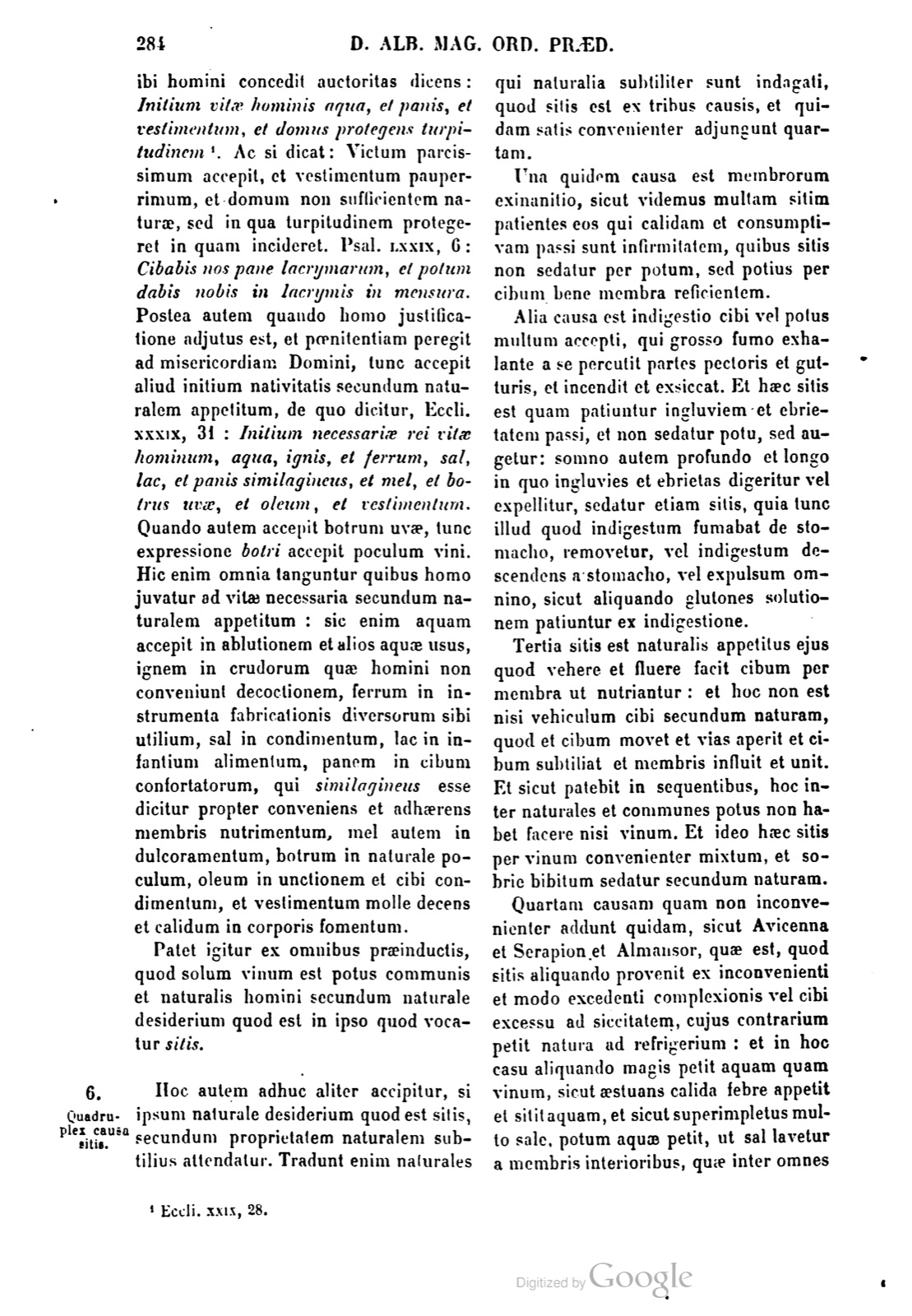
De prima siti dicitur litteraliter, Thren. IV, 4: Adhaesit lingua lactentis ad palatum ejus in siti: parvuli petierunt panem, et non erat qui frangeret eis. In tali desiderio petitur quidquid reficere potest. Job, VI, 7: Quae prius nolebat tangere anima mea, nunc prae angustia cibi mei sunt. In hoc etiam desiderio dictum est, Thren. II, 11 et 12: Effusum est in terra jecur meum super contritione filiae populi mei, cum deficeret parvulus et lactens in plateis oppidi. Matribus suis dixerunt: Ubi est triticum et vinum? cum deficerent quasi vulnerati in plateis civitatis, cum exhalarent animas suas in sinu matrum suarum.
De secundo appetitu sitis dicitur, Proverb. XXIII, 31 et 32: Ne intuearis vinum quando flavescit, cum splenduerit in vitro color ejus. Ingreditur blande: sed in novissimo mordebit ut coluber, et sicut regulus venena diffundet. Et post pauca, vv. 34 et 35: Et eris sicut dormiens in medio mari, et quasi sopitus gubernator, amisso clavo. Et dices: Verberaverunt me, sed non dolui: traxerunt me, et ego non sensi. Quando evigilabo, et rursus vina reperiam? Quia in glutionibus et ebriis abyssus abyssum invocat in voce cataractarum potationum et epularum suarum.
De tertia siti, quae sola naturalis est, dicitur, Cantic. VIII, 2: Dabo tibi poculum ex vino condito.
De quarto appetitu est illud quod dicitur, II Regum, XXIII, 15: O si quis mihi daret potum aquae de cisterna quae est in Betlehem! Hoc enim dicit David quando labore pugnae et onere armorum incensa natura complexionis ad magnam inaequalitatem caumatis deducta fuit, et tunc ad exstinctionem caumatis desideravit aquam frigidissimam, quae fuit in cisterna Betlehemitica.
Ex omnibus inductis patet, quod vinum solum est a natura potus communiter desideratus.
7. Vinum natura juvativum. Hoc autem iterum patet ex hoc quod secundo induximus: quia naturale desiderium mixti non desiderat nisi quod est juvativum mixti. Hoc autem, sicut ante habitum est, non potest esse simplex, nec potest esse frigidum: quia frigidum naturam non juvat, sed impedit: et ideo potus aquae naturam non est juvans, sed impedit: alii autem potus, sicut habitum est, semper naturae aliquod praestant impedimentum. Vinum autem incorruptum et proportionatum naturae hominis ad digestionem stomachi est juvativum et confortativum: et ideo illud natura desiderat, quia ipsum quoad hoc est potus naturalis, et qui significationem ponit ad sanguinem Christi, de quo dicitur, Joan. VI, 56, quod sanguis meus vere est potus, juvans scilicet naturam et confortans. Hoc autem probatur, I ad Timoth. V, 23, ubi dicitur: Modico vino utere, propter stomachum tuum et frequentes tuas infirmitates. Vinum enim juvat naturam, et confortat digestionem, et ideo laetificat cor, quod gaudet in naturae confortatione, sicut dicitur in Psalmo CIII, 14: Vinum laetificat cor hominis. Omnia enim quae naturalia sunt, quando ad appetitum naturalem conferuntur naturae, laetificant naturam: et quae non sunt naturalia, ex pondere gravant, sicut dicitur, Proverb. XXXI, 6 et 7: Date siceram moerentibus, et vinum his qui amaro sunt animo. Bibant, et obliviscantur egestatis suae, et doloris sui non recordentur amplius.
8. Naturae influxivum. Similiter ex tertio quod proprium est potui naturali, et hoc est quod per naturam membris est influxivus. Quod enim venas calore aperit et poros et siccitate naturali tenet ne laxentur et concidant, hoc est naturae influxivum. Hoc autem facit vinum quod calore naturali venas aperit, et per subtile humidum influit, et per moderatam siccitatem tenet ne concidant et oppilent vias. Aqua autem econtra frigiditate sua propria poros constringit et vias, et humiditate frigida laxat, ut emolliti concidant et oppilent: et ideo ad influxum cibi naturalis non desideratur aqua, sed vinum. Alii autem potus ut cervisia et medo et alia vapore et ventositate grossissima, impediunt vias oppilando, et ideo non sunt potus naturales. Sed vinum calore aperit subtili, et vapore vias quantumcumque parvas influit, et omnia quae sunt animae et virium animae perficit: et ideo etiam sponsa ubi subtilia penetravit, vini beneficio cuncta dicit esse perfecta et ordinata, Cantic. II, 4: Introduxit me rex in cellam vinariam: ordinavit in me charitatem. Et statim in delicias resoluta dicit, v. 5: Fulcite me floribus, stipate me malis, quia amore langueo. Et quia vinum solum est poculum salubriter naturae influxivum: quia statim post diluvium quando natura confortante in cibo indiguit, et quod cibus per membra flueret. Genes. IX, 20 et 21: Coepitque Noe vir agricola exercere terram, et plantavit vineam: bibensque vinum, inebriatus est, et nudatus in tabernaculo suo. Hoc vero non fuit ex vino, sed quia vinum immoderate bibit.
Of the first thirst it is said literally, Lamentations 4:4: "The tongue of the nursing infant has clung to his palate in thirst; the little ones asked for bread, and there was no one to break it for them." In such desire whatever can refresh is sought. Job 6:7: "The things which my soul previously was unwilling to touch are now before the anguish of my food." In this desire also it was said, Lamentations 2:11 and 12: "My liver has been poured out on the earth over the crushing of the daughter of my people, when the little one and the nursing infant failed in the streets of the town. They said to their mothers, Where is wheat and wine? when they failed like wounded men in the streets of the city, when they breathed out their souls in the bosom of their mothers."
Of the second appetite of thirst it is said, Proverbs 23:31 and 32: "Do not look at wine when it grows yellow, when its color has shone in the glass. It enters blandly, but at the last it will bite like a snake, and like a basilisk it will pour out poisons." And a little after, vv. 34 and 35: "And you will be like one sleeping in the middle of the sea, and as a drowsy pilot, the rudder having been lost. And you will say: They struck me, but I did not grieve; they dragged me, and I did not feel it. When will I awake and again find wines?" Because in gluttons and drunkards deep calls to deep in the voice of the cataracts of their potations and feasts.
Of the third thirst, which alone is natural, it is said, Canticles 8:2: "I will give you a cup from spiced wine."
Of the fourth appetite there is that which is said, 2 Kings 23:15: "O if someone would give me a drink of water from the cistern which is in Bethlehem!" For David says this when, by the labor of battle and the burden of arms, the inflamed nature of the complexion had been led to a great inequality of heat, and then for extinction of the heat he desired the coldest water, which was in the Bethlehemite cistern.
From all the things introduced, it is clear that wine alone is the drink commonly desired by nature.
7. Wine helpful to nature. But this again is clear from what we introduced second, because the natural desire of the mixed thing does not desire except what is helpful to the mixed thing. But this, as was held above, cannot be simple, nor can it be cold, because the cold does not help nature, but impedes it; and therefore a drink of water is not helping nature, but impedes it. But other drinks, as has been held, always present some impediment to nature. But wine uncorrupted and proportioned to the nature of man for the digestion of the stomach is helpful and strengthening; and therefore nature desires it, because in this respect it is a natural drink, and one which sets down a signification toward the blood of Christ, concerning which it is said, John 6:56, that "my blood truly is drink," namely helping and strengthening nature. This is proved, 1 Timothy 5:23, where it is said: "Use a little wine, because of your stomach and your frequent infirmities." For wine helps nature and strengthens digestion, and therefore it gladdens the heart, which rejoices in the strengthening of nature, as is said in Psalm 103:14: "Wine gladdens the heart of man." For all things which are natural, when they are furnished to nature for natural appetite, gladden nature; and things which are not natural weigh down from their heaviness, as is said, Proverbs 31:6 and 7: "Give strong drink to those grieving, and wine to those who are bitter in soul. Let them drink, and forget their want, and not remember their sorrow anymore."
8. Flowing into nature. Similarly from the third thing, which is proper to natural drink, and this is that through nature it flows into the members. For that which by heat opens veins and pores and by natural dryness holds them lest they be relaxed and collapse, this flows into nature. But wine does this, which by natural heat opens the veins, and flows in through subtle moisture, and by moderate dryness holds them lest they collapse and obstruct the ways. But water, on the contrary, by its proper coldness constricts the pores and ways, and by cold moisture relaxes them so that, softened, they collapse and obstruct; and therefore for the inflow of natural food water is not desired, but wine. But other drinks, such as beer and mead and other things, by very gross vapor and windiness impede the ways by obstructing them, and therefore they are not natural drinks. But wine opens by subtle heat, and by vapor flows into however small ways, and perfects all the things which belong to the soul and the powers of the soul; and therefore also the bride, when she penetrated subtle things, says that all things were perfected and ordered by the benefit of wine, Canticles 2:4: "The king brought me into the wine-cellar; he ordered charity in me." And at once, dissolved into delights, she says, v. 5: "Support me with flowers, surround me with apples, because I languish with love." And because wine alone is a cup that flows healthfully into nature, therefore immediately after the flood, when nature needed strengthening in food, and needed food to flow through the members, Genesis 9:20 and 21: "Noah, a man and farmer, began to work the earth, and planted a vineyard; and drinking wine, he was drunk and uncovered in his tent." But this was not from the wine, but because he drank wine immoderately.
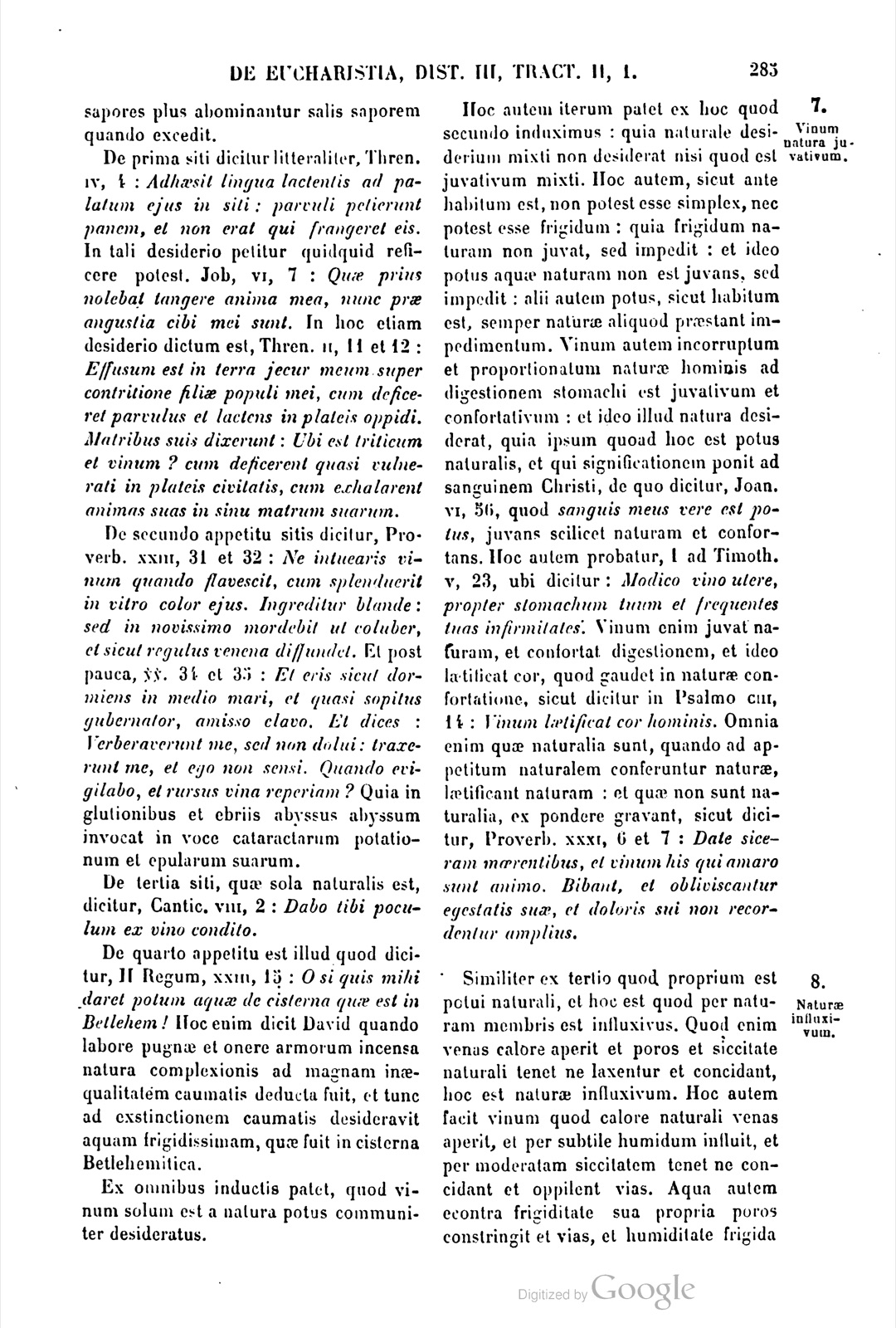
9. Cibi lativum. Quod autem quarto dicitur, quod potus naturalis cibi est lativus, nulli potui ita convenit sicut vino: quia ille calore cibum movet et vapore suo, eo quod vaporativum est, cibum pellit, ut fluat. Et hoc patet: quia vias venarum ampliat ut sanguis currere possit, et calore movendo vapore pellit, et humiditate lubricat, ut bene fluat, quorum nihil ordinate facit aqua: si enim lubricat aqua, hoc facit inordinate, vias scilicet emolliendo, et quasi paralysim dissolvendo. Et ideo potus naturalis est vinum. Hoc signatum est, Genes. XXVII, 25 et seq., ubi dicitur de Isaac, quod cum cibos a Rebecca praeparatos comedisset, obtulit ei Jacob et vinum, quo hausto dixit ad eum: Accede ad me, et da mihi osculum, fili mi. Quia cum per vinum latus esset cibus dulcis ad membra, delectatus pater ad dilectionem filii statim conversus est, et osculum dedit in signum futurae statim benedictionis.
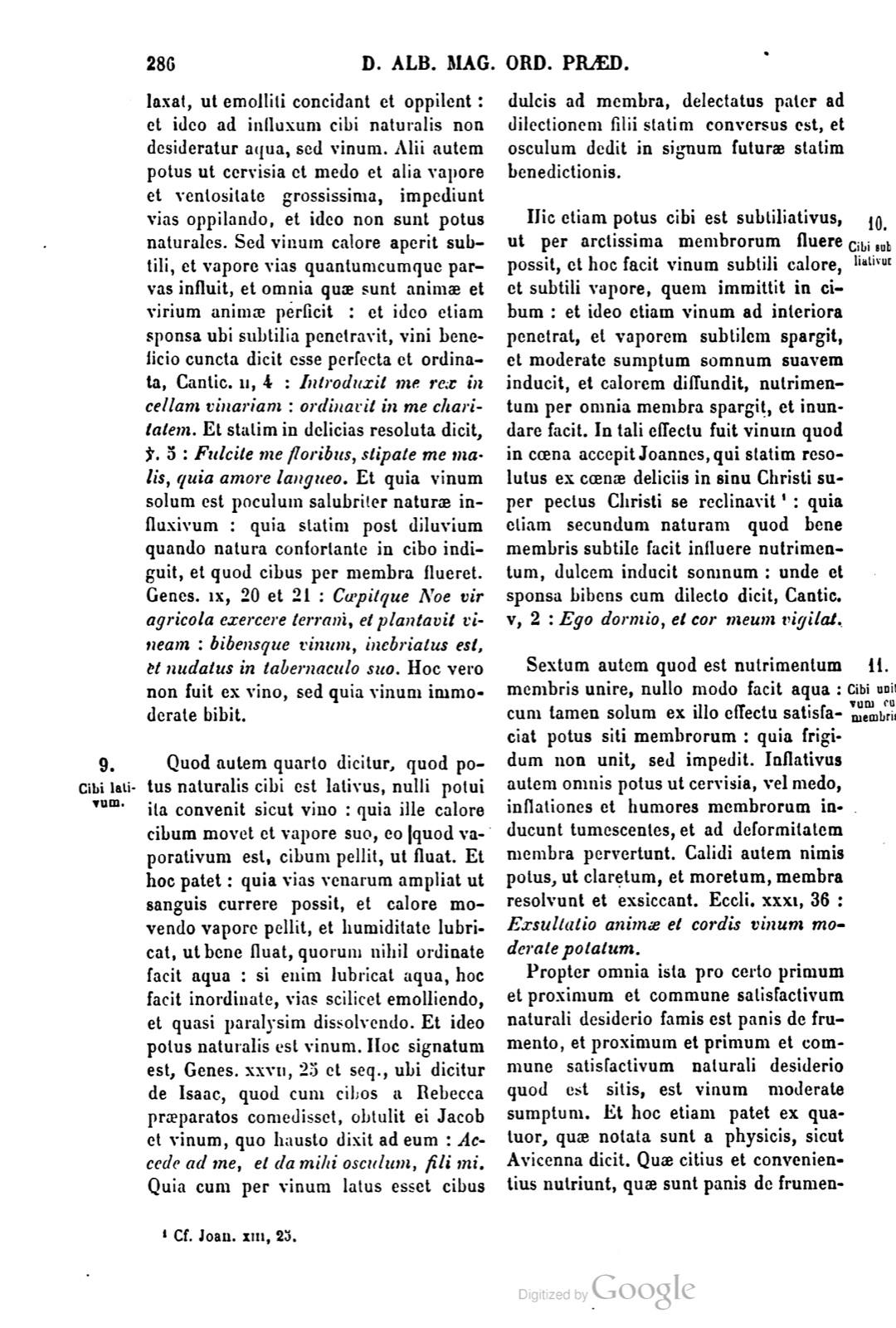
10. Cibi subtiliativum. Hic etiam potus cibi est subtiliativus, ut per arctissima membrorum fluere possit, et hoc facit vinum subtili calore, et subtili vapore, quem immittit in cibum: et ideo etiam vinum ad interiora penetrat, et vaporem subtilem spargit, et moderate sumptum somnum suavem inducit, et calorem diffundit, nutrimentum per omnia membra spargit, et inundare facit. In tali effectu fuit vinum quod in coena accepit Joannes, qui statim resolutus ex coenae deliciis in sinu Christi super pectus Christi se reclinavit2: quia etiam secundum naturam quod bene membris subtile facit influere nutrimentum, dulcem inducit somnum: unde et sponsa bibens cum dilecto dicit, Cantic. V, 2: Ego dormio, et cor meum vigilat.
11. Cibi unitivum cum membris. Sextum autem quod est nutrimentum membris unire, nullo modo facit aqua: cum tamen solum ex illo effectu satisfaciat potus siti membrorum: quia frigidum non unit, sed impedit. Inflativus autem omnis potus ut cervisia, vel medo, inflationes et humores membrorum inducunt tumescentes, et ad deformitatem membra pervertunt. Calidi autem nimis potus, ut claretum, et moretum, membra resolvunt et exsiccant. Eccli. XXXI, 36: Exsultatio animae et cordis vinum moderate potatum.
Propter omnia ista pro certo primum et proximum et commune satisfactivum naturali desiderio famis est panis de frumento, et proximum et primum et commune satisfactivum naturali desiderio quod est sitis, est vinum moderate sumptum. Et hoc etiam patet ex quatuor, quae notata sunt a physicis, sicut Avicenna dicit. Quae citius et convenientius nutriunt, quae sunt panis de frumento
9. Carrying food. But as to what is said fourth, that natural drink carries food, this belongs to no drink as it does to wine, because it moves food by heat and by its vapor, because it is vaporative, drives food so that it may flow. And this is clear, because it widens the ways of the veins so that blood can run, and by heat moving through vapor it drives, and by moisture lubricates so that it may flow well; none of these things water does in an ordered way. For if water lubricates, it does this inordinately, namely by softening the ways and dissolving as into paralysis. And therefore the natural drink is wine. This was signified, Genesis 27:25 and following, where it is said of Isaac that when he had eaten the foods prepared by Rebecca, Jacob offered him also wine; and when this had been drunk, he said to him: "Come to me and give me a kiss, my son." Because when the sweet food had been carried to the members through the wine, the father, delighted, was at once turned to love of the son, and he gave the kiss as a sign of the blessing immediately to come.
10. Subtilizing food. This drink also subtilizes food, so that it can flow through the narrowest parts of the members; and wine does this by subtle heat, and by the subtle vapor which it sends into the food. And therefore wine also penetrates to the inner parts and scatters subtle vapor, and taken moderately it brings on sweet sleep, diffuses heat, scatters nourishment through all the members, and makes it overflow. Of such effect was the wine which John received at the supper, who at once, dissolved by the delights of the supper, reclined in Christ's bosom upon Christ's breast2; because even according to nature that which makes subtle nourishment flow well into the members brings on sweet sleep. Hence also the bride, drinking with the beloved, says, Canticles 5:2: "I sleep, and my heart watches."
11. Uniting food with the members. But the sixth thing, which is to unite nourishment to the members, water in no way does, although drink satisfies the thirst of the members only from that effect, because the cold does not unite, but impedes. But every inflating drink, such as beer or mead, brings on swellings and humors of the members, and turns the members to deformity. But drinks that are too hot, such as claret and mulberry wine, dissolve and dry out the members. Ecclesiasticus 31:36: "Wine drunk moderately is exultation of soul and heart."
On account of all these things, certainly the first and nearest and common thing satisfying the natural desire of hunger is bread made from wheat, and the nearest and first and common thing satisfying the natural desire which is thirst is wine taken moderately. And this also is clear from four things which have been noted by the physicians, as Avicenna says. The things which nourish more quickly and more fittingly are bread made from wheat
If a page does not appear, its photograph has not been uploaded yet.