Works › The Book on the Sacrament of the Eucharist
Volume 38 · pp. 231–232
Tractate I, Chapter I. On the Nobility of This Food from Its Genus: Royal Food.
A marker with ≈ is an approximate page boundary, placed by measure of the text; the page photographs remain the authority. In the paired views, clicking a page marker brings that page into view.
Marginal label (printed p. 231): Eucharistia cibus regius, quia regibus praeparatus, quia filiis regis debitus, quia ex promptuariis summi regis assumptus.
Marginal label (printed p. 232): Quare Christus vitulo, agno, hoedo, mannate et frumento fuit praesignatus?
Tractatus I. Cujusmodi sit hic sacramentalis cibus?
Caput I. De nobilitate hujus cibi ex genere.
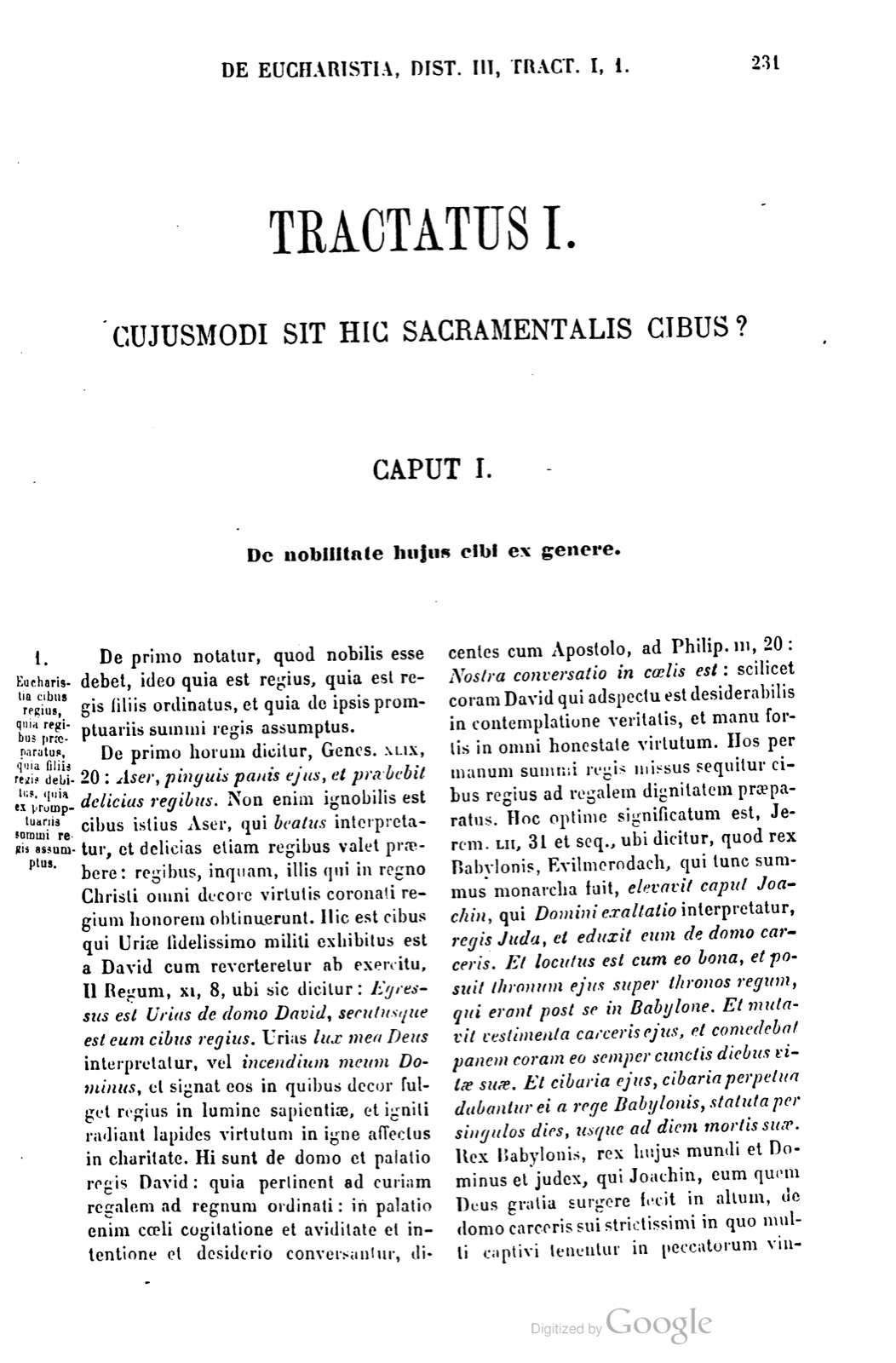
1. De primo notatur, quod nobilis esse debet, ideo quia est regius, quia est regis filiis ordinatus, et quia de ipsis promptuariis summi regis assumptus.
De primo horum dicitur, Genes. xlix, 20: Aser, pinguis panis ejus, et praebebit delicias regibus. Non enim ignobilis est cibus istius Aser, qui beatus interpretatur, et delicias etiam regibus valet praebere: regibus, inquam, illis qui in Christi omni decore virtutis coronati regium honorem obtinuerunt. Hic est cibus qui Uriae fidelissimo militi exhibitus est a David cum reverteretur ab exercitu, II Regum, xi, 8, ubi sic dicitur: Egressus est Urias de domo David, secutusque est eum cibus regius. Urias lux mea Deus interpretatur, vel incendium meum Dominus, et signat eos in quibus decor fulget regius in lumine sapientiae, et igniti radiant lapides virtutum in igne affectus in charitate. Hi sunt de domo et palatio regis David: quia pertinent ad curiam regalem ad regnum ordinati: in palatio enim caeli cogitatione et aviditate et intentione et desiderio conversantur, dicentes cum Apostolo, ad Philip. iii, 20: Nostra conversatio in caelis est: scilicet coram David qui adspectu est desiderabilis in contemplatione veritatis, et manu fortis in omni honestate virtutum. Hos per manum summi regis missus sequitur cibus regius ad regalem dignitatem praeparatus. Hoc optime significatum est, Jerem. lii, 31 et seq., ubi dicitur, quod Evilmerodach, rex Babylonis, qui tunc fuit monarcha, elevavit caput Joachin, qui Domini exaltatio interpretatur, regis Juda, et eduxit eum de domo carceris. Et locutus est cum eo bona, et posuit thronum ejus super thronos regum, qui erant post se in Babylone. Et mutavit vestimenta carceris ejus, et comedebat panem coram eo semper cunctis diebus vitae suae. Et cibaria ejus, cibaria perpetua dabantur ei a rege Babylonis, statuta per singulos dies, usque ad diem mortis suae. Rex Babylonis, rex hujus mundi et Dominus et judex, qui Joachin, eum quem Deus gratia surgere fecit in altum, de domo carceris sui strictissimi in quo multi captivi tenentur in peccatorum vinculis, elevatum, benigne alloquitur, et vesci eum conversatione regii decoris, et de mensa regali cibaria facit exhibere in refectione hujus cibi cunctis diebus perpetuo, quae vegetent in aeternum.
Marginal label (printed p. 231): The Eucharist is royal food, because prepared for kings, because owed to the sons of the king, because taken from the storehouses of the highest king.
Marginal label (printed p. 232): Why Christ was pre-signified by the calf, the lamb, the kid, manna, and wheat.
Tractate I. Of what sort is this sacramental food?
Chapter I. On the nobility of this food from its genus.
1. Concerning the first, it is noted that it ought to be noble, because it is royal, because it has been ordained for the sons of the king, and because it has been taken from the very storerooms of the highest king.
Concerning the first of these Genesis 49:20 says: Asher, his bread is fat, and he will provide delights for kings. For the food of that Asher, which is interpreted blessed, is not ignoble, and it is strong enough to provide delights even for kings: for kings, I say, those who, crowned in Christ with every beauty of virtue, have obtained royal honor. This is the food which was offered by David to Uriah, the most faithful soldier, when he returned from the army, 2 Kings 11:8, where it is said thus: Uriah went out from the house of David, and royal food followed him. Uriah is interpreted my light is God, or my burning is the Lord, and he signifies those in whom royal beauty shines in the light of wisdom, and the fiery stones of virtues shine in the fire of affection in charity. These are of the house and palace of King David, because they belong to the royal court, ordained to the kingdom; for in the palace of heaven they dwell by thought and avidity and intention and desire, saying with the Apostle in Philippians 3:20: Our conversation is in the heavens, namely before David, who in appearance is desirable in the contemplation of truth and strong in hand in every honorableness of virtues. Royal food, sent by the hand of the highest king, follows these persons, prepared for royal dignity. This was signified very well in Jeremiah 52:31 and following, where it is said that Evilmerodach, king of Babylon, who then was monarch, lifted up the head of Joachin, who is interpreted exaltation of the Lord, king of Judah, and brought him out of the house of prison. And he spoke good things with him, and set his throne above the thrones of the kings who were after him in Babylon. And he changed the garments of his prison, and he ate bread before him always, all the days of his life. And his provisions, perpetual provisions, were given him by the king of Babylon, appointed for single days, until the day of his death. The king of Babylon, the king of this world and Lord and judge, who lifts up Joachin, him whom God by grace caused to rise on high, from the house of his very strict prison in which many captives are held in the chains of sins, speaks kindly to him, and causes him to be fed with the conversation of royal beauty, and causes provisions from the royal table to be offered for the refreshment of this food through all days perpetually, which will enliven unto eternity.
Sic ergo cibus iste est regius, quia regibus praeparatus.
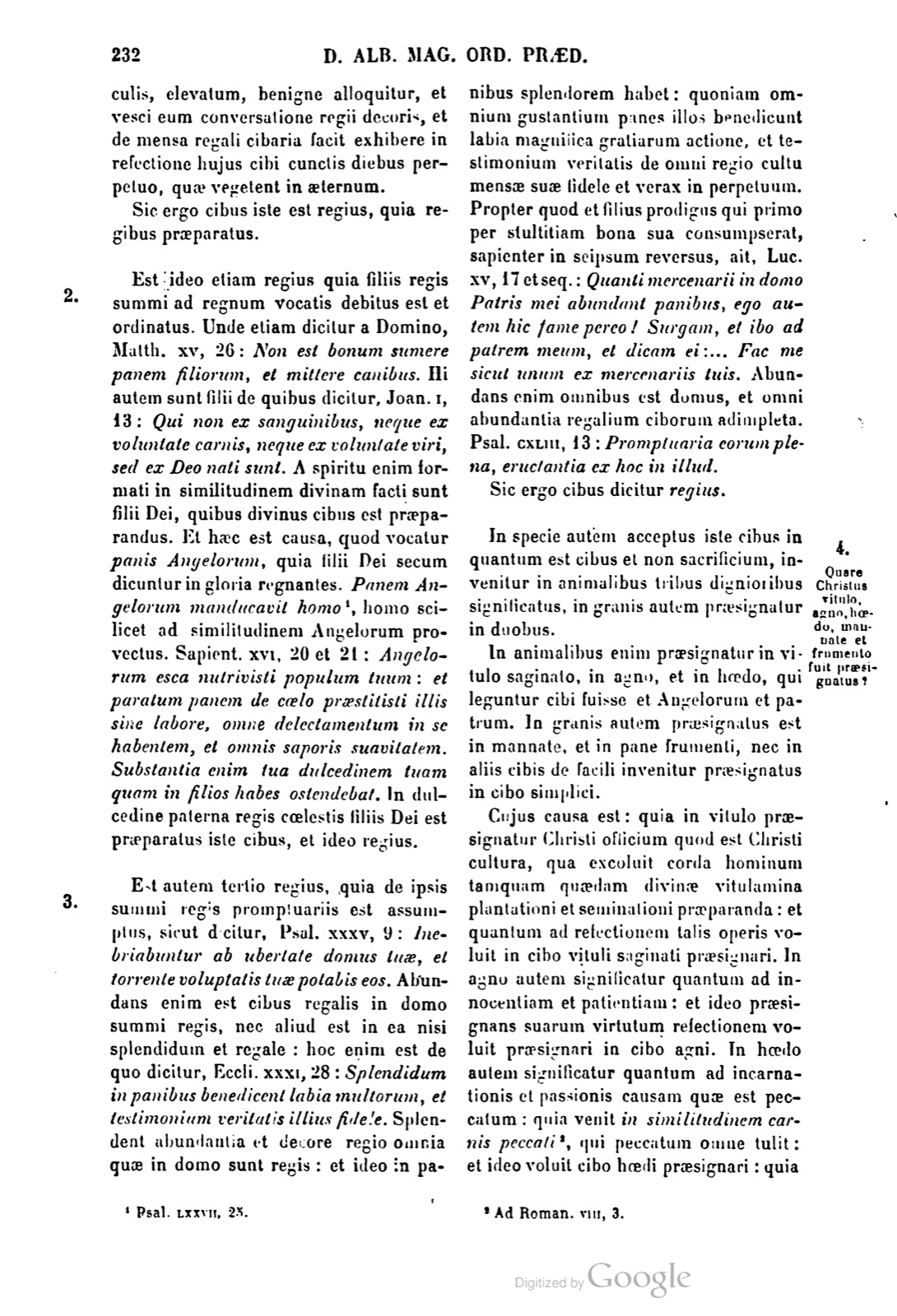
2. Est ideo etiam regius quia filiis regis summi ad regnum vocatis debitus est et ordinatus. Unde etiam dicitur a Domino, Matth. xv, 26: Non est bonum sumere panem filiorum, et mittere canibus. Hi autem sunt filii de quibus dicitur, Joan. i, 13: Qui non ex sanguinibus, neque ex voluntate carnis, neque ex voluntate viri, sed ex Deo nati sunt. A spiritu enim formati in similitudinem divinam facti sunt filii Dei, quibus divinus cibus est praeparandus. Et haec est causa, quod vocatur panis Angelorum, quia filii Dei secum dicuntur in gloria regnantes. Panem Angelorum manducavit homo1, homo scilicet ad similitudinem Angelorum provectus. Sapient. xvi, 20 et 21: Angelorum esca nutrivisti populum tuum: et paratum panem de caelo praestitisti illis sine labore, omne delectamentum in se habentem, et omnis saporis suavitatem. Substantia enim tua dulcedinem tuam quam in filios habes ostendebat. In dulcedine paterna regis coelestis filiis Dei est praeparatus iste cibus, et ideo regius.
3. Est autem tertio regius, quia de ipsis summi regis promptuariis est assumptus, sicut dicitur, Psal. xxxv, 9: Inebriabuntur ab ubertate domus tuae, et torrente voluptatis tuae potabis eos. Abundans enim est cibus regalis in domo summi regis, nec aliud est in ea nisi splendidum et regale: hoc enim est de quo dicitur, Eccli. xxxi, 28: Splendidum in panibus benedicent labia multorum, et testimonium veritatis illius fidele. Splendent abundantia et decore regio omnia quae in domo sunt regis: et ideo in panibus splendorem habet: quoniam omnium gustantium panes illos benedicunt labia magnifica gratiarum actione, et testimonium veritatis de omni regio cultu mensae suae fidele et verax in perpetuum. Propter quod et filius prodigus qui primo per stultitiam bona sua consumpserat, sapienter in seipsum reversus, ait, Luc. xv, 17 et seq.: Quanti mercenarii in domo Patris mei abundant panibus, ego autem hic fame pereo! Surgam, et ibo ad patrem meum, et dicam ei: ... Fac me sicut unum ex mercenariis tuis. Abundans enim omnibus est domus, et omni abundantia regalium ciborum adimpleta. Psal. cxliii, 13: Promptuaria eorum plena, eructantia ex hoc in illud.
Sic ergo cibus dicitur regius.
Thus therefore this food is royal, because it has been prepared for kings.
2. It is therefore also royal because it is due and ordained to the sons of the highest king called to the kingdom. Hence it is also said by the Lord in Matthew 15:26: It is not good to take the bread of the children and cast it to dogs. But these are the sons concerning whom John 1:13 says: Who were born not from bloods, nor from the will of flesh, nor from the will of man, but from God. For, formed by the Spirit into divine likeness, they were made sons of God, for whom divine food must be prepared. And this is the cause why it is called bread of angels, because the sons of God are said to reign with them in glory. Man ate the bread of angels1, namely a man advanced to the likeness of angels. Wisdom 16:20 and 21: You nourished your people with the food of angels, and you furnished them prepared bread from heaven without labor, having every delight in itself and the sweetness of every taste. For your substance showed your sweetness which you have toward sons. This food has been prepared for the sons of God in the paternal sweetness of the heavenly king, and therefore it is royal.
3. But it is royal in the third place because it has been taken from the very storerooms of the highest king, as Psalm 35:9 says: They will be inebriated from the richness of your house, and you will give them drink from the torrent of your pleasure. For royal food is abundant in the house of the highest king, nor is there anything in it except what is splendid and royal. For this is that concerning which Ecclesiasticus 31:28 says: The splendid thing in breads the lips of many will bless, and the testimony of its truth is faithful. All things which are in the king's house shine with abundance and royal beauty; and therefore in breads it has splendor, because the magnificent lips of all who taste those breads bless them with thanksgiving, and the testimony of truth concerning every royal furnishing of his table is faithful and true forever. On account of this also the prodigal son, who at first through foolishness had consumed his goods, wisely returned into himself and said, Luke 15:17 and following: How many hired servants in my Father's house abound with breads, but I here perish by hunger! I shall arise and go to my father and say to him: ... Make me like one of your hired servants. For the house is abundant for all, and filled with every abundance of royal foods. Psalm 143:13: Their storerooms are full, pouring forth from this into that.
Thus therefore the food is called royal.
Notes
- Psalm 77:25. (Psal. lxxvii, 25.) ↩
If a page does not appear, its photograph has not been uploaded yet.