Works › The Book on the Sacrament of the Eucharist
Volume 38 · pp. 428–430
Chapter II, 15-16
A marker with ≈ is an approximate page boundary, placed by measure of the text; the page photographs remain the authority. In the paired views, clicking a page marker brings that page into view.
Marginal label (printed p. 428): Utrum plures sacerdotes unam possint consecrare hostiam?
Marginal label (printed p. 429): Responsio ad objecta.
15. De ritu ex parte ministri remanet adhuc inquirendum, si plures sacerdotes unam possint consecrare hostiam?
Videtur autem, quod sic: quia secundum antiquam Ecclesiae Romanae consuetudinem, quando Papa celebrat, Cardinales sacerdotes assistunt ei ad altare stantes, et signa quae ipse facit facientes: et sicut quidam dicunt, etiam verba Canonis submisse pronuntiantes. Cum ergo verba sacerdotum non in vacuum proferantur, videtur quod omnium illorum verba sacerdotum ad eamdem hostiam consecrandam referantur, et ad eumdem calicem benedicendum: et sic videtur, quod plures sacerdotes unicam consecrent hostiam.
Adhuc autem, cum Episcopus celebrat ordines, omnes sacerdotes de novo ordinati circa altare in quo celebrat Episcopus, disponuntur, et omnes simul cum eo signa faciunt ad corporis Dominici confectionem: et sic videtur, quod eadem hostia a pluribus simul in una et eadem Missa consecretur.
Adhuc, in consecratione chrismatis plures sunt consecratores tam Episcopi si sint praesentes, quam etiam presbyteri si plures Episcopi non habentur: et hoc fit propter chrismatis excellentiam. Cum ergo multo excellentius in omni gratia sit corpus Christi, videtur quod non sit incongruum in una et eadem Missa plures esse simul corpus Domini conficientes.
Adhuc, in ordinatione et consecratione Episcopi, plures sunt cum uno Episcopo consecrantes: nihil autem excellentius est quam corpus Domini: ergo videtur, quod non tantum possunt plures simul unam hostiam consecrare: quinimo in omni Missa videtur, quod plures debeant esse simul consecrantes.
Si autem hoc forte concedatur, tunc constat, quod non omnes simul in uno et eodem momento verba confectionis possunt enuntiare. Si autem unus ante alium verba profert, et statim prolatis ab unoquoque verbis, hostia est transsubstantiata, tunc videtur, quod pro nihilo sit quod alii pronuntiant.
Adhuc autem, secundum hoc accidit, quod eadem verba multoties dicuntur super unam et eamdem hostiam: hoc autem quotiescumque fit, injuria fit sacramento, ut dicit Augustinus: ergo in talibus celebrationibus injuria fit sacramento, et omnino hoc est evitandum: quia injuriam facere sacramento non est catholicum.
Marginal label (printed p. 428): Whether several priests can consecrate one host?
Marginal label (printed p. 429): Response to the objections.
15. Concerning the rite on the part of the minister, it remains still to inquire whether several priests can consecrate one host.
But it seems that they can, because according to the ancient custom of the Roman Church, when the Pope celebrates, the cardinal priests stand by him at the altar, making the signs which he himself makes; and as some say, also pronouncing the words of the Canon quietly. Since therefore the words of priests are not brought forth in vain, it seems that the words of all those priests are referred to consecrating the same host and blessing the same chalice; and thus it seems that several priests consecrate one host.
Moreover, when a bishop celebrates ordinations, all the newly ordained priests are arranged around the altar on which the bishop celebrates, and all together with him make signs for the confection of the Lord's body; and thus it seems that the same host is consecrated by several at the same time in one and the same Mass.
Moreover, in the consecration of chrism there are several consecrators, both bishops if they are present, and also presbyters if several bishops are not had; and this happens because of the excellence of chrism. Since therefore the body of Christ is much more excellent in every grace, it seems that it is not unfitting that in one and the same Mass there be several together confecting the body of the Lord.
Moreover, in the ordination and consecration of a bishop, several are consecrating with one bishop; but nothing is more excellent than the body of the Lord. Therefore it seems not only that several together can consecrate one host, but rather that in every Mass it seems that several ought to be consecrating together.
But if perhaps this is conceded, then it is agreed that not all can utter the words of confection at the same time in one and the same moment. But if one brings forth the words before another, and immediately when the words have been brought forth by each one, the host has been transubstantiated, then it seems that what the others pronounce is for nothing.
Moreover, according to this it happens that the same words are said many times over one and the same host. But whenever this happens, injury is done to the sacrament, as Augustine says. Therefore in such celebrations injury is done to the sacrament, and this is altogether to be avoided, because to do injury to the sacrament is not Catholic.
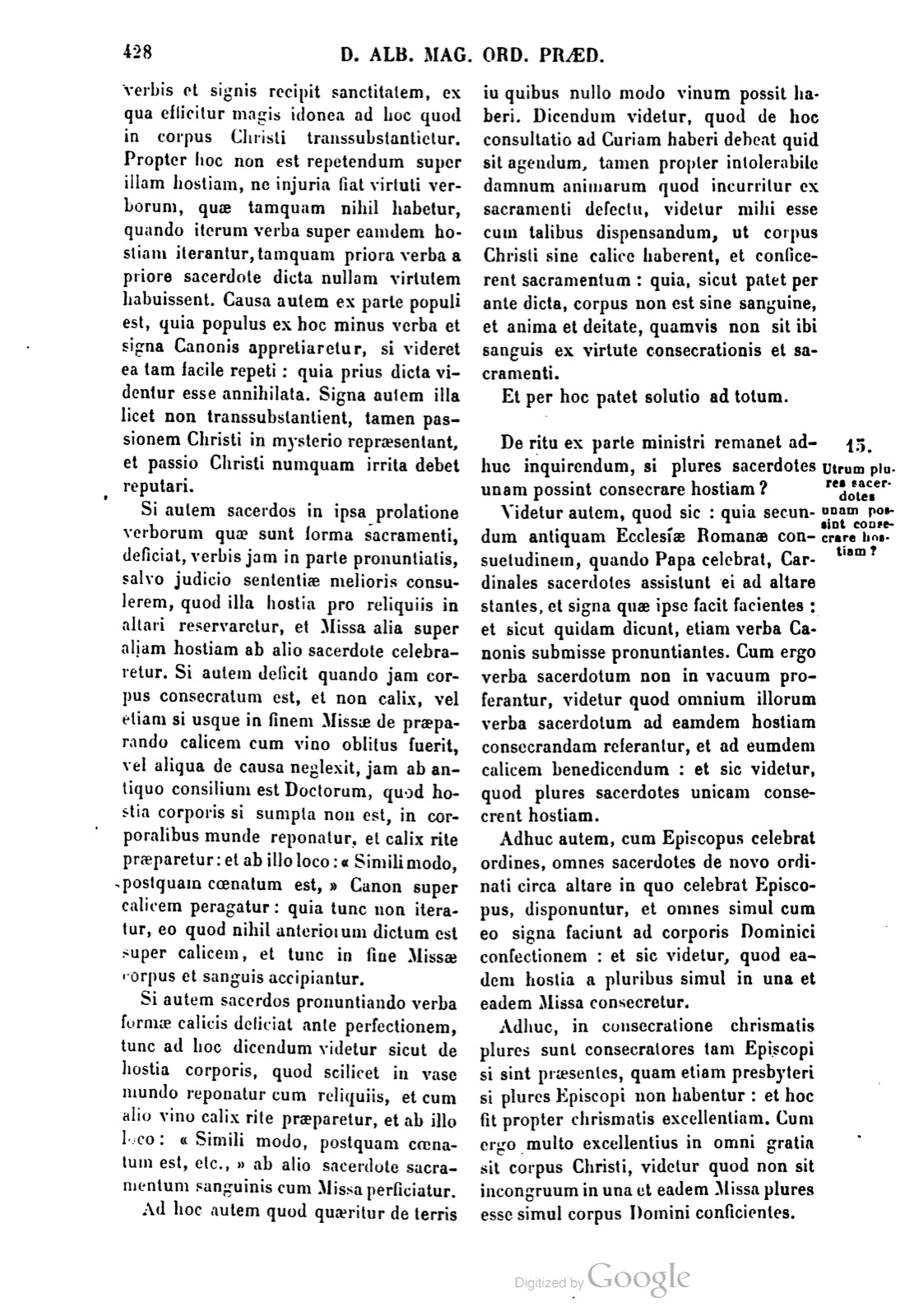
Juxta haec iterum quaeritur de quodam verbo quod dicitur, I ad Corinth. X, 27: Quicumque manducaverit panem hunc, vel biberit calicem Domini indigne, reus erit corporis et sanguinis Domini. Ibi dicit Glossa, quod indigne manducat et bibit indevotus: indevotus autem est, qui aliter celebrat sacramentum quam institutum est. Quaeratur quis est ille qui aliter celebrat? Quia hoc Glossa non determinat.
16. Ad haec et similia sine praejudicio sententiae melioris dicendum, quod plures sacerdotes simul nec debent nec possunt simul unam consecrare hostiam: quia pro certo secundum Augustinum, injuria fit sacramento.
Adhuc autem, vanum est facere a pluribus quod melius uno potest fieri: vanum autem non est in operibus naturae, et multo minus debet esse in operibus gratiae.
Ad id autem quod objicitur de cardinalibus presbyteris, qui Domino Papae assistunt, dicendum quod propter obsequium assistunt, et non propter consecrationem quae a pluribus fieri debeat.
Ad id autem quod objicitur, quod faciunt signa et pronuntiant verba, dicendum, quod hoc meo judicio fieri non debet, nec etiam fit: quia injuria fieret sacramento.
Ad id quod objicitur de Episcopo ordines celebrante, cui assistunt sacerdotes de novo ordinandi. Dicendum, quod illa verba non pronuntiant, sed assistunt propter reverentiam sacramenti, et propter doctrinam: et ideo signa quae faciunt, sunt ad imitationem signorum quae facit Episcopus, ut illi sacerdotes addiscant signare, et sint docibiles in exercitio officii quod susceperunt.
Ad id autem quod objicitur de consecratione chrismatis. Dicendum, quod non est simile: quia ibi nulla substantia transmutatur, sed tantum sanctificatur: et quia sanctitas illa universaliter omnia sanctificans est altaria, et Ecclesias, et confirmandos, et manus impositionem ad Episcopatum recepturos, ideo conveniens est, quod Episcopus in impetratione istius sanctitatis plures habeat coadjutores. Hac etiam de causa in impositione manus, quando ordinatur Episcopus, quia officium magnum suscipit potius quam ordinem, plures habet coadjutores, ut gratia largior impetretur ad regimen quod ibi suscipit animarum. Sic autem non est de corpore Christi: ibi enim Verbum increatum operatur in verbo creato ad transsubstantiationem substantiarum, et hoc non plus valet in uno quam in pluribus: et ideo ab uno tantum debet confici sacramentum. Sunt tamen quidam antiqui qui dixerunt, quod una hostia a pluribus consecratur in casibus inductis in objectione, et dicunt, quod primus inter sacerdotes pronuntians et perficiens formam sacramenti operatur transsubstantiationem, et nullus alius: nec tamen, ut dicunt, aliorum fraudatur intentio: quia factum est jam quod intendunt: sed hoc nihil videtur esse: quia non fit propter hoc, quia fraudatur intentio, sed potius ideo quia sacramento fit injuria, sicut diximus.
Next to these things it is again asked concerning a certain word which is said in 1 Corinthians 10:27: Whoever eats this bread or drinks the chalice of the Lord unworthily will be guilty of the body and blood of the Lord. There the Gloss says that the undevout man eats and drinks unworthily. But the undevout man is he who celebrates the sacrament otherwise than it was instituted. Let it be asked who is he who celebrates otherwise? Because the Gloss does not determine this.
16. To these and similar things, without prejudice to a better opinion, it must be said that several priests together neither ought nor can consecrate one host together, because certainly, according to Augustine, injury is done to the sacrament.
Moreover, it is vain to do by several what can be done better by one. But vainness is not in the works of nature, and much less ought it to be in the works of grace.
To that which is objected concerning cardinal presbyters who assist the Lord Pope, it must be said that they assist because of service, and not because of a consecration which ought to be made by several.
To that which is objected, that they make signs and pronounce words, it must be said that in my judgment this ought not to be done, nor is it even done, because injury would be done to the sacrament.
To that which is objected concerning the bishop celebrating ordinations, whom the priests newly to be ordained assist, it must be said that they do not pronounce those words, but assist because of reverence for the sacrament and because of teaching; and therefore the signs which they make are in imitation of the signs which the bishop makes, so that those priests may learn to sign and may be teachable in the exercise of the office which they have received.
To that which is objected concerning the consecration of chrism, it must be said that it is not similar, because there no substance is transmuted, but only sanctified; and because that sanctity universally sanctifying all things is altars, and churches, and those to be confirmed, and those about to receive imposition of hands for the episcopate, therefore it is fitting that the bishop have several coadjutors in the obtaining of that sanctity. Also for this cause in the imposition of a hand, when a bishop is ordained, because he receives a great office rather than an order, he has several coadjutors so that a more abundant grace may be obtained for the rule of souls which he receives there. But it is not so concerning the body of Christ; for there the uncreated Word works in the created word for the transubstantiation of substances, and this is not worth more in one than in several; and therefore the sacrament ought to be confected by one only. Yet there are certain ancient persons who said that one host is consecrated by several in the cases introduced in the objection; and they say that the first among the priests pronouncing and completing the form of the sacrament operates the transubstantiation, and no other; nor nevertheless, as they say, is the intention of the others defrauded, because what they intend has already been done. But this seems to be nothing, because it does not happen because the intention is defrauded, but rather because injury is done to the sacrament, as we have said.
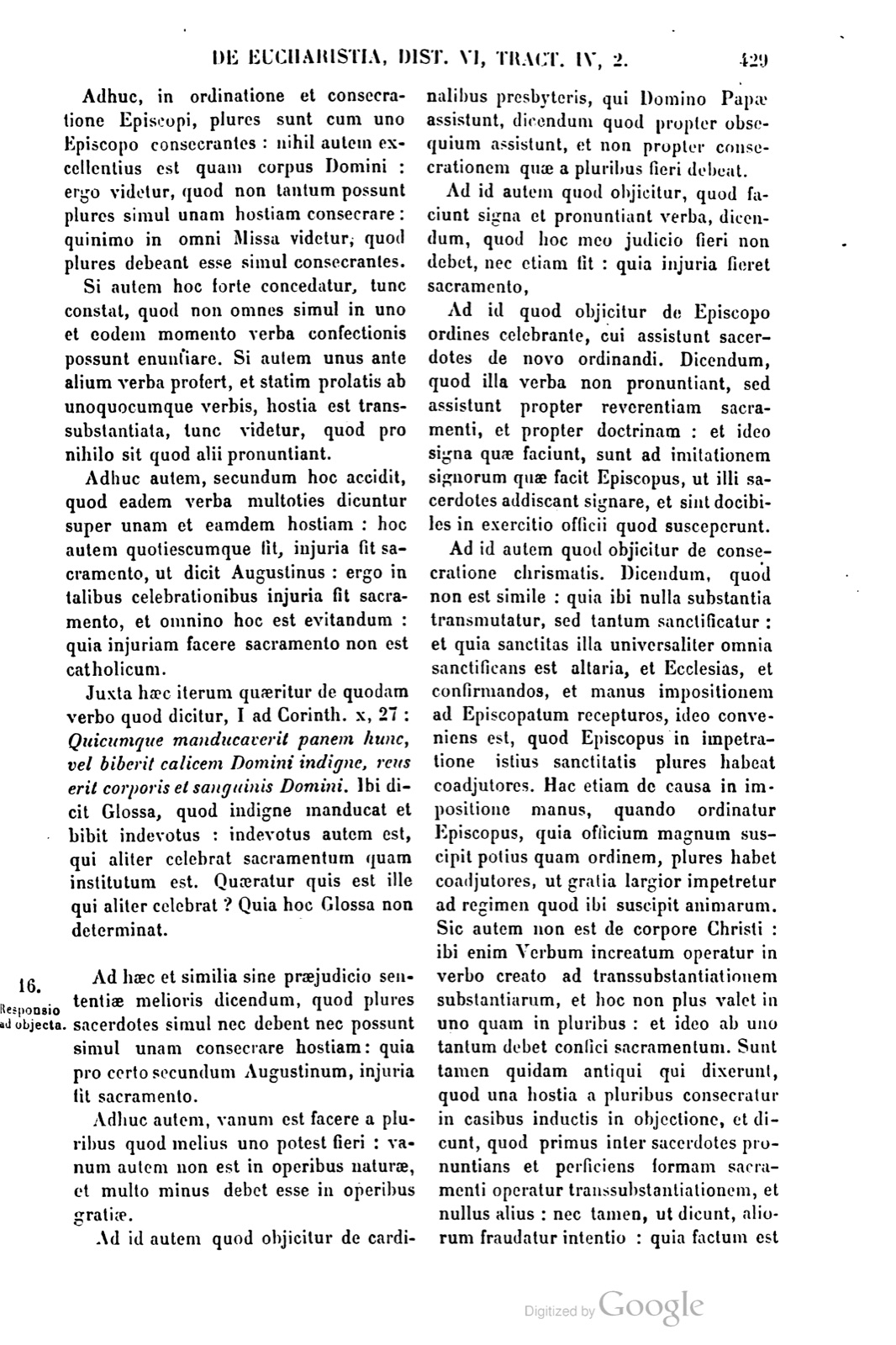
Ad hoc autem quod ulterius quaeritur, dicendum sicut dicit Glossa: « Indevotus est, qui aliter celebrat sacramentum quam a Christo et a sanctis patribus est institutum. » Et est hoc si forte non jejunus vellet celebrare, aut sine sacris vestibus, aut in loco non consecrato, aut etiam indignus ex ordine vel ex vita immunda. Ex ordine quidem, sicut si ordinem excommunicatus, vel simoniacus, vel per simoniam esset adeptus. Indignus autem vita est sicut adhuc peccatorum recentia cruentatus et scandalum faciens in celebrando sacrosancta mysteria, quamvis talis conficiat, tamen incurrit reatum traditoris ex celebratione: quia simoniacus Christum vendit, et immundus recipiens corpus Domini, Christum quantum in se est, inimicis tradit sicut fecit Judas. Judas enim de corpore et sanguine Christi cupiditatem satiavit, et recipiendo buccellam a Domino diabolus eum possedit. Unde, Joan. XIII, 27, dicitur: Post buccellam, introivit in eum Satanas, et amplioris ex tunc malitiae est effectus.
But to this which is further asked, one must speak as the Gloss says: "The undevout man is he who celebrates the sacrament otherwise than it was instituted by Christ and by the holy fathers." And this is if perhaps he would wish to celebrate not fasting, or without sacred vestments, or in a place not consecrated, or even as unworthy from order or from unclean life. From order indeed, as if he had obtained order while excommunicated, or simoniac, or through simony. But one unworthy by life is as one still bloodied by the freshness of sins and causing scandal in celebrating the sacrosanct mysteries; although such a man confects, nevertheless he incurs the guilt of a betrayer from the celebration, because the simoniac sells Christ, and the unclean man receiving the body of the Lord, as much as is in him, hands Christ over to enemies, as Judas did. For Judas satisfied cupidity from the body and blood of Christ, and by receiving the morsel from the Lord the devil possessed him. Hence in John 13:27 it is said: After the morsel, Satan entered into him, and from then on he was made of greater malice.
If a page does not appear, its photograph has not been uploaded yet.