Works › The Book on the Sacrament of the Eucharist
Volume 38 · p. 239
Chapter I Conclusion and Chapter II Opening.
Marginal label (printed p. 239): Eucharistia sex habet sapores in causando, scilicet saporem puritatis ex corpore.
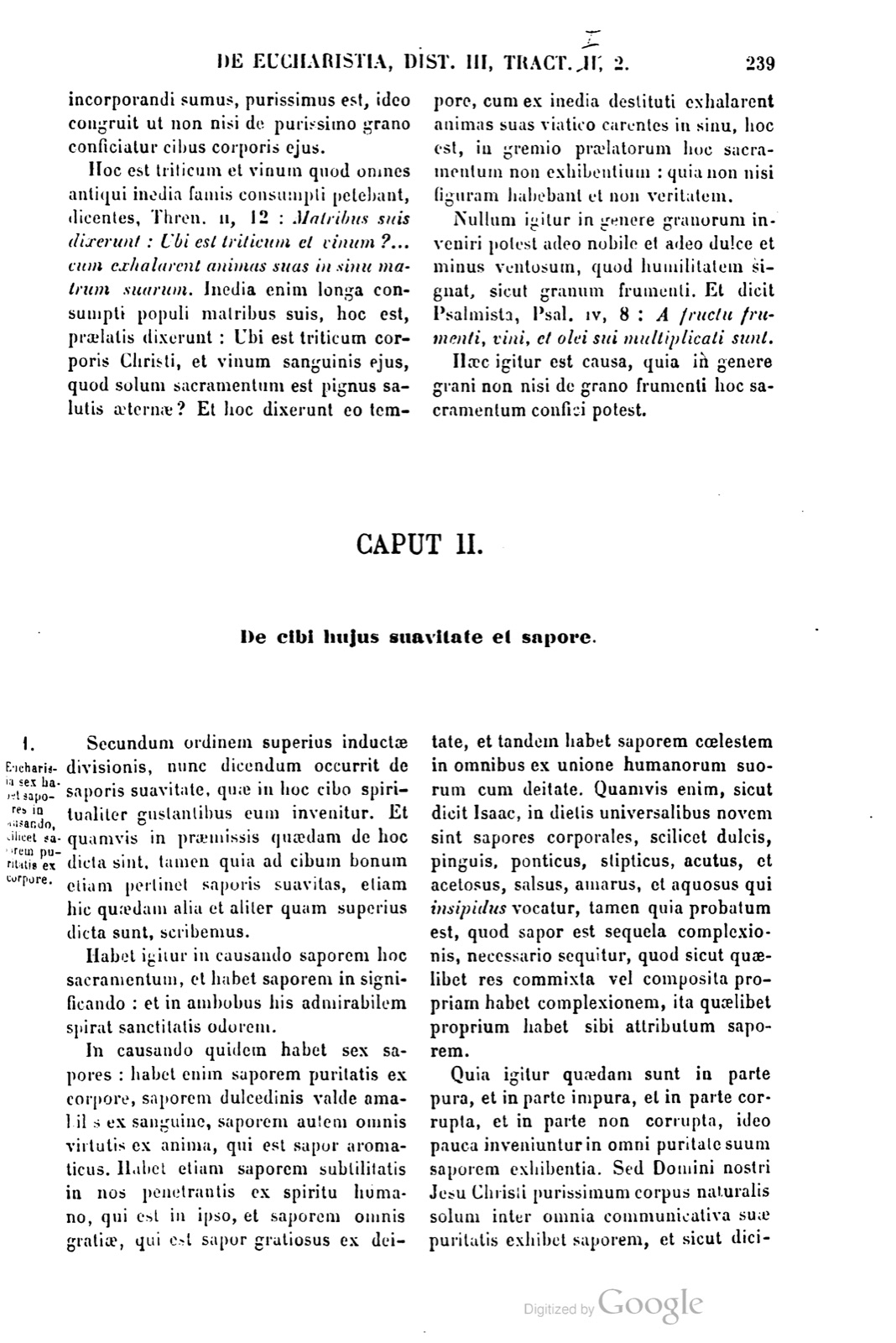
incorporandi sumus, purissimus est, ideo congruit ut non nisi de purissimo grano conficiatur cibus corporis ejus.
Hoc est triticum et vinum quod omnes antiqui inedia famis consumpti petebant, dicentes, Thren. ii, 12: Matribus suis dixerunt: Ubi est triticum et vinum?... cum exhalarent animas suas in sinu matrum suarum. Inedia enim longa consumpti populi matribus suis, hoc est, praelatis dixerunt: Ubi est triticum corporis Christi, et vinum sanguinis ejus, quod solum sacramentum est pignus salutis aeternae? Et hoc dixerunt eo tempore, cum ex inedia destituti exhalarent animas suas viatico carentes in sinu, hoc est, in gremio praelatorum hoc sacramentum non exhibentium: quia non nisi figuram habebant et non veritatem.
Nullum igitur in genere granorum inveniri potest adeo nobile et adeo dulce et minus ventosum, quod humilitatem signat, sicut granum frumenti. Et dicit Psalmista, Psal. iv, 8: A fructu frumenti, vini, et olei sui multiplicati sunt.
Haec igitur est causa, quia in genere grani non nisi de grano frumenti hoc sacramentum confici potest.
Caput II. De cibi hujus suavitate et sapore.
1. Secundum ordinem superius inductae divisionis, nunc dicendum occurrit de saporis suavitate, quae in hoc cibo spiritualiter gustantibus eum invenitur. Et quamvis in praemissis quaedam de hoc dicta sint, tamen quia ad cibum bonum etiam pertinet saporis suavitas, etiam hic quaedam alia et aliter quam superius dicta sunt, scribemus.
Habet igitur in causando saporem hoc sacramentum, et habet saporem in significando: et in ambobus his admirabilem spirat sanctitatis odorem.
In causando quidem habet sex sapores: habet enim saporem puritatis ex corpore, saporem dulcedinis valde amabilis ex sanguine, saporem autem omnis virtutis ex anima, qui est sapor aromaticus. Habet etiam saporem subtilitatis in nos penetrantis ex spiritu humano, qui est in ipso, et saporem omnis gratiae, qui est sapor gratiosus ex deitate, et tandem habet saporem coelestem in omnibus ex unione humanorum suorum cum deitate. Quamvis enim, sicut dicit Isaac, in dietis universalibus novem sint sapores corporales, scilicet dulcis, pinguis, ponticus, stipticus, acutus, et acetosus, salsus, amarus, et aquosus qui insipidus vocatur, tamen quia probatum est, quod sapor est sequela complexionis, necessario sequitur, quod sicut quaelibet res commixta vel composita propriam habet complexionem, ita quaelibet proprium habet sibi attributum saporem.
Quia igitur quaedam sunt in parte pura, et in parte impura, et in parte corrupta, et in parte non corrupta, ideo pauca inveniuntur in omni puritate suum saporem exhibentia. Sed Domini nostri Jesu Christi purissimum corpus naturalis solum inter omnia communicativa suae puritatis exhibet saporem.
Marginal label (printed p. 239): The Eucharist has six flavors in causing, namely the flavor of purity from the body.
we are to be incorporated, is most pure; therefore it is fitting that the food of his body be made only from the purest grain.
This is the wheat and wine which all the ancients, consumed by the hunger of famine, sought, saying in Lamentations 2:12: They said to their mothers: Where is wheat and wine?... when they breathed out their souls in the bosom of their mothers. For the peoples consumed by long hunger said to their mothers, that is, to their prelates: Where is the wheat of Christ's body and the wine of his blood, which alone is the sacrament and pledge of eternal salvation? And they said this at that time when, destitute from hunger, lacking viaticum, they breathed out their souls in the bosom, that is, in the lap of prelates not offering this sacrament, because they had only the figure and not the truth.
Therefore nothing in the genus of grains can be found so noble and so sweet and less windy, which signifies humility, as the grain of wheat. And the Psalmist says, Psalm 4:8: From the fruit of their wheat, wine, and oil they have been multiplied.
This therefore is the cause why, in the genus of grain, this sacrament can be made only from the grain of wheat.
Chapter II. On the sweetness and taste of this food.
1. According to the order of the division introduced above, it now occurs that we must speak about the sweetness of taste which is found in this food by those tasting it spiritually. And although certain things about this have been said in what came before, nevertheless, because the sweetness of taste also belongs to good food, here too we shall write certain other things and in another way than those said above.
Therefore this sacrament has taste in causing, and it has taste in signifying; and in both of these it breathes a wonderful odor of holiness.
In causing, indeed, it has six tastes. For it has the taste of purity from the body, the taste of very lovable sweetness from the blood, and the taste of every virtue from the soul, which is an aromatic taste. It also has the taste of subtlety penetrating into us from the human spirit which is in him, and the taste of every grace, which is a gracious taste from deity, and finally it has a heavenly taste in all things from the union of his human things with deity. For although, as Isaac says, in universal diets there are nine bodily tastes, namely sweet, fat, pontic, styptic, sharp, acidic, salty, bitter, and watery, which is called tasteless, nevertheless, because it has been proved that taste is a consequence of complexion, it follows necessarily that just as each mixed or composite thing has its own complexion, so each thing has its own taste attributed to it.
Therefore, because certain things are in part pure and in part impure, and in part corrupt and in part not corrupt, few things are found offering their taste in all purity. But the most pure body of our Lord Jesus Christ alone, among all natural communicative things, offers the taste of its purity.
If a page does not appear, its photograph has not been uploaded yet.