Works › The Book on the Sacrament of the Eucharist
Volume 38 · pp. 353–355
Chapter I, the Second, Third, and Fourth Causes
A marker with ≈ is an approximate page boundary, placed by measure of the text; the page photographs remain the authority. In the paired views, clicking a page marker brings that page into view.
Marginal label (printed p. 353): Secunda causa.
Marginal label (printed p. 353): Tertia causa.
Marginal label (printed p. 354): Quarta causa.
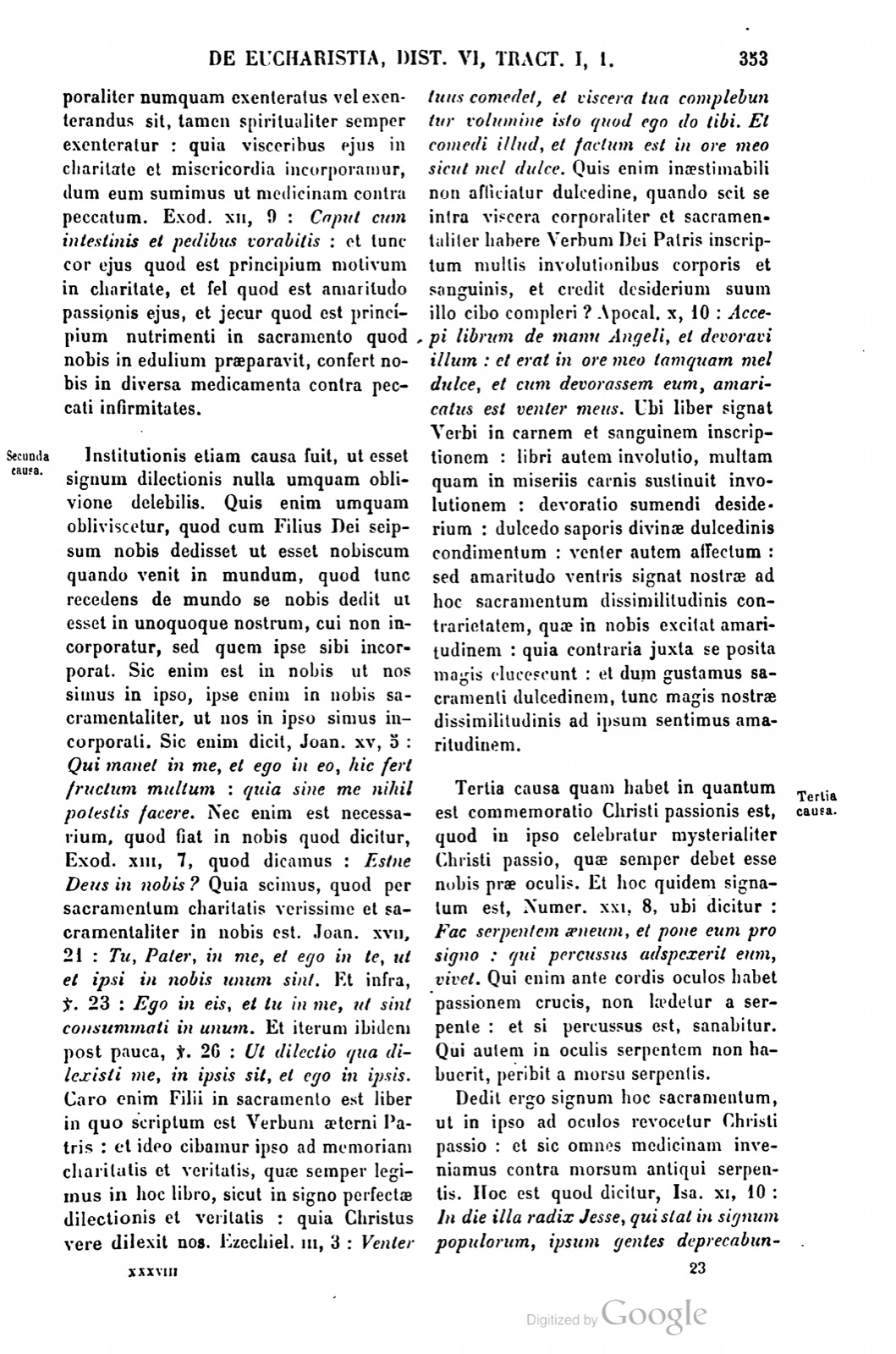
Institutionis etiam causa fuit, ut esset signum dilectionis nulla umquam oblivione delebilis. Quis enim umquam obliviscetur, quod cum Filius Dei seipsum nobis dedisset ut esset nobiscum quando venit in mundum, quod tunc recedens de mundo se nobis dedit ut esset in unoquoque nostrum, cui non incorporatur, sed quem ipse sibi incorporat. Sic enim est in nobis ut nos simus in ipso, ipse enim in nobis sacramentaliter, ut nos in ipso simus incorporati. Sic enim dicit, Joan. XV, 5: Qui manet in me, et ego in eo, hic fert fructum multum: quia sine me nihil potestis facere. Nec enim est necessarium, quod fiat in nobis quod dicitur, Exod. XIII, 7, quod dicamus: Estne Deus in nobis? Quia scimus, quod per sacramentum charitatis verissime et sacramentaliter in nobis est. Joan. XVII, 21: Tu, Pater, in me, et ego in te, ut et ipsi in nobis unum sint. Et infra, v. 23: Ego in eis, et tu in me, ut sint consummati in unum. Et iterum ibidem post pauca, v. 26: Ut dilectio qua dilexisti me, in ipsis sit, et ego in ipsis. Caro enim Filii in sacramento est liber in quo scriptum est Verbum aeterni Patris: et ideo cibamur ipso ad memoriam charitatis et veritatis, quae semper legimus in hoc libro, sicut in signo perfectae dilectionis et veritatis: quia Christus vere dilexit nos. Ezechiel. III, 3: Venter tuus comedet, et viscera tua complebuntur volumine isto quod ego do tibi. Et comedi illud, et factum est in ore meo sicut mel dulce. Quis enim inaestimabili non afficiatur dulcedine, quando scit se intra viscera corporaliter et sacramentaliter habere Verbum Dei Patris inscriptum multis involutionibus corporis et sanguinis, et credit desiderium suum illo cibo compleri? Apocal. X, 10: Accepi librum de manu Angeli, et devoravi illum: et erat in ore meo tamquam mel dulce, et cum devorassem eum, amaricatus est venter meus. Ubi liber signat Verbi in carnem et sanguinem inscriptionem: libri autem involutio, multam quam in miseriis carnis sustinuit involutionem: devoratio sumendi desiderium: dulcedo saporis divinae dulcedinis condimentum: venter autem affectum: sed amaritudo ventris signat nostrae ad hoc sacramentum dissimilitudinis contrarietatem, quae in nobis excitat amaritudinem: quia contraria juxta se posita magis elucescunt: et dum gustamus sacramenti dulcedinem, tunc magis nostrae dissimilitudinis ad ipsum sentimus amaritudinem.
Tertia causa quam habet in quantum est commemoratio Christi passionis est, quod in ipso celebratur mysterialiter Christi passio, quae semper debet esse nobis prae oculis. Et hoc quidem signatum est, Numer. XXI, 8, ubi dicitur: Fac serpentem aeneum, et pone eum pro signo: qui percussus adspexerit eum, vivet. Qui enim ante cordis oculos habet passionem crucis, non laedetur a serpente: et si percussus est, sanabitur. Qui autem in oculis serpentem non habuerit, peribit a morsu serpentis. Dedit ergo signum hoc sacramentum, ut in ipso ad oculos revocetur Christi passio: et sic omnes medicinam inveniamus contra morsum antiqui serpentis. Hoc est quod dicitur, Isa. XI, 10: In die illa radix Jesse, qui stat in signum populorum, ipsum gentes deprecabuntur, et erit sepulcrum ejus gloriosum. Radix enim Jesse, quae interpretatur incendium, est Christus Dominus incendio charitatis se decoquens in igne passionis, et nobis se communicans, qui in altari elevatus in signum populorum sicut exaltatus fuit in cruce, ita elevatur a manibus sacerdotis, ut signi crucis et exaltationis quotidie fiat memoria: et ideo ipsum sic elevatum gentes deprecabuntur, sicut paenitentes cum Centurione deprecati sunt in cruce revertentes in civitatem, et percutientes pectora sua, sicut dicitur, Luc. XXIII, 47. Et sepulcrum ejus quo conditur et absconditur, scilicet formae sacramentales, erit gloriosum: quia in ipso conditum adoramus Dominum Jesum Christum. Unde etiam ritus qui usque hodie servatur in Ecclesiis, praedictus est, Isa. XVIII, 3, ubi dicitur: Cum elevatum fuerit signum in montibus, videbitis, et clangorem tubae audietis. Summa enim sanctitas sacerdotum et Angelorum hujus passionis memoriale celebrantium, montes dicuntur, et cum confectum est corpus Domini, elevatur ab omnibus adorandum. Ad quod videndum omnis multitudo occurrit fidelium: et qui non sunt potentes, audiunt clangorem campanarum, ut simili veneratione recipiant Dominum venientem, et suam in cruce exaltationem iterum ostendentem. Isa. XIX, 20: Erit in signum et in testimonium Domini exercituum in terra Aegypti: quia per hoc signum continue ad memoriam reducitur, qualiter in cruce fuit exaltatus et omnia traxit ad seipsum. Ad Hebr. XII, 2: Adspicientes in auctorem fidei et consummatorem, Jesum, qui proposito sibi gaudio sustinuit crucem, etc.
Marginal label (printed p. 353): The second cause.
Marginal label (printed p. 353): The third cause.
Marginal label (printed p. 354): The fourth cause.
A cause of the institution also was that it should be a sign of love never to be erased by any forgetfulness. For who will ever forget that, when the Son of God had given himself to us so that he might be with us when he came into the world, then, departing from the world, he gave himself to us so that he might be in each one of us, in whom he is not incorporated, but whom he incorporates to himself. For he is in us in such a way that we are in him; for he himself is in us sacramentally, so that we may be incorporated in him. For thus he says, John 15:5: "He who remains in me, and I in him, this one bears much fruit, because without me you can do nothing." Nor is it necessary that there be done in us what is said, Exodus 13:7, that we should say: "Is God in us?" Because we know that through the sacrament of charity he is most truly and sacramentally in us. John 17:21: "You, Father, in me, and I in you, that they also may be one in us." And below, v. 23: "I in them, and you in me, that they may be consummated into one." And again in the same place after a few words, v. 26: "That the love by which you have loved me may be in them, and I in them." For the flesh of the Son in the sacrament is the book in which the Word of the eternal Father is written; and therefore we are fed by him unto the memory of charity and truth, which we always read in this book, as in the sign of perfect love and truth, because Christ truly loved us. Ezekiel 3:3: "Your belly shall eat, and your inward parts shall be filled with this volume which I give to you. And I ate it, and it became in my mouth like sweet honey." For who would not be affected by inestimable sweetness, when he knows that within his inward parts he has bodily and sacramentally the Word of God the Father, inscribed with many involutions of body and blood, and believes his desire to be filled by that food? Apocalypse 10:10: "I received the book from the hand of the Angel and devoured it, and it was in my mouth like sweet honey; and when I had devoured it, my belly was made bitter." There the book signifies the inscription of the Word into flesh and blood; the wrapping of the book, however, the much wrapping which he sustained in the miseries of the flesh; the devouring, the desire of receiving; the sweetness of taste, the seasoning of divine sweetness; but the belly, affection; but the bitterness of the belly signifies the contrariety of our dissimilarity to this sacrament, which excites bitterness in us, because contraries placed next to each other shine out more; and when we taste the sweetness of the sacrament, then we feel more the bitterness of our dissimilarity to it.
The third cause, which it has insofar as it is a commemoration of Christ's Passion, is that in it Christ's Passion is celebrated mysterially, which always ought to be before our eyes. And this indeed was signified, Numbers 21:8, where it is said: "Make a bronze serpent and place it for a sign; whoever, having been struck, shall look upon it, shall live." For he who has the Passion of the cross before the eyes of the heart will not be harmed by the serpent; and if he has been struck, he will be healed. But he who will not have the serpent in his eyes will perish from the bite of the serpent. Therefore he gave this sacrament as a sign, so that in it Christ's Passion may be recalled to the eyes, and thus we all may find medicine against the bite of the ancient serpent. This is what is said, Isaiah 11:10: "On that day the root of Jesse, who stands as a sign of peoples, the nations shall beseech him, and his sepulcher shall be glorious." For the root of Jesse, which is interpreted "burning," is Christ the Lord, cooking himself by the burning of charity in the fire of the Passion and communicating himself to us; he, raised up on the altar as a sign of peoples just as he was exalted on the cross, is so raised by the hands of the priest, that the memory of the sign of the cross and of the exaltation may be made daily. And therefore the nations shall beseech him so raised, just as the penitents with the centurion beseeched on the cross, returning into the city and striking their breasts, as is said, Luke 23:47. And his sepulcher, in which he is laid up and hidden, namely the sacramental forms, will be glorious, because in it, laid up, we adore the Lord Jesus Christ. Hence also the rite which is preserved even to this day in the Churches was foretold, Isaiah 18:3, where it is said: "When the sign has been raised in the mountains, you will see, and you will hear the sound of the trumpet." For the highest holiness of priests and Angels celebrating the memorial of this Passion are called mountains, and when the body of the Lord has been confected, it is raised to be adored by all. To see it the whole multitude of the faithful comes together; and those who are not able hear the sound of the bells, so that with like veneration they may receive the Lord coming and again showing his exaltation on the cross. Isaiah 19:20: "It shall be for a sign and for a testimony of the Lord of hosts in the land of Egypt," because through this sign it is continually brought back to memory how he was exalted on the cross and drew all things to himself. Hebrews 12:2: "Looking upon Jesus, the author and consummator of faith, who, joy having been set before him, sustained the cross," etc.
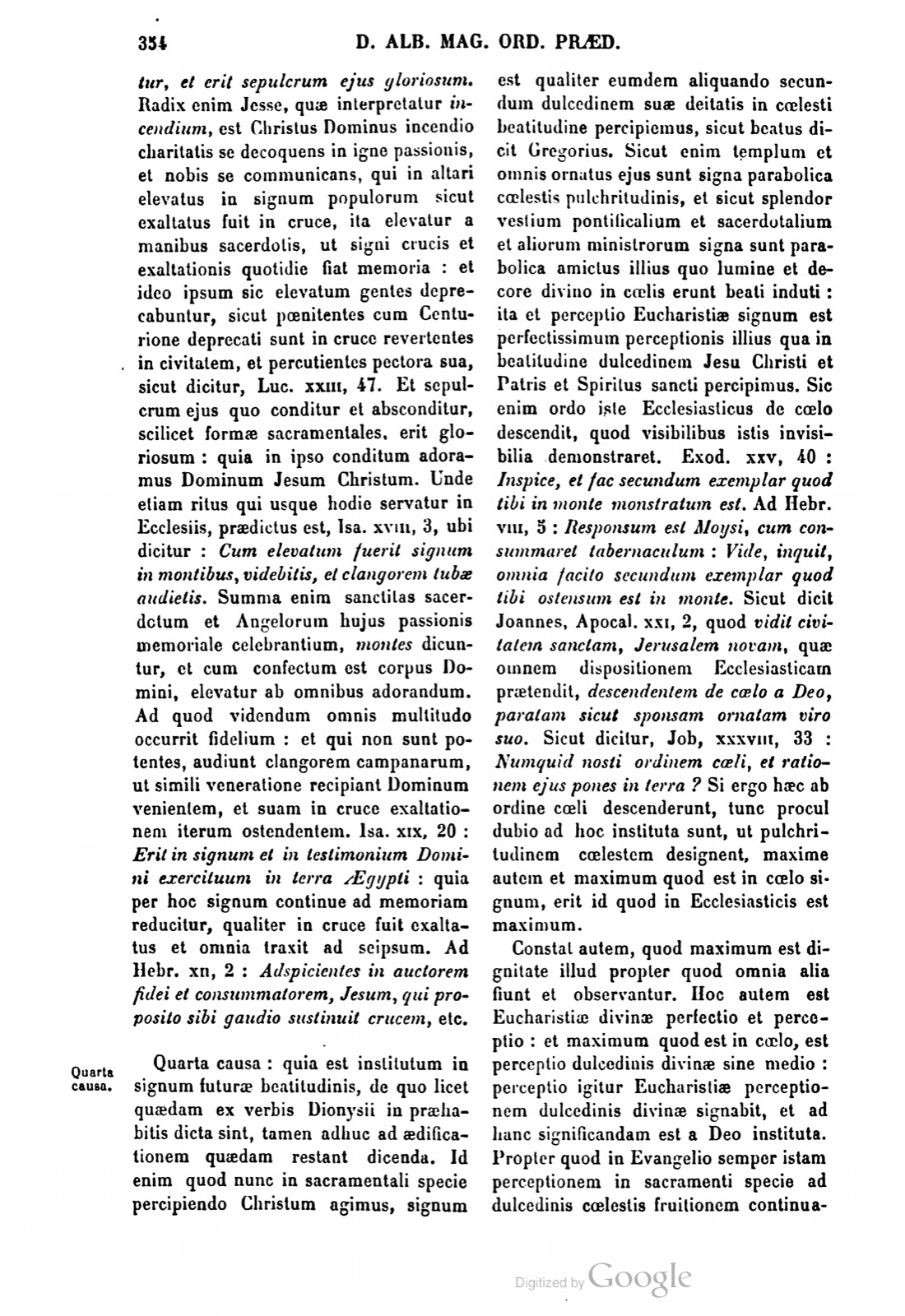
Quarta causa: quia est institutum in signum futurae beatitudinis, de quo licet quaedam ex verbis Dionysii in prae habitis dicta sint, tamen adhuc ad aedificationem quaedam restant dicenda. Id enim quod nunc in sacramentali specie percipiendo Christum agimus, signum est qualiter eumdem aliquando secundum dulcedinem suae deitatis in caelesti beatitudine percipiemus, sicut beatus dicit Gregorius. Sicut enim templum et omnis ornatus ejus sunt signa parabolica caelestis pulchritudinis, et sicut splendor vestium pontificalium et sacerdotalium et aliorum ministrorum signa sunt parabolica amictus illius quo lumine et decore divino in caelis erunt beati induti: ita et perceptio Eucharistiae signum est perfectissimum perceptionis illius qua in beatitudine dulcedinem Jesu Christi et Patris et Spiritus sancti percipimus. Sic enim ordo iste Ecclesiasticus de caelo descendit, quod visibilibus istis invisibilia demonstraret. Exod. XXV, 40: Inspice, et fac secundum exemplar quod tibi in monte monstratum est. Ad Hebr. VIII, 5: Responsum est Moysi, cum consummaret tabernaculum: Vide, inquit, omnia facito secundum exemplar quod tibi ostensum est in monte. Sicut dicit Joannes, Apocal. XXI, 2, quod vidit civitatem sanctam, Jerusalem novam, quae omnem dispositionem Ecclesiasticam praetendit, descendentem de caelo a Deo, paratam sicut sponsam ornatam viro suo. Sicut dicitur, Job, XXXVIII, 33: Numquid nosti ordinem caeli, et rationem ejus pones in terra? Si ergo haec ab ordine caeli descenderunt, tunc procul dubio ad hoc instituta sunt, ut pulchritudinem caelestem designent, maxime autem et maximum quod est in caelo signum, erit id quod in Ecclesiasticis est maximum. Constat autem, quod maximum est dignitate illud propter quod omnia alia fiunt et observantur. Hoc autem est Eucharistiae divinae perfectio et perceptio: et maximum quod est in caelo, est perceptio dulcedinis divinae sine medio: perceptio igitur Eucharistiae perceptionem dulcedinis divinae signabit, et ad hanc significandam est a Deo instituta. Propter quod in Evangelio semper istam perceptionem in sacramenti specie ad dulcedinis caelestis fruitionem continuavit, dicens: Non bibam de hoc genimine vitis, usque in diem illum cum illud bibam novum in regno Dei.1 Genimen enim vitis sacramentum est sub vini specie: novum autem in regno Dei est sub gaudii divini veritate. Unde, Matth. XXVI, 29: Dico autem vobis, non bibam amodo de hoc genimine vitis, usque in diem illum cum illud bibam vobiscum novum in regno Patris mei. Quia sicut hic sacramentaliter bibit in gratia, ita in die illustrationis plenae gloriae bibit cum suis in gloria fruendo bonis divinis et in gratia et in gloria. Unde Gregorius super Job, XXXVIII: « Dum se fruitur, nullo bono indiget. » Et simile huic Matthaeo dicit etiam Marcus. Sed, Luc. XXII, 18, dicit sic: Dico enim vobis quod non bibam de generatione vitis, donec regnum Dei veniat. Venit autem regnum Dei per manifestationem in caelesti beatitudine. Hoc signatum est, Joel, III, 18, ubi dicitur, quod stillabunt montes dulcedinem. Hoc enim continget, quando illi benedicti montes, Pater et Filius et Spiritus sanctus, naturalem dulcedinem omnibus beatis instillabunt, in qua dulcedine perfectam habebunt beatitudinem, de caetero numquam miseri futuri.
The fourth cause: because it was instituted as a sign of future beatitude; concerning this, although certain things from the words of Dionysius have been said in what was held before, nevertheless certain things still remain to be said for edification. For that which now we do by perceiving Christ in sacramental species is a sign of how we shall sometime perceive the same one according to the sweetness of his deity in heavenly beatitude, as blessed Gregory says. For just as the temple and all its adornment are parabolic signs of heavenly beauty, and just as the splendor of pontifical and priestly vestments and of the other ministers are parabolic signs of that clothing with which the blessed will be clothed in the heavens with divine light and beauty, so also the perception of the Eucharist is the most perfect sign of that perception by which in beatitude we perceive the sweetness of Jesus Christ and of the Father and of the Holy Spirit. For this Ecclesiastical order has descended from heaven in such a way that by these visible things it would demonstrate invisible things. Exodus 25:40: "Look, and make according to the exemplar which has been shown to you on the mountain." Hebrews 8:5: "It was answered to Moses, when he was completing the tabernacle: See, he says, do all things according to the exemplar which was shown to you on the mountain." As John says, Apocalypse 21:2, that he saw "the holy city, new Jerusalem," which shows before it every Ecclesiastical arrangement, "descending from heaven from God, prepared as a bride adorned for her husband." As is said, Job 38:33: "Do you know the order of heaven, and will you set down its reason on earth?" If therefore these things descended from the order of heaven, then without doubt they were instituted for this, that they may designate heavenly beauty; and especially, moreover, the greatest sign which is in heaven will be that which is greatest among Ecclesiastical things. But it is clear that that is greatest in dignity on account of which all other things are done and observed. And this is the perfection and perception of the divine Eucharist; and the greatest thing that is in heaven is the perception of divine sweetness without a medium. Therefore the perception of the Eucharist will signify the perception of divine sweetness, and it was instituted by God to signify this. On account of this in the Gospel he always joined that perception in the species of the sacrament to the fruition of heavenly sweetness, saying: "I will not drink of this fruit of the vine until that day when I drink it new in the kingdom of God."1 For the fruit of the vine is the sacrament under the species of wine; but the new thing in the kingdom of God is under the truth of divine joy. Hence, Matthew 26:29: "But I say to you, I will not drink from now of this fruit of the vine, until that day when I drink it with you new in the kingdom of my Father." Because just as here he drinks sacramentally in grace, so on the day of the manifestation of full glory he drinks with his own in glory by enjoying divine goods both in grace and in glory. Hence Gregory on Job 38: "While he enjoys himself, he lacks no good." And Mark also says a thing similar to this Matthew. But Luke 22:18 says thus: "For I say to you that I will not drink of the generation of the vine until the kingdom of God comes." But the kingdom of God comes through manifestation in heavenly beatitude. This was signified, Joel 3:18, where it is said that "the mountains will drip sweetness." For this will happen when those blessed mountains, the Father and the Son and the Holy Spirit, will instill natural sweetness into all the blessed; in this sweetness they will have perfect beatitude, never thereafter to be miserable.
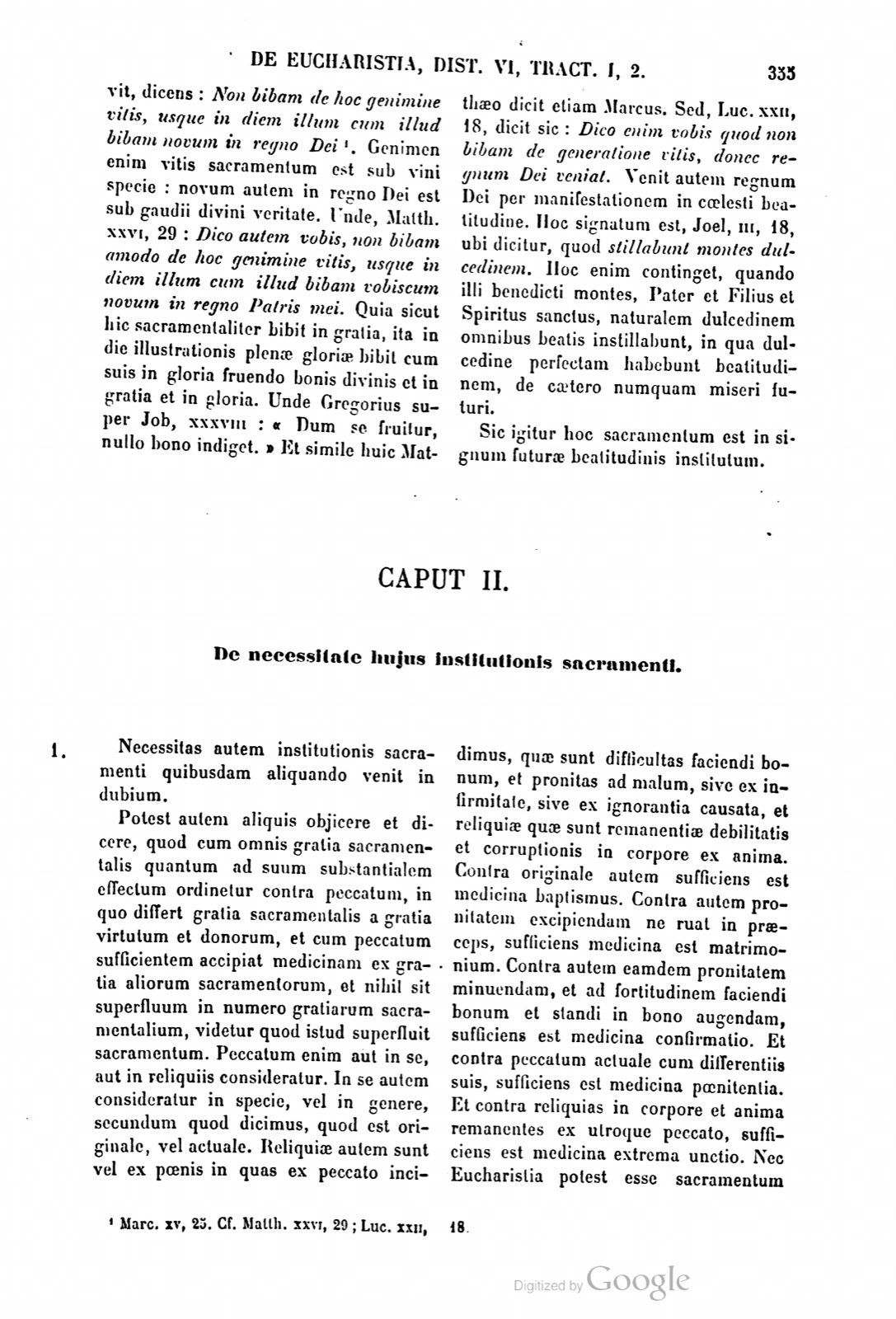
Sic igitur hoc sacramentum est in signum futurae beatitudinis institutum.
Thus therefore this sacrament was instituted as a sign of future beatitude.
Notes
- Mark 14:25. Compare Matthew 26:29; Luke 22:18. (Marc. XIV, 25. Cf. Matth. XXVI, 29; Luc. XXII, 18.) ↩
If a page does not appear, its photograph has not been uploaded yet.