Works › The Book on the Sacrament of the Eucharist
Volume 38 · pp. 419–423
Tractate IV, Chapter I, 3-8
A marker with ≈ is an approximate page boundary, placed by measure of the text; the page photographs remain the authority. In the paired views, clicking a page marker brings that page into view.
Marginal label (printed p. 420): Hoc nomen Paschae septem modis sumitur.
Marginal label (printed p. 422): Utrum corpus Christi possit confici in fermentato?
Marginal label (printed p. 422): Qua forma Christus usus est in consecratione?
Marginal label (printed p. 423): Quando nam corpus suum dedit?
Marginal label (printed p. 423): Utrum non sacerdos possit consecrare?
Haec igitur sunt potissima, quae ego ipse legi in Graecorum assertionibus.
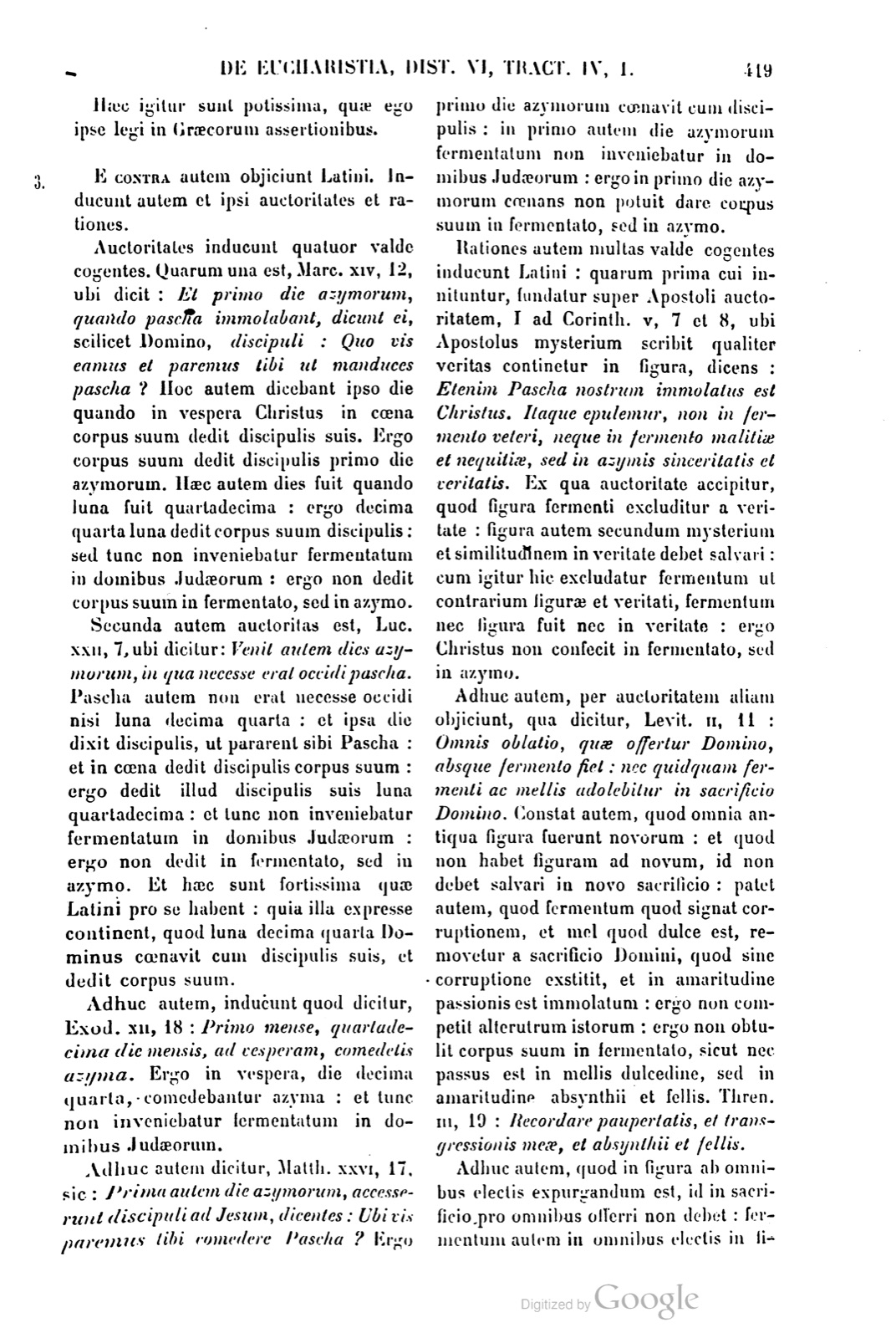
3. E CONTRA autem objiciunt Latini. Inducunt autem et ipsi auctoritates et rationes.
Auctoritates inducunt quatuor valde cogentes. Quarum una est, Marc. XIV, 12, ubi dicit: Et primo die azymorum, quando pascha immolabant, dicunt ei, scilicet Domino, discipuli: Quo vis eamus et paremus tibi ut manduces pascha? Hoc autem dicebant ipso die quando in vespera Christus in coena corpus suum dedit discipulis suis. Ergo corpus suum dedit discipulis primo die azymorum. Haec autem dies fuit quando luna fuit quartadecima: ergo decima quarta luna dedit corpus suum discipulis: sed tunc non inveniebatur fermentatum in domibus Judaeorum: ergo non dedit corpus suum in fermentato, sed in azymo.
Secunda autem auctoritas est, Luc. XXII, 7, ubi dicitur: Venit autem dies azymorum, in qua necesse erat occidi pascha. Pascha autem non erat necesse occidi nisi luna decima quarta: et ipsa die dixit discipulis, ut pararent sibi Pascha: et in coena dedit discipulis corpus suum: ergo dedit illud discipulis suis luna quartadecima: et tunc non inveniebatur fermentatum in domibus Judaeorum: ergo non dedit in fermentato, sed in azymo. Et haec sunt fortissima quae Latini pro se habent: quia illa expresse continent, quod luna decima quarta Dominus coenavit cum discipulis suis, et dedit corpus suum.
Adhuc autem, inducunt quod dicitur, Exod. XII, 18: Primo mense, quartadecima die mensis, ad vesperam, comedetis azyma. Ergo in vespera, die decima quarta, comedebantur azyma: et tunc non inveniebatur fermentatum in domibus Judaeorum.
Adhuc autem dicitur, Matth. XXVI, 17, sic: Prima autem die azymorum, accesserunt discipuli ad Jesum, dicentes: Ubi vis paremus tibi comedere Pascha? Ergo primo die azymorum coenavit cum discipulis: in primo autem die azymorum fermentatum non inveniebatur in domibus Judaeorum: ergo in primo die azymorum coenans non potuit dare corpus suum in fermentato, sed in azymo.
Rationes autem multas valde cogentes inducunt Latini: quarum prima cui innituntur, fundatur super Apostoli auctoritatem, I ad Corinth. V, 7 et 8, ubi Apostolus mysterium scribit qualiter veritas continetur in figura, dicens: Etenim Pascha nostrum immolatus est Christus. Itaque epulemur, non in fermento veteri, neque in fermento malitiae et nequitiae, sed in azymis sinceritatis et veritatis. Ex qua auctoritate accipitur, quod figura fermenti excluditur a veritate: figura autem secundum mysterium et similitudinem in veritate debet salvari: cum igitur hic excludatur fermentum ut contrarium figurae et veritati, fermentum nec figura fuit nec in veritate: ergo Christus non confecit in fermentato, sed in azymo.
Adhuc autem, per auctoritatem aliam objiciunt, qua dicitur, Levit. II, 11: Omnis oblatio, quae offertur Domino, absque fermento fiet: nec quidquam fermenti ac mellis adolebitur in sacrificio Domino. Constat autem, quod omnia antiqua figura fuerunt novorum: et quod non habet figuram ad novum, id non debet salvari in novo sacrificio: patet autem, quod fermentum quod signat corruptionem, et mel quod dulce est, removetur a sacrificio Domini, quod sine corruptione exstitit, et in amaritudine passionis est immolatum: ergo non competit alterutrum istorum: ergo non obtulit corpus suum in fermentato, sicut nec passus est in mellis dulcedine, sed in amaritudine absynthii et fellis. Thren. III, 19: Recordare paupertatis, et transgressionis meae, et absynthii et fellis.
Marginal label (printed p. 420): This name of Pascha is taken in seven modes.
Marginal label (printed p. 422): Whether the body of Christ can be confected in leavened bread?
Marginal label (printed p. 422): What form did Christ use in consecration?
Marginal label (printed p. 423): When indeed did he give his body?
Marginal label (printed p. 423): Whether one who is not a priest can consecrate?
These therefore are the strongest things which I myself have read in the assertions of the Greeks.
3. But ON THE CONTRARY the Latins object. And they themselves also bring forward authorities and reasons.
They bring forward four very compelling authorities. One of them is Mark 14:12, where he says: And on the first day of unleavened breads, when they were sacrificing the Passover, the disciples say to him, namely to the Lord: Where do you wish us to go and prepare for you to eat the Passover? But they were saying this on that very day when in the evening Christ gave his body to his disciples at supper. Therefore he gave his body to the disciples on the first day of unleavened breads. But this day was when the moon was the fourteenth; therefore on the fourteenth moon he gave his body to the disciples. But then leavened bread was not found in the houses of the Jews; therefore he did not give his body in leavened bread, but in unleavened bread.
But the second authority is Luke 22:7, where it is said: But the day of unleavened breads came, on which it was necessary that the Passover be killed. But it was not necessary that the Passover be killed except on the fourteenth moon; and on that day he told the disciples to prepare the Passover for him; and at supper he gave his body to the disciples. Therefore he gave that to his disciples on the fourteenth moon; and then leavened bread was not found in the houses of the Jews; therefore he did not give it in leavened bread, but in unleavened bread. And these are the strongest things which the Latins have for themselves, because they expressly contain that on the fourteenth moon the Lord supped with his disciples and gave his body.
Moreover, they bring forward what is said in Exodus 12:18: In the first month, on the fourteenth day of the month, at evening, you shall eat unleavened breads. Therefore in the evening, on the fourteenth day, unleavened breads were being eaten; and then leavened bread was not found in the houses of the Jews.
Moreover it is said in Matthew 26:17 thus: But on the first day of unleavened breads, the disciples came to Jesus, saying: Where do you wish us to prepare for you to eat the Passover? Therefore he supped with the disciples on the first day of unleavened breads; but on the first day of unleavened breads leavened bread was not found in the houses of the Jews; therefore, supping on the first day of unleavened breads, he could not give his body in leavened bread, but in unleavened bread.
But the Latins bring forward many very compelling reasons. The first on which they rely is founded upon the authority of the Apostle, 1 Corinthians 5:7 and 8, where the Apostle writes the mystery, how truth is contained in figure, saying: For Christ our Passover has been sacrificed. Therefore let us feast, not in the old leaven, nor in the leaven of malice and wickedness, but in the unleavened breads of sincerity and truth. From this authority it is taken that the figure of leaven is excluded from the truth; but figure according to mystery and likeness ought to be preserved in the truth. Since therefore leaven is here excluded as contrary to figure and truth, leaven was neither in the figure nor in the truth; therefore Christ did not confect in leavened bread, but in unleavened bread.
Moreover, by another authority they object, by which it is said in Leviticus 2:11: Every oblation which is offered to the Lord shall be made without leaven; nor shall anything of leaven and honey be burned in sacrifice to the Lord. But it is agreed that all ancient things were a figure of new things; and what does not have a figure toward the new ought not to be preserved in the new sacrifice. But it is clear that leaven, which signifies corruption, and honey, which is sweet, are removed from the sacrifice of the Lord, which existed without corruption and was immolated in the bitterness of the passion. Therefore neither of those belongs to it; therefore he did not offer his body in leavened bread, just as neither did he suffer in the sweetness of honey, but in the bitterness of wormwood and gall. Lamentations 3:19: Remember my poverty, and my transgression, and the wormwood and the gall.
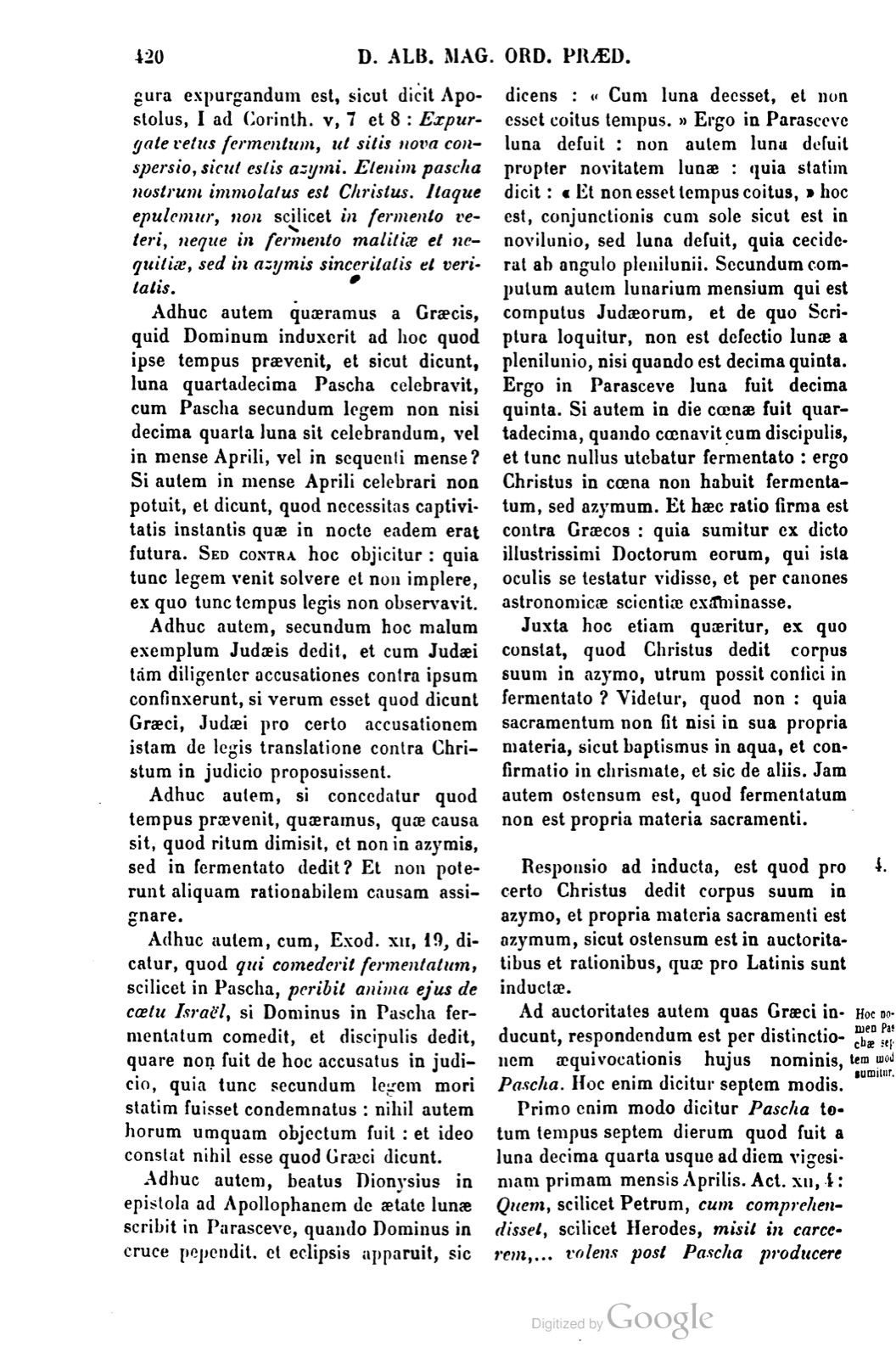
Adhuc autem, quod in figura ab omnibus electis expurgandum est, id in sacrificio pro omnibus offerri non debet: fermentum autem in omnibus electis in figura expurgandum est, sicut dicit Apostolus, I ad Corinth. V, 7 et 8: Expurgate vetus fermentum, ut sitis nova conspersio, sicut estis azymi. Etenim pascha nostrum immolatus est Christus. Itaque epulemur, non scilicet in fermento veteri, neque in fermento malitiae et nequitiae, sed in azymis sinceritatis et veritatis.
Adhuc autem quaeramus a Graecis, quid Dominum induxerit ad hoc quod ipse tempus praevenit, et sicut dicunt, luna quartadecima Pascha celebravit, cum Pascha secundum legem non nisi decima quarta luna sit celebrandum, vel in mense Aprili, vel in sequenti mense? Si autem in mense Aprili celebrari non potuit, et dicunt, quod necessitas captivitatis instantis quae in nocte eadem erat futura. SED CONTRA hoc objicitur: quia tunc legem venit solvere et non implere, ex quo tunc tempus legis non observavit.
Adhuc autem, secundum hoc malum exemplum Judaeis dedit, et cum Judaei tam diligenter accusationes contra ipsum confinxerunt, si verum esset quod dicunt Graeci, Judaei pro certo accusationem istam de legis translatione contra Christum in judicio proposuissent.
Adhuc autem, si concedatur quod tempus praevenit, quaeramus, quae causa sit, quod ritum dimisit, et non in azymis, sed in fermentato dedit? Et non poterunt aliquam rationabilem causam assignare.
Adhuc autem, cum, Exod. XII, 19, dicatur, quod qui comederit fermentatum, scilicet in Pascha, peribit anima ejus de coetu Israel, si Dominus in Pascha fermentatum comedit, et discipulis dedit, quare non fuit de hoc accusatus in judicio, quia tunc secundum legem mori statim fuisset condemnatus: nihil autem horum umquam objectum fuit: et ideo constat nihil esse quod Graeci dicunt.
Adhuc autem, beatus Dionysius in epistola ad Apollophanem de aetate lunae scribit in Parasceve, quando Dominus in cruce pependit, et eclipsis apparuit, sic dicens: « Cum luna deesset, et non esset coitus tempus. » Ergo in Parasceve luna defuit: non autem luna defuit propter novitatem lunae: quia statim dicit: « Et non esset tempus coitus, » hoc est, conjunctionis cum sole sicut est in novilunio, sed luna defuit, quia ceciderat ab angulo plenilunii. Secundum computum autem lunarium mensium qui est computus Judaeorum, et de quo Scriptura loquitur, non est defectio lunae a plenilunio, nisi quando est decima quinta. Ergo in Parasceve luna fuit decima quinta. Si autem in die coenae fuit quartadecima, quando coenavit cum discipulis, et tunc nullus utebatur fermentato: ergo Christus in coena non habuit fermentatum, sed azymum. Et haec ratio firma est contra Graecos: quia sumitur ex dicto illustrissimi Doctorum eorum, qui ista oculis se testatur vidisse, et per canones astronomicae scientiae examinasse.
Moreover, what in figure must be purged out from all the elect ought not to be offered in sacrifice for all; but leaven must be purged out in figure in all the elect, as the Apostle says, 1 Corinthians 5:7 and 8: Purge out the old leaven, that you may be a new sprinkling, as you are unleavened. For Christ our Passover has been sacrificed. Therefore let us feast, not, namely, in the old leaven, nor in the leaven of malice and wickedness, but in the unleavened breads of sincerity and truth.
Moreover, let us ask the Greeks what led the Lord to this, that he anticipated the time and, as they say, celebrated the Passover on the fourteenth moon, since according to the law the Passover must be celebrated only on the fourteenth moon, either in the month of April or in the following month. But if it could not be celebrated in the month of April, and they say that it was the necessity of the impending captivity which was going to happen on the same night. But AGAINST this it is objected that then he came to dissolve the law and not to fulfill it, since he then did not observe the time of the law.
Moreover, according to this he gave a bad example to the Jews; and since the Jews so diligently fabricated accusations against him, if what the Greeks say were true, the Jews certainly would have proposed that accusation concerning the transference of the law against Christ in the judgment.
Moreover, if it is conceded that he anticipated the time, let us ask what cause there is that he abandoned the rite and gave not in unleavened breads but in leavened bread. And they will not be able to assign any reasonable cause.
Moreover, since in Exodus 12:19 it is said that he who eats leavened bread, namely at Passover, shall have his soul perish from the assembly of Israel, if the Lord ate leavened bread at Passover and gave it to the disciples, why was he not accused of this in the judgment, because then according to the law he would immediately have been condemned to die? But none of these things was ever objected; and therefore it is agreed that there is nothing in what the Greeks say.
Moreover, blessed Dionysius in the letter to Apollophanes writes about the age of the moon on Parasceve, when the Lord hung on the cross and the eclipse appeared, saying thus: "When the moon was lacking, and it was not the time of conjunction." Therefore on Parasceve the moon was lacking; but the moon was not lacking because of the newness of the moon, because immediately he says: "And it was not the time of conjunction," that is, of conjunction with the sun as there is at new moon; but the moon was lacking because it had fallen away from the angle of the full moon. But according to the computation of lunar months, which is the computation of the Jews and of which Scripture speaks, there is no falling away of the moon from full moon except when it is the fifteenth. Therefore on Parasceve the moon was the fifteenth. But if on the day of the supper it was the fourteenth, when he supped with the disciples, and then no one used leavened bread, therefore Christ at supper did not have leavened bread, but unleavened bread. And this reason is firm against the Greeks, because it is taken from the saying of the most illustrious of their Doctors, who testifies that he saw these things with his eyes and examined them by the canons of astronomical science.
Juxta hoc etiam quaeritur, ex quo constat, quod Christus dedit corpus suum in azymo, utrum possit confici in fermentato? Videtur, quod non: quia sacramentum non fit nisi in sua propria materia, sicut baptismus in aqua, et confirmatio in chrismate, et sic de aliis. Jam autem ostensum est, quod fermentatum non est propria materia sacramenti.
4. Responsio ad inducta, est quod pro certo Christus dedit corpus suum in azymo, et propria materia sacramenti est azymum, sicut ostensum est in auctoritatibus et rationibus, quae pro Latinis sunt inductae.
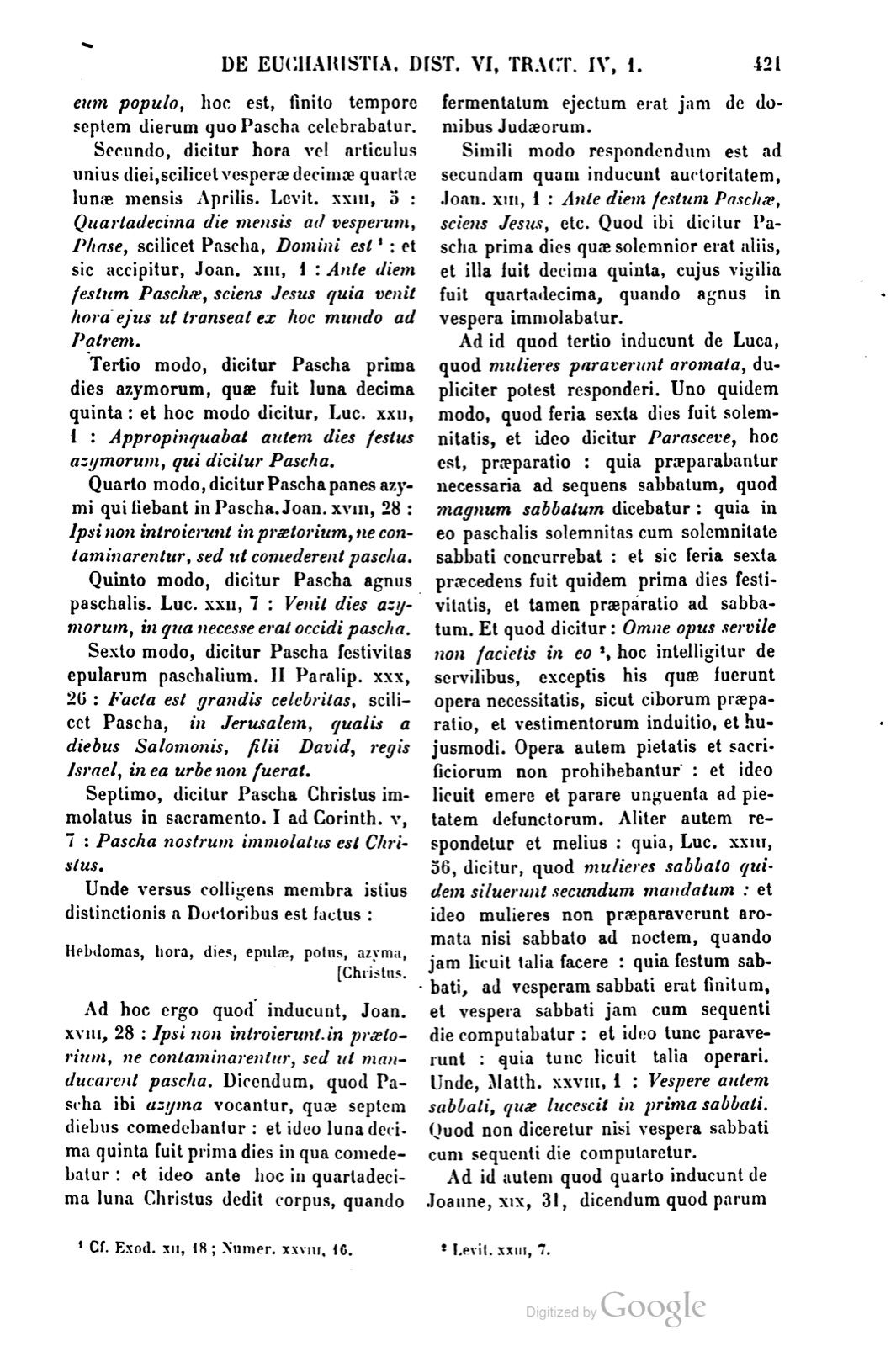
Ad auctoritates autem quas Graeci inducunt, respondendum est per distinctionem aequivocationis hujus nominis, Pascha. Hoc enim dicitur septem modis.
Primo enim modo dicitur Pascha totum tempus septem dierum quod fuit a luna decima quarta usque ad diem vigesimam primam mensis Aprilis. Act. XII, 4: Quem, scilicet Petrum, cum comprehendisset, scilicet Herodes, misit in carcerem, ... volens post Pascha producere eum populo, hoc est, finito tempore septem dierum quo Pascha celebrabatur.
Secundo, dicitur hora vel articulus unius diei, scilicet vesperae decimae quartae lunae mensis Aprilis. Levit. XXIII, 5: Quartadecima die mensis ad vesperum, Phase, scilicet Pascha, Domini est 1: et sic accipitur, Joan. XIII, 1: Ante diem festum Paschae, sciens Jesus quia venit hora ejus ut transeat ex hoc mundo ad Patrem.
Tertio modo, dicitur Pascha prima dies azymorum, quae fuit luna decima quinta: et hoc modo dicitur, Luc. XXII, 1: Appropinquabat autem dies festus azymorum, qui dicitur Pascha.
Quarto modo, dicitur Pascha panes azymi qui fiebant in Pascha. Joan. XVIII, 28: Ipsi non introierunt in praetorium, ne contaminarentur, sed ut comederent pascha.
Quinto modo, dicitur Pascha agnus paschalis. Luc. XXII, 7: Venit dies azymorum, in qua necesse erat occidi pascha.
Sexto modo, dicitur Pascha festivitas epularum paschalium. II Paralip. XXX, 26: Facta est grandis celebritas, scilicet Pascha, in Jerusalem, qualis a diebus Salomonis, filii David, regis Israel, in ea urbe non fuerat.
Septimo, dicitur Pascha Christus immolatus in sacramento. I ad Corinth. V, 7: Pascha nostrum immolatus est Christus.
Unde versus colligens membra istius distinctionis a Doctoribus est factus: Hebdomas, hora, dies, epulae, potus, azyma, Christus.
Ad hoc ergo quod inducunt, Joan. XVIII, 28: Ipsi non introierunt in praetorium, ne contaminarentur, sed ut manducarent pascha. Dicendum, quod Pascha ibi azyma vocantur, quae septem diebus comedebantur: et ideo luna decima quinta fuit prima dies in qua comedebatur: et ideo ante hoc in quartadecima luna Christus dedit corpus, quando fermentatum ejectum erat jam de domibus Judaeorum.
Simili modo respondendum est ad secundam quam inducunt auctoritatem, Joan. XIII, 1: Ante diem festum Paschae, sciens Jesus, etc. Quod ibi dicitur Pascha prima dies quae solemnior erat aliis, et illa fuit decima quinta, cujus vigilia fuit quartadecima, quando agnus in vespera immolabatur.
Ad id quod tertio inducunt de Luca, quod mulieres paraverunt aromata, dupliciter potest responderi. Uno quidem modo, quod feria sexta dies fuit solemnitatis, et ideo dicitur Parasceve, hoc est, praeparatio: quia praeparabantur necessaria ad sequens sabbatum, quod magnum sabbatum dicebatur: quia in eo paschalis solemnitas cum solemnitate sabbati concurrebat: et sic feria sexta praecedens fuit quidem prima dies festivitatis, et tamen praeparatio ad sabbatum. Et quod dicitur: Omne opus servile non facietis in eo 2, hoc intelligitur de servilibus, exceptis his quae fuerunt opera necessitatis, sicut ciborum praeparatio, et vestimentorum induitio, et hujusmodi. Opera autem pietatis et sacrificiorum non prohibebantur: et ideo licuit emere et parare unguenta ad pietatem defunctorum. Aliter autem respondetur et melius: quia, Luc. XXIII, 56, dicitur, quod mulieres sabbato quidem siluerunt secundum mandatum: et ideo mulieres non praeparaverunt aromata nisi sabbato ad noctem, quando jam licuit talia facere: quia festum sabbati, ad vesperam sabbati erat finitum, et vespera sabbati jam cum sequenti die computabatur: et ideo tunc paraverunt: quia tunc licuit talia operari. Unde, Matth. XXVIII, 1: Vespere autem sabbati, quae lucescit in prima sabbati. Quod non diceretur nisi vespera sabbati cum sequenti die computaretur.
Next to this it is also asked, since it is agreed that Christ gave his body in unleavened bread, whether it can be confected in leavened bread. It seems that it cannot, because a sacrament does not come to be except in its own proper matter, as baptism in water, and confirmation in chrism, and so concerning the others. But it has already been shown that leavened bread is not the proper matter of the sacrament.
4. The response to the things brought forward is that certainly Christ gave his body in unleavened bread, and the proper matter of the sacrament is unleavened bread, as has been shown in the authorities and reasons which were brought forward for the Latins.
But to the authorities which the Greeks bring forward, one must respond through the distinction of equivocation of this name, Passover. For this is said in seven ways.
In the first way, Passover is called the whole time of seven days which was from the fourteenth moon up to the twenty-first day of the month of April. Acts 12:4: Whom, namely Peter, when he had seized him, namely Herod, sent into prison, ... intending after Passover to bring him forth to the people; that is, when the time of seven days in which Passover was celebrated had been completed.
Secondly, it is called the hour or moment of one day, namely of the evening of the fourteenth moon of the month of April. Leviticus 23:5: On the fourteenth day of the month at evening, Phase, namely Passover, is of the Lord 1; and so it is taken in John 13:1: Before the feast day of Passover, Jesus knowing that his hour had come that he should pass from this world to the Father.
In the third way, Passover is called the first day of unleavened breads, which was the fifteenth moon; and in this way it is said in Luke 22:1: But the festal day of unleavened breads, which is called Passover, was drawing near.
In the fourth way, Passover is called the unleavened breads which were made at Passover. John 18:28: They did not enter into the praetorium, lest they be contaminated, but that they might eat the Passover.
In the fifth way, Passover is called the paschal lamb. Luke 22:7: The day of unleavened breads came, on which it was necessary that the Passover be killed.
In the sixth way, Passover is called the festivity of the paschal feasts. 2 Chronicles 30:26: A great celebration was made, namely Passover, in Jerusalem, such as from the days of Solomon, son of David, king of Israel, had not been in that city.
Seventhly, Passover is called Christ immolated in the sacrament. 1 Corinthians 5:7: Christ our Passover has been sacrificed.
Hence a verse collecting the members of this distinction was made by the Doctors: Week, hour, day, feasts, drink, unleavened breads, Christ.
Therefore to this which they bring forward, John 18:28: They did not enter into the praetorium, lest they be contaminated, but that they might eat the Passover. It must be said that Passover there is called the unleavened breads which were eaten for seven days; and therefore the fifteenth moon was the first day on which it was eaten; and therefore before this, on the fourteenth moon, Christ gave his body, when leavened bread had already been cast out of the houses of the Jews.
In a similar way one must respond to the second authority which they bring forward, John 13:1: Before the feast day of Passover, Jesus knowing, etc. What is there called Passover is the first day, which was more solemn than the others, and that was the fifteenth, whose vigil was the fourteenth, when the lamb was immolated in the evening.
To that which they bring forward third from Luke, that the women prepared spices, it can be answered in two ways. In one way indeed, that Friday was a day of solemnity, and therefore it is called Parasceve, that is, preparation, because necessities were being prepared for the following Sabbath, which was called the great Sabbath, because in it the paschal solemnity concurred with the solemnity of the Sabbath; and thus the preceding Friday was indeed the first day of festivity, and yet preparation for the Sabbath. And what is said: You shall do no servile work on it 2, is understood of servile works, excepting those which were works of necessity, such as preparation of foods, putting on of garments, and things of this kind. But works of piety and of sacrifices were not prohibited; and therefore it was permitted to buy and prepare ointments for piety toward the dead. But otherwise, and better, it is answered that in Luke 23:56 it is said that the women indeed were silent on the Sabbath according to the commandment; and therefore the women did not prepare spices except on Saturday toward night, when it was now permitted to do such things, because the feast of the Sabbath was finished at the evening of the Sabbath, and the evening of the Sabbath was now reckoned with the following day; and therefore they then prepared them, because then it was permitted to perform such things. Hence Matthew 28:1: But in the evening of the Sabbath, which dawns toward the first of the Sabbath. This would not be said unless the evening of the Sabbath were reckoned with the following day.
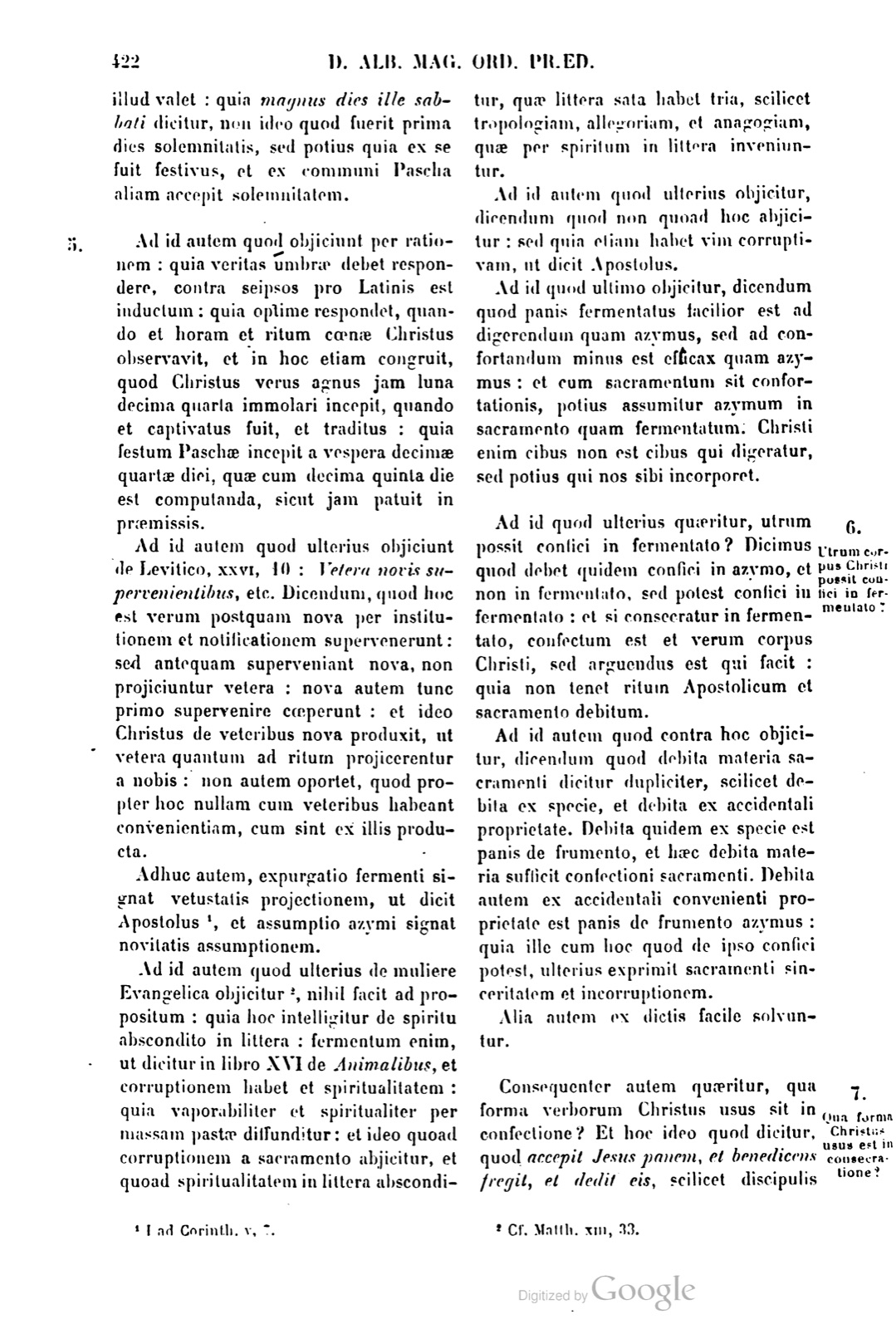
Ad id autem quod quarto inducunt de Joanne, XIX, 31, dicendum quod parum illud valet: quia magnus dies ille sabbati dicitur, non ideo quod fuerit prima dies solemnitatis, sed potius quia ex se fuit festivus, et ex communi Pascha aliam accepit solemnitatem.
5. Ad id autem quod objiciunt per rationem: quia veritas umbrae debet respondere, contra seipsos pro Latinis est inductum: quia optime respondet, quando et horam et ritum coenae Christus observavit, et in hoc etiam congruit, quod Christus verus agnus jam luna decima quarta immolari incepit, quando et captivatus fuit, et traditus: quia festum Paschae incepit a vespera decimae quartae diei, quae cum decima quinta die est computanda, sicut jam patuit in praemissis.
Ad id autem quod ulterius objiciunt de Levitico, XXVI, 10: Vetera novis supervenientibus, etc. Dicendum, quod hoc est verum postquam nova per institutionem et notificationem supervenerunt: sed antequam superveniant nova, non projiciuntur vetera: nova autem tunc primo supervenire coeperunt: et ideo Christus de veteribus nova produxit, ut vetera quantum ad ritum projicerentur a nobis: non autem oportet, quod propter hoc nullam cum veteribus habeant convenientiam, cum sint ex illis producta.
Adhuc autem, expurgatio fermenti signat vetustatis projectionem, ut dicit Apostolus, et assumptio azymi signat novitatis assumptionem.
Ad id autem quod ulterius de muliere Evangelica objicitur, nihil facit ad propositum: quia hoc intelligitur de spiritu abscondito in littera: fermentum enim, ut dicitur in libro XVI de Animalibus, et corruptionem habet et spiritualitatem: quia vaporabiliter et spiritualiter per massam pastae diffunditur: et ideo quoad corruptionem a sacramento abjicitur, et quoad spiritualitatem in littera absconditur, quae littera sata habet tria, scilicet tropologiam, allegoriam, et anagogiam, quae per spiritum in littera inveniuntur.
Ad id autem quod ulterius objicitur, dicendum quod non quoad hoc abjicitur: sed quia etiam habet vim corruptivam, ut dicit Apostolus.
But to that which they bring forward fourth from John 19:31, it must be said that it has little force, because that day of the Sabbath is called great not because it was the first day of solemnity, but rather because it was festive of itself and received another solemnity from the common Passover.
5. To that which they object by reason, because truth ought to correspond to shadow, it has been brought forward against themselves on behalf of the Latins, because it corresponds best when Christ observed both the hour and the rite of the supper; and it also agrees in this, that Christ the true lamb already began to be immolated on the fourteenth moon, when he was both captured and handed over, because the feast of Passover began from the evening of the fourteenth day, which must be reckoned with the fifteenth day, as has already been clear in the preceding matters.
To that which they further object from Leviticus 26:10: The old things with the new coming upon them, etc. It must be said that this is true after the new things have come upon them through institution and notification; but before the new things come upon them, the old things are not cast away. But the new things then first began to come upon them; and therefore Christ produced new things out of old things, so that the old things, as to the rite, might be cast away by us; but because of this it is not necessary that they have no fittingness with the old things, since they were produced out of them.
Moreover, the purging out of leaven signifies the casting away of oldness, as the Apostle says, and the assumption of unleavened bread signifies the assumption of newness.
To that which is further objected concerning the Gospel woman, it does nothing for the proposed matter, because this is understood of the spirit hidden in the letter; for leaven, as is said in book XVI On Animals, has both corruption and spirituality, because it is diffused vaporously and spiritually through the mass of dough; and therefore, as regards corruption, it is cast out from the sacrament, and as regards spirituality it is hidden in the letter, which letter has three measures, namely tropology, allegory, and anagogy, which are found through the spirit in the letter.
To that which is further objected, it must be said that it is not cast out in this respect, but because it also has a corruptive power, as the Apostle says.
Ad id quod ultimo objicitur, dicendum quod panis fermentatus facilior est ad digerendum quam azymus, sed ad confortandum minus est efficax quam azymus: et cum sacramentum sit confortationis, potius assumitur azymum in sacramento quam fermentatum. Christi enim cibus non est cibus qui digeratur, sed potius qui nos sibi incorporet.
6. Ad id quod ulterius quaeritur, utrum possit confici in fermentato? Dicimus quod debet quidem confici in azymo, et non in fermentato, sed potest confici in fermentato: et si consecratur in fermentato, confectum est et verum corpus Christi, sed arguendus est qui facit: quia non tenet ritum Apostolicum et sacramento debitum.
Ad id autem quod contra hoc objicitur, dicendum quod debita materia sacramenti dicitur dupliciter, scilicet debita ex specie, et debita ex accidentali proprietate. Debita quidem ex specie est panis de frumento, et haec debita materia sufficit confectioni sacramenti. Debita autem ex accidentali convenienti proprietate est panis de frumento azymus: quia ille cum hoc quod de ipso confici potest, ulterius exprimit sacramenti sinceritatem et incorruptionem.
Alia autem ex dictis facile solvuntur.
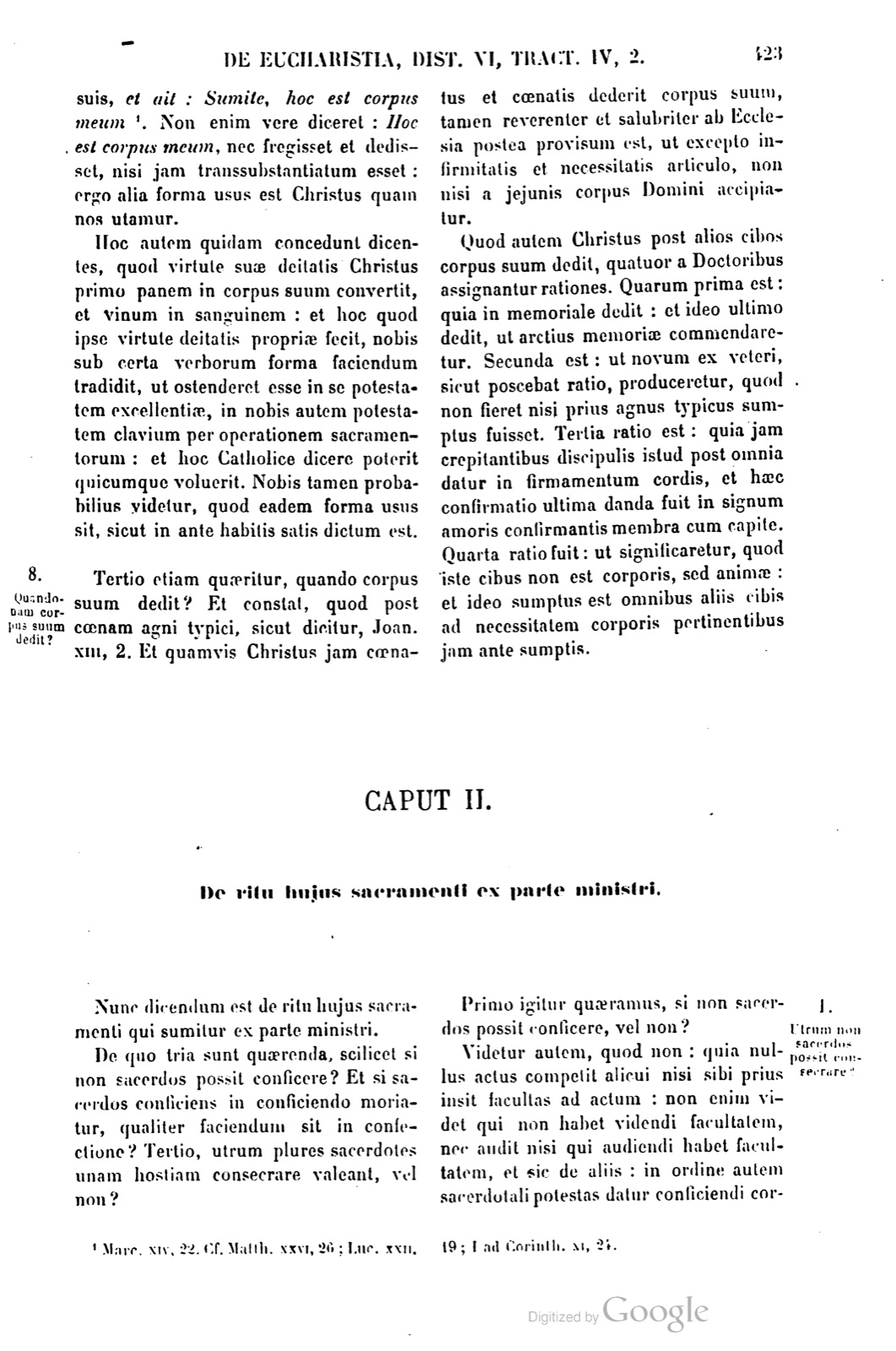
7. Consequenter autem quaeritur, qua forma verborum Christus usus sit in confectione? Et hoc ideo quod dicitur, quod accepit Jesus panem, et benedicens fregit, et dedit eis, scilicet discipulis suis, et ait: Sumite, hoc est corpus meum 3. Non enim vere diceret: Hoc est corpus meum, nec fregisset et dedisset, nisi jam transsubstantiatum esset: ergo alia forma usus est Christus quam nos utamur.
Hoc autem quidam concedunt dicentes, quod virtute suae deitatis Christus primo panem in corpus suum convertit, et vinum in sanguinem: et hoc quod ipse virtute deitatis propriae fecit, nobis sub certa verborum forma faciendum tradidit, ut ostenderet esse in se potestatem excellentiae, in nobis autem potestatem clavium per operationem sacramentorum: et hoc Catholice dicere poterit quicumque voluerit. Nobis tamen probabilius videtur, quod eadem forma usus sit, sicut in ante habitis satis dictum est.
8. Tertio etiam quaeritur, quando corpus suum dedit? Et constat, quod post coenam agni typici, sicut dicitur, Joan. XIII, 2. Et quamvis Christus jam coenatus et coenatis dederit corpus suum, tamen reverenter et salubriter ab Ecclesia postea provisum est, ut excepto infirmitatis et necessitatis articulo, non nisi a jejunis corpus Domini accipiatur.
Quod autem Christus post alios cibos corpus suum dedit, quatuor a Doctoribus assignantur rationes. Quarum prima est: quia in memoriale dedit: et ideo ultimo dedit, ut arctius memoriae commendaretur. Secunda est: ut novum ex veteri, sicut poscebat ratio, produceretur, quod non fieret nisi prius agnus typicus sumptus fuisset. Tertia ratio est: quia jam crepitantibus discipulis istud post omnia datur in firmamentum cordis, et haec confirmatio ultima danda fuit in signum amoris confirmantis membra cum capite. Quarta ratio fuit: ut significaretur, quod iste cibus non est corporis, sed animae: et ideo sumptus est omnibus aliis cibis ad necessitatem corporis pertinentibus jam ante sumptis.
To what is objected last, it must be said that leavened bread is easier to digest than unleavened bread, but for strengthening it is less efficacious than unleavened bread; and since the sacrament is one of strengthening, unleavened bread is taken up in the sacrament rather than leavened bread. For Christ's food is not food that is digested, but rather food that incorporates us into himself.
6. To that which is further asked, whether it can be confected in leavened bread, we say that it ought indeed to be confected in unleavened bread and not in leavened bread, but it can be confected in leavened bread; and if it is consecrated in leavened bread, it is confected and the true body of Christ, but he who does it must be rebuked, because he does not hold the Apostolic rite and the rite due to the sacrament.
But to that which is objected against this, it must be said that due matter of the sacrament is said in two ways, namely due from species and due from accidental property. Due indeed from species is bread from wheat, and this due matter suffices for the confection of the sacrament. But due from accidental fitting property is unleavened bread from wheat, because that bread, along with the fact that it can be confected from it, further expresses the sincerity and incorruption of the sacrament.
But the other things are easily solved from what has been said.
7. Consequently it is asked what form of words Christ used in the confection. And this is because it is said that Jesus took bread, and blessing it broke it and gave it to them, namely to his disciples, and said: Take, this is my body 3. For he would not truly say: This is my body, nor would he have broken and given it, unless it had already been transubstantiated. Therefore Christ used another form than we use.
But some concede this, saying that by the power of his deity Christ first converted bread into his body and wine into blood; and that which he himself did by the power of his own deity he handed down to us to be done under a certain form of words, so that he might show that in himself there is the power of excellence, but in us the power of the keys through the operation of the sacraments. And whoever wishes will be able to say this Catholicly. Yet it seems more probable to us that he used the same form, as has been sufficiently said in the things had before.
8. Thirdly it is also asked when he gave his body. And it is agreed that it was after the supper of the typical lamb, as is said in John 13:2. And although Christ, already having supped and to those having supped, gave his body, nevertheless afterwards it was provided reverently and wholesomely by the Church that, except in a moment of infirmity and necessity, the body of the Lord should be received only by those fasting.
But that Christ gave his body after other foods, four reasons are assigned by the Doctors. The first of these is that he gave it as a memorial; and therefore he gave it last, so that it might be commended more tightly to memory. The second is that the new might be produced from the old, as reason was demanding, which would not happen unless the typical lamb had first been taken. The third reason is that, when the disciples were already belching, this is given after all things for the firmament of the heart, and this final confirmation had to be given as a sign of the love confirming the members with the head. The fourth reason was so that it might be signified that this food is not of the body but of the soul; and therefore it was taken when all the other foods pertaining to the necessity of the body had already been taken before.
If a page does not appear, its photograph has not been uploaded yet.