Works › The Book on the Sacrament of the Eucharist
Volume 38 · pp. 364–366
Treatise II. Chapter I. On the Matter of the Sacrament, 1-3
A marker with ≈ is an approximate page boundary, placed by measure of the text; the page photographs remain the authority. In the paired views, clicking a page marker brings that page into view.
Marginal label (printed p. 364): In sacramento corporalis materia propter tres causas.
TRACTATUS II. DE MATERIA ET FORMA HUJUS SACRAMENTI.
CAPUT I. De materia sacramenti.
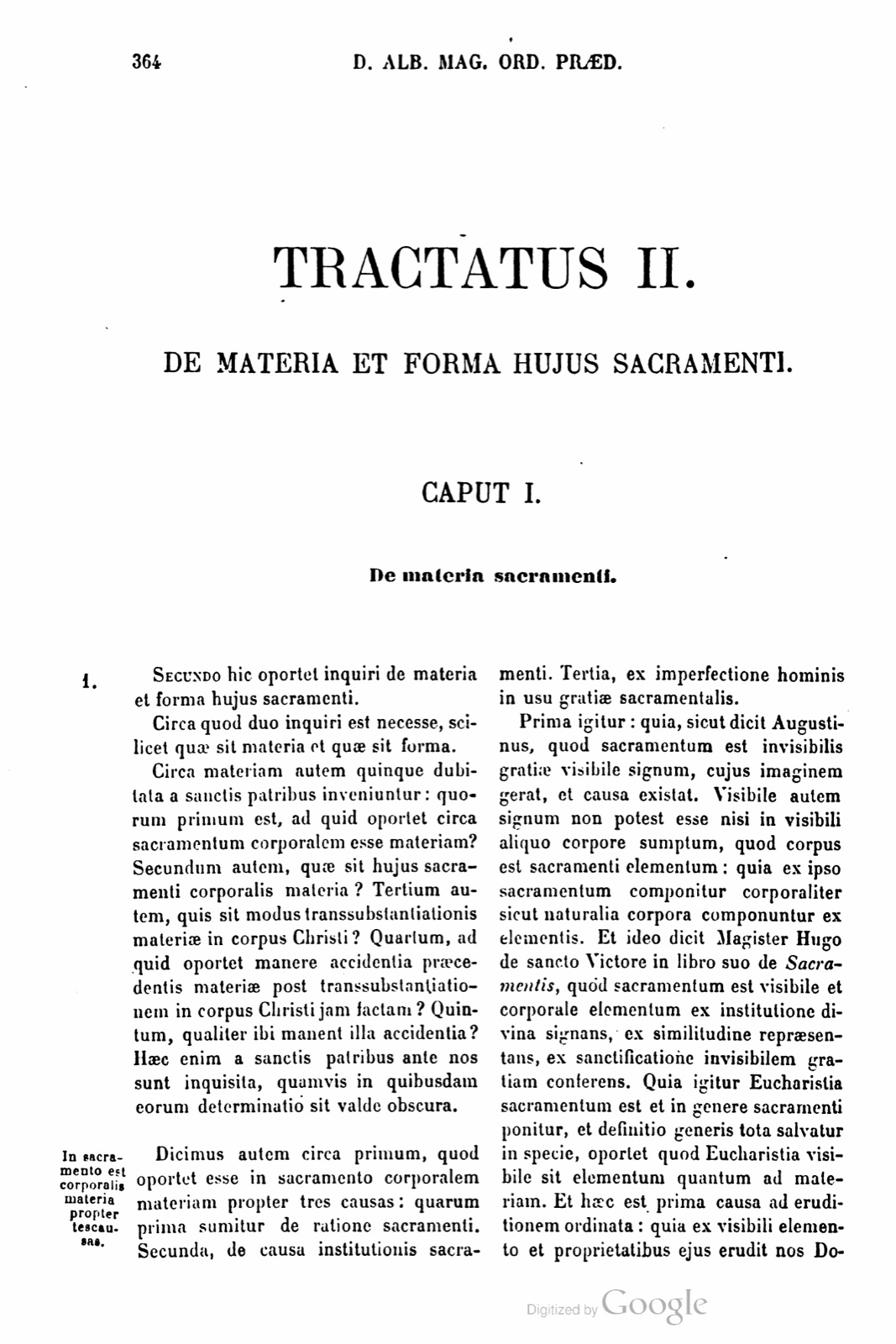
1. Secundo hic oportet inquiri de materia et forma hujus sacramenti.
Circa quod duo inquiri est necesse, scilicet quae sit materia et quae sit forma.
Circa materiam autem quinque dubitata a sanctis patribus inveniuntur: quorum primum est, ad quid oportet circa sacramentum corporalem esse materiam? Secundum autem, quae sit hujus sacramenti corporalis materia? Tertium autem, quis sit modus transsubstantiationis materiae in corpus Christi? Quartum, ad quid oportet manere accidentia praecedentis materiae post transsubstantiationem in corpus Christi jam factam? Quintum, qualiter ibi manent illa accidentia? Haec enim a sanctis patribus ante nos sunt inquisita, quamvis in quibusdam eorum determinatio sit valde obscura.
Dicimus autem circa primum, quod oportet esse in sacramento corporalem materiam propter tres causas: quarum prima sumitur de ratione sacramenti. Secunda, de causa institutionis sacramenti. Tertia, ex imperfectione hominis in usu gratiae sacramentalis.
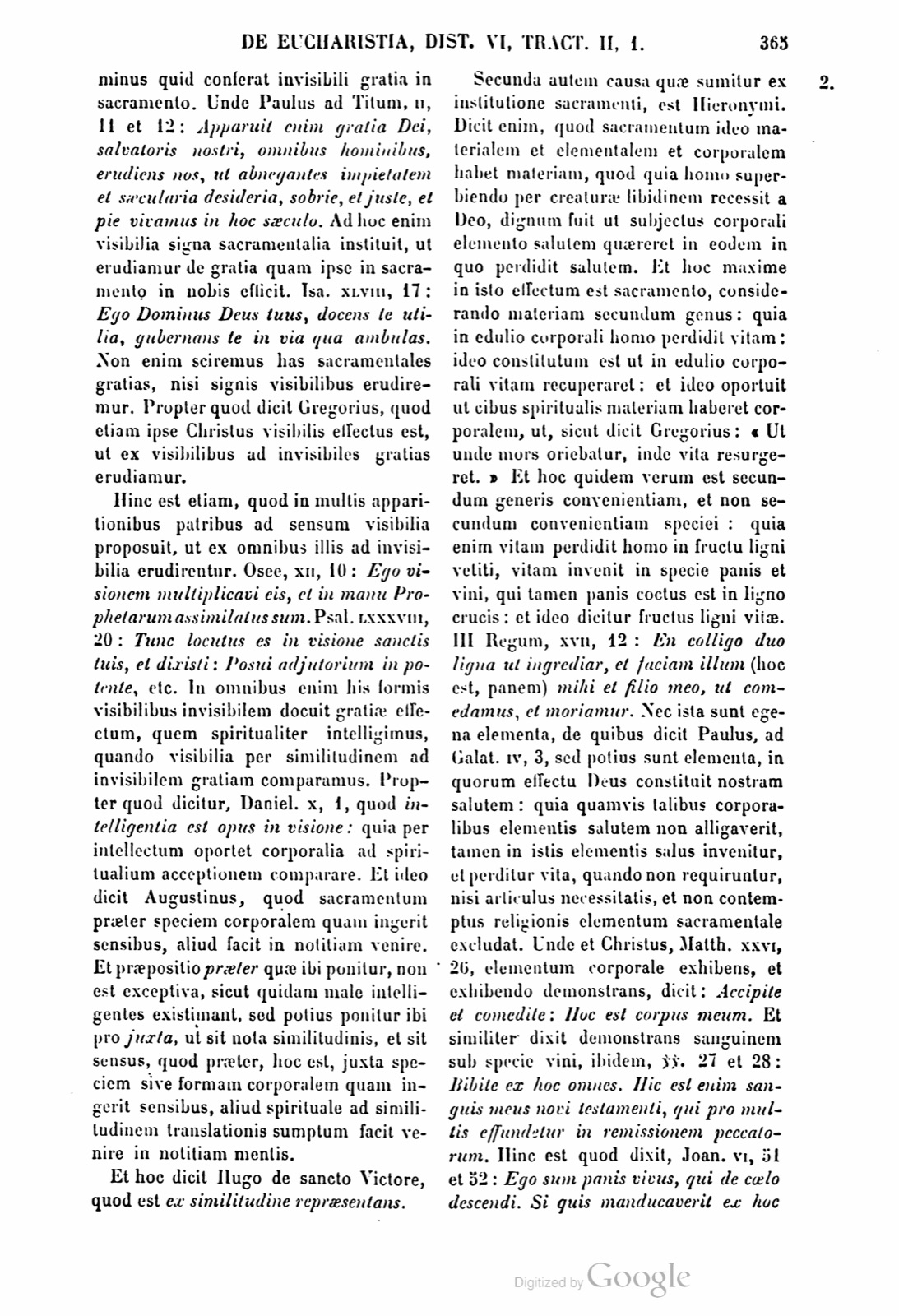
Prima igitur: quia, sicut dicit Augustinus, quod sacramentum est invisibilis gratiae visibile signum, cujus imaginem gerat, et causa existat. Visibile autem signum non potest esse nisi in visibili aliquo corpore sumptum, quod corpus est sacramenti elementum: quia ex ipso sacramentum componitur corporaliter sicut naturalia corpora componuntur ex elementis. Et ideo dicit Magister Hugo de sancto Victore in libro suo de Sacramentis, quod sacramentum est visibile et corporale elementum ex institutione divina signans, ex similitudine repraesentans, ex sanctificatione invisibilem gratiam conferens. Quia igitur Eucharistia sacramentum est et in genere sacramenti ponitur, et definitio generis tota salvatur in specie, oportet quod Eucharistia visibile sit elementum quantum ad materiam. Et haec est prima causa ad eruditionem ordinata: quia ex visibili elemento et proprietatibus ejus erudit nos Dominus quid conferat invisibili gratia in sacramento. Unde Paulus ad Titum, II, 11 et 12: Apparuit enim gratia Dei, salvatoris nostri, omnibus hominibus, erudiens nos, ut abnegantes impietatem et saecularia desideria, sobrie, et juste, et pie vivamus in hoc saeculo. Ad hoc enim visibilia signa sacramentalia instituit, ut erudiamur de gratia quam ipse in sacramento in nobis efficit. Isa. XLVIII, 17: Ego Dominus Deus tuus, docens te utilia, gubernans te in via qua ambulas. Non enim sciremus has sacramentales gratias, nisi signis visibilibus erudiremur. Propter quod dicit Gregorius, quod etiam ipse Christus visibilis effectus est, ut ex visibilibus ad invisibiles gratias erudiamur.
Hinc est etiam, quod in multis apparitionibus patribus ad sensum visibilia proposuit, ut ex omnibus illis ad invisibilia erudirentur. Osee, XII, 10: Ego visionem multiplicavi eis, et in manu Prophetarum assimilatus sum. Psal. LXXXVIII, 20: Tunc locutus es in visione sanctis tuis, et dixisti: Posui adjutorium in potente, etc. In omnibus enim his formis visibilibus invisibilem docuit gratiae effectum, quem spiritualiter intelligimus, quando visibilia per similitudinem ad invisibilem gratiam comparamus. Propter quod dicitur, Daniel. X, 1, quod intelligentia est opus in visione: quia per intellectum oportet corporalia ad spiritualium acceptionem comparare. Et ideo dicit Augustinus, quod sacramentum praeter speciem corporalem quam ingerit sensibus, aliud facit in notitiam venire. Et praepositio praeter quae ibi ponitur, non est exceptiva, sicut quidam male intelligentes existimant, sed potius ponitur ibi pro juxta, ut sit nota similitudinis, et sit sensus, quod praeter, hoc est, juxta speciem sive formam corporalem quam ingerit sensibus, aliud spirituale ad similitudinem translationis sumptum facit venire in notitiam mentis.
Marginal label (printed p. 364): In the sacrament there is bodily matter for three causes.
TREATISE II. ON THE MATTER AND FORM OF THIS SACRAMENT.
CHAPTER I. On the matter of the sacrament.
1. Secondly, here it is necessary to inquire concerning the matter and form of this sacrament.
Concerning this it is necessary to inquire into two things, namely what the matter is and what the form is.
But concerning the matter five things doubted by the holy fathers are found: the first of these is, why is it necessary that there be bodily matter concerning the sacrament? But the second is, what is the bodily matter of this sacrament? The third is, what is the mode of transubstantiation of the matter into the body of Christ? The fourth, why is it necessary that the accidents of the preceding matter remain after the transubstantiation into the body of Christ has already been made? The fifth, how do those accidents remain there? For these things have been inquired into by the holy fathers before us, although in certain of them the determination is very obscure.
But concerning the first we say that it is necessary that bodily matter be in the sacrament on account of three causes: the first of these is taken from the account of a sacrament; the second, from the cause of the institution of the sacrament; the third, from the imperfection of man in the use of sacramental grace.
The first, therefore: because, as Augustine says, a sacrament is a visible sign of invisible grace, whose image it bears, and whose cause it exists. But a visible sign cannot exist unless it is taken in some visible body, which body is the element of the sacrament, because from it the sacrament is bodily composed just as natural bodies are composed from elements. And therefore Master Hugh of Saint Victor says in his book On the Sacraments that a sacrament is a visible and bodily element, signifying from divine institution, representing from likeness, conferring invisible grace from sanctification. Therefore because the Eucharist is a sacrament and is placed in the genus of sacrament, and the whole definition of the genus is preserved in the species, it is necessary that the Eucharist be a visible element with respect to matter. And this is the first cause ordered to instruction, because from the visible element and its properties the Lord instructs us what he confers by invisible grace in the sacrament. Hence Paul to Titus 2:11 and 12: "For the grace of God our Savior has appeared to all human beings, instructing us that, denying impiety and worldly desires, we may live soberly and justly and piously in this age." For to this end he instituted visible sacramental signs, that we might be instructed concerning the grace which he himself effects in us in the sacrament. Isaiah 48:17: "I, the Lord your God, teaching you useful things, governing you in the way in which you walk." For we would not know these sacramental graces unless we were instructed by visible signs. On account of which Gregory says that even Christ himself was made visible, so that from visible things we might be instructed toward invisible graces.
Hence also, in many apparitions to the fathers, he proposed visible things to sense, so that from all those things they might be instructed toward invisible things. Hosea 12:10: "I multiplied vision for them, and in the hand of the Prophets I was likened." Psalm 88:20: "Then you spoke in vision to your saints, and said: I have placed help in the powerful one," etc. For in all these visible forms he taught the invisible effect of grace, which we understand spiritually when through likeness we compare visible things to invisible grace. On account of which it is said, Daniel 10:1, that "understanding is needed in a vision," because through intellect it is necessary to compare bodily things to the reception of spiritual things. And therefore Augustine says that a sacrament, besides the bodily species which it puts before the senses, makes another thing come into knowledge. And the preposition "besides" which is placed there is not exceptive, as certain persons understanding badly think, but rather is placed there for "alongside," so that it is a note of likeness, and the sense is that besides, that is, alongside the bodily species or form which it puts before the senses, it makes another spiritual thing, taken according to the likeness of transfer, come into the knowledge of the mind.
Et hoc dicit Hugo de sancto Victore, quod est ex similitudine repraesentans.
2. Secunda autem causa quae sumitur ex institutione sacramenti, est Hieronymi. Dicit enim, quod sacramentum ideo materialem et elementalem et corporalem habet materiam, quod quia homo superbiendo per creaturae libidinem recessit a Deo, dignum fuit ut subjectus corporali elemento salutem quaereret in eodem in quo perdidit salutem. Et hoc maxime in isto effectum est sacramento, considerando materiam secundum genus: quia in edulio corporali homo perdidit vitam: ideo constitutum est ut in edulio corporali vitam recuperaret: et ideo oportuit ut cibus spiritualis materiam haberet corporalem, ut, sicut dicit Gregorius: « Ut unde mors oriebatur, inde vita resurgeret. » Et hoc quidem verum est secundum generis convenientiam, et non secundum convenientiam speciei: quia enim vitam perdidit homo in fructu ligni vetiti, vitam invenit in specie panis et vini, qui tamen panis coctus est in ligno crucis: et ideo dicitur fructus ligni vitae. III Regum, XVII, 12: En colligo duo ligna ut ingrediar, et faciam illum, hoc est, panem, mihi et filio meo, ut comedamus, et moriamur. Nec ista sunt egena elementa, de quibus dicit Paulus, ad Galat. IV, 3, sed potius sunt elementa, in quorum effectu Deus constituit nostram salutem: quia quamvis talibus corporalibus elementis salutem non alligaverit, tamen in istis elementis salus invenitur, et perditur vita, quando non requiruntur, nisi articulus necessitatis, et non contemptus religionis elementum sacramentale excludat. Unde et Christus, Matth. XXVI, 26, elementum corporale exhibens, et exhibendo demonstrans, dicit: Accipite et comedite: Hoc est corpus meum. Et similiter dixit demonstrans sanguinem sub specie vini, ibidem, v. 27 et 28: Bibite ex hoc omnes. Hic est enim sanguis meus novi testamenti, qui pro multis effundetur in remissionem peccatorum. Hinc est quod dixit, Joan. VI, 51 et 52: Ego sum panis vivus, qui de caelo descendi. Si quis manducaverit ex hoc pane, vivet in aeternum. Quamvis enim homo per naturam illam qua factus est ad imaginem Dei, superior sit omni corpore inanimato, tamen quia se peccato subdidit per concupiscentiam rei corporalis, juste humiliatus est, ut salutem quaerat in eo quod secundum naturam inferius est ipso, et sic sanetur superbia ejus, qua voluit esse aequalis ei qui est super omnia per comestionem corporalis elementi vetiti. Unde, Jacobi, IV, 6, et I Petri, V, 5: Deus superbis resistit, humilibus autem dat gratiam. Hinc est quod dicitur, Proverb. IX, 5: Venite, comedite panem meum, et bibite vinum quod miscui vobis. Quia in corporali cibo vitam perdidistis, ideo ego corporalem cibum paravi vobis, in quo vitam invenietis. Hinc est quod de sapientia quae Filius Dei est, dicitur, Proverb. III, 18: Lignum vitae est his qui apprehenderint eam: et qui tenuerit eam, beatus. Unde, Joan. VI, 27: Operamini non cibum qui perit, sed qui permanet in vitam aeternam, quem Filius hominis dabit vobis. Hunc enim Pater signavit Deus.
And this is what Hugh of Saint Victor says: that it is representing from likeness.
2. But the second cause, which is taken from the institution of the sacrament, belongs to Jerome. For he says that a sacrament has material and elemental and bodily matter for this reason: because, since man by pride withdrew from God through desire for a creature, it was fitting that, subjected to a bodily element, he should seek salvation in the same thing in which he lost salvation. And this was effected especially in this sacrament, considering the matter according to genus, because in bodily food man lost life; therefore it was established that in bodily food he should recover life; and therefore it was necessary that spiritual food have bodily matter, so that, as Gregory says, "From where death was arising, from there life might rise again." And this indeed is true according to convenience of genus and not according to convenience of species; for because man lost life in the fruit of the forbidden tree, he finds life in the species of bread and wine, which bread nevertheless was baked on the wood of the cross, and therefore is called fruit of the tree of life. III Kings 17:12: "Behold, I am gathering two sticks that I may go in and make it," that is, bread, "for myself and my son, that we may eat and die." Nor are these the needy elements concerning which Paul speaks, Galatians 4:3, but rather they are elements in whose effect God established our salvation; because although he has not bound salvation to such bodily elements, nevertheless in these elements salvation is found, and life is lost when they are not sought, unless the article of necessity, and not contempt of religion, excludes the sacramental element. Hence also Christ, Matthew 26:26, displaying the bodily element and demonstrating by displaying it, says: "Receive and eat: this is my body." And similarly he spoke, demonstrating the blood under the species of wine, in the same place, vv. 27 and 28: "Drink of this, all of you. For this is my blood of the new testament, which shall be poured out for many unto remission of sins." Hence it is that he said, John 6:51 and 52: "I am the living bread, who came down from heaven. If anyone eats of this bread, he will live forever." For although man through that nature by which he was made to the image of God is higher than every inanimate body, nevertheless because he subjected himself to sin through concupiscence for a bodily thing, he was justly humbled, so that he should seek salvation in that which according to nature is lower than he, and thus his pride might be healed, by which through eating the forbidden bodily element he willed to be equal to him who is above all things. Hence, James 4:6 and I Peter 5:5: "God resists the proud, but gives grace to the humble." Hence it is said, Proverbs 9:5: "Come, eat my bread, and drink the wine which I have mixed for you." Because you lost life in bodily food, therefore I have prepared bodily food for you, in which you will find life. Hence concerning wisdom, which is the Son of God, it is said, Proverbs 3:18: "She is a tree of life to those who apprehend her, and he who holds her is blessed." Hence, John 6:27: "Work not for the food which perishes, but for that which remains unto eternal life, which the Son of Man will give you. For him God the Father has signed."
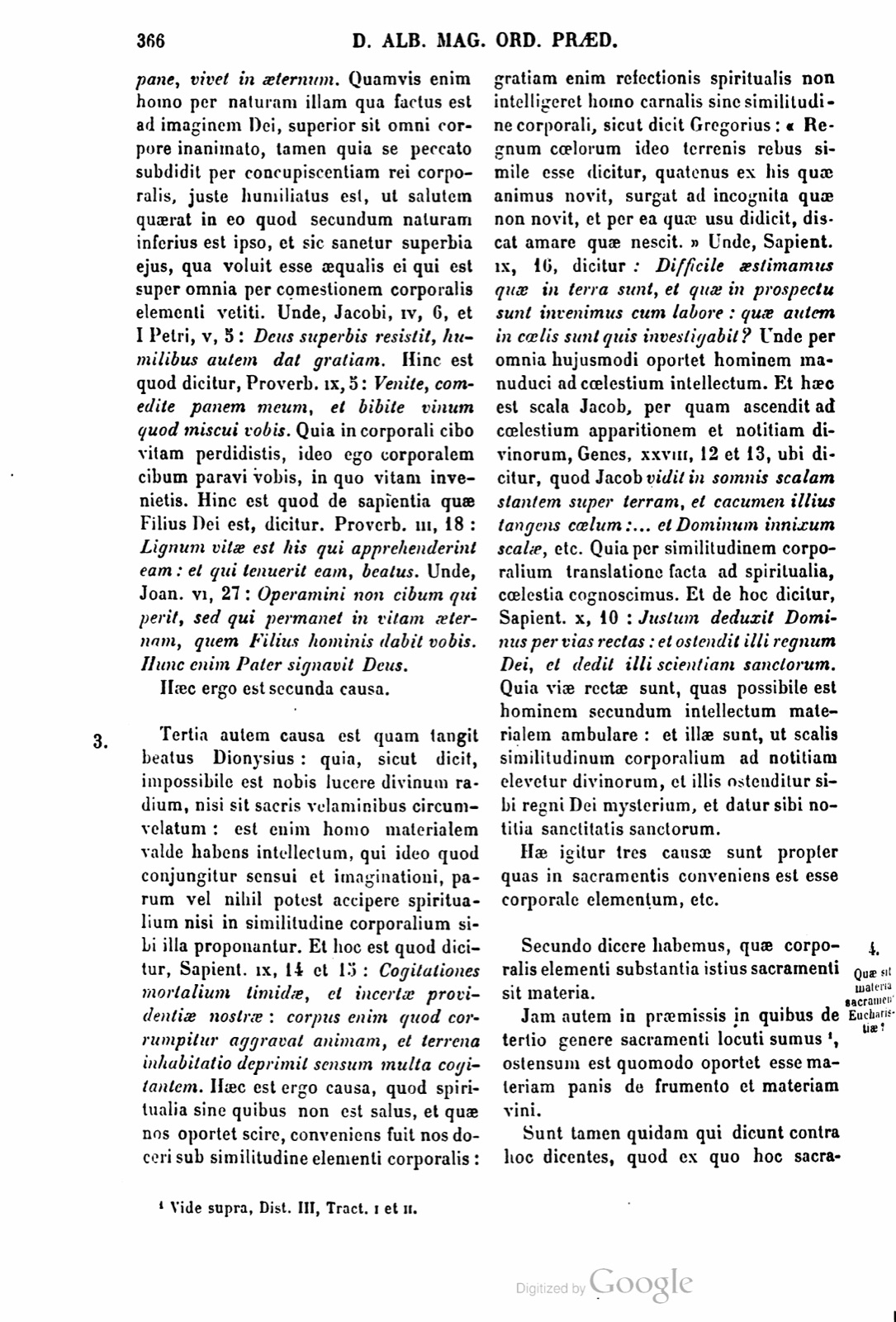
Haec ergo est secunda causa.
3. Tertia autem causa est quam tangit beatus Dionysius: quia, sicut dicit, impossibile est nobis lucere divinum radium, nisi sit sacris velaminibus circumvelatum: est enim homo materialem valde habens intellectum, qui ideo quod conjungitur sensui et imaginationi, parum vel nihil potest accipere spiritualium nisi in similitudine corporalium sibi illa proponantur. Et hoc est quod dicitur, Sapient. IX, 14 et 15: Cogitationes mortalium timidae, et incertae providentiae nostrae: corpus enim quod corrumpitur aggravat animam, et terrena inhabitatio deprimit sensum multa cogitantem. Haec est ergo causa, quod spiritualia sine quibus non est salus, et quae nos oportet scire, conveniens fuit nos doceri sub similitudine elementi corporalis: gratiam enim refectionis spiritualis non intelligeret homo carnalis sine similitudine corporali, sicut dicit Gregorius: « Regnum caelorum ideo terrenis rebus simile esse dicitur, quatenus ex his quae animus novit, surgat ad incognita quae non novit, et per ea quae usu didicit, discat amare quae nescit. » Unde, Sapient. IX, 16, dicitur: Difficile aestimamus quae in terra sunt, et quae in prospectu sunt invenimus cum labore: quae autem in caelis sunt quis investigabit? Unde per omnia hujusmodi oportet hominem manuduci ad caelestium intellectum. Et haec est scala Jacob, per quam ascendit ad caelestium apparitionem et notitiam divinorum, Genes. XXVIII, 12 et 13, ubi dicitur, quod Jacob vidit in somnis scalam stantem super terram, et cacumen illius tangens caelum:... et Dominum innixum scalae, etc. Quia per similitudinem corporalium translatione facta ad spiritualia, caelestia cognoscimus. Et de hoc dicitur, Sapient. X, 10: Justum deduxit Dominus per vias rectas: et ostendit illi regnum Dei, et dedit illi scientiam sanctorum. Quia viae rectae sunt, quas possibile est hominem secundum intellectum materialem ambulare: et illae sunt, ut scalis similitudinum corporalium ad notitiam elevetur divinorum, et illis ostenditur sibi regni Dei mysterium, et datur sibi notitia sanctitatis sanctorum.
Hae igitur tres causae sunt propter quas in sacramentis conveniens est esse corporale elementum, etc.
This therefore is the second cause.
3. But the third cause is that which blessed Dionysius touches, because, as he says, it is impossible for the divine ray to shine upon us unless it is veiled round about with sacred veils. For man has a very material intellect, which, because it is joined to sense and imagination, can receive little or nothing of spiritual things unless they are proposed to him in the likeness of bodily things. And this is what is said, Wisdom 9:14 and 15: "The thoughts of mortals are fearful, and our foresights uncertain; for the body which is corrupted weighs down the soul, and the earthly inhabitation depresses the sense thinking many things." This therefore is the cause why it was fitting for us to be taught spiritual things, without which there is no salvation, and which we must know, under the likeness of a bodily element. For carnal man would not understand the grace of spiritual refreshment without a bodily likeness, as Gregory says: "The kingdom of heaven is therefore said to be like earthly things, so that from those things which the mind knows, it may rise to unknown things which it does not know, and through those things which it has learned by use, it may learn to love what it does not know." Hence, Wisdom 9:16, it is said: "We judge with difficulty the things that are on earth, and the things that are in our sight we find with labor; but the things that are in the heavens, who will search them out?" Hence through all things of this sort it is necessary that man be led by the hand to the understanding of heavenly things. And this is the ladder of Jacob, through which he ascended to the appearance of heavenly things and the knowledge of divine things, Genesis 28:12 and 13, where it is said that Jacob saw in dreams a ladder standing upon the earth and its top touching heaven, "... and the Lord leaning on the ladder," etc. Because through the likeness of bodily things, a transfer having been made to spiritual things, we know heavenly things. And concerning this it is said, Wisdom 10:10: "The Lord led the just man by right ways, and showed him the kingdom of God, and gave him the knowledge of holy things." Because the right ways are those by which it is possible for man to walk according to a material intellect; and they are that he be elevated by the ladders of bodily likenesses to the knowledge of divine things, and by them the mystery of the kingdom of God is shown to him, and knowledge of the sanctity of holy things is given to him.
These therefore are the three causes on account of which it is fitting that there be a bodily element in the sacraments, etc.
If a page does not appear, its photograph has not been uploaded yet.