Works › The Book on the Sacrament of the Eucharist
Volume 38 · pp. 293–297
Chapter IV. What sort this drink should be in the use of this grace
A marker with ≈ is an approximate page boundary, placed by measure of the text; the page photographs remain the authority. In the paired views, clicking a page marker brings that page into view.
Caput IV. Qualis sit hic potus in usu gratiae istius?
1. Bonum et electum vinum debet esse in sacramento. Sequitur quale debeat esse hoc vinum in usu gratiae.
Circa autem hoc duo sunt attendenda, quod videlicet propter reverentiam sacramenti bonum vinum et electum debeat esse in sacramento ad usum sacramenti, et quod debeat esse sumptum simplex vinum absque panis intinctione. Decet enim, quod ad honorabilissimum sacramentum in usu optima quaerantur elementa, ex quibus conficiatur: unde sicut non decet ad purificationem baptismi aquam lutulentam accipere et paludosam et putridam, quamvis in tali aqua, quando alia haberi non potest, possit fieri baptismus, ita non decet ad optimi corporis sacramentum vinum accipere lutulentum et malum, quamvis ex tali vino aliquando propter necessitatem possit confici sacramentum. Esther, I, 7: Vinum quoque, ut magnificentia regia dignum erat, abundans et praecipuum ponebatur. Convivium enim Assueri signat convivium Christi. III Esdrae, III, 20: Vinum omnem mentem convertit in securitatem, et jucunditatem, et non meminit omnem tristitiam, et debitum. Tale igitur vinum significationem habet ad effectum sanguinis Christi, qui in securitatem et honestatem animam convertit, et facit oblivisci tristitiae antiquae. Hujus signum est, quod cum vinum in sacrificio Veteris Testamenti offerretur, fecit Dominus fieri acetabula et libatoria vasa, in quibus probaretur vinum libandum Domino, an acceptum esset, vel non. Exod. XXV, 29: Parabis et acetabula, ac phialas, thuribula, et cyathos, in quibus offerenda sunt libamina. Acetabula enim sunt vasa in quibus probatur liquidum, an esset acceptum ad gustum. Phiala autem in qua probatur ad visum, an esset in colore bonum. Thuribulum autem in quo probatur ad ardorem. Et cyathus in quo probatur ad haustum et fusionem, an esset pendulum, vel infirmum. Cum igitur tota ista diligentia adhibita fuerit ad vinum quod erat offerendum in sacramenti hujus figura, multo magis ista adhibenda sunt in vino quod adhibetur in ipsa sacramenti veritate. Haec autem dicuntur libatoria.1 Libare enim est degustare, et vasa in quibus ad gustum probatur, an vinum tanto sacrificio esset dignum, libatoria appellantur. Unde, III Esdrae, II, 13, dicitur, quod Darius inter vasa quae referri fecit ad templum, referri fecit libatoria argentea duo. Hoc autem describitur, I Machab. I, 23, quod inter alia vasa quae de templo accepit Antiochus, de templo accepit libatoria, et phialas. Ex quo iterum ostenditur, quod ad probationis experimentum debet esse electum vinum quod offertur. Si enim in aliis oblationibus debet esse electum quod offertur, tunc multo magis id quod ad sanguinem Christi offertur, debet esse electum. Dicitur autem, Malach. I, 14: Maledictus dolosus qui habet in grege suo masculum, hoc est, perfectum, et votum faciens, immolat debile Domino. Ergo multo magis maledictus est, qui ad mensam suam facit offerri vinum electum, et debile valde sumit ad sanguinis Domini sacrificium. Et merito maledictus est, qui vinum electum in vasis mundis et pretiosis bibit in mensa propria, et in vasis foetidis et ampullis corruptis permittit vinum infici, et sic foetidum in calice offert in Domini sacrificium: Dominus enim praecipit, quod non solum vasa, sed etiam ministri vasorum in sacrificio suo mundi esse deberent. Isa. LII, 11: Mundamini, qui fertis vasa Domini.
Chapter IV. What sort this drink should be in the use of this grace.
1. Good and chosen wine ought to be in the sacrament. It follows what sort this wine ought to be in the use of grace.
But concerning this two things must be attended to, namely that, because of reverence for the sacrament, good and chosen wine ought to be in the sacrament for the use of the sacrament, and that it ought to be taken as simple wine without the dipping of bread. For it is fitting that for the most honorable sacrament the best elements in use be sought from which it may be consecrated. Hence just as it is not fitting to take muddy, marshy, and rotten water for the purification of baptism, although in such water, when another cannot be had, baptism can happen, so it is not fitting to take muddy and bad wine for the sacrament of the best body, although from such wine sometimes because of necessity the sacrament can be consecrated. Esther 1:7: "Wine also, as was worthy of royal magnificence, was set forth abundant and choice." For the banquet of Ahasuerus signifies the banquet of Christ. 3 Esdras 3:20: "Wine converts every mind into security and gladness, and it does not remember any sadness and debt." Therefore such wine has signification toward the effect of Christ's blood, which converts the soul into security and honesty, and makes it forget ancient sadness. A sign of this is that when wine was offered in the sacrifice of the Old Testament, the Lord caused saucers and libation vessels to be made, in which the wine to be poured out to the Lord would be tested, whether it was acceptable or not. Exodus 25:29: "You shall prepare both saucers and bowls, censers and cups, in which libations are to be offered." For saucers are vessels in which liquid is tested, whether it would be acceptable to taste. But the bowl is that in which it is tested by sight, whether it would be good in color. But the censer is that in which it is tested by burning. And the cup is that in which it is tested by drinking and pouring, whether it would be hanging or weak. Therefore since all this diligence was applied to wine which was to be offered in the figure of this sacrament, much more must those things be applied to the wine which is used in the truth itself of the sacrament. But these are called libation vessels.1 For to libate is to taste, and the vessels in which it is tested by taste whether the wine would be worthy of so great a sacrifice are called libation vessels. Hence, 3 Esdras 2:13, it is said that Darius, among the vessels which he caused to be carried back to the temple, caused two silver libation vessels to be carried back. But this is described, 1 Maccabees 1:23, that among the other vessels which Antiochus received from the temple, from the temple he received the libation vessels and bowls. From this again it is shown that the wine which is offered ought to be chosen for the experiment of testing. For if in other offerings what is offered ought to be chosen, then much more that which is offered for the blood of Christ ought to be chosen. But it is said, Malachi 1:14: "Cursed is the deceitful man who has in his flock a male," that is, a perfect thing, "and making a vow, sacrifices a weak thing to the Lord." Therefore much more cursed is the one who causes chosen wine to be offered at his own table, and takes very weak wine for the sacrifice of the Lord's blood. And deservedly cursed is he who drinks chosen wine in clean and precious vessels at his own table, and in stinking vessels and corrupted flasks permits wine to be infected, and thus offers stinking wine in the chalice in the Lord's sacrifice. For the Lord commands that not only the vessels, but also the ministers of the vessels, ought to be clean in his sacrifice. Isaiah 52:11: "Be cleansed, you who carry the vessels of the Lord."
Sic igitur eligendum est vinum quod offertur in sacrificio Dominici sanguinis. Non tamen negamus, quin de quocumque vino vinosum saporem habente, et adhuc vini naturam retinente, possit fieri sacrificium: sed ex praemissis auctoritatibus patet, quod pro certo peccat, qui magnum ad corporis sui, et parum vel nullum ad Dominici sanguinis poculum adhibet studium.
Hoc etiam patet ex hoc quod in ante habitis diximus: quia Christi sanguis incorporat nos sibi, et ideo electio quae fit in cibo et potu corporalibus, quando incorporantur corpori, debet fieri in nobis in comparatione ad corpus et sanguinem Christi, quibus nos incorporamur. Omnis autem homo potest advertere quam purus, quam saporosus, quam electus esse debeat qui sanguini Christi, qui per omnia corporis ejus mystici fluere debet membra, est incorporandus: et ideo dicitur in Psalmo L, 21: Tunc acceptabis sacrificium justitiae, hoc est, acceptum erit tibi sacrificium, quod ad rectitudinem justitiae est electum et oblatum. Unde et, Michaeae, VI, 6, videns quam electum esse debeat quod Deo offertur, in seipso sollicitus dicit: Quid dignum offeram Domino? Ac si dicat: In humana infirmitate vix invenitur, quod satis dignum sit offerri Deo. Hoc signatum est, Numer. XIII, 24, ubi bonitatem terrae benedictionis Domini exploratores significare volentes, ostenderunt botrum quem duo homines in vecte portabant: botrus enim ille corpus Dominicum est. Viri autem adhaerentes omnes sancti sunt Christo incorporati, per quos omnis fluit succus dulcedinis sanguinis ejus: et ideo qui puro liquori ut vas praeparatur, valde debet esse depuratus. Hinc est etiam, quod, Isa. XXV, 6, convivium suum dicitur vindemiae defaecatae, ut in vino quod ad sacrificium offerimus, et in nobis, quibus ille sanguis purissimus liquor infunditur, nihil sit de faece peccatorum. Et ideo dicitur, Eccli. XXIV, 23: Ego quasi vitis fructificavi suavitatem odoris: et flores mei fructus honoris et honestatis. Christus enim plenus sanguine sicut uva rubea fructificat suavitatem odoris aromatici vini in omnibus granis membrorum corporis mystici, qui Christi bonus odor sunt, et flores sui quando hoc vinum aeterni gaudii dulcissimum floret, sunt fructus vini virtutum quae gaudium generant in cordibus sanctorum.
Hi sunt flores honoris: quia omni reverentia digni et honestatis: quia, sicut dicit Tullius, honestum est, quod sua vi nos trahit, et sua propria dignitate hominem allicit. Nihil est quod ita nos ad Christum trahat, sicut amor et dulcedo pro nobis effusi sui sanguinis, et nihil est quod ita nos suo amori alliciat, sicut amor calicis quem pro nobis bibit et nobis bibendum propinavit. Hoc est de quo gloriatur sponsa in Canticis, II, 13, dicens: Vineae florentes dederunt odorem suum, ad quem odorem omne fugit venenosum, et allicitur omne desiderium: quia odor tam pretiosi sanguinis qui totam Dei vineam ubertim influit, et omne venenosum primi serpentis virus expellit, et suo sapore et odore et pretiositate ad se trahit omne desiderium sanctorum: quia omnis sanctus scit, quod sine sanguine et corpore Christi non est vita gratiae et jucunditatis aeternae. Unde, Joan. VI, 54: Nisi manducaveritis carnem Filii hominis, et biberitis ejus sanguinem, non habebitis vitam in vobis. Vitam, inquam, qua membrum vivit in corpore unitum et consociatum spiritui vivifico Domini nostri Jesu Christi, sicut dicitur, ad Coloss. III, 3: Vita vestra est abscondita cum Christo in Deo. Hoc enim modo est pro certo verum quod dicitur, Luc. XX, 38, quod Deus non est mortuorum, sed vivorum.2 Omnes enim sic Christi corpori et sanguini incorporati vivunt: et extra incorporationem illam nemo vere vivit, quia vitam Christi non participat, qui solus est fons vitae omnium, sicut dicitur in Psalmo XXXV, 10: Domine, apud te est fons vitae, et in nomine tuo videbimus lumen.
Thus therefore the wine which is offered in the sacrifice of the Lord's blood must be chosen. Nevertheless we do not deny that from any wine whatsoever having a vinous taste and still retaining the nature of wine, sacrifice can happen; but from the authorities set forth before it is clear that certainly he sins who applies great zeal to the cup of his own body, and little or none to the cup of the Lord's blood.
This is also clear from what we said in what went before, because the blood of Christ incorporates us into himself; and therefore the choosing which happens in bodily food and drink, when they are incorporated into the body, ought to happen in us in relation to the body and blood of Christ, by which we are incorporated. But every man can notice how pure, how tasty, how chosen one ought to be who is to be incorporated into the blood of Christ, which must flow through all the members of his mystical body. And therefore it is said in Psalm 50:21: "Then you will accept the sacrifice of justice," that is, the sacrifice which has been chosen and offered for the rectitude of justice will be acceptable to you. Hence also Micah, 6:6, seeing how chosen what is offered to God ought to be, says anxiously within himself: "What worthy thing shall I offer to the Lord?" As if he were saying: In human weakness hardly anything is found that is sufficiently worthy to be offered to God. This was signified, Numbers 13:24, where the spies, wishing to signify the goodness of the land of the Lord's blessing, showed the cluster which two men carried on a pole. For that cluster is the Lord's body. But the men clinging to it are all the saints incorporated into Christ, through whom flows all the juice of the sweetness of his blood; and therefore one who is prepared as a vessel for a pure liquid ought to be very purified. Hence also, Isaiah 25:6, his banquet is called of refined vintage, so that in the wine which we offer for sacrifice, and in us, into whom that blood, the purest liquid, is poured, there may be nothing of the dregs of sins. And therefore it is said, Ecclesiasticus 24:23: "I, like a vine, have borne fruit of sweetness of odor; and my flowers are fruits of honor and honesty." For Christ, full of blood like a red grape, bears fruit of the sweetness of aromatic wine's odor in all the grains of the members of the mystical body, who are the good odor of Christ; and his flowers, when this sweetest wine of eternal joy blooms, are fruits of the wine of virtues which generate joy in the hearts of the saints.
These are flowers of honor, because they are worthy of every reverence, and of honesty, because, as Tully says, the honorable is that which draws us by its own force and entices man by its own dignity. There is nothing that draws us to Christ as does the love and sweetness of his blood poured out for us, and there is nothing that entices us to his love as does love of the chalice which he drank for us and offered to us to drink. This is that concerning which the bride glories in Canticles 2:13, saying: "The flowering vineyards have given their odor," to which odor every poisonous thing flees, and every desire is enticed; because the odor of so precious a blood, which flows richly into the whole vineyard of God, both expels every poisonous venom of the first serpent and, by its taste and odor and preciousness, draws to itself every desire of the saints; because every saint knows that without the blood and body of Christ there is no life of grace and eternal gladness. Hence, John 6:54: "Unless you eat the flesh of the Son of man and drink his blood, you will not have life in you." Life, I say, by which the member lives in the body, united and joined to the life-giving spirit of our Lord Jesus Christ, as is said, Colossians 3:3: "Your life is hidden with Christ in God." For in this way what is said, Luke 20:38, is certainly true, that God is not of the dead, but of the living.2 For all who are thus incorporated into Christ's body and blood live; and outside that incorporation no one truly lives, because he does not participate in the life of Christ, who alone is the fountain of the life of all, as is said in Psalm 35:10: "Lord, with you is the fountain of life, and in your name we will see light."
Hoc est vinum, quod oculos claritate spiritus sui clarificat et mundificat, ut videant ea quae caeteri non vident. Genes. XLIX, 12: Pulchriores sunt oculi ejus vino. Vinum enim bonum et clarum inter caetera habet effectum, ut purget oculos a sordibus sua puritate et mordicatione. Et ideo congruenter Dominus cum vellet ostendere qualiter se suis esset manifestaturus et non mundo, dixit, Joan. XIV, 19: Adhuc modicum, et mundus me jam non videt. Vos autem videtis me, quia ego vivo, et vos vivetis. Sicut enim dicitur, Genes. IX, 5, sedes animae quae principium et causa est vitae, in sanguine est. Et ideo spiritu Christi non vivit, qui purissimo sanguini ejus non est sociatus: nec oculos claros habet, cujus oculos sanguis Christi efficacissimus non clarificavit.
2. Quare vinum et panis seorsum ponuntur in sacramento? Ad usum etiam istius gratiae refertur, quod vinum in sacramento ponatur seorsum, et panis seorsum absque panis intinctione in vinum. Dominus enim, Joan. XIII, 26, panis intinctione notavit proditorem, dicens: Ille est cui ego intinctum panem porrexero. Et ibi dicit Glossa, quod intinctio signat infectionem: quia ea quae tinguntur, non mundantur, sed inficiuntur: et si aliquod bonum significaret tinctio, illi etiam bono ingratum se exhibuit: et ideo Ecclesia nulli intinctum porrigit panem. Ideo etiam dicitur, Matth. XXVI, 23: Qui intingit mecum manum in paropside, hic me tradet. Marc. XIV, 20, dicitur: Unus ex duodecim, qui intingit mecum manum in catino, ille me tradet. Per quae omnia demonstratur, quod intinctione panis nihil boni demonstratur. Cum igitur omnis Christi actio, nostra sit instructio, instruimur ex hoc quod nulli panis detur intinctus, neque in vino, neque in sanguine, sed corpus totum datur siccum in specie panis, et sanguis purus datur specie vini.
This is the wine which clarifies and cleanses the eyes by the brightness of its spirit, so that they may see things which others do not see. Genesis 49:12: "His eyes are more beautiful than wine." For good and clear wine has, among other effects, that it purges eyes from filth by its purity and biting. And therefore fittingly the Lord, when he wished to show how he was going to manifest himself to his own and not to the world, said, John 14:19: "Yet a little while, and the world now does not see me. But you see me, because I live, and you will live." For as is said, Genesis 9:5, the seat of the soul, which is the principle and cause of life, is in the blood. And therefore he does not live by the spirit of Christ who is not joined to his purest blood; nor does he have clear eyes whose eyes the most efficacious blood of Christ has not clarified.
2. Why wine and bread are set separately in the sacrament. It also pertains to the use of this grace that wine in the sacrament be set separately, and bread separately, without dipping bread in wine. For the Lord, John 13:26, marked the betrayer by the dipping of bread, saying: "It is he to whom I will offer the dipped bread." And there the Gloss says that dipping signifies infection, because things that are dyed are not cleansed but infected; and if dipping signified some good thing, he showed himself ungrateful also to that good; and therefore the Church offers dipped bread to no one. Therefore it is also said, Matthew 26:23: "He who dips his hand with me in the dish, he will betray me." Mark 14:20 says: "One of the twelve, who dips his hand with me in the bowl, he will betray me." Through all these things it is shown that no good thing is shown by the dipping of bread. Therefore, since every action of Christ is our instruction, we are instructed from this that dipped bread be given to no one, neither in wine nor in blood, but the whole body is given dry under the species of bread, and pure blood is given under the species of wine.
Sunt tamen quaedam in sacra Scriptura et in factis Ecclesiae, quae huic quod dictum est hic, adversari videntur. Etenim Ruth, II, 14, dicitur a Booz ad Ruth quae signat Ecclesiam: Intinge buccellam tuam in aceto. Et sic videtur, quod buccella panis in aceto vini acetosi sit intingenda ab Ecclesia. In factis autem Ecclesia videtur obviare, quod Parasceve sacerdos corpus Domini intingit in vinum, et sic sumit. Adhuc, quod in frequentatione sacramenti omni die sacerdos unam tertiam partem hostiae in sanguinem immittit, et intingit, et sic sumit: et sic videtur, quod non sit verum quod ante dictum est, quod panis in cujus specie datur corpus Christi in esum, in vinum vel sanguinem non sit intingendus. Adhuc autem ex eo quod dicitur in Evangelio, omnes Apostoli cum Christo panem intingebant in paropsidem sive catinum3: factum autem Christi et Apostolorum exemplum instructorium debet esse Ecclesiae: videtur igitur, quod Ecclesia in sumptione sacramenti debet panem intinctum accipere.
Ad haec autem quae dicta sunt et omnia similia dicimus, quod Ecclesia nulli dat panem intinctum, neque in sanguinem, neque in vinum, sicut diximus, eo quod Judas proditor per intinctum panem est demonstratus, et quod sicut dicit Glossa, tinctio infectionem proditionis signat: quia tinctio exterius inficit et non mundat ex profundo: bibentes autem sanguinem in profundum sui sanguinem accipiunt, et mundatur: sed quibus adhaeret exterius sanguis, sunt viri sanguinum et homicidae. Isa. I, 15: Manus vestrae sanguine plenae sunt. Psal. LIV, 24: Viri sanguinum et dolosi non dimidiabunt dies suos. Osee, IV, 2: Sanguis sanguinem tetigit.
Quod autem objicitur de Booz et Ruth, dicendum quod in veritate Booz, qui firmitas interpretatur, ibi Christum signat, qui Ecclesiam facto suo mystice confirmat: et Ruth signat Ecclesiam: sed acetum non est signum sanguinis Domini, quia, sicut diximus in ante habitis, de aceto sanguis Christi confici non potest: sed acetum ibi signat acerbitatem passionis Christi, in cujus acerbitatis memoriam debet sumi a fidelibus corpus Christi. Luc. XXII, 19: Hoc facite in meam commemorationem. I ad Corinth. XI, 26: Quotiescumque manducabitis panem hunc, et calicem bibetis, mortem Domini annuntiabitis, donec veniat. Signat autem etiam acetum acetosam aversionem synagogae, quae in vinea Domini fuit, et sitim suam aceto pro vino potavit: et ideo dicitur, Matth. XXVII, 34, quod cum gustasset, noluit bibere, hoc est, acetosos noluit sibi incorporare. Fideles autem sumentes sanguinem Christi ad hoc sumunt, ut Christo incorporentur. Unde patet, quod nihil est acetum de sanguine quantum ad significatum.
Nevertheless there are some things in Sacred Scripture and in the deeds of the Church which seem to oppose what has been said here. For Ruth 2:14, it is said by Boaz to Ruth, who signifies the Church: "Dip your morsel in vinegar." And thus it seems that the morsel of bread should be dipped by the Church in the vinegar of vinegary wine. But in the deeds of the Church it seems to be opposed by the fact that on Good Friday the priest dips the body of the Lord in wine and thus receives it. Moreover, because in the frequenting of the sacrament every day the priest sends one third part of the host into the blood, and dips it, and thus receives; and thus it seems that what was said before is not true, that the bread under whose species the body of Christ is given for eating should not be dipped into wine or blood. Moreover, from what is said in the Gospel, all the Apostles with Christ were dipping bread in the dish or bowl3; but the deed of Christ and of the Apostles ought to be an instructive example for the Church. Therefore it seems that in the reception of the sacrament the Church ought to receive dipped bread.
But to these things which have been said, and all similar things, we say that the Church gives dipped bread to no one, neither into blood nor into wine, as we have said, because Judas the betrayer was shown through dipped bread, and because, as the Gloss says, dyeing signifies the infection of betrayal; for dyeing infects exteriorly and does not cleanse from the depth. But those drinking blood receive the blood into the depth of themselves, and it is cleansed; but those to whom blood clings exteriorly are men of blood and murderers. Isaiah 1:15: "Your hands are full of blood." Psalm 54:24: "Men of blood and deceit will not halve their days." Hosea 4:2: "Blood has touched blood."
But as to what is objected concerning Boaz and Ruth, it must be said that in truth Boaz, which is interpreted firmness, there signifies Christ, who mystically confirms the Church by his deed; and Ruth signifies the Church. But vinegar is not a sign of the Lord's blood, because, as we said in what went before, the blood of Christ cannot be consecrated from vinegar; rather vinegar there signifies the bitterness of Christ's passion, in memory of whose bitterness the body of Christ ought to be received by the faithful. Luke 22:19: "Do this in remembrance of me." 1 Corinthians 11:26: "As often as you eat this bread and drink the chalice, you will announce the death of the Lord until he comes." But vinegar also signifies the vinegary aversion of the synagogue, which was in the Lord's vineyard and gave his thirst vinegar to drink instead of wine; and therefore it is said, Matthew 27:34, that when he had tasted it, he would not drink, that is, he did not wish to incorporate the vinegary ones into himself. But the faithful receiving the blood of Christ receive it for this, that they may be incorporated into Christ. Hence it is clear that vinegar is nothing of blood as regards the signified.
Quod autem dicitur de facto Ecclesiae in Parasceve, dicendum, quod Ecclesiae consuetudo non est illo die corpus Domini vel sanguinem conficere, sed potius reservatum corpus in pyxide confectum in die Coenae, Ecclesia in Parasceve in calicem in quo est vinum, immittit. Et sic sacerdos sumit de calice, sed nulli sumendum porrigit. Et hoc significatur, quod corpus Domini tinctum est illo die in sanguine ipsius et sic oblatum pro nobis. Isa. LXIII, 1: Quis est iste qui venit de Edom, tinctis vestibus de Bosra? iste formosus in stola sua, gradiens in multitudine virtutis suae. Et post pauca, v. 2: Quare ergo rubrum est indumentum tuum, et vestimentum tuum sicut calcantium in torculari? Et iterum postea parum, v. 3: Aspersus est sanguis eorum super vestimenta mea. Sanguis autem eorum dicitur: quia ab eis et pro eis fusus est. Et hoc significat Ecclesia illo die: et ideo nec conficit, nec porrigit illo die corpus vel sanguinem ad sumptionem alicujus.
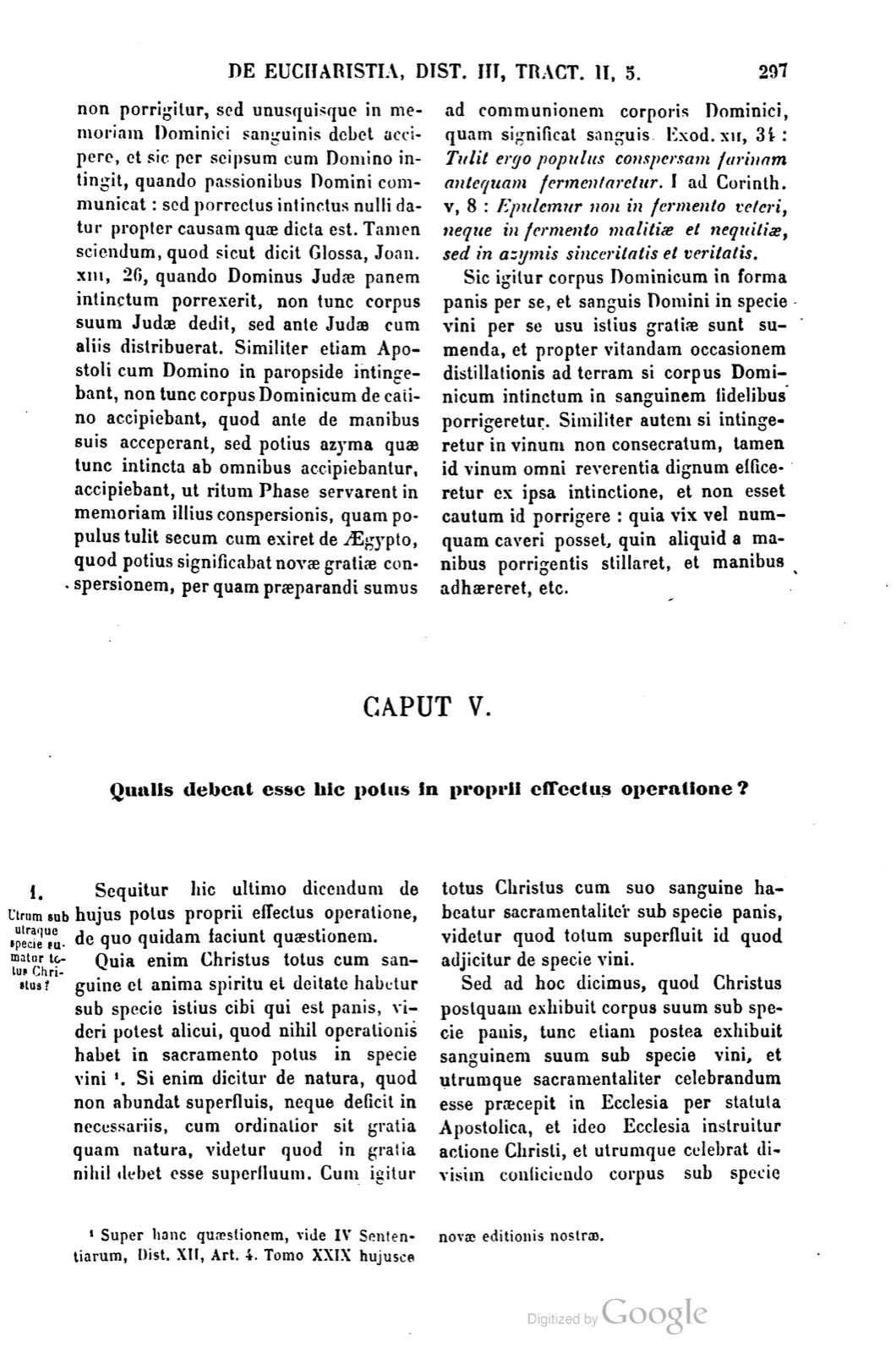
Ad illud quod dicitur, quod Apostoli cum Christo intinxerunt. Respondendum est, quod nullus est qui accipit corpus, quin ipsum intinctum spiritualiter debeat accipere: sed intinctus ei non porrigitur, sed unusquisque in memoriam Dominici sanguinis debet accipere, et sic per seipsum cum Domino intingit, quando passionibus Domini communicat: sed porrectus intinctus nulli datur propter causam quae dicta est. Tamen sciendum, quod sicut dicit Glossa, Joan. XIII, 26, quando Dominus Judae panem intinctum porrexerit, non tunc corpus suum Judae dedit, sed ante Judae cum aliis distribuerat. Similiter etiam Apostoli cum Domino in paropside intingebant, non tunc corpus Dominicum de catino accipiebant, quod ante de manibus suis acceperant, sed potius azyma quae tunc intincta ab omnibus accipiebantur, accipiebant, ut ritum Phase servarent in memoriam illius conspersionis, quam populus tulit secum cum exiret de Aegypto, quod potius significabat novae gratiae conspersionem, per quam praeparandi sumus ad communionem corporis Dominici, quam significat sanguis. Exod. XII, 34: Tulit ergo populus conspersam farinam antequam fermentaretur. I ad Corinth. V, 8: Epulemur non in fermento veteri, neque in fermento malitiae et nequitiae, sed in azymis sinceritatis et veritatis.
Sic igitur corpus Dominicum in forma panis per se, et sanguis Domini in specie vini per se usu istius gratiae sunt sumenda, et propter vitandam occasionem distillationis ad terram si corpus Dominicum intinctum in sanguinem fidelibus porrigeretur. Similiter autem si intingeretur in vinum non consecratum, tamen id vinum omni reverentia dignum efficeretur ex ipsa intinctione, et non esset cautum id porrigere: quia vix vel numquam caveri posset, quin aliquid a manibus porrigentis stillaret, et manibus adhaereret, etc.
But as to what is said concerning the deed of the Church on Good Friday, it must be said that the custom of the Church is not to consecrate the Lord's body or blood on that day, but rather the Church on Good Friday sends into the chalice in which there is wine the reserved body consecrated in the pyx on the day of the Supper. And thus the priest receives from the chalice, but offers it to no one for reception. And by this it is signified that the Lord's body was dyed on that day in his own blood and thus offered for us. Isaiah 63:1: "Who is this who comes from Edom, with garments dyed from Bosra? this beautiful one in his robe, walking in the multitude of his strength." And a little after, v. 2: "Why then is your garment red, and your clothing like that of those treading in the winepress?" And again a little afterward, v. 3: "Their blood has been sprinkled over my garments." But it is called their blood because it was poured out by them and for them. And this the Church signifies on that day; and therefore on that day she neither consecrates nor offers the body or blood for the reception of anyone.
To that which is said, that the Apostles dipped with Christ, one must answer that there is no one who receives the body who ought not to receive it spiritually dipped; but it is not offered to him dipped. Rather each one ought to receive in memory of the Lord's blood, and thus through himself he dips with the Lord when he communicates in the Lord's passions; but one offered dipped is given to no one, for the cause which has been said. Nevertheless it must be known that, as the Gloss says, John 13:26, when the Lord offered dipped bread to Judas, he did not then give his body to Judas, but before that he had distributed it to Judas with the others. Similarly also the Apostles dipped with the Lord in the dish; they did not then receive the Lord's body from the bowl, which before they had received from his hands, but rather they received the unleavened bread which at that time was received dipped by all, so that they would observe the rite of Passover in memory of that sprinkling which the people took with them when they left Egypt, which rather signified the sprinkling of new grace, by which we must be prepared for communion of the Lord's body, which blood signifies. Exodus 12:34: "Therefore the people took the sprinkled flour before it was leavened." 1 Corinthians 5:8: "Let us feast not in the old leaven, nor in the leaven of malice and wickedness, but in the unleavened things of sincerity and truth."
Thus therefore the Lord's body under the form of bread by itself, and the Lord's blood under the species of wine by itself, are to be received in the use of this grace, also to avoid an occasion of dripping to the earth if the Lord's body dipped in blood were offered to the faithful. Similarly, if it were dipped in unconsecrated wine, nevertheless that wine would be made worthy of all reverence from the very dipping, and it would not be safe to offer it, because scarcely or never could it be guarded that something would not drip from the hands of the one offering and cling to the hands, etc.
If a page does not appear, its photograph has not been uploaded yet.