Works › The Book on the Sacrifice of the Mass
Volume 38 · pp. 172–173
Index of Notable Things, A-C
A marker with ≈ is an approximate page boundary, placed by measure of the text; the page photographs remain the authority. In the paired views, clicking a page marker brings that page into view.
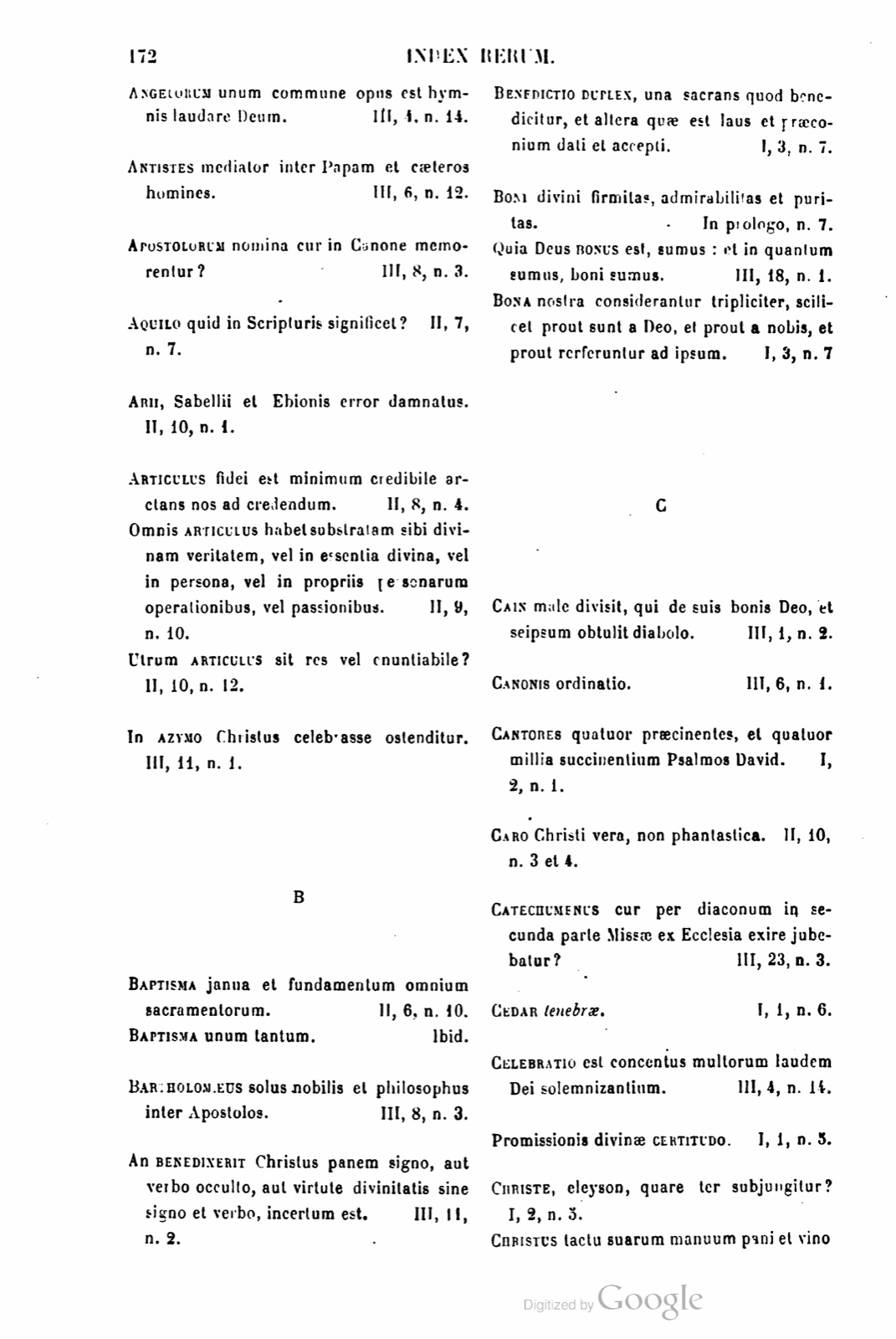
ANGELORUM unum commune opus est hymnis laudare Deum. III, 4, n. 14.
ANTISTES mediator inter Papam et caeteros homines. III, 6, n. 12.
APOSTOLORUM nomina cur in Canone memorentur? III, 8, n. 3.
AQUILO quid in Scripturis significet? II, 7, n. 7.
ARII, Sabellii et Ebionis error damnatus. II, 10, n. 1.
ARTICULUS fidei est minimum credibile arctans nos ad credendum. II, 8, n. 4.
Omnis ARTICULUS habet substratam sibi divinam veritatem, vel in essentia divina, vel in persona, vel in propriis personarum operationibus, vel passionibus. II, 9, n. 10.
Utrum ARTICULUS sit res vel enuntiabile? II, 10, n. 12.
In AZYMO Christus celebrasse ostenditur. III, 11, n. 1.
B
BAPTISMA janua et fundamentum omnium sacramentorum. II, 6, n. 10.
BAPTISMA Unum tantum. Ibidem.
BARTHOLOMEUS solus nobilis et philosophus inter Apostolos. III, 8, n. 3.
An BENEDIXERIT Christus panem signo, aut verbo occulto, aut virtute divinitatis sine signo et verbo, incertum est. III, 11, n. 2.
BENEDICTIO DUPLEX, una sacrans quod benedicitur, et altera quae est laus et praeconium dati et accepti. I, 3, n. 7.
BONI divini firmitas, admirabilitas et puritas. In prologo, n. 7.
Quia Deus BONUS est, sumus: et in quantum sumus, boni sumus. III, 18, n. 1.
BONA nostra considerantur tripliciter, scilicet prout sunt a Deo, et prout a nobis, et prout referuntur ad ipsum. I, 3, n. 7.
C
CAIN male divisit, qui de suis bonis Deo, et seipsum obtulit diabolo. III, 1, n. 2.
CANONIS ordinatio. III, 6, n. 1.
CANTORES quatuor praecinentes, et quatuor millia succinentium Psalmos David. I, 2, n. 1.
CARO Christi vera, non phantastica. II, 10, n. 3 et 4.
CATECHUMENUS cur per diaconum in secunda parte Missae ex Ecclesia exire jubebatur? III, 23, n. 3.
CEDAR tenebrae. I, 1, n. 6.
CELEBRATIO est concentus multorum laudem Dei solemnizantium. III, 4, n. 14.
Promissionis divinae CERTITUDO. I, 1, n. 3.
CHRISTE, eleyson, quare ter subjungitur? I, 2, n. 3.
CHRISTUS tactu suarum manuum pani et vino contulit ut semper possint in suum corpus et sanguinem converti. III, 11, n. 1. Et 12, n. 1.
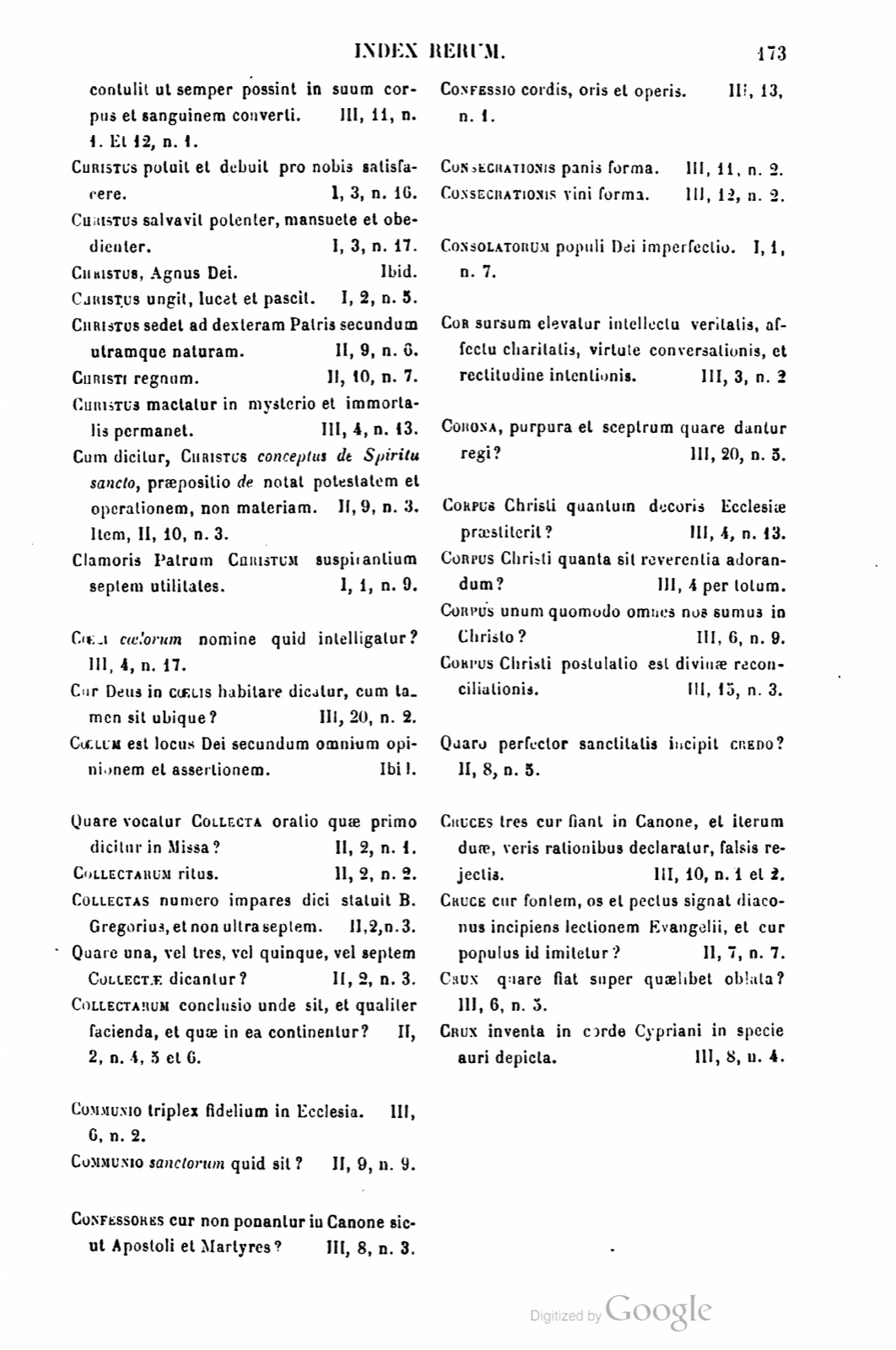
CHRISTUS potuit et debuit pro nobis satisfacere. I, 3, n. 16.
CHRISTUS salvavit potenter, mansuete et obedienter. I, 3, n. 17.
CHRISTUS, Agnus Dei. Ibidem.
CHRISTUS ungit, lucet et pascit. I, 2, n. 5.
One common work of the ANGELS is to praise God with hymns. III, 4, n. 14.
The BISHOP is mediator between the Pope and the other human beings. III, 6, n. 12.
Why are the names of the APOSTLES remembered in the Canon? III, 8, n. 3.
What does the NORTH WIND signify in the Scriptures? II, 7, n. 7.
The condemned error of Arius, Sabellius, and Ebion. II, 10, n. 1.
An ARTICLE of faith is the least believable thing constraining us to believe. II, 8, n. 4.
Every ARTICLE has underlying it divine truth, either in the divine essence, or in a person, or in the proper operations of the persons, or in the passions. II, 9, n. 10.
Whether an ARTICLE is a thing or something enuntiable. II, 10, n. 12.
It is shown that Christ celebrated in UNLEAVENED BREAD. III, 11, n. 1.
B
BAPTISM is the door and foundation of all the sacraments. II, 6, n. 10.
One BAPTISM only. In the same place.
BARTHOLOMEW alone was noble and a philosopher among the Apostles. III, 8, n. 3.
Whether Christ BLESSED the bread by a sign, or by a hidden word, or by the power of divinity without sign and word, is uncertain. III, 11, n. 2.
A TWOFOLD BLESSING: one consecrating that which is blessed, and the other which is the praise and proclamation of the thing given and received. I, 3, n. 7.
The firmness, wondrousness, and purity of the divine GOOD. In the prologue, n. 7.
Because God is GOOD, we are; and insofar as we are, we are good. III, 18, n. 1.
Our GOODS are considered in three ways, namely as they are from God, and as they are from us, and as they are referred to him. I, 3, n. 7.
C
CAIN divided badly, who offered to God from his goods, and offered himself to the devil. III, 1, n. 2.
The ordering of the CANON. III, 6, n. 1.
Four SINGERS singing before, and four thousand singing David's Psalms in response. I, 2, n. 1.
The true FLESH of Christ, not phantasmal. II, 10, n. 3 and 4.
Why was the CATECHUMEN commanded by the deacon, in the second part of the Mass, to go out from the Church? III, 23, n. 3.
CEDAR means shadows. I, 1, n. 6.
CELEBRATION is the concord of many persons solemnizing the praise of God. III, 4, n. 14.
The CERTAINTY of the divine promise. I, 1, n. 3.
CHRISTE, eleyson, why is it added three times? I, 2, n. 3.
By the touch of his hands CHRIST conferred on bread and wine that they could always be converted into his body and blood. III, 11, n. 1. And 12, n. 1.
CHRIST was able and ought to satisfy for us. I, 3, n. 16.
CHRIST saved powerfully, meekly, and obediently. I, 3, n. 17.
CHRIST, the Lamb of God. In the same place.
CHRIST anoints, shines, and feeds. I, 2, n. 5.
CHRISTUS sedet ad dexteram Patris secundum utramque naturam. II, 9, n. 6.
CHRISTI regnum. II, 10, n. 7.
CHRISTUS mactatur in mysterio et immortalis permanet. III, 4, n. 13.
Cum dicitur, CHRISTUS conceptus de Spiritu sancto, praepositio de notat potestatem et operationem, non materiam. II, 9, n. 3. Item, II, 10, n. 3.
Clamoris Patrum CHRISTUM suspirantium septem utilitates. I, 1, n. 9.
COELORUM nomine quid intelligatur? III, 4, n. 17.
Cur Deus in COELIS habitare dicatur, cum tamen sit ubique? III, 20, n. 2.
COELUM est locus Dei secundum omnium opinionem et assertionem. Ibid.
Quare vocatur COLLECTA oratio quae primo dicitur in Missa? II, 2, n. 1.
COLLECTARUM ritus. II, 2, n. 2.
COLLECTAS numero impares dici statuit B. Gregorius, et non ultra septem. II, 2, n. 3.
Quare una, vel tres, vel quinque, vel septem COLLECTAE dicantur? II, 2, n. 3.
COLLECTARUM conclusio unde sit, et qualiter facienda, et quae in ea continentur? II, 2, n. 4, 5 et 6.
COMMUNIO triplex fidelium in Ecclesia. III, 6, n. 2.
COMMUNIO sanctorum quid sit? II, 9, n. 9.
CONFESSORES cur non ponantur in Canone sicut Apostoli et Martyres? III, 8, n. 3.
CONFESSIO cordis, oris et operis. III, 13, n. 1.
CONSECRATIONIS panis forma. III, 11, n. 2.
CONSECRATIONIS vini forma. III, 12, n. 2.
CONSOLATORUM populi Dei imperfectio. I, 1, n. 7.
Cor sursum elevatur intellectu veritatis, affectu charitatis, virtute conversationis, et rectitudine intentionis. III, 3, n. 2.
CORONA, purpura et sceptrum quare dantur regi? III, 20, n. 5.
CORPUS Christi quantum decoris Ecclesiae praestiterit? III, 4, n. 13.
CORPUS Christi quanta sit reverentia adorandum? III, 4 per totum.
CORPUS unum quomodo omnes nos sumus in Christo? III, 6, n. 9.
CORPUS Christi postulatio est divinae reconciliationis. III, 15, n. 3.
Quare perfector sanctitatis incipit CREDO? II, 8, n. 5.
CRUCES tres cur fiant in Canone, et iterum duae, veris rationibus declaratur, falsis rejectis. III, 10, n. 1 et 2.
CRUCE cur frontem, os et pectus signat diaconus incipiens lectionem Evangelii, et cur populus id imitetur? II, 7, n. 7.
CRUX quare fiat super quaelibet oblata? III, 6, n. 3.
CRUX inventa in corde Cypriani in specie auri depicta. III, 8, n. 4.
CHRIST sits at the right hand of the Father according to each nature. II, 9, n. 6.
The kingdom of CHRIST. II, 10, n. 7.
CHRIST is slain in mystery and remains immortal. III, 4, n. 13.
When it is said, CHRIST was conceived of the Holy Spirit, the preposition 'of' denotes power and operation, not matter. II, 9, n. 3. Likewise, II, 10, n. 3.
The seven uses of the cry of the Fathers sighing for CHRIST. I, 1, n. 9.
What is understood by the name of the HEAVENS? III, 4, n. 17.
Why is God said to dwell IN THE HEAVENS, although nevertheless he is everywhere? III, 20, n. 2.
HEAVEN is the place of God according to the opinion and assertion of all. Ibid.
Why is the prayer which is first said in the Mass called a COLLECT? II, 2, n. 1.
The rite of the COLLECTS. II, 2, n. 2.
Blessed Gregory appointed that COLLECTS be said in an odd number, and not beyond seven. II, 2, n. 3.
Why are one, or three, or five, or seven COLLECTS said? II, 2, n. 3.
Whence is the conclusion of the COLLECTS, and how is it to be made, and what is contained in it? II, 2, n. 4, 5 and 6.
The threefold COMMUNION of the faithful in the Church. III, 6, n. 2.
What is the COMMUNION of saints? II, 9, n. 9.
Why are CONFESSORS not placed in the Canon as Apostles and Martyrs are? III, 8, n. 3.
CONFESSION of heart, of mouth, and of work. III, 13, n. 1.
The form of the CONSECRATION of bread. III, 11, n. 2.
The form of the CONSECRATION of wine. III, 12, n. 2.
The imperfection of the CONSOLERS of the people of God. I, 1, n. 7.
The heart is lifted upward by the intellect of truth, the affection of charity, the virtue of conduct, and the rectitude of intention. III, 3, n. 2.
Why are CROWN, purple, and scepter given to a king? III, 20, n. 5.
How great an adornment the BODY of Christ has furnished to the Church? III, 4, n. 13.
With how much reverence ought the BODY of Christ to be adored? III, 4 throughout.
How are we all one BODY in Christ? III, 6, n. 9.
The BODY of Christ is the request for divine reconciliation. III, 15, n. 3.
Why does the perfecter of sanctity begin CREDO? II, 8, n. 5.
Why are three CROSSES made in the Canon, and then again two? It is declared by true reasons, false ones being rejected. III, 10, n. 1 and 2.
Why does the deacon, beginning the reading of the Gospel, sign the forehead, mouth, and breast with the CROSS, and why does the people imitate this? II, 7, n. 7.
Why is the CROSS made over each of the offerings? III, 6, n. 3.
The CROSS found in the heart of Cyprian, depicted in the appearance of gold. III, 8, n. 4.
If a page does not appear, its photograph has not been uploaded yet.