Works › The Book on the Sacrifice of the Mass
Volume 38 · pp. 116–118
Tractate III, Chapter X
A marker with ≈ is an approximate page boundary, placed by measure of the text; the page photographs remain the authority. In the paired views, clicking a page marker brings that page into view.
CAPUT X.
De modo quo oblatio petitur acceptari.
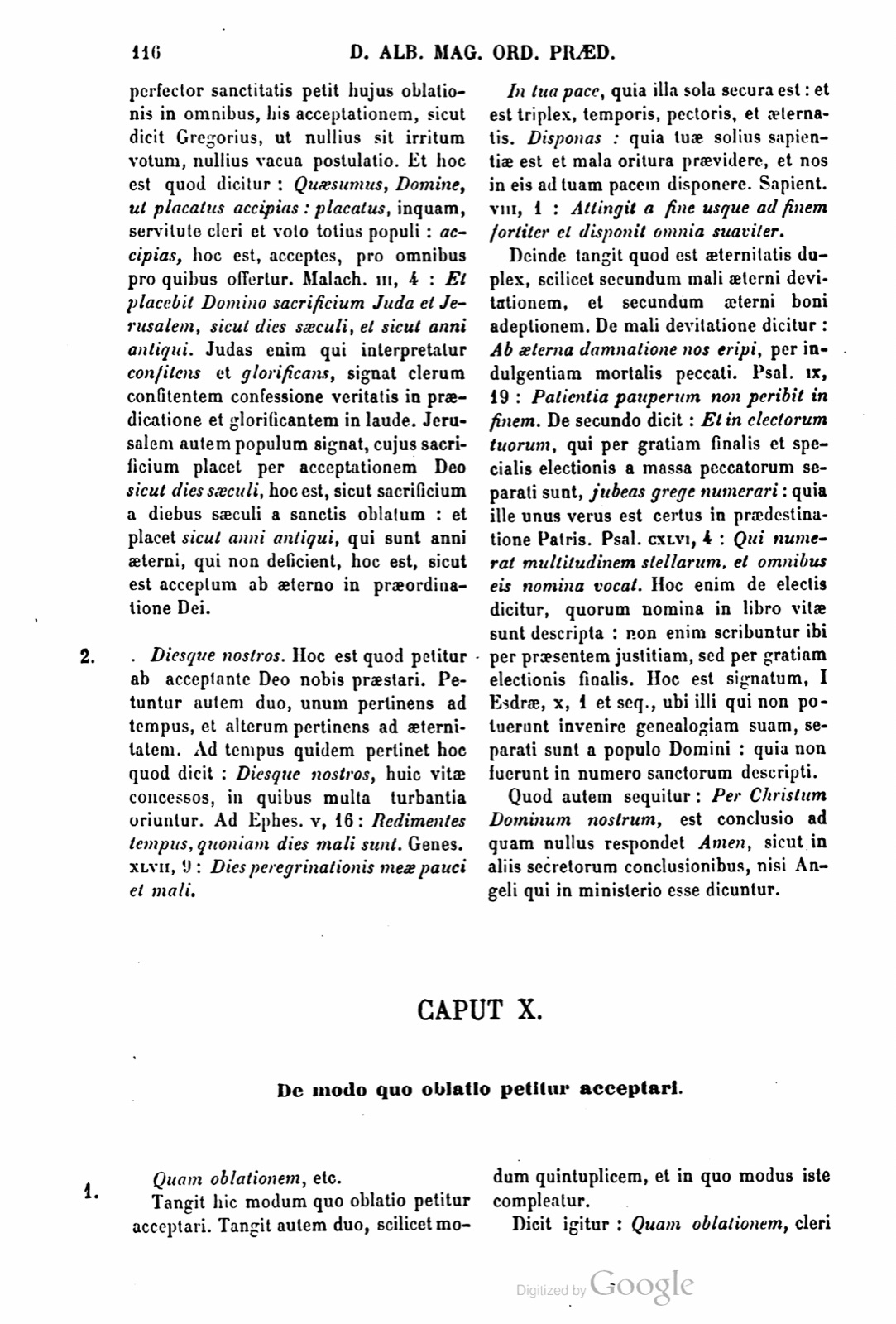
1. Quam oblationem, etc. Tangit hic modum quo oblatio petitur acceptari. Tangit autem duo, scilicet modum quintuplicem, et in quo modus iste compleatur.
Dicit igitur: Quam oblationem, cleri et populi, tu, Deus, cui soli offerendum est, quia dixisti, Exod. XX, 3: Non habebis deos alienos coram me.
In omnibus, gradibus cleri et populi, quaesumus, hoc est, rogamus, nullum ab oratione excipientes. Sapient. VI, 8: Pusillum et magnum ipse fecit, et aequaliter cura est illi de omnibus.
[Marginal label: Differentia inter oblationes Veteris et Novi Testamenti.] Benedictam. Quinque fuerunt in antiquis oblationibus ad exclusionem quorum hic quinque dicuntur: antiquae enim oblationes fuerunt vacuae a gratia: et ideo nulla ab ipsis profluxit benedictio. Antiquae oblationes ob memoriam aeternam non fuerunt adscriptae, sed potius ab hominibus inventae, et a Deo, ne idolis fierent, ordinatae. Antiquae etiam oblationes non fuerunt ratae: quia multa ratione improbatae, et quia convulsae fuerunt irrationabiles, et numquam secundum cor Dei acceptae. Et ideo contraria dicit quinque de ista: Benedictam, hoc est, benedictione gratiae plenam. Deuter. XXXIII, 5: Vertitque maledictionem ejus in benedictionem tuam, eo quod diligeret te. Eccli. XXXIX, 27: Benedictio illius quasi fluvius inundavit, etc.
Adscriptam, inter acceptissima munera Dei ad tantae rei aeternam memoriam. Habacuc, II, 2: Scribe visum, et explana eum super tabulas, ut percurrat qui legerit eum. Apocal. III, 5: Non delebo nomina eorum de libro vitae.
Ratam. Ratum est firmum, quod nulla ratione potest esse convulsum: numquam enim illa oblatio patietur repulsam, et numquam erit convulsa: quia sicut dicit Psalmista, Psal. CIX, 4: Juravit Dominus, et non paenitebit eum: Tu es sacerdos in aeternum secundum ordinem Melchisedech. Ita enim rata est oblatio, quod propter eam sacerdotium quod, sicut diximus, est servitus ejus, manet in aeternum, cui numquam aliud succedet sacerdotium. Ad Hebr. VII, 24 et 25: Hic autem eo quod maneat in aeternum, sempiternum habet sacerdotium. Unde et salvare in perpetuum potest accedentes per semetipsum ad Deum, semper vivens ad interpellandum pro nobis.
CHAPTER X.
On the mode by which the oblation is sought to be accepted.
1. Which oblation, etc. Here he touches the mode by which the oblation is sought to be accepted. But he touches two things, namely the fivefold mode and in what this mode is completed.
Therefore he says: Which oblation, of the clergy and people, thou, O God, to whom alone offering must be made, because thou said, Exodus 20:3: Thou shalt not have strange gods before me.
In all things, in the ranks of clergy and people, we beseech, that is, we ask, excepting no one from prayer. Wisdom 6:8: He made the small and the great, and equally there is care to him concerning all.
[Marginal label: Difference between the oblations of the Old and New Testament.] Blessed. There were five things in the ancient oblations, for the exclusion of which these five are said here; for the ancient oblations were empty of grace, and therefore no blessing flowed from them. The ancient oblations were not inscribed for an eternal memory, but rather invented by human beings and ordained by God lest they be made to idols. The ancient oblations also were not ratified, because they were disapproved by much reason, and because, having been convulsed, they were irrational, and never accepted according to the heart of God. And therefore he says five contrary things concerning this one: Blessed, that is, full of the blessing of grace. Deuteronomy 33:5: And he turned his curse into thy blessing, because he loved thee. Ecclesiasticus 39:27: His blessing overflowed like a river, etc.
Inscribed, among the most acceptable gifts of God for the eternal memory of so great a thing. Habakkuk 2:2: Write the vision and explain it on tablets, so that he who reads it may run through it. Apocalypse 3:5: I will not delete their names from the book of life.
Ratified. Ratified is firm, what cannot be convulsed by any reason; for that oblation will never suffer rejection, and will never be convulsed, because, as the Psalmist says, Psalm 109:4: The Lord has sworn, and it will not repent him: Thou art a priest forever according to the order of Melchizedek. For the oblation is so ratified that on account of it the priesthood which, as we have said, is his service, remains forever, to which no other priesthood will ever succeed. Hebrews 7:24 and 25: But this one, because he remains forever, has an everlasting priesthood. Hence he can also save forever those approaching God through himself, always living to intercede for us.
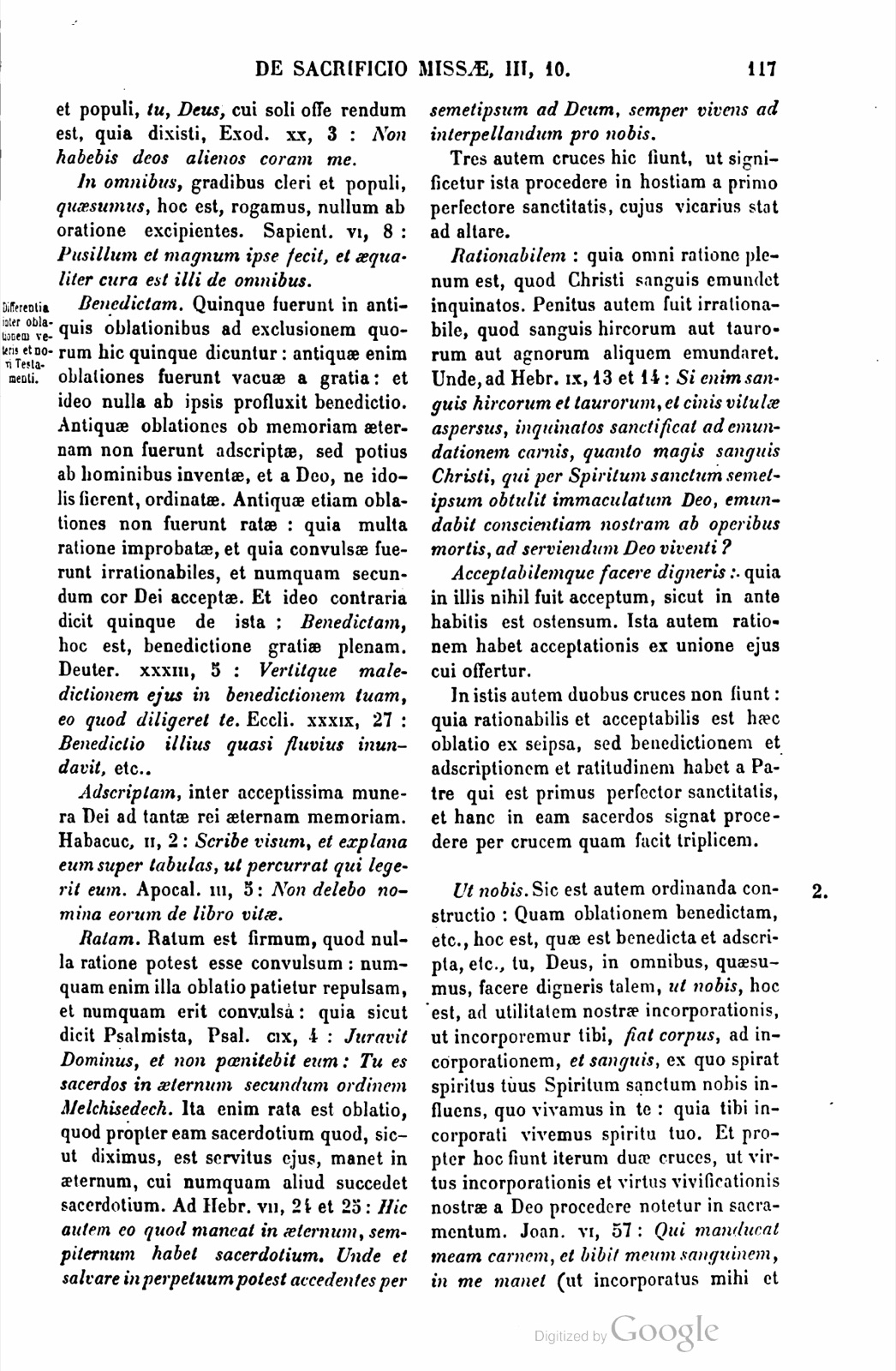
Tres autem cruces hic fiunt, ut significetur ista procedere in hostiam a primo perfectore sanctitatis, cujus vicarius stat ad altare.
Rationabilem: quia omni ratione plenum est, quod Christi sanguis emundet inquinatos. Penitus autem fuit irrationabile, quod sanguis hircorum aut taurorum aut agnorum aliquem emundaret. Unde, ad Hebr. IX, 13 et 14: Si enim sanguis hircorum et taurorum, et cinis vitulae aspersus, inquinatos sanctificat ad emundationem carnis, quanto magis sanguis Christi, qui per Spiritum sanctum semetipsum obtulit immaculatum Deo, emundabit conscientiam nostram ab operibus mortis, ad serviendum Deo viventi?
Acceptabilemque facere digneris: quia in illis nihil fuit acceptum, sicut in ante habitis est ostensum. Ista autem rationem habet acceptationis ex unione ejus cui offertur.
In istis autem duobus cruces non fiunt: quia rationabilis et acceptabilis est haec oblatio ex seipsa, sed benedictionem et adscriptionem et ratitudinem habet a Patre qui est primus perfector sanctitatis, et hanc in eam sacerdos signat procedere per crucem quam facit triplicem.
2. Ut nobis. Sic est autem ordinanda constructio: Quam oblationem benedictam, etc., hoc est, quae est benedicta et adscripta, etc., tu, Deus, in omnibus, quaesumus, facere digneris talem, ut nobis, hoc est, ad utilitatem nostrae incorporationis, ut incorporemur tibi, fiat corpus, ad incorporationem, et sanguis, ex quo spirat spiritus tuus Spiritum sanctum nobis influens, quo vivamus in te: quia tibi incorporati vivemus spiritu tuo. Et propter hoc fiunt iterum duae cruces, ut virtus incorporationis et virtus vivificationis nostrae a Deo procedere notetur in sacramentum. Joan. VI, 57: Qui manducat meam carnem, et bibit meum sanguinem, in me manet, ut incorporatus mihi et spiritui meo sociatus, et ego in eo, ut caput in membris et vita in viventibus.
But three crosses are made here so that these things may be signified to proceed into the host from the first perfecter of sanctity, whose vicar stands at the altar.
Rational, because it is full of every reason that the blood of Christ cleanses the defiled. But it was wholly irrational that the blood of goats or bulls or lambs should cleanse anyone. Hence, Hebrews 9:13 and 14: For if the blood of goats and bulls, and the ash of a heifer sprinkled, sanctifies the defiled unto cleansing of the flesh, how much more will the blood of Christ, who through the Holy Spirit offered himself immaculate to God, cleanse our conscience from works of death, to serve the living God?
And thou wouldest deign to make it acceptable, because in those things nothing was acceptable, as was shown in the preceding things. But this one has the account of acceptance from union with him to whom it is offered.
But in these two things crosses are not made, because this oblation is rational and acceptable from itself; but it has blessing and inscription and ratification from the Father, who is the first perfecter of sanctity, and the priest signifies this to proceed into it by the cross which he makes threefold.
2. For us. Thus the construction must be ordered: Which oblation blessed, etc., that is, which is blessed and inscribed, etc., thou, O God, in all things, we beseech, wouldest deign to make such that for us, that is, for the usefulness of our incorporation, so that we may be incorporated into thee, it may become body, unto incorporation, and blood, from which thy spirit breathes the Holy Spirit flowing into us, by whom we may live in thee; because incorporated into thee we shall live by thy spirit. And on account of this two crosses are again made, so that the power of our incorporation and the power of our vivification may be noted to proceed from God into the sacrament. John 6:57: He who eats my flesh and drinks my blood remains in me, as incorporated into me and associated to my spirit, and I in him, as head in members and life in living beings.
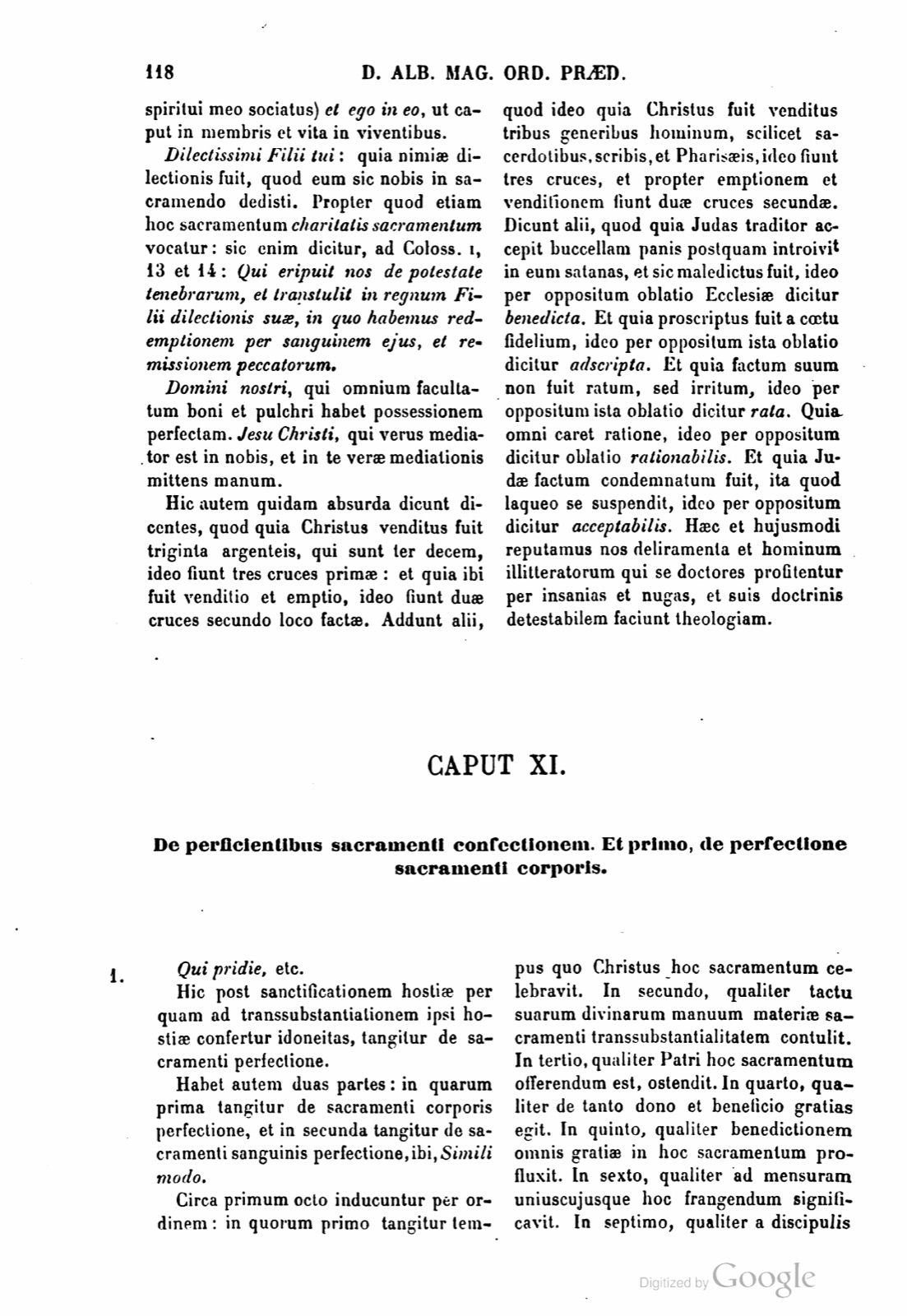
Dilectissimi Filii tui: quia nimiae dilectionis fuit, quod eum sic nobis in sacramento dedisti. Propter quod etiam hoc sacramentum charitatis sacramentum vocatur: sic enim dicitur, ad Coloss. I, 13 et 14: Qui eripuit nos de potestate tenebrarum, et transtulit in regnum Filii dilectionis suae, in quo habemus redemptionem per sanguinem ejus, et remissionem peccatorum.
Domini nostri, qui omnium facultatum boni et pulchri habet possessionem perfectam. Jesu Christi, qui verus mediator est in nobis, et in te verae mediationis mittens manum.
Hic autem quidam absurda dicunt dicentes, quod quia Christus venditus fuit triginta argenteis, qui sunt ter decem, ideo fiunt tres cruces primae: et quia ibi fuit venditio et emptio, ideo fiunt duae cruces secundo loco factae. Addunt alii, quod ideo quia Christus fuit venditus tribus generibus hominum, scilicet sacerdotibus, scribis, et Pharisaeis, ideo fiunt tres cruces, et propter emptionem et venditionem fiunt duae cruces secundae. Dicunt alii, quod quia Judas traditor accepit buccellam panis postquam introivit in eum satanas, et sic maledictus fuit, ideo per oppositum oblatio Ecclesiae dicitur benedicta. Et quia proscriptus fuit a coetu fidelium, ideo per oppositum ista oblatio dicitur adscripta. Et quia factum suum non fuit ratum, sed irritum, ideo per oppositum ista oblatio dicitur rata. Quia omni caret ratione, ideo per oppositum dicitur oblatio rationabilis. Et quia Judae factum condemnatum fuit, ita quod laqueo se suspendit, ideo per oppositum dicitur acceptabilis. Haec et hujusmodi reputamus nos deliramenta et hominum illitteratorum qui se doctores profitentur per insanias et nugas, et suis doctrinis detestabilem faciunt theologiam.
Of thy most beloved Son, because it was of excessive love that thou gavest him thus to us in the sacrament. For this reason also this sacrament is called the sacrament of charity; for thus it is said, Colossians 1:13 and 14: Who rescued us from the power of darkness and transferred us into the kingdom of the Son of his love, in whom we have redemption through his blood and remission of sins.
Of our Lord, who has perfect possession of all resources of the good and beautiful. Jesus Christ, who is true mediator in us and in thee, placing the hand of true mediation.
But here some say absurd things, saying that because Christ was sold for thirty pieces of silver, which are three tens, therefore the first three crosses are made; and because there was buying and selling there, therefore the two second crosses are made. Others add that because Christ was sold to three kinds of human beings, namely priests, scribes, and Pharisees, therefore three crosses are made, and because of buying and selling the two second crosses are made. Others say that because Judas the betrayer received the morsel of bread after Satan entered into him, and thus was cursed, therefore by opposition the oblation of the Church is called blessed. And because he was proscribed from the company of the faithful, therefore by opposition that oblation is called inscribed. And because his deed was not ratified, but void, therefore by opposition that oblation is called ratified. Because it lacks every reason, therefore by opposition the oblation is called rational. And because the deed of Judas was condemned, so that he hanged himself by a noose, therefore by opposition it is called acceptable. We reckon these and things of this sort to be ravings and of illiterate persons who profess themselves teachers through insanities and trifles, and by their teachings make theology detestable.
If a page does not appear, its photograph has not been uploaded yet.