Works › The Book on the Sacrifice of the Mass
Volume 38 · pp. 84–92
Tractate III, Chapter IV opening
A marker with ≈ is an approximate page boundary, placed by measure of the text; the page photographs remain the authority. In the paired views, clicking a page marker brings that page into view.
CAPUT IV.
De ipsa Praefatione.
1. Hac autem habita responsione, statim sanctitatis perfector magnitudinem tam magnifici doni praefatur, ut omnes excitet in admirationem ipsius et laudem: et ideo duo hic se consequuntur, Praefatio scilicet, et laus chori in laudem per praefationem excitati.
Circa Praefationem autem duo sunt attendenda, scilicet auctoritas a qua ortum habuit Praefatio, et expositio eorum quae in praefatione habentur.
[Marginal label: Praefationis Auctor.] Nomen enim Praefationis in ante habitis est expositum. De auctoritate autem sic in gestis Paparum, hoc est, re gesta legitur: "Gelasius Papa hymnos et tractus composuit, et sacramentorum Praefationes, cantus quidem et elimato sermone dictavit. Sixtus autem Papa hymnum: Sanctus, sanctus, sanctus, cantari in Missa ante confectionem sacramenti post Praefationem constituit." Et ideo de istis potest intelligi quod dicitur, Eccli. XLVII, 11: Stare fecit cantores contra altare, et in sono eorum dulces fecit modos.
[Marginal label: Quae continentur in Praefatione?] Ea vero quae in Praefatione continentur, in tribus comprehenduntur. Quorum primum est responsionis acceptae comprobatio. Secundum, sacramenti supereminens ostensa magnitudo. Tertium vero ut voces laudantis Ecclesiae vocibus angelicis misceantur, devota supplicatio.
In primo horum quatuor continentur, scilicet responsionis approbatio, approbatae responsionis determinatio, ejus cui gratiae referendae sunt in laudem praedicatio, et per quem sicut mediatorem tanti boni perficitur sanctificatio.
[Marginal label: Responsionis acceptae approbatio.] 2. In approbatione vero dicitur: Vere dignum et justum est, aequum et salutare. Quae sunt quinque sumpta a quinque quae sunt in sacramenti consideratione. Si enim consideramus sacramentum ut veritatem umbrarum Veteris Testamenti, sic dicitur sacramentum veritatis: et hoc modo dicitur hic: Vere. Ad Hebr. X, 1: Umbram habens lex futurorum bonorum, non ipsam imaginem rerum: quia boni gratiae fuerunt signa et non causa: sed hoc sacramentum auctorem in veritate continet omnis gratiae. Sic enim dicitur, Joan. I, 17, quod lex per Moysem, scilicet in umbris et figuris, data est: sed gratia et veritas, scilicet in verbis, per Jesum Christum facta est.
3. Si autem hujus sacramenti consideratur nobilitas, tunc est dignum Deo sacrificium, et sic dicitur dignum solum. Et ideo cum in veteri lege quaereretur, quid digne offerretur, non est inventum, dicente Michaea, VI, 6: Quid dignum offeram Domino? Et ideo, Apocal. V, 4, repraesentans gemitum Patrum antiquorum hoc sacrificio carentium, dicit: Ego flebam multum, quoniam nemo dignus inventus est aperire librum, nec videre eum. Istud enim sacramentum omnia aperit secreta divina et caelestia. Et ideo quibusdam interpositis dicitur, ibidem, vv. 8 et 9, de laude dignitatis istius: Et cum aperuisset librum, quatuor animalia et viginti quatuor seniores ceciderunt
CHAPTER IV.
On the Preface itself.
1. But when this response has been received, the perfecter of sanctity immediately prefaces the greatness of so magnificent a gift, so that he may excite all to admiration of it and to praise. And therefore two things follow each other here, namely the Preface and the praise of the choir excited to praise through the Preface.
But concerning the Preface two things are to be attended to, namely the authority from which the Preface had its origin, and the exposition of the things which are contained in the preface.
[Marginal label: The author of the Preface.] For the name of Preface has been explained in the things already had. But concerning the authority it is read thus in the deeds of the Popes, that is, in the historical deed: "Pope Gelasius composed hymns and tracts, and dictated the Prefaces of the sacraments, indeed chants and in polished speech. But Pope Sixtus established that the hymn Holy, holy, holy be sung in the Mass before the making of the sacrament after the Preface." And therefore concerning these one can understand what is said, Ecclesiasticus 47:11: He made singers stand opposite the altar, and in their sound he made sweet modes.
[Marginal label: What things are contained in the Preface?] But the things which are contained in the Preface are comprehended in three. The first of these is the confirmation of the response that has been received. The second is the shown supereminent greatness of the sacrament. But the third is the devout supplication that the voices of the praising Church be mingled with the angelic voices.
In the first of these four things are contained, namely approval of the response, determination of the approved response, proclamation in praise of him to whom thanks are to be referred, and through whom, as mediator, the sanctification of so great a good is perfected.
[Marginal label: Approval of the received response.] 2. But in the approval it is said: Truly it is worthy and just, equitable and salutary. These are five, taken from five things which are in consideration of the sacrament. For if we consider the sacrament as the truth of the shadows of the Old Testament, then it is called the sacrament of truth, and in this way here it is called: Truly. Hebrews 10:1: The law having the shadow of future goods, not the very image of the things, because they were signs of the good of grace and not the cause; but this sacrament contains in truth the author of all grace. For thus it is said, John 1:17, that the law was given through Moses, namely in shadows and figures, but grace and truth, namely in the words, was made through Jesus Christ.
3. But if the nobility of this sacrament is considered, then it is a sacrifice worthy of God, and so worthy alone is said. And therefore, when in the old law it was asked what might worthily be offered, it was not found, Micah 6:6 saying: What worthy thing shall I offer to the Lord? And therefore Apocalypse 5:4, representing the groaning of the ancient Fathers lacking this sacrifice, says: I wept much, because no one was found worthy to open the book, nor to see it. For that sacrament opens all divine and heavenly secrets. And therefore, with certain things interposed, it is said in the same place, verses 8 and 9, concerning the praise of this dignity: And when he had opened the book, the four living creatures and the twenty-four elders fell down
coram Agno, habentes singuli citharas, et phialas aureas plenas odoramentorum, quae sunt orationes sanctorum: et cantabant canticum novum, dicentes: Dignus es, Domine, accipere librum, et aperire signacula ejus, quoniam occisus es, et redemisti nos Deo in sanguine tuo. Liber enim est secretum consilium sapientiae divinae, quo disposuit in sacramentis ornare et ordinare Ecclesiam: hunc nemo aperire potuit nisi is qui sanguine suo de corde suo sacramenta profluere fecit: et ideo quatuor animalia Evangelicae praedicationis in se figuram praeferentia, ut rationem sacramentorum intelligant, sicut homo: in sacrificium se exhibebant, ut vitulus: fortiter mortem vincant, ut leo: altissima contemplatione Verbum apud Deum comprehendant, ut aquila: et viginti quatuor seniores qui signant duodecim patres Veteris Testamenti et duodecim Apostolos novae gratiae patres, statim cadunt in faciem suam in unam fidem praecedentium et sequentium, tam dignum sacramentum venerantes et jucunda laude citharizantes in omnium virtutum consonantia, et phialas auro divinitatis splendentes, hoc est, divinis cordibus flagrantes omni odoramento pietatis et bonitatis statim in venerationem tam digni excitantur sacramenti. Et ideo clara voce dicit perfector sanctitatis: Dignum.
4. Consideratur autem sacramentum ut nos obligans nobis donatum: quia, sicut dicit Gregorius: "Cum crescunt dona, rationes etiam crescunt donorum." Ex maximo igitur sacramentali dono maxime obligamur, et hoc considerans dicit: Et justum est. Est autem ista justitia ab istius sacramenti institutione: quia justum est ut instituta Dei teneamus, praecipue quae ad tantum instituta sunt utilitatem. Psal. CXVIII, 3: Utinam dirigantur viae meae ad custodiendas justificationes tuas. Dixit enim, Luc. XXII, 19: Hoc facite in meam commemorationem. Et quia injunxit in tanto charitatis affectu, ideo justum est, imo nihil tam justum, ut omni devotione celebretur.
5. Si autem consideretur sacramentum, et ejus qui dedit ad nos quibus dedit, par vel aequum est, secundum rationem dati et accepti, ut illud nos extollamus magnifica laude. Iniquum enim omnino est et impar invenitur ad Dei dona, magna et multa a Deo accipere, et non ad paria quantum valemus in laude reddere, et hoc attendendo perfector sanctitatis dicit: Aequum. Sapient. XI, 21: Omnia in mensura, et numero, et pondere disposuisti. Luc. VI, 38: Eadem quippe mensura qua mensi fueritis, remetietur vobis.
6. Si autem hujus sacramenti attendamus effectus, qui omnes salutares sunt et causa salutis aeternae: tunc salutare est Salvatori gratias rependere, ut continuo ab ipso in nos et a nobis in eum fluat et refluat in sacramento effectus salutis. Et hoc, Luc. II, 30, consideravit in ipso Simeon senex, dicens: Viderunt oculi mei salutare tuum. Hoc salutare erat in desiderio patrum. Et ideo dixit Jacob, Genes. XLIX, 18: Salutare tuum exspectabo, Domine. Sic igitur hic quinque perfector sanctitatis praefatur ad populum.
[Marginal label: Approbatae responsionis determinatio.] 7. Nos tibi semper, etc. Hic tangitur approbatae responsionis determinatio. Haec autem est, quod ubique et semper agantur gratiae de tanto sacramento.
Ubique quidem: quia per ipsum instauratur quae in caelis sunt et in terra: et ideo trina agit gratias machina, caelum pro ruinae angelicae reparatione, terra pro Ecclesiae militantis redemptione, infernus pro eorum qui ibi erant liberatione: et hoc est ubique. Ad Philip. II, 10: Ut in nomine Domini omne genu flectatur, caelestium, terrestrium, et infernorum. Et ideo etiam hoc sacrificium offertur pro caelestibus ad laudem, pro terrestribus ad gratiae perceptionem, pro his qui in infernalibus poenis sunt, ad liberationis supplicationem. Psal. CII, 22: In omni loco dominationis ejus, benedic, anima mea, Domino.
before the Lamb, each having harps and golden bowls full of odors, which are the prayers of the saints; and they were singing a new song, saying: Worthy art thou, O Lord, to receive the book and to open its seals, because thou wast slain, and hast redeemed us to God in thy blood. For the book is the secret counsel of divine wisdom, by which he disposed to adorn and order the Church in sacraments; no one could open this except he who by his blood made the sacraments flow forth from his heart. And therefore the four living creatures bearing in themselves the figure of evangelical preaching, that they might understand the reason of the sacraments, as man; that they might present themselves in sacrifice, as calf; that they might strongly conquer death, as lion; that by most high contemplation they might comprehend the Word with God, as eagle; and the twenty-four elders, who signify the twelve fathers of the Old Testament and the twelve Apostles, fathers of the new grace, immediately fall on their face in one faith of those preceding and those following, venerating so worthy a sacrament and harping with joyful praise in the consonance of all virtues; and with bowls shining with the gold of divinity, that is, with divine hearts burning with every odor of piety and goodness, they are immediately excited to the veneration of so worthy a sacrament. And therefore the perfecter of sanctity says in a clear voice: Worthy.
4. But the sacrament is considered as given to us and obliging us, because, as Gregory says: "When gifts increase, the accounts also of gifts increase." Therefore by the greatest sacramental gift we are most greatly obliged, and considering this he says: And just. But this justice is from the institution of this sacrament, because it is just that we keep the things instituted by God, especially those things which have been instituted for so great a usefulness. Psalm 118:3: Would that my ways be directed to keeping thy justifications. For he said, Luke 22:19: Do this in memory of me. And because he commanded it in so great an affection of charity, therefore it is just, indeed nothing is so just, that it be celebrated with all devotion.
5. But if the sacrament is considered, and the one who gave it, in relation to us to whom he gave it, it is fitting or equitable, according to the account of thing given and thing received, that we extol it with magnificent praise. For it is found wholly inequitable and unequal in relation to God's gifts to receive great and many things from God, and not to return equal things in praise insofar as we are able; and attending to this the perfecter of sanctity says: Equitable. Wisdom 11:21: Thou hast disposed all things in measure and number and weight. Luke 6:38: For with the same measure with which you have measured, it will be measured back to you.
6. But if we attend to the effects of this sacrament, which are all salutary and the cause of eternal salvation, then it is salutary to return thanks to the Savior, so that the effect of salvation may continually flow from him into us and flow back from us into him in the sacrament. And this, Luke 2:30, the aged Simeon considered in him, saying: My eyes have seen thy salvation. This salvation was in the desire of the fathers. And therefore Jacob said, Genesis 49:18: I will await thy salvation, O Lord. Thus therefore the perfecter of sanctity prefaces these five things here to the people.
[Marginal label: Determination of the approved response.] 7. To thee always, etc. Here the determination of the approved response is touched. But this is that thanks be given everywhere and always concerning so great a sacrament.
Everywhere indeed, because through it the things which are in heaven and on earth are restored; and therefore the threefold structure gives thanks: heaven for the repair of the angelic ruin, earth for the redemption of the militant Church, hell for the liberation of those who were there; and this is everywhere. Philippians 2:10: That at the name of the Lord every knee should bow, of heavenly, earthly, and infernal beings. And therefore this sacrifice is also offered for heavenly beings unto praise, for earthly beings unto the perception of grace, and for those who are in infernal punishments, unto supplication for liberation. Psalm 102:22: In every place of his dominion, bless the Lord, O my soul.
Semper autem: quia et in tempore gratiae, et in aeternitate gloriae: quia sicut in tempore percipitur in sacramentali et figurali specie, ita in aeterna beatitudine percipitur in ipsius rei veritate et manifestatione. Psal. XXXIII, 1: Benedicam Dominum in omni tempore, semper laus ejus in ore meo. Tob. IV, 20: Omni tempore benedic Deum. Sic igitur terminata approbatio est responsionis.
[Marginal label: Ejus cui gratiae referendae sunt in laude praedicatio.] 8. Domine sancte, Pater omnipotens, etc. Hic tangitur ejus cui gratiae referendae sunt in laude praedicatio.
Praedicatur enim per tres combinationes, quarum prima est: Domine sancte. Dominus enim, sicut jam diximus, dicit eum qui facultatibus pulchrorum et bonorum hanc potuit ministrare oblationem: quia dives est et copiosus in omni gratia. Quod autem additur: Sancte, ideo fit, ut has omnes impensas et divitias in rebus sanctis nos sanctificantibus sciamus esse accipiendas, sicut dicitur, Levit. XI, 44: Sancti estote, quoniam ego sanctus sum, ne polluatis animas vestras. Luc. I, 75: In sanctitate et justitia coram ipso omnibus diebus nostris. Tales enim magnificentiae suae divitias Dominus majestatis ostendit, cum nobis tam magnificum et omni sanctitate plenum et gratia largitus est sacramentum: et ideo Eucharistiae nomen accepit, de cujus plenitudine omnes nos accepimus, et gratiam pro gratia, sicut dicitur, Joan. I, 16. Hoc enim est illud gomor de quo dicitur, Exod. XVI, 32: Imple gomor ex eo, scilicet mannate, et custodiatur in futuras retro generationes, ut noverint panem, quo alui vos in solitudine, quando educti estis de terra Egypti. Gomor autem vas mensurale est, quod signat sacramentum corporis Dominici, in quo manna ponitur: quia in ipso omnis refectio divitiarum Domini invenitur. Et ideo frequentatio et usus ejus in omnes retro generationes custoditur, ut cuncti fideles panem illum ditissimum in omni sanctitate noverint per devotam venerationem, quo alimur in via hujus solitudinis, per quam redimus ad patriam, ubi ista in rerum veritate facie ad faciem percipiemus. Hoc etiam de ipso dicitur, Psal. LXXVII, 6: Filii qui nascentur, et exsurgent, et enarrabunt filiis suis: et ideo etiam in figura sacerdoti summo servandum est commissum. Exod. XVI, 33 et 34: Dixit Moyses ad Aaron: Sume vas unum, et mitte ibi Man, quantum potest capere gomor, et repone coram Deo ad servandum in generationes vestras, sicut praecepit Dominus Moysi. Hac igitur de causa dicitur: Domine sancte.
9. Secundum praeconium est: Pater omnipotens. Qui enim est Dominus omnium cum superpositione possessionis pulchrorum verorum et bonorum, pro affectu dignatur esse pater. Pater, inquam, qui in sua nimia dulcedine talem refectionem nobis praeparat. Sapient. XVI, 20 et 21: Paratum panem de caelo praestitisti illis sine labore, omne delectamentum in se habentem, et omnis saporis suavitatem. Substantia enim tua dulcedinem tuam quam in filios habes ostendebat, et deserviens uniuscujusque voluntati, ad quod quisque volebat, convertebatur. Parare enim in uno cibo omnem saporem gratiae, ostendit non domini terrentis in timore, sed patris dulcescentis in affectu pro nobis benignitatem et pietatem. Unde quod dicitur: Pater, intelligitur essentialiter, sicut totam trinitatem Patrem vocamus in dulcedine affectus sui de nobis cogitante. Psal. LXVII, 11: Parasti in dulcedine tua pauperi, Deus. Psal. LXIV, 10: Parasti cibum illorum: quoniam ita est praeparatio ejus. Propter quod et talis gratia dicitur panis filiorum. Matth. XV, 26: Non est bonum sumere panem filiorum, et mittere canibus.
But always, because both in the time of grace and in the eternity of glory; because just as in time it is received in sacramental and figural species, so in eternal beatitude it is received in the truth and manifestation of the thing itself. Psalm 33:1: I will bless the Lord at every time; his praise always in my mouth. Tobit 4:20: Bless God at every time. Thus therefore the approval of the response has been determined.
[Marginal label: The proclamation in praise of him to whom thanks are to be referred.] 8. Holy Lord, almighty Father, etc. Here the proclamation in praise of him to whom thanks are to be referred is touched.
For he is proclaimed through three combinations, the first of which is: Holy Lord. For Lord, as we have already said, names him who by the resources of beautiful and good things was able to minister this oblation, because he is rich and abundant in every grace. But what is added, Holy, is done so that we may know that all these expenses and riches are to be received in holy things that sanctify us, as is said, Leviticus 11:44: Be holy, because I am holy, lest you pollute your souls. Luke 1:75: In holiness and justice before him all our days. For the Lord of majesty showed such riches of his magnificence when he bestowed on us a sacrament so magnificent and full of all holiness and grace; and therefore it received the name Eucharist, from whose fullness we all have received, and grace for grace, as is said, John 1:16. For this is that gomor of which it is said, Exodus 16:32: Fill a gomor from it, namely from the manna, and let it be kept for future generations backward, so that they may know the bread with which I nourished you in the solitude, when you were led out of the land of Egypt. But the gomor is a measuring vessel, which signifies the sacrament of the Lord's body, in which the manna is placed, because in it every refreshment of the riches of the Lord is found. And therefore its repetition and use is kept into all generations backward, so that all the faithful may know by devout veneration that richest bread in all holiness, by which we are nourished on the way of this solitude through which we return to the homeland, where we shall receive those things in the truth of the realities face to face. This is also said of it, Psalm 77:6: The sons who will be born and will rise up will tell their sons. And therefore also in figure it was entrusted to the high priest to be kept. Exodus 16:33 and 34: Moses said to Aaron: Take one vessel, and put manna there, as much as a gomor can hold, and place it before God to be kept for your generations, as the Lord commanded Moses. Therefore for this reason it is said: Holy Lord.
9. The second proclamation is: Almighty Father. For he who is Lord of all things with the superposition of possession of true beautiful and good things deigns, through affection, to be father. Father, I say, who in his exceedingly great sweetness prepares such a refreshment for us. Wisdom 16:20 and 21: Thou furnished them prepared bread from heaven without labor, having every delight in itself and the sweetness of every taste. For thy substance showed thy sweetness which thou hast toward sons, and, serving the will of each one, it was changed into whatever each wished. For to prepare every savor of grace in one food shows the kindness and piety for us, not of a lord terrifying in fear, but of a father growing sweet in affection. Hence what is said, Father, is understood essentially, as we call the whole Trinity Father in the sweetness of his affection thinking about us. Psalm 67:11: Thou hast prepared in thy sweetness for the poor, O God. Psalm 64:10: Thou hast prepared their food, because thus is its preparation. For this reason such grace is also called the bread of sons. Matthew 15:26: It is not good to take the bread of sons and cast it to dogs.
Quia autem in hac benigna praeparatione transsubstantiatio panis in corpus Dominicum, et vini in sanguinem Dominicum exigitur, et haec transsubstantiatio non tam a minori quam ab omnipotentia procedit, ideo Patri praeparanti jungitur omnipotentia, qua tantam praeparationem potest perficere, et dicitur: Pater omnipotens. De omnipotentia qualis et quanta sit, supra in expositione hymni Gloria in excelsis, satis dictum est: sicut enim beatae Virgini Mariae omnia quae dixerat, credibilia fecit id quod de omnipotentia subjecit: Non erit impossibile apud Deum omne verbum 1: ita hoc quod nobis Pater in affectu paterno tantam gratiam paret, indubitatam fidem facit omnipotentia. Vult enim, quia pater: potest, quia omnipotens: scit autem ex diligentia parare, quia sapiens.
10. Tertium praeconium ejus cui offertur gratiarum actio, est quod subjungitur: Aeterne Deus. Aeternitas enim est, ut dicit Boetius in libro de Consolatione philosophiae, interminabilis vitae tota simul et perfecta possessio. Deus autem quod Graece θεός vocatur a θεῖν quod est ardere, derivatur. Aeternae igitur vitae alimonia, ut dicit Gregorius, non nisi ab aeterno vitae fonte qui in sacramento est, per deitatem vegetat et nutrit ad aeternitatem: nec a nobis est, sed a Deo nimia charitate sua succenso hoc nobis conferente. Et ideo dicitur aeterne: quia nos ad aeternitatem vegetans est in sacramento. Et dicitur Deus: quia hoc factum est nimia charitate Dei, de qua dicitur, Cantic. VIII, 6 et 7: Lampades ejus lampades ignis atque flammarum. Aquae multae non potuerunt exstinguere charitatem. Sic tibi dignum est gratias agere, Domine sancte, qui ad omnes sanctitatis copias quae in sacramento sunt, habes omnibus superpositas facultates. Pater, quia dulcedine patris affectus vis. Omnipotens, quia hujusmodi omnipotentia paras. Aeterne Deus, qui tantae charitatis sacramentum aeternam in eo plantans virtutem exhibes, quod nos vegetat ad aeternitatis immortalitatem.
[Marginal label: Ejus per quem tanti sacramenti est perfecta sanctificatio sicut per mediatorem, jucunda commemoratio.] 11. Per Christum Dominum, etc. Hic tangitur ejus per quem tanti boni perfecta est sanctificatio sicut per mediatorem, jucunda commemoratio. Unde mediationem notat praepositio per. Naturas autem quibus mediat, notat cum dicitur, per Christum qui unctus interpretatur, cujus unctio est deitas, et uncta humanitas, ut sicut canalis tangit fontem a quo haurit et hortum quem rigat, ita Emmanuel noster per divinitatem tangit Deum a quo sicut a fonte fluunt gratiarum chrismata, et per humanitatem tangit nos in quos profluunt per ipsum tanta charismata gratiarum. Ad Galat. III, 20: Mediator unius non est: Deus autem unus est. I ad Timoth. II, 5: Mediator Dei et hominum, homo Christus Jesus. Ad Hebr. IX, 11: Christus assistens pontifex futurorum bonorum. Ibi dicit Glossa: "Assistens nobis." Hoc sancti patres ante Christi praesentiam in carne deploraverunt, quod talem pontificem Dei et hominum non habuerunt: et ideo sua sanctificatio perfecta sacrificia non fuerunt. Unde in persona patrum dicitur, Job, IX, 32 et 33: Neque enim viro qui similis mei est, respondebo: nec qui mecum in judicio ex aequo possit audiri. Non est qui utrumque valeat arguere, et ponere manum suam in ambobus. Et ideo nullus verus pontifex fuit, nec alicujus sacrificium omnino poterat esse acceptum. Modo autem per pontificem Christum acceptum est, de quo dicit Pater: Tu es sacerdos in aeternum secundum ordinem Melchisedech 2. Et ideo per ipsum magnifice gratias agimus: quia sicut gratiae ad nos a Deo per Christum fluunt, ita per eumdem mediatorem ad Deum per gratiarum actionem revertuntur et reflectuntur, et continue inter nos et Deum redundant flumina gratiarum, quae totam laetificant civitatem Dei, hoc est, Ecclesiam.
But because in this benign preparation the transubstantiation of bread into the Lord's body and of wine into the Lord's blood is required, and this transubstantiation proceeds not from something lesser but from omnipotence, therefore omnipotence is joined to the Father preparing, by which he can perfect so great a preparation, and it is said: Father almighty. Concerning what sort and how great omnipotence is, enough has been said above in the exposition of the hymn Glory to God in the highest. For just as to the blessed Virgin Mary all things which he had said were made believable by what he added concerning omnipotence: No word will be impossible with God 1, so that the Father prepares so great a grace for us in fatherly affection, omnipotence makes an undoubted faith. For he wills because he is father; he can because he is almighty; and he knows how to prepare from diligence because he is wise.
10. The third proclamation of him to whom thanksgiving is offered is what is joined: Eternal God. For eternity, as Boethius says in the book On the Consolation of Philosophy, is the whole, simultaneous, and perfect possession of interminable life. But God, who is called theos in Greek, is derived from a word meaning to burn. Therefore the nourishment of eternal life, as Gregory says, vegetates and nourishes unto eternity only from the eternal font of life which is in the sacrament, through deity; and it is not from us, but from God, kindled by his exceedingly great charity, bestowing this on us. And therefore he is called eternal, because, vegetating us unto eternity, he is in the sacrament. And he is called God because this has been done by the exceedingly great charity of God, concerning which it is said, Song of Songs 8:6 and 7: Its lamps are lamps of fire and flames. Many waters could not extinguish charity. Thus it is worthy to give thanks to thee, holy Lord, who hast resources placed above all, for all the stores of sanctity which are in the sacrament. Father, because by the sweetness of a father's affection thou willest. Almighty, because thou preparest by omnipotence of this kind. Eternal God, who, planting eternal virtue in it, displayest the sacrament of such charity, which vegetates us to the immortality of eternity.
[Marginal label: Joyful commemoration of him through whom the sanctification of so great a sacrament is perfected as through a mediator.] 11. Through Christ our Lord, etc. Here a joyful commemoration is touched of him through whom the perfect sanctification of so great a good has been made as through a mediator. Hence the preposition through marks mediation. But the natures by which he mediates are marked when it is said, through Christ, who is interpreted anointed, whose anointing is deity and whose anointed reality is humanity, so that, just as a canal touches the fountain from which it draws and the garden which it waters, so our Emmanuel through divinity touches God from whom as from a font the chrismata of graces flow, and through humanity touches us, into whom so great charismata of graces flow forth through him. Galatians 3:20: A mediator is not of one; but God is one. 1 Timothy 2:5: The mediator of God and human beings, the man Christ Jesus. Hebrews 9:11: Christ, assisting as pontiff of future goods. There the Gloss says: "Assisting us." Before the presence of Christ in the flesh the holy fathers lamented this, that they did not have such a pontiff of God and human beings, and therefore their sacrifices did not become perfect sanctification. Hence in the person of the fathers it is said, Job 9:32 and 33: For I shall not answer a man who is like me, nor one who can be heard with me in judgment as an equal. There is no one who can argue both and place his hand on both. And therefore there was no true pontiff, nor could anyone's sacrifice be wholly acceptable. But now it has been accepted through the pontiff Christ, concerning whom the Father says: Thou art a priest forever according to the order of Melchizedek 2. And therefore through him we give magnificent thanks, because just as graces flow to us from God through Christ, so through the same mediator they return and are reflected back to God through thanksgiving, and continually between us and God overflow the rivers of graces, which gladden the whole city of God, that is, the Church.
12. Quod autem additur: Dominum nostrum, speciale dominium notat, quo nos sanguine suo redemit in suam possessionem. Dicit enim Chrysostomus super Joannem, quod sicut homo dominus auro servos emit, et emptos ornat et decorat: ita Christus nos suo sanguine in servos emit, et emptos tam digno sui sanguinis sacramento ornavit. I ad Corinth. VI, 20: Empti enim estis pretio magno. Glorificate et portate Deum in corpore vestro. I Petri, I, 18 et 19: Non corruptibilibus auro vel argento redempti estis de vana vestra conversatione paternae traditionis, sed pretioso sanguine quasi agni immaculati Christi.
[Marginal label: Ejus qui gratiae referendae sunt in hoc sacramento supereminens magnitudo.] 13. Per quem majestatem tuam, etc. Ostenditur hic cujus gratiae referendae sunt in hoc sacramento supereminens magnitudo.
Et hoc ostenditur praeconio angelicae vocis: et in hoc importantur tria, scilicet laudis altissimae praeconium: reverentiae ab his quibus omnis reverentia exhibenda est, impensum obsequium: et ab altissimis concelebratum gaudium.
In primo horum tria sunt notanda, scilicet mediatoris in laude officium, laudati culmen eximium, et laudentium dignissimum obsequium.
De primo horum dicit: Per quem, scilicet sicut per mediatorem, per quem Angelis data est laudis materia: quia mediatione sua perficitur eorum custodiae effectus, et casus eorum reparatur defectus, et in custodia promovetur profectus. Custodiunt enim homines Angeli, sicut dicitur in Psalmo XC, 11: Angelis suis Deus mandavit de te, ut custodiant te in omnibus viis tuis. Et ideo quia Christus fecit redemptionis opere, quod effectum habet custodia, ideo laudant Angeli per Christum: quia per Christum fit eis laudis materia. Hoc signatum est, Apocal. XII, 10 et 11, ubi sic dicitur: Audivi vocem magnam in caelo, dicentem: Nunc facta est salus, et virtus, et regnum Dei nostri, et potestas Christi ejus, quia projectus est accusator fratrum nostrorum, qui accusabat illos ante conspectum Dei nostri die ac nocte, hoc est, accusabiles reddebat: et ipsi vicerunt eum propter sanguinem Agni. Et post pauca subjungit, v. 12: Propterea laetamini, caeli, et qui habitatis in eis. Vox enim magna haec, vox est laudantium Angelorum, ut dicit Gregorius, in contemplatione tantae gratiae admirantium Dei consilium, qualiter per Christum hominem a diaboli captivitate absolvit et angelicam custodiam ad effectum salutis provexit.
Per hoc etiam ruinae Angelorum reintegratur defectus. Ad Ephes. I, 9 et 10: Secundum beneplacitum ejus, quod proposuit in eo, in dispensatione plenitudinis temporum, instaurare omnia in Christo, quae in caelis et quae in terra sunt, in ipso. Ad Coloss. I, 19 et 20: In ipso complacuit omnem plenitudinem inhabitare, et per eum reconciliare omnia in ipsum, pacificans per sanguinem crucis ejus sive quae in terris, sive quae in caelis sunt. Haec ergo restauratio casus angelici est causa et materia laudis Angelorum in officio isto mediatoris, qui sicut dicitur, Luc. XV, 9, drachmam decimam invenit, et eam in loco cadentis Angeli reposuit. Amos, IX, 11: In die illa suscitabo tabernaculum David, quod cecidit: et reaedificabo aperturas murorum ejus, et ea quae corruerant instaurabo: et reaedificabo illud sicut in diebus antiquis. Tabernaculum est hic caelum caelestium excubiarum tabernaculum, quod dicitur esse nostri David qui manu fortis et adspectu desiderabilis interpretatur: quia in eo propugnator est ad salvandum, ut manu fortis: et in eum desiderant Angeli prospicere, quia adspectu est desiderabilis. Hoc autem cecidit in ruina Angelorum, et in apertura in defectu vacuarum mansionum stetit. Et unde poterant suppleri, hoc est, ex homine in caelum assumendo, etiam corruit in primo hominis peccato, et sic mediatione sua Pater illud per Christum tripliciter reaedificavit: quia hominem a casu redemit, Angelorum numerum ex hominibus reintegravit, hominem in caelum in mansiones paratas introduxit.
12. But what is added, our Lord, marks a special dominion by which he redeemed us into his possession by his blood. For Chrysostom says on John that just as a human lord buys slaves with gold, and adorns and decorates those bought, so Christ bought us with his blood into slavery, and adorned those bought with so worthy a sacrament of his blood. 1 Corinthians 6:20: For you have been bought with a great price; glorify and carry God in your body. 1 Peter 1:18 and 19: You have been redeemed, not with corruptible gold or silver from the vain manner of life of paternal tradition, but with the precious blood as of an immaculate lamb, Christ.
[Marginal label: The supereminent greatness in this sacrament of him to whom thanks are to be referred.] 13. Through whom thy majesty, etc. Here the supereminent greatness in this sacrament of him to whom thanks are to be referred is shown.
And this is shown by the proclamation of the angelic voice; and in this three things are conveyed: namely the proclamation of highest praise, the service of reverence shown by those by whom all reverence must be shown, and joy concelebrated by the highest ones.
In the first of these three things are to be noted, namely the office of the mediator in praise, the excellent height of the one praised, and the most worthy service of those praising.
Concerning the first of these he says: Through whom, namely as through a mediator, through whom material of praise was given to Angels, because by his mediation the effect of their guardianship is perfected, the defect of their fall is repaired, and progress in guardianship is advanced. For Angels guard human beings, as is said in Psalm 90:11: God commanded his Angels concerning you, that they guard you in all your ways. And therefore, because Christ by the work of redemption brought about that which has the effect of guardianship, therefore the Angels praise through Christ, because through Christ material of praise is made for them. This was signified, Apocalypse 12:10 and 11, where it is said thus: I heard a great voice in heaven, saying: Now salvation has been made, and power, and the kingdom of our God, and the power of his Christ, because the accuser of our brothers has been cast forth, who accused them before the sight of our God day and night, that is, made them accusable; and they conquered him because of the blood of the Lamb. And after a few words he adds, verse 12: Therefore rejoice, heavens, and you who dwell in them. For this great voice is the voice of the praising Angels, as Gregory says, wondering in contemplation of so great a grace at the counsel of God, how through Christ as man he released the human being from the captivity of the devil and advanced angelic guardianship to the effect of salvation.
Through this also the defect of the ruin of the Angels is restored. Ephesians 1:9 and 10: According to his good pleasure, which he set forth in him, in the dispensation of the fullness of times, to restore all things in Christ, the things which are in heaven and the things which are on earth, in him. Colossians 1:19 and 20: In him it pleased that all fullness dwell, and through him to reconcile all things into himself, pacifying through the blood of his cross whether the things on earth or the things in heaven. Therefore this restoration of the angelic fall is the cause and material of the praise of Angels in this office of the mediator, who, as is said, Luke 15:9, found the tenth drachma and placed it back in the place of the fallen Angel. Amos 9:11: On that day I will raise up the tabernacle of David which fell, and I will rebuild the openings of its walls, and the things which had collapsed I will restore, and I will rebuild it as in the days of old. Here the tabernacle is the heaven, the tabernacle of the heavenly watches, which is said to belong to our David, who is interpreted strong of hand and desirable of appearance, because in it he is defender for saving, as strong of hand, and Angels desire to look into him, because he is desirable in appearance. But this fell in the ruin of the Angels, and in the opening it stood in the defect of vacant mansions. And that from which they could have been filled, that is, from a human being assumed into heaven, also fell in the first sin of man; and thus by his mediation the Father rebuilt it threefold through Christ, because he redeemed the human being from the fall, restored the number of the Angels from human beings, and introduced the human being into heaven, into prepared mansions.
Ex mediatione etiam Christi officium proficit Angelis: quia virtute sanguinis adjuvatur manus angelica ut hominem facilius provehat ad virtutum profectum et perfectionem. Et ideo dicitur in Psalmo XC, 12: In manibus portabunt te. Quia operibus Angelorum portamur ad profectum, remoto pondere circumstantis nos peccati per Christi sanguinem. Hoc signatum est, Matth. IV, 11, ubi Christo pro nobis vincente tentatorem, ne inducamur in ipsam tentationem, Angeli accesserunt, et ministrabant ei.
Sic igitur triplex angelica laus promovetur per officium mediatoris.
[Marginal label: Laudati culmen eximium.] 14. Majestatem tuam. Tangitur hic laudati culmen eximium. Majestas autem est magnitudo supereminens stans, quae numquam declinat ad parvitatem. Hanc autem maxime ostendit Deus in hoc magno, in quo mirabili majestate effecit, ut incomprehensus comprehendatur in tam parvo, sumptus maneat in seipso, regnans aeternaliter in ara mactetur in ministerio. Isa. LXVI, 8: Quis audivit umquam tale, et quis vidit huic simile? III Regum, VIII, 27: Si caelum et caeli caelorum te capere non possunt, quanto magis domus haec quam aedificavi! et quanto minus forma minima panis et vini, quae est in altari! Sed haec est majestas: quia sicut dicitur, ad Roman. IX, 27, incircumscriptus et immensus Deus verbum breviatum fecit super terram, ut esset vobiscum, sicut dicitur, Isa. X, 23: Consummationem et abbreviationem Dominus Deus exercituum faciet in medio omnis terrae. Et hoc ipsum non in substantia, sed in signo totum Deum et hominem continente secundum omnem sui veritatem et magnitudinem fecit, ut esset in nobis corporaliter et spiritualiter in perceptione sacramenti. III Regum, VIII, 11: Impleverat enim gloria Domini domum Domini: sic et natura quam assumpsit in sacramentali specie in qua totus habitavit. Sic igitur dicitur de Ecclesia, Aggaei, II, 10: Magna erit gloria domus istius novissimae, hoc est, Ecclesiae, in cujus sacrificio Deus divinitus et corporaliter habitat, plusquam primae, hoc est, synagogae, in qua non habitavit nisi in figuris umbrarum.
Hic sumimus Christum in sacramento, et integer manet apud Patrem in caelo. Sumimus, inquam, ut in eo vivamus. Manet ut ipsi in caelo conregnemus. De primo dicitur, Joan. VI, 58: Qui manducat me, et ipse vivet propter me. Et hujus alimoniae virtute tendimus continue ad hujus sacramenti principium quod est Christus, in figurae propriae integritate regnans in caelo apud Patrem, ut ibi conregnemus. Et hoc signans dixit Dominus apud Lucam, XXII, 29 et 30: Et ego dispono vobis, sicut disposuit mihi Pater meus, regnum, ut edatis et bibatis super mensam meam in regno meo. Nemo etiam secundum naturam ascendit, nisi natura superior efficiatur in ipso. Ita naturam regnantis influit nobis summa majestas, ut per ipsam mensam quam sumimus, ad locum regnantis in caelo tendamus.
By the mediation of Christ the office also profits the Angels, because by the power of the blood the angelic hand is aided so that it may more easily advance the human being to the progress and perfection of virtues. And therefore it is said in Psalm 90:12: They will bear you in their hands. For we are carried to progress by the works of Angels, the weight of sin surrounding us having been removed through the blood of Christ. This was signified, Matthew 4:11, where, when Christ conquered the tempter for us, lest we be led into that temptation, Angels came and ministered to him.
Thus therefore threefold angelic praise is advanced through the office of the mediator.
[Marginal label: The excellent height of the one praised.] 14. Thy majesty. Here the excellent height of the one praised is touched. But majesty is a standing supereminent greatness which never declines to littleness. And God shows this especially in this great thing, in which by wondrous majesty he brought it about that the incomprehensible one is comprehended in so small a thing, that having been received he remains in himself, that reigning eternally he is slaughtered on the altar in ministry. Isaiah 66:8: Who has ever heard such a thing, and who has seen anything like this? 3 Kings 8:27: If heaven and the heavens of heavens cannot contain thee, how much less this house which I have built, and how much less the minimal form of bread and wine which is on the altar! But this is majesty, because, as is said, Romans 9:27, the uncircumscribed and immense God made a shortened word upon the earth, so that he might be with you, as is said, Isaiah 10:23: The Lord God of hosts will make consummation and abbreviation in the midst of all the earth. And this very thing he made, not in substance, but in the sign containing the whole God and man according to all his truth and magnitude, so that he might be in us corporally and spiritually in the reception of the sacrament. 3 Kings 8:11: For the glory of the Lord had filled the house of the Lord; so also the nature which he assumed in the sacramental species, in which he wholly dwelt. Thus therefore it is said of the Church, Haggai 2:10: Great will be the glory of this last house, that is, of the Church, in whose sacrifice God dwells divinely and corporally, more than of the first, that is, of the synagogue, in which he dwelt only in figures of shadows.
Here we receive Christ in the sacrament, and he remains whole with the Father in heaven. We receive him, I say, so that we may live in him. He remains so that we may reign with him in heaven. Concerning the first it is said, John 6:58: He who eats me will also live because of me. And by the power of this nourishment we tend continually to the principle of this sacrament, which is Christ, reigning in heaven with the Father in the integrity of his proper figure, so that there we may reign together. And signifying this the Lord said according to Luke 22:29 and 30: And I dispose to you, as my Father disposed to me, a kingdom, that you may eat and drink at my table in my kingdom. No one also ascends according to nature unless a higher nature is brought about in him. Thus the highest majesty flows into us the nature of the one reigning, so that through the very table which we receive, we may tend to the place of the one reigning in heaven.
Mactatur in mysterio et immortalis permanet, dicente ipso Domino: Hoc facite in meam commemorationem 3. I ad Corinth. XI, 26: Quotiescumque manducabitis panem hunc, et calicem Domini bibetis, mortem Domini annuntiabitis donec veniat. Unde calice utimur pro sepulcro, patena pro lapide ad os monumenti posito, pallis et corporalibus pro sindone qua involutum fuit corpus Dominicum a sancto Joseph pietatis officio. Et de hoc habentur metra ista, scilicet,
Ara crucis, tumulique calix, lapidisque patena, Sindonis officium candida byssus habet.
Scimus tamen et firmiter credimus et simpliciter confitemur id quod dicitur, ad Roman. VI, 9 et 10: Christus resurgens ex mortuis jam non moritur, mors illi ultra non dominabitur. Quod enim mortuus est, peccato mortuus est semel: quod autem vivit, vivit Deo, hoc est, ad similitudinem Dei, qui solus habet immortalitatem et lucem habitat inaccessibilem, sicut dicitur, I ad Timoth. VI, 16: quia numquam in caelo vel in terra ostensa est major majestas prorsus nulla. Et ideo majestatem in hoc sacramento laudandam esse dicimus per Christum, in cujus sacrificio et sacerdotio tripliciter haec majestas declaratur.
[Marginal label: Laus, quid? Honor, quid?] 15. Laudant Angeli. Angeli hic meo judicio non dicuntur specialiter et infimus caelestium spirituum ordo, sed potius sicut beatus Dionysius dicit, Angeli hic omnes caelestes essentiae vocantur, quorum ut dicit Damascenus: "Unum est commune opus hymnis laudare Deum." In his enim verbis nec nomina ordinum Angelorum, nec distributio per hierarchias describitur, sed communis laudis praeconium caelestium spirituum in sacramento declaratur. In sacramento enim habemus hujus sacramenti virtutem, honorem, et profectus generalitatem. Virtutem autem decet laus: quia laus est virtutis praeconium. Honorem condecet reverentia: quia honor est exhibitio reverentiae in testimonium virtutis, ut volunt Philosophi. Generalem autem profectum quem omnia caelestia et terrestria et infernalia habent in sacramento, condecet concelebratio: quia celebratio, ut dicit Fulgentius, est concentus multorum laudem Dei solemnizantium. Et haec tria per ordinem inducuntur. Quia igitur commune caelestium virtutum et essentiarum officium est laudare Dei virtutem, quae de hoste per hoc triumphavit sacrificium, ideo dicitur: Laudant Angeli. Eccli. LI, 15: Laudabo nomen tuum assidue, et collaudabo illud in confessione. Psal. CXLVII, 2: Laudate Dominum, omnes Angeli ejus, laudate eum, omnes virtutes ejus. Psal. CII, 20: Benedicite Domino, omnes Angeli ejus, potentes virtute, facientes verbum illius, ad audiendam vocem sermonum ejus. Sic igitur et hac de causa laudant Angeli divinam in sacramento majestatem, quorum laus, ut dicit Gregorius, admiratio est in sapientia et majestate talem in sacramento virtutem perficientis.
16. Adorant Dominationes, etc. Tangitur hic secundum quod pertinet ad reverentiam tanti honoris, quantus est in sacramento. Est enim hoc sacramentum plenum omni gratia, propter quod sibi honor debetur, quia honor est praemium gratiae et virtutis: et plenum Deo, propter quod cultus sibi debetur divinus, quia θεοσεβεῖα vocatur Graece. Et ideo talis hic cultus inducitur Angelorum reverentia quam Deo Patri per Dominum Jesum Christum exhibent Angeli, ut et homines ad similem cultum et reverentiam provocentur.
Inducit enim hic duos ordines Angelorum, qui minus inclinari videntur ad reverentiam, et quando scitur, quod et illi voluntate ad reverentiam inclinantur, quod de omnibus non dubitetur, quin ad eumdem modum inclinentur, et quod et nos cum omni devotione similia faciamus.
He is slaughtered in mystery and remains immortal, the Lord himself saying: Do this in memory of me 3. 1 Corinthians 11:26: As often as you shall eat this bread and drink the chalice of the Lord, you will announce the death of the Lord until he comes. Hence we use the chalice for the sepulcher, the paten for the stone placed at the mouth of the monument, the palls and corporals for the shroud in which the Lord's body was wrapped by holy Joseph with the office of piety. And concerning this these verses are had, namely:
The altar has the office of the cross, the chalice of the tomb, the paten of the stone, and the white linen has the office of the shroud.
Nevertheless we know and firmly believe and simply confess what is said, Romans 6:9 and 10: Christ rising from the dead now does not die; death will no longer have dominion over him. For in that he died, he died once to sin; but in that he lives, he lives to God, that is, after the likeness of God, who alone has immortality and inhabits inaccessible light, as is said, 1 Timothy 6:16, because absolutely no greater majesty has ever been shown in heaven or on earth. And therefore we say that majesty in this sacrament must be praised through Christ, in whose sacrifice and priesthood this majesty is declared threefold.
[Marginal label: What is praise? What is honor?] 15. The Angels praise. Angels here, in my judgment, are not called especially and as the lowest order of heavenly spirits, but rather, as blessed Dionysius says, here all heavenly essences are called Angels; as Damascene says, "One common work is to praise God with hymns." For in these words neither the names of the orders of Angels, nor the distribution by hierarchies, is described, but the common proclamation of praise of the heavenly spirits in the sacrament is declared. For in the sacrament we have the power of this sacrament, its honor, and the universality of its advance. But praise is fitting for power, because praise is the proclamation of power. Reverence befits honor, because honor is the exhibition of reverence in testimony of virtue, as the Philosophers hold. But the general progress which all heavenly, earthly, and infernal things have in the sacrament is fittingly accompanied by concelebration, because celebration, as Fulgentius says, is the harmony of many persons solemnizing the praise of God. And these three things are introduced in order. Therefore, because it is the common office of heavenly powers and essences to praise the power of God which triumphed over the enemy through this sacrifice, therefore it is said: The Angels praise. Ecclesiasticus 51:15: I will praise thy name continually, and I will praise it together in confession. Psalm 147:2: Praise the Lord, all his Angels; praise him, all his powers. Psalm 102:20: Bless the Lord, all his Angels, mighty in power, doing his word, for hearing the voice of his words. Thus therefore, and for this reason, the Angels praise the divine majesty in the sacrament; their praise, as Gregory says, is wonder in wisdom and majesty of the one perfecting such a power in the sacrament.
16. The Dominations adore, etc. Here the second thing is touched, which pertains to the reverence of so great an honor, as great as there is in the sacrament. For this sacrament is full of every grace, on account of which honor is owed to it, because honor is the reward of grace and virtue; and it is full of God, on account of which divine worship is owed to it, because in Greek it is called theosebeia. And therefore such worship is introduced here by the reverence of the Angels which the Angels exhibit to God the Father through the Lord Jesus Christ, so that human beings also may be summoned to a similar worship and reverence.
For he introduces here two orders of Angels which seem less inclined to reverence; and when it is known that even they are inclined by will to reverence, there should be no doubt concerning all the others that they are inclined in the same way, and that we also should do similar things with all devotion.
Primus ordo est, quod dicit: Adorant Dominationes. Dominationum enim, ut dicit Dionysius in libro de Caelesti hierarchia, est omnibus inferioribus et per naturam humilibus superponi, et superpositionis et dominationis divinae incessanter esse appetitivos. Et talium qui sic in altitudine semper feruntur cum actu et omni desiderio, non est adorare, sed potius adorari. Ex quo igitur adorant, scitur quod hoc sacramentum est altissimum et in omnibus summis creaturis omni dignitate et veneratione superpositum, utpote vero Deo et omni gratia plenum. Unde, ad Hebr. I, 6: Cum introducit primogenitum in orbem terrae, dicit: Et adorent eum omnes Angeli Dei. Adoratio enim est prostratio super terram in recognitionem, quod ille qui adorat, est de nihilo. In hoc quod est elevatus ab eo qui adoratur. Apocal. V, 11 et 12: Et vidi, et audivi vocem Angelorum multorum in circuitu throni, et animalium, et seniorum: et erat numerus eorum millia millium, dicentium voce magna: Dignus est Agnus, qui occisus est, accipere virtutem, et divinitatem, et sapientiam, et fortitudinem, et honorem, et gloriam, et benedictionem. Igitur adorant Dominationes. Et ideo dignum est ut omnis creatura adoret id quod Dominationes adorant. Unde, Apocal. V, 13: Et omnem creaturam quae in caelo est, et super terram, et sub terra, et quae sunt in mari, et quae in eo, omnes audivi dicentes: Sedenti in throno et Agno, benedictio, et honor, et gloria, et potestas in saecula saeculorum. Reverentia autem non tantum est adoratio honoris et majestatis in eo qui adoratur, sed est recisio quaedam et relapsus in cognitione propriae parvitatis in eo qui adorat respectu magnitudinis in eo qui adoratur cognitae, et quoad hoc inducitur id quod sequitur:
17. Tremunt Potestates. Potestatum enim, ut dicit Dionysius, libera severitate est corripere omne quod rectitudini legum divinarum non congruit, et vindicare in omne quod legibus obstando repugnat. Et ideo Potestatum non est tremere, sed potius, quod aliqua tremant coram eo. Quod ergo tremant, hoc est coram eo qui eximiae est potestatis, et tremunt tremore reverentiae, et non timiditatis, cognoscentes suam nihil esse potestatem respectu potestatis divinae, quae in sacramento manifestatur et continetur. Et ex quo sic tremunt et pavent reverentia potestatis qui minus tremere videbantur, oportet quod ad sacramentum omnis tremat et paveat creatura. Et hoc est quod dicit Jacob, Genes. XXVIII, 17: Pavensque, Quam terribilis est, inquit, locus iste! non est hic aliud nisi domus Dei, et porta caeli. Et supra, v. 16: Vere Dominus est in loco isto, et ego nesciebam. Quamvis autem omnis locus pavendus et terribilis sit, in quo Deus sua ostendit sacramenta, tamen locus specierum sacramentalium specialiter est omni veneratione tremendus, ubi ostendit ea quae in cruce perfecit, ubi et saxa scissa sunt, et monumenta aperta, et ubi terra tremuit, et ipse sol globos lucis suae abscondit. Et hoc est illud reverentiae signum quod dicitur, Job, XXVI, 11: Columnae caeli contremiscunt et pavent ad nutum ejus. Si autem sic Potestates caeli et columnae tremunt in reverentia illius magnitudinis, tunc omnis homo in se concussus in reverentia ad sacramentum debet contremere et pavere.
18. Caeli caelorumque virtutes. Tangit celebrationem totius caelestis concentus, et inducit tria, caelos, et caelorum virtutes, et beata Seraphim. Caeli autem per metonymiam hic dicuntur angelicae virtutes, quae supra se eum qui in sacramento est, venerantur, sicut dicitur in Psalmo CXLVIII, 4: Laudate eum, caeli caelorum. Et iterum, CXLVIII, 1: Laudate Dominum de caelis, laudate eum in excelsis. Quia ipse ascendit dignitate super omnes caelos, hoc est, angelicas virtutes. Ad Ephes. IV, 10: Qui descendit, ipse est et qui ascendit super omnes caelos, ut impleret omnia.
The first order is what he says: The Dominations adore. For it belongs to the Dominations, as Dionysius says in the book On the Heavenly Hierarchy, to be placed above all lower and naturally humble things, and to be unceasingly appetitive of divine superposition and domination. And for such beings, who are thus always borne in height with act and every desire, it is not their part to adore, but rather to be adored. Therefore from the fact that they adore, it is known that this sacrament is highest and placed above all highest creatures in every dignity and veneration, as true God and full of every grace. Hence Hebrews 1:6: When he brings the firstborn into the world, he says: And let all the Angels of God adore him. For adoration is prostration upon the earth in recognition that the one who adores is from nothing. In this, because he is elevated by the one who is adored. Apocalypse 5:11 and 12: And I saw and heard the voice of many Angels around the throne and the living creatures and the elders; and their number was thousands of thousands, saying with a great voice: Worthy is the Lamb who was slain to receive power and divinity and wisdom and strength and honor and glory and blessing. Therefore the Dominations adore. And therefore it is worthy that every creature adore that which the Dominations adore. Hence Apocalypse 5:13: And every creature which is in heaven and upon the earth and under the earth, and the things that are in the sea and the things that are in it, I heard all saying: To the one sitting on the throne and to the Lamb, blessing and honor and glory and power forever and ever. But reverence is not only the adoration of honor and majesty in the one who is adored, but it is a certain cutting back and falling back into knowledge of one's own littleness in the one who adores, with respect to the known greatness in the one who is adored; and with regard to this is introduced what follows:
17. The Powers tremble. For it belongs to the Powers, as Dionysius says, with free severity to correct everything that does not agree with the rectitude of divine laws, and to vindicate against everything that resists by opposing the laws. And therefore it is not the part of the Powers to tremble, but rather that other things tremble before them. Therefore that they tremble means that this happens before him who is of excellent power; and they tremble with the trembling of reverence and not of fear, recognizing that their own power is nothing in respect of the divine power which is manifested and contained in the sacrament. And since those who seemed less likely to tremble thus tremble and fear with reverence for power, every creature must tremble and fear before the sacrament. And this is what Jacob says, Genesis 28:17: And fearing, he said, How terrible is this place! This is nothing other than the house of God and the gate of heaven. And above, verse 16: Truly the Lord is in this place, and I did not know. But although every place is to be feared and is terrible in which God shows his sacraments, nevertheless the place of the sacramental species especially must be trembled before with every veneration, where he shows the things he perfected on the cross, where rocks were split, and monuments opened, and where the earth trembled, and the sun itself hid the globes of its light. And this is that sign of reverence which is said, Job 26:11: The columns of heaven tremble and fear at his nod. But if the Powers of heaven and the columns tremble thus in reverence of that greatness, then every human being, shaken in himself, ought to tremble and fear in reverence toward the sacrament.
18. The heavens and the powers of the heavens. He touches the celebration of the whole heavenly harmony, and introduces three things: the heavens, the powers of the heavens, and the blessed Seraphim. But heavens here by metonymy are called angelic powers, which venerate above themselves him who is in the sacrament, as is said in Psalm 148:4: Praise him, heavens of heavens. And again, 148:1: Praise the Lord from the heavens; praise him in the highest. Because he ascends in dignity above all the heavens, that is, the angelic powers. Ephesians 4:10: He who descended is himself also the one who ascended above all the heavens, that he might fill all things.
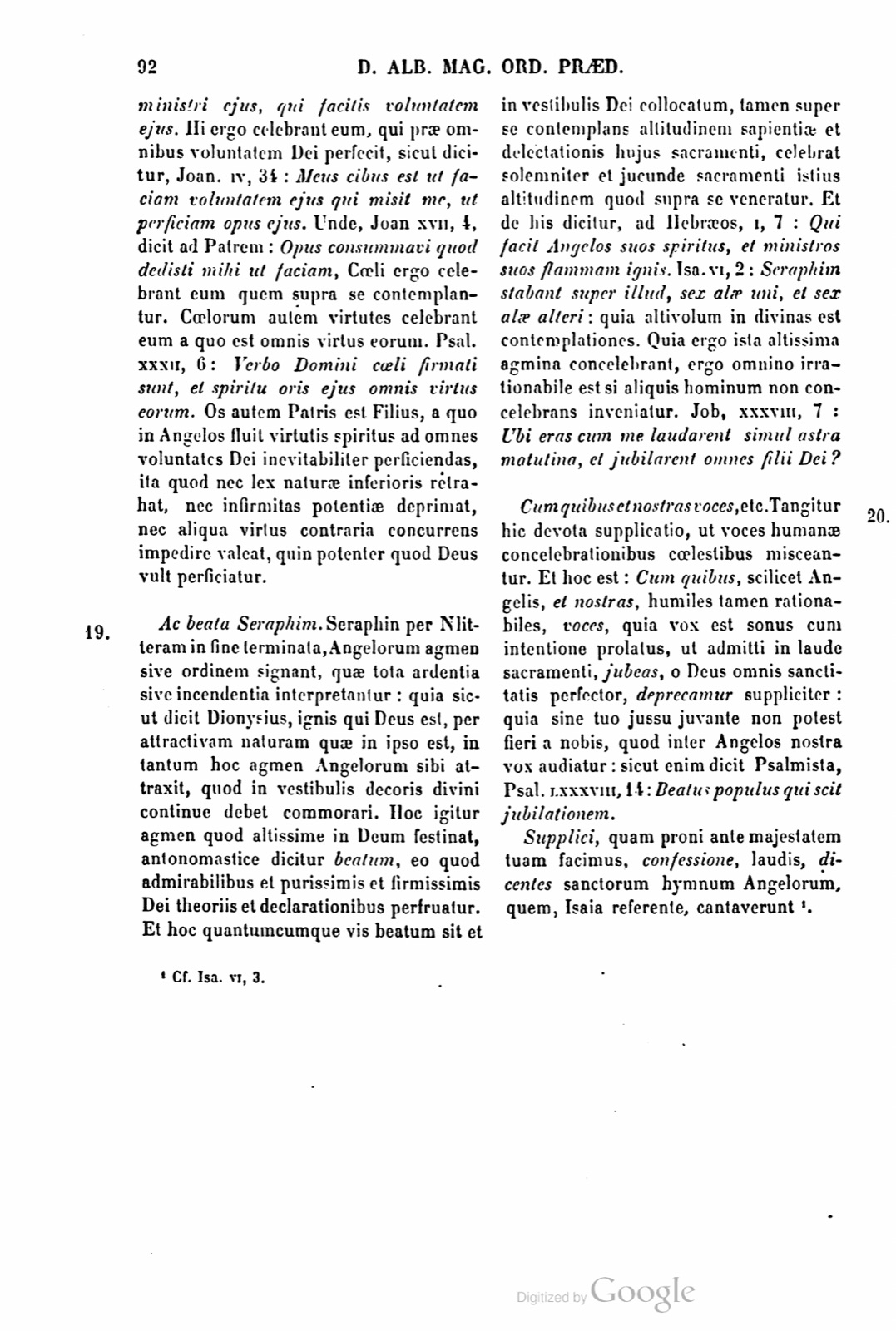
Caelorum autem virtutes sunt quibus virtus caelestis sine obstaculo perficitur: quia, sicut dicit Philosophus, virtus in omni re est ultimum potentiae, ultra quod agendo nihil potest potentia. Et hoc sunt Angeli mandata et decreta Dei et voluntates ejus invincibiliter perficientes, ut dicit beatus Dionysius. [Marginal label: Virtus, quid?] Psal. CII, 21: Benedicite Domino, omnes virtutes ejus, ministri ejus, qui facitis voluntatem ejus. Hi ergo celebrant eum, qui prae omnibus voluntatem Dei perfecit, sicut dicitur, Joan. IV, 34: Meus cibus est ut faciam voluntatem ejus qui misit me, ut perficiam opus ejus. Unde, Joan. XVII, 4, dicit ad Patrem: Opus consummavi quod dedisti mihi ut faciam. Caeli ergo celebrant eum quem supra se contemplantur. Caelorum autem virtutes celebrant eum a quo est omnis virtus eorum. Psal. XXXII, 6: Verbo Domini caeli firmati sunt, et spiritu oris ejus omnis virtus eorum. Os autem Patris est Filius, a quo in Angelos fluit virtutis spiritus ad omnes voluntates Dei inevitabiliter perficiendas, ita quod nec lex naturae inferioris retrahat, nec infirmitas potentiae deprimat, nec aliqua virtus contraria concurrens impedire valeat, quin potenter quod Deus vult perficiatur.
19. Ac beata Seraphim. Seraphim per M litteram in fine terminata, Angelorum agmen sive ordinem signant, quae tota ardentia sive incendentia interpretantur: quia sicut dicit Dionysius, ignis qui Deus est, per attractivam naturam quae in ipso est, in tantum hoc agmen Angelorum sibi attraxit, quod in vestibulis decoris divini continue debet commorari. Hoc igitur agmen quod altissime in Deum festinat, antonomastice dicitur beatum, eo quod admirabilibus et purissimis et firmissimis Dei theoriis et declarationibus perfruatur. Et hoc quantumcumque vis beatum sit et in vestibulis Dei collocatum, tamen super se contemplans altitudinem sapientiae et delectationis hujus sacramenti, celebrat solemniter et jucunde sacramenti istius altitudinem quod supra se veneratur. Et de his dicitur, ad Hebraeos, I, 7: Qui facit Angelos suos spiritus, et ministros suos flammam ignis. Isa. VI, 2: Seraphim stabant super illud, sex alae uni, et sex alae alteri: quia altivolum in divinas est contemplationes. Quia ergo ista altissima agmina concelebrant, ergo omnino irrationabile est si aliquis hominum non concelebrans inveniatur. Job, XXXVIII, 7: Ubi eras cum me laudarent simul astra matutina, et jubilarent omnes filii Dei?
20. Cum quibus et nostras voces, etc. Tangitur hic devota supplicatio, ut voces humanae concelebrationibus caelestibus misceantur. Et hoc est: Cum quibus, scilicet Angelis, et nostras, humiles tamen rationabiles, voces, quia vox est sonus cum intentione prolatus, ut admitti in laude sacramenti, jubeas, o Deus omnis sanctitatis perfector, deprecamur suppliciter: quia sine tuo jussu juvante non potest fieri a nobis, quod inter Angelos nostra vox audiatur: sicut enim dicit Psalmista, Psal. LXXXVIII, 14: Beatus populus qui scit jubilationem.
Supplici, quam proni ante majestatem tuam facimus, confessione, laudis, dicentes sanctorum hymnum Angelorum, quem, Isaia referente, cantaverunt 4.
But the powers of the heavens are those through whom heavenly power is perfected without obstacle, because, as the Philosopher says, power in every thing is the ultimate of potency, beyond which potency can do nothing by acting. And these are the Angels, invincibly perfecting the commands and decrees of God and his wills, as blessed Dionysius says. [Marginal label: What is power?] Psalm 102:21: Bless the Lord, all his powers, his ministers, who do his will. These therefore celebrate him who before all others perfected the will of God, as is said, John 4:34: My food is to do the will of him who sent me, that I may perfect his work. Hence, John 17:4, he says to the Father: I have consummated the work which thou gavest me to do. Therefore the heavens celebrate him whom they contemplate above themselves. But the powers of the heavens celebrate him from whom is all their power. Psalm 32:6: By the Word of the Lord the heavens were established, and by the spirit of his mouth all their power. But the mouth of the Father is the Son, from whom the spirit of power flows into the Angels for the inevitable perfecting of all God's wills, so that neither the law of an inferior nature draws back, nor weakness of potency depresses, nor any contrary power running against it can impede, but that what God wills is powerfully perfected.
19. And the blessed Seraphim. Seraphim, ending with the letter M at the end, signify the company or order of Angels who are interpreted wholly burning or inflaming, because, as Dionysius says, the fire which is God, through the attractive nature that is in him, has so drawn that company of Angels to himself that it must dwell continually in the vestibules of divine beauty. Therefore this company, which hastens most highly into God, is called blessed by antonomasia, because it enjoys the admirable and purest and firmest contemplations and declarations of God. And however blessed and placed in the vestibules of God this force may be, nevertheless, contemplating above itself the height of the wisdom and delight of this sacrament, it solemnly and joyfully celebrates the height of this sacrament, which it venerates above itself. And concerning these it is said, Hebrews 1:7: He makes his Angels spirits, and his ministers a flame of fire. Isaiah 6:2: The Seraphim were standing above it, six wings to one and six wings to the other, because it is high-flying into divine contemplations. Therefore, because those highest companies concelebrate, it is wholly irrational if any human being should be found not concelebrating. Job 38:7: Where were you when the morning stars praised me together, and all the sons of God rejoiced?
20. With whom also our voices, etc. Here the devout supplication is touched, that human voices be mingled with heavenly concelebrations. And this is: With whom, namely the Angels, and our voices, humble yet rational, because voice is sound brought forth with intention, deign, O God, perfecter of all sanctity, to command to be admitted in the praise of the sacrament, we supplicantly beseech; because without thy assisting command it cannot be done by us that our voice be heard among the Angels. For as the Psalmist says, Psalm 88:14: Blessed is the people that knows jubilation.
With a suppliant confession of praise, which we make prone before thy majesty, saying the hymn of the holy Angels, which, as Isaiah relates, they sang 4.
If a page does not appear, its photograph has not been uploaded yet.