Works › The Book on the Sacrifice of the Mass
Volume 38 · pp. 107–110
Tractate III, Chapter VII opening
A marker with ≈ is an approximate page boundary, placed by measure of the text; the page photographs remain the authority. In the paired views, clicking a page marker brings that page into view.
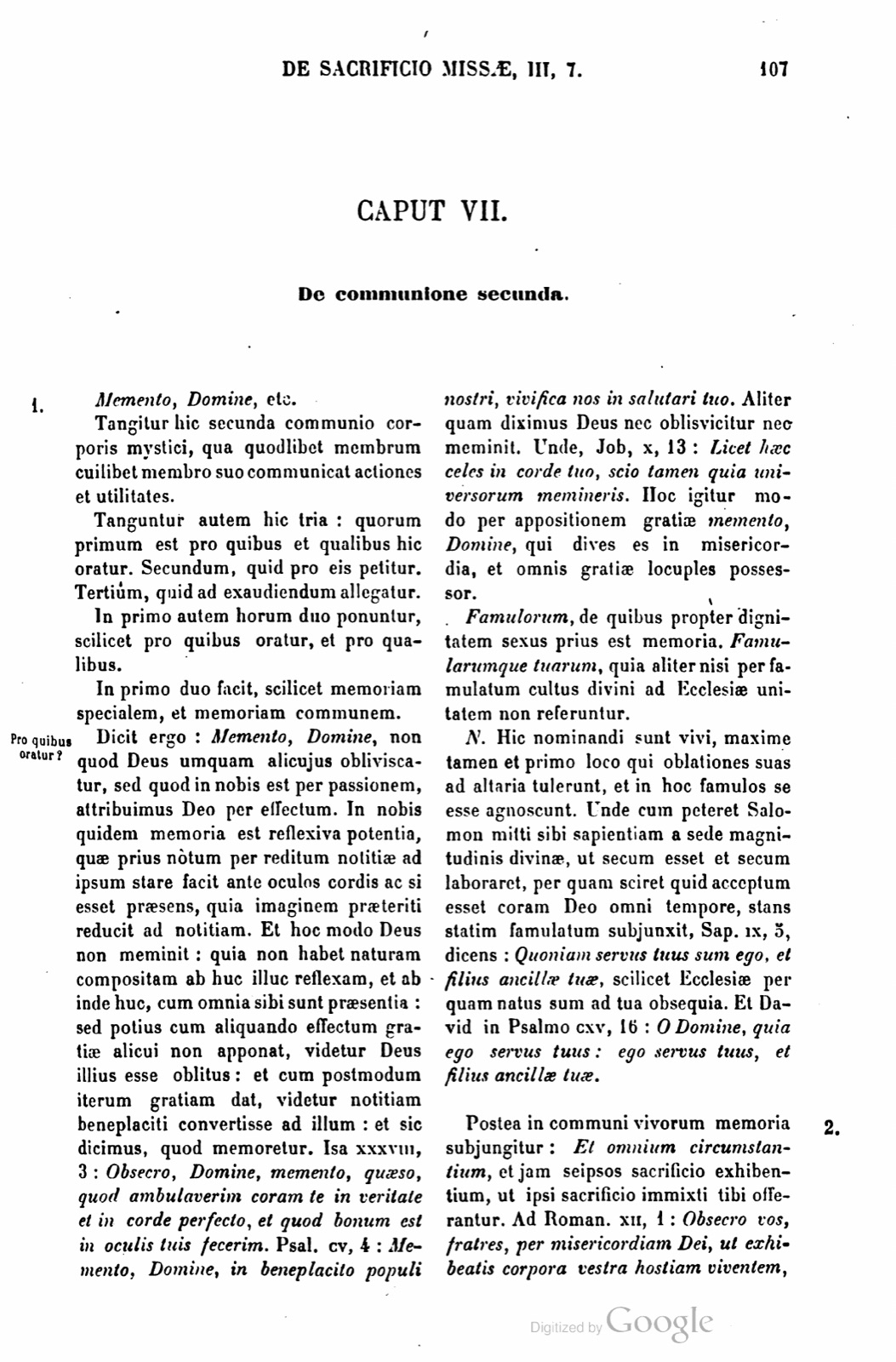
CAPUT VII.
De communione secunda.
1. Memento, Domine, etc. Tangitur hic secunda communio corporis mystici, qua quodlibet membrum cuilibet membro suo communicat actiones et utilitates.
Tanguntur autem hic tria: quorum primum est pro quibus et qualibus hic oratur. Secundum, quid pro eis petitur. Tertium, quid ad exaudiendum allegatur.
In primo autem horum duo ponuntur, scilicet pro quibus oratur, et pro qualibus.
In primo duo facit, scilicet memoriam specialem, et memoriam communem.
[Marginal label: Pro quibus oratur?] Dicit ergo: Memento, Domine, non quod Deus umquam alicujus obliviscatur, sed quod in nobis est per passionem, attribuimus Deo per effectum. In nobis quidem memoria est reflexiva potentia, quae prius notum per reditum notitiae ad ipsum stare facit ante oculos cordis ac si esset praesens, quia imaginem praeteriti reducit ad notitiam. Et hoc modo Deus non meminit: quia non habet naturam compositam ab huc illuc reflexam, et ab inde huc, cum omnia sibi sunt praesentia: sed potius cum aliquando effectum gratiae alicui non apponat, videtur Deus illius esse oblitus: et cum postmodum iterum gratiam dat, videtur notitiam beneplaciti convertisse ad illum: et sic dicimus, quod memoretur. Isa. XXXVIII, 3: Obsecro, Domine, memento, quaeso, quod ambulaverim coram te in veritate et in corde perfecto, et quod bonum est in oculis tuis fecerim. Psal. CV, 4: Memento, Domine, in beneplacito populi nostri, vivifica nos in salutari tuo. Aliter quam diximus Deus nec obliviscitur nec meminit. Unde, Job, X, 13: Licet haec celes in corde tuo, scio tamen quia universorum memineris. Hoc igitur modo per appositionem gratiae memento, Domine, qui dives es in misericordia, et omnis gratiae locuples possessor.
Famulorum, de quibus propter dignitatem sexus prius est memoria. Famularumque tuarum, quia aliter nisi per famulatum cultus divini ad Ecclesiae unitatem non referuntur.
N. Hic nominandi sunt vivi, maxime tamen et primo loco qui oblationes suas ad altaria tulerunt, et in hoc famulos se esse agnoscunt. Unde cum peteret Salomon mitti sibi sapientiam a sede magnitudinis divinae, ut secum esset et secum laboraret, per quam sciret quid acceptum esset coram Deo omni tempore, stans statim famulatum subjunxit, Sap. IX, 5, dicens: Quoniam servus tuus sum ego, et filius ancillae tuae, scilicet Ecclesiae per quam natus sum ad tua obsequia. Et David in Psalmo CXV, 16: O Domine, quia ego servus tuus: ego servus tuus, et filius ancillae tuae.
2. Postea in communi vivorum memoria subjungitur: Et omnium circumstantium, et jam seipsos sacrificio exhibentium, ut ipsi sacrificio immixti tibi offerantur. Ad Roman. XII, 1: Obsecro vos, fratres, per misericordiam Dei, ut exhibeatis corpora vestra hostiam viventem, sanctam, Deo placentem, rationabile obsequium vestrum.
Quales autem sunt qui in memoria oblationis habentur, subjungit dicens: Quorum tibi fides cognita est, per quam in unitatem sacramenti recipiuntur: quia fides operans per dilectionem purificat eos, ut tibi in oblatione ista quae in puritate sua puritatem mystici corporis importat, offerantur. Act. XV, 9: Fide purificans corda eorum. Fides enim quae veritati innititur, unit eos veritatis sacramento. Charitas autem per quam fides operatur, perficit eos ad sacramenti virtutem, ut sic veritate et virtute tibi uniti sint per intellectum et affectum. Haec enim fides tibi cognita est per approbationem. II ad Timoth. II, 19: Cognovit Dominus qui sunt ejus. Joan. X, 14: Cognosco meas, scilicet oves, et cognoscunt me meae.
CHAPTER VII.
On the second communion.
1. Remember, O Lord, etc. Here the second communion of the mystical body is touched, by which any member communicates actions and utilities to any fellow member.
But three things are touched here. The first is for whom and for what sort of persons prayer is made here. The second, what is sought for them. The third, what is alleged for being heard.
In the first of these two things are set down, namely for whom prayer is made, and for what sort.
In the first he does two things, namely special memory and common memory.
[Marginal label: For whom is prayer made?] Therefore he says: Remember, O Lord, not because God ever forgets anyone, but because what is in us through suffering we attribute to God by effect. For in us memory is a reflexive potency, which makes a thing previously known stand before the eyes of the heart through the return of knowledge to it as if it were present, because it leads back the image of the past to knowledge. And in this way God does not remember, because he does not have a nature composed, bent back from here to there and from there to here, since all things are present to him. But rather, when at some time he does not apply the effect of grace to someone, God seems to have forgotten him; and when afterward he again gives grace, he seems to have turned the knowledge of good pleasure toward him; and thus we say that he is mindful. Isaiah 38:3: I beseech, O Lord, remember, I pray, that I have walked before thee in truth and with a perfect heart, and that I have done what is good in thy eyes. Psalm 105:4: Remember us, O Lord, in the good pleasure of thy people; give us life in thy salvation. God neither forgets nor remembers otherwise than we have said. Hence Job 10:13: Although thou hidest these things in thy heart, nevertheless I know that thou rememberest all things. Therefore in this way, through the application of grace, remember, O Lord, who art rich in mercy and the wealthy possessor of every grace.
Of thy servants, concerning whom, because of the dignity of sex, there is memory first. And of thy handmaids, because otherwise, unless through service of divine worship, they are not referred to the unity of the Church.
N. Here the living are to be named, yet especially and in the first place those who brought their oblations to the altars and in this acknowledge themselves to be servants. Hence when Solomon sought that wisdom be sent to him from the seat of divine greatness, so that it might be with him and labor with him, through which he might know what was acceptable before God at every time, standing immediately he joined service, Wisdom 9:5, saying: Because I am thy servant and the son of thy handmaid, namely of the Church, through whom I was born for thy services. And David in Psalm 115:16: O Lord, because I am thy servant; I am thy servant and the son of thy handmaid.
2. Afterward in the common memory of the living there is added: And of all standing around, and now exhibiting themselves to the sacrifice, so that they themselves, mixed into the sacrifice, may be offered to thee. Romans 12:1: I beseech you, brothers, by the mercy of God, that you present your bodies as a living victim, holy, pleasing to God, your rational service.
But what sort those are who are held in the memory of the oblation, he adds, saying: Whose faith is known to thee, through which they are received into the unity of the sacrament; because faith working through love purifies them, so that they may be offered to thee in that oblation which in its purity carries the purity of the mystical body. Acts 15:9: Purifying their hearts by faith. For faith which rests on truth unites them to the sacrament of truth. But charity, through which faith works, perfects them for the power of the sacrament, so that they may be united to thee by truth and power through intellect and affection. For this faith is known to thee through approval. 2 Timothy 2:19: The Lord has known those who are his. John 10:14: I know mine, namely sheep, and mine know me.
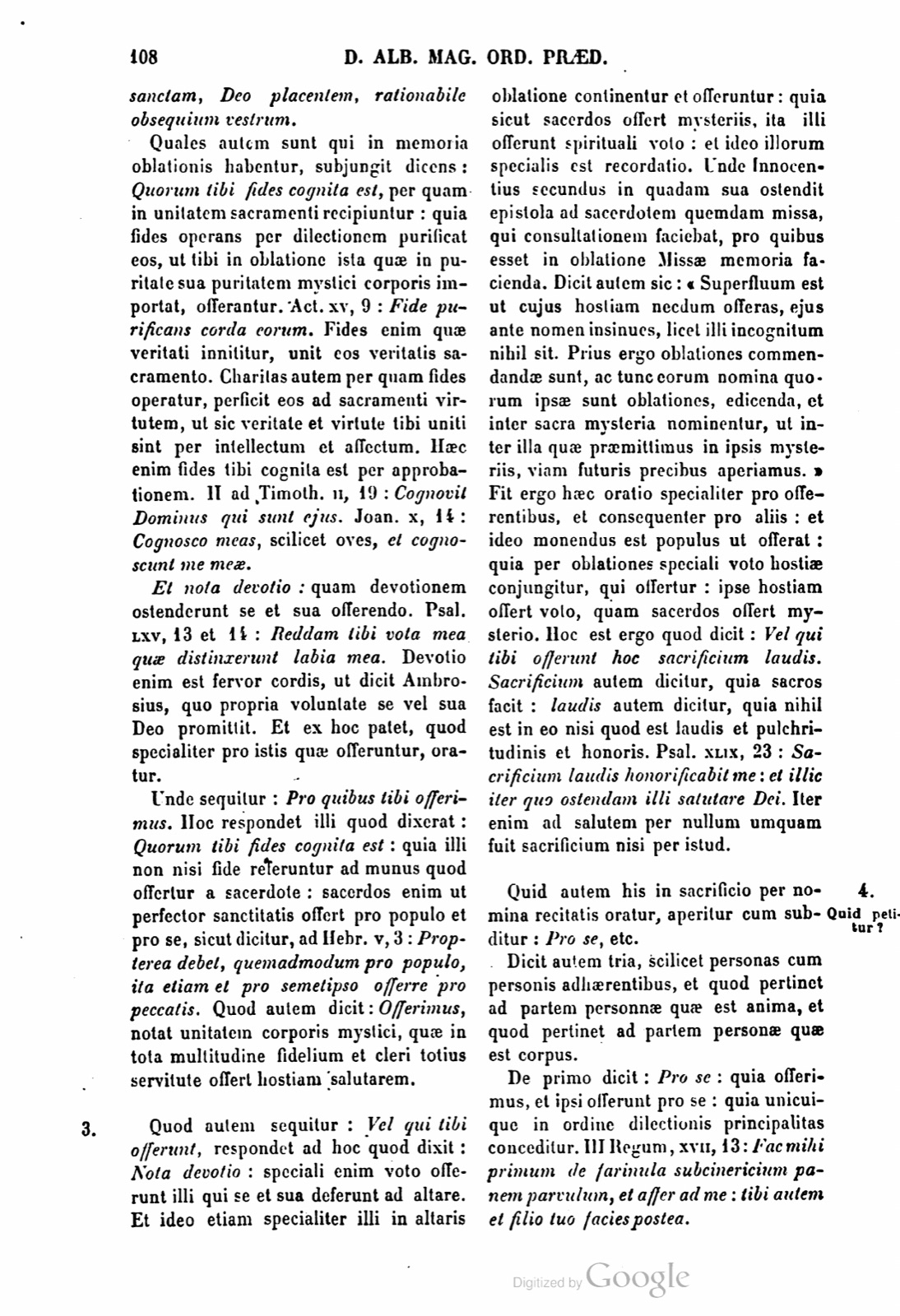
Et nota devotio: quam devotionem ostenderunt se et sua offerendo. Psal. LXV, 13 et 14: Reddam tibi vota mea quae distinxerunt labia mea. Devotio enim est fervor cordis, ut dicit Ambrosius, quo propria voluntate se vel sua Deo promittit. Et ex hoc patet, quod specialiter pro istis quae offeruntur, oratur.
Unde sequitur: Pro quibus tibi offerimus. Hoc respondet illi quod dixerat: Quorum tibi fides cognita est: quia illi non nisi fide referuntur ad munus quod offertur a sacerdote: sacerdos enim ut perfector sanctitatis offert pro populo et pro se, sicut dicitur, ad Hebr. V, 3: Propterea debet, quemadmodum pro populo, ita etiam et pro semetipso offerre pro peccatis. Quod autem dicit: Offerimus, notat unitatem corporis mystici, quae in tota multitudine fidelium et cleri totius servitute offert hostiam salutarem.
3. Quod autem sequitur: Vel qui tibi offerunt, respondet ad hoc quod dixit: Nota devotio: speciali enim voto offerunt illi qui se et sua deferunt ad altare. Et ideo etiam specialiter illi in altaris oblatione continentur et offeruntur: quia sicut sacerdos offert mysteriis, ita illi offerunt spirituali voto: et ideo illorum specialis est recordatio. Unde Innocentius secundus in quadam sua ostendit epistola ad sacerdotem quemdam missa, qui consultationem faciebat, pro quibus esset in oblatione Missae memoria facienda. Dicit autem sic: Superfluum est ut cujus hostiam necdum offeras, ejus ante nomen insinues, licet illi incognitum nihil sit. Prius ergo oblationes commendandae sunt, ac tunc eorum nomina quorum ipsae sunt oblationes, edicenda, et inter sacra mysteria nominentur, ut inter illa quae praemittimus in ipsis mysteriis, viam futuris precibus aperiamus.
Fit ergo haec oratio specialiter pro offerentibus, et consequenter pro aliis: et ideo monendus est populus ut offerat: quia per oblationes speciali voto hostiae conjungitur, qui offertur: ipse hostiam offert voto, quam sacerdos offert mysterio. Hoc est ergo quod dicit: Vel qui tibi offerunt hoc sacrificium laudis. Sacrificium autem dicitur, quia sacros facit: laudis autem dicitur, quia nihil est in eo nisi quod est laudis et pulchritudinis et honoris. Psal. XLIX, 23: Sacrificium laudis honorificabit me: et illic iter quo ostendam illi salutare Dei. Iter enim ad salutem per nullum umquam fuit sacrificium nisi per istud.
[Marginal label: Quid petitur?] 4. Quid autem his in sacrificio per nomina recitatis oratur, aperitur cum subditur: Pro se, etc.
Dicit autem tria, scilicet personas cum personis adhaerentibus, et quod pertinet ad partem personae quae est anima, et quod pertinet ad partem personae quae est corpus.
De primo dicit: Pro se: quia offerimus, et ipsi offerunt pro se: quia unicuique in ordine dilectionis principalitas conceditur. III Regum, XVII, 13: Fac mihi primum de farinula subcinericium panem parvulum, et affer ad me: tibi autem et filio tuo facies postea.
And known is the devotion, which devotion they showed by offering themselves and their things. Psalm 65:13 and 14: I will render to thee my vows which my lips distinguished. For devotion is fervor of heart, as Ambrose says, by which one promises himself or his things to God by his own will. And from this it is clear that prayer is made especially for those things which are offered.
Hence there follows: For whom we offer to thee. This corresponds to what he had said: Whose faith is known to thee, because they are referred to the gift which is offered by the priest only by faith. For the priest as perfecter of sanctity offers for the people and for himself, as is said, Hebrews 5:3: Therefore he ought, just as for the people, so also for himself, to offer for sins. But what he says, We offer, notes the unity of the mystical body, which offers the saving victim in the whole multitude of the faithful and in the service of the whole clergy.
3. But what follows: Or who offer to thee, corresponds to what he said: And known is the devotion. For by a special vow those who bring themselves and their things to the altar offer. And therefore they too are especially contained and offered in the oblation of the altar, because just as the priest offers by mysteries, so they offer by spiritual vow; and therefore there is special remembrance of them. Hence Innocent II, in a certain letter of his sent to a certain priest who was making consultation concerning those for whom memory should be made in the oblation of the Mass, shows this. But he says thus: It is superfluous that before you have yet offered someone's victim, you should announce his name, although nothing is unknown to him. Therefore the oblations must first be commended, and then the names of those whose oblations they are must be proclaimed and named among the sacred mysteries, so that among those things which we set before in the mysteries themselves, we may open a way for future prayers.
Therefore this prayer is made especially for those offering, and consequently for others; and therefore the people must be admonished to offer, because through oblations, by special vow, the one who offers is joined to the victim. He offers by vow the victim which the priest offers by mystery. Therefore this is what he says: Or who offer to thee this sacrifice of praise. But it is called sacrifice because it makes things sacred; but it is called of praise because there is nothing in it except what belongs to praise and beauty and honor. Psalm 49:23: The sacrifice of praise will honor me, and there is the way by which I will show him the salvation of God. For there was never a way to salvation through any sacrifice except through this one.
[Marginal label: What is sought?] 4. But what is prayed for these persons named in the sacrifice is opened when there is added: For themselves, etc.
But he says three things, namely the persons with things adhering to the persons, and what pertains to the part of the person which is soul, and what pertains to the part of the person which is body.
Concerning the first he says: For themselves, because we offer, and they themselves offer for themselves, because principal place is granted to each one in the order of love. 3 Kings 17:13: Make for me first from the meal a little hearth-baked loaf, and bring it to me; but afterward thou shalt make for thyself and thy son.
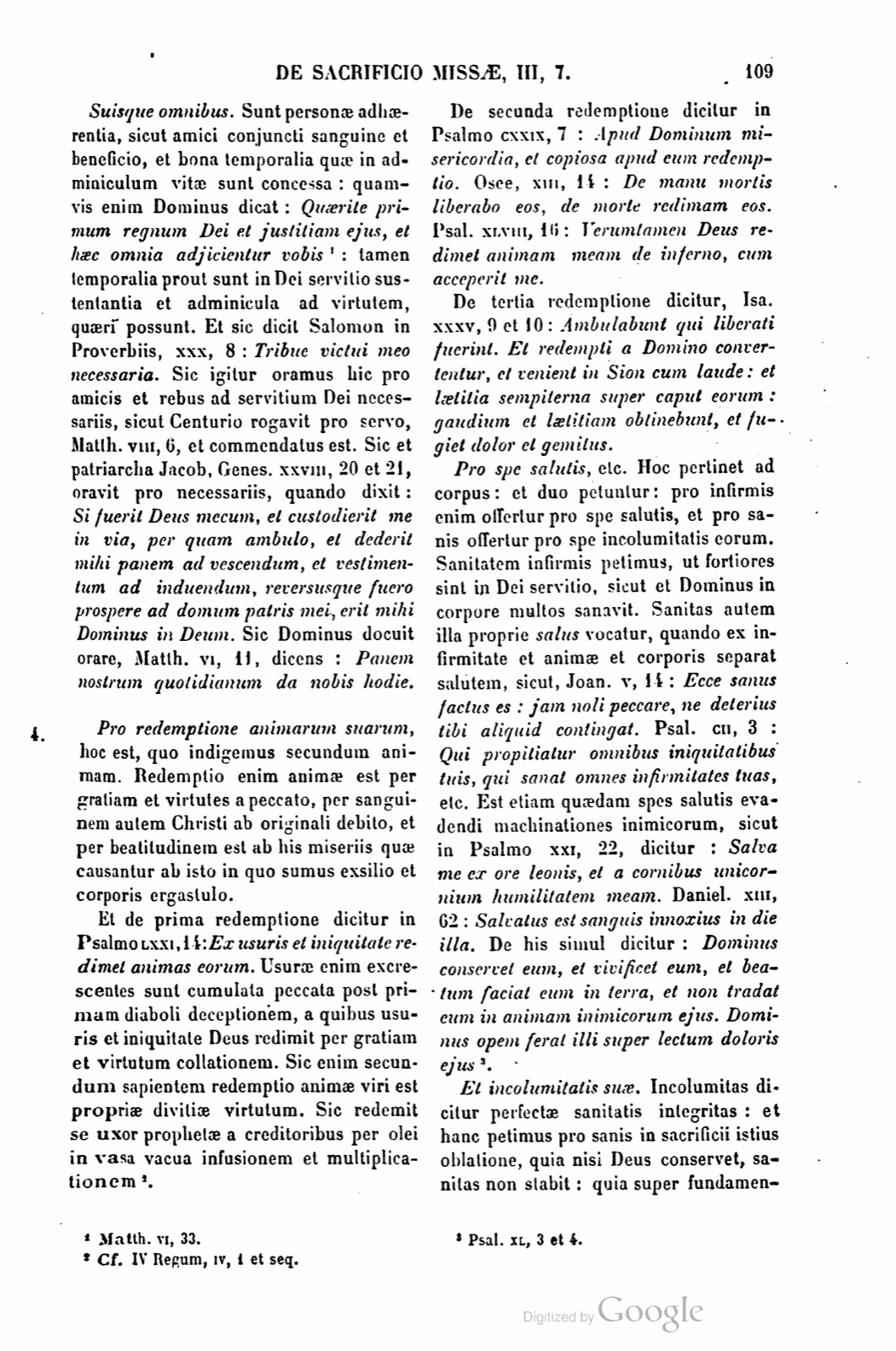
Suisque omnibus. Sunt personae adhaerentia, sicut amici conjuncti sanguine et beneficio, et bona temporalia quae in adminiculum vitae sunt concessa: quamvis enim Dominus dicat: Quaerite primum regnum Dei et justitiam ejus, et haec omnia adjicientur vobis 1: tamen temporalia prout sunt in Dei servitio sustentantia et adminicula ad virtutem, quaeri possunt. Et sic dicit Salomon in Proverbiis, XXX, 8: Tribue victui meo necessaria. Sic igitur oramus hic pro amicis et rebus ad servitium Dei necessariis, sicut Centurio rogavit pro servo, Matth. VIII, 6, et commendatus est. Sic et patriarcha Jacob, Genes. XXVIII, 20 et 21, oravit pro necessariis, quando dixit: Si fuerit Deus mecum, et custodierit me in via, per quam ambulo, et dederit mihi panem ad vescendum, et vestimentum ad induendum, reversusque fuero prospere ad domum patris mei, erit mihi Dominus in Deum. Sic Dominus docuit orare, Matth. VI, 11, dicens: Panem nostrum quotidianum da nobis hodie.
4. Pro redemptione animarum suarum, hoc est, quo indigemus secundum animam. Redemptio enim animae est per gratiam et virtutes a peccato, per sanguinem autem Christi ab originali debito, et per beatitudinem est ab his miseriis quae causantur ab isto in quo sumus exsilio et corporis ergastulo.
Et de prima redemptione dicitur in Psalmo LXXI, 14: Ex usuris et iniquitate redimet animas eorum. Usurae enim excrescentes sunt cumulata peccata post primam diaboli deceptionem, a quibus usuris et iniquitate Deus redimit per gratiam et virtutum collationem. Sic enim secundum sapientem redemptio animae viri est propriae divitiae virtutum. Sic redemit se uxor prophetae a creditoribus per olei in vasa vacua infusionem et multiplicationem 2.
De secunda redemptione dicitur in Psalmo CXXIX, 7: Apud Dominum misericordia, et copiosa apud eum redemptio. Osee, XI, 14: De manu mortis liberabo eos, de morte redimam eos. Psal. XLVIII, 16: Verumtamen Deus redimet animam meam de inferno, cum acceperit me.
De tertia redemptione dicitur, Isa. XXXV, 9 et 10: Ambulabunt qui liberati fuerint. Et redempti a Domino convertentur, et venient in Sion cum laude: et laetitia sempiterna super caput eorum: gaudium et laetitiam obtinebunt, et fugiet dolor et gemitus.
Pro spe salutis, etc. Hoc pertinet ad corpus: et duo petuntur: pro infirmis enim offertur pro spe salutis, et pro sanis offertur pro spe incolumitatis eorum. Sanitatem infirmis petimus, ut fortiores sint in Dei servitio, sicut et Dominus in corpore multos sanavit. Sanitas autem illa proprie salus vocatur, quando ex infirmitate et animae et corporis separat salutem, sicut, Joan. V, 14: Ecce sanus factus es: jam noli peccare, ne deterius tibi aliquid contingat. Psal. CII, 3: Qui propitiatur omnibus iniquitatibus tuis, qui sanat omnes infirmitates tuas, etc. Est etiam quaedam spes salutis evadendi machinationes inimicorum, sicut in Psalmo XXI, 22, dicitur: Salva me ex ore leonis, et a cornibus unicornium humilitatem meam. Daniel. XIII, 62: Salvatus est sanguis innoxius in die illa. De his simul dicitur: Dominus conservet eum, et vivificet eum, et beatum faciat eum in terra, et non tradat eum in animam inimicorum ejus. Dominus opem ferat illi super lectum doloris ejus 3.
And for all belonging to them. These are things adhering to the person, such as friends joined by blood and by benefit, and temporal goods which have been granted as an aid to life; for although the Lord says: Seek first the kingdom of God and his justice, and all these things will be added to you 1, nevertheless temporal things, insofar as they sustain in the service of God and are aids to virtue, can be sought. And thus Solomon says in Proverbs 30:8: Grant to my living what is necessary. Therefore thus we pray here for friends and things necessary for the service of God, just as the centurion prayed for his servant, Matthew 8:6, and was commended. Thus also the patriarch Jacob, Genesis 28:20 and 21, prayed for necessities when he said: If God shall be with me, and shall guard me on the way by which I walk, and shall give me bread to eat and clothing to put on, and I shall return prosperously to the house of my father, the Lord will be my God. Thus the Lord taught us to pray, Matthew 6:11, saying: Give us this day our daily bread.
4. For the redemption of their souls, that is, with respect to what we need according to the soul. For the redemption of the soul is by grace and virtues from sin, but by the blood of Christ from original debt, and by beatitude it is from these miseries which are caused by this exile and prison-house of the body in which we are.
And concerning the first redemption it is said in Psalm 71:14: From usuries and iniquity he will redeem their souls. For increasing usuries are the sins accumulated after the first deception of the devil, from which usuries and iniquity God redeems through grace and the conferral of virtues. For thus, according to the wise man, the redemption of a man's soul is his own riches of virtues. Thus the wife of the prophet redeemed herself from her creditors through the pouring and multiplication of oil into empty vessels 2.
Concerning the second redemption it is said in Psalm 129:7: With the Lord is mercy, and with him copious redemption. Hosea 11:14: From the hand of death I will free them, from death I will redeem them. Psalm 48:16: Nevertheless God will redeem my soul from hell, when he shall receive me.
Concerning the third redemption it is said, Isaiah 35:9 and 10: Those who have been freed shall walk. And the redeemed of the Lord shall return, and shall come into Sion with praise; and everlasting joy shall be upon their head; they shall obtain joy and gladness, and pain and groaning shall flee.
For the hope of salvation, etc. This pertains to the body, and two things are sought: for it is offered for the sick for the hope of salvation, and for the healthy it is offered for the hope of their soundness. We seek health for the sick, so that they may be stronger in the service of God, just as the Lord also healed many in the body. But that health is properly called salvation when, from infirmity of both soul and body, it separates salvation, as John 5:14 says: Behold, thou hast been made whole; now sin no more, lest something worse happen to thee. Psalm 102:3: Who is propitiated toward all thy iniquities, who heals all thy infirmities, etc. There is also a certain hope of salvation in escaping the plots of enemies, as is said in Psalm 21:22: Save me from the mouth of the lion, and my humility from the horns of unicorns. Daniel 13:62: Innocent blood was saved on that day. Concerning these together it is said: The Lord preserve him and give him life, and make him blessed on earth, and not hand him over to the soul of his enemies. May the Lord bring help to him upon the bed of his sorrow 3.
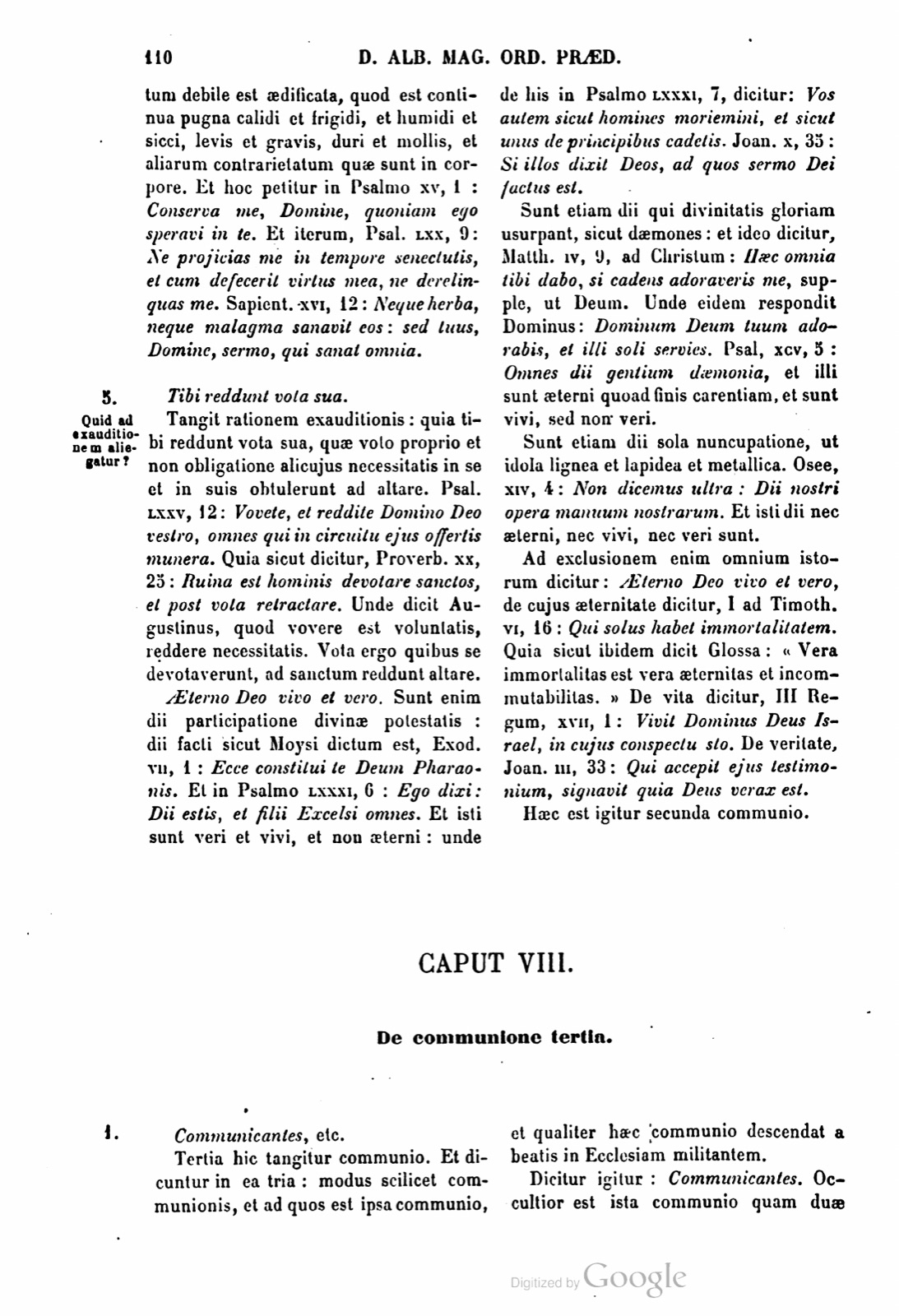
Et incolumitatis suae. Incolumitas dicitur perfectae sanitatis integritas: et hanc petimus pro sanis in sacrificii istius oblatione, quia nisi Deus conservet, sanitas non stabit: quia super fundamentum debile est aedificata, quod est continua pugna calidi et frigidi, et humidi et sicci, levis et gravis, duri et mollis, et aliarum contrarietatum quae sunt in corpore. Et hoc petitur in Psalmo XV, 1: Conserva me, Domine, quoniam ego speravi in te. Et iterum, Psal. LXX, 9: Ne projicias me in tempore senectutis, et cum defecerit virtus mea, ne derelinquas me. Sapient. XVI, 12: Neque herba, neque malagma sanavit eos: sed tuus, Domine, sermo, qui sanat omnia.
[Marginal label: Quid ad exauditionem allegatur?] 5. Tibi reddunt vota sua. Tangit rationem exauditionis: quia tibi reddunt vota sua, quae voto proprio et non obligatione alicujus necessitatis in se et in suis obtulerunt ad altare. Psal. LXXV, 12: Vovete, et reddite Domino Deo vestro, omnes qui in circuitu ejus offertis munera. Quia sicut dicitur, Proverb. XX, 25: Ruina est hominis devotare sanctos, et post vota retractare. Unde dicit Augustinus, quod vovere est voluntatis, reddere necessitatis. Vota ergo quibus se devotaverunt, ad sanctum reddunt altare.
Aeterno Deo vivo et vero. Sunt enim dii participatione divinae potestatis: dii facti sicut Moysi dictum est, Exod. VII, 1: Ecce constitui te Deum Pharaonis. Et in Psalmo LXXXI, 6: Ego dixi: Dii estis, et filii Excelsi omnes. Et isti sunt veri et vivi, et non aeterni: unde de his in Psalmo LXXXI, 7, dicitur: Vos autem sicut homines moriemini, et sicut unus de principibus cadetis. Joan. X, 35: Si illos dixit Deos, ad quos sermo Dei factus est.
Sunt etiam dii qui divinitatis gloriam usurpant, sicut daemones: et ideo dicitur, Matth. IV, 9, ad Christum: Haec omnia tibi dabo, si cadens adoraveris me, supple, ut Deum. Unde eidem respondit Dominus: Dominum Deum tuum adorabis, et illi soli servies. Psal. XCV, 5: Omnes dii gentium daemonia, et illi sunt aeterni quoad finis carentiam, et sunt vivi, sed non veri.
Sunt etiam dii sola nuncupatione, ut idola lignea et lapidea et metallica. Osee, XIV, 4: Non dicemus ultra: Dii nostri opera manuum nostrarum. Et isti dii nec aeterni, nec vivi, nec veri sunt.
Ad exclusionem enim omnium istorum dicitur: Aeterno Deo vivo et vero, de cujus aeternitate dicitur, I ad Timoth. VI, 16: Qui solus habet immortalitatem. Quia sicut ibidem dicit Glossa: Vera immortalitas est vera aeternitas et incommutabilitas. De vita dicitur, III Regum, XVII, 1: Vivit Dominus Deus Israel, in cujus conspectu sto. De veritate, Joan. III, 33: Qui accepit ejus testimonium, signavit quia Deus verax est.
Haec est igitur secunda communio.
And of their soundness. Soundness is called the integrity of perfect health, and we seek this for the healthy in the oblation of this sacrifice, because unless God preserves it, health will not stand, because it is built upon a weak foundation, which is the continual struggle of hot and cold, wet and dry, light and heavy, hard and soft, and the other contrarieties which are in the body. And this is sought in Psalm 15:1: Preserve me, O Lord, because I have hoped in thee. And again, Psalm 70:9: Cast me not off in the time of old age, and when my strength shall fail, do not forsake me. Wisdom 16:12: Neither herb nor poultice healed them, but thy word, O Lord, which heals all things.
[Marginal label: What is alleged for being heard?] 5. They render their vows to thee. He touches the reason for being heard: because they render to thee their vows, which by their own vow and not by obligation of any necessity they have offered in themselves and in their own things to the altar. Psalm 75:12: Vow, and render to the Lord your God, all you who around him offer presents. Because, as is said in Proverbs 20:25: It is ruin for a man to vow holy things, and after vows to draw back. Hence Augustine says that to vow belongs to will, to render belongs to necessity. Therefore the vows by which they have devoted themselves they render to the holy altar.
To the eternal, living, and true God. For there are gods by participation in divine power, made gods as was said to Moses, Exodus 7:1: Behold, I have established thee as God to Pharaoh. And in Psalm 81:6: I have said: You are gods, and all sons of the Most High. And these are true and living, but not eternal; hence concerning these it is said in Psalm 81:7: But you shall die like men, and shall fall like one of the princes. John 10:35: If he called them gods, to whom the word of God was made.
There are also gods who usurp the glory of divinity, such as demons; and therefore it is said to Christ, Matthew 4:9: All these things I will give thee, if falling down thou wilt adore me, supply, as God. Hence the Lord answered him: The Lord thy God shalt thou adore, and him alone shalt thou serve. Psalm 95:5: All the gods of the nations are demons, and those are eternal with respect to lacking an end, and they are living, but not true.
There are also gods by naming alone, as wooden and stone and metal idols. Hosea 14:4: We will say no more: Our gods are the works of our hands. And those gods are neither eternal, nor living, nor true.
Therefore for the exclusion of all these it is said: To the eternal, living, and true God, concerning whose eternity it is said, 1 Timothy 6:16: Who alone has immortality. Because, as the Gloss says there: True immortality is true eternity and immutability. Concerning life it is said, 3 Kings 17:1: The Lord God of Israel lives, in whose sight I stand. Concerning truth, John 3:33: He who has accepted his testimony has sealed that God is true.
This therefore is the second communion.
If a page does not appear, its photograph has not been uploaded yet.