Works › The Book on the Sacrifice of the Mass
Volume 38 · pp. 93–96
Tractate III, Chapter V
A marker with ≈ is an approximate page boundary, placed by measure of the text; the page photographs remain the authority. In the paired views, clicking a page marker brings that page into view.
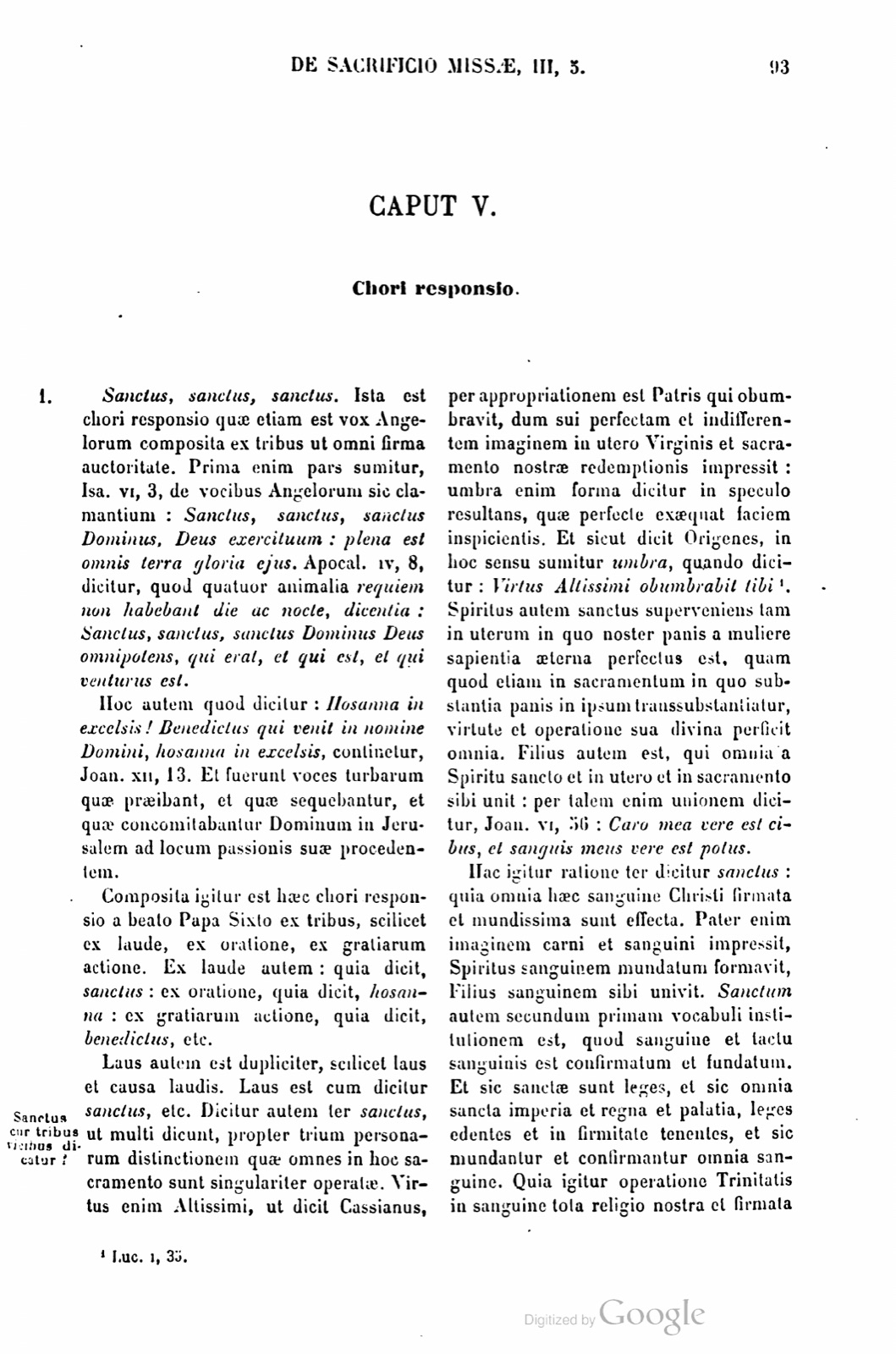
CAPUT V.
Chori responsio.
1. Sanctus, sanctus, sanctus. Ista est chori responsio quae etiam est vox Angelorum composita ex tribus ut omni firma auctoritate. Prima enim pars sumitur, Isa. VI, 3, de vocibus Angelorum sic clamantium: Sanctus, sanctus, sanctus Dominus, Deus exercituum: plena est omnis terra gloria ejus. Apocal. IV, 8, dicitur, quod quatuor animalia requiem non habebant die ac nocte, dicentia: Sanctus, sanctus, sanctus Dominus Deus omnipotens, qui erat, et qui est, et qui venturus est.
Hoc autem quod dicitur: Hosanna in excelsis! Benedictus qui venit in nomine Domini, hosanna in excelsis, continetur, Joan. XII, 13. Et fuerunt voces turbarum quae praeibant, et quae sequebantur, et quae concomitabantur Dominum in Jerusalem ad locum passionis suae procedentem.
Composita igitur est haec chori responsio a beato Papa Sixto ex tribus, scilicet ex laude, ex oratione, ex gratiarum actione. Ex laude autem: quia dicit, sanctus: ex oratione, quia dicit, hosanna: ex gratiarum actione, quia dicit, benedictus, etc.
[Marginal label: Sanctus cur tribus vicibus dicatur?] Laus autem est dupliciter, scilicet laus et causa laudis. Laus est cum dicitur sanctus, etc. Dicitur autem ter sanctus, ut multi dicunt, propter trium personarum distinctionem quae omnes in hoc sacramento sunt singulariter operatae. Virtus enim Altissimi, ut dicit Cassianus, per appropriationem est Patris qui obumbravit, dum sui perfectam et indifferentem imaginem in utero Virginis et sacramento nostrae redemptionis impressit: umbra enim forma dicitur in speculo resultans, quae perfecte exaequat faciem inspicientis. Et sicut dicit Origenes, in hoc sensu sumitur umbra, quando dicitur: Virtus Altissimi obumbrabit tibi 1. Spiritus autem sanctus superveniens tam in uterum in quo noster panis a muliere sapientia aeterna perfectus est, quam quod etiam in sacramentum in quo substantia panis in ipsum transsubstantiatur, virtute et operatione sua divina perficit omnia. Filius autem est, qui omnia a Spiritu sancto et in utero et in sacramento sibi unit: per talem enim unionem dicitur, Joan. VI, 56: Caro mea vere est cibus, et sanguis meus vere est potus.
Hac igitur ratione ter dicitur sanctus: quia omnia haec sanguine Christi firmata et mundissima sunt effecta. Pater enim imaginem carni et sanguini impressit, Spiritus sanguinem mundatum formavit, Filius sanguinem sibi univit. Sanctum autem secundum primam vocabuli institutionem est, quod sanguine et tactu sanguinis est confirmatum et fundatum. Et sic sanctae sunt leges, et sic omnia sancta imperia et regna et palatia, leges edentes et in firmitate tenentes, et sic mundantur et confirmantur omnia sanguine. Quia igitur operatione Trinitatis in sanguine tota religio nostra et firmata et mundata est, ideo ter in ista celebratione dicimus sanctus.
CHAPTER V.
The response of the choir.
1. Holy, holy, holy. This is the response of the choir, which is also the voice of Angels, composed from three things so that it may be firm by every authority. For the first part is taken, Isaiah 6:3, from the voices of Angels crying out thus: Holy, holy, holy, Lord God of hosts; the whole earth is full of his glory. Apocalypse 4:8 says that the four living creatures had no rest day and night, saying: Holy, holy, holy, Lord God almighty, who was, and who is, and who is to come.
But what is said, Hosanna in the highest! Blessed is he who comes in the name of the Lord; hosanna in the highest, is contained in John 12:13. And they were the voices of the crowds that went before and that followed, and that accompanied the Lord as he went forward into Jerusalem to the place of his passion.
Therefore this response of the choir was composed by blessed Pope Sixtus from three things, namely from praise, from prayer, and from thanksgiving. From praise, because it says holy; from prayer, because it says hosanna; from thanksgiving, because it says blessed, etc.
[Marginal label: Why is Holy said three times?] But praise is twofold, namely praise and the cause of praise. Praise is when holy, etc., is said. But holy is said three times, as many say, on account of the distinction of the three persons, who have all operated singularly in this sacrament. For the power of the Most High, as Cassian says, by appropriation belongs to the Father, who overshadowed, when he impressed the perfect and indifferent image of himself in the womb of the Virgin and in the sacrament of our redemption. For a shadow is called the form resulting in a mirror, which perfectly equals the face of the one looking in. And, as Origen says, shadow is taken in this sense when it is said: The power of the Most High will overshadow thee 1. But the Holy Spirit coming upon both the womb in which our bread was perfected by the woman, eternal wisdom, and also upon the sacrament in which the substance of bread is transubstantiated into him, perfects all things by his divine power and operation. But the Son is the one who unites all things to himself from the Holy Spirit, both in the womb and in the sacrament. For by such union it is said, John 6:56: My flesh is truly food, and my blood is truly drink.
Therefore for this reason holy is said three times, because all these things have been confirmed by the blood of Christ and made most clean. For the Father impressed the image on the flesh and blood, the Spirit formed the cleansed blood, and the Son united the blood to himself. But according to the first institution of the word, holy is what has been confirmed and founded by blood and the touch of blood. And thus laws are holy, and thus all empires and kingdoms and palaces are holy, issuing laws and holding them in firmness; and thus all things are cleansed and confirmed by blood. Therefore, because by the operation of the Trinity in blood all our religion has been both confirmed and cleansed, we say holy three times in that celebration.
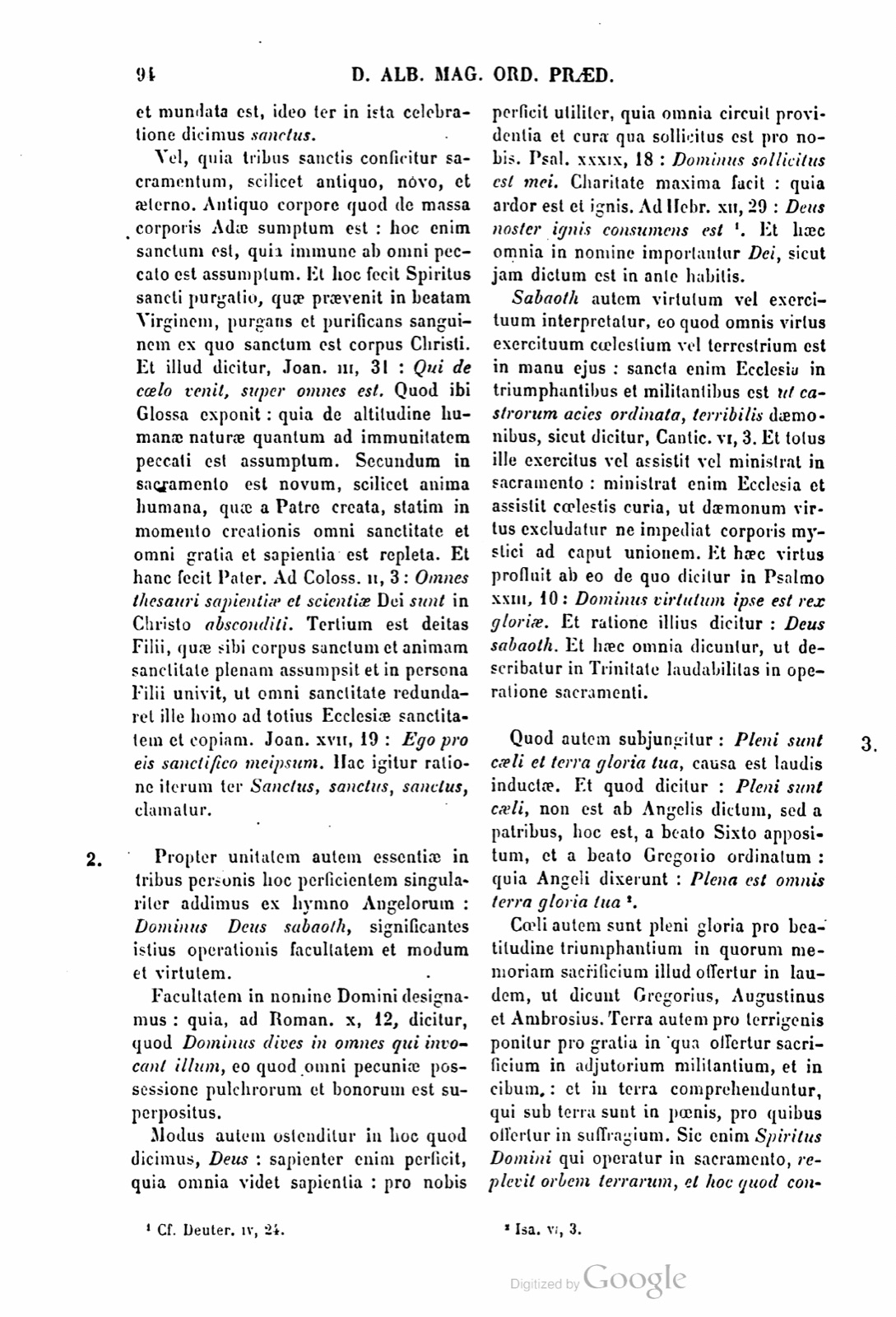
Vel, quia tribus sanctis conficitur sacramentum, scilicet antiquo, novo, et aeterno. Antiquo corpore quod de massa corporis Adae sumptum est: hoc enim sanctum est, quia immune ab omni peccato est assumptum. Et hoc fecit Spiritus sancti purgatio, quae praevenit in beatam Virginem, purgans et purificans sanguinem ex quo sanctum est corpus Christi. Et illud dicitur, Joan. III, 31: Qui de caelo venit, super omnes est. Quod ibi Glossa exponit: quia de altitudine humanae naturae quantum ad immunitatem peccati est assumptum. Secundum in sacramento est novum, scilicet anima humana, quae a Patre creata, statim in momento creationis omni sanctitate et omni gratia et sapientia est repleta. Et hanc fecit Pater. Ad Coloss. II, 3: Omnes thesauri sapientiae et scientiae Dei sunt in Christo absconditi. Tertium est deitas Filii, quae sibi corpus sanctum et animam sanctitate plenam assumpsit et in persona Filii univit, ut omni sanctitate redundaret ille homo ad totius Ecclesiae sanctitatem et copiam. Joan. XVII, 19: Ego pro eis sanctifico meipsum. Hac igitur ratione iterum ter Sanctus, sanctus, sanctus, clamatur.
2. Propter unitatem autem essentiae in tribus personis hoc perficientem singulariter addimus ex hymno Angelorum: Dominus Deus sabaoth, significantes istius operationis facultatem et modum et virtutem.
Facultatem in nomine Domini designamus: quia, ad Roman. X, 12, dicitur, quod Dominus dives in omnes qui invocant illum, eo quod omni pecuniae possessione pulchrorum et bonorum est superpositus.
Modus autem ostenditur in hoc quod dicimus, Deus: sapienter enim perficit, quia omnia videt sapientia: pro nobis perficit utiliter, quia omnia circuit providentia et cura qua sollicitus est pro nobis. Psal. XXXIX, 18: Dominus sollicitus est mei. Charitate maxima facit: quia ardor est et ignis. Ad Hebr. XII, 29: Deus noster ignis consumens est 2. Et haec omnia in nomine importantur Dei, sicut jam dictum est in ante habitis.
Sabaoth autem virtutum vel exercituum interpretatur, eo quod omnis virtus exercituum caelestium vel terrestrium est in manu ejus: sancta enim Ecclesia in triumphantibus et militantibus est ut castrorum acies ordinata, terribilis daemonibus, sicut dicitur, Cantic. VI, 3. Et totus ille exercitus vel assistit vel ministrat in sacramento: ministrat enim Ecclesia et assistit caelestis curia, ut daemonum virtus excludatur ne impediat corporis mystici ad caput unionem. Et haec virtus profluit ab eo de quo dicitur in Psalmo XXIII, 10: Dominus virtutum ipse est rex gloriae. Et ratione illius dicitur: Deus sabaoth. Et haec omnia dicuntur, ut describatur in Trinitate laudabilitas in operatione sacramenti.
Or, because the sacrament is made by three holy things, namely ancient, new, and eternal. By the ancient body which was taken from the mass of the body of Adam; for this is holy, because it was assumed immune from every sin. And the cleansing of the Holy Spirit did this, which came beforehand into the blessed Virgin, cleansing and purifying the blood from which the body of Christ is holy. And that is said, John 3:31: He who comes from heaven is above all. There the Gloss explains: because it was assumed from the height of human nature with respect to immunity from sin. The second thing in the sacrament is new, namely the human soul, which, created by the Father, at once in the moment of creation was filled with every sanctity and every grace and wisdom. And the Father made this. Colossians 2:3: All the treasures of the wisdom and knowledge of God are hidden in Christ. The third is the deity of the Son, which assumed to itself the holy body and the soul full of sanctity and united them in the person of the Son, so that that man might overflow with every sanctity unto the sanctity and abundance of the whole Church. John 17:19: I sanctify myself for them. Therefore for this reason again Holy, holy, holy is cried three times.
2. But on account of the unity of the essence singularly perfecting this in the three persons, we add from the hymn of the Angels: Lord God Sabaoth, signifying the resource, mode, and power of this operation.
We designate the resource in the name of Lord, because, Romans 10:12, it is said that the Lord is rich toward all who invoke him, since he is placed above every possession of money, of beautiful and good things.
But the mode is shown in this, that we say God. For he perfects wisely, because he sees all things by wisdom; he perfects usefully for us, because by providence and care he goes around all things, being solicitous for us. Psalm 39:18: The Lord is solicitous for me. He does it by the greatest charity, because he is ardor and fire. Hebrews 12:29: Our God is a consuming fire 2. And all these things are conveyed in the name of God, as has already been said in the things had above.
But Sabaoth is interpreted "of powers" or "of armies," because every power of heavenly or earthly armies is in his hand. For the holy Church, in the triumphant and the militant, is as a battle-line of camps ordered, terrible to demons, as is said, Song of Songs 6:3. And that whole army either assists or ministers in the sacrament. For the Church ministers, and the heavenly court assists, so that the power of demons may be excluded lest it impede the union of the mystical body to the head. And this power flows from him of whom it is said in Psalm 23:10: The Lord of powers, he is the king of glory. And by reason of this it is said: God Sabaoth. And all these things are said so that the praiseworthiness in the Trinity may be described in the operation of the sacrament.
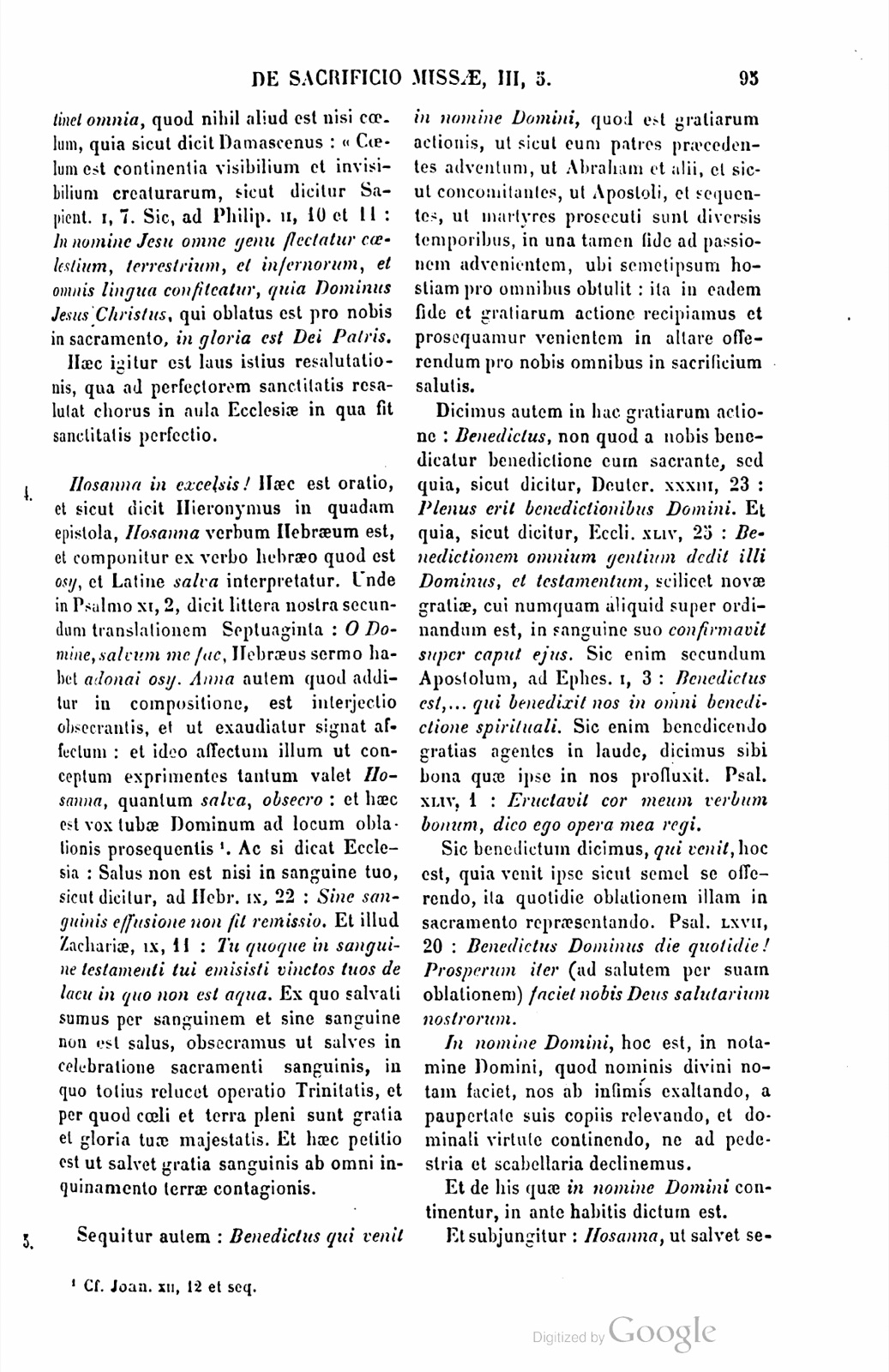
3. Quod autem subjungitur: Pleni sunt caeli et terra gloria tua, causa est laudis inductae. Et quod dicitur: Pleni sunt caeli, non est ab Angelis dictum, sed a patribus, hoc est, a beato Sixto appositum, et a beato Gregorio ordinatum: quia Angeli dixerunt: Plena est omnis terra gloria tua 3.
Caeli autem sunt pleni gloria pro beatitudine triumphantium in quorum memoriam sacrificium illud offertur in laudem, ut dicunt Gregorius, Augustinus et Ambrosius. Terra autem pro terrigenis ponitur pro gratia in qua offertur sacrificium in adjutorium militantium, et in cibum, et in terra comprehenduntur, qui sub terra sunt in poenis, pro quibus offertur in suffragium. Sic enim Spiritus Domini qui operatur in sacramento, replevit orbem terrarum, et hoc quod continet omnia, quod nihil aliud est nisi caelum, quia sicut dicit Damascenus: "Caelum est continentia visibilium et invisibilium creaturarum, sicut dicitur Sapient. I, 7." Sic, ad Philip. II, 10 et 11: In nomine Jesu omne genu flectatur caelestium, terrestrium, et infernorum, et omnis lingua confiteatur, quia Dominus Jesus Christus, qui oblatus est pro nobis in sacramento, in gloria est Dei Patris.
Haec igitur est laus istius resalutationis, qua ad perfectorem sanctitatis resalutat chorus in aula Ecclesiae in qua fit sanctitatis perfectio.
4. Hosanna in excelsis! Haec est oratio, et sicut dicit Hieronymus in quadam epistola, Hosanna verbum Hebraeum est, et componitur ex verbo Hebraeo quod est osy, et Latine salva interpretatur. Unde in Psalmo XI, 2, dicit littera nostra secundum translationem Septuaginta: O Domine, salvum me fac, Hebraeus sermo habet adonai osy. Anna autem quod additur in compositione, est interjectio obsecrantis, et ut exaudiatur signat affectum: et ideo affectum illum ut conceptum exprimentes tantum valet Hosanna, quantum salva, obsecro: et haec est vox tubae Dominum ad locum oblationis prosequentis 4. Ac si dicat Ecclesia: Salus non est nisi in sanguine tuo, sicut dicitur, ad Hebr. IX, 22: Sine sanguinis effusione non fit remissio. Et illud Zachariae, IX, 11: Tu quoque in sanguine testamenti tui emisisti vinctos tuos de lacu in quo non est aqua. Ex quo salvati sumus per sanguinem et sine sanguine non est salus, obsecramus ut salves in celebratione sacramenti sanguinis, in quo totius relucet operatio Trinitatis, et per quod caeli et terra pleni sunt gratia et gloria tuae majestatis. Et haec petitio est ut salvet gratia sanguinis ab omni inquinamento terrae contagionis.
3. But what is joined, Heaven and earth are full of thy glory, is the cause of the praise introduced. And what is said, The heavens are full, was not said by the Angels, but was added by the fathers, that is, by blessed Sixtus, and ordered by blessed Gregory, because the Angels said: The whole earth is full of thy glory 3.
But the heavens are full of glory on account of the beatitude of the triumphant, in whose memory that sacrifice is offered for praise, as Gregory, Augustine, and Ambrose say. But earth is put for the earth-born, on account of the grace in which the sacrifice is offered for the aid of those militant, and as food; and in earth are included those who are under the earth in punishments, for whom it is offered as suffrage. For thus the Spirit of the Lord, who works in the sacrament, has filled the globe of the earth, and that which contains all things, which is nothing other than heaven, because, as Damascene says, "Heaven is the containment of visible and invisible creatures, as is said, Wisdom 1:7." Thus, Philippians 2:10 and 11: At the name of Jesus every knee should bow, of heavenly, earthly, and infernal beings, and every tongue confess that the Lord Jesus Christ, who is offered for us in the sacrament, is in the glory of God the Father.
This therefore is the praise of that return-salutation, by which the choir returns greeting to the perfecter of sanctity in the hall of the Church, in which the perfection of sanctity is made.
4. Hosanna in the highest! This is prayer, and as Jerome says in a certain letter, Hosanna is a Hebrew word and is composed from the Hebrew word which is osy and in Latin is interpreted save. Hence in Psalm 11:2, our letter according to the translation of the Septuagint says: O Lord, save me; the Hebrew speech has adonai osy. But anna, which is added in composition, is the interjection of one beseeching and signifies the affection that he be heard. And therefore, expressing that affection as conceived, Hosanna is worth as much as save, I beseech, and this is the voice of the trumpet accompanying the Lord to the place of oblation 4. As if the Church were saying: Salvation exists only in thy blood, as is said, Hebrews 9:22: Without the shedding of blood there is no remission. And that word of Zechariah 9:11: Thou also, in the blood of thy testament, hast sent forth thy bound ones from the pit in which there is no water. Since we have been saved through blood and without blood there is no salvation, we beseech that thou save us in the celebration of the sacrament of blood, in which the operation of the whole Trinity shines forth, and through which heaven and earth are full of the grace and glory of thy majesty. And this petition is that the grace of blood may save from every defilement of earthly contagion.
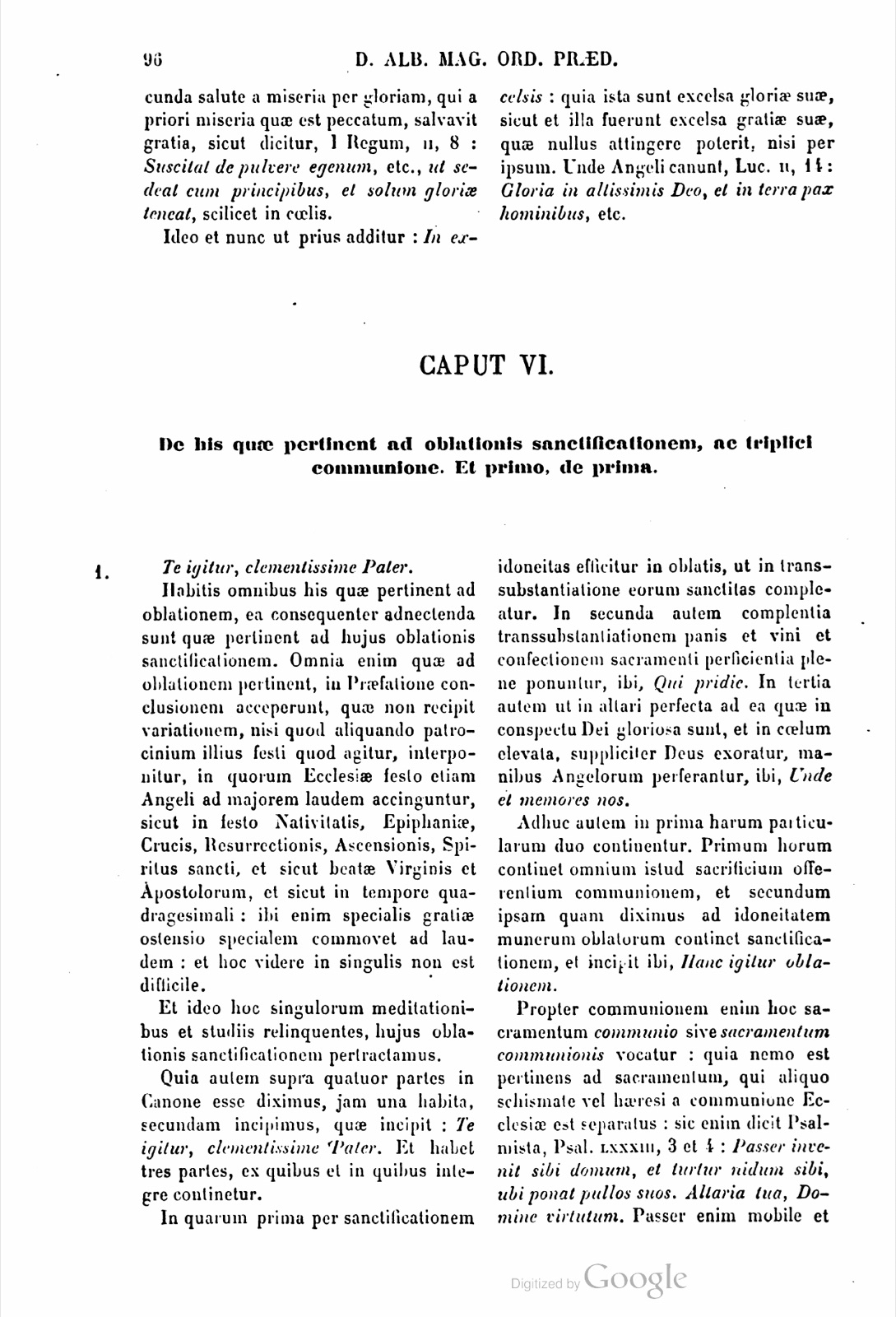
5. Sequitur autem: Benedictus qui venit in nomine Domini, quod est gratiarum actionis, ut sicut eum patres praecedentes adventum, ut Abraham et alii, et sicut concomitantes, ut Apostoli, et sequentes, ut martyres prosecuti sunt diversis temporibus, in una tamen fide ad passionem advenientem, ubi semetipsum hostiam pro omnibus obtulit: ita in eadem fide et gratiarum actione recipiamus et prosequamur venientem in altare offerendum pro nobis omnibus in sacrificium salutis.
Dicimus autem in hac gratiarum actione: Benedictus, non quod a nobis benedicatur benedictione cum sacrante, sed quia, sicut dicitur, Deuter. XXXIII, 23: Plenus erit benedictionibus Domini. Et quia, sicut dicitur, Eccli. XLIV, 25: Benedictionem omnium gentium dedit illi Dominus, et testamentum, scilicet novae gratiae, cui numquam aliquid super ordinandum est, in sanguine suo confirmavit super caput ejus. Sic enim secundum Apostolum, ad Ephes. I, 3: Benedictus est, ... qui benedixit nos in omni benedictione spirituali. Sic enim benedicendo gratias agentes in laude, dicimus sibi bona quae ipse in nos profluxit. Psal. XLIV, 1: Eructavit cor meum verbum bonum, dico ego opera mea regi.
Sic benedictum dicimus, qui venit, hoc est, quia venit ipse sicut semel se offerendo, ita quotidie oblationem illam in sacramento repraesentando. Psal. LXVII, 20: Benedictus Dominus die quotidie! Prosperum iter ad salutem per suam oblationem faciet nobis Deus salutarium nostrorum.
In nomine Domini, hoc est, in notamine Domini, quod nominis divini notam faciet, nos ab infimis exaltando, a paupertate suis copiis relevando, et dominali virtute continendo, ne ad pedestria et scabellaria declinemus.
Et de his quae in nomine Domini continentur, in ante habitis dictum est.
Et subjungitur: Hosanna, ut salvet secunda salute a miseria per gloriam, qui a priori miseria quae est peccatum, salvavit gratia, sicut dicitur, I Regum, II, 8: Suscitat de pulvere egenum, etc., ut sedeat cum principibus, et solum gloriae teneat, scilicet in caelis.
Ideo et nunc ut prius additur: In excelsis: quia ista sunt excelsa gloriae suae, sicut et illa fuerunt excelsa gratiae suae, quae nullus attingere poterit, nisi per ipsum. Unde Angeli canunt, Luc. II, 14: Gloria in altissimis Deo, et in terra pax hominibus, etc.
5. But there follows: Blessed is he who comes in the name of the Lord, which belongs to thanksgiving, so that just as the fathers preceding the advent, such as Abraham and others, and those accompanying him, such as the Apostles, and those following, such as the martyrs, followed him at diverse times, yet in one faith, as he came to the passion, where he offered himself as victim for all, so in the same faith and thanksgiving we may receive and follow him as he comes onto the altar to be offered for all of us as the sacrifice of salvation.
But in this thanksgiving we say: Blessed, not because he is blessed by us with the blessing along with the one consecrating, but because, as is said, Deuteronomy 33:23: He will be full of the blessings of the Lord. And because, as is said, Ecclesiasticus 44:25: The Lord gave him the blessing of all nations, and confirmed upon his head the testament, namely of the new grace, to which nothing must ever be added as needing arrangement, in his blood. For thus according to the Apostle, Ephesians 1:3: Blessed is he ... who has blessed us in every spiritual blessing. For thus, blessing him and giving thanks in praise, we say to him the good things which he himself has poured forth into us. Psalm 44:1: My heart has uttered a good word; I speak my works to the king.
Thus we call him blessed, who comes, that is, because he comes himself just as by offering himself once, so by representing daily that oblation in the sacrament. Psalm 67:20: Blessed be the Lord day by day. The God of our salvations will make a prosperous way to salvation through his oblation for us.
In the name of the Lord, that is, in the mark of the Lord, because he will make the mark of the divine name, by exalting us from the lowest things, by relieving us from poverty with his stores, and by containing us with lordly power, lest we decline to pedestrian and footstool-like things.
And concerning the things which are contained in the name of the Lord, it has been said in the things already had.
And there is added: Hosanna, so that he may save by a second salvation from misery through glory, who saved by grace from the prior misery, which is sin, as is said, 1 Kings 2:8: He raises the needy from the dust, etc., so that he may sit with princes and hold the throne of glory, namely in the heavens.
Therefore now also, as before, there is added: In the highest, because those things are the heights of his glory, just as those former things were the heights of his grace, which no one will be able to attain except through him. Hence the Angels sing, Luke 2:14: Glory to God in the highest, and on earth peace to human beings, etc.
If a page does not appear, its photograph has not been uploaded yet.