Works › The Book on the Sacrifice of the Mass
Volume 38 · pp. 118–120
Tractate III, Chapter XI opening
A marker with ≈ is an approximate page boundary, placed by measure of the text; the page photographs remain the authority. In the paired views, clicking a page marker brings that page into view.
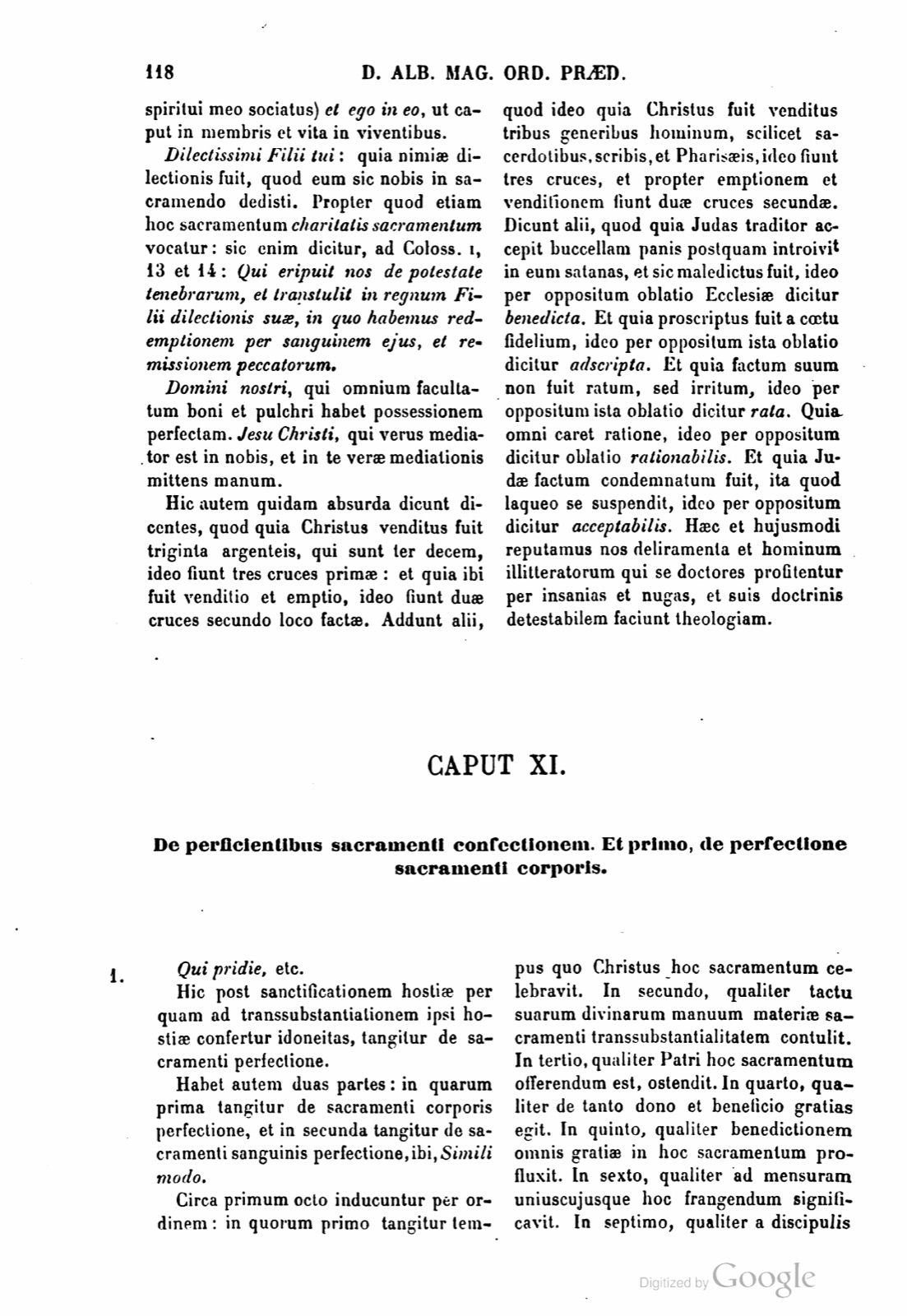
CAPUT XI.
De perficientibus sacramenti confectionem. Et primo, de perfectione sacramenti corporis.
1. Qui pridie, etc. Hic post sanctificationem hostiae per quam ad transsubstantiationem ipsi hostiae confertur idoneitas, tangitur de sacramenti perfectione.
Habet autem duas partes: in quarum prima tangitur de sacramenti corporis perfectione, et in secunda tangitur de sacramenti sanguinis perfectione, ibi, Simili modo.
Circa primum octo inducuntur per ordinem: in quorum primo tangitur tempus quo Christus hoc sacramentum celebravit. In secundo, qualiter tactu suarum divinarum manuum materiae sacramenti transsubstantialitatem contulit. In tertio, qualiter Patri hoc sacramentum offerendum est, ostendit. In quarto, qualiter de tanto dono et beneficio gratias egit. In quinto, qualiter benedictionem omnis gratiae in hoc sacramentum profluxit. In sexto, qualiter ad mensuram uniuscujusque hoc frangendum significavit. In septimo, qualiter a discipulis hoc sacramentum frequentandum esse instituit. In octavo, qualiter formam sanctificationis expressit.
[Marginal label: Tempus quo sacramentum Christus instituit.] Dicit ergo: Qui pridie, hoc est priori die, quam pateretur, hoc est, feria quinta in nocte in qua tradebatur, post quam in Parasceve, hoc est, in sexta feria patiebatur. In illa autem nocte luna fuit quartadecima, et non erat fermentatum in domibus Judaeorum: et ideo convincitur celebrasse in azymo. Exod. XII, 15: Septem diebus azyma comedetis, et non erit fermentatum in domibus vestris. Hoc enim competit signato. I ad Corinth. V, 7 et 8: Etenim Pascha nostrum immolatus est Christus. Itaque epulemur, non in fermento veteri, neque in fermento malitiae et nequitiae, sed in azymis sinceritatis et veritatis. De hoc tempore Apostolus dicit, I ad Corinth. XI, 23 et 24: Quoniam Dominus Jesus, in qua nocte tradebatur, accepit panem, et gratias agens fregit.
De secundo dicit: Accepit panem de frumento puro azymum, in sanctas, hoc est, sanctificantes, ac venerabiles, propter unitam manibus deitatem, manus suas, ut tactu suarum sanctarum et divinarum manuum tali materiae sacramenti conferret, quod in omni tempore in corpus Christi transsubstantiari posset, sicut ipse tactu suae mundissimae carnis vim regenerativam conferebat aquis: talem enim virtutem creatura accipit ad tactum Creatoris. Et hoc significatum est, Joan. VI, 11, ubi Jesus ad manus accepit panes, de quibus turbas pascere voluit. Hinc est quod dicitur, Cantic. V, 14: Manus ejus tornatiles, aureae, plenae hyacinthis. Tornatiles dicuntur, id est, omnium volubiles operationum. Aureae autem, quia in omnibus earum operationibus splendet virtus deitatis mutans divinitus omne quod tangit manus. Plenae autem dicuntur hyacinthis, qui caelestis est virtutis et coloris: quia in omnibus operibus caelestem indicat vitam et intentionem.
CHAPTER XI.
On the things perfecting the confection of the sacrament. And first, on the perfection of the sacrament of the body.
1. Who the day before, etc. Here, after the sanctification of the host by which fitness for transubstantiation is conferred on the host itself, he touches the perfection of the sacrament.
But it has two parts: in the first of which the perfection of the sacrament of the body is touched, and in the second the perfection of the sacrament of the blood is touched, there, In like manner.
Concerning the first, eight things are introduced in order. In the first of these is touched the time at which Christ celebrated this sacrament. In the second, how by the touch of his divine hands he conferred transubstantiality on the matter of the sacrament. In the third, he shows how this sacrament is to be offered to the Father. In the fourth, how he gave thanks for so great a gift and benefit. In the fifth, how he flowed forth the blessing of every grace into this sacrament. In the sixth, how he signified that this must be broken according to the measure of each one. In the seventh, how he instituted that this sacrament must be frequented by the disciples. In the eighth, how he expressed the form of sanctification.
[Marginal label: The time when Christ instituted the sacrament.] Therefore he says: Who the day before, that is, on the prior day, before he suffered, that is, on the fifth feria in the night in which he was handed over, after which he suffered on Parasceve, that is, on the sixth feria. But on that night the moon was fourteenth, and there was no leaven in the houses of the Jews; and therefore he is proved to have celebrated with unleavened bread. Exodus 12:15: For seven days you shall eat unleavened bread, and there shall be no leaven in your houses. For this fits the thing signified. 1 Corinthians 5:7 and 8: For Christ our Pasch has been immolated. Therefore let us feast, not in the old leaven, nor in the leaven of malice and wickedness, but in the unleavened breads of sincerity and truth. Concerning this time the Apostle says, 1 Corinthians 11:23 and 24: Because the Lord Jesus, on the night in which he was handed over, took bread, and giving thanks broke it.
Concerning the second he says: He took bread, unleavened from pure wheat, into his holy hands, that is, sanctifying hands, and venerable, on account of deity united to the hands, so that by the touch of his holy and divine hands he conferred on such matter of the sacrament that it could at every time be transubstantiated into the body of Christ, just as by the touch of his most clean flesh he conferred regenerative power on waters; for the creature receives such power at the touch of the Creator. And this was signified, John 6:11, where Jesus took into his hands the loaves with which he wished to feed the crowds. Hence it is said, Song of Songs 5:14: His hands are rounded, golden, full of hyacinths. They are called rounded, that is, moveable for all operations; golden, because in all their operations the power of deity shines, divinely changing everything that the hands touch. But they are called full of hyacinths, which is of heavenly power and color, because in all works it indicates heavenly life and intention.
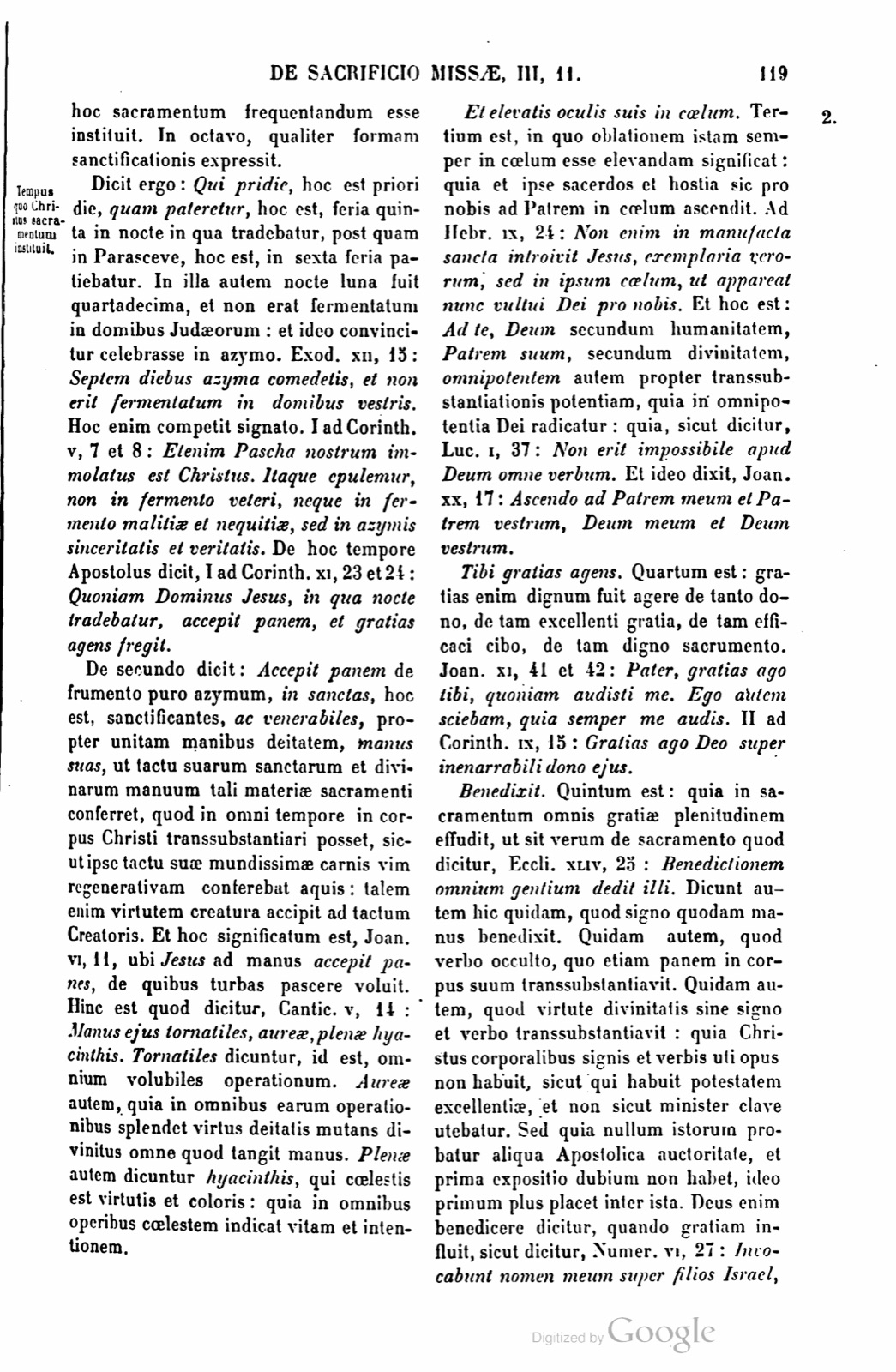
2. Et elevatis oculis suis in caelum. Tertium est, in quo oblationem istam semper in caelum esse elevandam significat: quia et ipse sacerdos et hostia sic pro nobis ad Patrem in caelum ascendit. Ad Hebr. IX, 24: Non enim in manufacta sancta introivit Jesus, exemplaria verorum, sed in ipsum caelum, ut appareat nunc vultui Dei pro nobis. Et hoc est: Ad te, Deum secundum humanitatem, Patrem suum, secundum divinitatem, omnipotentem autem propter transsubstantiationis potentiam, quia in omnipotentia Dei radicatur: quia, sicut dicitur, Luc. I, 37: Non erit impossibile apud Deum omne verbum. Et ideo dixit, Joan. XX, 17: Ascendo ad Patrem meum et Patrem vestrum, Deum meum et Deum vestrum.
Tibi gratias agens. Quartum est: gratias enim dignum fuit agere de tanto dono, de tam excellenti gratia, de tam efficaci cibo, de tam digno sacramento. Joan. XI, 41 et 42: Pater, gratias ago tibi, quoniam audisti me. Ego autem sciebam, quia semper me audis. II ad Corinth. IX, 15: Gratias ago Deo super inenarrabili dono ejus.
Benedixit. Quintum est: quia in sacramentum omnis gratiae plenitudinem effudit, ut sit verum de sacramento quod dicitur, Eccli. XLIV, 25: Benedictionem omnium gentium dedit illi. Dicunt autem hic quidam, quod signo quodam manus benedixit. Quidam autem, quod verbo occulto, quo etiam panem in corpus suum transsubstantiavit. Quidam autem, quod virtute divinitatis sine signo et verbo transsubstantiavit: quia Christus corporalibus signis et verbis uti opus non habuit, sicut qui habuit potestatem excellentiae, et non sicut minister clave utebatur. Sed quia nullum istorum probatur aliqua Apostolica auctoritate, et prima expositio dubium non habet, ideo primum plus placet inter ista. Deus enim benedicere dicitur, quando gratiam influit, sicut dicitur, Numer. VI, 27: Invocabunt nomen meum super filios Israel, ego autem benedicam eis. Psal. CXIII, 15: Benedicti vos a Domino, qui fecit caelum et terram.
2. And with his eyes lifted up to heaven. The third is that in which he signifies that this oblation must always be lifted into heaven, because both the priest himself and the host thus ascended for us to the Father in heaven. Hebrews 9:24: For Jesus did not enter into holy places made by hand, copies of the true, but into heaven itself, so that he may now appear before the face of God for us. And this is: To thee, God according to humanity, his Father according to divinity, but almighty on account of the power of transubstantiation, because it is rooted in the omnipotence of God; because, as is said, Luke 1:37: No word will be impossible with God. And therefore he said, John 20:17: I ascend to my Father and your Father, my God and your God.
Giving thanks to thee. The fourth is this: for it was worthy to give thanks concerning so great a gift, concerning so excellent a grace, concerning so effective a food, concerning so worthy a sacrament. John 11:41 and 42: Father, I give thanks to thee, because thou hast heard me. But I knew that thou always hearest me. 2 Corinthians 9:15: I give thanks to God for his unspeakable gift.
He blessed. The fifth is this, because he poured the fullness of every grace into the sacrament, so that what is said in Ecclesiasticus 44:25 may be true concerning the sacrament: He gave to him the blessing of all nations. But some here say that he blessed with a certain sign of the hand. Others say that it was by a hidden word, by which he also transubstantiated the bread into his body. Others say that he transubstantiated by the power of divinity without sign and word, because Christ did not need to use bodily signs and words, as one who had the power of excellence, and not as a minister using a key. But because none of these is proved by any Apostolic authority, and the first exposition has no doubt, therefore the first is more pleasing among these. For God is said to bless when he flows grace in, as is said, Numbers 6:27: They shall invoke my name over the sons of Israel, but I will bless them. Psalm 113:15: Blessed are you by the Lord, who made heaven and earth.
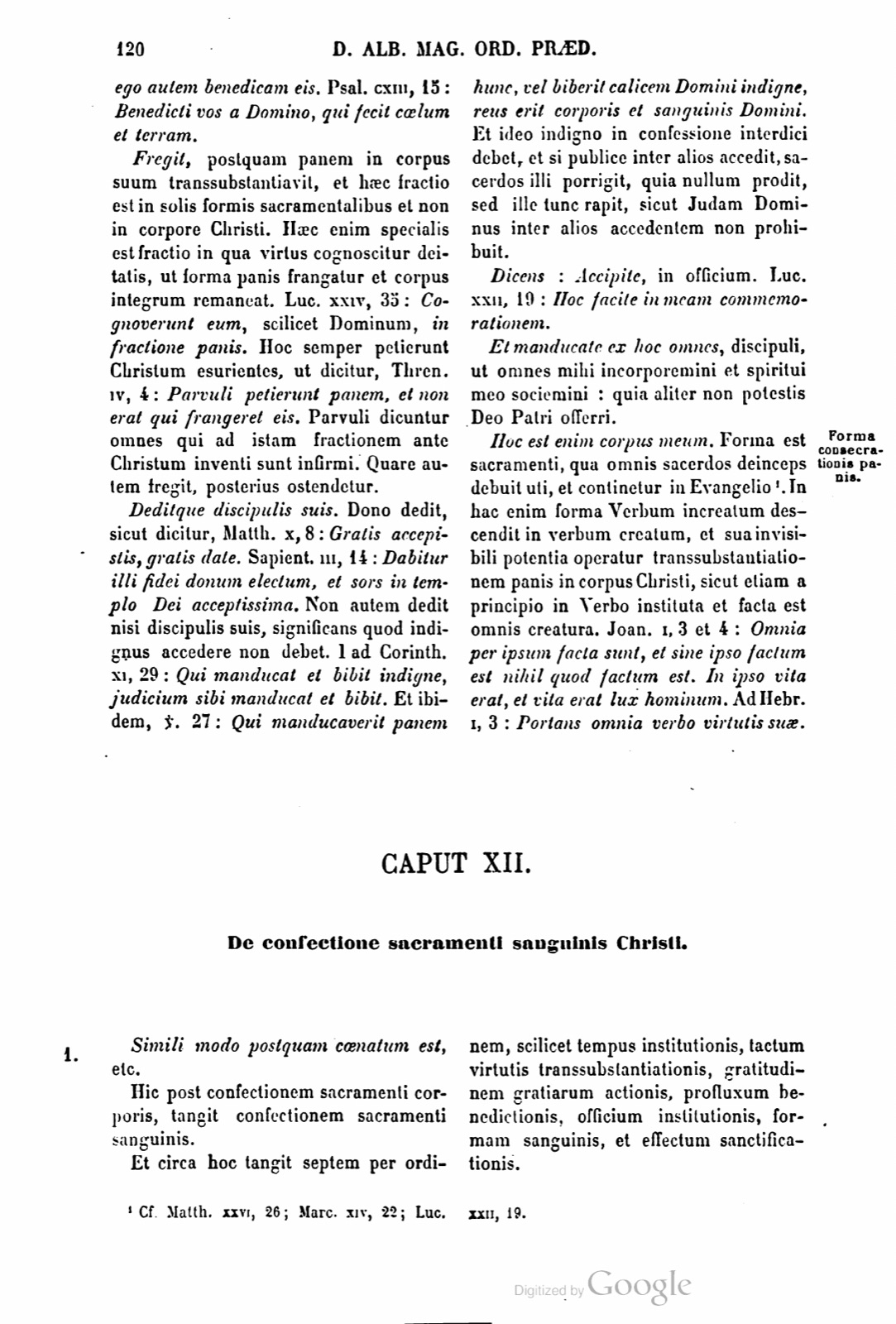
Fregit, postquam panem in corpus suum transsubstantiavit, et haec fractio est in solis formis sacramentalibus et non in corpore Christi. Haec enim specialis est fractio in qua virtus cognoscitur deitatis, ut forma panis frangatur et corpus integrum remaneat. Luc. XXIV, 35: Cognoverunt eum, scilicet Dominum, in fractione panis. Hoc semper petierunt Christum esurientes, ut dicitur, Thren. IV, 4: Parvuli petierunt panem, et non erat qui frangeret eis. Parvuli dicuntur omnes qui ad istam fractionem ante Christum inventi sunt infirmi. Quare autem fregit, posterius ostendetur.
Deditque discipulis suis. Dono dedit, sicut dicitur, Matth. X, 8: Gratis accepistis, gratis date. Sapient. III, 14: Dabitur illi fidei donum electum, et sors in templo Dei acceptissima. Non autem dedit nisi discipulis suis, significans quod indignus accedere non debet. I ad Corinth. XI, 29: Qui manducat et bibit indigne, judicium sibi manducat et bibit. Et ibidem, v. 27: Qui manducaverit panem hunc, vel biberit calicem Domini indigne, reus erit corporis et sanguinis Domini. Et ideo indigno in confessione interdici debet, et si publice inter alios accedit, sacerdos illi porrigit, quia nullum prodit, sed ille tunc rapit, sicut Judam Dominus inter alios accedentem non prohibuit.
Dicens: Accipite, in officium. Luc. XXII, 19: Hoc facite in meam commemorationem.
Et manducate ex hoc omnes, discipuli, ut omnes mihi incorporemini et spiritui meo sociemini: quia aliter non potestis Deo Patri offerri.
[Marginal label: Forma consecrationis panis.] Hoc est enim corpus meum. Forma est sacramenti, qua omnis sacerdos deinceps debuit uti, et continetur in Evangelio 1. In hac enim forma Verbum increatum descendit in verbum creatum, et sua invisibili potentia operatur transsubstantiationem panis in corpus Christi, sicut etiam a principio in Verbo instituta et facta est omnis creatura. Joan. I, 3 et 4: Omnia per ipsum facta sunt, et sine ipso factum est nihil quod factum est. In ipso vita erat, et vita erat lux hominum. Ad Hebr. I, 3: Portans omnia verbo virtutis suae.
He broke, after he had transubstantiated the bread into his body, and this breaking is in the sacramental forms alone and not in the body of Christ. For this is a special breaking in which the power of deity is known, that the form of bread is broken and the body remains whole. Luke 24:35: They knew him, namely the Lord, in the breaking of bread. Those hungry for Christ always sought this, as is said, Lamentations 4:4: The little ones asked for bread, and there was no one to break it for them. Little ones are called all those who before Christ were found weak for this breaking. But why he broke it will be shown later.
And he gave it to his disciples. He gave it as a gift, as is said, Matthew 10:8: Freely you have received, freely give. Wisdom 3:14: To him will be given the chosen gift of faith and a most acceptable lot in the temple of God. But he gave only to his disciples, signifying that an unworthy person ought not approach. 1 Corinthians 11:29: He who eats and drinks unworthily eats and drinks judgment to himself. And in the same place, verse 27: Whoever shall eat this bread or drink the chalice of the Lord unworthily will be guilty of the body and blood of the Lord. And therefore in confession the unworthy person ought to be forbidden, and if publicly he approaches among others, the priest extends it to him because he betrays no one, but that man then seizes it, just as the Lord did not prohibit Judas approaching among the others.
Saying: Take, unto office. Luke 22:19: Do this in memory of me.
And eat of this, all of you, disciples, so that all of you may be incorporated into me and associated to my spirit, because otherwise you cannot be offered to God the Father.
[Marginal label: Form of the consecration of bread.] For this is my body. This is the form of the sacrament, which every priest thereafter had to use, and it is contained in the Gospel 1. For in this form the uncreated Word descends into the created word, and by his invisible power works the transubstantiation of bread into the body of Christ, just as also from the beginning in the Word every creature was instituted and made. John 1:3 and 4: All things were made through him, and without him nothing was made that was made. In him was life, and the life was the light of men. Hebrews 1:3: Carrying all things by the word of his power.
Notes
- Compare Matthew 26:26; Mark 14:22; Luke 22:19. (Cf. Matth. XXVI, 26; Marc. XIV, 22; Luc. XXII, 19.) ↩
If a page does not appear, its photograph has not been uploaded yet.