Works › The Book on the Sacrifice of the Mass
Volume 38 · pp. 7–15
Treatise I. On the First Part of the Mass. Chapter I. On the calling of the divine good through great cries. And first, on the Introit
A marker with ≈ is an approximate page boundary, placed by measure of the text; the page photographs remain the authority. In the paired views, clicking a page marker brings that page into view.
Tractatus I.
De prima parte Missae.
Caput I.
De boni divini per magnos clamores advocatione. Et primo, de Introitu.
1. [Marginal label: Christi Patres praesentiam suspirantes.] Isaiae, XXVI, 9: Anima mea desideravit te in nocte, sed et spiritu meo in praecordiis meis de mane vigilabo ad te. Haec verba dicit Isaias in desiderio Patrum suspirantium in carne Christi praesentiam. Omne tempus quod fuit a tenebris primi peccati parentum usque ad lucem quae est in tenebris exortum lumen rectis corde in ortu Salvatoris, quando, sicut dicitur, Malach. IV, 2: Orietur vobis timentibus nomen meum Sol justitiae, et sanitas in pennis ejus: vocatur tam densarum tenebrarum, quod lumen veritatis Evangelicae non luxit nisi in umbris figurarum legis, et lumen gratiae et bonitatis in virtute caliginis peccati fuit obnubilatum, ita ut omnes sederent in tenebris et in umbra primae mortis, sicut dicitur, Sap. XVII, 17: Una catena tenebrarum omnes erant colligati, vinculis longae noctis compediti nullam penitus habebant consolationem, nisi in spe futuri et orituri solis, qui, sicut dicitur, Joan. I, 9: Erat lux vera, quae illuminat omnem hominem venientem in hunc mundum. Et ideo longae noctis tetras umbras sustinentes omnes desiderio lucis, cum quadam a Prophetis quaerebant impatientia, dicentes illud Isaiae, XXI, 11 et 12: Custos, quid de nocte? Custos, quid de nocte? Dixit custos: Venit mane, et nox: si quaeritis, quaerite: convertimini et venite. Prophetam enim quemlibet custodem appellabant Domini, et ob hoc quaerebant taedio affecti quantum de nocte transierit, et quantum usque ad ortum verae lucis restaret de eadem. Respondit custos verba simul consolationis et desolationis. Consolationis quidem: quia venit mane, hoc est, in veniendo est mane surgentis aurorae in novae lucis exortu. Verba autem desolationis in hoc quod addit custos: Et nox est adhuc longius protelanda: et ideo si lucem quaeritis, vere quaerite eam corde et ore et opere: quia tunc citius orietur: et hoc ut facere congruenter possitis, convertimini ad ortum, et venite per devotionem ad lucem, abjectis operibus tenebrarum, sicut dicitur, ad Roman. XIII, 12 et 13: Abjiciamus opera tenebrarum, et induamur arma lucis. Sicut in die honeste ambulemus.
In hac ergo nocte in desiderio dixit Isaias: Anima mea desideravit te in nocte. Nec mirum: quia noctis illius tenebras, nec lux quae interdum in verbis et exemplis sanctorum emicuit, nec frigus ejus aliqua charitate sanctorum consolari potuit. Unde, Sapient. XVII, 5 dicitur: Ignis quidem nulla vis poterat illis lumen praebere, nec siderum limpidae flammae poterant illuminare noctem illam horrendam: quia etiam illa scintilla sanctorum post mortem in tenebris limbi infernalis absorpta fuit. Et ideo suspirans anima Isaiae et sanctorum, Christum lucem veram, qui tenebras fugaret, desideravit. Et hoc est quod dicit: Anima mea desideravit te in nocte, sed et spiritu meo, qui est spiritus creatus, quem alloquitur in revelatione spiritus increatus, et hic est spiritus qui est animae pars purior et simplicior et superior, in qua imago Dei dicitur descripta, digito Dei depicta in praecordiis pectoris mei, de mane juventutis meae, quando lux intelligentiae primae oritur, quando vigilabo ad te desiderans et clamans ad te, ut venias et nobis salutare tuum ostendas. Psal. LXII, 1 et 2: Deus, Deus meus, ad te luce vigilo. Sitivit in te anima mea. Sic enim dicitur, Eccli. XXXIX, 6: Justus cor suum tradet ad vigilandum diluculo ad Dominum qui fecit illum, et in conspectu Altissimi deprecabitur.
Treatise I.
On the First Part of the Mass.
Chapter I.
On the calling of the divine good through great cries. And first, on the Introit.
1. [Marginal label: The Fathers sighing for Christ's presence.] Isaiah 26:9: My soul has desired you in the night, but also with my spirit in my innermost parts I will watch for you from the morning. Isaiah says these words in the desire of the Fathers sighing for the presence of Christ in the flesh. The whole time that was from the darkness of the first sin of the parents until the light that is the light arisen in darkness for those right in heart, at the rising of the Savior, when, as is said in Malachi 4:2: The Sun of justice shall arise for you who fear my name, and health in his wings, is called a time of such dense darkness, because the light of Gospel truth did not shine except in the shadows of the figures of the law, and the light of grace and goodness was clouded over in the force of the darkness of sin, so that all sat in darkness and in the shadow of the first death, as is said in Wisdom 17:17: All were bound by one chain of darkness, fettered by the bonds of the long night, and had utterly no consolation, except in the hope of the sun that was to be and to rise, who, as is said in John 1:9: Was the true light, which illumines every man coming into this world. And therefore all, enduring the foul shadows of the long night in desire for the light, were asking with a certain impatience from the Prophets, saying that word of Isaiah 21:11 and 12: Watchman, what of the night? Watchman, what of the night? The watchman said: Morning comes, and night; if you seek, seek; be converted and come. For they called any Prophet a watchman of the Lord, and on this account, affected by weariness, they asked how much of the night had passed, and how much of the same night remained until the rising of the true light. The watchman answered words at once of consolation and desolation. Of consolation indeed, because morning comes, that is, the morning of the rising dawn is in the act of coming in the rising of the new light. But words of desolation are in this, that the watchman adds: And night is still to be prolonged further; and therefore if you seek light, seek it truly with heart and mouth and work, because then it will rise more quickly; and so that you may fittingly be able to do this, be converted toward the rising, and come through devotion to the light, casting away the works of darkness, as is said in Romans 13:12 and 13: Let us cast away the works of darkness, and let us put on the armor of light. Let us walk honorably as in the day.
Therefore in this night Isaiah said in desire: My soul has desired you in the night. Nor is it strange, because neither the light that sometimes flashed forth in the words and examples of the saints, nor the coldness of that night, could console the darkness of that night by any charity of the saints. Hence in Wisdom 17:5 it is said: Indeed no force of fire could give them light, nor could the clear flames of the stars illumine that horrible night, because even that spark of the saints after death was swallowed up in the darkness of the infernal limbo. And therefore the soul of Isaiah and of the saints, sighing, desired Christ the true light, who would put darkness to flight. And this is what he says: My soul has desired you in the night, but also with my spirit, which is a created spirit, which he addresses in the revelation of the uncreated Spirit, and this is the spirit that is the purer and simpler and higher part of the soul, in which the image of God is said to be inscribed, painted by the finger of God in the innermost parts of my breast; from the morning of my youth, when the light of first intelligence arises, when I will watch for you, desiring and crying to you that you may come and show us your salvation. Psalm 62:1 and 2: God, my God, I keep watch for you at dawn. My soul has thirsted for you. For thus it is said in Ecclesiasticus 39:6: The just man will give his heart to keeping watch at daybreak for the Lord who made him, and in the sight of the Most High he will make supplication.
2. [Marginal label: Suspiria Patrum in Missae introitu repraesentantur.] Horum igitur Patrum clamorem affectantium Christi adventum Ecclesia Spiritu sancto afflata, repraesentat in eo cantu, qui dicitur Missae introitus, quando subito affectu interiori victa, vocem extollit a clamore inchoans Missam, in qua celebratur Christi adventus in sacramento. Dicitur autem introitus, non tam ab introitu celebrationis Missae, quae in hoc cantu inchoatur, quam ab introitu salutis et gratiae, cujus initium in clamore sanctorum commemoratur et repraesentatur. Unde, ad Hebr. X, 19 et seq., dicitur: Habentes itaque, fratres, fiduciam in introitu sanctorum in sanguine Christi, quam initiavit nobis vitam novam et viventem per velamen, id est, carnem suam, et sacerdotem magnum super domum Dei: accedamus cum vero corde in plenitudine fidei, aspersi corda a conscientia mala, et abluti corpus aqua munda. Dicitur etiam hic introitus ab antiquis antiphona, quod est verbum Graecum, et est idem quod reciprocus sonus, et componitur ab ἀντί Graeco quod est circa, et φωνή, quod est vox sive sonus: quia est sonus circuiens geminatus ad versus Psalmi, et Gloria Patri, quod post illum cantatur. Et fuit in antiquis Ecclesiis aliquando consuetum, quod totus Psalmus per singulos versus cantabatur, et ad quemlibet versum ille sonus geminabatur, quod modo propter prolixitatem est dimissum, sed semel reciprocatur adhuc, ut ingeminatio et reciprocatio saepius repetiti clamoris Patrum et commemoretur et repraesentetur ab Ecclesia, sicut dicitur, Isa. LXII, 6 et 7: Qui reminiscimini Domini, ne taceatis, et ne detis ei silentium. Et quia ardor suspirantium compulit ad clamorem potius quam ad orationem, ideo Missa non incipit a precibus sicut aliae horae canonicae, ut dicatur: Domine, labia mea aperies, vel, Deus in adjutorium, vel, Converte nos, Deus, salutaris noster: sed subito totus chorus prorumpit in clamorem ad desiderium adventus Domini.
3. [Marginal label: Sex praecipuae causae, cur Patres clamaverunt in desiderio adventus Domini.] Excitantia autem et incitantia Patres ad sic clamandum, sex fuerunt praecipuae. Primum quidem est miseria conditionis. Secundum autem instantia hostis. Tertium, certitudo promissionis. Quartum, taedium longae exspectationis. Quintum, imperfectio interdum consolantis. Sextum autem ardor suspirii ad praesentiam liberatoris. Primum horum pungit, secundum stimulat, tertium trahit, quartum angit: quintum ab his quae consolari videntur, avertit: sextum ad clamandum fortiter ignit et accendit.
4. [Marginal label: Prima causa.] De primo dicitur in Psalmo LXXXVII, 16: Pauper sum ego, et in laboribus a juventute mea: exaltatus autem, humiliatus sum et conturbatus. Pauper quidem: quia sibi homo ex suis non sufficit. In laboribus autem hujus vitae non proficit, sed deficit. Exaltatus autem phantastica mundi exaltatione, statim cadens humiliatus, ut vile lutum colliditur, et a miseriis praesentibus conturbatur. Psal. XXXVII, 11: Cor meum conturbatum est, et inde dolor: dereliquit me virtus mea, et inde deficiendi timor: et lumen oculorum meorum, et ipsum non est mecum, et inde caecitatis error. Job, XIV, 1 et 2: Homo natus de muliere, et inde plenus verecundia: brevi vivens tempore, et inde vitae deficientia: repletur multis miseriis, et inde infelicitas et angustia: qui quasi flos egreditur, et inde efficitur vana omnis gloria ejus: et conteritur, et inde luctuosa et omnis defectus aerumna: et numquam in eodem statu permanet, et inde miserrima inconstantia. Quis hoc attendat, et non clamet, et dicat? Educ de custodia animam meam, ad confitendum nomini tuo 1, Domine, suspirans continue ad praesentiam liberatoris nostrae naturae. Et consideratio hujus movet Patres ad clamandum, et nos hujus clamoris memores puncti cogimur clamare ad Redemptorem: sicut enim dicit Apostolus, ad Philip. III, 20 et 21: Salvatorem exspectamus Dominum nostrum Jesum Christum, qui reformabit corpus humilitatis nostrae configuratum corpori claritatis suae. Et tunc finem habebit omnis humanae conditionis miseria.
2. [Marginal label: The sighs of the Fathers are represented in the Introit of the Mass.] Therefore the Church, breathed upon by the Holy Spirit, represents this cry of the Fathers desiring the coming of Christ in that chant which is called the Introit of the Mass, when, suddenly conquered by inward affection, she lifts up her voice, beginning the Mass from a cry, in which the coming of Christ in the sacrament is celebrated. Now it is called introit, not so much from the entrance of the celebration of the Mass, which is begun in this chant, as from the entrance of salvation and grace, whose beginning is commemorated and represented in the cry of the saints. Hence in Hebrews 10:19 and following it is said: Having therefore, brothers, confidence in the entrance of the saints in the blood of Christ, which he initiated for us as a new and living way through the veil, that is, his flesh, and having a great priest over the house of God, let us approach with a true heart in the fullness of faith, our hearts sprinkled from an evil conscience, and our body washed with clean water. This introit is also called antiphon by the ancients; this is a Greek word and is the same as reciprocal sound, and it is composed from the Greek ἀντί, which is around, and φωνή, which is voice or sound, because it is a circling sound repeated at the verses of the Psalm and at the Glory be to the Father that is sung after it. And in the ancient Churches it was once customary for the whole Psalm to be sung through individual verses, and for that sound to be repeated at each verse; this has now been dropped on account of prolixity, but it is still reciprocated once, so that the doubling and reciprocation of the often repeated cry of the Fathers may be both commemorated and represented by the Church, as is said in Isaiah 62:6 and 7: You who remember the Lord, do not be silent, and do not give him silence. And because the ardor of those sighing drove them to a cry rather than to a prayer, therefore the Mass does not begin with prayers as the other canonical hours do, so that it would be said: Lord, you will open my lips, or, God, come to my assistance, or, Convert us, God our savior; but suddenly the whole choir breaks forth into a cry for the desire of the Lord's coming.
3. [Marginal label: Six chief causes why the Fathers cried out in desire for the Lord's coming.] The things exciting and inciting the Fathers to cry out in this way were six chiefly. The first indeed is the misery of condition. The second is the pressure of the enemy. The third is the certainty of the promise. The fourth is the weariness of the long expectation. The fifth is the imperfection of the one sometimes consoling. But the sixth is the ardor of sighing for the presence of the liberator. The first of these pricks; the second goads; the third draws; the fourth constricts; the fifth turns away from those things that seem to console; the sixth strongly fires and kindles for crying out.
4. [Marginal label: First cause.] Concerning the first it is said in Psalm 87:16: I am poor, and in labors from my youth; but having been exalted, I have been humbled and troubled. Poor indeed, because a human being does not suffice for himself from his own resources. But in the labors of this life he does not advance, but fails. Exalted, however, by the fantastic exaltation of the world, immediately falling humbled, he is dashed down like vile mud and is troubled by present miseries. Psalm 37:11: My heart has been troubled, and hence there is pain; my strength has forsaken me, and hence there is fear of failing; and the light of my eyes, and it is not with me, and hence there is the error of blindness. Job 14:1 and 2: Man born of woman, and hence full of shame; living a short time, and hence the failing of life; he is filled with many miseries, and hence there is unhappiness and distress; he comes forth like a flower, and hence all his glory is made vain; and he is crushed, and hence there is mournful misery and every defect; and he never remains in the same state, and hence there is most miserable inconstancy. Who attends to this and does not cry out and say? Lead my soul out of prison, that I may confess your name 1, O Lord, sighing continually for the presence of the liberator of our nature. And consideration of this moves the Fathers to crying out; and we, mindful of this cry, being pricked, are compelled to cry out to the Redeemer; for as the Apostle says, Philippians 3:20 and 21: We await as Savior our Lord Jesus Christ, who will refashion the body of our humility, conformed to the body of his glory. And then all the misery of the human condition will have an end.
5. [Marginal label: Secunda causa.] De secundo, scilicet de instantia hostis dicitur, Job, XLI, 10 et seq.: De ore ejus lampades procedunt, sicut taedae ignis accensae. De naribus ejus procedit fumus, sicut ollae succensae atque ferventis. Halitus ejus prunas ardere facit, et flamma de ore ejus egreditur. In collo ejus morabitur fortitudo, et faciem ejus praecedet egestas. Membra carnium ejus cohaerentia sibi.
Os quidem hostis verba sunt tentatoris impugnantis, et haec quia de cupiditate sunt mundi et concupiscentia, succedunt sicut lampades: quia delectabilia promittit, et caro corrupta candet sicut taeda succensa.
Nares autem astutiam persuasionis significant, quae persuasio fomitem carnis tetrum fumum facit emittere, sicut fumat olla succensa et fervens, quae olla corpus significat igne fomitis succensum.
Halitus autem ejus sive sufflatio significat incendium quod immiscens se sanguini excitat. Ille enim halitus calores nocivos jam aliquando sopitos recalescere facit ad illicita. Dicit enim Beda, quod incensores sunt daemones malarum cogitationum, et concupiscentiarum, non immissores. De ore autem adspirationis ejus dum in quo tentat corda, occulte suggerit, egreditur flamma libidinis, et in collo cervicoso superbiae suae, quae facit quod nihil sibi in malis nostris sufficit, moratur, quae numquam transit formido malis: quia hoc est valde formidandum de ejus fortitudine: quia non sufficit persuasio nisi ducat ad delectationem, et delectationem producat in moram, et morosam delectationem protrahat ad consensum, et consensum ad voluntatem, et voluntatem ad impetum, et impetum ad opus, et opus ad consuetudinem, et consuetudinem ad contemptum et gloriam in peccato, et contemptum ad desperationem, et sic nudam ac ream animam in aeternam praecipitet inferni poenam.
Facies autem est notitia daemonis in malis, quam semper omnis boni praecedit egestas: etenim gratuita tollit, et naturalia corrumpit, et ab aeternis avertit, et temporalia ad inutilitatem convertit.
Membra autem hostis omnes iniqui sunt, qui licet divisi sunt voluntate et opere, tamen intentione nocendi fortiter cohaerent, dum omnium una est sententia Dei honorem exstinguere et sanctum semen de terra tollere. Psal. LXXXII, 6: Cogitaverunt unanimiter, simul adversum te testamentum disposuerunt: tabernacula Idumaeorum, scilicet in concupiscentia carnis, et Ismaelitae, scilicet in tyrannide oppressionis. Idumaeus quippe sanguineus, carnis luxuriam: Ismael autem ferus, feritatem signat oppressorum. Habacuc clamavit Propheta dicens, I, 13 et seq.: Quare respicis super iniqua agentes, et taces devorante impio justiorem se? Et facies homines quasi pisces maris, et quasi reptile non habens principem. Totum in hamo suo sublevavit, traxit illud in sagena sua, et congregavit in rete suum. Super hoc laetabitur et exsultabit. Ita instans est hostis, sicut dicit Gregorius, quod insidiando circumvolat, quod promittendo decipit, quod suadendo blanditur, quod minando terret, quod opprimendo rapit, quod omnibus sanctis fuerunt lacrymae suae panes die ac nocte, dum ab insultante hoste dicitur eis quotidie: Ubi est Deus tuus 2? Ita quod quasi desperantes dixerunt illud Isaiae, XLIX, 24: Numquid tolletur a forti praeda, aut quod captum fuerit a robusto, salvum esse poterit? Et ideo omnes una voce clamabant ad fortiorem, ut veniret et alligaret fortem, et diriperet in partem Dei vasa quae ipse ante rapuerat: et hunc clamorem Patrum commemoramus in Introitu, scilicet vocando fortiorem qui nos a potestate tyranni redimat et liberet, dicendo illud Isaiae, XXVI, 13: Domine Deus noster, possederunt nos domini absque te: tantum in te recordemur nominis tui. Dominos autem vocat crudeles tyrannos daemones, qui nos injuste culpis nostris exigentibus oppresserunt, et ideo isti Domini in duro suo dominio absque Domino, in cujus dominio benignissimo de jure sumus, esse dicuntur.
5. [Marginal label: Second cause.] Concerning the second, namely concerning the pressure of the enemy, it is said in Job 41:10 and following: From his mouth lamps proceed, like torches of fire kindled. From his nostrils smoke proceeds, like that of a kindled and boiling pot. His breath makes coals burn, and flame goes forth from his mouth. In his neck strength will dwell, and want will go before his face. The members of his flesh cling to themselves.
The mouth of the enemy, indeed, is the words of the tempter attacking; and these, because they are from the cupidity and concupiscence of the world, come forth like lamps, because he promises delightful things, and corrupted flesh glows like a kindled torch.
But the nostrils signify the cleverness of persuasion, and this persuasion makes the tinder of the flesh emit foul smoke, as a kindled and boiling pot smokes; this pot signifies the body kindled by the fire of tinder.
But his breath or blowing signifies the fire that he excites by mingling himself with the blood. For that breath makes harmful heats, which at some time had been lulled, grow hot again toward unlawful things. For Bede says that demons are kindlers of evil thoughts and concupiscences, not inserters. But from the mouth of his breathing, while in which he tempts hearts, he secretly suggests, there goes forth the flame of lust; and it dwells in the stiff neck of his pride, which causes nothing in our evils to suffice for him; this fear for evils never passes, because this is greatly to be feared about his strength: because persuasion does not suffice unless it leads to delight, and produces delight into delay, and draws out lingering delight to consent, and consent to will, and will to impulse, and impulse to deed, and deed to custom, and custom to contempt and glory in sin, and contempt to despair, and thus casts the naked and guilty soul down into the eternal punishment of hell.
But the face is the knowledge of the demon in evils, which the want of every good always precedes; for he takes away gracious gifts, corrupts natural things, turns away from eternal things, and turns temporal things to uselessness.
The members of the enemy, however, are all the wicked, who, although they are divided in will and work, nevertheless cling strongly in the intention of harming, since there is one sentence of all: to extinguish the honor of God and to remove the holy seed from the earth. Psalm 82:6: They have devised unanimously; together they have arranged a covenant against you: the tents of the Idumaeans, namely in the concupiscence of the flesh, and the Ishmaelites, namely in the tyranny of oppression. For the Idumaean, as blood-red, signifies the luxury of the flesh; but Ishmael, as wild, signifies the fierceness of oppressors. The Prophet Habakkuk cried out, saying, 1:13 and following: Why do you look upon those doing wicked things, and are silent while the impious devours one more just than himself? And you will make men like the fish of the sea, and like a creeping thing having no ruler. He lifted up the whole in his hook; he dragged it in his dragnet, and gathered it into his net. Over this he will rejoice and exult. So pressing is the enemy, as Gregory says, that by lying in ambush he flies around, by promising he deceives, by persuading he flatters, by threatening he terrifies, by oppressing he snatches away; because for all the saints their tears were their bread day and night, while it is said to them daily by the insulting enemy: Where is your God 2? So that, as if despairing, they said that word of Isaiah 49:24: Will prey be taken away from the strong, or will what has been captured by the robust be able to be saved? And therefore all cried with one voice to the stronger one, that he would come and bind the strong man and would snatch away for the portion of God the vessels that he had carried off before; and we commemorate this cry of the Fathers in the Introit, namely by calling the stronger one who may redeem and free us from the power of the tyrant, saying that word of Isaiah 26:13: O Lord our God, lords have possessed us apart from you; let us remember your name only in you. But he calls the demons cruel tyrants as lords, who unjustly oppressed us, our sins requiring it; and therefore these lords are said to be in their hard dominion apart from the Lord, in whose most benign dominion we are by right.
6. [Marginal label: Tertia causa.] De tertio scilicet de certitudine promissionis qua promisit venire, dicitur, Deuter. XXXII, 4: Deus fidelis, et absque ulla iniquitate, justus et rectus. Proverb. VIII, 8: Justi sunt omnes sermones mei, non est in eis pravum quid neque perversum. Numer. XXIII, 19: Non est Deus quasi homo ut mentiatur, neque ut filius hominis ut mutetur. Tamen tot erant peccata hominum, quod multi dixerunt, quod propter peccata differret promissa. Quidam etiam fidem non habentes, dixerunt quod non esset nisi temporalibus intendendum: quia adventus Redemptoris nullus esset exspectandus: quia Prophetae essent locuti spiritu suo, quando adventum Domini promiserunt, et quod non essent locuti Spiritu sancto, sicut et multi dicunt quod non erit secundus adventus, de quibus dicitur, II Petri, III, 3 et 4: Venient in novissimis diebus in deceptione illusores, juxta proprias concupiscentias ambulantes, dicentes: Ubi est promissio, aut adventus ejus? Ex quo enim patres dormierunt, omnia sic perseverant ab initio creaturae. Contra quos et propter quos uno ore Patres clamaverunt ad Dominum, dicentes in desiderio spiritus illud Ecclesiastici, XXXVI, 18: Da mercedem sustinentibus te, ut Prophetae tui fideles inveniantur, hoc est, veraces, qui in spiritu tuo tuum promiserunt adventum. Et illud Psalmi L, 6: Justificeris in sermonibus tuis, et vincas cum judicaris, hoc est, verax, Domine, in promissis ostendaris: quia tunc sermones tui justi apparebunt, et judicium humanum quod judicat propter peccata promissa non impleturum, vincas, cum te humanum judicium judicat dilaturum: implendo enim quod promisisti, vincis judicium eorum. Jacobi, II, 13: Superexaltat autem misericordia judicium.
Hac igitur de causa fortiter clamabant Patres, ut promissa sua compleret.
7. [Marginal label: Quarta causa.] Quarta causa fuit taedium longissimae exspectationis. Unde, Psal. CXIX, 5 et 6: Heu mihi, quia incolatus meus prolongatus est! Habitavi cum habitantibus Cedar: multum incola fuit anima mea. Cedar tenebrae interpretatur: quia tenebrosos in tenebris diu exspectare valde taediosum est. Psal. XII, 1 et seq.: Usquequo, Domine, oblivisceris me in finem? Usquequo avertis faciem tuam a me? Quamdiu ponam consilia in anima mea, et dolorem in corde meo per diem? Usquequo exaltabitur inimicus meus super me? Respice et exaudi me, Domine, Deus meus, illumina oculos meos lumine praesentiae tuae, ne umquam obdormiam in morte. Haec igitur longa exspectatio fecit clamoribus interpellare Dominum ut acceleraret: et si quando Propheta missus est ad consolandum, taedia affecti dicebant alii illud Ezechielis, XII, 22: In longum differuntur dies, et peribit omnis visio. Alii autem irridentes, illud dixerunt quod dicit Isaias, XXVIII, 13: Manda, remanda: manda, remanda: exspecta, reexspecta: exspecta, reexspecta: modicum ibi, modicum ibi. Ac si dicant: Nihil est quod dicunt Prophetae tota die ingeminantes ex parte Domini: Manda, remanda, hoc est, hoc mandat Deus et remandat: et quando non fit sicut dicunt, tunc Prophetae dicunt: Exspecta, reexspecta: exspecta, reexspecta, sicut dicitur. Habacuc, II, 3: Quia adhuc visus procul: et apparebit in finem, et non mentietur: si moram fecerit, exspecta illum, quia veniens veniet, et non tardabit. Unde tantum exspectamus et sic exspectavimus, quod taedio victi quasi desperamus: et ideo festina, Domine, et ne tardaveris, et magna nobis virtute succurre, ut per auxilium gratiae tuae quod nostra peccata praepediunt, indulgentia tuae propitiationis acceleret. Et illud Psalmi LXXIX, 3: Excita potentiam tuam, et veni.
6. [Marginal label: Third cause.] Concerning the third, namely concerning the certainty of the promise by which he promised to come, it is said in Deuteronomy 32:4: God is faithful and without any iniquity, just and right. Proverbs 8:8: All my words are just; there is nothing wicked or perverse in them. Numbers 23:19: God is not like a man, that he should lie, nor like a son of man, that he should be changed. Yet the sins of human beings were so many that many said that because of sins he was delaying the promises. Some also, not having faith, said that one should attend only to temporal things, because no coming of the Redeemer was to be awaited: because the Prophets had spoken by their own spirit when they promised the coming of the Lord, and had not spoken by the Holy Spirit, just as many also say that there will not be a second coming; concerning them it is said, 2 Peter 3:3 and 4: In the last days there shall come mockers in deception, walking according to their own concupiscences, saying: Where is the promise, or his coming? For from the time the fathers slept, all things continue thus from the beginning of creation. Against these and on account of these the Fathers cried to the Lord with one mouth, saying in desire of spirit that word of Ecclesiasticus 36:18: Give reward to those who sustain you, that your Prophets may be found faithful, that is, truthful, who in your spirit promised your coming. And that word of Psalm 50:6: That you may be justified in your words and may conquer when you are judged, that is, O Lord, may you be shown truthful in your promises, because then your words will appear just, and may you conquer the human judgment that judges that promises will not be fulfilled because of sins, when human judgment judges that you will delay; for by fulfilling what you promised, you conquer their judgment. James 2:13: But mercy exalts itself above judgment.
Therefore for this reason the Fathers cried out strongly, that he might complete his promises.
7. [Marginal label: Fourth cause.] The fourth cause was the weariness of the very long expectation. Hence Psalm 119:5 and 6: Woe to me, because my sojourning has been prolonged! I have dwelt with those dwelling in Cedar; my soul was much a sojourner. Cedar is interpreted as darkness, because it is very wearisome for darkened persons to await for a long time in darkness. Psalm 12:1 and following: How long, O Lord, will you forget me unto the end? How long will you turn your face away from me? How long shall I put counsels in my soul and sorrow in my heart through the day? How long shall my enemy be exalted over me? Look upon me and hear me, O Lord my God; illumine my eyes with the light of your presence, lest I ever sleep in death. Therefore this long expectation caused them with cries to entreat the Lord that he would hasten; and if at any time a Prophet was sent to console, some, affected by weariness, said that word of Ezekiel 12:22: The days are deferred for a long time, and every vision will perish. But others, mocking, said that which Isaiah says, 28:13: Command, command again; command, command again; wait, wait again; wait, wait again; a little there, a little there. As if they were saying: What the Prophets say all day, repeating from the Lord's side, is nothing: Command, command again, that is, God commands this and commands it again; and when it does not happen as they say, then the Prophets say: Wait, wait again; wait, wait again, as is said. Habakkuk 2:3: Because as yet the vision is far off, and it will appear in the end and will not lie; if it makes delay, wait for it, because coming it will come and will not delay. Hence we wait so much, and we have waited in such a way, that, overcome by weariness, we as it were despair; and therefore hasten, Lord, and do not delay, and with great power aid us, so that by the help of your grace, which our sins hinder, the indulgence of your propitiation may hasten. And that word of Psalm 79:3: Stir up your power and come.
8. [Marginal label: Quinta causa.] Quinta causa est imperfectio consolatorum, qui interdum ad consolandum populum mittebantur, quorum nullus efficaciter consolari potuit: sed verba dixit, et consolationem in futuro promisit: et ideo ipsi consolatores onerosi facti sunt populo Dei: quia in eis quod quaerebatur, non est inventum. Job, XVI, 21: Verbosi amici mei: ad Deum stillat oculus meus. Quia ille solus consolari potest. Et illud Job, XVI, 2: Audivi frequenter talia: consolatores onerosi omnes vos estis. Et paulo post, v. 4 et seq.: Atque utinam esset anima vestra pro anima mea! Consolarer et ego vos sermonibus, et moverem caput meum super vos. Roborarem vos ore meo, et moverem labia mea, quasi parcens vobis. Quid enim in Abraham consolationis esse poterit, quia ipse dicit, Genes. XVIII, 27: Quia semel coepi, loquar ad Dominum meum, cum sim pulvis et cinis? Quid in Jacob, qui, Genes. XXXII, 10, dicit: Minor sum cunctis miserationibus tuis? Moyses fuit impeditioris linguae, non eloquens ab heri et nudiustertius 3. Isaias vir pollutus labiis est, et in medio populi polluta labia habentis habitat 4. Jeremias nescit loqui, quia puer est 5. Et sic omnes subjacent defectibus, et perfectio consolationis in eis non invenitur. Sed si consolari debeo, dixit quilibet consolationem exspectans, ipse veniat in quo non est defectus, et nos consoletur: quia sine ipso et non nisi per ipsum consolationem accipio, et aliter consolatio abscondita est ab oculis meis, sicut dicitur, Osee, XIII, 14. Et ideo omnis qui in spiritu erat, dicebat: Si cura est illi de me, non amplius mittat nuntios, sed ipse veniat, et salvet me, qui salvare poterit. Sic dixit Jacob, Genes. XLIX, 18: Salutare tuum exspectabo, Domine. In hoc affectu dictum est: Osculetur me osculo oris sui 6. Ac si dicat: Si amicitias quaerit, et reconciliationem, sicut ipse dicit per Prophetas, jam non mittat nuntios, sed osculum imprimat per susceptionem, et spiritum suum in eo misceat per oris sui et mei conjunctionem: quia sicut dicitur, I ad Corinth. VI, 17: Qui autem adhaeret Domino, unus spiritus est. Haec ergo fuit quinta causa clamoris.
8. [Marginal label: Fifth cause.] The fifth cause is the imperfection of the consolers who were sometimes sent to console the people, none of whom could console efficaciously; but he spoke words and promised consolation in the future; and therefore the consolers themselves were made burdensome to the people of God, because in them what was sought was not found. Job 16:21: My friends are wordy; my eye drips toward God. Because he alone can console. And that word of Job 16:2: I have often heard such things; you are all burdensome consolers. And a little later, verse 4 and following: And would that your soul were in place of my soul! I too would console you with words, and would move my head over you. I would strengthen you with my mouth, and I would move my lips, as if sparing you. For what consolation will there be in Abraham, since he himself says, Genesis 18:27: Since once I have begun, I will speak to my Lord, though I am dust and ashes? What in Jacob, who says in Genesis 32:10: I am less than all your mercies? Moses was of a more impeded tongue, not eloquent from yesterday and the day before 3. Isaiah is a man of polluted lips, and dwells in the midst of a people having polluted lips 4. Jeremiah does not know how to speak, because he is a boy 5. And thus all are subject to defects, and the perfection of consolation is not found in them. But if I must be consoled, said each one awaiting consolation, let him himself come in whom there is no defect, and let him console us, because without him and only through him do I receive consolation, and otherwise consolation is hidden from my eyes, as is said in Hosea 13:14. And therefore everyone who was in spirit said: If he has care for me, let him no longer send messengers, but let him himself come and save me, who will be able to save. Thus Jacob said, Genesis 49:18: I will await your salvation, O Lord. In this affection it was said: Let him kiss me with the kiss of his mouth 6. As if he were saying: If he seeks friendships and reconciliation, as he himself says through the Prophets, let him no longer send messengers, but let him impress a kiss through assumption, and let him mingle his spirit in him through the joining of his mouth and mine, because as is said in 1 Corinthians 6:17: But he who adheres to the Lord is one spirit. This therefore was the fifth cause of the cry.
9. [Marginal label: Sexta causa.] Sexta autem fuit ardor clamoris ad praesentiam Christi redemptoris, quem similem sibi in carne desideraverunt Patres adspicere: in quo affectu hoc dictum est, Cantic. VIII, 1: Quis mihi det te fratrem meum, sugentem ubera matris meae, ut inveniam te foris, et deosculer te, et jam me nemo despiciat? Frater enim in eadem carne circumdatus, eadem sugit ubera matris sapientiae: quia ipse, ut dicit Augustinus, est sapientia genita de Patre sapientia ingenita. Foris autem desiderat eum invenire Ecclesia, extra occultum divinitatis, in manifesto humanitatis. Deosculari autem petit, ut os imprimat ori per naturae conformitatem, et spiritum misceat spiritui per cordium consensionem spiritus creati cum increato: quia ex tunc scit Ecclesia se esse susceptam, et numquam amplius despiciendam. Unde dicit B. Bernardus: "Ardorem desiderii Patrum suspirantium in carne Christi praesentiam saepe recogitans, compungor, et confundor in memetipso, et nunc vix contineo lacrymas, ita pudet teporis torporisque miserabilium temporum horum. Cuinam nostrum tantum ingerat gaudium hujus gratiae exhibitio, quantum veteribus sanctis accenderat desiderium promissio? Omnis enim qui tunc in spiritu esse poterat, dicebat, putas videbo, putas durabo, putas quod credo ex Scripturis videam oculis meis? Sciebant enim omnes, quod nec vir ineloquens esset, nec vir polluti labii, nec puer nesciens loqui, sed quod gratia esse diffundenda in labiis illius, et quod mel et lac sub lingua ejus futura esset, et vox sua futura dulcis, et facies sua foret decora, utpote speciosus prae filiis hominum et prae vultibus Angelorum, in quem, ut dicit Petrus, I Petri, I, 12: desiderant Angeli prospicere: et ideo omnes ejus desiderant videre faciem, et audire vocem. Et dicentes illud Canticorum, II, 14: Ostende mihi faciem tuam, sonet vox tua in auribus meis. Vox enim tua dulcis, et facies tua decora. Et illud Psalmi XLIV, 3: Speciosus forma prae filiis hominum, diffusa est gratia in labiis tuis. Et ideo nullus consolari potest nisi tu, nec in aliquo quiescit cor nostrum nisi in te: sic enim dicitur, Aggaei, II, 8: Veniet desideratus cunctis gentibus, et implebo domum istam gloria, hoc est, familia Domini, quae modo repleta est miseria 7."
In hoc ergo affectu clamans Ecclesia petit adventum Domini per Introitum, commemorationem faciens desiderii Patrum suspirantium ad Christi in carne adventum.
10. [Marginal label: Clamoris Patrum septem utilitates.] Clamor enim ille septem et in nobis et in Patribus facit utilitates, quarum prima est, quod facit intentionis intensionem. Secunda, quod facit devotionis fervorem. Tertia facit anxietatis relevationem. Quarta, a debito oris nostri deobligationem. Quinta, cordis dulcedinem. Sexta, proximi aedificationem. Septima laudis caelestis in tetra ponit similitudinem.
11. [Marginal label: Prima utilitas.] Prima igitur utilitas est intentionis intensio, qua sicut dicit Augustinus, in Deum tenditur, per cultum et sacrificium intenditur, ut velocius ad Deum perveniatur: quia dum ad Deum clamatur, cordis desiderium velocius tendit, et hoc clamor ostendit, et hoc est quod dicitur, Isa. XL, 31: Current, et non laborabunt: ambulabunt, et non deficient. Psal. LII, 7: Quis dabit mihi pennas sicut columbae, et volabo, et requiescam?
9. [Marginal label: Sixth cause.] But the sixth was the ardor of the cry for the presence of Christ the redeemer, whom the Fathers desired to see as like themselves in the flesh. In this affection this was said, Canticles 8:1: Who will give you to me as my brother, sucking the breasts of my mother, so that I may find you outside and kiss you, and now no one may despise me? For as a brother, surrounded by the same flesh, he sucks the same breasts of mother Wisdom, because he himself, as Augustine says, is Wisdom begotten from the Father, Wisdom unbegotten. But the Church desires to find him outside, outside the hiddenness of divinity, in the manifestation of humanity. But she asks to kiss him, so that he may impress mouth upon mouth through conformity of nature, and may mingle spirit with spirit through the agreement of hearts of created spirit with uncreated, because from that time the Church knows that she has been accepted and is never again to be despised. Hence Blessed Bernard says: "Often thinking again upon the ardor of desire of the Fathers sighing for the presence of Christ in the flesh, I am pierced and confounded in myself, and now I scarcely hold back tears, so much am I ashamed of the tepidity and torpor of these miserable times. To which of us does the display of this grace bring as much joy as the promise had kindled desire in the ancient saints? For everyone who then could be in the spirit was saying, Do you think I shall see? Do you think I shall endure? Do you think I shall see with my eyes what I believe from the Scriptures? For all knew that there would be neither a man without eloquence, nor a man of polluted lip, nor a boy not knowing how to speak, but that grace was to be poured forth on his lips, and that honey and milk would be under his tongue, and that his voice would be sweet, and his face would be beautiful, as one beautiful beyond the sons of men and beyond the countenances of the Angels, into whom, as Peter says, 1 Peter 1:12, the Angels desire to look; and therefore all desire to see his face and hear his voice. And saying that word of the Canticles 2:14: Show me your face; let your voice sound in my ears. For your voice is sweet, and your face beautiful. And that word of Psalm 44:3: Beautiful in form beyond the sons of men, grace has been poured forth on your lips. And therefore no one can console except you, nor does our heart rest in anyone except in you; for thus it is said in Haggai 2:8: The one desired by all nations will come, and I will fill this house with glory, that is, the household of the Lord, which now is filled with misery 7."
Therefore, crying out in this affection, the Church asks for the coming of the Lord through the Introit, making commemoration of the desire of the Fathers sighing for the coming of Christ in the flesh.
10. [Marginal label: Seven utilities of the cry of the Fathers.] For that cry produces seven utilities both in us and in the Fathers. The first of these is that it produces the tightening of intention. The second, that it produces the fervor of devotion. The third produces the relieving of anxiety. The fourth, release from the debt of our mouth. The fifth, sweetness of heart. The sixth, the edification of neighbor. The seventh sets a likeness of heavenly praise upon the gloomy earth.
11. [Marginal label: First utility.] Therefore the first utility is the tightening of intention, by which, as Augustine says, one is directed toward God; through worship and sacrifice one is intent, so that one may come more swiftly to God, because while one cries out to God, the desire of the heart tends more swiftly, and the cry shows this; and this is what is said in Isaiah 40:31: They shall run and shall not labor; they shall walk and shall not fail. Psalm 52:7: Who will give me wings like a dove, and I will fly and rest?
hoc est, ad Deum elevatus pennis desiderii volabo, in quo quies est secura sine labore. In hujus rei significationem animalia Dei quorum capitibus caelum imminet, alata et volantia describuntur, Ezechiel. I, 12: et dicitur de eis, quod ubi erat spiritus impetus, illuc gradiebantur cum ambularent: spiritus autem impetus in Deum per clamorem ostenditur.
10. [Marginal label: Secunda utilitas.] Secundo, facit fervorem devotionis: quia numquam clamor ad Deum nisi de fervore devotionis exsurgit. Et hoc figuratum est, Isa. VI, 3, ubi dicit, quod Seraphim clamabant alter ad alterum. Seraphim enim incendentes vel ardentes interpretantur. Hinc est, quod animalia, Ezechiel. I, 13, in medio ignis apparuerunt. Unde ibidem dicitur: Haec erat visio discurrens in medio quatuor animalium, splendor ignis, et de igne fulgur egrediens, ita quod ignis devotionis indicet fervorem, et tonitruum clamorem designet. Et ideo ibidem, v. 24, dicit, quod audivit sonum quasi sonum sublimis Dei, qui est sonus Deum laudantium. Hinc est, quod, Act. II, 2, dicitur, quod subito factus est sonus de caelo. Et sequitur, v. 3, quod in igne sedit Spiritus sanctus supra singulos eorum.
11. [Marginal label: Tertia utilitas.] Tertio, facit anxietatis relevationem: quia saepissime qui ad laudem anxius pro peccatis suis accedit, in ipsius Dei laude concipit gaudium et praesumere incipit de venia. Unde etiam ipsa angustia quae clamare facit, relevatur quando attente ad Deum clamatur. Baruch, III, 1: Anima in angustiis, et spiritus anxius clamat ad te. Audi, Domine, et miserere, quia Deus es misericors. Daniel. XIII, 22, dicitur de Susanna: Angustiae mihi sunt undique. Si enim hoc egero, mors mihi est: si autem non egero, non effugiam manus vestras. Et post pauca, v. 24, exclamavit voce magna Susanna: et ideo Dominus ab omni angustia eam liberavit. Unde etiam de martyribus cantatur Introitus: "Exclamaverunt ad te, Domine, in tempore tribulationis suae: et tu de caelo exaudisti eos." Et hoc sumitur, Nehemiae, seu II Esdrae, IX, 28.
12. [Marginal label: Quarta utilitas.] Quarto, facit a debito oris deobligationem: quia omnis homo et maxime clericus laudare debet ex debito oris sui. Unde, Osee, XIV, 3: Tollite vobiscum verba, et convertimini ad Dominum, et dicite ei: Omnem aufer iniquitatem, accipe bonum, et reddemus vitulos labiorum nostrorum. Vituli autem labiorum jucundum significant laudis divinae sonum, qui exaltando neumata, deprimendo et acuendo et gravando, et morulis silentiorum interpositis, quasi dat saltus vitulorum. Ad Hebr. XIII, 15: Per ipsum offeramus hostiam laudis semper Deo, id est, fructum labiorum confitentium nomini ejus. Psal. XLIX, 23: Sacrificium laudis honorificabit me, illic iter quo ostendam illi salutare Dei. Super quod verbum dicit Gregorius, quod devote psallentibus, aut datur in laude Dei spiritus prophetiae, aut quod utilius est, spiritus compunctionis.
13. [Marginal label: Quinta utilitas.] Quinto facit cordis dulcedinem. Unde Augustinus in libro I Confessionum: "Non satiabor dulcedine mirabili considerare altitudinem consilii divini super salutem generis humani. Auditu enim patulo recepi modulos in hymnis et canticis suave sonantis Ecclesiae. Voces enim illae influebant auribus meis, et eliquabatur veritas in cor meum, et fluebant lacrymae ab oculis meis, et bene erat mihi cum illis 8." Hinc est quod dicit Psalmista, Psal. CXVIII, 103: Quam dulcia faucibus meis eloquia tua! Super mel ori meo. Eccli. XLVII, 11: Stare fecit cantores super altare, et in sono eorum dulces fecit modos, et dedit in celebrationibus decus.
that is, raised to God on the wings of desire I will fly, in whom there is secure rest without labor. As a signification of this thing, the animals of God, over whose heads heaven hangs, are described as winged and flying, Ezekiel 1:12; and it is said of them that where the impetus of the spirit was, there they advanced when they walked. But the impetus of the spirit toward God is shown through a cry.
10. [Marginal label: Second utility.] Second, it produces the fervor of devotion, because a cry to God never arises except from the fervor of devotion. And this was figured in Isaiah 6:3, where he says that the Seraphim cried one to another. For Seraphim are interpreted as inflaming or burning ones. Hence it is that the animals in Ezekiel 1:13 appeared in the midst of fire. Hence it is said in the same place: This was a vision running in the midst of the four animals, a splendor of fire, and lightning coming forth from the fire, so that fire indicates the fervor of devotion, and thunder designates the cry. And therefore in the same place, verse 24, he says that he heard a sound as it were the sound of the sublime God, which is the sound of those praising God. Hence it is that in Acts 2:2 it is said that suddenly a sound was made from heaven. And it follows, verse 3, that the Holy Spirit rested in fire above each of them.
11. [Marginal label: Third utility.] Third, it produces the relieving of anxiety, because very often one who anxiously approaches praise on account of his sins conceives joy in the praise of God himself and begins to presume concerning pardon. Hence even the very anguish that makes one cry out is relieved when one cries attentively to God. Baruch 3:1: A soul in anguish and an anxious spirit cries to you. Hear, Lord, and have mercy, because you are a merciful God. In Daniel 13:22 it is said of Susanna: Anguishes are around me on every side. For if I do this, death is for me; but if I do not do it, I shall not escape your hands. And a little afterward, verse 24, Susanna cried out with a loud voice, and therefore the Lord freed her from every anguish. Hence also concerning the martyrs the Introit is sung: "They cried out to you, Lord, in the time of their tribulation; and you heard them from heaven." And this is taken from Nehemiah, or 2 Esdras, 9:28.
12. [Marginal label: Fourth utility.] Fourth, it produces release from the debt of the mouth, because every human being, and especially a cleric, ought to praise from the debt of his mouth. Hence Hosea 14:3: Take words with you, and be converted to the Lord, and say to him: Take away all iniquity, accept the good, and we will render the calves of our lips. But the calves of the lips signify the pleasant sound of divine praise, which, by raising neumes, by lowering and sharpening and deepening them, and with little delays of silences interposed, as it were gives the leaps of calves. Hebrews 13:15: Through him let us always offer to God the sacrifice of praise, that is, the fruit of lips confessing his name. Psalm 49:23: The sacrifice of praise will honor me; there is the way by which I will show him the salvation of God. On this word Gregory says that to those singing psalms devoutly, either the spirit of prophecy is given in the praise of God, or, what is more useful, the spirit of compunction.
13. [Marginal label: Fifth utility.] Fifth, it produces sweetness of heart. Hence Augustine in book I of the Confessions: "I shall not be satisfied with a wonderful sweetness in considering the depth of the divine plan concerning the salvation of the human race. With an open hearing I received measures in hymns and canticles from the sweet-sounding Church. For those voices flowed into my ears, and truth was poured into my heart, and tears flowed from my eyes, and it was well for me with them 8." Hence it is that the Psalmist says, Psalm 118:103: How sweet are your words to my throat! Above honey to my mouth. Ecclesiasticus 47:11: He made singers stand over the altar, and in their sound he made sweet measures, and gave beauty in the celebrations.
14. [Marginal label: Sexta utilitas.] Sexto, facit proximi aedificationem: quia populus audiens hoc, aedificatur ad omne bonum. Unde, Psal. XXVI, 6: Circumivi et immolavi in tabernaculo ejus hostiam vociferationis: cantabo et psalmum dicam Domino. Circuit enim omnes, quando omnium infert auribus laudem divinam. Isa. XII, 4: Notas facite in populis adinventiones ejus, mementote, quoniam excelsum est nomen ejus. Psal. XXI, 23: Narrabo nomen tuum fratribus meis, in medio Ecclesiae laudabo te. Sic enim fratribus omnibus narratur, quando in medio Ecclesiae laudatur, ut ab omnibus aequaliter percipiatur.
15. [Marginal label: Septima utilitas.] Septimo, facit etiam in terris caelestis jucunditatis similitudinem. Unde beatus Bernardus: "Nihil est quod adeo repraesentat caelestis curiae similitudinem, sicut alacritas laudantium Deum." Psal. LXXXIII, 5: Beati qui habitant in domo tua, Domine, in saecula saeculorum laudabunt te. Et ideo etiam Angeli laudem Dei diligentes, leguntur se immiscuisse choro laudantium. Psal. LXVII, 26: Praevenerunt principes conjuncti psallentibus, in medio juvencularum tympanistriarum. Principes sunt Angeli, qui saepe in locum sicut in chorum ante laudantes Deum praeveniunt, ut ibidem laudantibus ad devotionem excitandam misceantur. Juvenculae autem tympanistriae sunt clerici, aut laici mortificatione carnis et voce modulationis Angelis concinentes. Juvenculae autem in sexu dicuntur propter bonorum affectuum, et operis foecunditatem, et in aetate dicuntur juvenculae propter aetatis teneritudinem et amoris delicationem. Unde etiam quidam arguuntur, Matth. XI, 17, ubi dicit Dominus: Cecinimus vobis, et non saltastis: lamentavimus, et non planxistis. Quia quidam inertes homines nec jubilant ad Dei laudem, nec compunguntur ad Ecclesiae planctum et lamentationem. Psal. CXLVI, 7: Praecinite Domino in confessione, psallite Deo nostro in cithara. Haec igitur et multa plura bona clamor ad Deum operatur.
Et hic Introitus est repraesentatio et commemoratio clamoris Patrum, cum hic Introitus, sicut dictum est, geminatur, ut geminatio clamoris Patrum commemoretur.
16. [Marginal label: Gloria Patri, etc., cur singulis Psalmis annectatur?] Versus autem Psalmi aliquis consonans cum Gloria Patri interponitur, et ipse quidem versus profectum signat virtutis in merito: quia Psalmus bonam signat operationem, sicut dicit Cassianus: Gloria Patri autem, quod interponitur, gloriam dandam Deo de profectibus nostris signat, et hoc Gloria Patri beatus Hieronymus fecit, et Damaso Papae misit, ut singulis Psalmis faceret annecti, cui Papa ipse Damasus addidit: Sicut erat, etc.: ut aeternitas in praeteritum et futurum aequalis gloriae esse crederetur, contra Arium qui Filium ponebat inglorium, et contra Nestorium et Eutichetem et Paulum Samosatensem, qui Spiritum sanctum dixerunt esse Patris et Filii servum, et nullam habuisse gloriam in praeterito, sed in futuro consecuturos esse gloriam quam serviendo Patri promeruerunt.
14. [Marginal label: Sixth utility.] Sixth, it produces the edification of neighbor, because the people hearing this are edified toward every good. Hence Psalm 26:6: I went around and offered in his tabernacle a sacrifice of shouting; I will sing and say a psalm to the Lord. For he goes around all when he brings divine praise to the ears of all. Isaiah 12:4: Make his inventions known among the peoples; remember that his name is exalted. Psalm 21:23: I will narrate your name to my brothers; in the midst of the Church I will praise you. For thus it is narrated to all the brothers when he is praised in the midst of the Church, so that he may be perceived equally by all.
15. [Marginal label: Seventh utility.] Seventh, it also produces on earth a likeness of heavenly pleasantness. Hence blessed Bernard says: "There is nothing that so represents the likeness of the heavenly court as the cheerfulness of those praising God." Psalm 83:5: Blessed are those who dwell in your house, Lord; forever and ever they shall praise you. And therefore even the Angels, loving the praise of God, are read to have mingled themselves with the choir of those praising. Psalm 67:26: The princes went before, joined with those singing psalms, in the midst of young women playing timbrels. The princes are Angels, who often go before into a place as into a choir before those praising God, so that they may be mingled there with those praising, for the stirring up of devotion. But the young women playing timbrels are clerics, or lay people, singing together with the Angels by mortification of the flesh and by the voice of modulation. They are called young women in sex on account of the fruitfulness of good affections and of work, and they are called young women in age on account of the tenderness of age and the delicacy of love. Hence some are also reproved in Matthew 11:17, where the Lord says: We sang to you, and you did not dance; we lamented, and you did not mourn. Because certain sluggish human beings neither rejoice unto the praise of God nor are pierced with compunction unto the weeping and lamentation of the Church. Psalm 146:7: Sing beforehand to the Lord in confession; sing psalms to our God on the harp. Therefore this cry to God works these and many more good things.
And this Introit is a representation and commemoration of the cry of the Fathers, since this Introit, as has been said, is doubled, so that the doubling of the cry of the Fathers may be commemorated.
16. [Marginal label: Why is Glory be to the Father, etc., attached to individual Psalms?] But some verse of the Psalm harmonizing with the Glory be to the Father is interposed, and that verse indeed signifies progress of virtue in merit, because the Psalm signifies good operation, as Cassian says. But the Glory be to the Father, which is interposed, signifies the glory to be given to God from our advances. And blessed Jerome made this Glory be to the Father, and sent it to Pope Damasus, so that he would cause it to be attached to individual Psalms. Pope Damasus himself added to it: As it was, etc., so that eternity in the past and in the future might be believed to belong to equal glory, against Arius, who posited the Son as without glory, and against Nestorius and Eutyches and Paul of Samosata, who said that the Holy Spirit was the servant of the Father and the Son, and had had no glory in the past, but would obtain in the future the glory that they merited by serving the Father.
17. Hic forte objiciet aliquis, quod non omnis anni Introitus in verbis Patrum desiderium repraesentat, sed solum illi Introitus qui sunt in Adventu, sicut, Ad te levavi: et, Populus Sion, et alii significant desiderium Patrum. In aliis autem Missis, tam de tempore quam de Festis sanctorum nullum signatur Patrum ad Christi adventum desiderium.
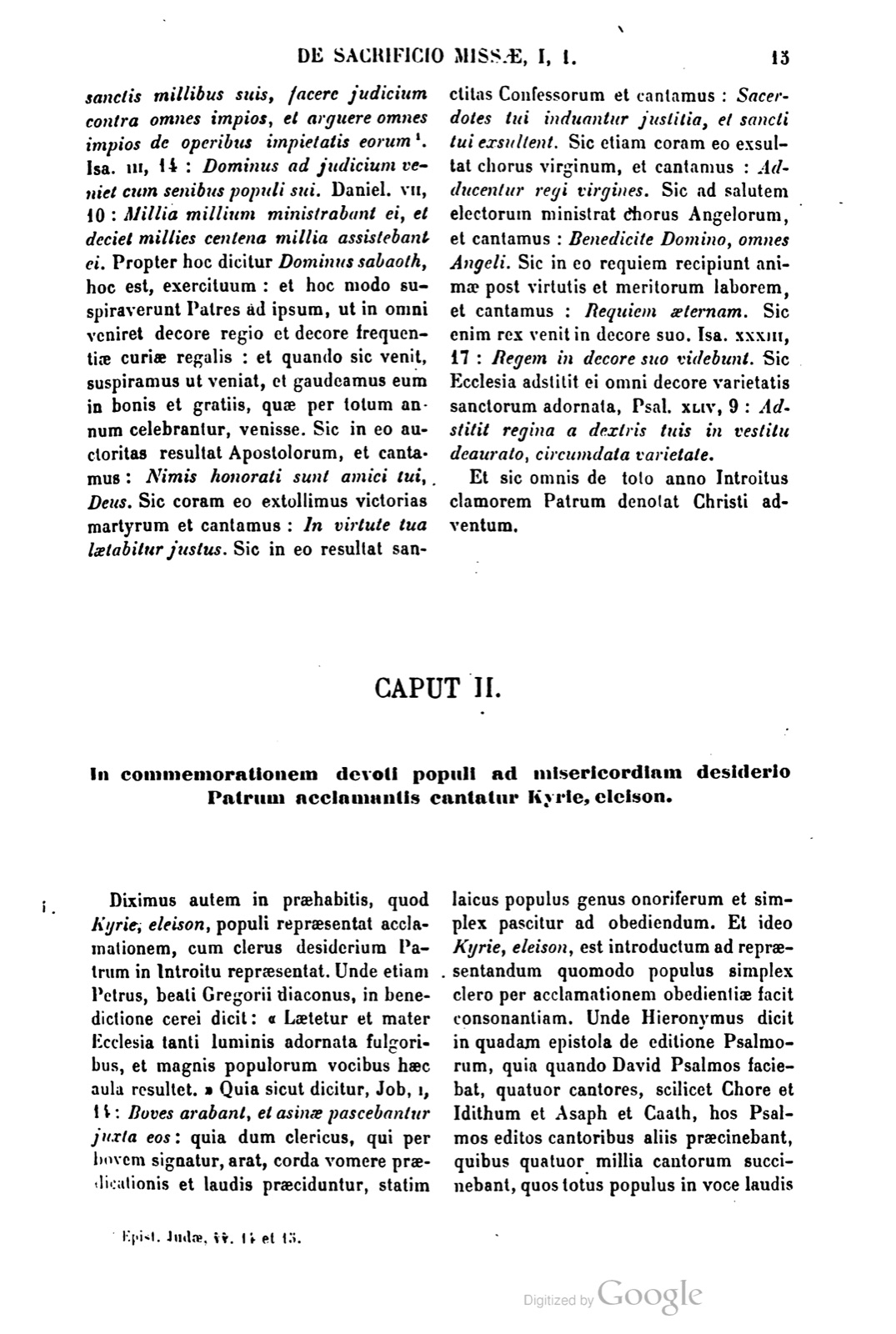
Sed ad hoc dicendum, quod Christus a Patribus non exspectabatur ut homo privatus, sed potius ut Christus omnibus promissus, qui in seipso gratias infinitas afferret, et omnium coetu sanctorum vallatus, veniret ut rex, in cujus curia omnes sancti facerent curiae regalis frequentiam, sicut in epistola sua Judas dicit septimum ab Adam Enoch prophetasse, sic dicentem: Ecce venit Dominus in sanctis millibus suis, facere judicium contra omnes impios, et arguere omnes impios de operibus impietatis eorum 9. Isa. III, 14: Dominus ad judicium veniet cum senibus populi sui. Daniel. VII, 10: Millia millium ministrabant ei, et decies millies centena millia assistebant ei. Propter hoc dicitur Dominus sabaoth, hoc est, exercituum: et hoc modo suspiraverunt Patres ad ipsum, ut in omni veniret decore regio et decore frequentiae curiae regalis: et quando sic venit, suspiramus ut veniat, et gaudeamus eum in bonis et gratiis, quae per totum annum celebrantur, venisse. Sic in eo auctoritas resultat Apostolorum, et cantamus: Nimis honorati sunt amici tui, Deus. Sic coram eo extollimus victorias martyrum et cantamus: In virtute tua laetabitur justus. Sic in eo resultat sanctitas Confessorum et cantamus: Sacerdotes tui induantur justitia, et sancti tui exsultent. Sic etiam coram eo exsultat chorus virginum, et cantamus: Adducentur regi virgines. Sic ad salutem electorum ministrat chorus Angelorum, et cantamus: Benedicite Domino, omnes Angeli. Sic in eo requiem recipiunt animae post virtutis et meritorum laborem, et cantamus: Requiem aeternam. Sic enim rex venit in decore suo. Isa. XXXIII, 17: Regem in decore suo videbunt. Sic Ecclesia adstitit ei omni decore varietatis sanctorum adornata, Psal. XLIV, 9: Adstitit regina a dextris tuis in vestitu deaurato, circumdata varietate.
Et sic omnis de toto anno Introitus clamorem Patrum denotat Christi adventum.
17. Here perhaps someone will object that the Introit of the whole year does not represent the desire of the Fathers in its words, but only those Introits that are in Advent, such as Ad te levavi, and Populus Sion, and others, signify the desire of the Fathers. But in other Masses, both of the time and of the Feasts of the saints, no desire of the Fathers for the coming of Christ is signified.
But to this one must say that Christ was not awaited by the Fathers as a private man, but rather as the Christ promised to all, who in himself would bring infinite graces, and, surrounded by the whole company of the saints, would come as a king, in whose court all the saints would make the assembly of a royal court, just as in his epistle Jude says that Enoch, the seventh from Adam, prophesied, saying thus: Behold, the Lord came among his holy thousands, to make judgment against all the impious, and to accuse all the impious concerning the works of their impiety 9. Isaiah 3:14: The Lord will come to judgment with the elders of his people. Daniel 7:10: Thousands of thousands ministered to him, and ten thousand times a hundred thousand stood before him. For this reason he is called the Lord sabaoth, that is, of armies; and in this way the Fathers sighed for him, that he might come in every royal beauty and in the beauty of the assembly of the royal court. And when he so comes, we sigh that he may come, and we rejoice that he has come in the goods and graces that are celebrated through the whole year. Thus in him the authority of the Apostles resounds, and we sing: Your friends, O God, have been made exceedingly honorable. Thus before him we extol the victories of the martyrs, and we sing: The just man will rejoice in your strength. Thus in him the holiness of Confessors resounds, and we sing: Let your priests be clothed with justice, and let your saints rejoice. Thus also before him the choir of virgins rejoices, and we sing: Virgins shall be brought to the king. Thus the choir of Angels ministers for the salvation of the elect, and we sing: Bless the Lord, all Angels. Thus in him souls receive rest after the labor of virtue and merits, and we sing: Eternal rest. For thus the king comes in his beauty. Isaiah 33:17: They shall see the king in his beauty. Thus the Church stood by him adorned with every beauty of the variety of the saints, Psalm 44:9: The queen stood at your right hand in gilded clothing, surrounded with variety.
And thus the Introit of the whole year denotes the cry of the Fathers for the coming of Christ.
Notes
- Psalm 141:8. (Psal. CXLI, 8.) ↩
- Psalm 41:4 and 11. (Psal. XLI, 4 et 11.) ↩
- Compare Exodus 4:10. (Cf. Exod. IV, 10.) ↩
- Compare Isaiah 6:5. (Cf. Isa. VI, 5.) ↩
- Compare Jeremiah 1:6. (Cf. Jerem. I, 6.) ↩
- Canticles 1:1. (Cantic. I, 1.) ↩
- St. Bernard, Sermon 2 on the Canticles. (S. Bernardus, Serm. 2 super Cantica.) ↩
- St. Augustine, book I of the Confessions, chapter 6. (S. Augustinus, Lib. I Confessionum, cap. 6.) ↩
- Epistle of Jude, verses 14 and 15. (Epist. Judae, vv. 14 et 15.) ↩
If a page does not appear, its photograph has not been uploaded yet.