Works › The Book on the Sacrifice of the Mass
Volume 38 · pp. 61–66
Chapter IX, Articles I-XII (continuation of the exposition of the Apostles' Symbol)
A marker with ≈ is an approximate page boundary, placed by measure of the text; the page photographs remain the authority. In the paired views, clicking a page marker brings that page into view.
dicat: Corde assentio, devotione tendo in Deum, qui paternitate sua est principium totius divinitatis: quia ab ipso est Filius per generationem, et Spiritus sanctus per processionem.
Et quod addit: Omnipotentem, intelligitur, quod sibi posse sit pro voluntate liberum, non lege alicujus inferioris vel ignobilis naturae retractum, sicut nos multa non possumus lege ponderosae naturae nostrae retracti. Secundo, quod posse suum nulla infirmitate sit depressum. Et tertio, quod nulla re in contrarium operante sit umquam impeditum, sed ad voluntatem omnino liberum, nec retractum, nec depressum, nec impeditum. Sapient. XII, 18: Subest tibi cum volueris posse. Psal. CXIII, 11: Omnia quaecumque voluit, fecit. Esther, XIII, 9: Domine Deus, rex omnipotens, in ditione tua cuncta sunt posita, et non est qui possit tuae resistere voluntati. Ad Roman. IX, 19: Voluntati ejus quis resistit? Sic ergo dicitur omnipotens Deus.
Quod autem dicitur: Creatorem caeli et terrae, ad eumdem pertinet articulum sicut effectus pertinet ad suam causam: quia sicut artifex qui facit domum vel arcam, necesse est ut gignat primo suo intellectu verbum et artem, quod est forma et ratio faciendi operis: ita necesse fuit ex quo Deus per sapientiam suam fecit mundum, quod prius de suo intellectu substantiali gigneret Verbum, quod est forma idealis et ars et ratio faciendi operis: quia aliter nesciret quid operaretur. Et sic patet, quod Deus est Pater Verbi, et haec est causa formalis et idealis faciendi mundi. Et sicut in artifice qui operatur per intellectum, necesse est quod ab ipso fluat spiritus qui verbum, quod est idea et ars et forma operis, vehit in id quod facit vel facere intendit: ita necesse fuit, quod a summo Patre procederet spiritus Verbi sui, qui verbum vehat in facienda sive faciat in opere creationis, sive in opere sanctificationis, sive in opere glorificationis. Et sic patet, quod processio personarum a Patre causa est processus creationis et glorificationis et gratificationis a tribus personis. Et hoc est dictum Anselmi in Monologio. Et sic probat sicut hoc probatum est. Hujus signum est, quod in primordio mundi, statim ut creaturae formatae sunt, ante semper praemittitur: "Dixit Deus: Fiat hoc vel illud." Et dicit Glossa, hoc est, Verbum genuit in quo erat ut fieret. De Spiritu autem dicitur simul et Verbo: Verbo Domini caeli formati sunt: et spiritu oris ejus omnis virtus eorum 1. Sic ergo patet, quod ad idem pertinet Pater Filii, et creatorem esse caeli et terrae. Ideo dicit Apostolus, ad Coloss. I, 13 et 16, de Filio qui est imago Dei invisibilis, primogenitus omnis creaturae: quoniam in ipso condita sunt universa. Matth. XI, 25: Confiteor tibi, Pater caeli et terrae.
Ostenso igitur, quod haec ad idem pertinent, et non habent flexum et divisionem in diversa, dicimus quod hic est articulus primus quem statuendo posuit Petrus.
ARTICULUS II.
Secundus autem in concilio fuit Andreas, frater Simonis Petri, qui bolum suum posuit dicendo: Et in Jesum Christum, Filium ejus unicum, Dominum nostrum. Et hoc dicto siluit.
let him say: With the heart I assent, with devotion I tend into God, who by his fatherhood is the principle of the whole divinity, because from him is the Son through generation, and the Holy Spirit through procession.
And as to what he adds, Almighty, it is understood that for him ability is free according to will, not drawn back by the law of some inferior or ignoble nature, as we are unable to do many things because we are drawn back by the law of our weighty nature. Secondly, that his ability is depressed by no weakness. And thirdly, that it is never impeded by anything acting to the contrary, but is wholly free according to will, neither drawn back, nor depressed, nor impeded. Wisdom 12:18: Power is subject to thee when thou wilt. Psalm 113:11: He has done all things whatsoever he willed. Esther 13:9: O Lord God, almighty king, all things are placed in thy power, and there is no one who can resist thy will. Romans 9:19: Who resists his will? Thus therefore God is called almighty.
But what is said, Creator of heaven and earth, belongs to the same article, as an effect belongs to its cause, because just as an artisan who makes a house or chest must first beget in his intellect a word and art, which is the form and reason of making the work, so, since God made the world through his wisdom, it was necessary that he first beget from his substantial intellect the Word, which is the ideal form and the art and reason of making the work; for otherwise he would not know what he was working. And thus it is clear that God is the Father of the Word, and this is the formal and ideal cause of making the world. And just as in an artisan who works through intellect it is necessary that from him flow a spirit which carries the word, which is the idea and art and form of the work, into that which he makes or intends to make, so it was necessary that from the highest Father proceed the spirit of his Word, who carries the word into things to be made, or makes it in the work of creation, or in the work of sanctification, or in the work of glorification. And thus it is clear that the procession of the persons from the Father is the cause of the procession of creation and glorification and gracious making by the three persons. And this is the saying of Anselm in the Monologion. And thus he proves it, just as this has been proved. The sign of this is that, in the beginning of the world, as soon as creatures were formed, it is always put before: "God said: Let this or that be made." And the Gloss says that this means: he begot the Word in which it was that it should be made. But concerning the Spirit it is said together with the Word: By the Word of the Lord the heavens were formed, and by the spirit of his mouth all their power 1. Thus therefore it is clear that the Father of the Son belongs to the same thing, and also being creator of heaven and earth. Therefore the Apostle says, Colossians 1:13 and 16, concerning the Son who is the image of the invisible God, the firstborn of every creature: for in him all things were created. Matthew 11:25: I confess to thee, Father of heaven and earth.
Therefore, once it has been shown that these things belong to the same thing and do not have a bending and division into diverse things, we say that this is the first article which Peter set down by establishing it.
ARTICLE II.
But the second in the council was Andrew, the brother of Simon Peter, who set down his own small portion by saying: And in Jesus Christ, his only Son, our Lord. And having said this he was silent.
Quod enim dixit: Et in Jesum Christum, notat mediatoris personam, sicut constat ex habitis.
Quod autem dixit: Filium ejus unicum, in Filio ejus notat et generationis processionem et connaturalitatem divinitatis, quae inter hominem generantem est et genitum, si ab ipso naturaliter et substantialiter generatur. Et cum deitas nec secundum esse nec per naturam possit multiplicari, oportet quod inter generantem et genitum consubstantialitas esse credatur.
Quod autem dicit: Unicum, notat quod totam gloriam Patris possedit, et eam cum alio secundo genito non divisit, ut in ante habitis ex verbis Basilii habitum est.
Et quod dicit: Dominum, notat quod omnium divitiarum sit possessor et largitor.
Et quod dicit: Nostrum, notatur quod noster debitor ex sua charitate qua nostra in se suscepit, sit effectus.
Haec autem omnia in ante habitis sunt exposita.
ARTICULUS III.
Post hunc, scilicet Andream, proposuit Jacobus major, qui dixit: Qui conceptus est de Spiritu sancto, natus ex Maria Virgine. Haec enim duo, conceptus et nativitas, ad idem pertinent sacramentum incarnationis: quia consummatio conceptionis est nativitas.
Quod autem dicit: De Spiritu sancto, praepositio de quidem notat potestatem et operationem, ut sit sensus: Qui conceptus est de potestate et operatione Spiritus sancti. Non autem notat substantiam vel materiam: quia qui de substantia alicujus conceptus est, filius ejus est: Christus autem non est filius Spiritus sancti secundum temporalem generationem, quia secundum illam generationem non est factus de substantia Spiritus sancti.
Quod autem dicitur: Natus, intelligit duas nativitates: unam in utero, quia Christus naturam nostram assumpsit et sibi univit: et aliam ex utero, qua de utero in lucem processit, non reseratis claustris virginei pudoris. Et ideo dicit: De Maria Virgine, quod sicut ante partum fuit illibata, ita in conceptione fuit sine concupiscentia, et in gravidatione sine pondere, et in partu sine dolore. De conceptu autem dicitur, Luc. I, 35: Spiritus sanctus superveniet in te, et virtus Altissimi obumbrabit tibi. De nativitate autem in utero dicitur, Matth. I, 20: Quod enim in ea natum est, de Spiritu sancto est. De nativitate autem ex utero dicitur in Psalmo XVIII, 6: In sole posuit tabernaculum suum: et ipse tamquam sponsus procedens de thalamo suo. Quia sicut sol radium, ita mater virgo filium de thalamo uteri sui protulit incorrupta. De hoc autem quod virgo mansit ante partum, et in partu, et post partum, dicitur, Ezechiel XLIV, 2: Porta haec, quam vidisti, clausa erit: non aperietur, ... quoniam Dominus Deus Israel ingressus est per eam: eritque clausa principi, hoc est, ad honorem principis.
Hic igitur est tertius articulus.
ARTICULUS IV.
Joannes autem Evangelista quarto loco posuit bolum, dicens: Passus sub Pontio Pilato, crucifixus, mortuus, et sepultus. Articulus enim iste est passio Christi: determinatio autem articuli est, quod sub Pontio Pilato est passus: qui quidem Pontius dicitur, quia devicit Pontum insulam, sicut Scipio dicitur Africanus, quia devicit Africam.
For what he said, And in Jesus Christ, marks the person of the mediator, as is clear from the things already had.
But what he said, his only Son, in his Son marks both the procession of generation and the connaturality of the divinity, which exists between a human father and one begotten, if he is begotten naturally and substantially from him. And since the Godhead cannot be multiplied either according to being or through nature, it is necessary that consubstantiality be believed between the one generating and the one generated.
But what he says, only, marks that he possessed the whole glory of the Father and did not divide it with another second-begotten one, as was had above from the words of Basil.
And what he says, Lord, marks that he is possessor and giver of all riches.
And what he says, our, marks that he has been made our debtor from his charity by which he took our things into himself.
But all these things have been explained in the things already had.
ARTICLE III.
After him, namely Andrew, James the Greater proposed, and he said: Who was conceived by the Holy Spirit, born of the Virgin Mary. For these two things, conception and nativity, belong to the same sacrament of the incarnation, because the completion of conception is nativity.
But what he says, by the Holy Spirit, the preposition by marks power and operation, so that the sense is: who was conceived by the power and operation of the Holy Spirit. It does not, however, mark substance or matter, because one who is conceived from the substance of someone is his son; but Christ is not the son of the Holy Spirit according to temporal generation, because according to that generation he was not made from the substance of the Holy Spirit.
But what is said, born, understands two nativities: one in the womb, because Christ assumed our nature and united it to himself; and another from the womb, by which he proceeded from the womb into the light, without the barriers of virginal modesty being unlocked. And therefore he says, of the Virgin Mary, because just as before birth she was inviolate, so in conception she was without concupiscence, and in pregnancy without weight, and in childbirth without pain. But concerning the conception it is said, Luke 1:35: The Holy Spirit will come upon thee, and the power of the Most High will overshadow thee. But concerning the nativity in the womb it is said, Matthew 1:20: For that which is born in her is of the Holy Spirit. But concerning the nativity from the womb it is said in Psalm 18:6: He placed his tabernacle in the sun, and he himself is like a bridegroom coming forth from his bridal chamber. For as the sun brings forth a ray, so the virgin mother brought forth a son from the chamber of her womb, uncorrupted. But concerning this, that the virgin remained before birth, and in birth, and after birth, it is said, Ezekiel 44:2: This gate, which thou hast seen, will be closed; it will not be opened, ... because the Lord God of Israel has entered through it; and it will be closed for the prince, that is, for the honor of the prince.
This, therefore, is the third article.
ARTICLE IV.
But John the Evangelist set down the small portion in the fourth place, saying: Suffered under Pontius Pilate, was crucified, died, and was buried. For this article is the passion of Christ; but the determination of the article is that he suffered under Pontius Pilate, who is indeed called Pontius because he conquered the island Pontus, just as Scipio is called African because he conquered Africa.
Quod autem addit: Crucifixus, modum explanat passionis. Et quod dicit: Mortuus, dicit multae passionis quantitatem. Et sumitur de verbis Apostoli, ad Philip. II, 8, ubi dicitur factus obediens Patri usque ad mortem, mortem autem crucis.
Quod autem addit: Sepultus, non aliud dicit, sed circa mortem addit officium funeris. Tobiae, IV, 3: Cum acceperit Deus animam meam, corpus meum sepeli. Et ideo sepultura nihil addit nisi quod ad mortem pertinet. Propter quod totum illud ad unum et eumdem pertinet articulum. Isa. XI, 10: Erit sepulcrum ejus gloriosum.
ARTICULUS V.
Quinto loco suum bolum posuit Philippus, dicens: Descendit ad inferos: tertia die resurrexit a mortuis. In quo quidam multum dubitaverunt, utrum descensus ad inferos, et resurrectio mortuorum ad unum et idem credibile, quod vocatur articulus, pertineant. Sed salvo judicio melioris sententiae dicendum videtur, quod resurrectio duplex est; animae scilicet et corporis, et descensus ad infernum, ut dicit Damascenus, animae Christi deificatae, ideo in inferno vitam fecit beatitudinis in visione deitatis conjunctae cum anima Christi, et ibi implevit quod dicitur Osee, XIII, 14: Ero mors tua, o mors! morsus tuus ero, inferne! Perimere autem mortem et mordere infernum sunt actus vitae et non mortis: ibi enim implebit quod dixit, Matth. XII, 29, quod fortior Christus intravit in domum fortis, scilicet diaboli, et alligavit fortem, et omnia vasa illius diripuit 2. Et haec omnia pro certo sunt actus vitae et ad resurrectionem relata: et ideo cum resurrectione in eodem credibili ab Apostolo conjuncta. Eccli. XXIV, 45: Penetrabo omnes inferiores partes terrae, et inspiciam omnes dormientes, et illuminabo omnes sperantes in Domino.
De resurrectione autem dicitur in Psalmo CXXXVIII, 18: Exsurrexi, et adhuc sum tecum. Non enim in toto perii per mortem, sicut inimici mei Judaei arbitrati sunt. Psal. II, 6: Ego dormivi et soporatus sum: et exsurrexi, quia Dominus suscepit me.
ARTICULUS VI.
Post hoc proposuit Bartholomaeus: Ascendit ad caelos, sedet ad dexteram Dei Patris omnipotentis. Sedere enim a dextris Dei Patris, terminus est ascensionis. Et ideo ad idem pertinet credibile. Quia autem Christus verus Deus fuit, ideo propria virtute, non Angelorum manibus supervectus, sicut Lazarus loris ascendit. Michaeae, II, 13: Ascendet pandens iter ante eos. Joan. XX, 17: Ascendo ad Patrem meum et Patrem vestrum, Deum meum et Deum vestrum. Et secundum deitatem quidem sedere ad dexteram Patris, est sedere in aequalitate Patris. Secundum autem humanitatem sedere a dextris, est potissimis bonis ultra omnem creaturam perfrui. Ad Coloss. III, 1 et 2: Quae sursum sunt quaerite, ubi Christus est in dextera Dei sedens: quae sursum sunt sapite, non quae super terram.
ARTICULUS VII.
Thomas post illum adjunxit bolum, dicens: Inde venturus est judicare vivos et mortuos. Act. I, 11: Sic veniet quemadmodum vidistis eum euntem in caelum. In forma autem humana ivit: quia in forma divina nusquam defuit. Et ideo in forma humana redibit ad judicium, in qua et a bonis et a malis videbitur. Joan. XIX, 37: Videbunt in quem transfixerunt. A malis autem forma divina videri non poterit: quia, sicut dicit Augustinus: "Hanc nemo videre poterit, nisi gaudeat et glorietur in ea." Isa. XXVI, 10: "Tollatur impius ne videat gloriam Dei:" et est translatio Septuaginta 3. Act. XVII, 31: Statuit diem in quo judicaturus est orbem in aequitate, in viro in quo statuit, fidem praebens omnibus, suscitans eum a mortuis. II ad Corinth. V, 10: Omnes nos manifestari oportet ante tribunal Christi, ut referat unusquisque propria corporis prout gessit, sive bonum, sive malum. Et hic modus judicii, Matth. XXV, 33 et seq., describitur, ubi dicitur quod rex noster Christus statuet oves a dextris, haedos autem a sinistris. Et bonis dicet: Venite, benedicti Patris mei. Malis autem: Discedite a me, maledicti, in ignem aeternum.
But what he adds, crucified, explains the mode of the passion. And what he says, died, states the magnitude of his many sufferings. And it is taken from the words of the Apostle, Philippians 2:8, where he is said to have been made obedient to the Father even unto death, and death of the cross.
But what he adds, buried, says nothing else, but concerning death it adds the office of funeral. Tobias 4:3: When God receives my soul, bury my body. And therefore burial adds nothing except what pertains to death. On account of this that whole thing belongs to one and the same article. Isaiah 11:10: His sepulcher will be glorious.
ARTICLE V.
In the fifth place Philip set down his own small portion, saying: He descended to the lower regions; on the third day he rose again from the dead. In this some have greatly doubted whether the descent to the lower regions and the resurrection of the dead belong to one and the same thing to be believed, which is called an article. But, saving the judgment of a better opinion, it seems that one must say that resurrection is twofold, namely of the soul and of the body, and that the descent to hell, as Damascene says, of the deified soul of Christ, therefore made in hell the life of blessedness in the vision of the deity joined with the soul of Christ; and there he fulfilled what is said, Hosea 13:14: I will be thy death, O death; I will be thy bite, O hell! But to destroy death and bite hell are acts of life and not of death. For there he will fulfill what he said, Matthew 12:29, that the stronger Christ entered into the house of the strong one, namely the devil, and bound the strong one, and plundered all his vessels 2. And all these things certainly are acts of life and referred to resurrection; and therefore they are joined by the Apostle with resurrection in the same thing to be believed. Ecclesiasticus 24:45: I will penetrate all the lower parts of the earth, and I will inspect all who sleep, and I will illuminate all who hope in the Lord.
But concerning the resurrection it is said in Psalm 138:18: I have risen up, and I am still with thee. For I did not wholly perish through death, as my enemies the Jews judged. Psalm 2:6: I slept and was lulled to sleep, and I rose again, because the Lord received me.
ARTICLE VI.
After this Bartholomew proposed: He ascended to the heavens, he sits at the right hand of God the Father almighty. For to sit at the right hand of God the Father is the end of the ascension. And therefore it belongs to the same thing to be believed. But because Christ was true God, therefore by his own power, not carried by the hands of Angels, as Lazarus ascended by cords. Micah 2:13: He will ascend, opening the way before them. John 20:17: I ascend to my Father and your Father, to my God and your God. And according to deity, indeed, to sit at the right hand of the Father is to sit in equality with the Father. But according to humanity, to sit at the right hand is to enjoy the most excellent goods beyond every creature. Colossians 3:1 and 2: Seek the things that are above, where Christ is sitting at the right hand of God; savor the things that are above, not the things that are upon the earth.
ARTICLE VII.
Thomas after him added the small portion, saying: Thence he will come to judge the living and the dead. Acts 1:11: He will come thus, in the same manner as you saw him going into heaven. But he went in human form, because in divine form he was absent nowhere. And therefore he will return to judgment in human form, in which he will be seen both by the good and by the evil. John 19:37: They will see him whom they pierced. But by the evil the divine form will not be able to be seen, because, as Augustine says, "No one will be able to see this unless he rejoices and is glorified in it." Isaiah 26:10: "Let the impious man be taken away lest he see the glory of God"; and it is the translation of the Septuagint 3. Acts 17:31: He has appointed a day on which he will judge the world in equity, by the man in whom he appointed it, giving faith to all, by raising him from the dead. 2 Corinthians 5:10: We all must be manifested before the tribunal of Christ, so that each one may receive the proper things of the body according as he has borne himself, whether good or evil. And this mode of judgment is described in Matthew 25:33 and following, where it is said that our king Christ will set the sheep at the right hand, but the goats at the left. And to the good he will say: Come, blessed of my Father. But to the evil: Depart from me, accursed, into eternal fire.
ARTICULUS VIII.
Matthaeus autem post hunc bolum posuit, dicens: Credo in Spiritum sanctum. Quia post sacramenta quae fuerunt de Filii divinitate et humanitate, consequens est de Spiritu sancto qui procedit ab utroque, a Patre scilicet et Filio.
Dicitur autem hic: Credo: quia a primo articulo usque huc intermissum fuerat: et ideo consequens erat hic iterare, quando de alia persona articuli erant ponendi.
Spiritus autem dicitur: quia spirat vitam gratiae et intelligentiae: et sic dicitur, Joan. VI, 64, de primo: Spiritus est qui vivificat. De secundo dicitur, Job, XXXII, 8: Sed, ut video, spiritus est in hominibus, et inspiratio Omnipotentis dat intelligentiam. Ex primo habet, quod dicitur spiritus bonitatis et bonus. Psal. CXLII, 10: Spiritus tuus bonus deducet me in terram rectam. Ex secundo quod dicitur spiritus veritatis. Joan. XVI, 13: Cum autem venerit ille spiritus veritatis, docebit vos omnem veritatem: et quae ventura sunt annuntiabit vobis. Ex utroque probat se esse spiritum Christi, sicut dicitur, Joan. I, 17: Gratia et veritas per Jesum Christum facta est.
Sanctus autem dicitur: quia est omnis sanctitatis perfector. Sanctitas enim, ut dicit Dionysius, est ab omni inquinamento libera munditia. Liberat autem cor et corpus ab immunditia peccati, virtutem ab immunditia fictionis, intellectum ab immunditia erroris, et opus ab immunditia negligentiae et omissionis. De primo horum dicitur, I ad Corinth. VI, 19: An nescitis quoniam membra vestra templum sunt Spiritus sancti, qui in vobis est, quem habetis a Deo. Ac si dicat: Spiritus sanctus sanctificavit vel mundavit vos ab immunditia carnis sua sanctitate: et ideo iterum non estis inquinandi. De secundo, Sapient. VII, 22: Est enim in illa spiritus intelligentiae, sanctus, hoc est, qui intellectum sanctificat ab immunditia erroris per inspiratam veritatem. De tertio simul et duobus praemissis dicitur, Sapient. I, 5: Spiritus sanctus disciplinae effugiet fictum, et sic mundat virtutem a fictione: et auferet se a cogitationibus quae sunt sine intellectu, et sic liberat intellectum ab errore. Et parum ante, v. 4, dicit: Quoniam in malevolam animam non introibit sapientia, hoc est, sapientiae spiritus, nec habitabit in corpore subdito peccatis, et sic mundat cor et corpus a peccato, antequam introeat in illa. De liberatione autem operis a negligentia omissionis dicitur, I ad Corinth. XII, 11, quia haec omnia operatur unus atque idem spiritus, dividens singulis prout vult. Spiritus enim sanctus omnia operatur, et nihil negligit.
ARTICLE VIII.
But Matthew after this set down the small portion, saying: I believe in the Holy Spirit. Because after the sacraments which concerned the divinity and humanity of the Son, what follows is concerning the Holy Spirit, who proceeds from both, namely from the Father and the Son.
But here it is said, I believe, because from the first article up to this point it had been omitted; and therefore it was fitting to repeat it here, when articles concerning another person had to be set down.
But he is called Spirit because he breathes the life of grace and intelligence; and thus it is said, John 6:64, concerning the first: It is the Spirit who gives life. Concerning the second it is said, Job 32:8: But, as I see, there is a spirit in human beings, and the inspiration of the Almighty gives intelligence. From the first he has that he is called the spirit of goodness and good. Psalm 142:10: Thy good Spirit will lead me into the right land. From the second he has that he is called the spirit of truth. John 16:13: But when that spirit of truth comes, he will teach you all truth, and the things that are to come he will announce to you. From both he proves himself to be the spirit of Christ, as it is said, John 1:17: Grace and truth was made through Jesus Christ.
But he is called Holy because he is the perfecter of all holiness. For holiness, as Dionysius says, is cleanness free from every defilement. But he liberates the heart and body from the uncleanness of sin, virtue from the uncleanness of pretense, the intellect from the uncleanness of error, and work from the uncleanness of negligence and omission. Concerning the first of these it is said, 1 Corinthians 6:19: Do you not know that your members are the temple of the Holy Spirit, who is in you, whom you have from God? As if he were saying: The Holy Spirit has sanctified or cleansed you from the uncleanness of the flesh by his holiness; and therefore you are not again to be defiled. Concerning the second, Wisdom 7:22: For in her there is a spirit of intelligence, holy, that is, one who sanctifies the intellect from the uncleanness of error through inspired truth. Concerning the third together and the two preceding it is said, Wisdom 1:5: The Holy Spirit of discipline will flee pretense, and so he cleanses virtue from pretense; and he will withdraw himself from thoughts which are without understanding, and so he frees the intellect from error. And a little before, verse 4, it says: For wisdom will not enter a malevolent soul, that is, the spirit of wisdom, nor will it dwell in a body subject to sins, and so he cleanses the heart and body from sin before he enters into them. But concerning liberation of work from the negligence of omission it is said, 1 Corinthians 12:11, that one and the same Spirit works all these things, dividing to each one as he wills. For the Holy Spirit works all things and neglects nothing.
Sic ergo credendum est in Spiritum sanctum.
ARTICULUS IX.
Deinde suum bolum ponit Jacobus minor, dicens: Sanctam Ecclesiam Catholicam, Sanctorum communionem.
Respiciens autem ad hoc quod Spiritus sanctus datur et mittitur ad sanctificandam creaturam, quae sanctitas numquam fallit in Ecclesia, sed nonnumquam fallit in persona, dixit: Sanctam Ecclesiam. Et quia omnis articulus fundatur in divina et aeterna veritate, non super creatam veritatem, quia omnis creatura vana est et non habet solidam veritatem, ideo iste articulus sic resolvendus est ad proprium opus Spiritus sancti, hoc est, Credo in Spiritum sanctum, non tantum secundum se, sicut dicit praecedens articulus, sed etiam in eum credo secundum proprium opus ejus, quod est, quod sanctificat Ecclesiam, quam sanctitatem perfundit in sacramentis et virtutibus et donis quae dat ad sanctitatis perfectionem, et tandem in miraculis et donis gratis datis, sicut sapientia, scientia, fides, discretio spirituum, operatio sanitatum, et prophetia, et hujusmodi quae dat Spiritus ad sanctitatis Ecclesiae demonstrationem.
Hanc Ecclesiam dicit esse Catholicam, hoc est, universalem, duabus de causis, sicut diximus in ante habitis: quia scilicet principia ejus universaliter vera sunt, et quia per totum orbem universaliter dilatanda.
Quod autem dicit: Sanctorum communionem, non facit alium articulum, sed declarat eumdem: quia ad sanctitatis Ecclesiae perfectionem pertinet Sanctorum communio. Sicut enim in homine unus spiritus hominis, qui est in ipso, bona unius membri vehit ad profectum alterius, sicut ex cerebro sensum et motum, ex corde vitalem et pulsantem spiritum, et ex stomacho et hepate cibum et naturalem spiritum: ita Spiritus Christi in corpore mystico a capite Christo et aliis membris nobilibus, sicut Apostoli, et beata Virgo, et sancti martyres, et alii sancti excellentes sunt et fuerunt, vehit bona in omnia membra, et sic efficitur commune quod est uniuscujusque proprium, et sic sanctitas perficitur in Ecclesia: unde, Numer. XI, 17, cum communicare vellet Dominus bona Moysi aliis de populo, dixit: Et auferam de spiritu tuo, tradamque eis, ut sustentent tecum onus populi. Et hanc communionis sanctificationem ostendit Dominus, Joan. XX, 22, quando insufflavit in discipulos, et dixit: Accipite Spiritum sanctum. Hoc etiam signatum est, IV Regum, II, 13, ubi spiritus Eliae requievit super Eliseum.
Iste est ergo articulus quem sic intelligendum posuit Jacobus minor.
ARTICULUS X.
Simon autem Cananaeus, qui zelotes interpretatur, eo quod de Cana Galilaeae fuisse dicitur, quae zelus interpretatur, post Jacobum fratrem suum carnalem posuit bolum: detulit enim fratri primatum, eo quod Jacobus ille episcopus erat Jerosolymorum. Dixit igitur: Remissionem peccatorum. Hoc autem dixit respiciens ad sanctum opus Spiritus sancti. Et est sensus: Credo in Spiritum sanctum, qui facit remissionem peccatorum: quia sicut diximus, omnis articulus habet substratam sibi divinam veritatem, vel in essentia divina, vel in personis, vel in propriis personarum operationibus, vel passionibus. Non enim fit remissio peccatorum, nisi in Spiritu sancto: quod ostenditur, Joan. XX, 22 et 23, ubi dicitur: Accipite Spiritum sanctum: quorum remiseritis peccata, remittuntur eis. Et sic omnis baptismus qui est peccati ablutio, dicitur fieri in Spiritu sancto. Act. I, 5: Vos baptizabimini Spiritu sancto non post multos hos dies.
Thus therefore one must believe in the Holy Spirit.
ARTICLE IX.
Then James the Less sets down his small portion, saying: The holy Catholic Church, the communion of Saints.
Looking to this, that the Holy Spirit is given and sent for sanctifying the creature, and that this sanctity never fails in the Church, but sometimes fails in a person, he said: The holy Church. And because every article is founded upon divine and eternal truth, not upon created truth, because every creature is vain and does not have solid truth, therefore this article is to be resolved thus to the proper work of the Holy Spirit, that is: I believe in the Holy Spirit, not only according to himself, as the preceding article says, but I also believe in him according to his proper work, which is that he sanctifies the Church; and he pours this sanctity into it in the sacraments and virtues and gifts which he gives for the perfection of sanctity, and finally in miracles and gifts freely given, such as wisdom, knowledge, faith, discernment of spirits, operation of healings, and prophecy, and things of this kind, which the Spirit gives for the demonstration of the sanctity of the Church.
He says that this Church is Catholic, that is, universal, for two reasons, as we said in the things already had: namely because its principles are universally true, and because it is to be spread universally through the whole world.
But what he says, the communion of Saints, does not make another article, but declares the same one, because the communion of Saints belongs to the perfection of the sanctity of the Church. For just as in a human being one spirit of a human being, which is in him, carries the goods of one member to the profit of another, as from the brain sense and movement, from the heart the vital and pulsing spirit, and from the stomach and liver food and natural spirit, so the Spirit of Christ in the mystical body carries goods from the head, Christ, and from other noble members, such as the Apostles, and the blessed Virgin, and holy martyrs, and other excellent saints who are and were, into all the members; and thus what is proper to each one is made common, and so sanctity is perfected in the Church. Hence, Numbers 11:17, when the Lord wished to communicate the goods of Moses to others from the people, he said: And I will take away from thy spirit and hand over to them, that they may sustain the burden of the people with thee. And the Lord showed this sanctification of communion, John 20:22, when he breathed upon the disciples and said: Receive the Holy Spirit. This also was signified, 4 Kings 2:13, where the spirit of Elijah rested upon Elisha.
This, therefore, is the article which James the Less set down to be understood thus.
ARTICLE X.
But Simon Cananaeus, who is interpreted "zealot," because he is said to have been from Cana of Galilee, which is interpreted "zeal," after James, his brother according to the flesh, set down the small portion; for he gave precedence to his brother, because that James was bishop of Jerusalem. Therefore he said: The forgiveness of sins. But he said this looking to the holy work of the Holy Spirit. And the sense is: I believe in the Holy Spirit, who brings about the forgiveness of sins, because, as we have said, every article has divine truth laid beneath it, either in the divine essence, or in the persons, or in the proper operations of the persons, or in the passions. For the forgiveness of sins does not come about except in the Holy Spirit; this is shown, John 20:22 and 23, where it is said: Receive the Holy Spirit; whose sins you forgive, they are forgiven them. And thus every baptism, which is the washing away of sin, is said to take place in the Holy Spirit. Acts 1:5: You will be baptized with the Holy Spirit not many days hence.
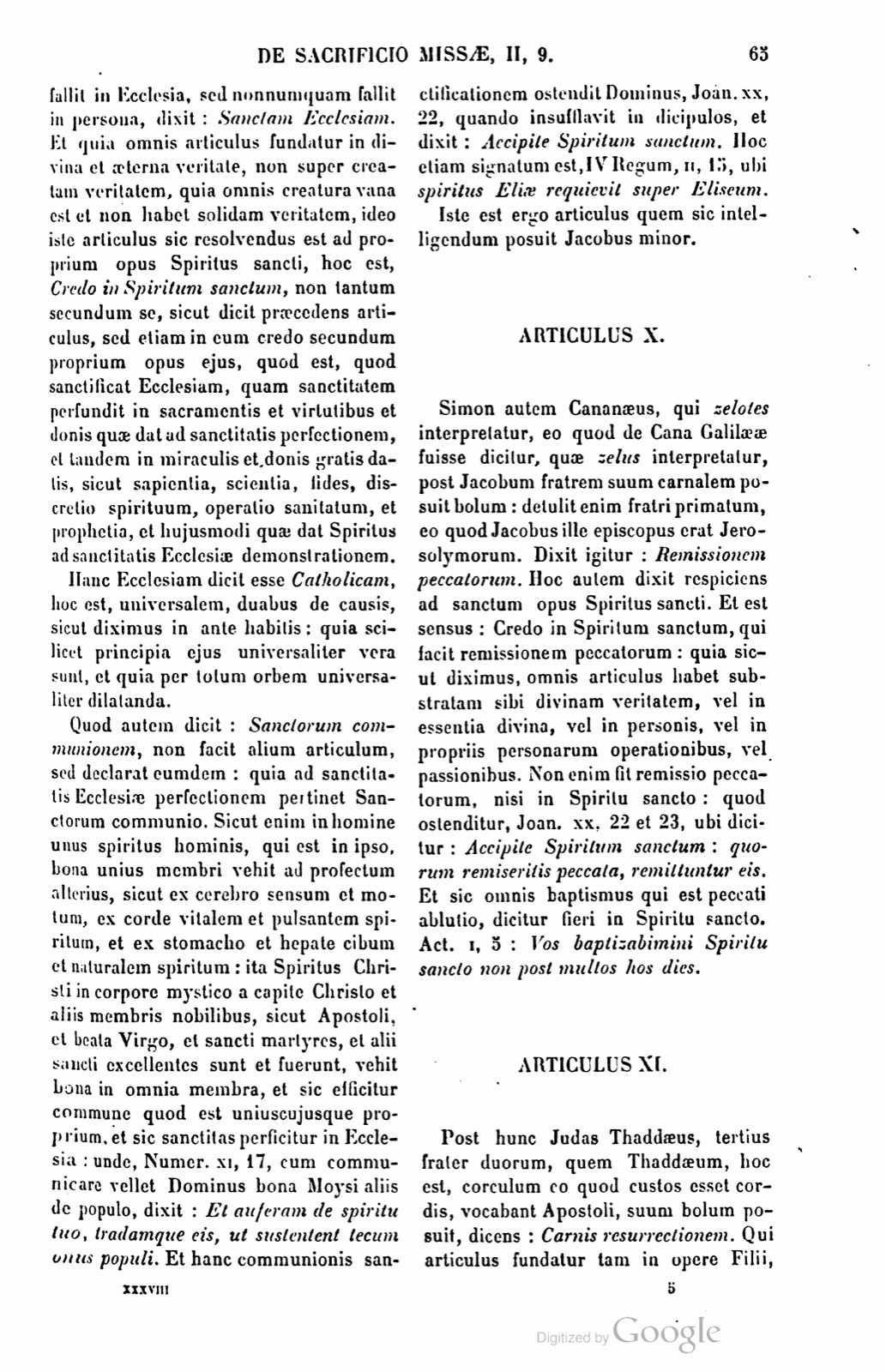
ARTICULUS XI.
Post hunc Judas Thaddaeus, tertius frater duorum, quem Thaddaeum, hoc est, corculum eo quod custos esset cordis, vocabant Apostoli, suum bolum posuit, dicens: Carnis resurrectionem. Qui articulus fundatur tam in opere Filii, quam in opere Spiritus sancti. In operatione quidem Filii: quia, sicut dicit Augustinus: "Christi resurrectio causa est nostrae resurrectionis." Unde, I ad Corinth. XV, 16: Si mortui non resurgunt, neque Christus resurrexit. Et infra, v. 20 et 21: Nunc autem Christus resurrexit a mortuis, primitiae dormientium: quoniam quidem per hominem mors, et per hominem resurrectio mortuorum. Et ideo, Apocal. I, 5, dicitur: Primogenitus mortuorum, et princeps regum terrae. Super opus autem Spiritus sancti fundatur: quia spiritus gloriae et incorruptionis inspirabit corpora resurgentium, cujus donatio attribuitur Spiritui sancto. Spiritus quidem gloriae in sanctis resurgentibus ad gloriam: spiritus autem incorruptionis in omnibus: quia omnes mortui tam in complexione, quam in compositione membrorum resurgent incorrupti. Unde, I ad Corinth. XV, 52: Canet enim tuba, et mortui resurgent incorrupti, et nos immutabimur. De isto spiritu mortuos vivificante dicitur, Ezechiel. XXXVII, 9: A quatuor ventis veni, spiritus, et insuffla super interfectos istos, et reviviscant.
ARTICULUS XII.
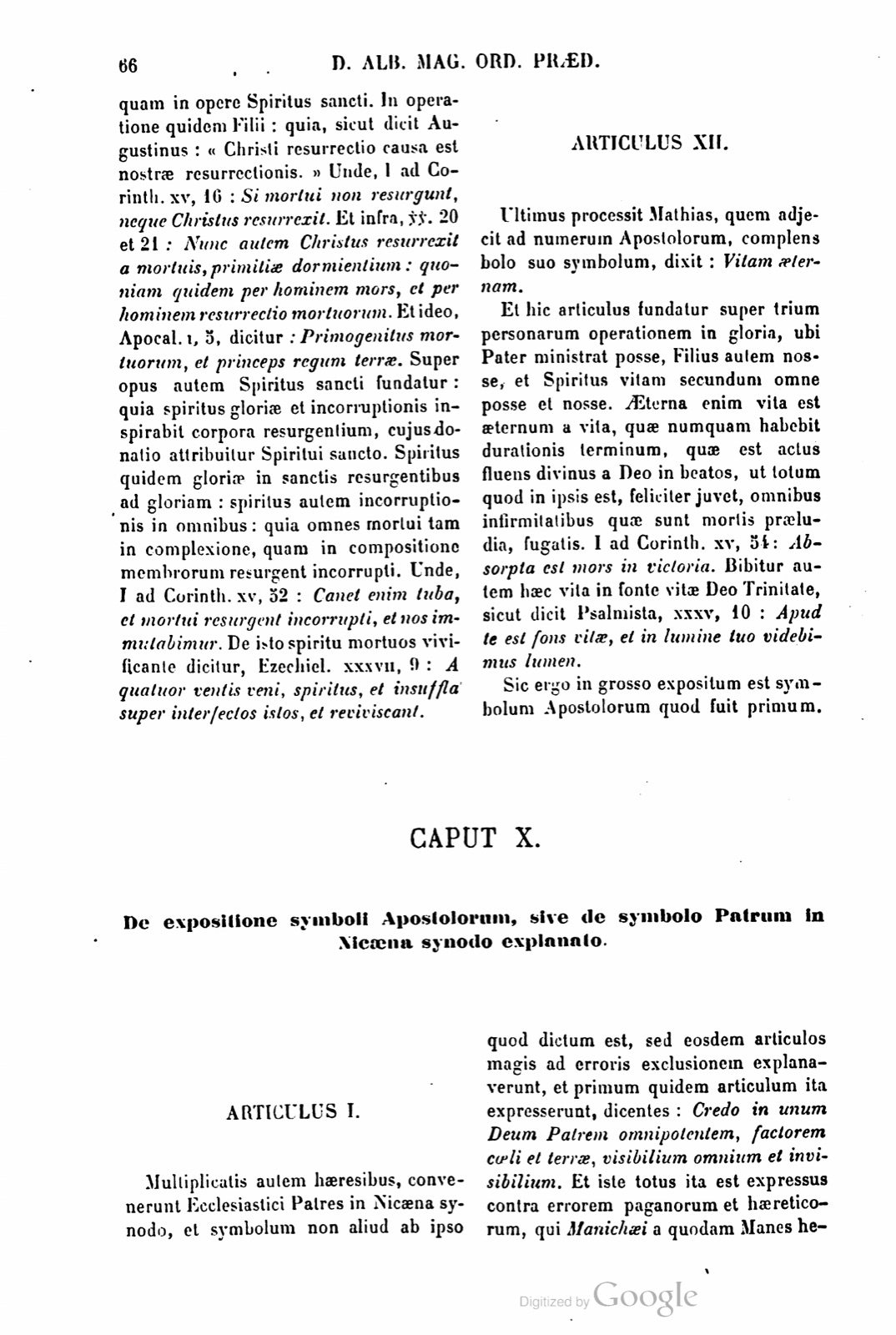
Ultimus processit Mathias, quem adjecit ad numerum Apostolorum, complens bolo suo symbolum, dixit: Vitam aeternam.
Et hic articulus fundatur super trium personarum operationem in gloria, ubi Pater ministrat posse, Filius autem nosse, et Spiritus vitam secundum omne posse et nosse. Aeterna enim vita est aeternum a vita, quae numquam habebit durationis terminum, quae est actus fluens divinus a Deo in beatos, ut totum quod in ipsis est, feliciter juvet, omnibus infirmitatibus quae sunt mortis praeludia, fugatis. I ad Corinth. XV, 54: Absorpta est mors in victoria. Bibitur autem haec vita in fonte vitae Deo Trinitate, sicut dicit Psalmista, XXXV, 10: Apud te est fons vitae, et in lumine tuo videbimus lumen.
Sic ergo in grosso expositum est symbolum Apostolorum quod fuit primum.
ARTICLE XI.
After him Judas Thaddaeus, the third brother of the two, whom the Apostles called Thaddaeus, that is, little heart, because he was keeper of the heart, set down his own small portion, saying: The resurrection of the flesh. This article is founded both on the work of the Son and on the work of the Holy Spirit. On the operation of the Son, indeed, because, as Augustine says, "The resurrection of Christ is the cause of our resurrection." Hence, 1 Corinthians 15:16: If the dead do not rise, neither has Christ risen. And below, verses 20 and 21: But now Christ has risen from the dead, the firstfruits of those who sleep; since indeed through a man came death, and through a man the resurrection of the dead. And therefore, Apocalypse 1:5, he is called the firstborn of the dead, and prince of the kings of the earth. But it is founded upon the work of the Holy Spirit because the spirit of glory and incorruption will breathe into the bodies of those rising, whose giving is attributed to the Holy Spirit: the spirit of glory indeed in the saints rising to glory, but the spirit of incorruption in all, because all the dead, both in complexion and in composition of members, will rise incorrupt. Hence, 1 Corinthians 15:52: For the trumpet will sound, and the dead will rise incorrupt, and we shall be changed. Concerning that spirit giving life to the dead it is said, Ezekiel 37:9: Come from the four winds, O spirit, and breathe upon those slain, and let them live again.
ARTICLE XII.
Last came forward Matthias, whom he added to the number of the Apostles; completing the Symbol by his own small portion, he said: Eternal life.
And this article is founded upon the operation of the three persons in glory, where the Father ministers ability, the Son knowing, and the Spirit life according to every ability and knowing. For eternal life is eternal from life, which will never have an end of duration, which is a divine flowing act from God into the blessed, so that everything that is in them may happily aid, with all infirmities that are preludes of death driven away. 1 Corinthians 15:54: Death has been swallowed up in victory. But this life is drunk in the font of life, God the Trinity, as the Psalmist says, 35:10: With thee is the font of life, and in thy light we shall see light.
Thus therefore in a broad way the Symbol of the Apostles, which was first, has been explained.
Notes
- Psalm 32:6. (Psal. XXXII, 6.) ↩
- Compare Luke 11:22. (Cf. Luc. XI, 22.) ↩
- The Vulgate has, Isaiah 26:10: Let us pity the impious man, and he will not learn justice; in the land of the holy ones he has done wicked things, and he will not see the glory of the Lord. (Vulgata habet, Isa. XXVI, 10: Misereamur impio, et non discet justitiam: in terra sanctorum iniqua gessit, et non videbit gloriam Domini.) ↩
If a page does not appear, its photograph has not been uploaded yet.