Works › The Book on the Sacrifice of the Mass
Volume 38 · pp. 142–143
Tractate III, Chapter XIX
A marker with ≈ is an approximate page boundary, placed by measure of the text; the page photographs remain the authority. In the paired views, clicking a page marker brings that page into view.
CAPUT XIX.
De excitatione desiderii ad petendum panem coelestem, et de praemissione institutionis orationis Dominicae.
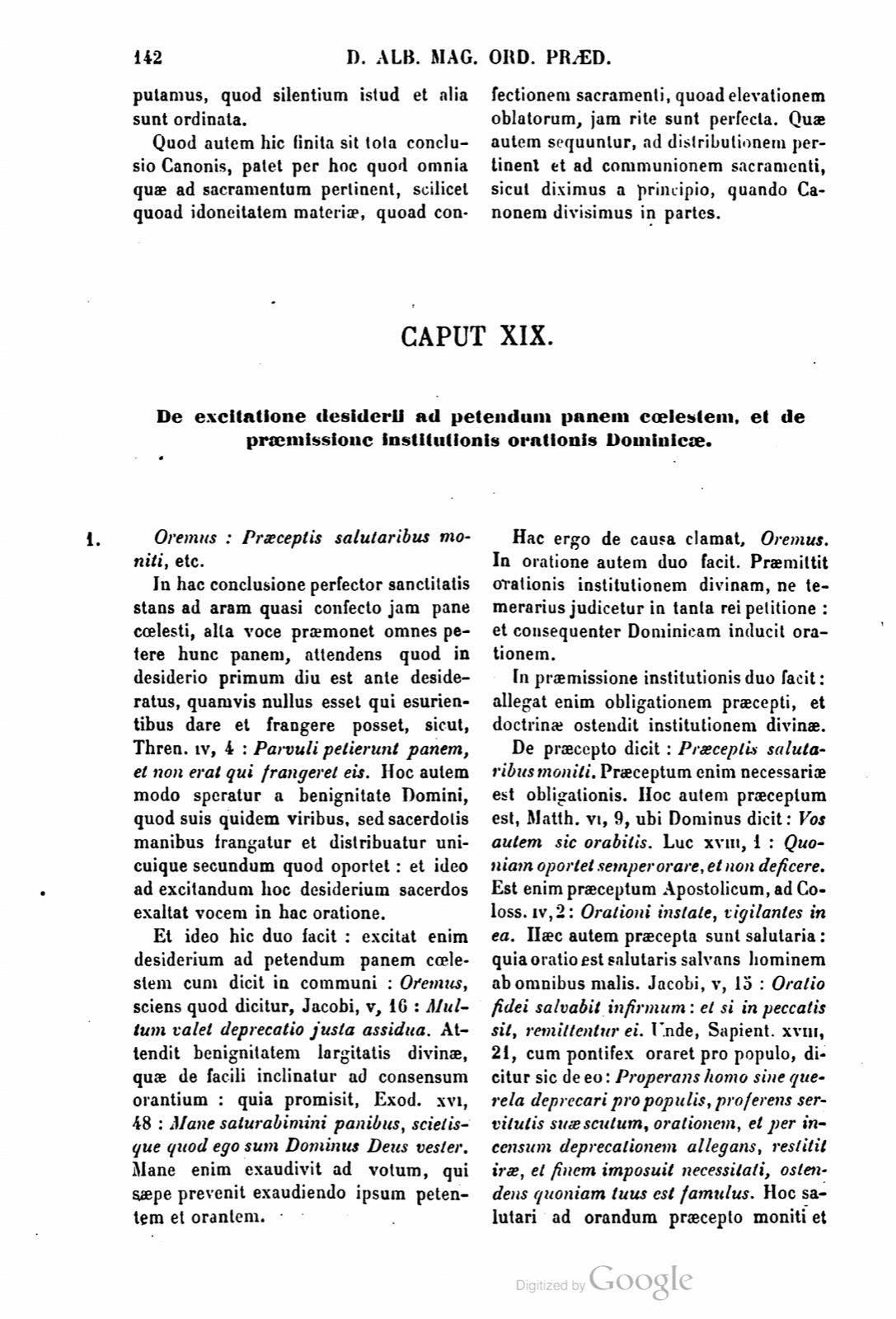
1. Oremus: Praeceptis salutaribus moniti, etc. In hac conclusione perfector sanctitatis stans ad aram quasi confecto jam pane coelesti, alta voce praemonet omnes petere hunc panem, attendens quod in desiderio primum diu est ante desideratus, quamvis nullus esset qui esurientibus dare et frangere posset, sicut, Thren. IV, 4: Parvuli petierunt panem, et non erat qui frangeret eis. Hoc autem modo speratur a benignitate Domini, quod suis quidem viribus, sed sacerdotis manibus frangatur et distribuatur unicuique secundum quod oportet: et ideo ad excitandum hoc desiderium sacerdos exaltat vocem in hac oratione.
Et ideo hic duo facit: excitat enim desiderium ad petendum panem coelestem cum dicit in communi: Oremus, sciens quod dicitur, Jacobi, V, 16: Multum valet deprecatio justa assidua. Attendit benignitatem largitatis divinae, quae de facili inclinatur ad consensum orantium: quia promisit, Exod. XVI, 48: Mane saturabimini panibus, scietisque quod ego sum Dominus Deus vester. Mane enim exaudivit ad votum, qui saepe praevenit exaudiendo ipsum petentem et orantem.
Hac ergo de causa clamat, Oremus. In oratione autem duo facit. Praemittit orationis institutionem divinam, ne temerarius judicetur in tanta rei petitione: et consequenter Dominicam inducit orationem.
In praemissione institutionis duo facit: allegat enim obligationem praecepti, et doctrinae ostendit institutionem divinae.
De praecepto dicit: Praeceptis salutaribus moniti. Praeceptum enim necessariae est obligationis. Hoc autem praeceptum est, Matth. VI, 9, ubi Dominus dicit: Vos autem sic orabitis. Luc. XVIII, 1: Quoniam oportet semper orare, et non deficere. Est enim praeceptum Apostolicum, ad Coloss. IV, 2: Orationi instate, vigilantes in ea. Haec autem praecepta sunt salutaria: quia oratio est salutaris salvans hominem ab omnibus malis. Jacobi, V, 15: Oratio fidei salvabit infirmum: et si in peccatis sit, remittentur ei. Unde, Sapient. XVIII, 21, cum pontifex oraret pro populo, dicitur sic de eo: Properans homo sine querela deprecari pro populis, proferens servitutis suae scutum, orationem, et per incensum deprecationem allegans, restitit irae, et finem imposuit necessitati, ostendens quoniam tuus est famulus. Hoc salutari ad orandum praecepto moniti et praemoniti a Deo benignissimo, qui semper monet nos de salutaribus. Ad Hebr. XII, 10: Hic autem, scilicet Filius Dei, erudit nos ad id quod utile est in recipiendo sanctificationem ejus. Isa. XXX, 20 et 21: Erunt oculi tui videntes praeceptorem tuum: et aures tuae audient verbum post tergum monentis.
CHAPTER XIX.
On the stirring up of desire for seeking the heavenly bread, and on the premising of the institution of the Lord's Prayer.
1. Let us pray: warned by saving precepts, etc. In this conclusion the perfecter of sanctity, standing at the altar as if the heavenly bread has now been confected, with a loud voice forewarns all to seek this bread, attending to the fact that in desire it was first long desired beforehand, although there was no one who could give and break it for those hungering, as, Lamentations 4:4: The little ones sought bread, and there was no one who would break it for them. But in this mode it is hoped from the benignity of the Lord that by his own powers indeed, but by the hands of the priest, it may be broken and distributed to each one according as is fitting; and therefore to stir up this desire the priest raises his voice in this prayer.
And therefore here he does two things: for he stirs up desire for seeking the heavenly bread when he says in common: Let us pray, knowing what is said, James 5:16: The assiduous just prayer avails much. He attends to the benignity of divine largess, which is easily inclined to the consent of those praying, because he promised, Exodus 16:48: In the morning you shall be filled with breads, and you shall know that I am the Lord your God. For in the morning he heard according to the vow, who often anticipates by hearing the one seeking and praying.
Therefore for this reason he cries, Let us pray. But in the prayer he does two things. He premises the divine institution of prayer, lest he be judged rash in the petition of so great a thing, and consequently he introduces the Lord's Prayer.
In the premising of the institution he does two things: for he alleges the obligation of the precept and shows the divine institution of the teaching.
Concerning the precept he says: Warned by saving precepts. For a precept is of necessary obligation. But this precept is Matthew 6:9, where the Lord says: But you shall pray thus. Luke 18:1: Since one ought always to pray and not to fail. For there is the Apostolic precept, Colossians 4:2: Be instant in prayer, watching in it. But these precepts are saving, because prayer is saving, saving man from all evils. James 5:15: The prayer of faith will save the sick person, and if he is in sins, they will be remitted to him. Hence, Wisdom 18:21, when the pontiff prayed for the people, it is said thus of him: The blameless man hastening to pray for the peoples, bringing forth the shield of his service, prayer, and alleging supplication through incense, resisted wrath and set an end to the necessity, showing that he is thy servant. By this saving precept for praying we are warned and forewarned by the most benign God, who always warns us concerning saving things. Hebrews 12:10: But this one, namely the Son of God, educates us toward what is useful in receiving his sanctification. Isaiah 30:20 and 21: Thy eyes shall be seeing thy teacher, and thy ears shall hear the word of one warning behind thy back.
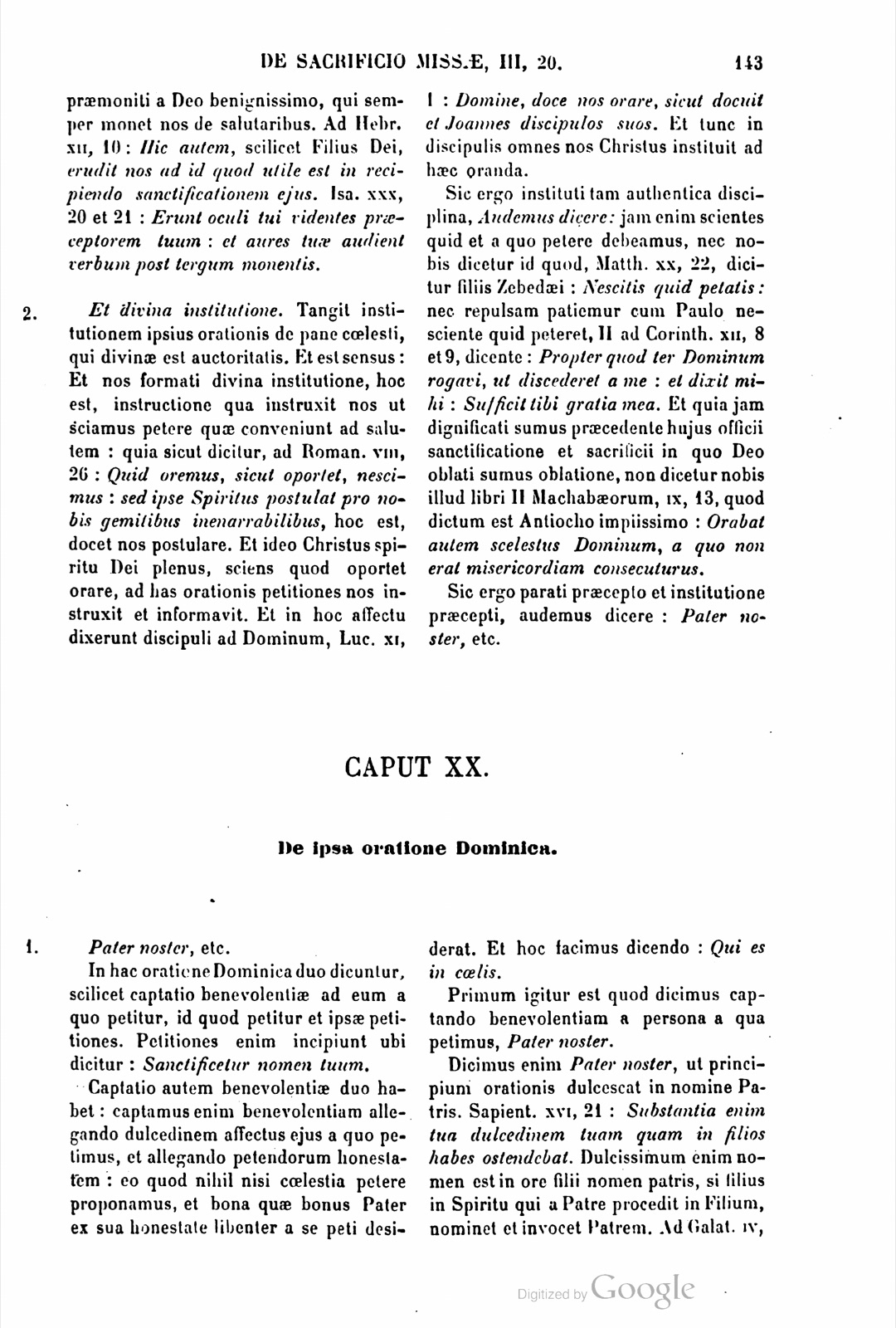
2. Et divina institutione. Tangit institutionem ipsius orationis de pane coelesti, qui divinae est auctoritatis. Et est sensus: Et nos formati divina institutione, hoc est, instructione qua instruxit nos ut sciamus petere quae conveniunt ad salutem: quia sicut dicitur, ad Roman. VIII, 26: Quid oremus, sicut oportet, nescimus: sed ipse Spiritus postulat pro nobis gemitibus inenarrabilibus, hoc est, docet nos postulare. Et ideo Christus spiritu Dei plenus, sciens quod oportet orare, ad has orationis petitiones nos instruxit et informavit. Et in hoc affectu dixerunt discipuli ad Dominum, Luc. XI, 1: Domine, doce nos orare, sicut docuit et Joannes discipulos suos. Et tunc in discipulis omnes nos Christus instituit ad haec oranda.
Sic ergo instituti tam authentica disciplina, Audemus dicere: jam enim scientes quid et a quo petere debeamus, nec nobis dicetur id quod, Matth. XX, 22, dicitur filiis Zebedaei: Nescitis quid petatis: nec repulsam patiemur cum Paulo nesciente quid peteret, II ad Corinth. XII, 8 et 9, dicente: Propter quod ter Dominum rogavi, ut discederet a me: et dixit mihi: Sufficit tibi gratia mea. Et quia jam dignificati sumus praecedente hujus officii sanctificatione et sacrificii in quo Deo oblati sumus oblatione, non dicetur nobis illud libri II Machabaeorum, IX, 13, quod dictum est Antiocho impiissimo: Orabat autem scelestus Dominum, a quo non erat misericordiam consecuturus.
Sic ergo parati praecepto et institutione praecepti, audemus dicere: Pater noster, etc.
2. And by divine institution. He touches the institution of the prayer itself concerning the heavenly bread, which is of divine authority. And the sense is: And we, formed by divine institution, that is, by the instruction by which he instructed us so that we might know to seek those things which befit salvation, because as is said, Romans 8:26: What we should pray for as we ought, we do not know; but the Spirit himself asks for us with unutterable groanings, that is, teaches us to ask. And therefore Christ, full of the Spirit of God, knowing what one ought to pray, instructed and formed us for these petitions of prayer. And in this affection the disciples said to the Lord, Luke 11:1: Lord, teach us to pray, just as John also taught his disciples. And then in the disciples Christ instructed all of us for praying these things.
Thus, therefore, instructed by so authoritative a discipline, we dare to say, for now knowing what and from whom we ought to seek, neither will that be said to us which, Matthew 20:22, is said to the sons of Zebedee: You do not know what you seek; nor shall we suffer repulse with Paul not knowing what he sought, 2 Corinthians 12:8 and 9, saying: Because of this I prayed to the Lord three times that it depart from me; and he said to me: My grace is sufficient for thee. And because we have now been made worthy by the preceding sanctification of this office and by the oblation of the sacrifice in which we have been offered to God, that saying of the book of 2 Maccabees 9:13, which was said to most impious Antiochus, will not be said to us: But the wicked man prayed to the Lord, from whom he was not going to obtain mercy.
Thus, therefore, prepared by the precept and institution of the precept, we dare to say: Our Father, etc.
If a page does not appear, its photograph has not been uploaded yet.