Works › The Book on the Sacrifice of the Mass
Volume 38 · pp. 73–74
Chapter X, Articles X-XII and conclusion on the Symbols
A marker with ≈ is an approximate page boundary, placed by measure of the text; the page photographs remain the authority. In the paired views, clicking a page marker brings that page into view.
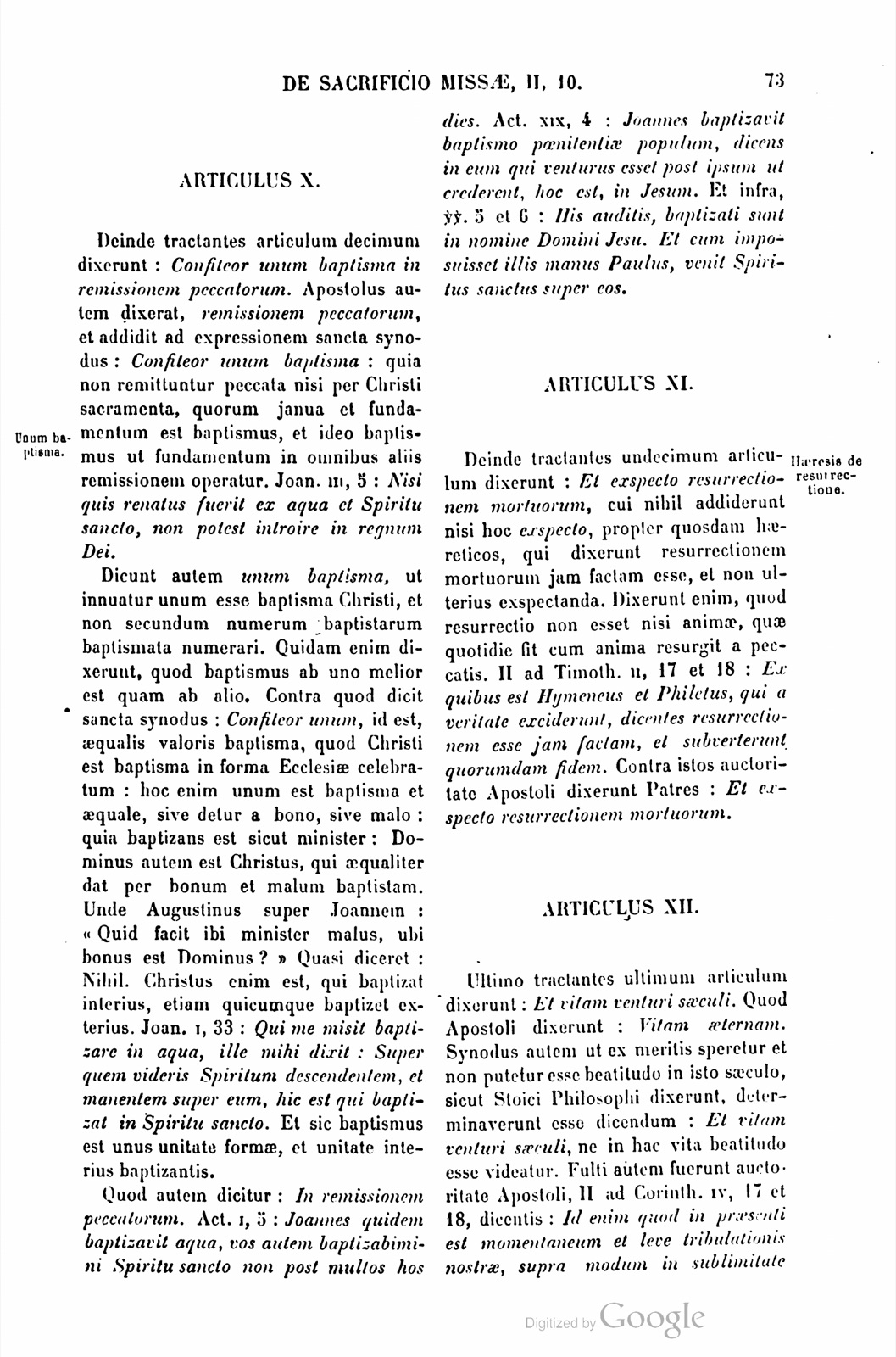
ARTICULUS X.
Deinde tractantes articulum decimum dixerunt: Confiteor unum baptisma in remissionem peccatorum. Apostolus autem dixerat, remissionem peccatorum, et addidit ad expressionem sancta synodus: Confiteor unum baptisma: quia non remittuntur peccata nisi per Christi sacramenta, quorum janua et fundamentum est baptismus, et ideo baptismus ut fundamentum in omnibus aliis remissionem operatur. [Marginal label: Unum baptisma.] Joan. III, 5: Nisi quis renatus fuerit ex aqua et Spiritu sancto, non potest introire in regnum Dei.
Dicunt autem unum baptisma, ut innuatur unum esse baptisma Christi, et non secundum numerum baptistarum baptismata numerari. Quidam enim dixerunt, quod baptismus ab uno melior est quam ab alio. Contra quod dicit sancta synodus: Confiteor unum, id est, aequalis valoris baptisma, quod Christi est baptisma in forma Ecclesiae celebratum: hoc enim unum est baptisma et aequale, sive detur a bono, sive malo: quia baptizans est sicut minister: Dominus autem est Christus, qui aequaliter dat per bonum et malum baptistam. Unde Augustinus super Joannem: "Quid facit ibi minister malus, ubi bonus est Dominus?" Quasi diceret: Nihil. Christus enim est, qui baptizat interius, etiam quicumque baptizet exterius. Joan. I, 33: Qui me misit baptizare in aqua, ille mihi dixit: Super quem videris Spiritum descendentem, et manentem super eum, hic est qui baptizat in Spiritu sancto. Et sic baptismus est unus unitate formae, et unitate interius baptizantis.
Quod autem dicitur: In remissionem peccatorum. Act. I, 5: Joannes quidem baptizavit aqua, vos autem baptizabimini Spiritu sancto non post multos hos dies. Act. XIX, 4: Joannes baptizavit baptismo paenitentiae populum, dicens in eum qui venturus esset post ipsum ut crederent, hoc est, in Jesum. Et infra, vv. 5 et 6: His auditis, baptizati sunt in nomine Domini Jesu. Et cum imposuisset illis manus Paulus, venit Spiritus sanctus super eos.
ARTICULUS XI.
Deinde tractantes undecimum articulum dixerunt: Et exspecto resurrectionem mortuorum, cui nihil addiderunt nisi hoc exspecto, propter quosdam haereticos, qui dixerunt resurrectionem mortuorum jam factam esse, et non ulterius exspectandam. [Marginal label: Haeresis de resurrectione.] Dixerunt enim, quod resurrectio non esset nisi animae, quae quotidie fit cum anima resurgit a peccatis. II ad Timoth. II, 17 et 18: Ex quibus est Hymeneus et Philetus, qui a veritate exciderunt, dicentes resurrectionem esse jam factam, et subverterunt quorumdam fidem. Contra istos auctoritate Apostoli dixerunt Patres: Et exspecto resurrectionem mortuorum.
ARTICULUS XII.
Ultimo tractantes ultimum articulum dixerunt: Et vitam venturi saeculi. Quod Apostoli dixerunt: Vitam aeternam. Synodus autem ut ex meritis speretur et non putetur esse beatitudo in isto saeculo, sicut Stoici Philosophi dixerunt, determinaverunt esse dicendum: Et vitam venturi saeculi, ne in hac vita beatitudo esse videatur. Fulti autem fuerunt auctoritate Apostoli, II ad Corinth. IV, 17 et 18, dicentis: Id enim quod in praesenti est momentaneum et leve tribulationis nostrae, supra modum in sublimitate aeternum gloriae pondus operatur in nobis, non contemplantibus nobis quae videntur sed quae non videntur: quae enim videntur temporalia sunt, quae autem non videntur aeterna sunt.
ARTICLE X.
Then, treating the tenth article, they said: I confess one baptism for the forgiveness of sins. But the Apostle had said, the forgiveness of sins, and the holy synod added for expression: I confess one baptism, because sins are not forgiven except through the sacraments of Christ, whose gate and foundation is baptism; and therefore baptism, as foundation, works forgiveness in all the others. [Marginal label: One baptism.] John 3:5: Unless someone has been reborn from water and the Holy Spirit, he cannot enter into the kingdom of God.
But they say one baptism so that it may be suggested that the baptism of Christ is one, and that baptisms are not numbered according to the number of those baptizing. For some said that baptism is better from one than from another. Against this the holy synod says: I confess one, that is, a baptism of equal value, which is Christ's baptism celebrated in the form of the Church. For this baptism is one and equal, whether it is given by a good man or an evil one, because the one baptizing is like a minister; but the Lord is Christ, who gives equally through a good and an evil baptizer. Hence Augustine on John: "What does the evil minister do there, where the Lord is good?" As if he were saying: Nothing. For Christ is the one who baptizes inwardly, whoever may baptize outwardly. John 1:33: He who sent me to baptize in water, he said to me: Upon whom you see the Spirit descending and remaining upon him, this is he who baptizes in the Holy Spirit. And thus baptism is one by unity of form and by unity of the one baptizing inwardly.
But as to what is said, For the forgiveness of sins. Acts 1:5: John indeed baptized with water, but you will be baptized with the Holy Spirit not many days hence. Acts 19:4: John baptized the people with the baptism of penance, saying that they should believe in him who was to come after him, that is, in Jesus. And below, verses 5 and 6: Having heard these things, they were baptized in the name of the Lord Jesus. And when Paul had laid hands on them, the Holy Spirit came upon them.
ARTICLE XI.
Then, treating the eleventh article, they said: And I await the resurrection of the dead, to which they added nothing except this, I await, on account of certain heretics who said that the resurrection of the dead had already been made and was not to be awaited further. [Marginal label: Heresy concerning the resurrection.] For they said that resurrection was nothing except of the soul, which happens daily when the soul rises again from sins. 2 Timothy 2:17 and 18: From whom are Hymenaeus and Philetus, who have fallen away from the truth, saying that the resurrection has already been made, and they have subverted the faith of certain persons. Against these, by the authority of the Apostle, the Fathers said: And I await the resurrection of the dead.
ARTICLE XII.
Last, treating the last article, they said: And the life of the age to come. What the Apostles said was: Eternal life. But the synod, so that it might be hoped for from merits and not be thought to be beatitude in this age, as the Stoic Philosophers said, determined that one must say: And the life of the age to come, lest beatitude seem to exist in this life. But they were supported by the authority of the Apostle, 2 Corinthians 4:17 and 18, saying: For that which at present is momentary and light in our tribulation works in us above measure an eternal weight of glory in sublimity, while we contemplate not the things which are seen but the things which are not seen; for the things which are seen are temporal, but the things which are not seen are eternal.
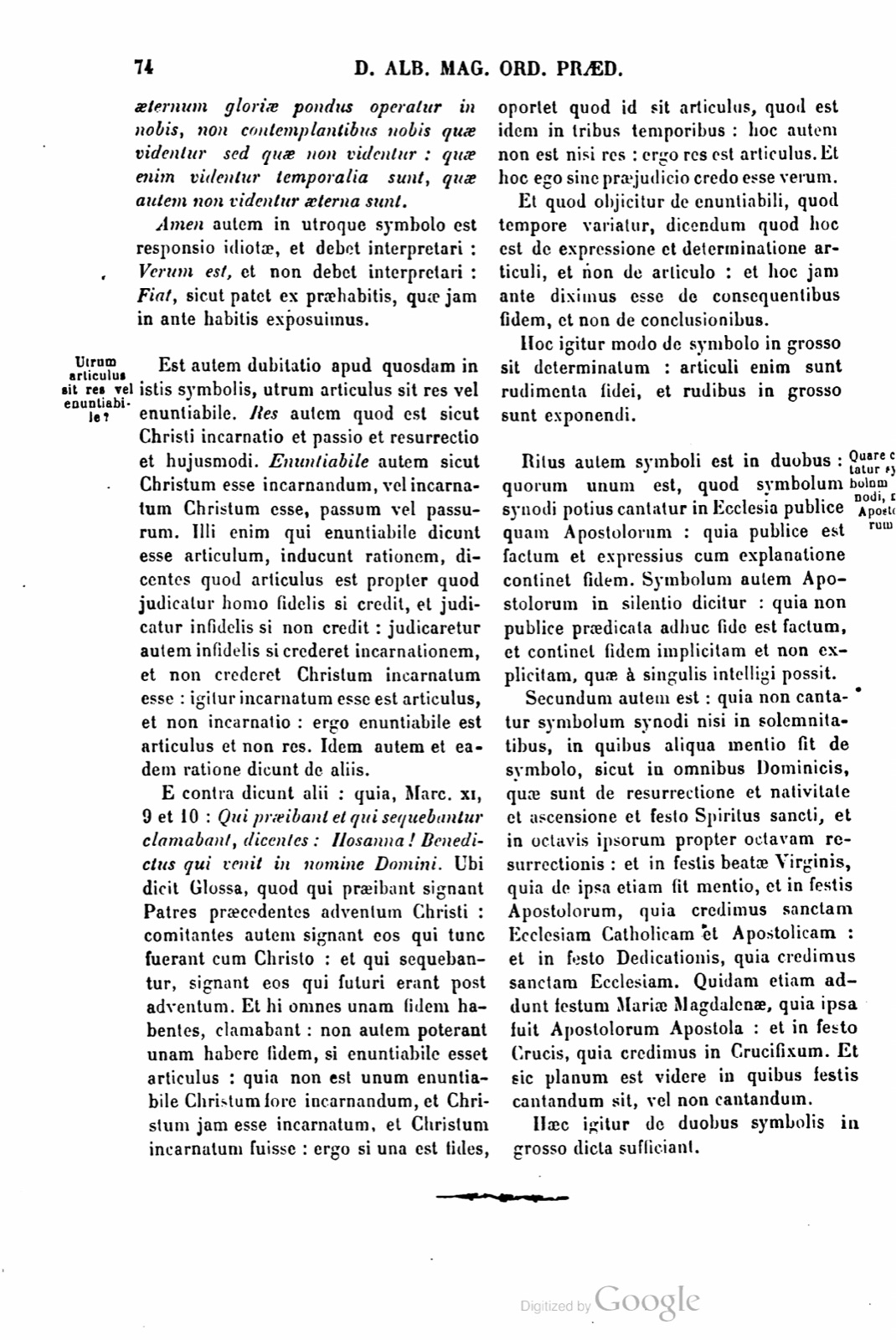
Amen autem in utroque symbolo est responsio idiotae, et debet interpretari: Verum est, et non debet interpretari: Fiat, sicut patet ex praehabitis, quae jam in ante habitis exposuimus.
[Marginal label: Utrum articulus sit res vel enuntiabile?] Est autem dubitatio apud quosdam in istis symbolis, utrum articulus sit res vel enuntiabile. Res autem quod est sicut Christi incarnatio et passio et resurrectio et hujusmodi. Enuntiabile autem sicut Christum esse incarnandum, vel incarnatum Christum esse, passum vel passurum. Illi enim qui enuntiabile dicunt esse articulum, inducunt rationem, dicentes quod articulus est propter quod judicatur homo fidelis si credit, et judicatur infidelis si non credit: judicaretur autem infidelis si crederet incarnationem, et non crederet Christum incarnatum esse: igitur incarnatum esse est articulus, et non incarnatio: ergo enuntiabile est articulus et non res. Idem autem et eadem ratione dicunt de aliis.
E contra dicunt alii: quia, Marc. XI, 9 et 10: Qui praeibant et qui sequebantur clamabant, dicentes: Hosanna! Benedictus qui venit in nomine Domini. Ubi dicit Glossa, quod qui praeibant signant Patres praecedentes adventum Christi: comitantes autem signant eos qui tunc fuerant cum Christo: et qui sequebantur, signant eos qui futuri erant post adventum. Et hi omnes unam fidem habentes, clamabant: non autem poterant unam habere fidem, si enuntiabile esset articulus: quia non est unum enuntiabile Christum fore incarnandum, et Christum jam esse incarnatum, et Christum incarnatum fuisse: ergo si una est fides, oportet quod id sit articulus, quod est idem in tribus temporibus: hoc autem non est nisi res: ergo res est articulus. Et hoc ego sine praejudicio credo esse verum. Et quod objicitur de enuntiabili, quod tempore variatur, dicendum quod hoc est de expressione et determinatione articuli, et non de articulo: et hoc jam ante diximus esse de consequentibus fidem, et non de conclusionibus.
Hoc igitur modo de symbolo in grosso sit determinatum: articuli enim sunt rudimenta fidei, et rudibus in grosso sunt exponendi.
[Marginal label: Quare symbolum synodi cantatur, Apostolorum non.] Ritus autem symboli est in duobus: quorum unum est, quod symbolum synodi potius cantatur in Ecclesia publice quam Apostolorum: quia publice est factum et expressius cum explanatione continet fidem. Symbolum autem Apostolorum in silentio dicitur: quia non publice praedicata adhuc fide est factum, et continet fidem implicitam et non explicitam, quae a singulis intelligi possit.
Secundum autem est: quia non cantatur symbolum synodi nisi in solemnitatibus, in quibus aliqua mentio fit de symbolo, sicut in omnibus Dominicis, quae sunt de resurrectione et nativitate et ascensione et festo Spiritus sancti, et in octavis ipsorum propter octavam resurrectionis: et in festis beatae Virginis, quia de ipsa etiam fit mentio, et in festis Apostolorum, quia credimus sanctam Ecclesiam Catholicam et Apostolicam: et in festo Dedicationis, quia credimus sanctam Ecclesiam. Quidam etiam addunt festum Mariae Magdalenae, quia ipsa fuit Apostolorum Apostola: et in festo Crucis, quia credimus in Crucifixum. Et sic planum est videre in quibus festis cantandum sit, vel non cantandum.
Haec igitur de duobus symbolis in grosso dicta sufficiant.
But Amen in either Symbol is the response of the simple person, and ought to be interpreted: It is true, and ought not to be interpreted: Let it be done, as is clear from the things said beforehand, which we have already explained above.
[Marginal label: Whether an article is a thing or an enunciable?] But there is a doubt among some concerning these Symbols, whether an article is a thing or an enunciable. A thing is what exists, such as the incarnation and passion and resurrection of Christ and things of this kind. But an enunciable is such as that Christ is to be incarnate, or that Christ has been incarnate, has suffered, or is going to suffer. For those who say that an article is an enunciable bring in a reason, saying that an article is that on account of which a human being is judged faithful if he believes, and is judged unfaithful if he does not believe. But he would be judged unfaithful if he believed the incarnation and did not believe that Christ has been incarnate. Therefore that Christ has been incarnate is an article, and not incarnation; therefore an enunciable is an article and not a thing. And they say the same about the others, and by the same reason.
On the contrary others say: because, Mark 11:9 and 10, Those who went before and those who followed cried out, saying: Hosanna! Blessed is he who comes in the name of the Lord. There the Gloss says that those who went before signify the Fathers preceding the advent of Christ; but those accompanying signify those who then had been with Christ; and those who followed signify those who were to come after the advent. And all these, having one faith, cried out. But they could not have one faith if an article were an enunciable, because it is not one enunciable that Christ would be incarnate, and that Christ has now been incarnate, and that Christ was incarnate. Therefore if faith is one, that must be the article which is the same in the three times; but this is nothing except a thing; therefore the thing is the article. And I, without prejudice, believe this to be true. And as to what is objected concerning the enunciable, that it varies by time, one must say that this concerns the expression and determination of the article, and not the article; and we have already said above that this concerns things consequent upon faith, and not conclusions.
Therefore in this way let the Symbol in broad outline be determined. For the articles are the rudiments of faith, and they must be explained to the unlearned in broad outline.
[Marginal label: Why the Symbol of the synod is sung, and the Apostles' is not.] But the rite of the Symbol is in two things. One of them is that the Symbol of the synod is sung publicly in the Church rather than the Symbol of the Apostles, because it was made publicly and contains the faith more expressly with explanation. But the Symbol of the Apostles is said in silence, because it was made when the faith had not yet been publicly preached, and it contains the faith implicitly and not explicitly, so that it can be understood by individual persons.
The second is that the Symbol of the synod is not sung except in solemnities in which some mention is made of the Symbol, as in all Lord's days, which concern resurrection and nativity and ascension and the feast of the Holy Spirit, and in their octaves on account of the octave of resurrection; and in the feasts of the blessed Virgin, because mention is also made of her; and in the feasts of the Apostles, because we believe in the holy Catholic and Apostolic Church; and in the feast of Dedication, because we believe in the holy Church. Certain persons also add the feast of Mary Magdalene, because she herself was the Apostle of the Apostles; and in the feast of the Cross, because we believe in the Crucified. And thus it is plain to see on which feasts it should be sung, or not sung.
Therefore let these things said in broad outline concerning the two Symbols suffice.
If a page does not appear, its photograph has not been uploaded yet.