Works › The Book on the Sacrifice of the Mass
Volume 38 · pp. 51–52
Chapter VI. On Alleluia
A marker with ≈ is an approximate page boundary, placed by measure of the text; the page photographs remain the authority. In the paired views, clicking a page marker brings that page into view.
CAPUT VI.
De Alleluia.
Diximus autem in ante habitis, quod profectus virtutis qui in Graduali significatur, sicut ex parte difficultatis habet luctum, ita ex parte gustus dulcedinis virtutis habet jubilum: ideo quando jubilus tempore jucunditatis adjuvatur, tunc non cantatur Tractus, sed Alleluia, quod interpretatur, laudate Dominum, vel laudatio Domini: et ideo statuit Ecclesia, quod in festo jucunditatis aeternae cantetur Alleluia. Tob. XIII, 22: Per vicos ejus, scilicet Jerusalem, Alleluia cantabitur. Et ideo in omnibus Psalmis post Dixit Dominus usque ad canticum Graduum, et in omnibus Psalmis a Psalmo CXLV, qui incipit: Lauda, anima mea, Dominum, usque in finem, Alleluia semper in Psalmis praenotatur: quia nihil aliud nisi laus Dei in illis Psalmis exprimitur.
[Marginal label: Triplex laus Dei.] Sed quia triplex est laus Dei, scilicet quia bonum Dei laudamus quod in se habet, et laudamus Dei bonum in nobis habitum et praegustatum, et bonum Dei laudamus in festo illo quod celebratur nobis ostensum et exhibitum, ideo Tractu submisso, cantamus Alleluia cum jucunda et longa nota valde, in commemorationem infiniti boni quod habemus in Deo: et ideo quod est infinitum est diu, et longis et jucundis notis illud jubilamus, scientes quod superfluens est magnitudo bonitatis illius. Eccli. XLIII, 32: Glorificantes Dominum quantumcumque potueritis, supervalebit enim adhuc. Et hanc immensam magnitudinem exprimimus magna et longa nota.
Bonum autem Dei in nobis participatum celebramus in versu qui habet quidem longas notas, sed non adeo longas. Et de istis duobus simul dicitur, Luc. VI, 38: Mensuram bonam, et confertam, et coagitatam, et supereffluentem dabunt in sinum vestrum. Bonam autem quantum ad naturae capacitatem: confertam quantum ad meriti mensuram: coagitatam quantum ad spei amplitudinem: sed haec sunt nobis in versu celebrata: et supereffluentem in Dei immensitate quae in Alleluia celebratur.
CHAPTER VI.
On Alleluia.
But we have said in what was had before that the progress of virtue that is signified in the Gradual, just as on the part of difficulty has mourning, so on the part of the taste of the sweetness of virtue has jubilation; therefore when jubilation is aided by the time of gladness, then the Tract is not sung, but Alleluia, which is interpreted, Praise the Lord, or praise of the Lord; and therefore the Church established that in the feast of eternal gladness Alleluia should be sung. Tobit 13:22: Through its streets, namely Jerusalem's, Alleluia will be sung. And therefore in all the Psalms after The Lord said up to the Canticle of Steps, and in all the Psalms from Psalm 145, which begins: Praise, my soul, the Lord, up to the end, Alleluia is always marked beforehand in the Psalms, because nothing else except the praise of God is expressed in those Psalms.
[Marginal label: Threefold praise of God.] But because the praise of God is threefold, namely because we praise the good of God that he has in himself, and we praise the good of God had and foretasted in us, and we praise the good of God shown and exhibited to us in that feast that is celebrated, therefore, the Tract having been set aside, we sing Alleluia with a very joyful and long note, in commemoration of the infinite good that we have in God; and therefore what is infinite is long-lasting, and we jubilate it with long and joyful notes, knowing that the magnitude of his goodness is overflowing. Ecclesiasticus 43:32: Glorifying the Lord however much you will be able, he will yet prevail beyond it. And we express this immeasurable magnitude by a great and long note.
But the good of God participated in us we celebrate in the verse, which indeed has long notes, but not so long. And concerning these two together it is said, Luke 6:38: A good measure, and pressed together, and shaken together, and overflowing, they will give into your bosom. Good with respect to the capacity of nature; pressed together with respect to the measure of merit; shaken together with respect to the breadth of hope; but these things are celebrated for us in the verse; and overflowing in the immensity of God, which is celebrated in Alleluia.
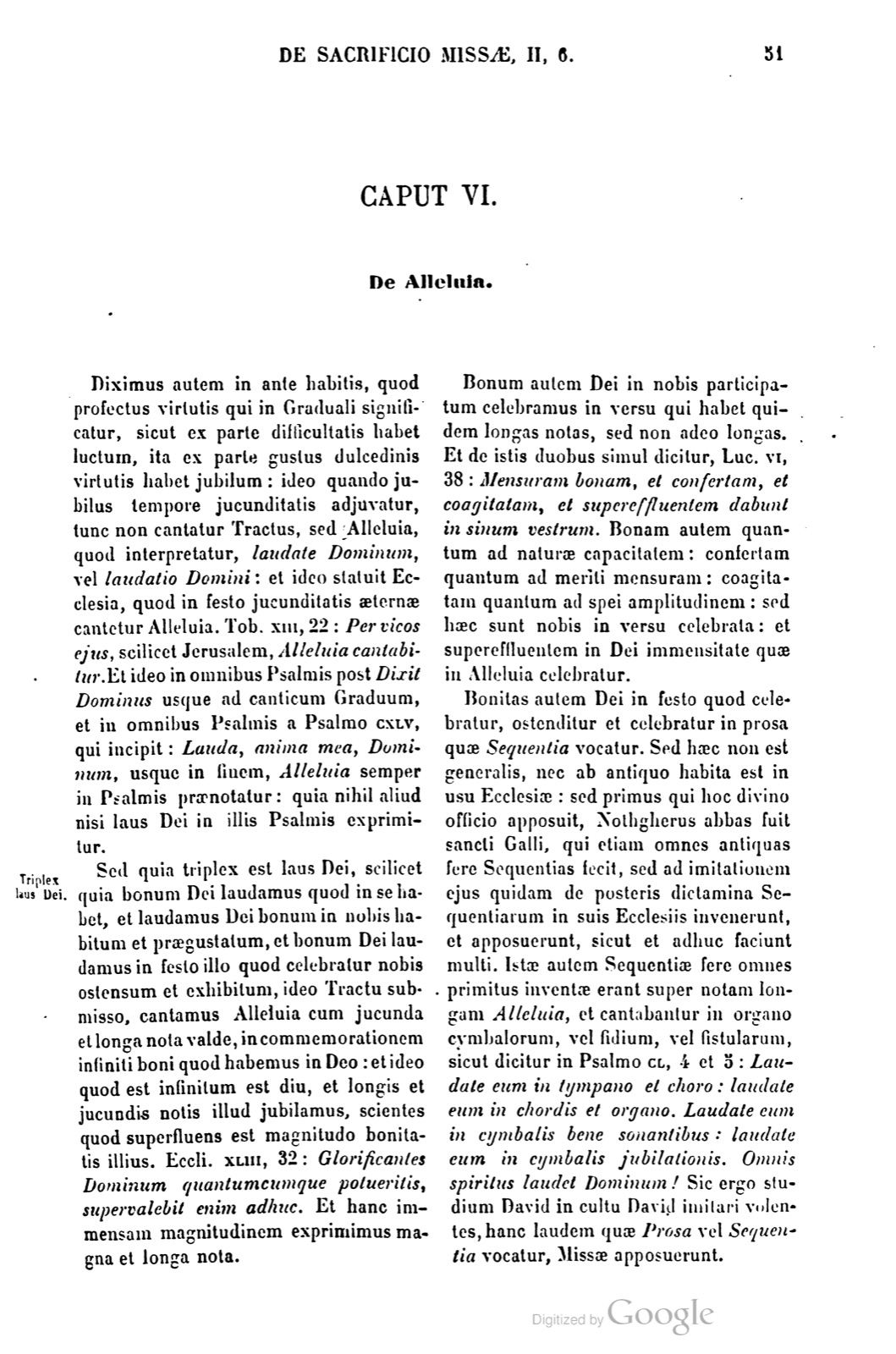
Bonitas autem Dei in festo quod celebratur, ostenditur et celebratur in prosa quae Sequentia vocatur. Sed haec non est generalis, nec ab antiquo habita est in usu Ecclesiae: sed primus qui hoc divino officio apposuit, Nothgherus abbas fuit sancti Galli, qui etiam omnes antiquas fere Sequentias fecit, sed ad imitationem ejus quidam de posteris dictamina Sequentiarum in suis Ecclesiis invenerunt, et apposuerunt, sicut et adhuc faciunt multi. Istae autem Sequentiae fere omnes primitus inventae erant super notam longam Alleluia, et cantabantur in organo cymbalorum, vel fidium, vel fistularum, sicut dicitur in Psalmo CL, 4 et 5: Laudate eum in tympano et choro: laudate eum in chordis et organo. Laudate eum in cymbalis bene sonantibus: laudate eum in cymbalis jubilationis. Omnis spiritus laudet Dominum! Sic ergo studium David in cultu David imitari volentes, hanc laudem quae Prosa vel Sequentia vocatur, Missae apposuerunt.
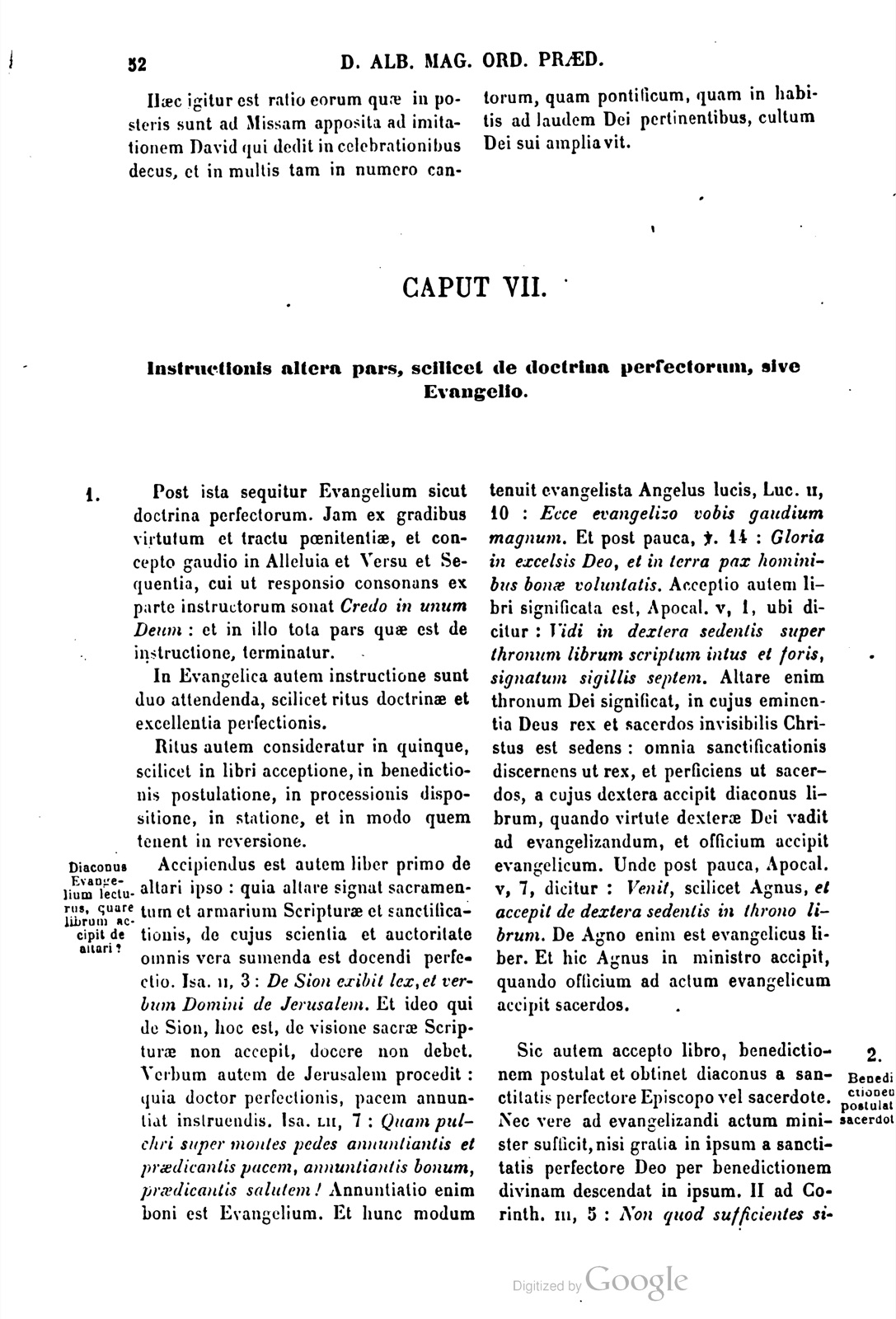
Haec igitur est ratio eorum quae in posteris sunt ad Missam apposita ad imitationem David qui dedit in celebrationibus decus, et in multis tam in numero cantorum, quam pontificum, quam in habitis ad laudem Dei pertinentibus, cultum Dei sui ampliavit.
But the goodness of God in the feast that is celebrated is shown and celebrated in the prose that is called Sequence. But this is not general, nor was it had from antiquity in the use of the Church; rather the first who added this to the divine office was Nothgherus, abbot of Saint Gall, who also made almost all the ancient Sequences. But in imitation of him certain ones from later people invented compositions of Sequences in their Churches and added them, as many still do. Moreover almost all those Sequences were originally invented upon the long note Alleluia, and were sung on an organ of cymbals, or of strings, or of pipes, as is said in Psalm 150:4 and 5: Praise him on timbrel and choir; praise him on strings and organ. Praise him on well-sounding cymbals; praise him on cymbals of jubilation. Let every spirit praise the Lord! Thus therefore, wishing to imitate the zeal of David in the worship of David, they added this praise, which is called Prose or Sequence, to the Mass.
This therefore is the reason for those things that in later times were added to the Mass in imitation of David, who gave beauty in celebrations, and in many things, as much in the number of singers as of pontiffs as in the vestments pertaining to the praise of God, enlarged the worship of his God.
If a page does not appear, its photograph has not been uploaded yet.