Works › The Book on the Sacrifice of the Mass
Volume 38 · pp. 37–41
Treatise II, Chapter I, The Lord be with you, etc.
A marker with ≈ is an approximate page boundary, placed by measure of the text; the page photographs remain the authority. In the paired views, clicking a page marker brings that page into view.
TRACTATUS II.
DE SECUNDA PARTE MISSAE.
CAPUT I.
Dominus vobiscum, etc.
1. Eccli. XLVII, 12: Dedit in celebrationibus decus, et ornavit tempora usque ad consummationem vitae.
Hoc enim de beato Gregorio potest dici, qui resecando superflua et apponens necessaria et ordinans confusa, dedit decus Ecclesiasticum in celebratione officii divini, et festiva tempora, et profestorum dierum ornavit propriis uniuscujusque diei officiis usque ad vitae Ecclesiasticae perfectum ornatum.
[Marginal label: Prima pars Missae in desiderio et acclamatione, secunda in instructione.] Et ideo postquam ordinavit primam partem Missae, in qua invocatus Dominus desiderio cleri et acclamatione populi locutus est verba bona, et pacifica, per adventum ipsius populo promittens pacem, statim subjunxit secundam partem Missae, quae est in instructione et manifestatione venientis: haec enim statim incipit post Gloria in excelsis in festis, et post acclamationem Kyrie, eleyson, in profestis diebus. Haec autem instructio durat usque ad Offertorium exclusive.
Habet autem duas partes: quia praemittitur instructio imperfectorum, et sequitur instructio perfectionis et perfectorum, et incipit in Evangelii lectione. Unde, I ad Corinth. III, 1 et 2: Et ego, fratres, non potui vobis loqui quasi spiritualibus, sed quasi carnalibus: tamquam parvulis in Christo, lac vobis potum dedi, non escam, nondum enim poteratis. De instructione autem perfectorum et perfectionis aliquibus interpositis, ibidem, in secundo capitulo, v. 6 et 7, dicit: Sapientiam autem loquimur inter perfectos, sapientiam vero non hujus saeculi, neque principum hujus saeculi qui destruuntur: sed loquimur Dei sapientiam in mysterio, quae abscondita est. Unde, Matth. XIII, 10 et seq., Christus usus est hac forma doctrinae: quia idiotis loquebatur in corporalibus parabolis, et Apostolis exposuit mysteria perfectae veritatis, dicens ad perfectos: Vobis datum est nosse mysterium regni caelorum, illis autem, scilicet idiotis, non est datum, nisi in parabolis. Attendens enim Beatus Papa verbum Apostoli, ad Roman. I, 14 et 15: Sapientibus et insipientibus debitor sum. Ita, quod in me, promptum est et vobis, ordinavit unde instrueretur primo imperfectus, et adjunxit secundo unde perfectus acciperet illuminationem. I ad Corinth. XV, 44: Si est corpus animale, est et spirituale. Et infra, 46: Sed non prius quod spiritale est, sed quod animale, deinde quod spiritale. Hunc etiam ordinem secutus est Dominus, qui ordine suae sapientiae voluit, quod praedicatio Joannis praecederet suam praedicationem, per quam sua praedicatio et facilius induceretur et efficacius probaretur.
[Marginal label: Epistola instructio imperfectorum.] Et hanc doctrinam signat lectio Epistolae. Et quia Joannis praedicatione inducitur, quae fuit finis legis et prophetiae, et Christum digito discipulis demonstravit, ideo lectio illius instructionis aliquando fit de lege, aliquando de Prophetis, aliquando de Apostolorum verbis, in quibus Christus quasi praesens digito gratiae, quod Joannes interpretatur, recipit demonstrationem. Etenim, Matth. XVII, 1 et seq., Christus in monte cum Moyse et Elia discipulis apparuit, et facies ejus ut sol refulsit. Per quod significatur, quod facies cognitionis ejus ut sol refulget in oculis cordis per verba Moysi, et per verba Prophetarum, quorum eximius fuit Elias, et demonstratur lumen ejus et veritas verbis discipulorum. De Moyse enim dicit ipse Dominus, Joan. V, 46: Si enim crederetis Moysi, crederetis forsitan et mihi: de me enim ille scripsit. De scriptura Prophetarum dicit, ibidem, v. 39: Scrutamini scripturas: quia vos putatis in ipsis vitam aeternam habere: et illae sunt quae testimonium perhibent de me. De discipulis autem dicit, Actuum, I, 8: Eritis mihi testes in Jerusalem, et in omni Judaea et Samaria, et usque ad ultimum terrae. In his ergo tribus consistit doctrina introductoria et imperfectorum.
TREATISE II.
ON THE SECOND PART OF THE MASS.
CHAPTER I.
The Lord be with you, etc.
1. Ecclesiasticus 47:12: He gave beauty in the celebrations, and adorned the times until the consummation of life.
For this can be said of blessed Gregory, who, by cutting away superfluous things and adding necessary things and ordering confused things, gave ecclesiastical beauty in the celebration of the divine office, and adorned festive times and the times of weekdays with the proper offices of each single day, even unto the perfect adornment of ecclesiastical life.
[Marginal label: The first part of the Mass is in desire and acclamation, the second in instruction.] And therefore, after he ordered the first part of the Mass, in which the Lord, invoked by the desire of the clergy and the acclamation of the people, spoke good and peaceful words, promising peace to the people through his own coming, he immediately added the second part of the Mass, which is in the instruction and manifestation of the one coming; for this begins immediately after the Glory to God in the highest on feasts, and after the acclamation Kyrie, eleyson on weekdays. But this instruction lasts up to the Offertory exclusively.
It has two parts: because the instruction of the imperfect is set before, and there follows the instruction of perfection and of the perfect, and it begins in the reading of the Gospel. Hence, 1 Corinthians 3:1 and 2: And I, brothers, was not able to speak to you as to spiritual persons, but as to carnal persons; as to little ones in Christ, I gave you milk to drink, not solid food, for you were not yet able. But concerning the instruction of the perfect and of perfection, with some things interposed, in the same place, in the second chapter, verses 6 and 7, he says: We speak wisdom among the perfect, but a wisdom not of this age, nor of the princes of this age who are destroyed; but we speak the wisdom of God in a mystery, which has been hidden. Hence, Matthew 13:10 and following, Christ used this form of doctrine, because he spoke to the unlearned in bodily parables and explained the mysteries of perfect truth to the Apostles, saying to the perfect: To you it has been given to know the mystery of the kingdom of heaven, but to those, namely to the unlearned, it has not been given, except in parables. Therefore blessed Pope Gregory, attending to the Apostle's word in Romans 1:14 and 15: I am debtor to the wise and to the unwise; so far as is in me, I am ready also for you, ordered that from which the imperfect would first be instructed, and added secondly that from which the perfect would receive illumination. 1 Corinthians 15:44: If there is an animal body, there is also a spiritual one. And below, verse 46: But not first that which is spiritual, but that which is animal, afterward that which is spiritual. The Lord also followed this order, who by the order of his wisdom willed that the preaching of John should precede his own preaching, through which his own preaching would both be more easily introduced and more efficaciously proved.
[Marginal label: The Epistle is the instruction of the imperfect.] And the reading of the Epistle signifies this doctrine. And because it is introduced by the preaching of John, which was the end of the law and prophecy and pointed Christ out with the finger to the disciples, therefore the reading of that instruction is sometimes made from the Law, sometimes from the Prophets, sometimes from the words of the Apostles, in which Christ, as though present, receives demonstration by the finger of grace, which John is interpreted. For indeed, Matthew 17:1 and following, Christ appeared on the mountain to the disciples with Moses and Elijah, and his face shone like the sun. By this it is signified that the face of his cognition shines like the sun in the eyes of the heart through the words of Moses and through the words of the Prophets, of whom Elijah was eminent, and that his light and truth is demonstrated by the words of the disciples. For concerning Moses the Lord himself says, John 5:46: For if you believed Moses, perhaps you would also believe me; for he wrote about me. Concerning the Scripture of the Prophets he says in the same place, verse 39: Search the Scriptures, because you think that in them you have eternal life; and they are those which bear testimony concerning me. But concerning the disciples he says, Acts 1:8: You shall be witnesses to me in Jerusalem, and in all Judea and Samaria, and even to the furthest part of the earth. In these three, therefore, consists the introductory doctrine and the doctrine of the imperfect.
[Marginal label: Evangelium instructio perfectorum.] In doctrina autem Evangelica doctrina consistit perfectionis et perfectorum. Ad doctrinam autem epistolarem, quae est instructio imperfectionis, adjunguntur quaedam ad eam ante disponentia, et quaedam subsequuntur ex parte populi instructi, de profectu instructionis respondentia. Et ideo ista pars instructionis, tres habet partes, antecedentia, ipsam doctrinam, et ipsam doctrinam consequentia.
Antecedentia sunt sicut Dominus vobiscum, et Collectae. Ipsa doctrina est in Epistola. Et subsequentia signantur in Graduali, Tractu, et Alleluia, et sequentia.
Antecedentia igitur duo sunt, scilicet salutatio instruendorum, et Oratio, ut Deus aperiat intellectum ad instructionis profectum.
2. [Marginal label: Quatuor notanda in hac salutatione, Dominus vobiscum.] In salutatione autem quatuor notanda sunt, scilicet quare is qui loco Dei est in Missa Episcopus vel sacerdos, converso vultu ad populum salutat, quare differenter Episcopus et sacerdos salutant, et quis sit modus salutationis, et quis modus responsionis?
De primo notandum, quod Episcopus vel sacerdos in dextro cornu altaris stans converso vultu ad populum salutat. Et in dextro quidem stat cornu: quia per dextram spiritualia signantur, et boni qui in dextera Dei locabuntur: et ideo dicitur, Joan. XXI, 6: Mittite in dextram navigii rete. Quia rete praedicationis et instructionis ad spiritualia converti debet. Convertit autem vultum is qui in loco Dei est, ut opere ostendat, quia vultus suae notitiae in scriptura Legis et Prophetarum refulget, sicut in speculo, et aperte demonstratur in lectione scripturae Apostolorum. Isa. LII, 10: Videbunt omnes fines terrae salutare Dei nostri. Numer. VI, 23: Ostendat tibi Deus faciem suam, et misereatur tui. Genes. XXXII, 30: Vidi Dominum facie ad faciem, et salva facta est anima mea. Psal. LXVI, 1: Illuminet vultum suum super nos, et misereatur nostri. Numer. VI, 26: Convertat Dominus vultum suum ad te, et det tibi pacem. Sic igitur qui loco Dei est, stat a dextris altaris, sicut Zacharias pontifex, Luc. I, 11, quando apparuit ei Gabriel Angelus: Apparuit enim ei Angelus Domini stans a dextris altaris incensi: in qua parte etiam stetit Zacharias. [Marginal label: Sacerdos Angelus est.] Sacerdos autem vel Episcopus Angelus Domini est, et in persona Domini in altari apparens. Malach. II, 7: Labia sacerdotis custodient scientiam, et legem requirent ex ore ejus, quia Angelus Domini exercituum est.
[Marginal label: The Gospel is the instruction of the perfect.] But in evangelical doctrine consists the doctrine of perfection and of the perfect. To the epistolary doctrine, which is the instruction of imperfection, certain things are joined that dispose before it, and certain things follow on the part of the instructed people, answering concerning the progress of instruction. And therefore this part of instruction has three parts: the antecedents, the doctrine itself, and the things consequent upon the doctrine itself.
The antecedents are such as, The Lord be with you, and the Collects. The doctrine itself is in the Epistle. And the consequent things are signified in the Gradual, the Tract, and the Alleluia, and the Sequence.
Therefore the antecedents are two, namely the greeting of those to be instructed, and the Prayer, so that God may open the intellect to the progress of instruction.
2. [Marginal label: Four things to be noted in this greeting, The Lord be with you.] But in the greeting four things must be noted, namely why he who is in the place of God in the Mass, the bishop or priest, greets the people with his face turned toward them; why bishop and priest greet differently; what the mode of the greeting is; and what the mode of the response is.
Concerning the first it must be noted that the bishop or priest, standing at the right horn of the altar, greets the people with his face turned toward them. And he stands at the right horn because spiritual things are signified by the right side, and the good who will be placed at the right hand of God; and therefore it is said in John 21:6: Cast the net on the right side of the ship. Because the net of preaching and instruction ought to be turned toward spiritual things. But he who is in the place of God turns his face, so that he may show by the act that the face of his knowledge shines in the Scripture of the Law and the Prophets, as in a mirror, and is openly demonstrated in the reading of the Scripture of the Apostles. Isaiah 52:10: All the ends of the earth will see the salvation of our God. Numbers 6:23: May God show you his face, and have mercy on you. Genesis 32:30: I have seen the Lord face to face, and my soul has been saved. Psalm 66:1: May he illumine his face upon us, and have mercy on us. Numbers 6:26: May the Lord turn his face to you, and give you peace. Thus therefore he who is in the place of God stands at the right side of the altar, just as Zacharias the high priest in Luke 1:11, when the Angel Gabriel appeared to him; for the Angel of the Lord appeared to him standing at the right side of the altar of incense; in that part Zacharias also stood. [Marginal label: The priest is an Angel.] But the priest or bishop is an Angel of the Lord, and appears at the altar in the person of the Lord. Malachi 2:7: The lips of the priest will guard knowledge, and they will seek the law from his mouth, because he is the Angel of the Lord of hosts.
Convertit autem vultum ad instruendos: quia quando Dominus de se notitiam fecit suis, claro vultu stetit inter eos. Joan. XX, 29: Stetit Jesus in medio discipulorum suorum.
Causa autem quare differenter Episcopus et sacerdos salutant, est: quia Episcopus est, qui superiori fungitur officio loco Christi: et ideo voce Christi utitur ad subditos. Prima enim salutatio quam Christus habuit ad Apostolos fuit: Pax vobis 1. Et ideo etiam qui loco Dei est, primam salutationem ad subditos habet: "Pax vobis." Matth. X, 12 et 13: Intrantes autem in domum, salutate eam dicentes: Pax huic domui. Et si quidem fuerit domus illa digna, veniet pax vestra super eam. Sacerdos qui est in inferiori officio, non audet eisdem verbis uti, sed verbis utitur sanctorum Patrum, qui dixerunt: Dominus vobiscum, sicut Booz dixit messoribus suis, Ruth, II, 4.
[Marginal label: Quare dicitur, Dominus, non Deus, vel Jesus, vel Christus vobiscum.] Modus autem salutationis est, quod sacerdos dicit: Dominus vobiscum, et non Deus, vel Jesus, vel Christus vobiscum: quia hoc verbum, Dominus, possessionem signat: unde omnes potest supplere defectus populi, quod non dicit Deus. Genes. XXVIII, 20: Si fuerit Deus mecum, et custodierit me in via per quam ego ambulo, et dederit mihi panem ad edendum, et vestimentum ad induendum, reversusque fuero prospere ad domum patris mei, erit mihi Dominus in Deum.
3. [Marginal label: Quare non dicitur, vos sitis cum Domino, sed Dominus vobiscum.] Objicitur autem contra modum loquendi: quia quandocumque unus cum alio esse dicitur, principalitas notatur esse in re ablativi, et ministerium in nominativo, sicut dicitur esse miles cum rege, et non e converso rex esse dicitur cum milite. Videtur igitur, quod cum principalis sit Deus et ad nos habens auctoritatem, quod non debet dici: Dominus vobiscum, sed potius sic: Sitis vos cum Domino, maxime cum dicat Apostolus, I ad Corinth. III, 9: Dei enim adjutores sumus.
Ad hoc dicendum, quod in veritate haec propositio, cum, associationem dicit. Et haec societas potest esse dupliciter, scilicet simpliciter vel in associatione duorum ad tertium: et quando notat associationem simpliciter, tunc revera notat principalitatem in re ablativi, sicut objectum est, sicut quando dicitur, miles est cum rege: quia in talibus ablativis supponit personam principalem, quae movet et continet personas alias, sicut rex. Si autem duorum notatur associatio ad tertium, tunc praepositio, cum, notat praepositionem societatis, sicut dicitur: Rex est cum milite in bello: quia tunc fortitudo regis facit militem pugnare et vincere. Psal. XC, 15: Cum ipso sum in tribulatione, eripiam eum, et glorificabo eum. Et sic sumitur hic Dominus vobiscum: Dominus enim vocatur fore nobiscum ad expugnandum hostem et perficiendum sacramentum.
But he turns his face toward those to be instructed because, when the Lord made knowledge of himself for his own, he stood among them with a bright face. John 20:29: Jesus stood in the midst of his disciples.
But the cause why bishop and priest greet differently is this: because the bishop is the one who performs a higher office in the place of Christ, and therefore he uses the voice of Christ toward subjects. For the first greeting that Christ had toward the Apostles was: Peace be to you 1. And therefore he also who is in the place of God has the first greeting toward subjects: "Peace be to you." Matthew 10:12 and 13: But entering into the house, greet it, saying: Peace to this house. And if indeed that house is worthy, your peace will come upon it. The priest, who is in a lower office, does not dare to use the same words, but uses the words of the holy Fathers, who said: The Lord be with you, as Boaz said to his reapers, Ruth 2:4.
[Marginal label: Why is it said, The Lord, not God, or Jesus, or Christ be with you.] But the mode of greeting is that the priest says: The Lord be with you, and not God, or Jesus, or Christ be with you, because this word Lord signifies possession; hence he is able to supply all the defects of the people, which God does not say. Genesis 28:20: If God will be with me and will keep me on the way by which I walk, and will give me bread to eat and clothing to put on, and I return prosperously to the house of my father, he will be Lord to me unto God.
3. [Marginal label: Why is it not said, May you be with the Lord, but, The Lord be with you.] But it is objected against the mode of speaking: because whenever one is said to be with another, principality is noted as being in the thing of the ablative, and ministry in the nominative, as a soldier is said to be with the king, and conversely the king is not said to be with the soldier. Therefore it seems that, since God is principal and has authority toward us, it ought not to be said: The Lord be with you, but rather thus: May you be with the Lord, especially since the Apostle says in 1 Corinthians 3:9: For we are God's helpers.
To this one must say that in truth this preposition, with, speaks of association. And this fellowship can be in two ways, namely simply or in the association of two to a third. And when it notes association simply, then indeed it notes principality in the thing of the ablative, as was objected, as when it is said, the soldier is with the king, because in such ablatives it supposes the principal person, who moves and contains the other persons, as the king. But if the association of two to a third is noted, then the preposition with notes the preposition of fellowship, as it is said: The king is with the soldier in war, because then the strength of the king makes the soldier fight and conquer. Psalm 90:15: I am with him in tribulation; I will rescue him and glorify him. And thus The Lord be with you is taken here; for the Lord is called to be with us for conquering the enemy and completing the sacrament.
4. [Marginal label: Quinque modis optatur Dominus esse nobiscum.] Et ut hoc bene clarum fiat, dicimus quod a sacerdote quinque modis optatur Dominus esse nobiscum, scilicet in voluntatis suae conformitate, in virtutis opere, in potentiae suae demonstratione, in gratiae sacramentalis participatione, in hostium devictione.
De primo horum modorum dicitur, Matth. XXVI, 39: Non sicut ego volo, sed sicut tu. Luc. XXII, 42: Non mea voluntas, sed tua fiat. Est enim haec conformitas quadruplex, scilicet secundum materiam voliti, quando volumus hoc quod Deus vult. Marc. XIV, 36: Non quod ego volo, sed quod tu. Secunda conformitas est in forma volendi, ut ex eadem charitate velimus hoc quod volumus, ex qua charitate Deus vult hoc quod vult. Matth. VI, 10: Fiat voluntas tua sicut in caelo et in terra. Tertia conformitas est in fine voluntatis, ut scilicet ad eumdem finem velimus quidquid volumus, ad quem Deus vult hoc quod vult, hoc est, ad gloriam suam: et hoc innuitur, Matth. V, 16: Videant opera vestra bona, et glorificent Patrem vestrum qui in caelis est. I ad Corinth. X, 31: Sive manducatis, sive bibitis, sive aliud quid facitis, omnia in gloriam Dei facite. Quarta autem conformitas est in causa efficiente, ut velim hoc quod Deus vult me velle, sicut quando dedit praeceptum, voluit me velle obedire praecepto: et similiter quando dedit consilium, voluit me velle sequi consilium: et quando fecit me patrem, voluit me velle provisionem filiorum, et similiter est de aliis. I ad Thessal. IV, 3 et seq.: Haec est voluntas Dei, sanctificatio vestra: ut abstineatis vos a fornicatione: ut sciat unusquisque vestrum possidere vas suum in sanctificatione et honore, non in passione desiderii, sicut et gentes, quae ignorant Deum. Sic igitur Dominus optatur esse nobiscum in voluntatum conformitate: quia voluntas in Deo errare potest.
Est secundo nobiscum in virtutis operatione, sicut dicitur, Matth. XXVIII, 20: Ecce ego vobiscum sum omnibus diebus usque ad consummationem saeculi. Isa. XXVI, 12: Omnia opera nostra operatus es nobis.
Est tertio etiam nobiscum in suae divinitatis et fortitudinis demonstratione. Judicum, VI, 12 et 13: Dominus tecum, virorum fortissime. Et respondit Gedeon: Si Dominus nobiscum est, cur apprehenderunt nos haec omnia? Et respondit Angelus, v. 14: Vade in hac fortitudine tua, et liberabis Israel de manu Madian, et sic factum est.
4. [Marginal label: In five ways the Lord is desired to be with us.] And so that this may become quite clear, we say that the Lord is desired by the priest to be with us in five ways, namely in conformity of his will, in the work of virtue, in the demonstration of his power, in participation of sacramental grace, and in the defeat of enemies.
Concerning the first of these modes it is said in Matthew 26:39: Not as I will, but as you will. Luke 22:42: Not my will, but yours be done. For this conformity is fourfold: namely according to the matter of the thing willed, when we will what God wills. Mark 14:36: Not what I will, but what you will. The second conformity is in the form of willing, so that we may will what we will from the same charity from which God wills what he wills. Matthew 6:10: Your will be done, as in heaven and on earth. The third conformity is in the end of the will, namely that we may will whatever we will toward the same end toward which God wills what he wills, that is, toward his glory; and this is hinted at in Matthew 5:16: Let them see your good works and glorify your Father who is in heaven. 1 Corinthians 10:31: Whether you eat or drink or do anything else, do all things for the glory of God. But the fourth conformity is in the efficient cause, so that I may will what God wills me to will, as when he gave a precept, he willed me to will to obey the precept; and similarly when he gave counsel, he willed me to will to follow the counsel; and when he made me a father, he willed me to will the provision of children, and similarly concerning the other things. 1 Thessalonians 4:3 and following: This is the will of God, your sanctification: that you abstain from fornication; that each one of you know how to possess his vessel in sanctification and honor, not in the passion of desire, as also the nations that do not know God. Thus therefore the Lord is desired to be with us in conformity of wills, because the will can err in God.
He is with us secondly in the operation of virtue, as is said in Matthew 28:20: Behold, I am with you all days even to the consummation of the age. Isaiah 26:12: You have worked all our works for us.
He is with us thirdly also in the demonstration of his divinity and strength. Judges 6:12 and 13: The Lord is with you, strongest of men. And Gideon answered: If the Lord is with us, why have all these things seized us? And the Angel answered, verse 14: Go in this strength of yours, and you will free Israel from the hand of Midian, and so it was done.
Dicitur quarto Dominus nobiscum in gratiae sacramentalis participatione, sicut dicitur, Luc. I, 28: Dominus tecum, benedicta tu in mulieribus. Hoc enim dicitur de participatione divina qua Deum in corde secum habebat.
Est quinto nobiscum in pugna. II Paralip. XX, 17: O Juda et Jerusalem, nolite timere, nec paveatis: cras egrediemini contra eos, et Dominus erit vobiscum. Iste ergo est modus salutationis.
5. [Marginal label: Quare respondet populus, Et cum spiritu tuo?] Considerandum est autem quare populus differenti modo resalutat: non enim dicit: Dominus sit tecum, vel aliquid hujusmodi: sed dicit: Et cum spiritu tuo.
Hujus autem tres sunt causae, quarum prima est: quia sacerdos stans ante altare, totus debet esse in spiritu. Secunda est, quia spiritus hominis errat frequenter. Tertia est causa, quia in altari totum demonstratur esse opus virtutis spiritus: stans enim ad aram, nihil debet esse nisi spiritus, et nihil sentire de corpore, vel de sollicitudine saeculi. Et hoc signatum est, Genes. XXII, 3, ubi Abraham perrexit immolare filium, et dixit ad pueros suos: Exspectate hic cum asino: ego et puer illuc usque properantes, postquam adoraverimus, revertemur ad vos. Servi sunt sollicitudines et curae de necessariis hujus vitae. Asinus autem animal pigrum indisciplinabile, oneriferum tamen, est pondus corporis quod pigrum est et indisciplinabile, sed tamen portans onus laboris. Puer autem est spiritus purus. Patriarcha autem loco sacerdotis est. Et ideo curis et sollicitudinibus et oneri corporis licentiam debet dare sacerdos immolaturus Filium Dei, et cum solo spiritu ad altare ad immolandum procedere. Et ideo dicit populus: Et cum spiritu tuo.
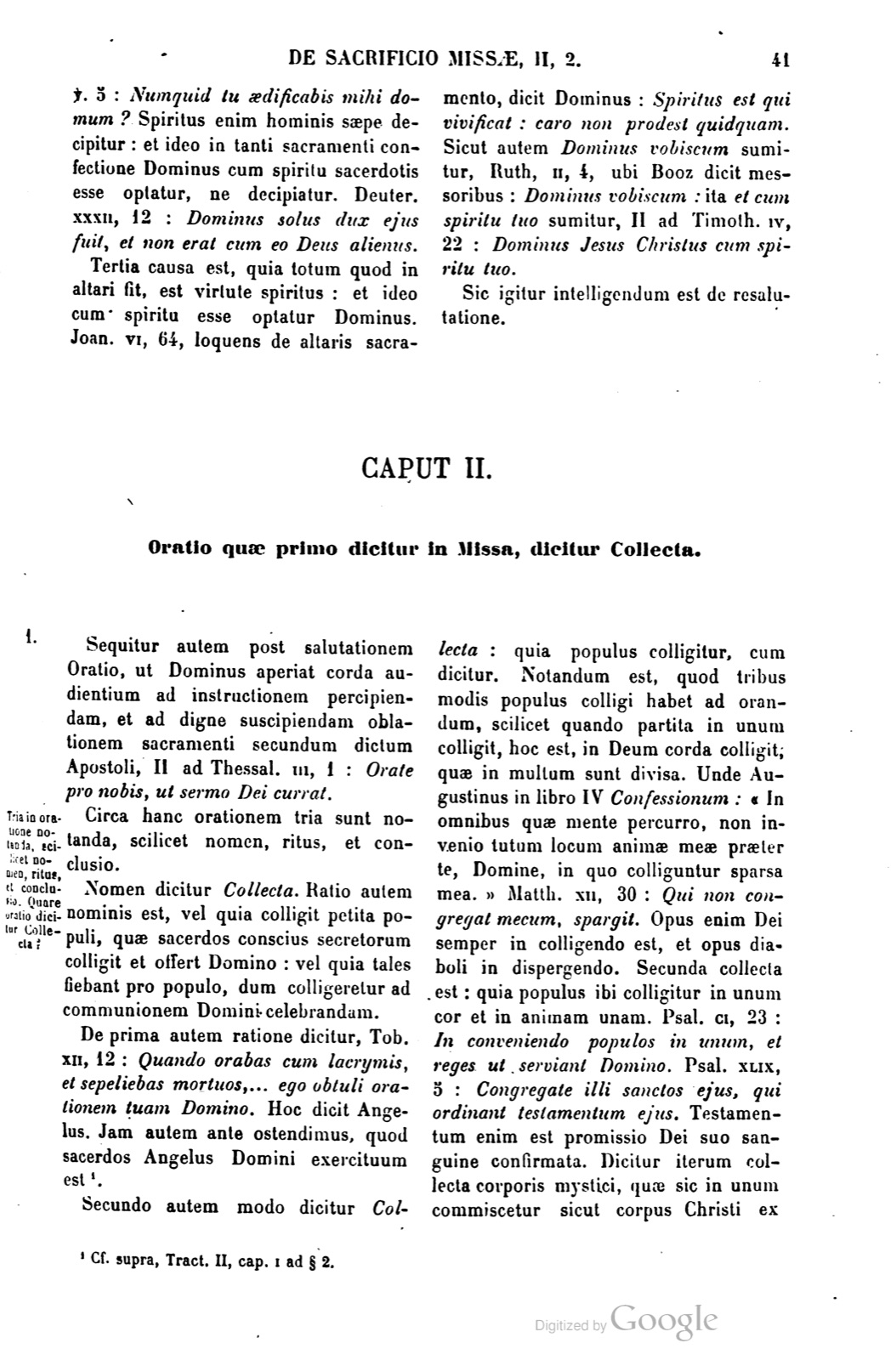
De secundo autem, scilicet quod non erret spiritus sacerdotis in tanto sacramento, sed Dominum habeat se dirigentem, patet, II Regum, VII, 3, quia cum Nathan propheta suo humano spiritu dixisset: Omne quod est in corde tuo, vade, fac, quia Dominus tecum est: statim correxit Dominus dicens, v. 3: Numquid tu aedificabis mihi domum? Spiritus enim hominis saepe decipitur: et ideo in tanti sacramenti confectione Dominus cum spiritu sacerdotis esse optatur, ne decipiatur. Deuter. XXXII, 12: Dominus solus dux ejus fuit, et non erat cum eo Deus alienus.
Tertia causa est, quia totum quod in altari fit, est virtute spiritus: et ideo cum spiritu esse optatur Dominus. Joan. VI, 64, loquens de altaris sacramento, dicit Dominus: Spiritus est qui vivificat: caro non prodest quidquam.
Sicut autem Dominus vobiscum sumitur, Ruth, II, 4, ubi Booz dicit messoribus: Dominus vobiscum: ita et cum spiritu tuo sumitur, II ad Timoth. IV, 22: Dominus Jesus Christus cum spiritu tuo.
Sic igitur intelligendum est de resalutatione.
Fourth, the Lord is said to be with us in participation of sacramental grace, as is said in Luke 1:28: The Lord is with you, blessed are you among women. For this is said concerning the divine participation by which she had God with herself in her heart.
Fifth, he is with us in battle. 2 Paralipomenon 20:17: O Judah and Jerusalem, do not fear, nor be afraid: tomorrow you will go out against them, and the Lord will be with you. This, therefore, is the mode of greeting.
5. [Marginal label: Why does the people respond, And with your spirit?] But one must consider why the people greets back in a different mode; for it does not say: May the Lord be with you, or anything of this sort, but says: And with your spirit.
There are three causes of this. The first is because the priest standing before the altar ought to be wholly in spirit. The second is because the spirit of a human being frequently errs. The third cause is because in the altar the whole thing is shown to be a work of the virtue of the spirit; for one standing at the altar ought to be nothing except spirit, and to sense nothing of the body or of the solicitude of the age. And this was signified in Genesis 22:3, where Abraham went to sacrifice his son, and said to his boys: Wait here with the donkey; I and the boy, hastening to that place, after we have adored, will return to you. The servants are the solicitudes and cares concerning the necessities of this life. But the donkey, an animal sluggish, undisciplinable, yet burden-bearing, is the weight of the body, which is sluggish and undisciplinable, yet nevertheless bears the burden of labor. But the boy is the pure spirit. The patriarch, however, is in the place of the priest. And therefore the priest who is about to sacrifice the Son of God ought to give leave to cares and solicitudes and to the burden of the body, and to proceed to the altar to sacrifice with spirit alone. And therefore the people says: And with your spirit.
But concerning the second, namely that the spirit of the priest should not err in so great a sacrament, but should have the Lord directing it, it is clear from 2 Kings 7:3, because when the prophet Nathan had said by his own human spirit: All that is in your heart, go, do, because the Lord is with you, the Lord immediately corrected him, saying, verse 3: Will you build me a house? For the spirit of a human being is often deceived; and therefore in the confecting of so great a sacrament the Lord is desired to be with the spirit of the priest, lest it be deceived. Deuteronomy 32:12: The Lord alone was his leader, and there was no strange god with him.
The third cause is because everything that is done at the altar is by the virtue of the spirit; and therefore the Lord is desired to be with the spirit. John 6:64, speaking of the sacrament of the altar, the Lord says: It is the Spirit who gives life; the flesh profits nothing.
But just as The Lord be with you is taken from Ruth 2:4, where Boaz says to the reapers, The Lord be with you, so also and with your spirit is taken from 2 Timothy 4:22: The Lord Jesus Christ be with your spirit.
Thus therefore it is to be understood concerning the greeting back.
Notes
- Compare Luke 24:36 and John 20:19. (Cf. Luc. XXIV, 36 et Joan. XX, 19.) ↩
If a page does not appear, its photograph has not been uploaded yet.