Works › The Book on the Sacrifice of the Mass
Volume 38 · pp. 57–60
Chapter VIII. On the acclamation of the choir through the Symbol, and what is said by that name?
A marker with ≈ is an approximate page boundary, placed by measure of the text; the page photographs remain the authority. In the paired views, clicking a page marker brings that page into view.
CAPUT VIII.
De acclamatione chori per Symbolum, et quid nomine illo dicatur?
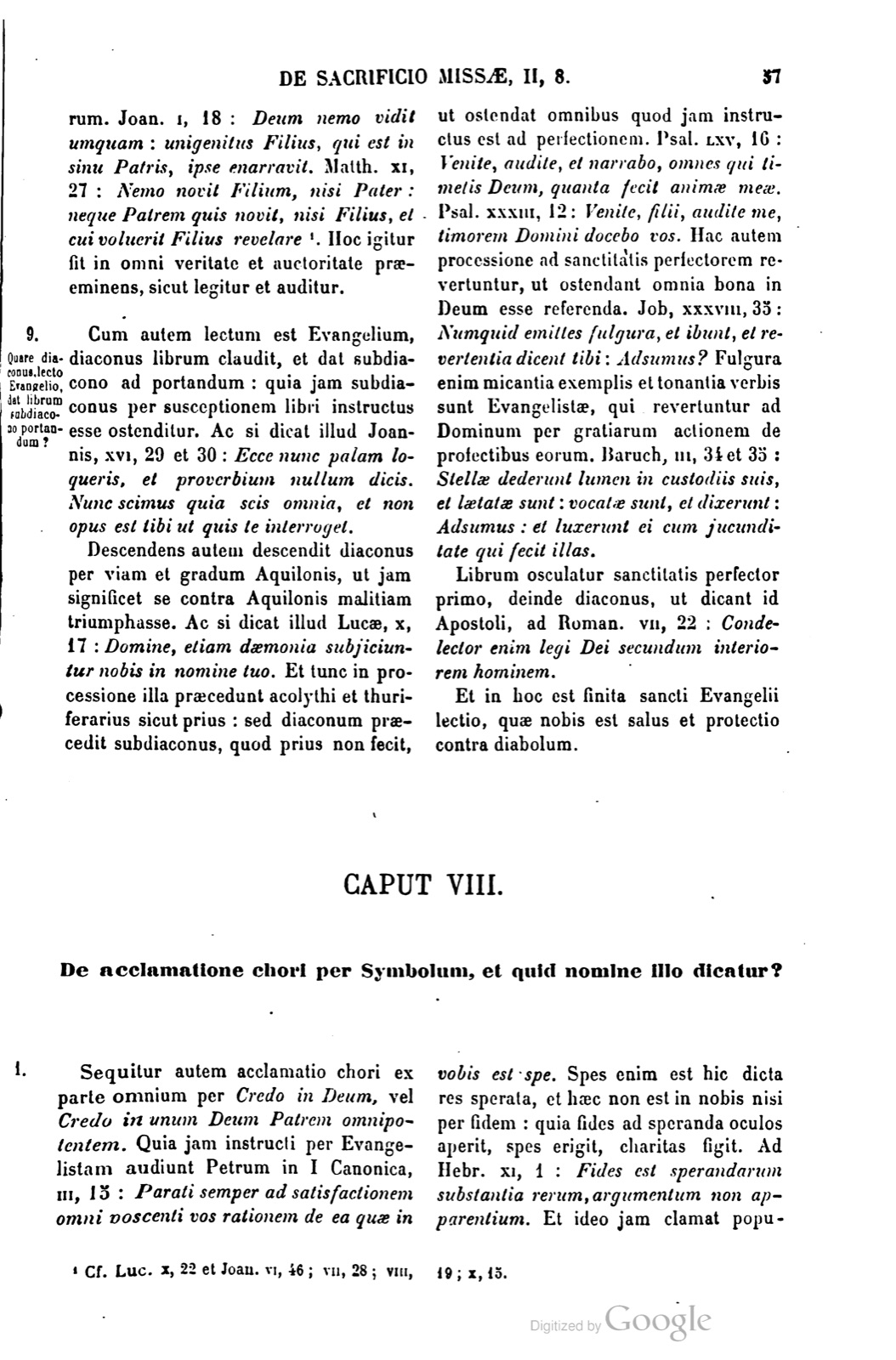
1. Sequitur autem acclamatio chori ex parte omnium per Credo in Deum, vel Credo in unum Deum Patrem omnipotentem. Quia jam instructi per Evangelistam audiunt Petrum in I Canonica, III, 15: Parati semper ad satisfactionem omni poscenti vos rationem de ea quae in vobis est spe. Spes enim est hic dicta res sperata, et haec non est in nobis nisi per fidem: quia fides ad speranda oculos aperit, spes erigit, charitas figit. Ad Hebr. XI, 1: Fides est sperandarum substantia rerum, argumentum non apparentium. Et ideo jam clamat populus instructus, quod toto corde credit.
Sed objicitur contra: quia secundum hoc non sanctitatis perfector, scilicet sacerdos, vel Episcopus deberet incipere symbolum, sed aliquis de populo: vel saltem de choro.
Sed ad hoc dicendum, quod sanctitatis perfector ideo incipit, ut ostendat quod fides donum Dei est, et quod a Deo per sanctitatis perfectores bona procedunt in populum ordinate per gradus Ecclesiae, sicut dicit Psalmista, Psal. CXXXII, 2: Sicut unguentum in capite, quod descendit in barbam, barbam Aaron, quod descendit in oram vestimenti ejus: sicut, I ad Corinth. XIV, 40: Omnia autem honeste et secundum ordinem fiant, scilicet in vobis. Et ideo dicit Dionysius in libro de Caelesti hierarchia, quod lex divinitatis est per prima media et per media ultima reducere.
[Marginal label: Quare sacerdos incipit Credo?] Incipiente sanctitatis perfectore symbolum, concinit statim chorus, ut ostendat, quod omnes illam fidem operantem per dilectionem recipiunt et receperunt per eum qui est perfectionis instructor: ac si quilibet dicat de se, Judicum, V, 3: Ego sum, ego sum quae Domino canam, psallam Domino Deo Israel.
2. [Marginal label: Symbolum, quid?] Hic autem circa symbolum tria sunt notanda, scilicet quid dicatur per nomen, et quae divisio symboli, et quare plura facta sunt symbola.
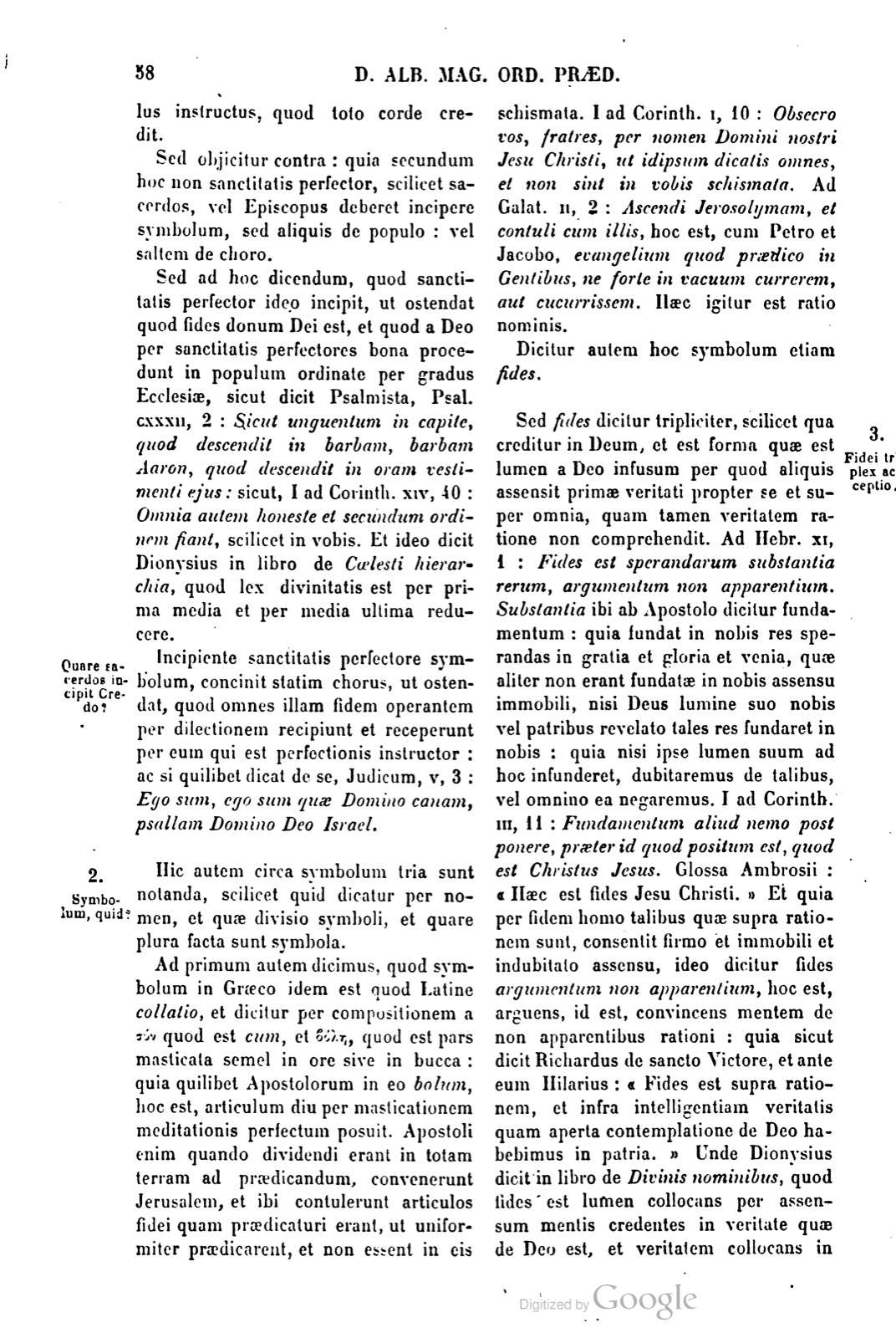
Ad primum autem dicimus, quod symbolum in Graeco idem est quod Latine collatio, et dicitur per compositionem a σών quod est cum, et βύλη, quod est pars masticata semel in ore sive in bucca: quia quilibet Apostolorum in eo bolum, hoc est, articulum diu per masticationem meditationis perfectum posuit. Apostoli enim quando dividendi erant in totam terram ad praedicandum, convenerunt Jerusalem, et ibi contulerunt articulos fidei quam praedicaturi erant, ut uniformiter praedicarent, et non essent in eis schismata. I ad Corinth. I, 10: Obsecro vos, fratres, per nomen Domini nostri Jesu Christi, ut idipsum dicatis omnes, et non sint in vobis schismata. Ad Galat. II, 2: Ascendi Jerosolymam, et contuli cum illis, hoc est, cum Petro et Jacobo, evangelium quod praedico in Gentibus, ne forte in vacuum currerem, aut cucurrissem. Haec igitur est ratio nominis.
CHAPTER VIII.
On the acclamation of the choir through the Symbol, and what is said by that name?
1. But the acclamation of the choir follows on the part of all through I believe in God, or I believe in one God, the Father almighty. Because now, instructed by the Evangelist, they hear Peter in the first canonical epistle, 3:15: Always ready unto satisfaction for everyone asking you for a reason concerning the hope that is in you. For hope here is called the thing hoped for, and this is not in us except through faith, because faith opens the eyes to things to be hoped for, hope raises them up, charity fixes them. Hebrews 11:1: Faith is the substance of things to be hoped for, the argument of things not appearing. And therefore the instructed people now cries out what it believes with the whole heart.
But it is objected to the contrary, because according to this it would not be the perfecter of holiness, namely the priest or bishop, who ought to begin the symbol, but someone from the people, or at least from the choir.
But to this one must say that the perfecter of holiness begins for this reason, so that he may show that faith is a gift of God, and that good things proceed from God into the people in an ordered way through the perfecters of holiness by the steps of the Church, as the Psalmist says, Psalm 132:2: Like ointment upon the head, which descends into the beard, the beard of Aaron, which descends into the hem of his garment; as in 1 Corinthians 14:40: But let all things be done honorably and according to order, namely among you. And therefore Dionysius says in the book On the Celestial Hierarchy that the law of divinity is to lead back through first things the middle things and through middle things the last things.
[Marginal label: Why does the priest begin the Creed?] When the perfecter of holiness begins the symbol, immediately the choir sings together, so that it may show that all receive and have received that faith working through love through him who is the instructor of perfection, as if each one were saying concerning himself, Judges 5:3: I am, I am the one who will sing to the Lord; I will sing a psalm to the Lord God of Israel.
2. [Marginal label: What is Symbol?] But here concerning the symbol three things must be noted, namely what is said by the name, what the division of the symbol is, and why several symbols were made.
To the first, however, we say that symbol in Greek is the same as collation in Latin, and it is said by composition from σών, which is with, and βύλη, which is a part chewed once in the mouth or in the cheek, because each of the Apostles placed in it a bolus, that is, an article perfected for a long time by the chewing of meditation. For when the Apostles were to be divided into the whole earth for preaching, they assembled at Jerusalem, and there they conferred the articles of the faith that they were going to preach, so that they might preach uniformly and there might not be schisms among them. 1 Corinthians 1:10: I beseech you, brothers, through the name of our Lord Jesus Christ, that you all say the same thing, and that there not be schisms among you. Galatians 2:2: I went up to Jerusalem and conferred with them, that is, with Peter and James, the Gospel that I preach among the Gentiles, lest perhaps I might run or had run in vain. This therefore is the reason for the name.
Dicitur autem hoc symbolum etiam fides.
3. [Marginal label: Fidei triplex acceptio.] Sed fides dicitur tripliciter, scilicet qua creditur in Deum, et est forma quae est lumen a Deo infusum per quod aliquis assensit primae veritati propter se et super omnia, quam tamen veritatem ratione non comprehendit. Ad Hebr. XI, 1: Fides est sperandarum substantia rerum, argumentum non apparentium. Substantia ibi ab Apostolo dicitur fundamentum: quia fundat in nobis res sperandas in gratia et gloria et venia, quae aliter non erant fundatae in nobis assensu immobili, nisi Deus lumine suo nobis vel patribus revelato tales res fundaret in nobis: quia nisi ipse lumen suum ad hoc infunderet, dubitaremus de talibus, vel omnino ea negaremus. I ad Corinth. III, 11: Fundamentum aliud nemo potest ponere, praeter id quod positum est, quod est Christus Jesus. Glossa Ambrosii: "Haec est fides Jesu Christi." Et quia per fidem homo talibus quae supra rationem sunt, consentit firmo et immobili et indubitato assensu, ideo dicitur fides argumentum non apparentium, hoc est, arguens, id est, convincens mentem de non apparentibus rationi: quia sicut dicit Richardus de sancto Victore, et ante eum Hilarius: "Fides est supra rationem, et infra intelligentiam veritatis quam aperta contemplatione de Deo habebimus in patria." Unde Dionysius dicit in libro de Divinis nominibus, quod fides est lumen collocans per assensum mentis credentes in veritate quae de Deo est, et veritatem collocans in credentibus 1. Haec igitur est fides habitualis virtus qua creditur in Deum.
4. [Marginal label: Articulus, quid?] Est iterum fides id quod creditur, scilicet quod Deus est trinus et unus, et quod unigenitus Dei conceptus et natus est ex Maria Virgine, et quod passus est, et alia hujusmodi quae credit sancta Ecclesia. Et sic dicitur fides articulus.
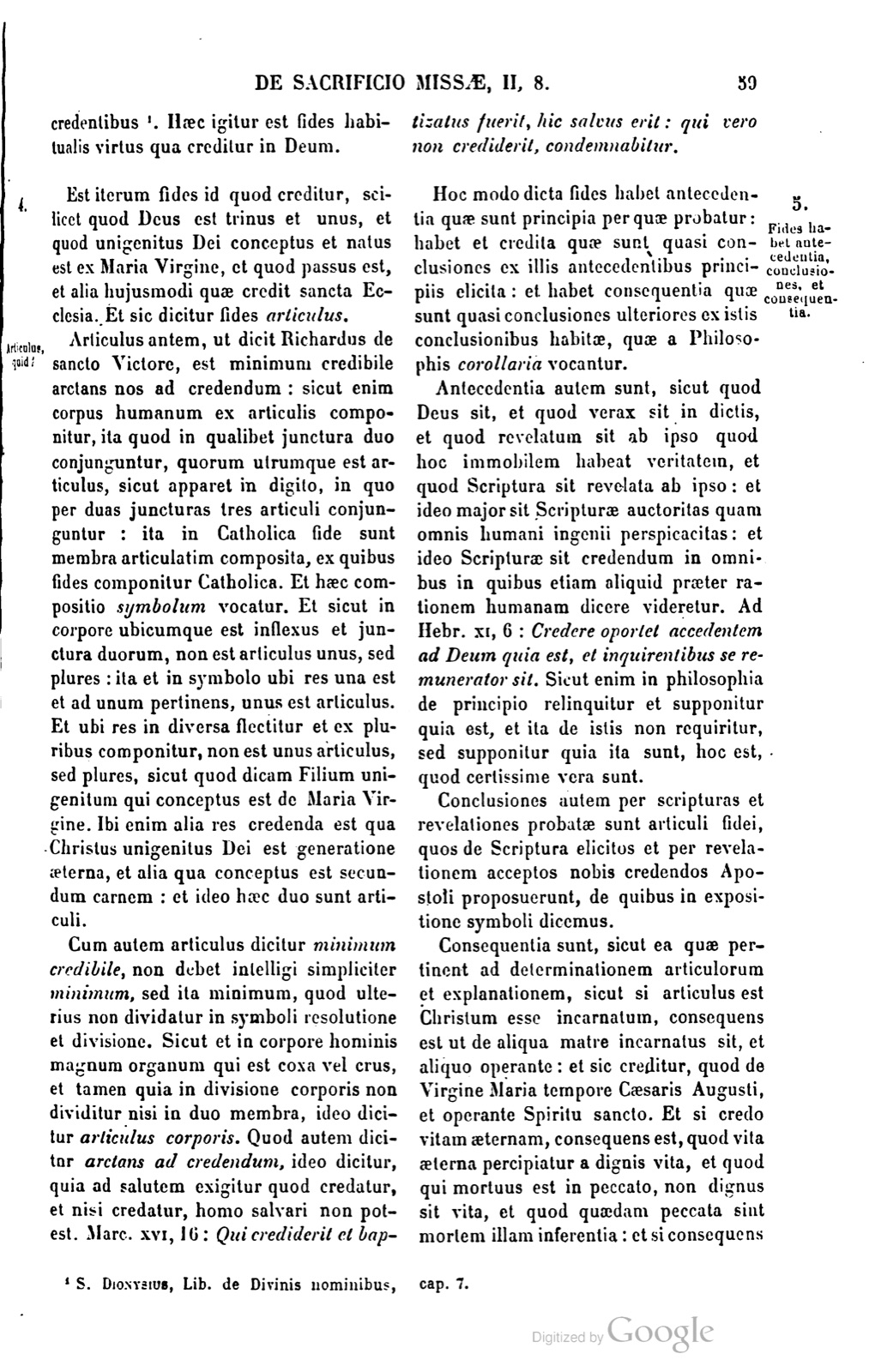
Articulus autem, ut dicit Richardus de sancto Victore, est minimum credibile arctans nos ad credendum: sicut enim corpus humanum ex articulis componitur, ita quod in qualibet junctura duo conjunguntur, quorum utrumque est articulus, sicut apparet in digito, in quo per duas juncturas tres articuli conjunguntur: ita in Catholica fide sunt membra articulatim composita, ex quibus fides componitur Catholica. Et haec compositio symbolum vocatur. Et sicut in corpore ubicumque est inflexus et junctura duorum, non est articulus unus, sed plures: ita et in symbolo ubi res una est et ad unum pertinens, unus est articulus. Et ubi res in diversa flectitur et ex pluribus componitur, non est unus articulus, sed plures, sicut quod dicam Filium unigenitum qui conceptus est de Maria Virgine. Ibi enim alia res credenda est qua Christus unigenitus Dei est generatione aeterna, et alia qua conceptus est secundum carnem: et ideo haec duo sunt articuli.
But this symbol is also called faith.
3. [Marginal label: The threefold acceptance of faith.] But faith is said in three ways, namely that by which one believes in God, and it is the form that is a light infused by God through which someone has assented to the first truth on account of itself and above all things, which truth nevertheless he does not comprehend by reason. Hebrews 11:1: Faith is the substance of things to be hoped for, the argument of things not appearing. Substance there is called by the Apostle foundation, because it founds in us the things to be hoped for in grace and glory and pardon, which otherwise were not founded in us by immovable assent, unless God, by his light revealed to us or to the fathers, founded such things in us; because unless he infused his light for this, we would doubt concerning such things or would wholly deny them. 1 Corinthians 3:11: No one can lay another foundation besides that which has been laid, which is Christ Jesus. The Gloss of Ambrose: "This is the faith of Jesus Christ." And because through faith a human being consents to such things that are above reason with firm and immovable and undoubted assent, therefore faith is called the argument of things not appearing, that is, arguing, that is, convincing the mind concerning things not apparent to reason; because as Richard of Saint Victor says, and Hilary before him: "Faith is above reason, and below the understanding of truth that we will have by open contemplation of God in the homeland." Hence Dionysius says in the book On the Divine Names that faith is a light placing believers, through the assent of the mind, in the truth that is concerning God, and placing truth in believers 1. This therefore is faith, the habitual virtue by which one believes in God.
4. [Marginal label: What is an article?] Again, faith is that which is believed, namely that God is three and one, and that the only-begotten of God was conceived and born from the Virgin Mary, and that he suffered, and the other things of this sort that the holy Church believes. And thus faith is called an article.
But an article, as Richard of Saint Victor says, is the least credible thing binding us to believe; for just as the human body is composed from joints, so that in any joint two things are joined, each of which is a joint, as appears in a finger, in which through two joints three joints are joined, so in the Catholic faith the members are composed articulately, from which the Catholic faith is composed. And this composition is called symbol. And just as in the body, wherever there is a bending and junction of two things, there is not one joint but several, so also in the symbol, where the thing is one and pertains to one thing, there is one article. And where the thing is bent into diverse things and is composed from several things, there is not one article but several, as when I say the only-begotten Son who was conceived of the Virgin Mary. For there one thing to be believed is that by which Christ is the only-begotten of God by eternal generation, and another by which he was conceived according to the flesh, and therefore these two are articles.
Cum autem articulus dicitur minimum credibile, non debet intelligi simpliciter minimum, sed ita minimum, quod ulterius non dividatur in symboli resolutione et divisione. Sicut et in corpore hominis magnum organum qui est coxa vel crus, et tamen quia in divisione corporis non dividitur nisi in duo membra, ideo dicitur articulus corporis. Quod autem dicitur arctans ad credendum, ideo dicitur, quia ad salutem exigitur quod credatur, et nisi credatur, homo salvari non potest. Marc. XVI, 16: Qui crediderit et baptizatus fuerit, hic salvus erit: qui vero non crediderit, condemnabitur.
5. [Marginal label: Fides habet antecedentia, conclusiones, et consequentia.] Hoc modo dicta fides habet antecedentia quae sunt principia per quae probatur: habet et credita quae sunt quasi conclusiones ex illis antecedentibus principiis elicita: et habet consequentia quae sunt quasi conclusiones ulteriores ex istis conclusionibus habitae, quae a Philosophis corollaria vocantur.
Antecedentia autem sunt, sicut quod Deus sit, et quod verax sit in dictis, et quod revelatum sit ab ipso quod hoc immobilem habeat veritatem, et quod Scriptura sit revelata ab ipso: et ideo major sit Scripturae auctoritas quam omnis humani ingenii perspicacitas: et ideo Scripturae sit credendum in omnibus in quibus etiam aliquid praeter rationem humanam dicere videretur. Ad Hebr. XI, 6: Credere oportet accedentem ad Deum quia est, et inquirentibus se remunerator sit. Sicut enim in philosophia de principio relinquitur et supponitur quia est, et ita de istis non requiritur, sed supponitur quia ita sunt, hoc est, quod certissime vera sunt.
Conclusiones autem per scripturas et revelationes probatae sunt articuli fidei, quos de Scriptura elicitos et per revelationem acceptos nobis credendos Apostoli proposuerunt, de quibus in expositione symboli dicemus.
Consequentia sunt, sicut ea quae pertinent ad determinationem articulorum et explanationem, sicut si articulus est Christum esse incarnatum, consequens est ut de aliqua matre incarnatus sit, et aliquo operante: et sic creditur, quod de Virgine Maria tempore Caesaris Augusti, et operante Spiritu sancto. Et si credo vitam aeternam, consequens est, quod vita aeterna percipiatur a dignis vita, et quod qui mortuus est in peccato, non dignus sit vita, et quod quaedam peccata sint mortem illam inferentia: et si consequens est, quod fornicatio et adulterium et furtum et alia quae morte Dominus condemnat, et vitam aeternam impediunt, sicut peccata mortalia. Et sic est facile videre in omnibus.
But when article is called the least credible thing, it ought not to be understood as simply least, but least in such a way that it is not further divided in the resolution and division of the symbol. Just so in the body of a human being there is a large organ, which is the thigh or leg; and nevertheless, because in the division of the body it is divided only into two members, therefore it is called a joint of the body. But it is said to bind to believing for this reason, because it is required for salvation that it be believed, and unless it is believed, a human being cannot be saved. Mark 16:16: He who has believed and has been baptized will be saved; but he who has not believed will be condemned.
5. [Marginal label: Faith has antecedents, conclusions, and consequents.] Faith said in this way has antecedents, which are principles through which it is proved; it also has things believed, which are, as it were, conclusions elicited from those antecedent principles; and it has consequents, which are, as it were, further conclusions had from those conclusions, which are called corollaries by the Philosophers.
But the antecedents are such as that God exists, and that he is truthful in what is said, and that what has been revealed by him has immovable truth, and that Scripture has been revealed by him; and therefore the authority of Scripture is greater than every perspicacity of human talent; and therefore Scripture is to be believed in all things in which it might even seem to say something beyond human reason. Hebrews 11:6: It is necessary for the one approaching God to believe that he is, and that he is a rewarder to those seeking him. For just as in philosophy, concerning a principle, that it exists is left and supposed, so also concerning these things it is not required, but is supposed that they are thus, that is, that they are most certainly true.
But the conclusions proved through Scriptures and revelations are the articles of faith, which, elicited from Scripture and received through revelation, the Apostles proposed to us to be believed; concerning these we will speak in the exposition of the symbol.
The consequents are such as those that pertain to the determination and explanation of articles. For instance, if the article is that Christ was incarnate, it is consequent that he was incarnate from some mother and by someone working; and thus it is believed that he was incarnate from the Virgin Mary in the time of Caesar Augustus and by the Holy Spirit working. And if I believe eternal life, it is consequent that eternal life is received by those worthy of life, and that one who is dead in sin is not worthy of life, and that certain sins bring in that death. And if it is consequent that fornication and adultery and theft and other things that the Lord condemns with death also impede eternal life, then they are mortal sins. And thus it is easy to see in all things.
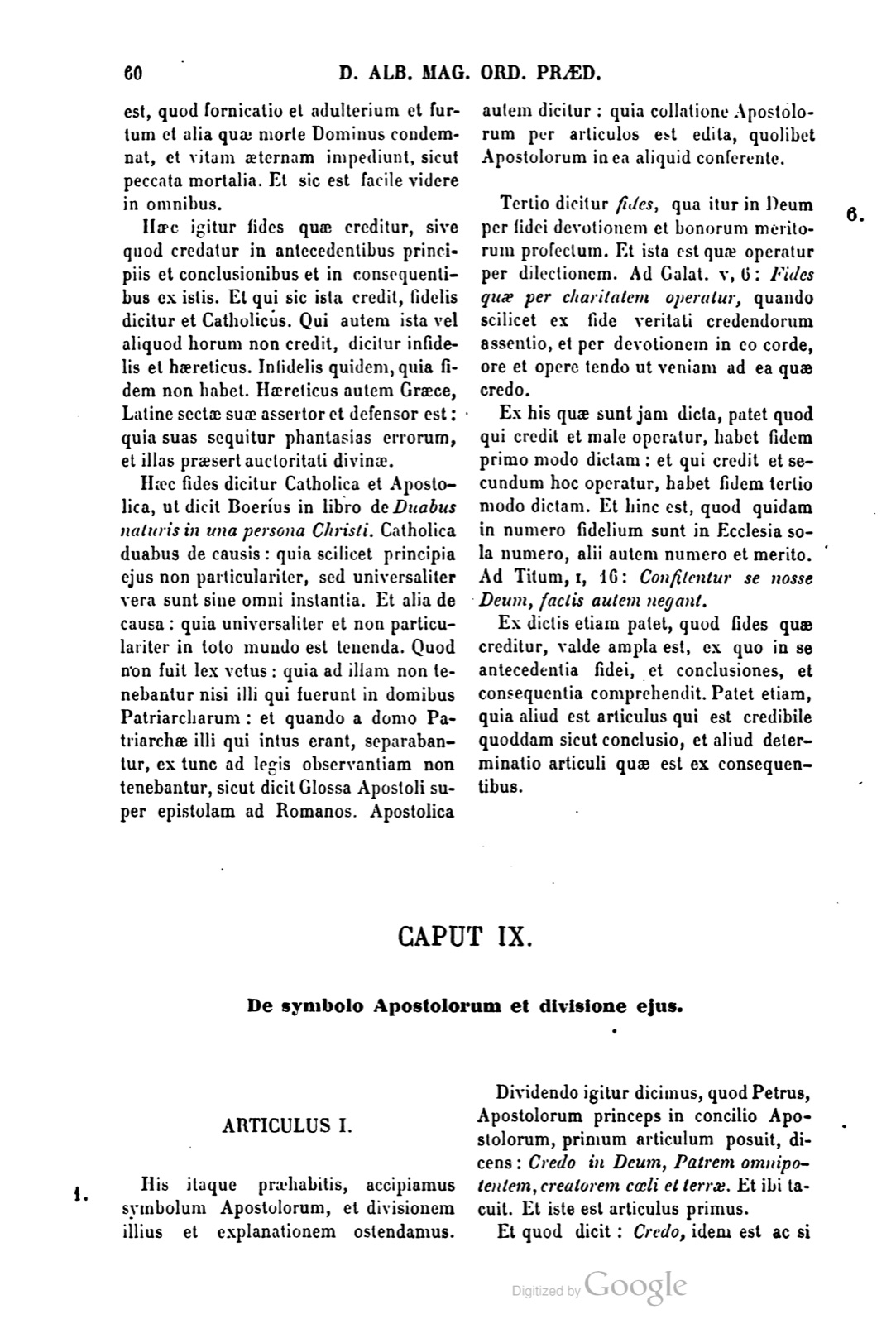
Haec igitur fides quae creditur, sive quod credatur in antecedentibus principiis et conclusionibus et in consequentibus ex istis. Et qui sic ista credit, fidelis dicitur et Catholicus. Qui autem ista vel aliquod horum non credit, dicitur infidelis et haereticus. Infidelis quidem, quia fidem non habet. Haereticus autem Graece, Latine sectae suae assertor et defensor est: quia suas sequitur phantasias errorum, et illas praefert auctoritati divinae.
Haec fides dicitur Catholica et Apostolica, ut dicit Boerius in libro de Duabus naturis in una persona Christi. Catholica duabus de causis: quia scilicet principia ejus non particulariter, sed universaliter vera sunt sine omni instantia. Et alia de causa: quia universaliter et non particulariter in toto mundo est tenenda. Quod non fuit lex vetus: quia ad illam non tenebantur nisi illi qui fuerunt in domibus Patriarcharum: et quando a domo Patriarchae illi qui intus erant, separabantur, ex tunc ad legis observantiam non tenebantur, sicut dicit Glossa Apostoli super epistolam ad Romanos. Apostolica autem dicitur: quia collatione Apostolorum per articulos est edita, quolibet Apostolorum in ea aliquid conferente.
6. Tertio dicitur fides, qua itur in Deum per fidei devotionem et bonorum meritorum profectum. Et ista est quae operatur per dilectionem. Ad Galat. V, 6: Fides quae per charitatem operatur, quando scilicet ex fide veritati credendorum assentio, et per devotionem in eo corde, ore et opere tendo ut veniam ad ea quae credo.
Ex his quae sunt jam dicta, patet quod qui credit et male operatur, habet fidem primo modo dictam: et qui credit et secundum hoc operatur, habet fidem tertio modo dictam. Et hinc est, quod quidam in numero fidelium sunt in Ecclesia sola numero, alii autem numero et merito. Ad Titum, I, 16: Confitentur se nosse Deum, factis autem negant.
Ex dictis etiam patet, quod fides quae creditur, valde ampla est, ex quo in se antecedentia fidei, et conclusiones, et consequentia comprehendit. Patet etiam, quia aliud est articulus qui est credibile quoddam sicut conclusio, et aliud determinatio articuli quae est ex consequentibus.
This therefore is the faith that is believed, whether because it is believed in antecedent principles and conclusions and in consequents from these. And one who believes those things in this way is called faithful and Catholic. But one who does not believe those things or some one of them is called unfaithful and heretical: unfaithful indeed because he does not have faith; but heretical, in Greek, in Latin is an assertor and defender of his own sect, because he follows his own fantasies of errors and prefers them to divine authority.
This faith is called Catholic and Apostolic, as Boerius says in the book On Two Natures in One Person of Christ. It is called Catholic for two causes: namely because its principles are true not particularly but universally, without any exception; and for another cause, because it is to be held universally and not particularly in the whole world. This was not the old law, because none were bound to it except those who were in the houses of the Patriarchs; and when those who were within were separated from the house of the Patriarch, from then on they were not bound to the observance of the law, as the Gloss of the Apostle says on the epistle to the Romans. But it is called Apostolic because it was issued by the collation of the Apostles through the articles, with each of the Apostles contributing something in it.
6. Third, faith is said to be that by which one goes into God through the devotion of faith and the progress of good merits. And this is the faith that works through love. Galatians 5:6: Faith that works through charity, when namely from faith I assent to the truth of things to be believed, and through devotion in it with heart, mouth, and work I tend so that I may come to those things that I believe.
From these things that have now been said, it is clear that one who believes and works badly has faith said in the first way; and one who believes and works according to this has faith said in the third way. And hence it is that certain persons are in the number of the faithful in the Church by number alone, but others by number and merit. Titus 1:16: They confess that they know God, but by deeds they deny him.
From the things said it is also clear that faith which is believed is very broad, since it comprehends in itself the antecedents of faith, and the conclusions, and the consequents. It is also clear that an article, which is a certain credible thing like a conclusion, is one thing, and the determination of an article, which is from consequents, is another thing.
Notes
- Saint Dionysius, book On the Divine Names, chapter 7. (S. Dionysius, Lib. de Divinis nominibus, cap. 7.) ↩
If a page does not appear, its photograph has not been uploaded yet.