Works › The Book on the Sacrifice of the Mass
Volume 38 · pp. 52–57
Chapter VII. The other part of instruction, namely concerning the doctrine of the perfect, or the Gospel
A marker with ≈ is an approximate page boundary, placed by measure of the text; the page photographs remain the authority. In the paired views, clicking a page marker brings that page into view.
CAPUT VII.
Instructionis altera pars, scilicet de doctrina perfectorum, sive Evangelio.
1. Post ista sequitur Evangelium sicut doctrina perfectorum. Jam ex gradibus virtutum et tractu poenitentiae, et concepto gaudio in Alleluia et Versu et Sequentia, cui ut responsio consonans ex parte instructorum sonat Credo in unum Deum: et in illo tota pars quae est de instructione, terminatur.
In Evangelica autem instructione sunt duo attendenda, scilicet ritus doctrinae et excellentia perfectionis.
Ritus autem consideratur in quinque, scilicet in libri acceptione, in benedictionis postulatione, in processionis dispositione, in statione, et in modo quem tenent in reversione.
[Marginal label: Diaconus Evangelium lecturus, quare librum accipit de altari?] Accipiendus est autem liber primo de altari ipso: quia altare signat sacramentum et armarium Scripturae et sanctificationis, de cujus scientia et auctoritate omnis vera sumenda est docendi perfectio. Isa. II, 3: De Sion exibit lex, et verbum Domini de Jerusalem. Et ideo qui de Sion, hoc est, de visione sacrae Scripturae non accepit, docere non debet. Verbum autem de Jerusalem procedit: quia doctor perfectionis, pacem annuntiat instruendis. Isa. LII, 7: Quam pulchri super montes pedes annuntiantis et praedicantis pacem, annuntiantis bonum, praedicantis salutem! Annuntiatio enim boni est Evangelium. Et hunc modum tenuit evangelista Angelus lucis, Luc. II, 10: Ecce evangelizo vobis gaudium magnum. Et post pauca, v. 14: Gloria in excelsis Deo, et in terra pax hominibus bonae voluntatis. Acceptio autem libri significata est, Apocal. V, 1, ubi dicitur: Vidi in dextera sedentis super thronum librum scriptum intus et foris, signatum sigillis septem. Altare enim thronum Dei significat, in cujus eminentia Deus rex et sacerdos invisibilis Christus est sedens: omnia sanctificationis discernens ut rex, et perficiens ut sacerdos, a cujus dextera accipit diaconus librum, quando virtute dexterae Dei vadit ad evangelizandum, et officium accipit evangelicum. Unde post pauca, Apocal. V, 7, dicitur: Venit, scilicet Agnus, et accepit de dextera sedentis in throno librum. De Agno enim est evangelicus liber. Et hic Agnus in ministro accipit, quando officium ad actum evangelicum accipit sacerdos.
2. [Marginal label: Benedictionem postulat sacerdoti.] Sic autem accepto libro, benedictionem postulat et obtinet diaconus a sanctitatis perfectore Episcopo vel sacerdote. Nec vere ad evangelizandi actum minister sufficit, nisi gratia in ipsum a sanctitatis perfectore Deo per benedictionem divinam descendat in ipsum. II ad Corinth. III, 5: Non quod sufficientes simus cogitare aliquid a nobis tamquam ex nobis: sed sufficientia nostra ex Deo est. Eccli. XLIII, 29: Multa dicemus, et deficiemus in verbis. Consummatio autem sermonum ipse est in omnibus. Sic Isaac filio suo Jacob benedixit 1. Sic Jacob filios suos singulos benedixit 2. Sic legislator tribubus benedixit 3. Sic unguentum gratiae descendere signatur a capite in barbam, et de barba in oram vestimenti 4. Dicitur enim, ad Hebr. VII, 7: Sine ulla contradictione, quod minus est a meliore benedicitur. Quod de benedictione sacrante intelligitur, sicut diximus in ante habitis.
CHAPTER VII.
The other part of instruction, namely concerning the doctrine of the perfect, or the Gospel.
1. After these things follows the Gospel as the doctrine of the perfect. Now from the steps of virtues and the tract of penitence, and from the joy conceived in Alleluia and the Verse and Sequence, to which, as a consonant response on the part of those instructed, there sounds I believe in one God; and in it the whole part that concerns instruction is terminated.
But in Evangelical instruction two things must be attended to, namely the rite of doctrine and the excellence of perfection.
The rite is considered in five things, namely in the receiving of the book, in the asking of the blessing, in the disposition of the procession, in the station, and in the manner that they keep in the return.
[Marginal label: Why does the deacon about to read the Gospel receive the book from the altar?] But the book must first be received from the altar itself, because the altar signifies the sacrament and the chest of Scripture and sanctification, from whose knowledge and authority every true perfection of teaching must be received. Isaiah 2:3: From Zion the law will go out, and the word of the Lord from Jerusalem. And therefore one who has not received from Zion, that is, from the vision of sacred Scripture, ought not to teach. But the word proceeds from Jerusalem, because the teacher of perfection announces peace to those to be instructed. Isaiah 52:7: How beautiful upon the mountains are the feet of the one announcing and preaching peace, announcing good, preaching salvation! For the announcement of good is Gospel. And the Evangelist, an Angel of light, held this manner, Luke 2:10: Behold, I evangelize to you great joy. And a little later, verse 14: Glory to God in the highest, and on earth peace to human beings of good will. But the receiving of the book was signified in Apocalypse 5:1, where it is said: I saw in the right hand of the one sitting upon the throne a book written within and without, sealed with seven seals. For the altar signifies the throne of God, on whose eminence God the invisible king and priest, Christ, is sitting, discerning all things of sanctification as king, and perfecting them as priest; from his right hand the deacon receives the book when by the virtue of the right hand of God he goes to evangelize, and receives the evangelical office. Hence a little later, Apocalypse 5:7, it is said: He came, namely the Lamb, and received the book from the right hand of the one sitting on the throne. For the evangelical book belongs to the Lamb. And this Lamb receives in the minister when the priest receives the office for the evangelical act.
2. [Marginal label: He asks a blessing from the priest.] But when the book has thus been received, the deacon asks and obtains a blessing from the perfecter of holiness, the bishop or priest. Nor is the minister truly sufficient for the act of evangelizing unless grace descend into him from God, the perfecter of holiness, through divine blessing. 2 Corinthians 3:5: Not that we are sufficient to think anything from ourselves as from ourselves, but our sufficiency is from God. Ecclesiasticus 43:29: We will say many things, and will fail in words. But he himself is the consummation of words in all things. Thus Isaac blessed his son Jacob 1. Thus Jacob blessed his individual sons 2. Thus the legislator blessed the tribes 3. Thus the grace of anointing is signified to descend from the head into the beard, and from the beard into the hem of the garment 4. For it is said in Hebrews 7:7: Without any contradiction, what is less is blessed by the better. This is understood concerning consecrating blessing, as we have said in what was had before.
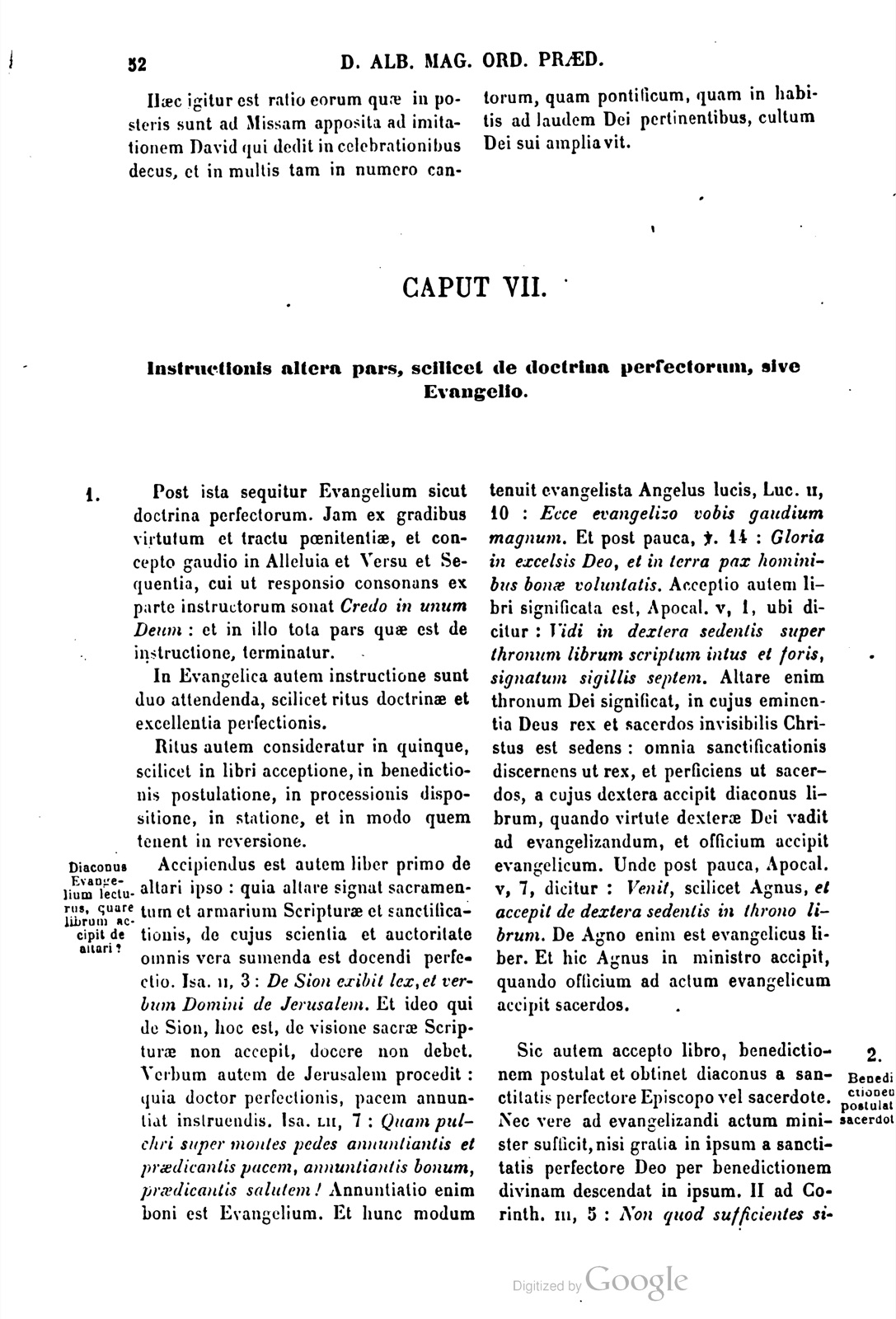
Accepta benedictione, ad benedictionem ejus qui est perfector sanctitatis, thus imponitur prunis, ut significetur quod omnis fragrans odor virtutum et orationum in sacrificio est a sacerdote Christo, qui invisibiliter omnem perficiat sanctitatem: et ideo conclusio orationum est: Per Dominum nostrum Jesum Christum, etc. Genes. XXVII, 27: Ecce odor filii mei sicut odor agri pleni, quem benedixit Dominus. Cantic. IV, 11: Odor vestimentorum tuorum sicut odor thuris. Hunc enim thurificandi ritum a Veteri Testamento servavit Ecclesia: quia non signat id quod factum est et ultra non est faciendum, sicut agnus paschalis, sed signat quod semper faciendum est et iterandum est, sicut suavitatem devotionis in oratione et in sacrificio. Psal. CXL, 2: Dirigatur oratio mea sicut incensum in conspectu tuo. Apocal. VIII, 3: Et alius Angelus venit, et stetit ante altare, habens thuribulum aureum: et data sunt illi incensa multa, ut daret de orationibus sanctorum omnium super altare aureum quod est ante thronum Dei. Et ibidem, v. 4: Et ascendit fumus incensorum de orationibus sanctorum de manu Angeli coram Deo.
3. [Marginal label: Procedit cum candelis et cruce.] His factis, processionaliter diaconus vadit ad legendum cum duabus flammis candelarum, in quarum medio crux a tertio portatur praecedentibus, quae flammae signant faces verbi in luce scientiae, et faces virtutis in operatione quae illuminant ad videndum ea quae in Evangelio dicuntur. De prima quidem candela dicitur, II ad Corinth. IV, 6: Deus qui dixit de tenebris lumen splendescere, ipse illuxit in cordibus nostris, ad illuminationem scientiae Evangelii in facie Christi Jesu. De secunda dicitur, Matth. V, 16: Sic luceat lux vestra coram hominibus, ut videant opera vestra bona, et glorificent Patrem vestrum qui in caelis est. Crux autem alte erecta portatur, ut significetur gloriam diaconi docentis et virtutem suae doctrinae esse in cruce. Ad Galat. VI, 14: Mihi autem absit gloriari nisi in cruce Domini nostri Jesu Christi, per quem mihi mundus crucifixus est, et ego mundo. De secundo dicitur, I ad Corinth. I, 23: Nos praedicamus Christum crucifixum, Judaeis quidem scandalum, Gentibus autem stultitiam, ipsis autem vocatis Judaeis atque Graecis, Christum Dei virtutem, et Dei sapientiam.
4. In hac processione procedit post ceroferarios is qui portat thuribulum fumans, ut significetur, quod odor bonae opinionis et non foetor infamiae debet praecedere Evangelistam. II ad Corinth. II, 14 et 15: Deo autem gratias, qui semper triumphat nos in Christo Jesu, et odorem notitiae suae manifestat per nos in omni loco: quia Christi bonus odor sumus Deo, in iis qui salvi fiunt, et in iis qui pereunt.
Statim autem post thuriferarium procedit diaconus super laevam habens librum Evangelii, et dextra amplexans eumdem: quia praedicatio non est necessaria, nisi dum sumus in laeva, hoc est, in vita praesenti temporali et obscura. Quando autem transimus ad dexteram, hoc est, ad aeternam vitam, erimus in amplexu in vultu Dei omnia cognoscentes quae beatitudinem perficiunt. Cantic. VIII, 3: Laeva ejus sub capite meo, et dextera illius amplexabitur me. Fulcitur enim laeva mens ignorans dum in temporali vita doctrina et verbo Dei erigitur et confirmatur: quia mens caput est animae. Dextera autem amplexabitur, quando visione et fruitione in facie Dei illuminatur et stringitur. Proverb. III, 15 et 16: Longitudo dierum in dextera ejus, id est, Dei, et in sinistra illius divitiae et gloria. Viae ejus viae pulchrae, et omnes semitae illius pacificae. Divitiae enim gratiae et scientiae gloria pertinent ad vitam praesentem: longitudo autem serenorum dierum ad aeternitatem pertinet lucis perpetuae in vita futura. In ordine autem istius processionis secundum antiqua statuta sequitur diaconum subdiaconus sicut ad doctrinam perfectionis instruendus.
After the blessing has been received, toward the blessing of him who is the perfecter of holiness, incense is placed on coals, so that it may be signified that every fragrant odor of virtues and prayers in the sacrifice is from Christ the priest, who invisibly perfects every holiness; and therefore the conclusion of prayers is: Through our Lord Jesus Christ, etc. Genesis 27:27: Behold, the odor of my son is like the odor of a full field, which the Lord has blessed. Canticles 4:11: The odor of your garments is like the odor of incense. For the Church kept this rite of incensing from the Old Testament, because it does not signify that which has been done and must not be done further, as the paschal lamb does, but signifies what must always be done and repeated, as the sweetness of devotion in prayer and in sacrifice. Psalm 140:2: Let my prayer be directed like incense in your sight. Apocalypse 8:3: And another Angel came and stood before the altar, having a golden thurible; and many incenses were given to him, that he might give from the prayers of all the saints upon the golden altar that is before the throne of God. And in the same place, verse 4: And the smoke of the incenses from the prayers of the saints ascended from the hand of the Angel before God.
3. [Marginal label: He proceeds with candles and cross.] These things having been done, the deacon goes processionally to read with two flames of candles, in whose middle the cross is carried by a third person going before; these flames signify the torches of the word in the light of knowledge, and the torches of virtue in operation, which illuminate for seeing the things that are said in the Gospel. Concerning the first candle it is said, 2 Corinthians 4:6: God who said light to shine out of darkness, himself shone in our hearts, unto the illumination of the knowledge of the Gospel in the face of Christ Jesus. Concerning the second it is said, Matthew 5:16: So let your light shine before human beings, that they may see your good works and glorify your Father who is in heaven. But the cross is carried raised high, so that it may be signified that the glory of the teaching deacon and the virtue of his doctrine are in the cross. Galatians 6:14: But may it be far from me to glory except in the cross of our Lord Jesus Christ, through whom the world is crucified to me, and I to the world. Concerning the second it is said, 1 Corinthians 1:23: We preach Christ crucified, to Jews indeed a scandal, but to Gentiles foolishness; yet to those called, Jews and Greeks, Christ the virtue of God and the wisdom of God.
4. In this procession, after the candle-bearers proceeds the one who carries the smoking thurible, so that it may be signified that the odor of good opinion, and not the stench of infamy, ought to precede the Evangelist. 2 Corinthians 2:14 and 15: But thanks be to God, who always triumphs us in Christ Jesus, and manifests the odor of his knowledge through us in every place, because we are the good odor of Christ to God, in those who are saved and in those who perish.
Immediately after the thurifer the deacon proceeds on the left, having the book of the Gospel, and embracing the same with his right hand, because preaching is not necessary except while we are on the left, that is, in the present temporal and obscure life. But when we pass over to the right, that is, to eternal life, we will be in an embrace in the face of God, knowing all things that perfect beatitude. Canticles 8:3: His left hand is under my head, and his right hand will embrace me. For the ignorant mind is supported by the left hand while in temporal life it is raised up and confirmed by doctrine and the word of God, because the mind is the head of the soul. But the right hand will embrace, when by vision and fruition in the face of God it is illumined and bound close. Proverbs 3:15 and 16: Length of days is in her right hand, that is, God's, and in her left hand riches and glory. Her ways are beautiful ways, and all her paths peaceful. For riches of grace and glory of knowledge pertain to the present life; but the length of serene days pertains to the eternity of perpetual light in the future life. In the order of this procession, according to ancient statutes, the subdeacon follows the deacon as one to be instructed for the doctrine of perfection.
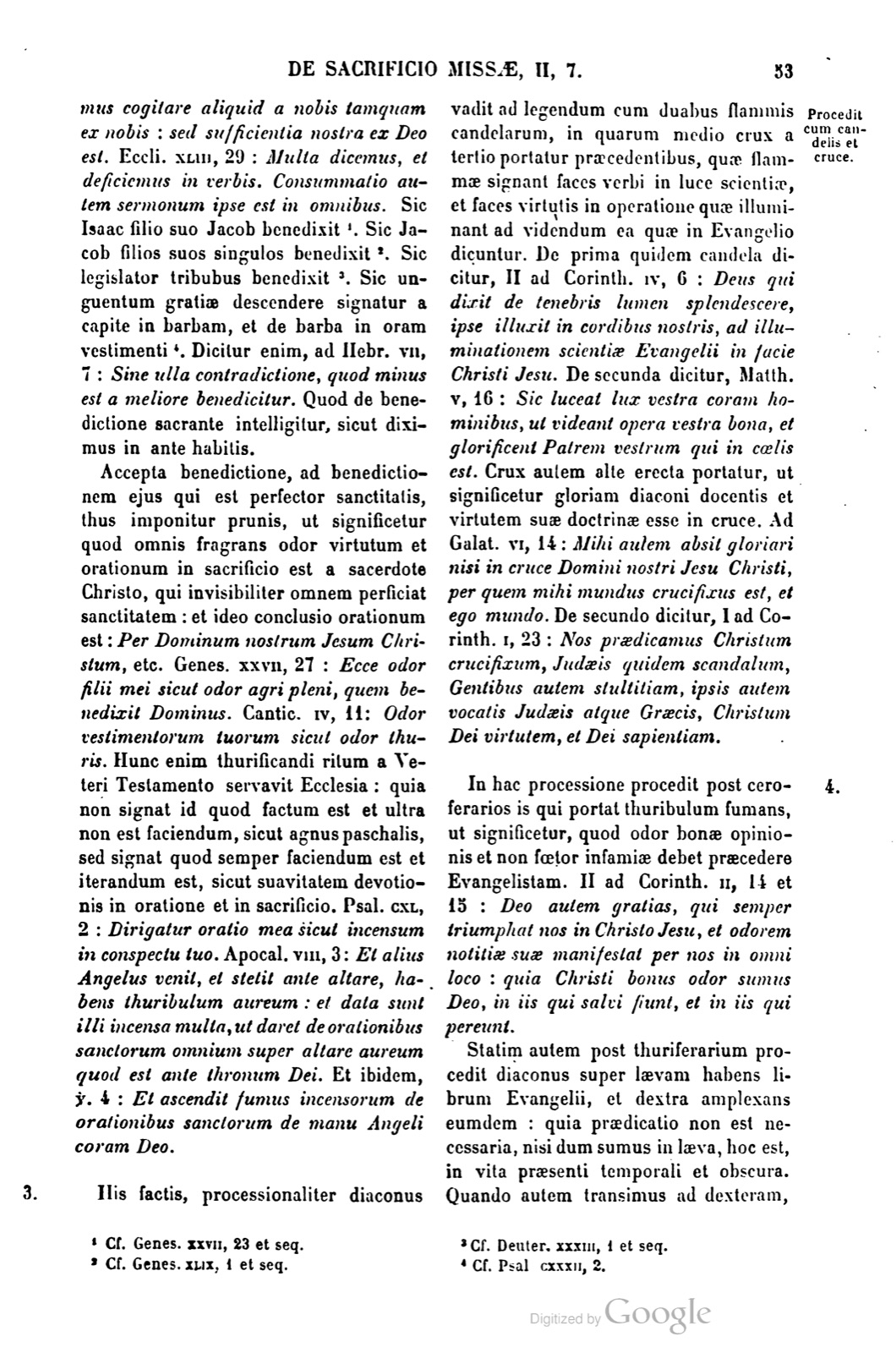
5. [Marginal label: Quare subdiaconus pulvillum portat?] Portat autem subdiaconus pulvillum ante pectus, ut significetur, quia non Evangelista cogitare habet de temporalibus subsidiis, sed is qui sequitur eum instruendus, hanc sollicitudinem debet suscipere pro ipso. Unde, ad Galat. VI, 6: Communicet autem is qui catechizatur verbo, ei qui se catechizat, in omnibus bonis. Catechizare est docere: et ideo doctus doctori debet ministrare et portare temporalia quae pulvillus significat, a quo spiritualium suscepit instructionem. I ad Corinth. IX, 11: Si nos vobis spiritualia seminamus, magnum est si carnalia vestra metamus? Quasi diceret: Non est magnum. Quod autem pulvillus positus est ad temporalium designationem, ortum habuit, Marc. IV, 38, ubi Dominus dum in procellis nataret, dormivit super cervical, quod est pulvillus in quo cervix requiescit. Dominus enim quamdiu in suis ministris gentibus praedicat in procella mundi, in eisdem natat. Et ideo cum a labore aliquando necesse sit quiescere et refici naturam, quiescit in pulvillo solatii temporalis, de quibus pectora subditorum debent cogitare, ne Evangelistae studium veritatis cogantur intermittere. Hoc signatum est, Genes. XLVII, 22, ubi dicitur, quod Joseph terram Aegypti emit in potestate regis per venditionem frumenti, praeter terram sacerdotum, quae a rege tradita fuerat eis: quibus et statuta cibaria ex horreis publicis praebebantur, et idcirco non sunt compulsi vendere possessiones suas. Scribenda est enim sapientia in tempore vacuitatis, ut dicitur, Eccli. XXXVIII, 25: nec potest simul animus in temporalium sollicitudine intendere, et in sapientiae contemplatione studere. Et ideo instruendus portat pulvillum. Dicit enim Philosophus in III Topicorum, quod tempore necessitatis melius est ditari quam philosophari. Et ideo dicit alibi, quod omnibus ad necessitatem et ad voluptatem habitis, sacerdotum gens in scholam intrare concessa est: quia si adhuc cogitandum esset de solatio vel necessitate temporalium, non sufficienter studio spiritualium intendi posset.
6. Sic ergo de sanctitatis perfectore, qui juxta aram stat, procedentes, procedunt ad ambonem, qui secundum antiquorum Patrum traditionem duos debet habere ascensus: unum quidem ad Meridiem, alterum autem ad Aquilonem: quia exaltantur in prosperis et in adversis: per Meridiem enim, quae est plaga lucis et caloris, significantur illuminatio et calefactio Spiritus sancti. Lux enim veritatis, et charitatis calor ducunt ad evangelizandum per rectam viam. Job, XXXVIII, 24: Indica mihi per quam viam spargitur lux, dividitur aestus super terram? Job, XXXVII, 17: Nonne vestimenta tua calida sunt, cum perflata fuerit terra austro? Per hanc igitur viam sive gradum ascendentes ministri omnes, tam subdiaconus quam ceroferarius, quam etiam thurificator post diaconum se ordinant. Sed crux sola ante oculos ejus tenetur, stante baculo crucis super pavimentum, ut significetur quod omnes sunt ab Evangelista erudiendi, tam ministri Ecclesiae, quam idiotae sive laici. Isa. LV, 1: Omnes sitientes, venite ad aquas. Et praecedit, LIV, 17: Haec est haereditas servorum Domini: et justitia eorum apud me, dicit Dominus. Quia omnes aquis Evangelistae sunt potandi.
5. [Marginal label: Why does the subdeacon carry the cushion?] But the subdeacon carries a cushion before the breast, so that it may be signified that the Evangelist ought not to think about temporal supports, but he who follows him as one to be instructed ought to take up this solicitude for him. Hence, Galatians 6:6: But let him who is catechized in the word communicate to him who catechizes him in all good things. To catechize is to teach; and therefore the one taught ought to minister to the teacher and carry the temporal things that the cushion signifies, from whom he received instruction in spiritual things. 1 Corinthians 9:11: If we have sown spiritual things for you, is it a great thing if we reap your carnal things? As if he were saying: It is not great. But that the cushion is placed for the signification of temporal things had its origin in Mark 4:38, where the Lord, while he was sailing amid storms, slept upon a pillow, which is a cushion on which the neck rests. For as long as the Lord preaches to the nations in his ministers in the storm of the world, he sails in the same ministers. And therefore, since sometimes it is necessary to rest from labor and refresh nature, he rests in the cushion of temporal consolation. The breasts of subjects ought to think about these things, lest they force the Evangelist's zeal for truth to be interrupted. This was signified in Genesis 47:22, where it is said that Joseph bought the land of Egypt into the king's power by the sale of grain, except the land of the priests, which had been given to them by the king; to them also established foods were supplied from public barns, and for that reason they were not compelled to sell their possessions. For wisdom must be written in the time of leisure, as is said in Ecclesiasticus 38:25; nor can the soul at the same time attend to solicitude for temporal things and devote itself to the contemplation of wisdom. And therefore the one to be instructed carries the cushion. For the Philosopher says in book III of the Topics that in a time of necessity it is better to be enriched than to philosophize. And therefore he says elsewhere that, when all things for necessity and for pleasure have been had, a race of priests is permitted to enter school, because if one still had to think about the consolation or necessity of temporal things, one could not attend sufficiently to the study of spiritual things.
6. Thus therefore, going forth from the perfecter of holiness, who stands beside the altar, they proceed to the ambo, which according to the tradition of the ancient Fathers ought to have two ascents: one indeed toward the South, the other toward the North, because they are exalted in prosperous things and in adverse things. For by the South, which is a region of light and heat, are signified the illumination and warming of the Holy Spirit. For the light of truth and the warmth of charity lead to evangelizing by the right way. Job 38:24: Indicate to me by what way light is scattered, heat is divided upon the earth? Job 37:17: Are not your garments warm when the earth has been blown through by the south wind? Therefore by this way or step all the ministers ascending, as much the subdeacon as the candle-bearer, as also the thurifer, arrange themselves after the deacon. But the cross alone is held before his eyes, with the staff of the cross standing upon the pavement, so that it may be signified that all are to be instructed by the Evangelist, as much the ministers of the Church as the unlearned or lay people. Isaiah 55:1: All who thirst, come to the waters. And before it, 54:17: This is the inheritance of the servants of the Lord, and their justice is with me, says the Lord. Because all are to be given drink by the waters of the Evangelist.
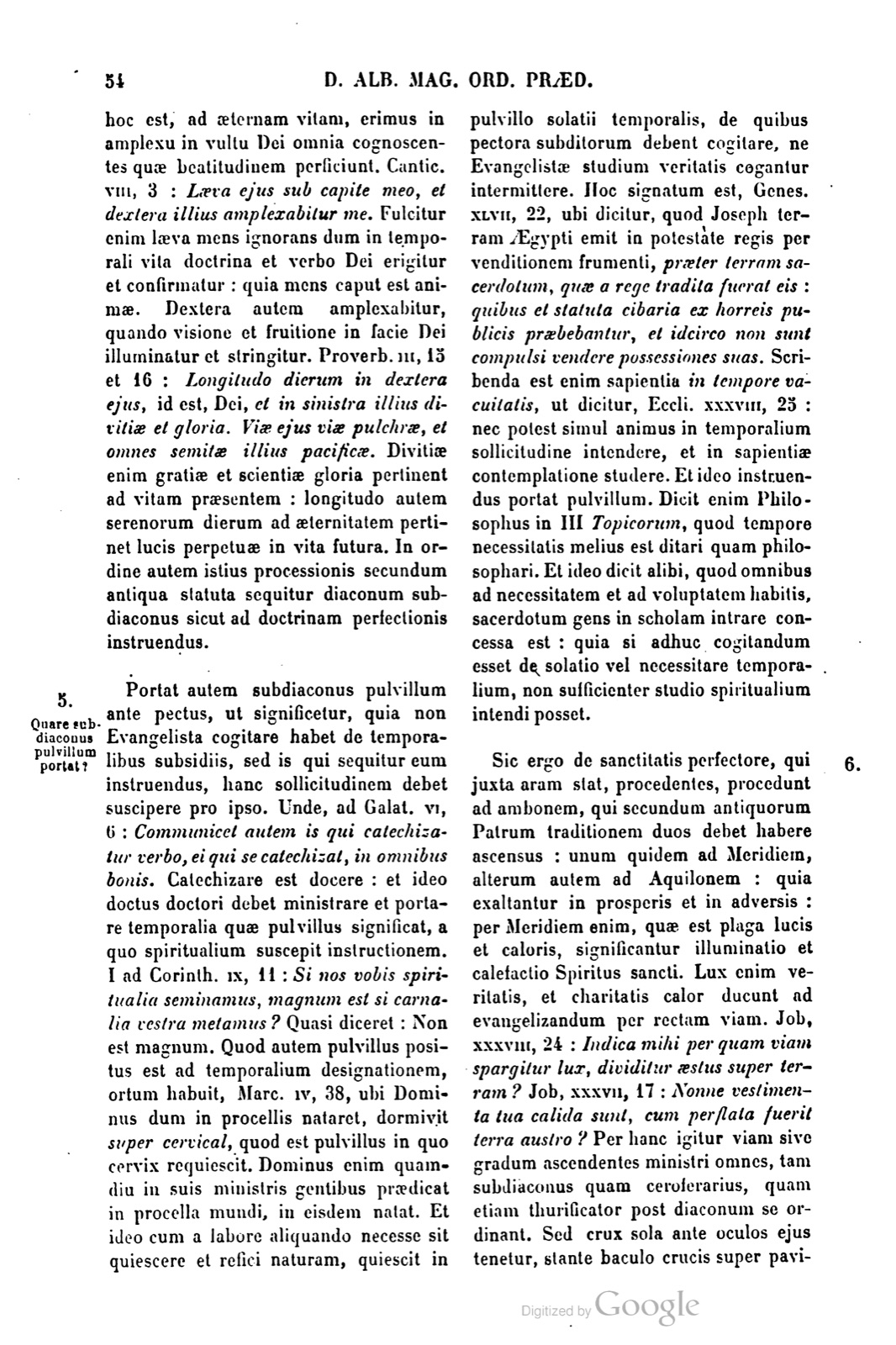
Thus tamen in inceptione Evangelii super librum ad faciem ejus qui legit Evangelium, dirigitur, ut fragrantia virtutum Evangelii a diacono pronuntiari significetur. Isa. XLI, 27: Primus ad Sion dicit: Ecce adsunt, et ad Jerusalem evangelistam dabo. Primus est subdiaconus rudium doctrinam pronuntians, et in hoc se quod asserit ostendens: Evangelista autem est doctor perfectionis, diaconus, a cujus ore fumat incensum bonum nuntii. Crux autem stans super pavimentum cum baculo crucis, significat quod est accipienda a quolibet per Evangelium: tamquam dicat diaconus illud Matthaei, XVI, 24: Qui vult post me venire, abneget semetipsum, et tollat crucem suam, et sequatur me. Et ideo liber ab omnium manibus appodiatus, ante diaconum ponitur.
Quod autem baculus crucis terram tangit ac si diaconus se in eam appodiat manu, significat quod virtus crucis eum in Evangelio sustentet, et quod omnia virtute crucis tam in clero quam in populo tamquam in duabus turmis perficiat. Genes. XXXII, 10: In baculo meo transivi Jordanem istum, et nunc cum duabus turmis regredior. Haec est etiam significatio, quod, Exod. XII, 11, baculos in manibus tenere praecipiuntur, qui comedunt agnum paschalem. In alto autem stat, ut per loci altitudinem altitudo spiritus et vitae designetur: quia, sicut dicit Gregorius: "Cujus vita despicitur, restat ut etiam ejus praedicatio contemnatur." Isa. XL, 9: Super montem excelsum ascende, tu qui evangelizas Sion: exalta in fortitudine vocem suam, qui evangelizas Jerusalem. Hinc est, quod, Cantic. IV, 15, dicitur de scientia Evangelica, quod est puteus aquarum viventium, quae fluunt impetu de Libano. Puteus est propter mysterii profunditatem, aquarum propter veritatis limpiditatem, viventium propter spiritus qui in littera sonat vivificationem, quae fluunt propter doctrinae modum et proprietatem, quia abundanter fluunt. Impetu autem fluunt propter divinae charitatis ad docendum promptitudinem. Ad Romanos, I, 14 et 15: Sapientibus et insipientibus debitor sum. Ita, quod in me, promptum est et vobis, qui Romae estis, evangelizare. De Libano autem fluunt propter instructorum candidationem. Psal. XLIX, 16: Peccatori autem dixit Deus: Quare tu enarras justitias meas, et assumis testamentum meum per os tuum? Eccli. XV, 9: Non est speciosa laus in ore peccatoris.
7. [Marginal label: Quare diaconus legens Evangelium, vertitur ad Aquilonem?] Sic stans et legens vertitur ad Aquilone, ut dicit Dionysius, quia Aquilo plaga frigida et tenebrosa malitiam tenebrosam significat diaboli et frigidam. Jerem. I, 14: Ab Aquilone pandetur omne malum super universos habitatores terrae. Eccli. XLIII, 22: Frigidus ventus Aquilo flavit, et gelavit crystallus ab aqua: quia omnium corda infrigidat et algere facit charitatis scintillam, et obtenebrat quantum potest lumen veritatis. Contra igitur illam plagam doctor perfectionis disponitur, ut tenebras fuget lumine veritatis. Joan. I, 5: Lux in tenebris lucet, et tenebrae eam non comprehenderunt. Et ut per calorem charitatis frigus Aquilonis arceat a cordibus auditorum. Ac si dicat illud Canticorum, IV, 16: Surge, Aquilo, et veni, Auster: perfla hortum meum, et fluent aromata illius. Ab ortu enim cordium surgere debet Aquilo, hoc est, expelli: Auster autem humidus et calidus vocari, ut cuncta aromata virtutum calore fragrent, et humore gratiae accipiant incrementum. Sic igitur in statione et hac de causa disponitur diaconus.
Nevertheless at the beginning of the Gospel the incense is directed over the book toward the face of him who reads the Gospel, so that the fragrance of the virtues of the Gospel may be signified to be pronounced by the deacon. Isaiah 41:27: The first says to Zion: Behold, they are present, and to Jerusalem I will give an evangelist. The first is the subdeacon, pronouncing the doctrine of the untaught and showing himself in this which he asserts. But the Evangelist is the teacher of perfection, the deacon, from whose mouth smokes the incense of a good message. But the cross standing upon the pavement with the staff of the cross signifies that it is to be accepted by anyone through the Gospel, as though the deacon were saying that word of Matthew 16:24: Whoever wishes to come after me, let him deny himself and take up his cross and follow me. And therefore the book, supported by the hands of all, is placed before the deacon.
But that the staff of the cross touches the earth, as if the deacon supports himself on it with his hand, signifies that the virtue of the cross sustains him in the Gospel, and that by the virtue of the cross it perfects all things both in the clergy and in the people as in two troops. Genesis 32:10: With my staff I crossed that Jordan, and now I return with two troops. This also is the signification, that, Exodus 12:11, those who eat the paschal lamb are commanded to hold staffs in their hands. But he stands on high, so that by the height of the place the height of spirit and of life may be designated, because, as Gregory says: "When someone's life is despised, it remains that even his preaching be contemned." Isaiah 40:9: Climb up upon a high mountain, you who evangelize Zion; exalt your voice in strength, you who evangelize Jerusalem. Hence it is that in Canticles 4:15, concerning Evangelical knowledge, it is said that it is a well of living waters, which flow with force from Lebanon. It is a well on account of the depth of the mystery; of waters on account of the clearness of truth; of living waters on account of the spirit that in the letter sounds vivification; they flow on account of the mode and propriety of doctrine, because they flow abundantly. But they flow with force on account of the promptness of divine charity for teaching. Romans 1:14 and 15: I am debtor to the wise and to the unwise. So far as is in me, I am ready also to evangelize to you who are at Rome. But they flow from Lebanon on account of the whitening of those instructed. Psalm 49:16: But to the sinner God said: Why do you narrate my justices and take up my testament through your mouth? Ecclesiasticus 15:9: Praise is not beautiful in the mouth of a sinner.
7. [Marginal label: Why is the deacon reading the Gospel turned toward the North?] Standing and reading thus, he is turned toward the North, as Dionysius says, because the North, a cold and dark region, signifies the devil's dark and cold malice. Jeremiah 1:14: From the North every evil will be spread over all the inhabitants of the earth. Ecclesiasticus 43:22: The cold north wind blew, and crystal froze from the water, because it cools the hearts of all and makes the spark of charity grow cold, and darkens the light of truth as much as it can. Therefore the teacher of perfection is disposed against that region, so that he may put darkness to flight by the light of truth. John 1:5: Light shines in darkness, and the darknesses did not comprehend it. And so that by the heat of charity he may drive off the cold of the North from the hearts of hearers. As if he were saying that word of Canticles 4:16: Rise, North wind, and come, South wind; blow through my garden, and its spices will flow. For the North ought to rise from the rising of hearts, that is, to be expelled; but the South wind, humid and warm, is to be called, so that all the spices of virtues may be fragrant with heat and receive increase by the moisture of grace. Thus therefore the deacon is disposed in the station and for this cause.
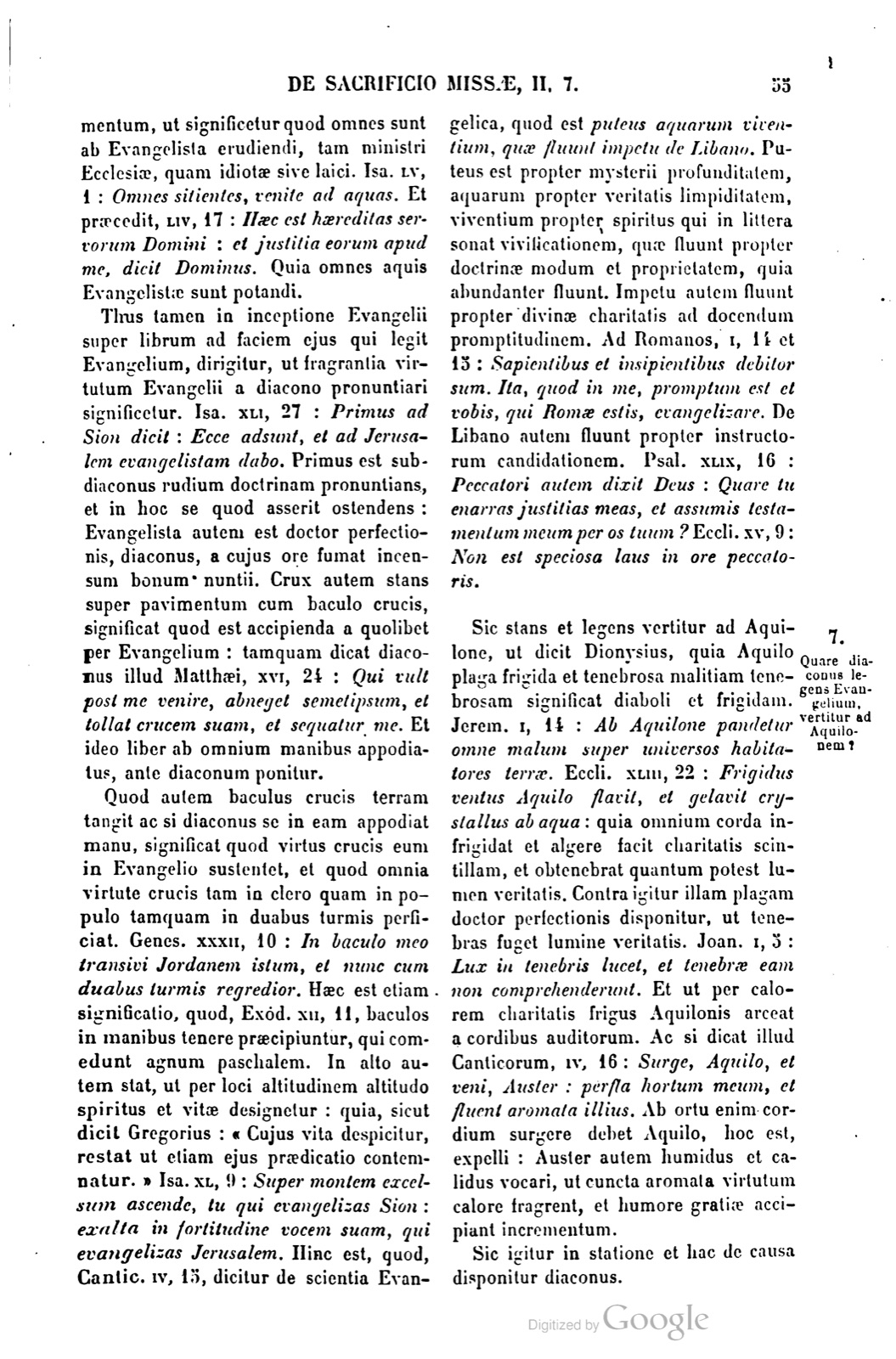
[Marginal label: Quare signat cruce frontem, os, et pectus?] Legens autem debet signare cruce frontem, os, et pectus. Similiter audientes. Frontem quidem: quia ibi est sedes verecundiae et gloriae, ut significet se non erubescere Evangelium, sed gloriari in cruce quam Evangelium praedicat. Ad Roman. I, 16: Non enim erubesco Evangelium: virtus enim Dei est in salutem omni credenti, Judaeo primum, et Graeco. Os autem, ut ore confiteatur veritatem in salutem. Psal. L, 17: Domine, labia mea aperies, et os meum annuntiabit laudem tuam. Pectus autem, ut corde credat. Unde, ad Romanos, X, 10: Corde enim creditur ad justitiam, ore autem confessio fit ad salutem. Et ibidem, v. 9: Quia si confitearis in ore tuo Dominum Jesum, et in corde tuo credideris quod Deus illum suscitavit a mortuis, salvus eris. Psal. CXV, 1: Credidi, propter quod locutus sum. Sic ergo signat se legens.
Populus autem ad hanc diaconi stationem stat revelando caput: et si induitur veste manus detinente, vestem illam deponit usque ad manuum liberationem et revelationem. Stant autem signando erectione corporis, ut mentem dirigant ad Deum. Psal. V, 3: Mane adstabo tibi, et videbo quoniam non Deus volens iniquitatem tu es. Stant etiam adversus malitiam Aquilonis pugnaturi. Psal. XCIII, 16: Quis consurget mihi adversus malignantes? aut quis stabit mecum adversus operantes iniquitatem? Stant etiam Evangelium secuturi. III Regum, X, 8: Beati viri tui, et beati servi tui, qui stant coram te semper et audiunt sapientiam tuam. Vela autem et pileos capitum deponunt, ut inter caput eorum et Deum nihil sit medium, et aures habeant reseratas. Luc. X, 23 et 24: Beati oculi, qui vident quae vos videtis. Dico enim vobis, quod multi prophetae et reges voluerunt videre quae vos videtis, et non viderunt: et audire quae auditis, et non audierunt. Proverb. XX, 12: Aurem audientem, et oculum videntem: Dominus fecit utrumque. Manuum autem liberatio signat expeditionem ad opus. Exod. XXIV, 7: Omnia quae locutus est Dominus, faciemus, et erimus obedientes.
8. [Marginal label: Evangelii sex praerogativae prae reliqua Scriptura.] Sic igitur stantibus et dispositis omnibus, legit Evangelium quod in sex praeeminentiam habet ad omnem Scripturam.
Primo quidem ex nomine: quia est boni nuntium. Boni, inquam, quod est omnis boni bonum, et non particulare bonum, et hoc est bonum solum divinum. Matth. XIX, 17: Quid me interrogas de bono? Unus est bonus, Deus. Psal. CXVII, 68: Bonus es tu, et in bonitate tua doce me justificationes tuas.
[Marginal label: Why does he sign with the cross the forehead, mouth, and breast?] But the one reading ought to sign with the cross the forehead, mouth, and breast. The hearers do similarly. The forehead indeed, because there is the seat of shame and glory, so that he may signify that he does not blush at the Gospel, but glories in the cross that the Gospel preaches. Romans 1:16: For I do not blush at the Gospel; for it is the virtue of God unto salvation for everyone believing, first for the Jew and for the Greek. But the mouth, so that with the mouth truth may be confessed unto salvation. Psalm 50:17: Lord, you will open my lips, and my mouth will announce your praise. But the breast, so that he may believe with the heart. Hence, Romans 10:10: For with the heart one believes unto justice, but confession is made with the mouth unto salvation. And in the same place, verse 9: Because if you confess the Lord Jesus with your mouth, and in your heart believe that God raised him from the dead, you will be saved. Psalm 115:1: I believed, for which reason I spoke. Thus therefore the reader signs himself.
But the people stands at this station of the deacon, uncovering the head; and if it is clothed with a garment holding the hands, it puts off that garment up to the freeing and revealing of the hands. They stand, moreover, by signifying the erection of the body, so that they may direct the mind to God. Psalm 5:3: In the morning I will stand before you and will see, because you are not a God willing iniquity. They also stand to fight against the malice of the North. Psalm 93:16: Who will rise up for me against the malignant? or who will stand with me against those working iniquity? They also stand to follow the Gospel. 3 Kings 10:8: Blessed are your men, and blessed are your servants, who stand before you always and hear your wisdom. They put off the veils and hats of their heads so that there may be nothing between their head and God, and that they may have their ears open. Luke 10:23 and 24: Blessed are the eyes that see the things that you see. For I say to you that many prophets and kings wished to see the things that you see and did not see them, and to hear the things that you hear and did not hear them. Proverbs 20:12: The hearing ear and the seeing eye: the Lord made both. But the freeing of the hands signifies readiness for work. Exodus 24:7: All the things that the Lord has spoken, we will do, and we will be obedient.
8. [Marginal label: The six prerogatives of the Gospel before the rest of Scripture.] Thus therefore, all standing and disposed, he reads the Gospel, which has preeminence in six things over every Scripture.
First indeed from the name, because it is the announcement of good. Of good, I say, which is the good of every good, and not a particular good, and this is the divine good alone. Matthew 19:17: Why do you ask me about the good? One is good, God. Psalm 117:68: You are good, and in your goodness teach me your justifications.
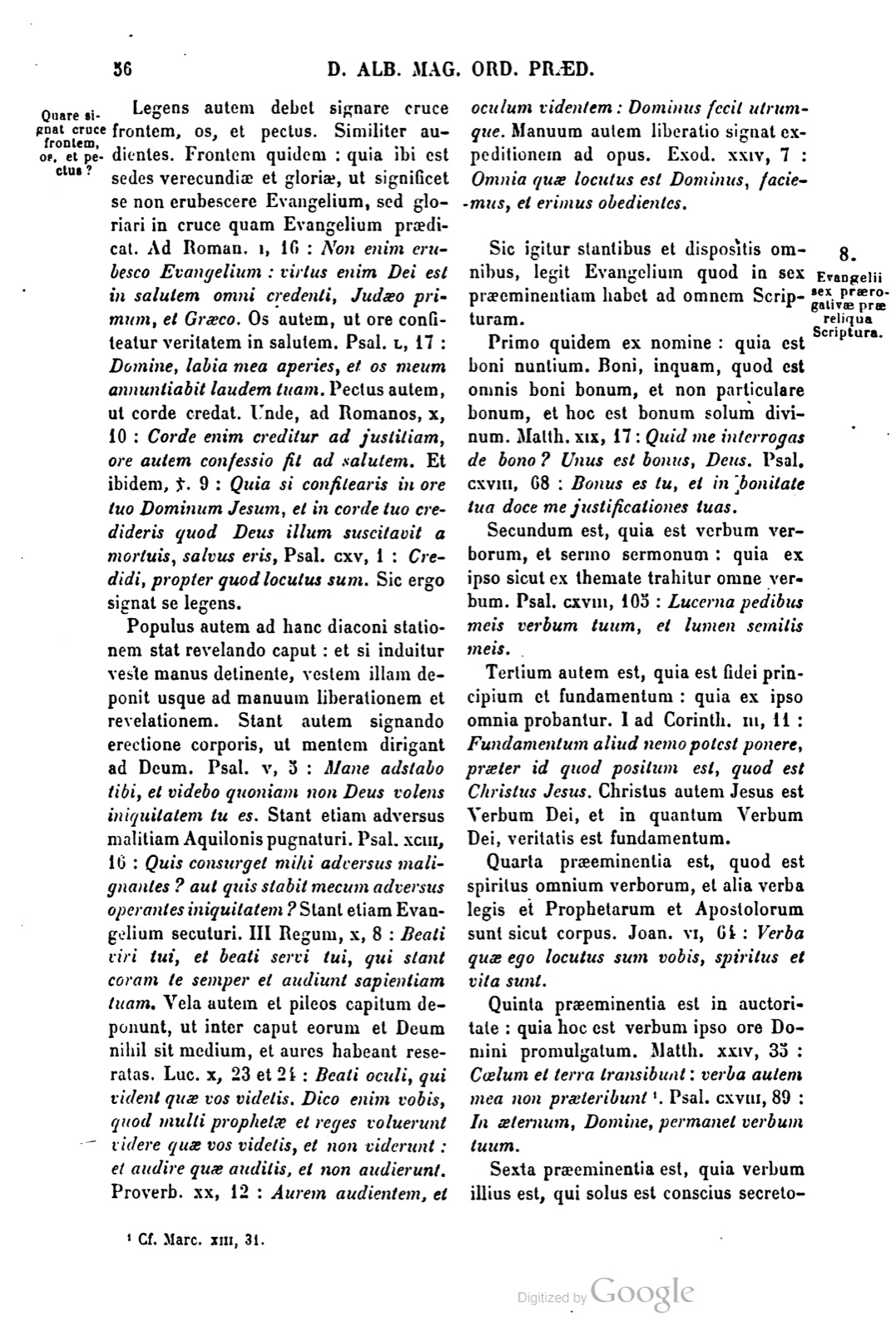
Secundum est, quia est verbum verborum, et sermo sermonum: quia ex ipso sicut ex themate trahitur omne verbum. Psal. CXVIII, 105: Lucerna pedibus meis verbum tuum, et lumen semitis meis.
Tertium autem est, quia est fidei principium et fundamentum: quia ex ipso omnia probantur. I ad Corinth. III, 11: Fundamentum aliud nemo potest ponere, praeter id quod positum est, quod est Christus Jesus. Christus autem Jesus est Verbum Dei, et in quantum Verbum Dei, veritatis est fundamentum.
Quarta praeeminentia est, quod est spiritus omnium verborum, et alia verba legis et Prophetarum et Apostolorum sunt sicut corpus. Joan. VI, 64: Verba quae ego locutus sum vobis, spiritus et vita sunt.
Quinta praeeminentia est in auctoritate: quia hoc est verbum ipso ore Domini promulgatum. Matth. XXIV, 35: Caelum et terra transibunt: verba autem mea non praeteribunt 5. Psal. CXVIII, 89: In aeternum, Domine, permanet verbum tuum.
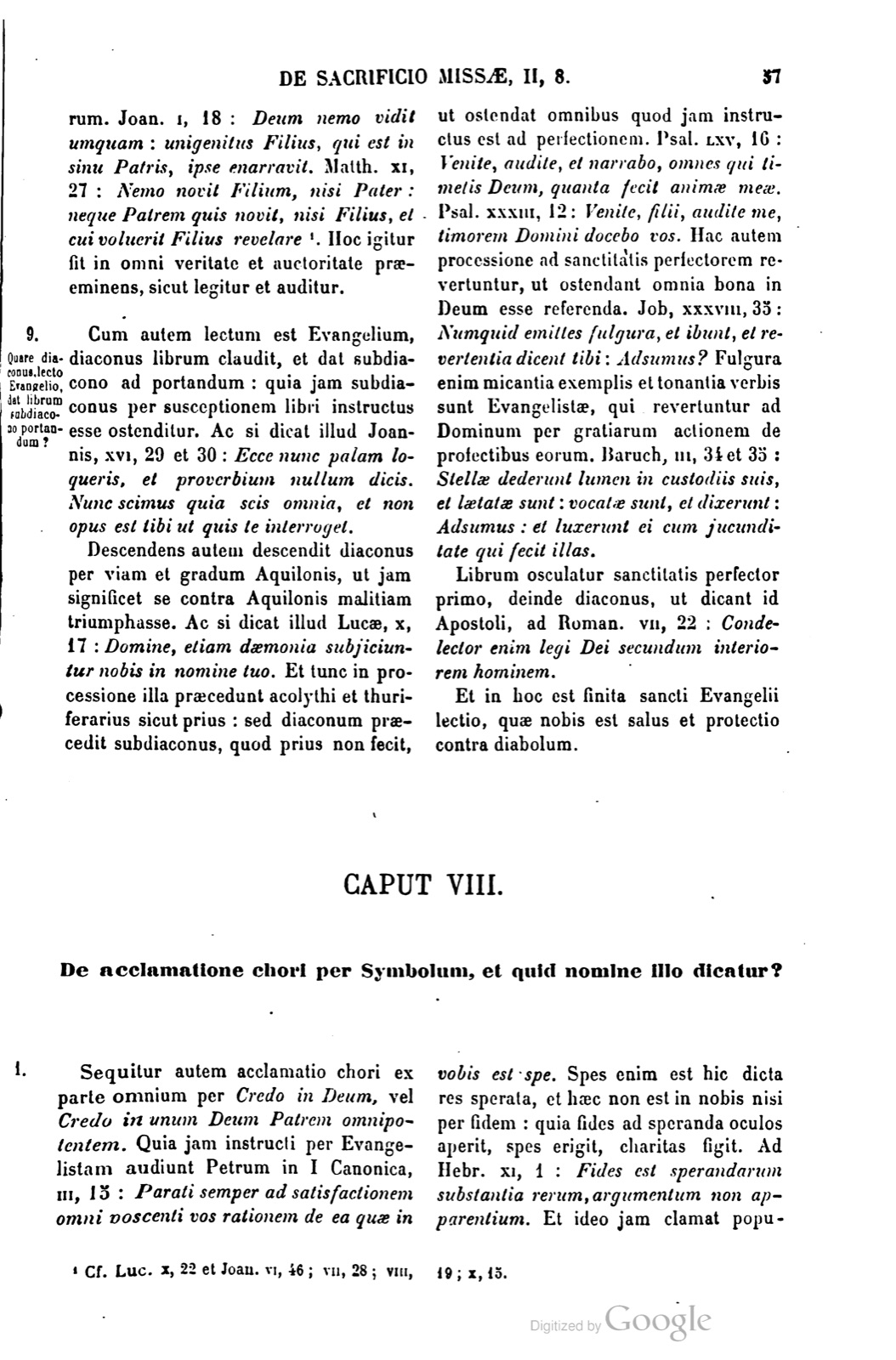
Sexta praeeminentia est, quia verbum illius est, qui solus est conscius secretorum. Joan. I, 18: Deum nemo vidit umquam: unigenitus Filius, qui est in sinu Patris, ipse enarravit. Matth. XI, 27: Nemo novit Filium, nisi Pater: neque Patrem quis novit, nisi Filius, et cui voluerit Filius revelare 6. Hoc igitur fit in omni veritate et auctoritate praeeminens, sicut legitur et auditur.
9. [Marginal label: Quare diaconus, lecto Evangelio, dat librum subdiacono portandum?] Cum autem lectum est Evangelium, diaconus librum claudit, et dat subdiacono ad portandum: quia jam subdiaconus per susceptionem libri instructus esse ostenditur. Ac si dicat illud Joannis, XVI, 29 et 30: Ecce nunc palam loqueris, et proverbium nullum dicis. Nunc scimus quia scis omnia, et non opus est tibi ut quis te interroget.
Descendens autem descendit diaconus per viam et gradum Aquilonis, ut jam significet se contra Aquilonis malitiam triumphasse. Ac si dicat illud Lucae, X, 17: Domine, etiam daemonia subjiciuntur nobis in nomine tuo. Et tunc in processione illa praecedunt acolythi et thuriferarius sicut prius: sed diaconum praecedit subdiaconus, quod prius non fecit, ut ostendat omnibus quod jam instructus est ad perfectionem. Psal. LXV, 16: Venite, audite, et narrabo, omnes qui timetis Deum, quanta fecit animae meae. Psal. XXXIII, 12: Venite, filii, audite me, timorem Domini docebo vos. Hac autem processione ad sanctitatis perfectorem revertuntur, ut ostendant omnia bona in Deum esse referenda. Job, XXXVIII, 35: Numquid emittes fulgura, et ibunt, et revertentia dicent tibi: Adsumus? Fulgura enim micantia exemplis et tonantia verbis sunt Evangelistae, qui revertuntur ad Dominum per gratiarum actionem de profectibus eorum. Baruch, III, 34 et 35: Stellae dederunt lumen in custodiis suis, et laetatae sunt: vocatae sunt, et dixerunt: Adsumus: et luxerunt ei cum jucunditate qui fecit illas.
Librum osculatur sanctitatis perfector primo, deinde diaconus, ut dicant id Apostoli, ad Roman. VII, 22: Condelector enim legi Dei secundum interiorem hominem.
Et in hoc est finita sancti Evangelii lectio, quae nobis est salus et protectio contra diabolum.
Second, because it is the word of words and the speech of speeches, because from it, as from a theme, every word is drawn. Psalm 118:105: Your word is a lamp to my feet and a light to my paths.
Third, because it is the beginning and foundation of faith, because from it all things are proved. 1 Corinthians 3:11: No one can lay another foundation besides that which has been laid, which is Christ Jesus. But Christ Jesus is the Word of God, and insofar as he is the Word of God, he is the foundation of truth.
The fourth preeminence is that it is the spirit of all words, and the other words of the Law and Prophets and Apostles are like the body. John 6:64: The words that I have spoken to you are spirit and life.
The fifth preeminence is in authority, because this is the word promulgated by the Lord's own mouth. Matthew 24:35: Heaven and earth will pass away, but my words will not pass away 5. Psalm 118:89: Forever, Lord, your word remains.
The sixth preeminence is because it is the word of him who alone is conscious of secrets. John 1:18: No one has ever seen God; the only-begotten Son, who is in the bosom of the Father, he has narrated him. Matthew 11:27: No one knows the Son except the Father; nor does anyone know the Father except the Son, and he to whom the Son has wished to reveal him 6. This therefore is preeminent in all truth and authority, as it is read and heard.
9. [Marginal label: Why, when the Gospel has been read, does the deacon give the book to the subdeacon to carry?] But when the Gospel has been read, the deacon closes the book and gives it to the subdeacon to carry, because now the subdeacon is shown to have been instructed through the reception of the book. As if he were saying that word of John 16:29 and 30: Behold, now you speak openly and say no proverb. Now we know that you know all things, and there is no need for anyone to question you.
But descending, the deacon descends by the way and step of the North, so that now he signifies that he has triumphed against the malice of the North. As if he were saying that word of Luke 10:17: Lord, even the demons are subject to us in your name. And then in that procession the acolytes and thurifer precede as before; but the subdeacon precedes the deacon, which he did not do before, so that he may show to all that he is now instructed unto perfection. Psalm 65:16: Come, hear, and I will narrate to you, all who fear God, how great things he has done for my soul. Psalm 33:12: Come, children, hear me; I will teach you the fear of the Lord. But by this procession they return to the perfecter of holiness, so that they may show that all good things are to be referred to God. Job 38:35: Will you send forth lightnings, and will they go, and returning say to you: Here we are? For lightnings flashing with examples and thundering with words are the Evangelists, who return to the Lord through giving of thanks concerning their progresses. Baruch 3:34 and 35: The stars gave light in their watches, and rejoiced; they were called, and said: Here we are; and they shone with gladness for him who made them.
The perfecter of holiness first kisses the book, then the deacon, so that they may say that word of the Apostle in Romans 7:22: For I delight together in the law of God according to the interior human being.
And in this the reading of the holy Gospel is finished, which is salvation and protection for us against the devil.
Notes
- Compare Genesis 27:23 and following. (Cf. Genes. XXVII, 23 et seq.) ↩
- Compare Genesis 49:1 and following. (Cf. Genes. XLIX, 1 et seq.) ↩
- Compare Deuteronomy 33:1 and following. (Cf. Deuter. XXXIII, 1 et seq.) ↩
- Compare Psalm 132:2. (Cf. Psal. CXXXII, 2.) ↩
- Compare Mark 13:31. (Cf. Marc. XIII, 31.) ↩
- Compare Luke 10:22 and John 6:46; 7:28; 8:19; 10:15. (Cf. Luc. X, 22 et Joan. VI, 46; VII, 28; VIII, 19; X, 15.) ↩
If a page does not appear, its photograph has not been uploaded yet.