Works › The Book on the Sacrifice of the Mass
Volume 38 · pp. 15–21
Chapter II. In commemoration of the devout people crying out for mercy by the desire of the Fathers, Kyrie, eleison is sung
A marker with ≈ is an approximate page boundary, placed by measure of the text; the page photographs remain the authority. In the paired views, clicking a page marker brings that page into view.
Caput II.
In commemorationem devoti populi ad misericordiam desiderio Patrum acclamantis cantatur Kyrie, eleison.
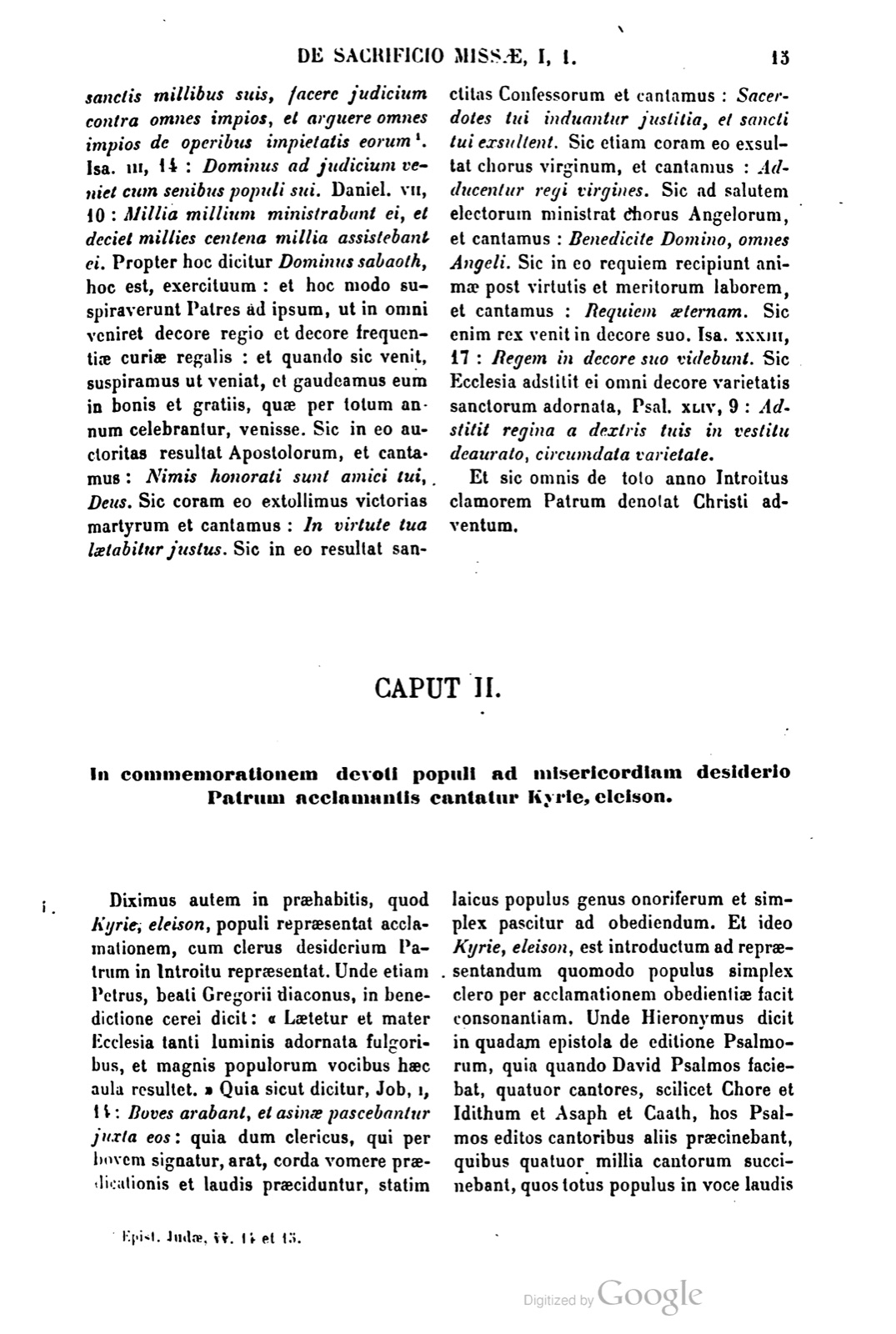
1. Diximus autem in praehabitis, quod Kyrie, eleison, populi repraesentat acclamationem, cum clerus desiderium Patrum in Introitu repraesentat. Unde etiam Petrus, beati Gregorii diaconus, in benedictione cerei dicit: "Laetetur et mater Ecclesia tanti luminis adornata fulgoribus, et magnis populorum vocibus haec aula resultet." Quia sicut dicitur, Job, I, 14: Boves arabant, et asinae pascebantur juxta eos: quia dum clericus, qui per bovem signatur, arat, corda vomere praedicationis et laudis praeciduntur, statim laicus populus genus honoriferum et simplex pascitur ad obediendum. Et ideo Kyrie, eleison, est introductum ad repraesentandum quomodo populus simplex clero per acclamationem obedientiae facit consonantiam. Unde Hieronymus dicit in quadam epistola de editione Psalmorum, quia quando David Psalmos faciebat, quatuor cantores, scilicet Chore et Idithum et Asaph et Caath, hos Psalmos editos cantoribus aliis praecinebant, quibus quatuor millia cantorum succinebant, quos totus populus in voce laudis subsequebatur. Et ideo in hoc ordine Episcopus vel sacerdos est in loco regis David. Quatuor autem cantores, duo scilicet in dextero choro, primus cantor et succentor, et duo in sinistro choro, scilicet secundus cantor et succentor, sunt in loco quatuor cantorum. Quatuor autem millia sunt sicut chorus totus clericorum, et hoc totum in Introitu repraesentatur. Populus autem repraesentatur ut acclamans Kyrie, eleison, et adhuc populus acclamat clero in Romana Ecclesia Kyrie, eleison. Et ideo in commemorationem boni et devoti populi desiderio Patrum acclamantis, Kyrie, eleison, est inductum in Missa post Introitum.
2. Hoc autem novies dicitur, ut quidam dicunt, propter novem choros Angelorum. Hujus autem signum dicunt esse, quod ter ternis cantibus formatur: quia primo ter dicitur Kyrie, eleison. Et secundo ter dicitur Christe, eleison. Et tertio iterum ter Kyrie, eleison. Quod quidam dicunt fieri propter tres hierarchias Angelorum, in quarum qualibet sunt tres ordines Angelorum. Hujus etiam signum esse dicunt, quia in solemnibus diebus quando non est tempus luctus, statim post acclamationem Kyrie, eleison, inducitur hymnus Angelorum qui est: Gloria in excelsis Deo. Sed hoc valde mirabile est quod dicunt, quia in veritate non est ista acclamatio ad Angelos, sed ad Dominum. Et quod novies clametur ad Dominum, quia novem sunt ordines Angelorum, non videtur aliquam habere rationem: quia secundum eamdem rationem septies cantaretur propter septem ordines beatorum, qui sunt Patriarchae et Prophetae et Domini praecursores, sicut Joannes Baptista, et Zacharias et Elizabeth, et beata Virgo, pastores et reges, et alii qui nobis Christum exhibuerunt et demonstraverunt. Iterum sunt Apostoli, Martyres, Confessores, et Virgines. Quare enim propter istas beatorum distinctiones non multo magis septies clamaretur, vel propter septem dona quibus juvamur ex Domini misericordia, vel cantarentur octies propter octo beatitudines, quae, Matth. V, 3-11, enumerantur, vel sexies propter opera sex dierum, ut sic daremus magnificentiam Domino nostro Deo: quia Dei perfecta sunt opera. Unde hujusmodi adaptationes quae non nisi in numero concordant, pro certo parum valent et multum sunt derisibiles.
Chapter II.
In commemoration of the devout people crying out for mercy by the desire of the Fathers, Kyrie, eleison is sung.
1. But we said in the preceding things that Kyrie, eleison represents the acclamation of the people, while the clergy represent the desire of the Fathers in the Introit. Hence also Peter, the deacon of blessed Gregory, says in the blessing of the candle: "Let mother Church also rejoice, adorned with the brightness of so great a light, and let this hall resound with the great voices of the peoples." Because, as is said in Job 1:14: The oxen were plowing, and the she-asses were feeding beside them; because while the cleric, who is signified by the ox, plows, hearts are cut by the plowshare of preaching and praise, and at once the lay people, an honor-bearing and simple race, are fed unto obedience. And therefore Kyrie, eleison was introduced to represent how the simple people make harmony with the clergy through an acclamation of obedience. Hence Jerome says in a certain epistle concerning the edition of the Psalms, that when David made the Psalms, four singers, namely Chore and Idithum and Asaph and Caath, sang beforehand these published Psalms to other singers; four thousand singers sang in response to them, and the whole people followed them in the voice of praise. And therefore in this order the bishop or priest is in the place of King David. But the four singers, namely two in the right choir, the first cantor and succentor, and two in the left choir, namely the second cantor and succentor, are in the place of the four singers. But the four thousand are like the whole choir of clerics, and this whole thing is represented in the Introit. But the people are represented as crying out Kyrie, eleison, and still the people cry out Kyrie, eleison to the clergy in the Roman Church. And therefore, in commemoration of the good and devout people crying out by the desire of the Fathers, Kyrie, eleison was brought into the Mass after the Introit.
2. But this is said nine times, as some say, on account of the nine choirs of Angels. They say that a sign of this is that it is formed by three sets of three chants, because first Kyrie, eleison is said three times; and second Christe, eleison is said three times; and third Kyrie, eleison again three times. Some say that this is done on account of the three hierarchies of Angels, in each of which there are three orders of Angels. They also say that a sign of this is that on solemn days, when it is not a time of mourning, immediately after the acclamation Kyrie, eleison the hymn of Angels is introduced, which is: Glory to God in the highest. But what they say is very astonishing, because in truth that acclamation is not to the Angels, but to the Lord. And that one should cry out to the Lord nine times because there are nine orders of Angels does not seem to have any reason, because by the same reasoning one would sing seven times on account of the seven orders of the blessed, who are the Patriarchs and Prophets and the Lord's forerunners, such as John the Baptist, and Zachariah and Elizabeth, and the blessed Virgin, shepherds and kings, and others who displayed and demonstrated Christ to us. Again there are Apostles, Martyrs, Confessors, and Virgins. For why, on account of these distinctions of the blessed, would one not much rather cry seven times, or on account of the seven gifts by which we are helped from the mercy of the Lord, or sing eight times on account of the eight beatitudes, which are enumerated in Matthew 5:3-11, or six times on account of the works of the six days, so that thus we might give magnificence to the Lord our God, because the works of God are perfect? Hence adaptations of this sort, which agree only in number, certainly have little force and are very laughable.
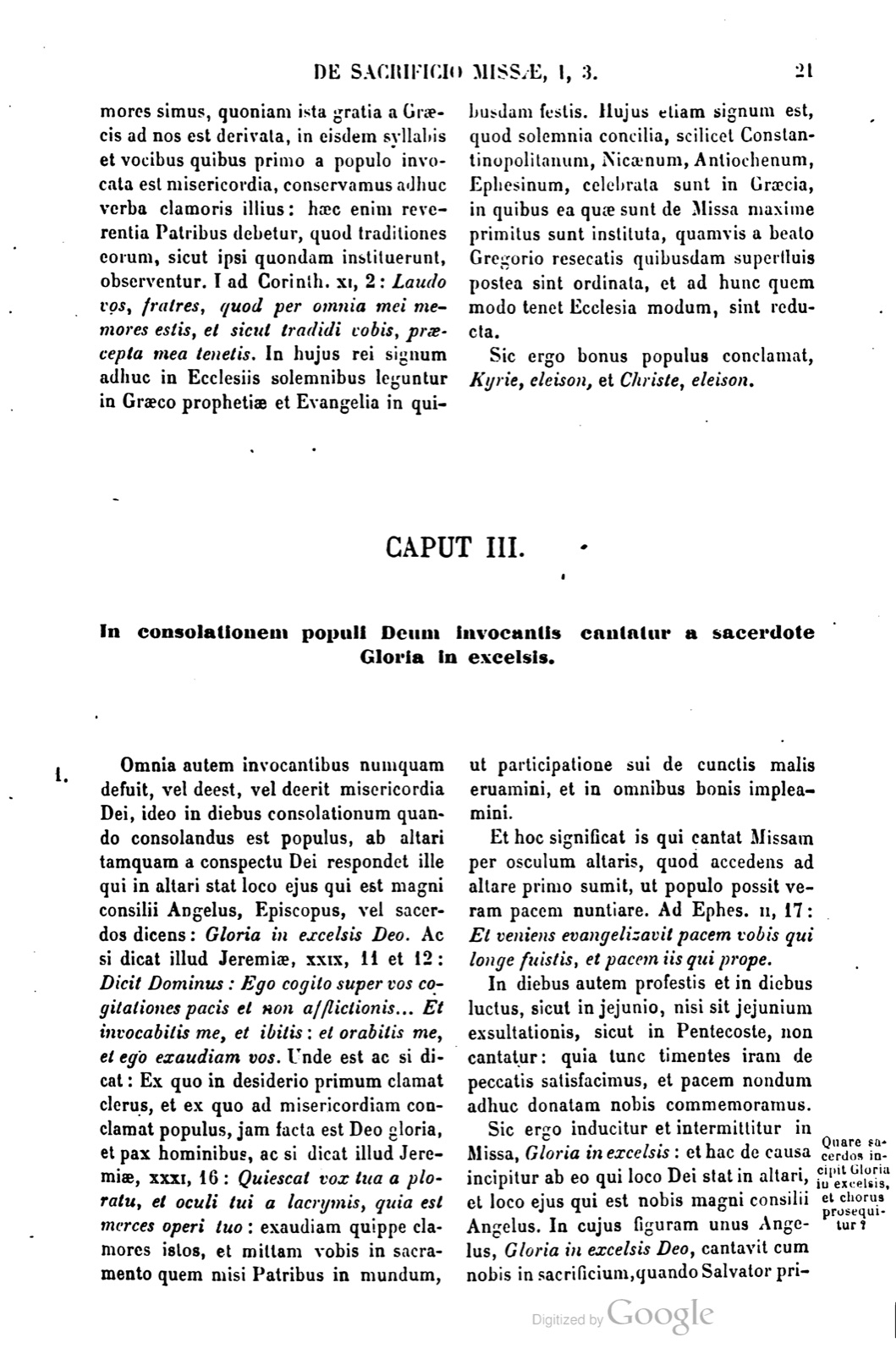
3. [Marginal label: Quare ter Kyrie, eleison, primo cantatur?] Nos igitur dicimus beatos Dionysium et Ambrosium sequentes, quod in ista acclamatione quatuor sunt notanda, propter quae et ista acclamatio instituta esse dignoscitur. Unum quidem, quare ter Kyrie, eleison, primo cantatur? Secundum, quare ter Christe, eleison, subjungitur? Tertium, quare iterum ter Kyrie, eleison, in fine subnectitur? Quartum, quare in voce Graeca non Latina cantatur?
Ad primum horum dicimus, quod sicut dicit Dionysius, Dominus nomen est superpositionis, et ideo est in genere relativorum. Ambrosius autem dicit, quod est nomen potestatis, et secundum hoc non est in genere relationis: quia sic correlativum ad quod dicatur, non haberet, unde secundum primum nominis intellectum est nomen superpositionis, quia a superpositione est impositum, secundum consequentem intellectum est nomen potestatis, quia hoc nomen habentibus potestatem est datum. In omni enim nomine ista duo considerantur, et ideo significat substantiam cum qualitate: qualitas autem est illud a quo nomen impositum est. Et substantia illud cui est impositum: et quia qualitas finit substantiam, ideo primus intellectus nominis est sumendus a qualitate a qua impositum est nomen.
Et hoc egregius doctor consideravit Dionysius, qui dicit ipsum esse nomen superpositionis. [Marginal label: Dominus est nomen superpositionis quae perficitur ex tribus.] Superpositio autem perfecta, ut idem dicit, consistit ex tribus, scilicet quod superpositum excedat inferiora, a nullo depressum, et quod perfectam in se habeat superpositionis causam, et quod perfectam in se habeat in altis continentem se virtutem, ne ad infima possit deflecti vel inclinari. Primum horum est honoris et honestatis. Secundum, ditissimae possessionis. Tertium autem fortitudinis et virtutis, et ideo dignitatem suam et honorem advertens, superpositionis et dominationis verus Dominus, ut dicit Dionysius, incessanter est appetitivus, et indignum est ei, quod aliquid sit super ipsum sic quod sibi dominetur, et sic solus Dominus Deus est, de quo dicitur, Esther, XIII, 11: Dominus omnium es, nec est qui resistat majestati tuae, de quo dicit Apostolus, ad Hebraeos, II, 8, quod Pater omnia subjecit sub pedibus ejus. Psal. CIX, 1: Dixit Dominus Domino meo: Sede a dextris meis. Genes. XXVII, 37: Dominum tuum illum constitui, et omnes fratres ejus servituti illius subjugavi. Sic dicitur Dominus Pater, Dominus Filius, Dominus Spiritus sanctus: et tamen non tres Domini, sed unus est Dominus, sicut dicitur, Exod. VI, 2 et 3: Ego Dominus qui apparui Abraham, Isaac et Jacob, in Deo omnipotente: et nomen magnum Adonai non indicavi eis: quia verum Dominum apparens Patribus non exhibuit, sed nobis Dominum dominorum exhibuit: quia sicut dicitur, ad Hebr. I, 1 et 2: Multifariam multisque modis olim loquens Deus patribus in Prophetis, novissime diebus istis locutus est nobis in Filio, quem, ut Dominum omnibus praepositum esse probaret et ostenderet, constituit haeredem universorum, per quem fecit et saecula, omnibus eum praeponens et omnia sibi subjiciens.
3. [Marginal label: Why is Kyrie, eleison sung three times first?] Therefore, following blessed Dionysius and Ambrose, we say that in this acclamation four things must be noted, on account of which this acclamation also is known to have been instituted. One is why Kyrie, eleison is first sung three times. The second, why Christe, eleison is added three times. The third, why Kyrie, eleison is again attached three times at the end. The fourth, why it is sung in the Greek voice and not the Latin.
To the first of these we say that, as Dionysius says, Lord is a name of being set above, and therefore it is in the genus of relatives. But Ambrose says that it is a name of power, and according to this it is not in the genus of relation, because then it would not have a correlative with respect to which it would be said. Hence according to the first understanding of the name it is a name of being set above, because it is imposed from being set above; according to the consequent understanding it is a name of power, because this name was given to those having power. For in every name these two things are considered, and therefore it signifies substance with a quality. But the quality is that from which the name was imposed; and the substance is that upon which it was imposed. And because the quality determines the substance, therefore the first understanding of a name must be taken from the quality from which the name was imposed.
And the excellent doctor Dionysius considered this, who says that it is a name of being set above. [Marginal label: Lord is a name of being set above, which is completed from three things.] But perfect being set above, as the same man says, consists of three things, namely that what is set above exceeds lower things, depressed by none; and that it has in itself a perfect cause of being set above; and that it has in itself a perfect power keeping itself in high things, so that it cannot be bent or inclined toward low things. The first of these belongs to honor and honorable condition. The second belongs to richest possession. The third belongs to strength and power. And therefore the true Lord of being set above and of dominion, considering his dignity and honor, as Dionysius says, is unceasingly desirous, and it is unworthy of him that anything should be above him in such a way that it rules over him; and thus God alone is Lord, of whom it is said in Esther 13:11: You are Lord of all, nor is there anyone who resists your majesty. Of him the Apostle says in Hebrews 2:8 that the Father has subjected all things under his feet. Psalm 109:1: The Lord said to my Lord: Sit at my right hand. Genesis 27:37: I have appointed him your lord, and I have subjected all his brothers to his service. Thus Father is called Lord, Son is called Lord, Holy Spirit is called Lord; and yet there are not three Lords, but there is one Lord, as is said in Exodus 6:2 and 3: I am the Lord who appeared to Abraham, Isaac, and Jacob in God almighty; and my great name Adonai I did not make known to them, because appearing to the Fathers he did not display the true Lord, but to us he displayed the Lord of lords; because, as is said in Hebrews 1:1 and 2: God, speaking formerly to the fathers in the Prophets in many portions and in many ways, most recently in these days has spoken to us in the Son, whom, in order that he might prove and show him to be the Lord set over all, he established as heir of all things, through whom he also made the ages, setting him over all things and subjecting all things to him.
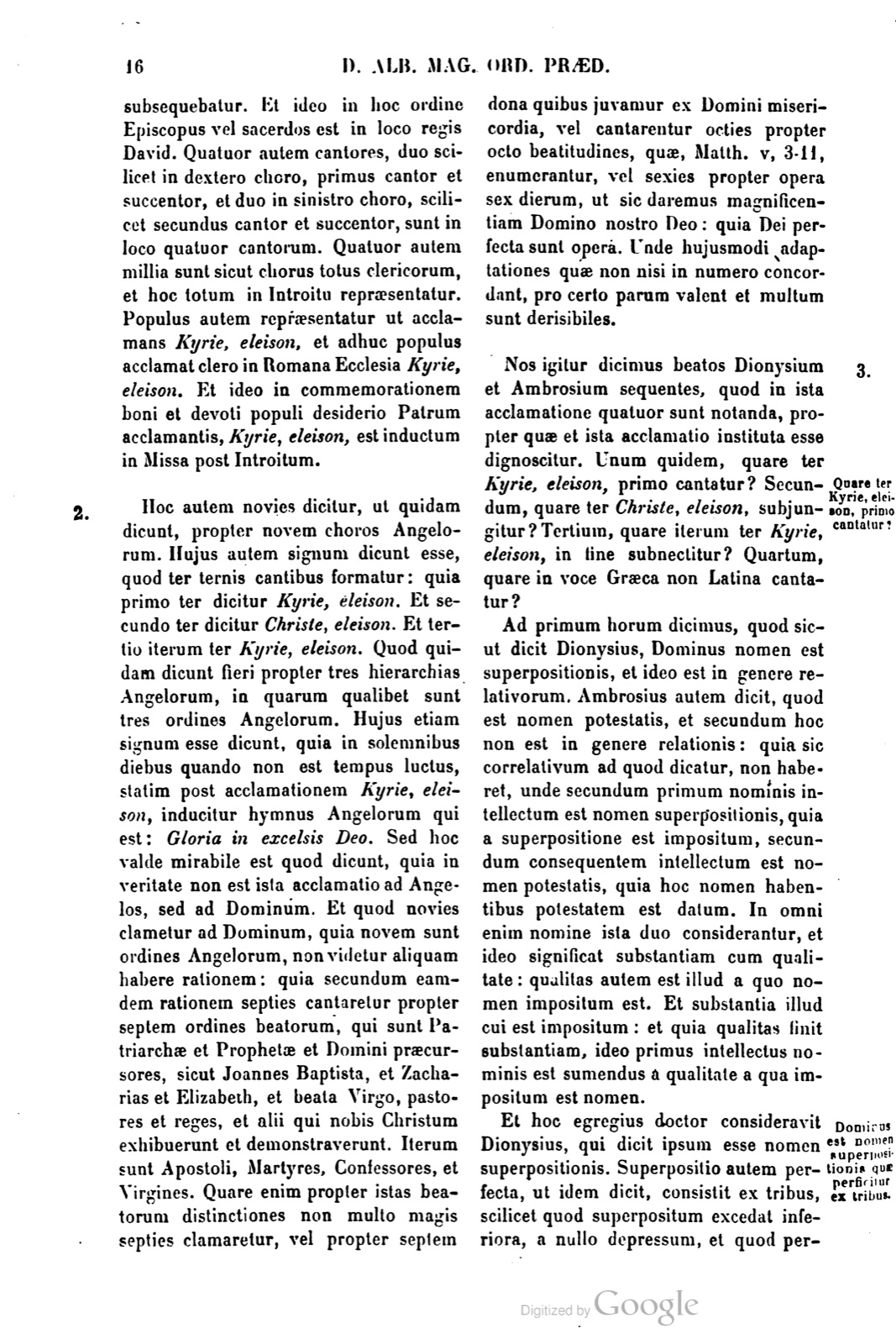
[Marginal label: Pulchrum et bonum quid?] Hunc exaltant omnes divitiae verae pulchrorum et bonorum. Pulchra enim, ut ait Tullius, sunt quae omni notitiae accedunt cum decora laude. Bona autem vera sunt, quae, ut dicit Anselmus omnibus est esse, et Deo et Angelis, et omnibus creaturis. Quicumque igitur perfectam et omnimodam pulchrorum et bonorum habet ditissimam et splendidissimam possessionem ad copiam, ut ab ipso omnes ditentur, ille perfectam habet causam suae superpositionis, et hanc non habet nisi Filius de quo dicitur, Joan. III, 34: Non enim ad mensuram dat Deus spiritum, supple, Filio. Caeteris autem dividit spiritus Patris, dans singulis prout vult, sicut dicitur, I ad Corinth. XII, 11: Dividens singulis prout vult, et, Matth. XXV, 15: Dedit unicuique secundum propriam virtutem. Ipse autem omnes simul possedit pulchrorum et bonorum divitias, de quo dicitur, Joan. I, 14: Vidimus gloriam ejus, gloriam quasi Unigeniti a Patre, plenum gratiae et veritatis. Unde, ad Coloss. II, 3: In ipso sunt omnes thesauri sapientiae et scientiae Dei absconditi. Genes. XXIV, 36: Et peperit Sara uxor domini mei filium domino meo in senectute sua, deditque ei omnia quae habuerat. Sara uxor domini nostri Patris est Ecclesia, quam signat beata Virgo Maria, quae casta concepit et virgo peperit Filium, non habens maculam concupiscentiae in conceptu, neque rugam poenae in partu: et huic Filio omnia data sunt in possessionem. Hic ergo est verus Dominus, sicut dicitur, ad Galat. IV, 1, quod licet humanitatis susceptione parvulus sit, et nihil differens a servo, cum sit tamen dominus omnium. Hic etiam veram virtutem habet se in altis continentem, qui ad ima et vilia numquam deflexus, et ideo numquam scabellaribus et conculcandis per appetitum vel opus appropinquavit. Unde dicitur, Eccli. XXIV, 7: Ego in altissimis habitavi, et thronus meus in columna nubis. Sedens in nube assumptae carnis ut Dominus, quae caro et columna est non inclinabilis ad aliquid conculcandum. Propter quod dicitur, Isa. XIV, 6: Ego Dominus, et non est alter. Psal. CXII, 5 et 6: Quis sicut Dominus Deus noster, qui in altis habitat, et humilia respicit in caelo et in terra?
4. [Marginal label: Per peccatum in triplicem incidimus miseriam, oppositam triplici bono quod continet nomen Dominus.] Haec autem tria in hoc nomine, Dominus, comprehendit beatus Dionysius his verbis: "Dominatio vero est non pejorum sive inferiorum excessus tantum, sed omnis pulchrorum et bonorum perfecta et omnimoda possessio, et vera et non cadere valens fortitudo 1." Nos autem per peccatum in triplicem incidimus miseriam, scilicet subjectionem servitutis peccati: quia sicut dicitur, Joan. VIII, 34: Qui facit peccatum, servus est peccati. Secundo, in paupertatem boni gratuiti: quia gratuitis sumus spoliati, unde dicitur, Apocal. III, 17: Et nescis quia tu es miser, et miserabilis, et pauper, et caecus, et nudus. Tertio, in conculcationem incidimus a daemonibus vilissimis, qui potius erant conculcandi, quia ipsi servi sunt. Thren. V, 8, in oratione Jeremiae: Servi dominati sunt nostri: non fuit qui redimeret de manu eorum.
[Marginal label: What are beautiful and good?] All the true riches of beautiful and good things exalt him. For beautiful things, as Tully says, are those that approach every knowledge with becoming praise. But true good things are those which, as Anselm says, are being for all, both for God and Angels and for all creatures. Therefore whoever has the richest and most splendid perfect and every-sided possession of beautiful and good things unto abundance, so that from him all may be enriched, has the perfect cause of his being set above, and no one has this except the Son, of whom it is said in John 3:34: For God does not give the Spirit by measure, supply: to the Son. But to others he divides the Spirit of the Father, giving to each as he wills, as is said in 1 Corinthians 12:11: Dividing to each as he wills, and Matthew 25:15: He gave to each according to his own power. But he himself possessed all at once the riches of beautiful and good things, of whom it is said in John 1:14: We saw his glory, glory as of the Only-begotten from the Father, full of grace and truth. Hence Colossians 2:3: In him are hidden all the treasures of the wisdom and knowledge of God. Genesis 24:36: And Sarah, the wife of my lord, bore a son to my lord in her old age, and he gave him all the things that he had. Sarah, wife of our lord the Father, is the Church, whom blessed Virgin Mary signifies, who conceived chastely and as a virgin bore the Son, having no stain of concupiscence in conception nor wrinkle of punishment in childbirth; and to this Son all things have been given as a possession. This, therefore, is the true Lord, as is said in Galatians 4:1, that although by the assumption of humanity he is a little child and differs nothing from a servant, still he is lord of all things. This one also has true power keeping itself in high things, he who was never bent toward low and vile things, and therefore never approached things serving as footstools and things to be trodden down by appetite or by work. Hence it is said in Ecclesiasticus 24:7: I dwelt in the highest things, and my throne was in a pillar of cloud. He sits in the cloud of the assumed flesh as Lord, which flesh is also a pillar not inclinable toward anything to be trampled. On account of this it is said in Isaiah 14:6: I am the Lord, and there is no other. Psalm 112:5 and 6: Who is like the Lord our God, who dwells on high and looks upon humble things in heaven and on earth?
4. [Marginal label: Through sin we have fallen into a threefold misery, opposed to the threefold good that the name Lord contains.] But blessed Dionysius comprehends these three things in this name, Lord, with these words: "Dominion truly is not only the excess of worse or lower things, but the perfect and every-sided possession of all beautiful and good things, and true strength unable to fall 1." But through sin we have fallen into a threefold misery, namely into subjection to the slavery of sin, because, as is said in John 8:34: Whoever commits sin is a slave of sin. Second, into poverty of gratuitous good, because we have been stripped of gratuitous things; hence it is said in Apocalypse 3:17: And you do not know that you are wretched and pitiable and poor and blind and naked. Third, we have fallen into being trampled by the vilest demons, who rather ought to have been trampled, because they themselves are slaves. Lamentations 5:8, in the prayer of Jeremiah: Slaves have ruled over us; there was no one who would redeem us from their hand.
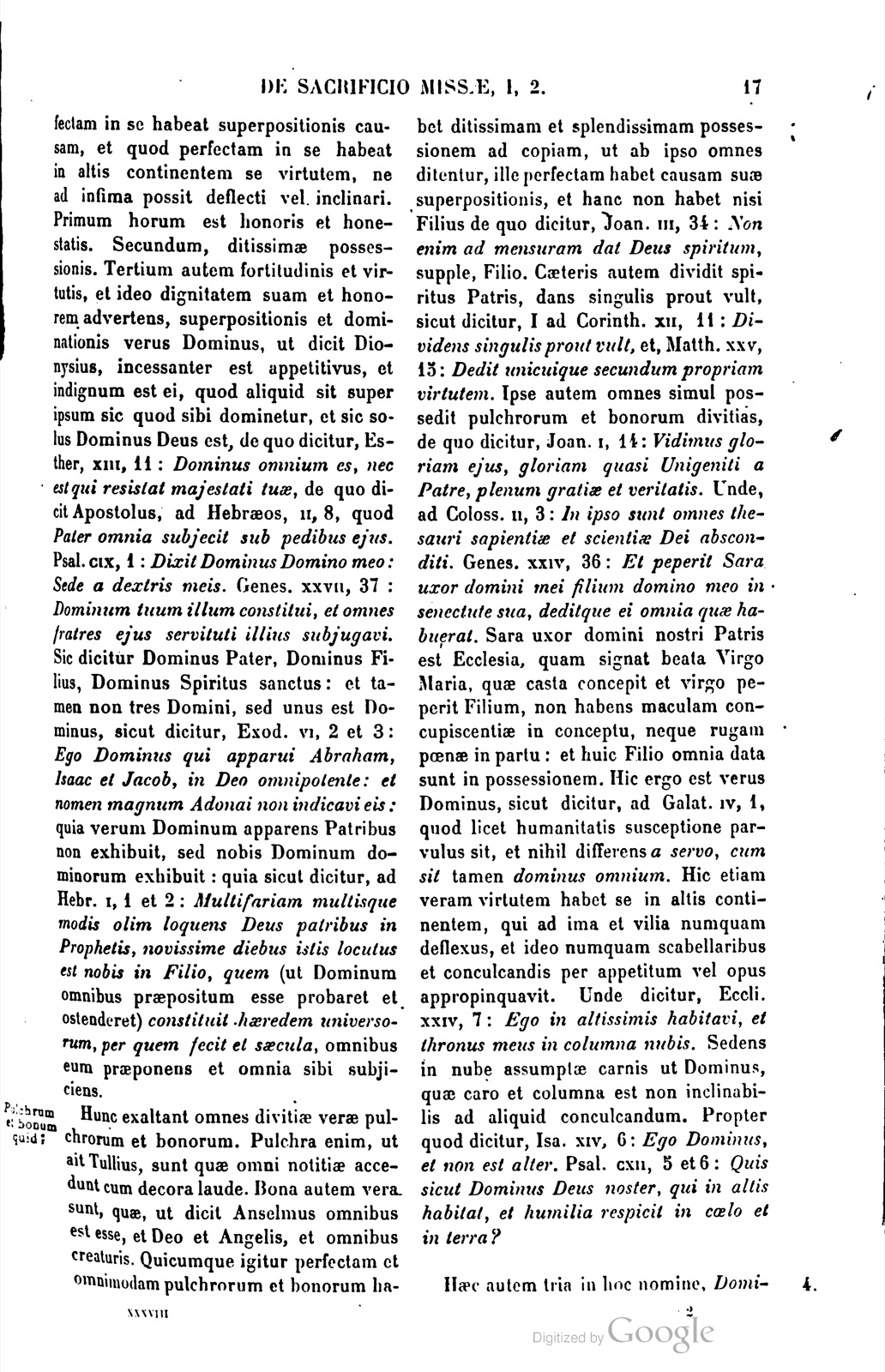
De primo horum dicitur, Isaiae, XLIX, 7: Haec dicit Dominus, redemptor Israel, Sanctus ejus, ad contemptibilem animam, ad abominatam gentem, ad servum dominorum. Genes. IX, 25: Maledictus Chanaan, servus servorum erit fratribus suis.
De secundo dicitur, Threnorum, III, 1: Ego vir videns paupertatem meam, in virga indignationis ejus. Eccle. V, 13: Generavit filium qui in summa egestate erit: hoc enim maxime dicitur de Adam, qui dives creatus fuit, et in extrema paupertate genuit filios. Job, I, 21: Nudus egressus sum de utero matris meae, nudus revertar illuc. Ezechiel. XVI, 7: Eras nuda, et confusione plena.
De tertio dicitur, Isa. LI, 23: Qui te humiliaverunt, et dixerunt animae tuae: Incurvare, ut transeamus: et posuisti ut terram corpus tuum, et quasi viam transeuntibus. Thren. V, 5: Cervicibus nostris minabamur, lassis non dabatur requies. Psal. LV, 3: Conculcaverunt me inimici mei tota die: quoniam multi bellantes adversum me. Eccli. IX, 10: Omnis mulier quae est fornicaria quasi stercus in via conculcabitur. Mulier emollita, anima fornicata, a Deo suo data daemonibus in conculcationem.
Quid ergo mirum si fidelis populus audiens clerum in desiderio Patrum advocantem ad nos Dominum, sentiens nihilominus triplicem suum defectum, conclamat et acclamat clero invocans verae superpositionis et ditissimae possessionis dominum, et tantae fortitudinis, ut non solum se contineat in altis, verum sicut dicitur, I Regum, II, 8: Suscitat de pulvere egenum, et de stercore elevat pauperem, ut sedeat cum principibus, et solium gloriae teneat, dicendo: Kyrie, eleison, tribus vicibus, ut ab hoc triplici defectu per misericordiam ad se clamantes sublevet. Haec est ergo causa, quod primo dicitur ter, Kyrie, eleison, quod sonat: Domine, miserere. Unde ordo beati Ambrosii habet, quod in principio Missae dicatur ter, Kyrie, eleison.
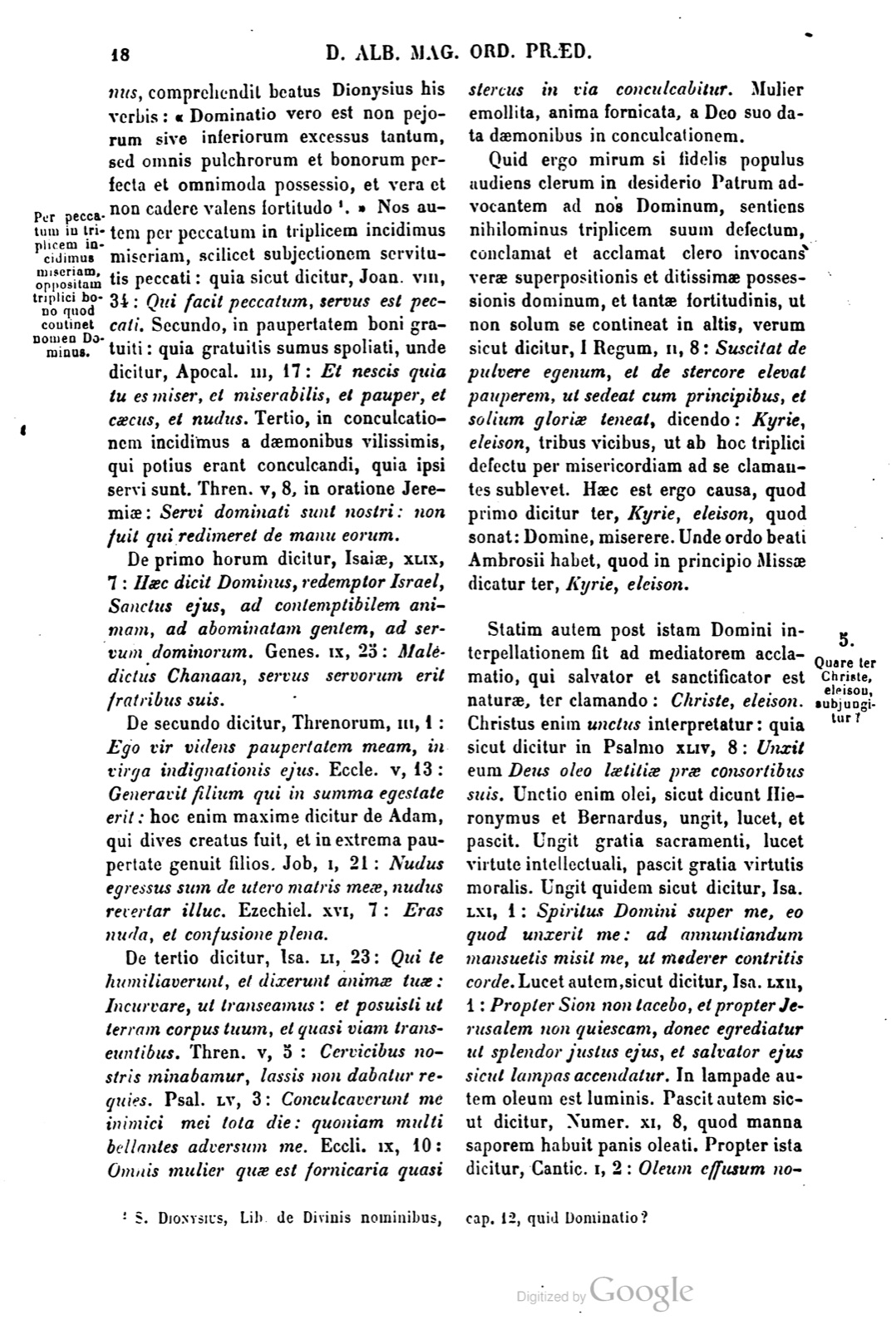
5. [Marginal label: Quare ter Christe, eleison, subjungitur?] Statim autem post istam Domini interpellationem fit ad mediatorem acclamatio, qui salvator et sanctificator est naturae, ter clamando: Christe, eleison. Christus enim unctus interpretatur: quia sicut dicitur in Psalmo XLIV, 8: Unxit eum Deus oleo laetitiae prae consortibus suis. Unctio enim olei, sicut dicunt Hieronymus et Bernardus, ungit, lucet, et pascit. Ungit gratia sacramenti, lucet virtute intellectuali, pascit gratia virtutis moralis. Ungit quidem sicut dicitur, Isa. LXI, 1: Spiritus Domini super me, eo quod unxerit me: ad annuntiandum mansuetis misit me, ut mederer contritis corde. Lucet autem, sicut dicitur, Isa. LXII, 1: Propter Sion non tacebo, et propter Jerusalem non quiescam, donec egrediatur ut splendor justus ejus, et salvator ejus sicut lampas accendatur. In lampade autem oleum est luminis. Pascit autem sicut dicitur, Numer. XI, 8, quod manna saporem habuit panis oleati. Propter ista dicitur, Cantic. I, 2: Oleum effusum nomen tuum. Ungit autem contra defectum infirmitatis in quam ex peccato incidimus. Lucet contra tenebras ignorantiae in quas per peccatum incidimus. Pascit contra defectum insipiditatis boni caelestis, in quam insipiditatis malitiam ex improba libidine commutabilis boni damnati sumus.
Concerning the first of these it is said, Isaiah 49:7: Thus says the Lord, redeemer of Israel, his Holy One, to a contemptible soul, to an abominated nation, to a slave of lords. Genesis 9:25: Cursed be Canaan; he shall be a slave of slaves to his brothers.
Concerning the second it is said, Lamentations 3:1: I am the man seeing my poverty in the rod of his indignation. Ecclesiastes 5:13: He begot a son who will be in utmost need; for this is said especially of Adam, who was created rich and begot sons in extreme poverty. Job 1:21: Naked I came out from my mother's womb, naked I shall return there. Ezekiel 16:7: You were naked and full of confusion.
Concerning the third it is said, Isaiah 51:23: Those who humbled you and said to your soul, Bend down, that we may pass over; and you put your body like the earth and like a road for those passing over. Lamentations 5:5: We were threatened at our necks; no rest was given to the weary. Psalm 55:3: My enemies trampled me all the day, because many are fighting against me. Ecclesiasticus 9:10: Every woman who is a fornicator shall be trampled in the road like dung. The softened woman, the fornicating soul, has been given by her God to demons for trampling.
What wonder is it, then, if the faithful people, hearing the clergy in the desire of the Fathers calling the Lord to us, and nevertheless sensing its own threefold defect, cries together and cries out to the clergy, invoking the lord of true being set above and of richest possession, and of such strength that he not only keeps himself in the heights, but, as is said in 1 Kings 2:8: He raises the needy from the dust, and lifts the poor from the dung, that he may sit with princes and hold the throne of glory, saying Kyrie, eleison three times, so that he may lift up by mercy those crying to him from this threefold defect. Therefore this is the cause why Kyrie, eleison, which sounds: Lord, have mercy, is first said three times. Hence the order of blessed Ambrose has it that at the beginning of Mass Kyrie, eleison be said three times.
5. [Marginal label: Why is Christe, eleison added three times?] But immediately after that appeal to the Lord there is made an acclamation to the mediator, who is savior and sanctifier of nature, by crying three times: Christe, eleison. For Christ is interpreted anointed, because as is said in Psalm 44:8: God anointed him with the oil of gladness before his companions. For the anointing of oil, as Jerome and Bernard say, anoints, shines, and feeds. It anoints by the grace of the sacrament, shines by intellectual power, and feeds by the grace of moral virtue. It anoints indeed as is said in Isaiah 61:1: The Spirit of the Lord is upon me, because he has anointed me; he has sent me to announce to the meek, that I might heal the contrite of heart. But it shines, as is said in Isaiah 62:1: For Zion I will not be silent, and for Jerusalem I will not be quiet, until her just one goes forth as splendor and her savior is kindled like a lamp. But in the lamp there is the oil of light. It feeds, however, as is said in Numbers 11:8, that the manna had the taste of oiled bread. On account of these things it is said in Canticles 1:2: Your name is oil poured out. But he anoints against the defect of weakness into which we have fallen from sin. He shines against the darkness of ignorance into which we have fallen through sin. He feeds against the defect of tastelessness of heavenly good, into which malice of tastelessness we have been condemned from the wicked lust of changeable good.
Dicitur de primo, Eccli. XXXVIII, 7: Unguentarius faciet pigmenta suavitatis, et unctiones conficiet sanitatis.
De secundo praecipitur, Exod. XXXVII, 20, ubi praecipitur, quod oleum purissimum semper infundatur in candelabro Domini.
De tertio, Psal. LXII, 6: Sicut adipe et pinguedine repleatur anima mea.
Sic ergo populus suam simul sentiens infirmitatem, patiens tenebras, et insipiditatem abhorrens, clamat ad unctum, Christe, eleison, ut unctione sanet infirmitatem. Ac si dicat: Unctione tua sana me, Domine, et sanabor: salvum me fac, et salvus ero: quoniam laus mea tu es 2. Clamat iterato ad illuminatorem, ex cujus lampade oleum non defecit, dicens: Deus meus, illumina tenebras meas 3. Et illud Michaeae, VII, 8: Cum sedero in tenebris, Dominus lux mea est. Clamat tertio ad omnis pinguedinis saporem: quia scit quod dicitur, Isa. LV, 2: Audite, audientes me: et comedite bonum, et delectabitur in crassitudine anima vestra. Et sic ter clamat Christe, eleison, non autem clamat Jesu, eleison: quia Jesus unctionem non sonat, sed salvatorem ex potentia suae divinitatis. Cum enim dicit Kyrie eleison, ex dominio sublevat, sicut diximus, sed remanent sauciati quos ex chrismate sanat. Et ideo statim post Kyrie, eleison, cantabitur ter Christe, eleison.
6. [Marginal label: Quare iterum ter Kyrie, eleison, in fine subnectitur?] Deinde Kyrie, eleison, iterum ter repetitur: quia sicut diximus, dominus est nomen potestatis: potestas autem, ut dicit Dionysius in libro de Caelesti hierarchia, tria facere habet. Ultrix enim est iniquitatis per justitiae vindicationem, compressiva est malae voluntatis per severitatem, defensiva est virtutis et bonitatis per legum aequitatem.
De primo horum dicitur: Deus ultionum Dominus, Deus ultionum libere egit 4.
De secundo dicitur in Psalmo LXVII, 31: Dissipa gentes quae bella volunt. Psal. LVII, 7: Molas leonum confringet Dominus.
Concerning the first it is said, Ecclesiasticus 38:7: The ointment-maker will make pigments of sweetness and will compound anointings of health.
Concerning the second it is commanded in Exodus 37:20, where it is commanded that the purest oil always be poured into the lampstand of the Lord.
Concerning the third, Psalm 62:6: Let my soul be filled as with fatness and richness.
Thus, therefore, the people, sensing at once their weakness, suffering darkness, and abhorring tastelessness, cry to the anointed one, Christe, eleison, so that by anointing he may heal weakness. As if it were saying: By your anointing heal me, Lord, and I shall be healed; save me, and I shall be saved, because you are my praise 2. It cries again to the illuminator, from whose lamp the oil did not fail, saying: My God, illumine my darkness 3. And that word of Micah 7:8: When I sit in darkness, the Lord is my light. It cries a third time to the savor of every richness, because it knows what is said in Isaiah 55:2: Hear, hearing me, and eat good, and your soul shall be delighted in richness. And thus it cries three times, Christe, eleison; but it does not cry Jesu, eleison, because Jesus does not sound anointing, but savior from the power of his divinity. For when it says Kyrie, eleison, he lifts up by lordship, as we have said, but the wounded remain, whom he heals from chrism. And therefore immediately after Kyrie, eleison, Christe, eleison will be sung three times.
6. [Marginal label: Why is Kyrie, eleison again attached three times at the end?] Then Kyrie, eleison is repeated again three times, because, as we have said, lord is a name of power. But power, as Dionysius says in the book On the Celestial Hierarchy, has three things to do. For it is avenging of iniquity through the vindication of justice, repressive of evil will through severity, and defensive of virtue and goodness through the equity of laws.
Concerning the first of these it is said: The Lord is the God of vengeance; the God of vengeance has acted freely 4.
Concerning the second it is said in Psalm 67:31: Scatter the nations that will wars. Psalm 57:7: The Lord will break the molars of lions.
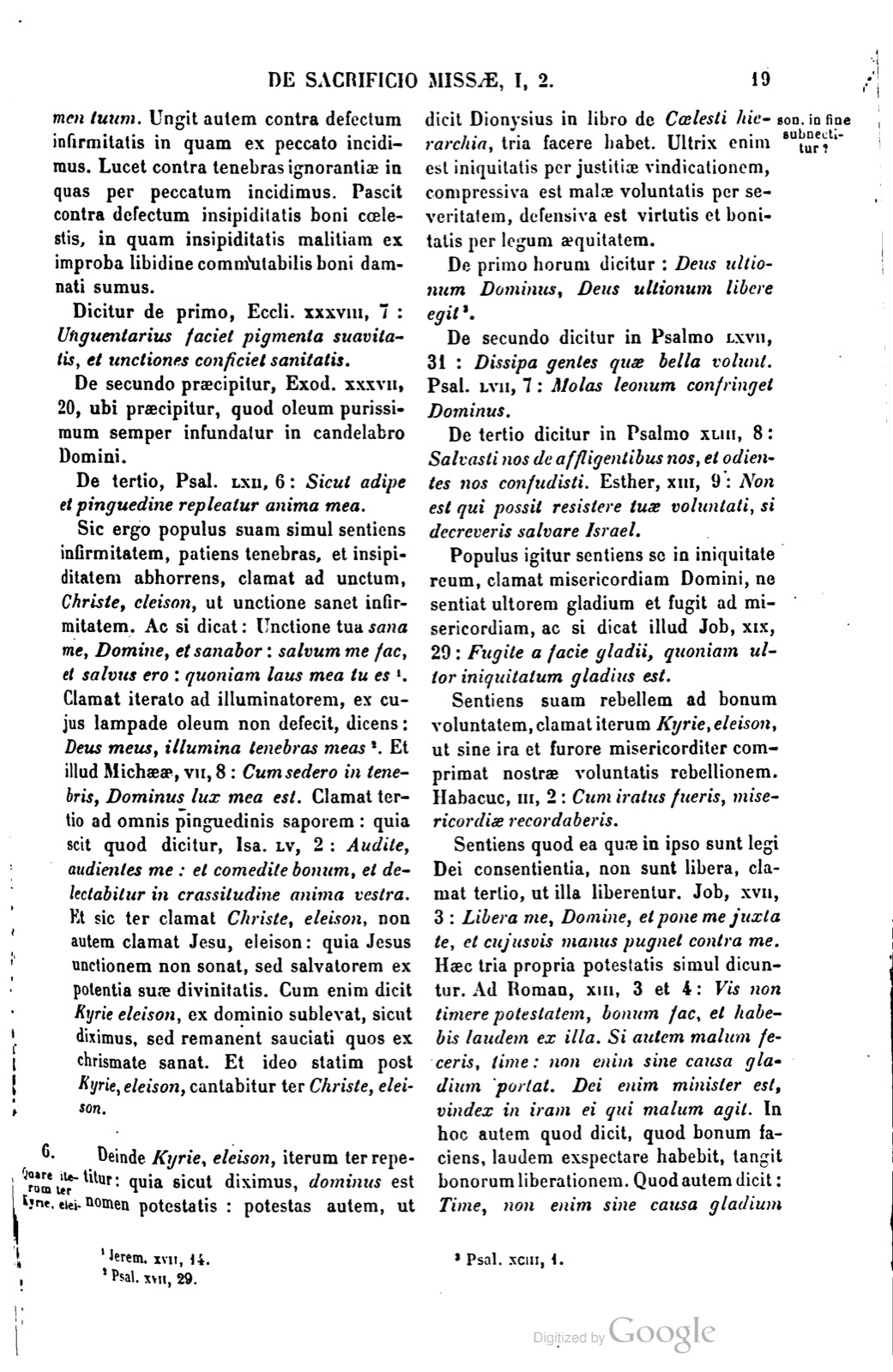
De tertio dicitur in Psalmo XLIII, 8: Salvasti nos de affligentibus nos, et odientes nos confudisti. Esther, XIII, 9: Non est qui possit resistere tuae voluntati, si decreveris salvare Israel.
Populus igitur sentiens se in iniquitate reum, clamat misericordiam Domini, ne sentiat ultorem gladium et fugit ad misericordiam, ac si dicat illud Job, XIX, 29: Fugite a facie gladii, quoniam ultor iniquitatum gladius est.
Sentiens suam rebellem ad bonum voluntatem, clamat iterum Kyrie, eleison, ut sine ira et furore misericorditer comprimat nostrae voluntatis rebellionem. Habacuc, III, 2: Cum iratus fueris, misericordiae recordaberis.
Sentiens quod ea quae in ipso sunt legi Dei consentientia, non sunt libera, clamat tertio, ut illa liberentur. Job, XVII, 3: Libera me, Domine, et pone me juxta te, et cujusvis manus pugnet contra me. Haec tria propria potestatis simul dicuntur. Ad Roman. XIII, 3 et 4: Vis non timere potestatem, bonum fac, et habebis laudem ex illa. Si autem malum feceris, time: non enim sine causa gladium portat. Dei enim minister est, vindex in iram ei qui malum agit. In hoc autem quod dicit, quod bonum faciens, laudem exspectare habebit, tangit bonorum liberationem. Quod autem dicit: Time, non enim sine causa gladium portat, tangit severitatem per quam iniqua comprimitur voluntas ne procedat in actum. In hoc autem quod dicit: Vindex in iram ei qui malum agit, tangit ultionem iniquitatis. Sublevata enim miseria, et sanata natura, adhuc indigemus ut non ulciscatur scelus valide. Adhuc indigemus, ut libera severitate, non in furore corripiat nostram rebellionem in voluntate. Adhuc egemus, ut liberos nos faciat in suae laudis confessione.
Haec est igitur vera causa quare ter primo clamatur, Kyrie, eleison. Et tunc ter subjungitur: Christe, eleison. Et tertio ter subnectitur iterum Kyrie, eleison.
Et sic tria prima quae de hoc quaerebantur, sunt soluta.
7. [Marginal label: Quare Graece dicitur Kyrie, etc.?] Quarto autem quaerebatur, quare in Graeco, et non in Latino clamatur?
De quo quatuor rationes a Patribus assignantur, quarum prima est: quia summa sapientia mundi in Graeco floruit, sicut dicitur, I ad Corinth. I, 22: Judaei signa petunt, et Graeci sapientiam quaerunt. Ut ergo ostendatur quod ista invocatio summa sapientia est, et ex summa sapientia procedit, in Graeco clamatur: sicut enim Judaeus per Scripturam Deum cognovit, ita Gentilis sapiens et philosophus per naturalem sapientiae rationem Deum cognovit, et ideo clamare ad Deum decuit. Et hoc est quod dicitur ad Romanos, I, 16: Non enim erubesco Evangelium: virtus enim Dei est in salutem omni credenti, Judaeo primum, et Graeco. Quia Judaeus primum virtutem Dei in Evangelio cognovit per Scripturam: Graecus autem virtutem eamdem per sapientiam acquisitam ductu rationis in Evangelio cognovit: quoniam inter omnes Gentiles, Graecus tali sapientia sapiens fuit.
Secundam causam assignant observationes legum quae apud Graecos primo fuerunt, sicut ostendunt leges duodecim Tabularum et Pandectarum sciencia, quae usque hodie perseverant a Graecis in nos observatae: et hac justitia etiam justitiam legis Christi cognoverunt, et acceperunt primi inter Gentiles. Unde, ad Roman. I, 17, dicit Apostolus, quod justitia Dei in eo, scilicet in Judaeo in Graeco, revelatur ex fide in fidem: quia sicut Judaeus ex fide justitiae legis Mosaicae justitiam Evangelii agnovit, ita Graecus ex fide justitiae naturalis cognovit justitiam Evangelii. Unde etiam David quosdam arguit hanc justitiam nolentes cognoscere, et dicit, Psal. IV, 6 et 7: Multi dicunt: Quis ostendit nobis bona? Ac si dicat: Haec quaestio supervacua est: quia signatum est super nos lumen vultus tui, Domine, in justitia naturali, quae est exemplum luminis vultus tui: et ex hoc dedisti laetitiam in corde meo: quia ex isto cognosco justitiam tuam, quae valde propinqua est rationi. Unde, ad Roman. X, 8: Prope est verbum in ore tuo, et in corde tuo: hoc est verbum fidei, quod praedicamus. Graecus autem prae omnibus Gentilibus istam studio invenit et coluit justitiam.
Concerning the third it is said in Psalm 43:8: You have saved us from those afflicting us, and you have confounded those hating us. Esther 13:9: There is no one who can resist your will, if you have decreed to save Israel.
Therefore the people, sensing itself guilty in iniquity, cries for the mercy of the Lord, lest it feel the avenging sword, and flees to mercy, as if it were saying that word of Job 19:29: Flee from the face of the sword, because the sword is the avenger of iniquities.
Sensing its will rebellious toward good, it again cries Kyrie, eleison, that without wrath and fury he may mercifully repress the rebellion of our will. Habakkuk 3:2: When you have been angry, you will remember mercy.
Sensing that the things in it that consent to the law of God are not free, it cries a third time that those things may be freed. Job 17:3: Free me, Lord, and set me beside you, and let the hand of anyone whatever fight against me. These three proper things of power are said together. Romans 13:3 and 4: Do you wish not to fear power? Do good, and you will have praise from it. But if you have done evil, fear; for not without cause does it bear the sword. For it is God's minister, an avenger unto wrath for him who does evil. In this, however, that he says that one doing good will have to expect praise, he touches upon the freeing of the good. But in what he says: Fear, for not without cause does it bear the sword, he touches upon severity by which an iniquitous will is repressed, lest it go forward into act. But in this that he says: An avenger unto wrath for him who does evil, he touches upon the vengeance of iniquity. For when misery has been lifted up and nature has been healed, we still need that he not avenge the crime mightily. We still need that with free severity, not in fury, he correct our rebellion in the will. We still need that he make us free in the confession of his praise.
This, therefore, is the true cause why Kyrie, eleison is first cried three times. And then Christe, eleison is added three times. And third, Kyrie, eleison is again attached three times.
And thus the first three things that were being asked about this are solved.
7. [Marginal label: Why is Kyrie, etc., said in Greek?] But fourth it was asked why it is cried out in Greek and not in Latin.
Concerning this four reasons are assigned by the Fathers, the first of which is that the highest wisdom of the world flourished in Greek, as is said in 1 Corinthians 1:22: The Jews seek signs, and the Greeks seek wisdom. Therefore, so that it may be shown that this invocation is highest wisdom and proceeds from highest wisdom, it is cried in Greek. For just as the Jew knew God through Scripture, so the wise Gentile and philosopher knew God through the natural reason of wisdom, and therefore it was fitting for him to cry to God. And this is what is said in Romans 1:16: For I am not ashamed of the Gospel; for it is the power of God unto salvation for everyone believing, first for the Jew and for the Greek. Because the Jew first knew the power of God in the Gospel through Scripture; but the Greek knew the same power in the Gospel through acquired wisdom by the guidance of reason, since among all Gentiles the Greek was wise with such wisdom.
They assign as the second cause the observances of laws that first existed among the Greeks, as the laws of the Twelve Tables and the learning of the Pandects show, which even to this day persevere, observed by the Greeks among us; and by this justice they also knew and first among the Gentiles received the justice of the law of Christ. Hence in Romans 1:17 the Apostle says that the justice of God in it, namely in the Jew and in the Greek, is revealed from faith unto faith, because just as the Jew from faith in the justice of the Mosaic law recognized the justice of the Gospel, so the Greek from faith in natural justice knew the justice of the Gospel. Hence also David reproves certain people not wishing to know this justice, and says in Psalm 4:6 and 7: Many say: Who shows us good things? As if he were saying: This question is superfluous, because the light of your countenance, Lord, has been signed upon us in natural justice, which is an exemplar of the light of your countenance; and from this you have given gladness in my heart, because from this I know your justice, which is very near to reason. Hence Romans 10:8: The word is near, in your mouth and in your heart; this is the word of faith that we preach. But the Greek, before all Gentiles, found and cultivated that justice by study.
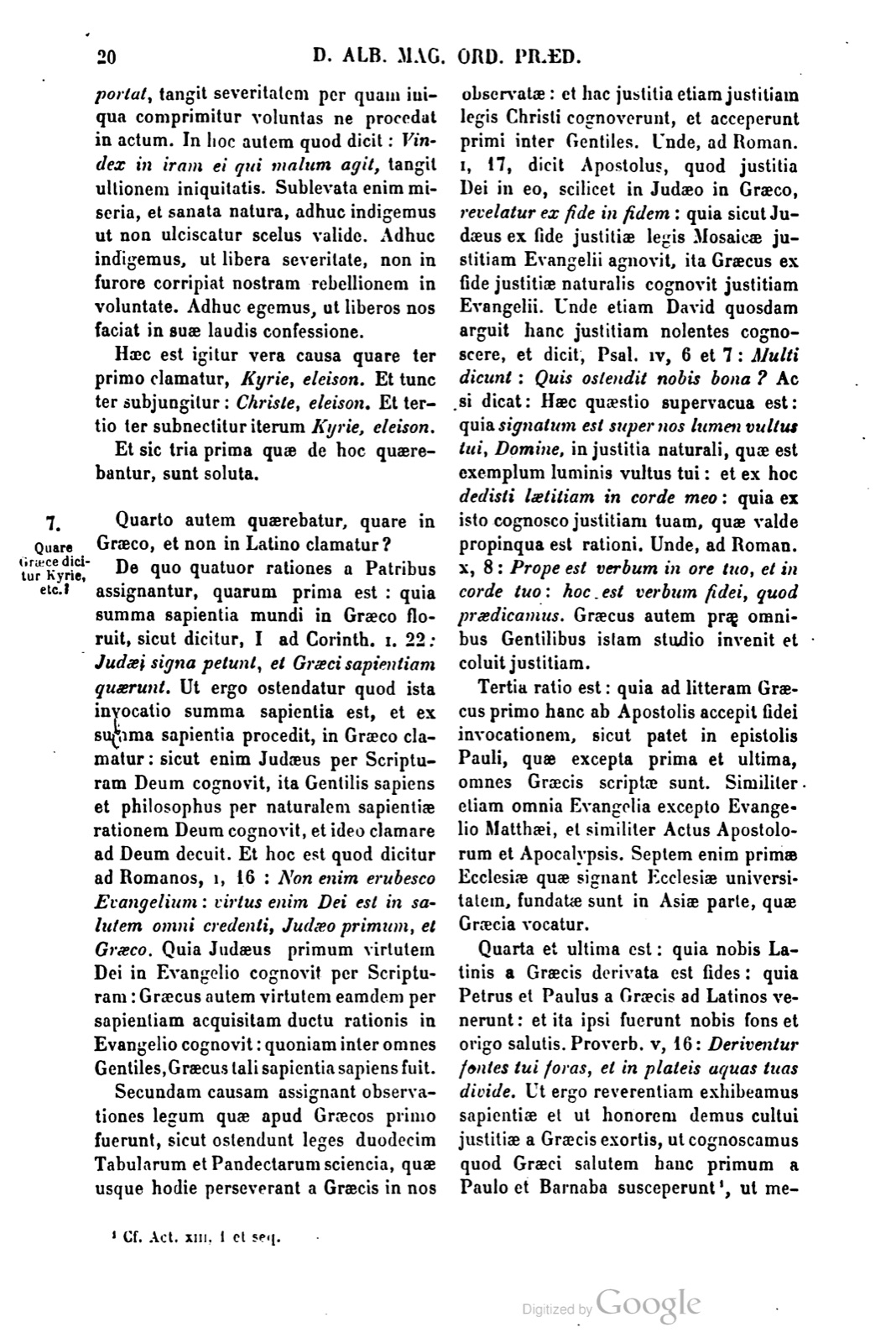
Tertia ratio est: quia ad litteram Graecus primo hanc ab Apostolis accepit fidei invocationem, sicut patet in epistolis Pauli, quae excepta prima et ultima, omnes Graecis scriptae sunt. Similiter etiam omnia Evangelia excepto Evangelio Matthaei, et similiter Actus Apostolorum et Apocalypsis. Septem enim primae Ecclesiae quae signant Ecclesiae universitatem, fundatae sunt in Asiae parte, quae Graecia vocatur.
Quarta et ultima est: quia nobis Latinis a Graecis derivata est fides: quia Petrus et Paulus a Graecis ad Latinos venerunt: et ita ipsi fuerunt nobis fons et origo salutis. Proverb. V, 16: Deriventur fontes tui foras, et in plateis aquas tuas divide. Ut ergo reverentiam exhibeamus sapientiae et ut honorem demus cultui justitiae a Graecis exortis, ut cognoscamus quod Graeci salutem hanc primum a Paulo et Barnaba susceperunt 5, ut memores simus, quoniam ista gratia a Graecis ad nos est derivata, in eisdem syllabis et vocibus quibus primo a populo invocata est misericordia, conservamus adhuc verba clamoris illius: haec enim reverentia Patribus debetur, quod traditiones eorum, sicut ipsi quondam instituerunt, observentur. I ad Corinth. XI, 2: Laudo vos, fratres, quod per omnia mei memores estis, et sicut tradidi vobis, praecepta mea tenetis. In hujus rei signum adhuc in Ecclesiis solemnibus leguntur in Graeco prophetiae et Evangelia in quibusdam festis. Hujus etiam signum est, quod solemnia concilia, scilicet Constantinopolitanum, Nicaenum, Antiochenum, Ephesinum, celebrata sunt in Graecia, in quibus ea quae sunt de Missa maxime primitus sunt instituta, quamvis a beato Gregorio resecatis quibusdam superfluis postea sint ordinata, et ad hunc quem modo tenet Ecclesia modum, sint reducta.
Sic ergo bonus populus conclamat, Kyrie, eleison, et Christe, eleison.
The third reason is that literally the Greek first received this invocation of faith from the Apostles, as is clear in the epistles of Paul, which, except the first and the last, were all written to Greeks. Similarly also all the Gospels except the Gospel of Matthew, and similarly the Acts of the Apostles and the Apocalypse. For the first seven Churches, which signify the universality of the Church, were founded in the part of Asia that is called Greece.
The fourth and last is that faith was derived to us Latins from the Greeks, because Peter and Paul came from the Greeks to the Latins, and so they were for us the fountain and origin of salvation. Proverbs 5:16: Let your fountains be derived abroad, and divide your waters in the streets. Therefore, so that we may exhibit reverence to wisdom, and so that we may give honor to the worship of justice arising from the Greeks, and so that we may recognize that the Greeks first received this salvation from Paul and Barnabas 5, so that we may be mindful that this grace has been derived from the Greeks to us, in the same syllables and voices in which mercy was first invoked by the people we still preserve the words of that cry. For this reverence is owed to the Fathers, that their traditions be observed just as they once established them. 1 Corinthians 11:2: I praise you, brothers, because through all things you are mindful of me, and as I handed them on to you, you keep my precepts. As a sign of this thing, in solemn Churches the prophecies and Gospels are still read in Greek on certain feasts. A sign of this also is that the solemn councils, namely the Constantinopolitan, Nicene, Antiochene, and Ephesian, were celebrated in Greece, in which those things that are concerning the Mass were first chiefly instituted, although afterward, with certain superfluous things removed by blessed Gregory, they were ordered and were reduced to this manner which the Church now holds.
Thus, therefore, the good people cry together, Kyrie, eleison, and Christe, eleison.
Notes
- St. Dionysius, book On the Divine Names, chapter 12, what is Dominion? (S. Dionysius, Lib. de Divinis nominibus, cap. 12, quid Dominatio?) ↩
- Jeremiah 17:14. (Jerem. XVII, 14.) ↩
- Psalm 17:29. (Psal. XVII, 29.) ↩
- Psalm 93:1. (Psal. XCIII, 1.) ↩
- Compare Acts 13:1 and following. (Cf. Act. XIII, 1 et seq.) ↩
If a page does not appear, its photograph has not been uploaded yet.