Works › The Book on the Sacrament of the Eucharist
Volume 38 · pp. 359–361
Chapter III. On the Time of the Institution of This Sacrament
A marker with ≈ is an approximate page boundary, placed by measure of the text; the page photographs remain the authority. In the paired views, clicking a page marker brings that page into view.
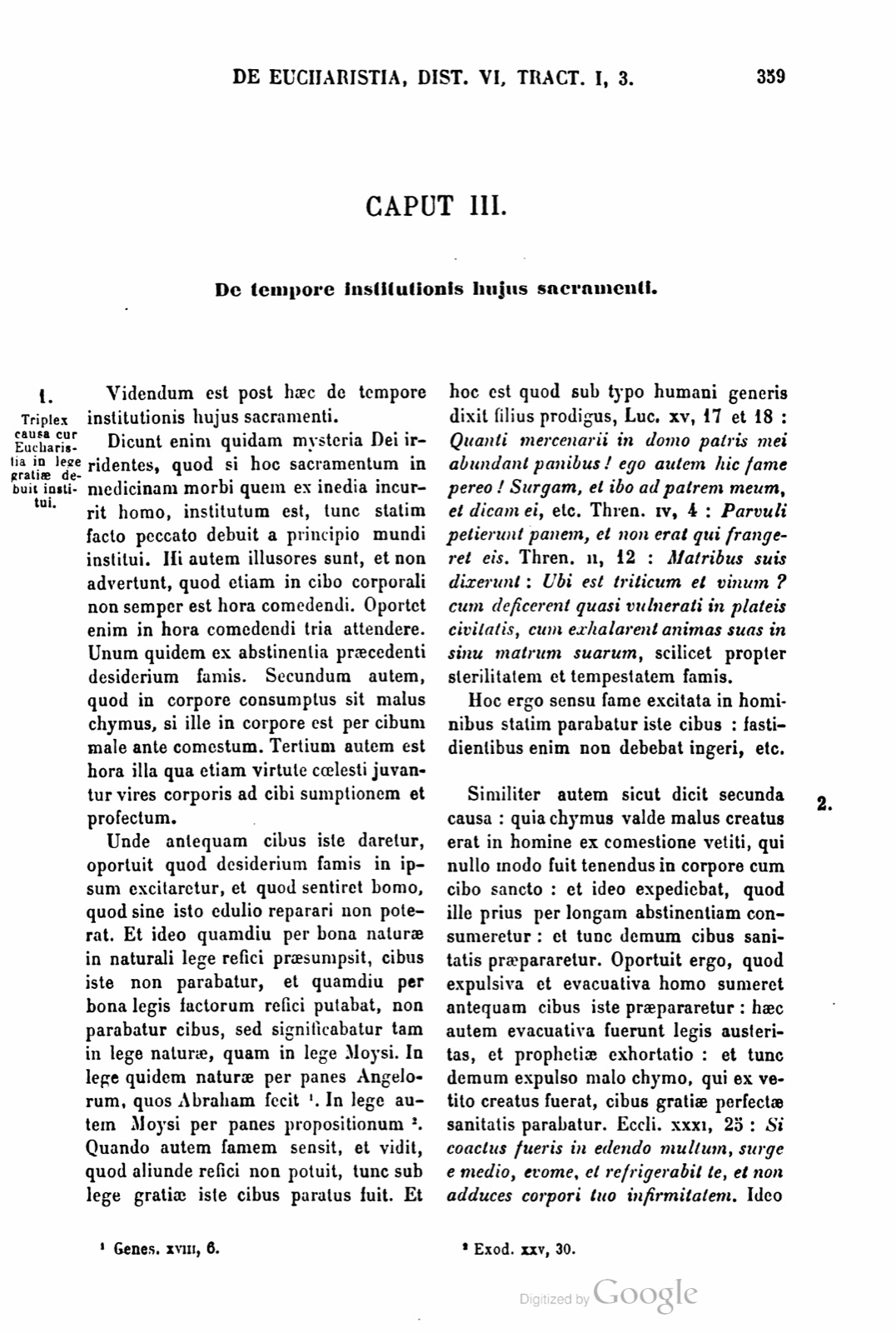
Marginal label (printed p. 359): Triplex causa cur Eucharistia in lege gratiae debuit institui.
CAPUT III. De tempore institutionis hujus sacramenti.
1. Videndum est post haec de tempore institutionis hujus sacramenti.
Dicunt enim quidam mysteria Dei irridentes, quod si hoc sacramentum in medicinam morbi quem ex inedia incurrit homo, institutum est, tunc statim facto peccato debuit a principio mundi institui. Hi autem illusores sunt, et non advertunt, quod etiam in cibo corporali non semper est hora comedendi. Oportet enim in hora comedendi tria attendere. Unum quidem ex abstinentia praecedenti desiderium famis. Secundum autem, quod in corpore consumptus sit malus chymus, si ille in corpore est per cibum male ante comestum. Tertium autem est hora illa qua etiam virtute caelesti juvantur vires corporis ad cibi sumptionem et profectum.
Unde antequam cibus iste daretur, oportuit quod desiderium famis in ipsum excitaretur, et quod sentiret homo, quod sine isto edulio reparari non poterat. Et ideo quamdiu per bona naturae in naturali lege refici praesumpsit, cibus iste non parabatur, et quamdiu per bona legis factorum refici putabat, non parabatur cibus, sed significabatur tam in lege naturae, quam in lege Moysi. In lege quidem naturae per panes Angelorum, quos Abraham fecit.1 In lege autem Moysi per panes propositionum.2 Quando autem famem sensit, et vidit, quod aliunde refici non potuit, tunc sub lege gratiae iste cibus paratus fuit. Et hoc est quod sub typo humani generis dixit filius prodigus, Luc. XV, 17 et 18: Quanti mercenarii in domo patris mei abundant panibus! ego autem hic fame pereo! Surgam, et ibo ad patrem meum, et dicam ei, etc. Thren. IV, 4: Parvuli petierunt panem, et non erat qui frangeret eis. Thren. II, 12: Matribus suis dixerunt: Ubi est triticum et vinum? cum deficerent quasi vulnerati in plateis civitatis, cum exhalarent animas suas in sinu matrum suarum, scilicet propter sterilitatem et tempestatem famis.
Hoc ergo sensu fame excitata in hominibus statim parabatur iste cibus: fastidientibus enim non debebat ingeri, etc.
2. Similiter autem sicut dicit secunda causa: quia chymus valde malus creatus erat in homine ex comestione vetiti, qui nullo modo fuit tenendus in corpore cum cibo sancto: et ideo expediebat, quod ille prius per longam abstinentiam consumeretur: et tunc demum cibus sanitatis praepararetur. Oportuit ergo, quod expulsiva et evacuativa homo sumeret antequam cibus iste praepararetur: haec autem evacuativa fuerunt legis austeritas, et prophetiae exhortatio: et tunc demum expulso malo chymo, qui ex vetito creatus fuerat, cibus gratiae perfectae sanitatis parabatur. Eccli. XXXI, 25: Si coactus fueris in edendo multum, surge e medio, evome, et refrigerabit te, et non adduces corpori tuo infirmitatem. Ideo dicitur, Proverb. XXX, 1: Verba Congregantis, filii Vomentis. Quia pro certo per confessionem et antidotum paenitentiae fellei humores sunt evomendi antequam salutaris cibus exhibeatur. Et ideo oportuit differri hunc cibum usque dum felleus humor et pestiferus chymus ex gustu vetiti contractus, sentiretur per infirmitatem, et medicina requireretur, et tunc vomeretur: et tunc evacuato ab illis, cibus homini pararetur et exhiberetur.
Marginal label (printed p. 359): The threefold cause why the Eucharist had to be instituted in the law of grace.
CHAPTER III. On the time of the institution of this sacrament.
1. After these things it must be seen concerning the time of the institution of this sacrament.
For certain persons, mocking the mysteries of God, say that if this sacrament was instituted as a medicine for the disease which a human being incurs from starvation, then immediately after sin had been committed it ought to have been instituted from the beginning of the world. But these people are mockers, and they do not notice that even in bodily food it is not always the hour of eating. For in the hour of eating three things must be attended to. One is the desire of hunger from preceding abstinence. The second is that bad chyle be consumed in the body, if it is in the body through food badly eaten before. But the third is that hour in which the powers of the body are also helped by heavenly virtue for the receiving and progress of food.
Hence before this food was given, it was necessary that the desire of hunger for it be stirred up, and that man should feel that without this nourishment he could not be repaired. And therefore as long as he presumed to be refreshed through the goods of nature in the natural law, this food was not prepared; and as long as he thought that he was being refreshed through the goods of the law of deeds, the food was not prepared, but was signified both in the law of nature and in the law of Moses. In the law of nature indeed by the breads of the Angels which Abraham made.1 But in the law of Moses by the breads of proposition.2 But when he felt hunger and saw that he could not be refreshed from elsewhere, then under the law of grace this food was prepared. And this is what under the type of the human race the prodigal son said, Luke 15:17 and 18: "How many hired servants in my father's house abound in breads; but I here perish with hunger. I will arise and go to my father, and I will say to him," etc. Lamentations 4:4: "The little ones sought bread, and there was no one who would break it to them." Lamentations 2:12: "They said to their mothers: Where is wheat and wine? when they failed like wounded persons in the streets of the city, when they breathed out their souls in the bosom of their mothers," namely because of sterility and tempest of hunger.
Therefore, with hunger stirred up in human beings by this sense, that food was immediately prepared; for it ought not be forced upon the fastidious, etc.
2. But similarly as the second cause says: because a very bad chyle had been created in man from the eating of the forbidden thing, which in no way was to be held in the body with holy food. And therefore it was expedient that it first be consumed through long abstinence, and then at last the food of health be prepared. Therefore it was necessary that man take expulsive and evacuative things before this food was prepared; but these evacuatives were the austerity of the Law and the exhortation of prophecy, and then at last, when the bad chyle which had been created from the forbidden thing had been expelled, the food of the grace of perfect health was prepared. Ecclesiasticus 31:25: "If you have been compelled in eating much, rise from the midst, vomit, and it will refresh you, and you will not bring infirmity upon your body." Therefore it is said, Proverbs 30:1: "The words of the Gatherer, son of the Vomiter." Because for certain through confession and the antidote of penance bilious humors must be vomited out before saving food is displayed. And therefore it was necessary for this food to be delayed until the bilious humor and pestiferous chyle, contracted from the taste of the forbidden thing, was felt through infirmity, and medicine was required, and then it was vomited; and then, when man was evacuated from those things, food would be prepared and displayed for him.
Et haec est secunda causa.
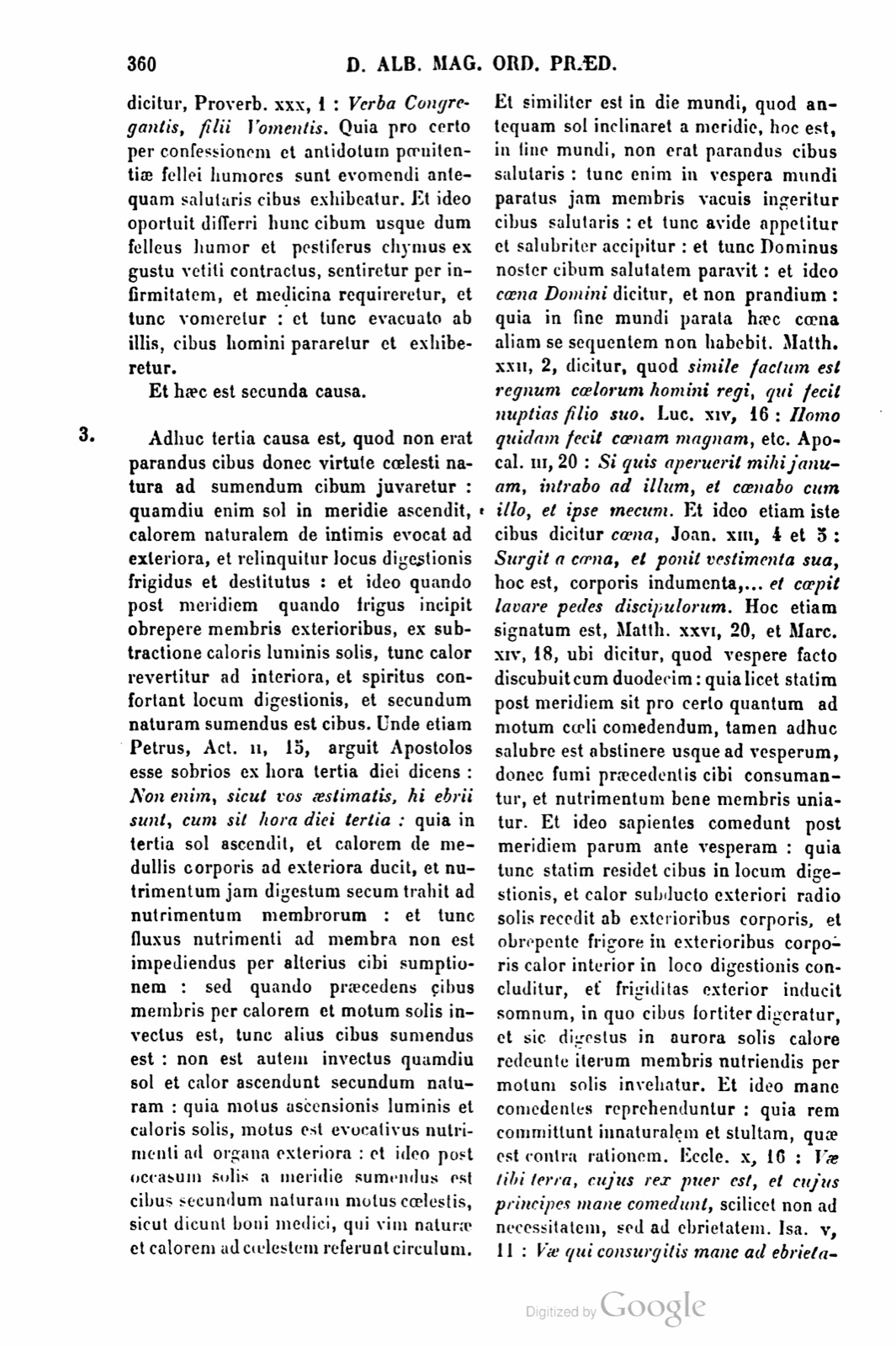
3. Adhuc tertia causa est, quod non erat parandus cibus donec virtute caelesti natura ad sumendum cibum juvaretur: quamdiu enim sol in meridie ascendit, calorem naturalem de intimis evocat ad exteriora, et relinquitur locus digestionis frigidus et destitutus: et ideo quando post meridiem quando frigus incipit obrepere membris exterioribus, ex subtractione caloris luminis solis, tunc calor revertitur ad interiora, et spiritus confortant locum digestionis, et secundum naturam sumendus est cibus. Unde etiam Petrus, Act. II, 15, arguit Apostolos esse sobrios ex hora tertia diei dicens: Non enim, sicut vos aestimatis, hi ebrii sunt, cum sit hora diei tertia: quia in tertia sol ascendit, et calorem de medullis corporis ad exteriora ducit, et nutrimentum jam digestum secum trahit ad nutrimentum membrorum: et tunc fluxus nutrimenti ad membra non est impediendus per alterius cibi sumptionem: sed quando praecedens cibus membris per calorem et motum solis invectus est, tunc alius cibus sumendus est: non est autem invectus quamdiu sol et calor ascendunt secundum naturam: quia motus ascensionis luminis et caloris solis, motus est evocativus nutrimenti ad organa exteriora: et ideo post occasum solis a meridie sumendus est cibus secundum naturam motus caelestis, sicut dicunt boni medici, qui vim naturae et calorem ad caelestem referunt circulum.
Et similiter est in die mundi, quod antequam sol inclinaret a meridie, hoc est, in fine mundi, non erat parandus cibus salutaris: tunc enim in vespera mundi paratus jam membris vacuis ingeritur cibus salutaris: et tunc avide appetitur et salubriter accipitur: et tunc Dominus noster cibum salutarem paravit: et ideo caena Domini dicitur, et non prandium: quia in fine mundi parata haec caena aliam se sequentem non habebit. Matth. XXII, 2, dicitur, quod simile factum est regnum caelorum homini regi, qui fecit nuptias filio suo. Luc. XIV, 16: Homo quidam fecit caenam magnam, etc. Apocal. III, 20: Si quis aperuerit mihi januam, intrabo ad illum, et caenabo cum illo, et ipse mecum. Et ideo etiam iste cibus dicitur caena, Joan. XIII, 4 et 5: Surgit a caena, et ponit vestimenta sua, hoc est, corporis indumenta,... et coepit lavare pedes discipulorum. Hoc etiam signatum est, Matth. XXVI, 20, et Marc. XIV, 18, ubi dicitur, quod vespere facto discubuit cum duodecim: quia licet statim post meridiem sit pro certo quantum ad motum caeli comedendum, tamen adhuc salubre est abstinere usque ad vesperum, donec fumi praecedentis cibi consumantur, et nutrimentum bene membris uniatur. Et ideo sapientes comedunt post meridiem parum ante vesperam: quia tunc statim residet cibus in locum digestionis, et calor subducto exteriori radio solis recedit ab exterioribus corporis, et obrepente frigore in exterioribus corporis calor interior in loco digestionis concluditur, et frigiditas exterior inducit somnum, in quo cibus fortiter digeratur, et sic digestus in aurora solis calore redeunte iterum membris nutriendis per motum solis invehatur. Et ideo mane comedentes reprehenduntur: quia rem committunt innaturalem et stultam, quae est contra rationem. Eccle. X, 16: Vae tibi terra, cujus rex puer est, et cujus principes mane comedunt, scilicet non ad necessitatem, sed ad ebrietatem. Isa. V, 11: Vae qui consurgitis mane ad ebrietatem sectandam, et potandum usque ad vesperam, ut vino aestuetis! Dominus ergo ea quae sunt naturae volens conformare his quae sunt gratiae, voluit in vespera mundi cibum suum parare, ut per hoc infrugalis homo disceret abstinentiam, et qualiter se per abstinentiam parare deberet ad cibum salutarem. Et hoc signans dicit Apostolus, I ad Corinth. XI, 18 et seq.: Primum quidem convenientibus vobis in ecclesiam,... jam non est Dominicam caenam manducare: unusquisque enim suam caenam praesumit ad manducandum. Et alius quidem esurit, alius autem ebrius est. Non enim expedit nec est honestum crapulam saturitatis hesternae eructare super caenam Domini, sed cum desiderio famis exinanito corpore ad caenam Domini accedere: sic enim ut dicitur, Matth. V, 6: Beati qui esuriunt et sitiunt justitiam, hoc est, hanc plenae justitiae caenam: quoniam ipsi saturabuntur.
And this is the second cause.
3. Moreover the third cause is that food was not to be prepared until nature was helped for taking food by heavenly virtue. For as long as the sun ascends at midday, it calls natural heat from the innermost things to the exterior things, and the place of digestion is left cold and destitute; and therefore when after midday cold begins to creep upon the exterior members, from the withdrawal of the heat of the light of the sun, then heat returns to the interior things, and the spirits strengthen the place of digestion, and according to nature food is to be taken. Hence also Peter, Acts 2:15, argues that the Apostles are sober from the third hour of the day, saying: "For these are not drunk, as you suppose, since it is the third hour of the day," because in the third hour the sun ascends and leads heat from the marrow of the body to the exterior things, and draws with itself the nourishment now digested for the nourishment of the members; and then the flow of nourishment to the members must not be impeded through the taking of other food. But when the preceding food has been carried into the members through the heat and motion of the sun, then another food is to be taken. But it has not been carried in as long as sun and heat ascend according to nature, because the motion of ascent of the light and heat of the sun is a motion calling nourishment forth to the exterior organs. And therefore after the setting of the sun from midday food is to be taken according to the nature of the heavenly motion, as good physicians say, who refer the force of nature and heat to the heavenly circle.
And it is similar in the day of the world: before the sun inclined from midday, that is, at the end of the world, saving food was not to be prepared. For then in the evening of the world the saving food, now prepared, is forced into empty members; and then it is eagerly desired and received wholesomely; and then our Lord prepared saving food. And therefore it is called the supper of the Lord and not luncheon, because this supper, prepared at the end of the world, will not have another following it. Matthew 22:2 says that "the kingdom of heaven has been made like a kingly man who made nuptials for his son." Luke 14:16: "A certain man made a great supper," etc. Apocalypse 3:20: "If anyone opens the door to me, I will enter to him, and I will sup with him, and he with me." And therefore this food is also called supper, John 13:4 and 5: "He rises from supper, and lays down his garments," that is, the coverings of the body, "... and began to wash the feet of the disciples." This also was signified, Matthew 26:20 and Mark 14:18, where it is said that when evening had been made he reclined with the twelve. For although for certain, according to the motion of heaven, one is to eat immediately after midday, nevertheless it is still wholesome to abstain until evening, until the fumes of the preceding food are consumed and the nourishment is well united to the members. And therefore the wise eat after midday a little before evening, because then food at once settles into the place of digestion, and when the exterior ray of the sun has been withdrawn, heat recedes from the exterior things of the body, and when cold creeps upon the exterior things of the body, the interior heat is enclosed in the place of digestion, and the exterior cold induces sleep, in which the food is strongly digested; and when thus digested, at dawn, with the heat of the sun returning, it is again carried by the motion of the sun into the members to be nourished. And therefore those eating in the morning are reproved, because they commit an unnatural and foolish thing, which is against reason. Ecclesiastes 10:16: "Woe to you, land whose king is a boy, and whose princes eat in the morning," namely not for necessity, but for drunkenness. Isaiah 5:11: "Woe to those who rise in the morning to pursue drunkenness, and to drink until evening, so that you may be inflamed with wine!" Therefore the Lord, wishing to conform those things which are of nature to those which are of grace, willed to prepare his food in the evening of the world, so that through this the fruitless man might learn abstinence, and how through abstinence he ought to prepare himself for saving food. And signifying this the Apostle says, I Corinthians 11:18 and following: "First indeed when you come together in the church, ... now it is not to eat the Lord's supper; for each one presumes his own supper to eat. And one indeed is hungry, but another is drunk." For it is not expedient nor honorable to belch the excess of yesterday's fullness over the supper of the Lord, but to approach the supper of the Lord with desire of hunger, the body being emptied. For thus as it is said, Matthew 5:6: "Blessed are those who hunger and thirst for justice," that is, this supper of full justice, "for they shall be filled."
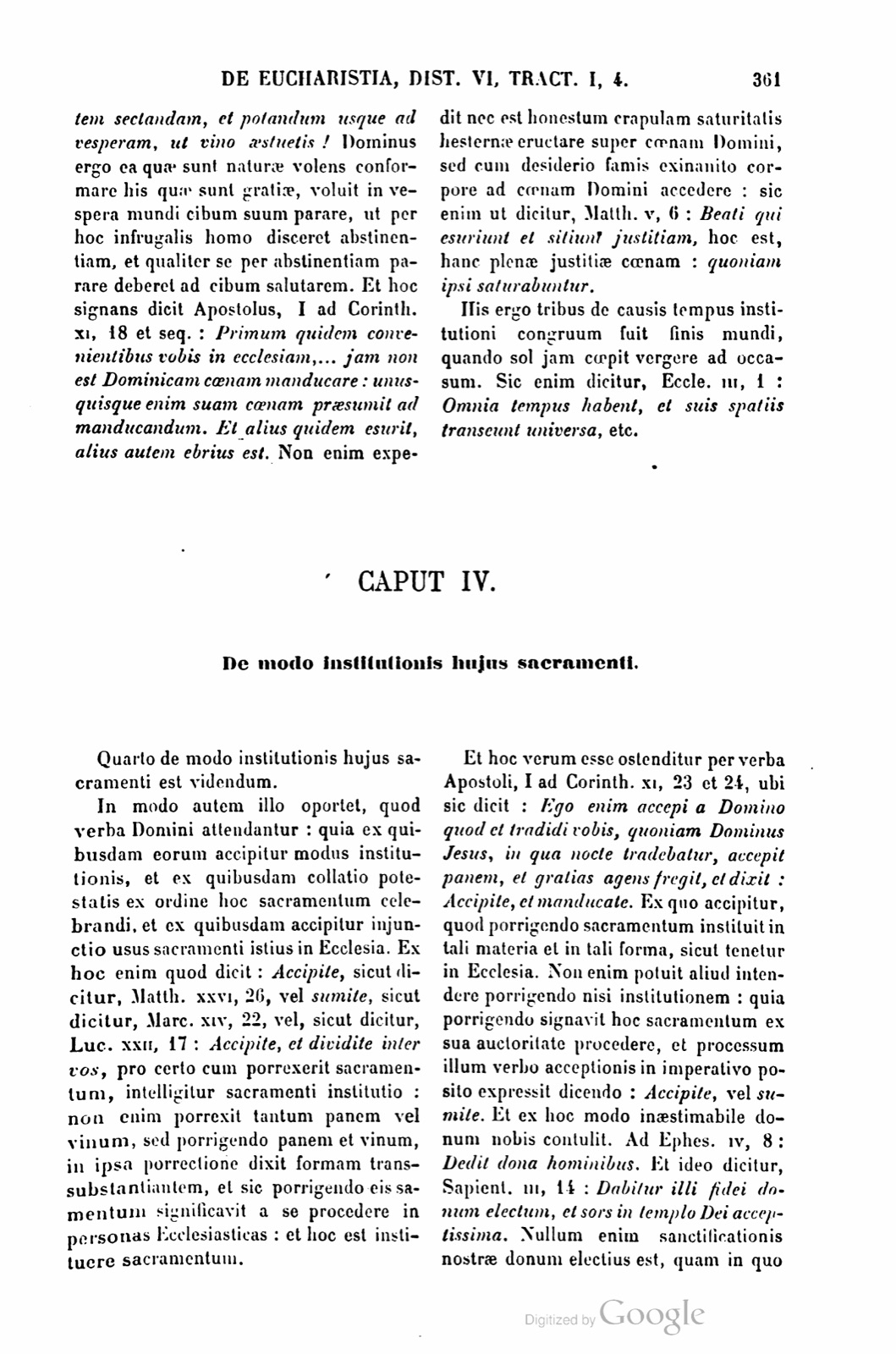
His ergo tribus de causis tempus institutioni congruum fuit finis mundi, quando sol jam coepit vergere ad occasum. Sic enim dicitur, Eccle. III, 1: Omnia tempus habent, et suis spatiis transeunt universa, etc.
Therefore for these three causes the end of the world was the time fitting for the institution, when the sun had now begun to turn toward setting. For thus it is said, Ecclesiastes 3:1: "All things have time, and all things pass through their spaces," etc.
If a page does not appear, its photograph has not been uploaded yet.