Works › The Book on the Sacrament of the Eucharist
Volume 38 · pp. 349–350
Chapter IV. On the Truth of This Sacrifice
A marker with ≈ is an approximate page boundary, placed by measure of the text; the page photographs remain the authority. In the paired views, clicking a page marker brings that page into view.
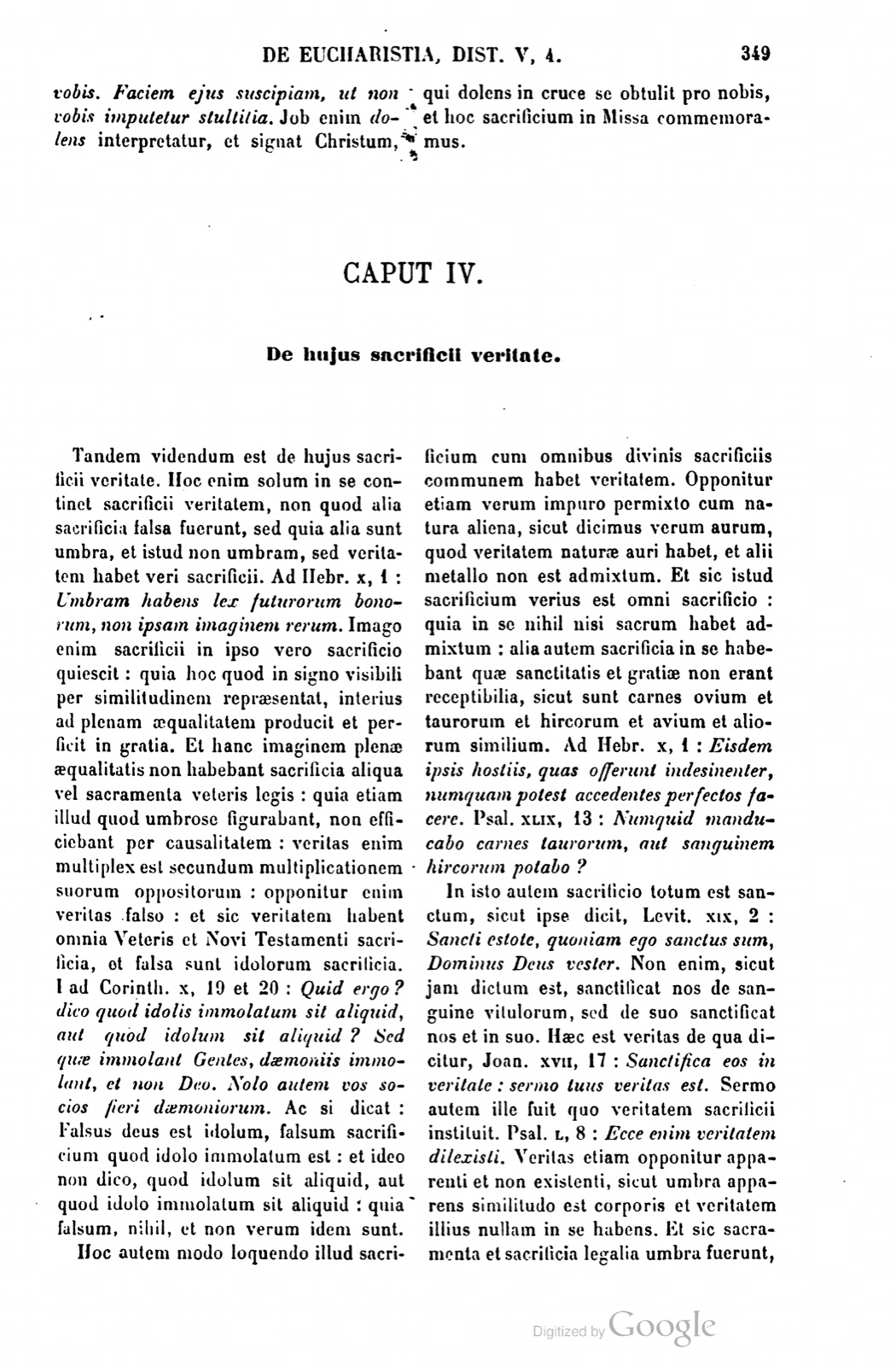
CAPUT IV. De hujus sacrificii veritate.
Tandem videndum est de hujus sacrificii veritate. Hoc enim solum in se continet sacrificii veritatem, non quod alia sacrificia falsa fuerunt, sed quia alia sunt umbra, et istud non umbram, sed veritatem habet veri sacrificii. Ad Hebr. X, 1: Umbram habens lex futurorum bonorum, non ipsam imaginem rerum. Imago enim sacrificii in ipso vero sacrificio quiescit: quia hoc quod in signo visibili per similitudinem repraesentat, interius ad plenam aequalitatem producit et perficit in gratia. Et hanc imaginem plenae aequalitatis non habebant sacrificia aliqua vel sacramenta veteris legis: quia etiam illud quod umbrose figurabant, non efficiebant per causalitatem: veritas enim multiplex est secundum multiplicationem suorum oppositorum: opponitur enim veritas falso: et sic veritatem habent omnia Veteris et Novi Testamenti sacrificia, et falsa sunt idolorum sacrificia. I ad Corinth. X, 19 et 20: Quid ergo? dico quod idolis immolatum sit aliquid, aut quod idolum sit aliquid? Sed nos quae immolant Gentes, daemoniis immolant, et non Deo. Nolo autem vos socios fieri daemoniorum. Ac si dicat: Falsus deus est idolum, falsum sacrificium quod idolo immolatum est: et ideo non dico, quod idolum sit aliquid, aut quod idolo immolatum sit aliquid: quia falsum, nihil, et non verum idem sunt. Hoc autem modo loquendo illud sacrificium cum omnibus divinis sacrificiis communem habet veritatem. Opponitur etiam verum impuro permixto cum natura aliena, sicut dicimus verum aurum, quod veritatem naturae auri habet, et alii metallo non est admixtum. Et sic istud sacrificium verius est omni sacrificio: quia in se nihil nisi sacrum habet admixtum: alia autem sacrificia in se habebant quae sanctitatis et gratiae non erant receptibilia, sicut sunt carnes ovium et taurorum et hircorum et avium et aliorum similium. Ad Hebr. X, 1: Eisdem ipsis hostiis, quas offerunt indesinenter, numquam potest accedentes perfectos facere. Psal. XLIX, 13: Numquid manducabo carnes taurorum, aut sanguinem hircorum potabo?
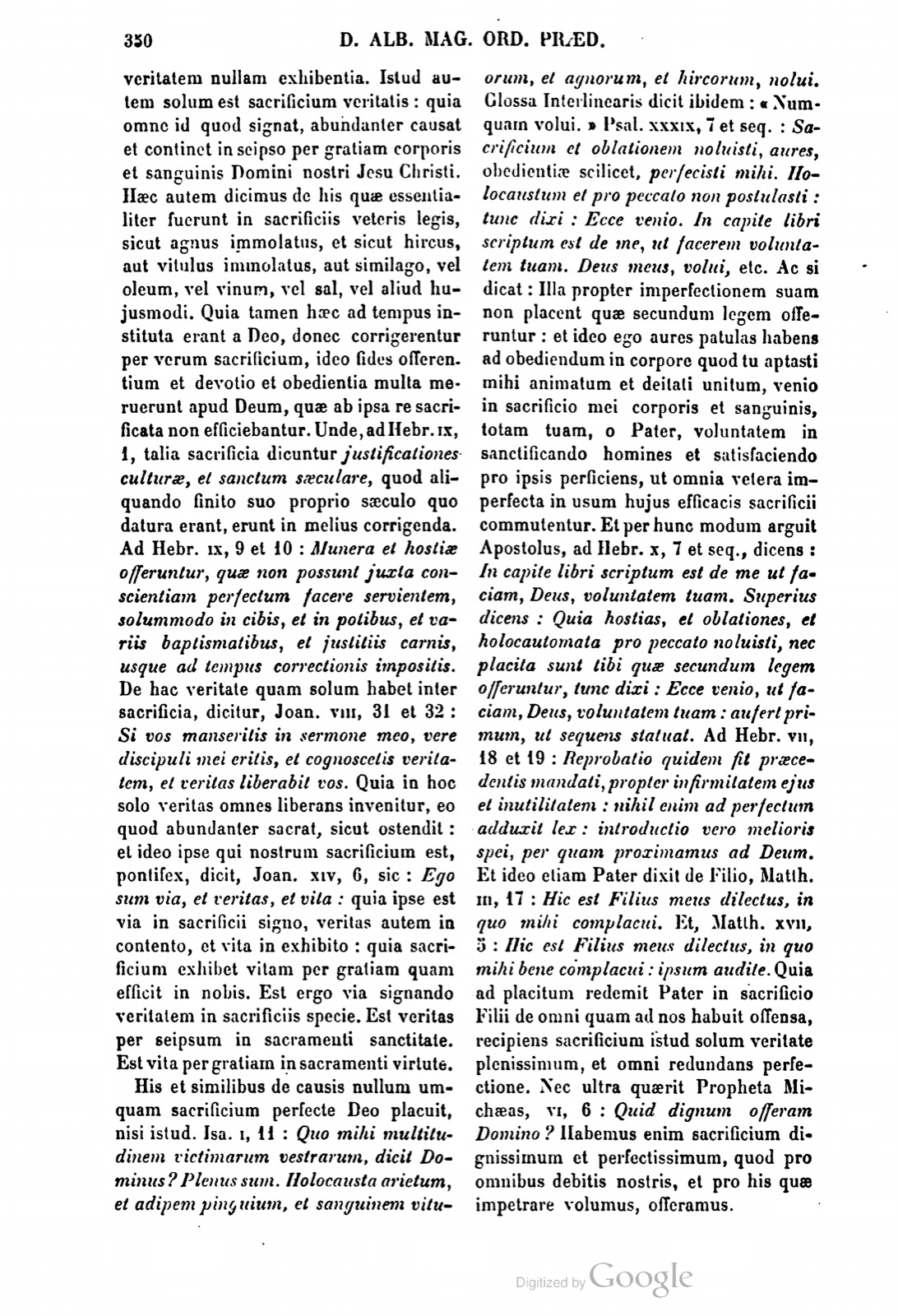
In isto autem sacrificio totum est sanctum, sicut ipse dicit, Levit. XIX, 2: Sancti estote, quoniam ego sanctus sum, Dominus Deus vester. Non enim, sicut jam dictum est, sanctificat nos de sanguine vitulorum, sed de suo sanctificat et in suo. Haec est veritas de qua dicitur, Joan. XVII, 17: Sanctifica eos in veritate: sermo tuus veritas est. Sermo autem ille fuit quo veritatem sacrificii instituit. Psal. L, 8: Ecce enim veritatem dilexisti. Veritas etiam opponitur apparenti et non existenti, sicut umbra apparens similitudo est corporis et veritatem illius nullam in se habens. Et sic sacramenta et sacrificia legalia umbra fuerunt, veritatem nullam exhibentia. Istud autem solum est sacrificium veritatis: quia omne id quod signat, abundanter causat et continet in seipso per gratiam corporis et sanguinis Domini nostri Jesu Christi. Haec autem dicimus de his quae essentialiter fuerunt in sacrificiis veteris legis, sicut agnus immolatus, et sicut hircus, aut vitulus immolatus, aut similago, vel oleum, vel vinum, vel sal, vel aliud hujusmodi. Quia tamen haec ad tempus instituta erant a Deo, donec corrigerentur per verum sacrificium, ideo fides offerentium et devotio et obedientia multa meruerunt apud Deum, quae ab ipsa re sacrificata non efficiebantur. Unde, ad Hebr. IX, 1, talia sacrificia dicuntur justificationes culturae, et sanctum saeculare, quod aliquando finito suo proprio saeculo quo datura erant, erunt in melius corrigenda. Ad Hebr. IX, 9 et 10: Munera et hostiae offeruntur, quae non possunt juxta conscientiam perfectum facere servientem, solummodo in cibis, et in potibus, et variis baptismatibus, et justitiis carnis, usque ad tempus correctionis impositis. De hac veritate quam solum habet inter sacrificia, dicitur, Joan. VIII, 31 et 32: Si vos manseritis in sermone meo, vere discipuli mei eritis, et cognoscetis veritatem, et veritas liberabit vos. Quia in hoc solo veritas omnes liberans invenitur, eo quod abundanter sacrat, sicut ostendit: et ideo ipse qui nostrum sacrificium est, pontifex, dicit, Joan. XIV, 6, sic: Ego sum via, et veritas, et vita: quia ipse est via in sacrificii signo, veritas autem in contento, et vita in exhibito: quia sacrificium exhibet vitam per gratiam quam efficit in nobis. Est ergo via signando ad veritatem in sacrificiis specie. Est veritas per seipsum in sacramenti sanctitate. Est vita per gratiam in sacramenti virtute.
CHAPTER IV. On the truth of this sacrifice.
Finally it must be seen concerning the truth of this sacrifice. For this alone contains in itself the truth of sacrifice, not because the other sacrifices were false, but because the others are shadow, and this does not have shadow, but the truth of a true sacrifice. Hebrews 10:1: "The Law having a shadow of future goods, not the very image of the things." For the image of sacrifice rests in the true sacrifice itself, because what it represents in a visible sign through likeness, it produces inwardly unto full equality and perfects in grace. And no sacrifices or sacraments of the old Law had this image of full equality, because even that which they figuratively shadowed, they did not effect through causality. For truth is manifold according to the multiplication of its opposites: for truth is opposed to the false, and in this way all sacrifices of the Old and New Testament have truth, and the sacrifices of idols are false. I Corinthians 10:19 and 20: "What then? Do I say that what is immolated to idols is anything, or that an idol is anything? But what the Gentiles immolate, they immolate to demons and not to God. But I do not want you to become associates of demons." As if he said: An idol is a false god; what has been immolated to an idol is a false sacrifice; and therefore I do not say that an idol is anything, or that what has been immolated to an idol is anything, because the false, nothing, and the not-true are the same. But speaking in this mode, that sacrifice has truth common with all divine sacrifices. The true is also opposed to the impure mixed with an alien nature, as we say true gold, which has the truth of the nature of gold and is not mixed with another metal. And thus this sacrifice is truer than every sacrifice, because in itself it has nothing mixed except what is sacred; but the other sacrifices had in themselves things which were not receptive of sanctity and grace, as are the flesh of sheep and bulls and goats and birds and other similar things. Hebrews 10:1: "With those same hosts, which they offer without ceasing, it can never make those approaching perfect." Psalm 49:13: "Shall I eat the flesh of bulls, or drink the blood of goats?"
But in this sacrifice the whole is holy, as he himself says, Leviticus 19:2: "Be holy, because I, the Lord your God, am holy." For, as has now been said, he does not sanctify us from the blood of calves, but sanctifies from his own and in his own. This is the truth concerning which it is said, John 17:17: "Sanctify them in truth; your word is truth." But that word was that by which he instituted the truth of the sacrifice. Psalm 50:8: "For behold, you have loved truth." Truth is also opposed to the apparent and non-existent, as a shadow is an appearing likeness of a body, having none of its truth in itself. And thus the legal sacraments and sacrifices were a shadow, displaying no truth. But this alone is the sacrifice of truth, because everything which it signifies, it abundantly causes and contains in itself through the grace of the body and blood of our Lord Jesus Christ. But we say these things about those which were essentially in the sacrifices of the old Law, such as the immolated lamb, and such as the goat, or immolated calf, or fine flour, or oil, or wine, or salt, or another thing of this kind. Yet because these had been instituted by God for a time, until they should be corrected through the true sacrifice, therefore the faith of those offering and devotion and obedience merited many things before God, which were not effected by the sacrificed thing itself. Hence, Hebrews 9:1, such sacrifices are called "justifications of worship" and "a worldly holy place," which, when sometime its own age for which they were to be given had been ended, were to be corrected into better things. Hebrews 9:9 and 10: "Gifts and hosts are offered which cannot, according to conscience, make the one serving perfect, imposed only in foods and in drinks and various baptisms and justices of flesh, until the time of correction." Concerning this truth, which alone among sacrifices has it, it is said, John 8:31 and 32: "If you remain in my word, you will truly be my disciples, and you will know the truth, and the truth will free you." Because in this alone truth freeing all is found, in that it consecrates abundantly, as he shows; and therefore he who is our sacrifice, the pontiff, says thus, John 14:6: "I am the way, and the truth, and the life," because he is the way in the sign of sacrifice, but the truth in the thing contained, and life in the thing displayed, because the sacrifice displays life through the grace which it effects in us. Therefore he is the way, by signifying toward truth in the species of sacrifices. He is truth through himself in the sanctity of the sacrament. He is life through grace in the power of the sacrament.
His et similibus de causis nullum umquam sacrificium perfecte Deo placuit, nisi istud. Isa. I, 11: Quo mihi multitudinem victimarum vestrarum, dicit Dominus? Plenus sum. Holocausta arietum, et adipem pinguium, et sanguinem vitulorum, et agnorum, et hircorum, nolui. Glossa Interlinearis dicit ibidem: « Numquam volui. » Psal. XXXIX, 7 et seq.: Sacrificium et oblationem noluisti, aures, obedientiae scilicet, perfecisti mihi. Holocaustum et pro peccato non postulasti: tunc dixi: Ecce venio. In capite libri scriptum est de me, ut facerem voluntatem tuam. Deus meus, volui, etc. Ac si dicat: Illa propter imperfectionem suam non placent quae secundum legem offeruntur: et ideo ego aures patulas habens ad obediendum in corpore quod tu aptasti mihi animatum et deitati unitum, venio in sacrificio mei corporis et sanguinis, totam tuam, o Pater, voluntatem in sanctificando homines et satisfaciendo pro ipsis perficiens, ut omnia vetera imperfecta in usum hujus efficacis sacrificii commutentur. Et per hunc modum arguit Apostolus, ad Hebr. X, 7 et seq., dicens: In capite libri scriptum est de me ut faciam, Deus, voluntatem tuam. Superius dicens: Quia hostias, et oblationes, et holocautomata pro peccato noluisti, nec placita sunt tibi quae secundum legem offeruntur, tunc dixi: Ecce venio, ut faciam, Deus, voluntatem tuam: aufert primum, ut sequens statuat. Ad Hebr. VII, 18 et 19: Reprobatio quidem fit praecedentis mandati, propter infirmitatem ejus et inutilitatem: nihil enim ad perfectum adduxit lex: introductio vero melioris spei, per quam proximamus ad Deum. Et ideo etiam Pater dixit de Filio, Matth. III, 17: Hic est Filius meus dilectus, in quo mihi complacui. Et, Matth. XVII, 5: Hic est Filius meus dilectus, in quo mihi bene complacui: ipsum audite. Quia ad placitum redemit Pater in sacrificio Filii de omni quam ad nos habuit offensa, recipiens sacrificium istud solum veritate plenissimum, et omni redundans perfectione. Nec ultra quaerit Propheta Michaeas, VI, 6: Quid dignum offeram Domino? Habemus enim sacrificium dignissimum et perfectissimum, quod pro omnibus debitis nostris, et pro his quae impetrare volumus, offeramus.
For these and similar causes no sacrifice ever perfectly pleased God except this one. Isaiah 1:11: "What to me is the multitude of your victims, says the Lord? I am full. Holocausts of rams, and the fat of fatlings, and the blood of calves, and lambs, and goats, I have not willed." The Interlinear Gloss says in the same place: "I have never willed." Psalm 39:7 and following: "Sacrifice and oblation you have not willed; ears," namely of obedience, "you have perfected for me. Holocaust and for sin you have not required; then I said: Behold, I come. In the head of the book it is written of me, that I should do your will. My God, I have willed," etc. As if he said: Those things which are offered according to the Law do not please because of their imperfection, and therefore I, having ears open for obeying in the body which you fitted to me, animated and united to deity, come in the sacrifice of my body and blood, fulfilling your whole will, O Father, in sanctifying human beings and satisfying for them, so that all the old imperfect things may be changed into the use of this efficacious sacrifice. And in this mode the Apostle argues, Hebrews 10:7 and following, saying: "In the head of the book it is written of me that I should do, O God, your will." Saying above: "Because hosts, and oblations, and holocausts for sin you have not willed, nor are the things which are offered according to the Law pleasing to you," then "I said: Behold, I come, that I should do, O God, your will": "he takes away the first, that he may establish the following." Hebrews 7:18 and 19: "A reprobation indeed is made of the preceding command, because of its weakness and uselessness; for the Law brought nothing to perfection; but an introduction of a better hope, through which we draw near to God." And therefore also the Father said concerning the Son, Matthew 3:17: "This is my beloved Son, in whom I have been well pleased." And Matthew 17:5: "This is my beloved Son, in whom I have been well pleased; hear him." Because the Father was pleased unto placation in the sacrifice of the Son from every offense which he had toward us, receiving this sacrifice alone, most full of truth and overflowing with every perfection. Nor does the Prophet Micah further ask, 6:6: "What worthy thing shall I offer to the Lord?" For we have the most worthy and most perfect sacrifice, which we may offer for all our debts and for those things which we wish to obtain.
If a page does not appear, its photograph has not been uploaded yet.