Works › The Book on the Sacrament of the Eucharist
Volume 38 · pp. 441–442
Index of Notable Things, A-Food
A marker with ≈ is an approximate page boundary, placed by measure of the text; the page photographs remain the authority. In the paired views, clicking a page marker brings that page into view.
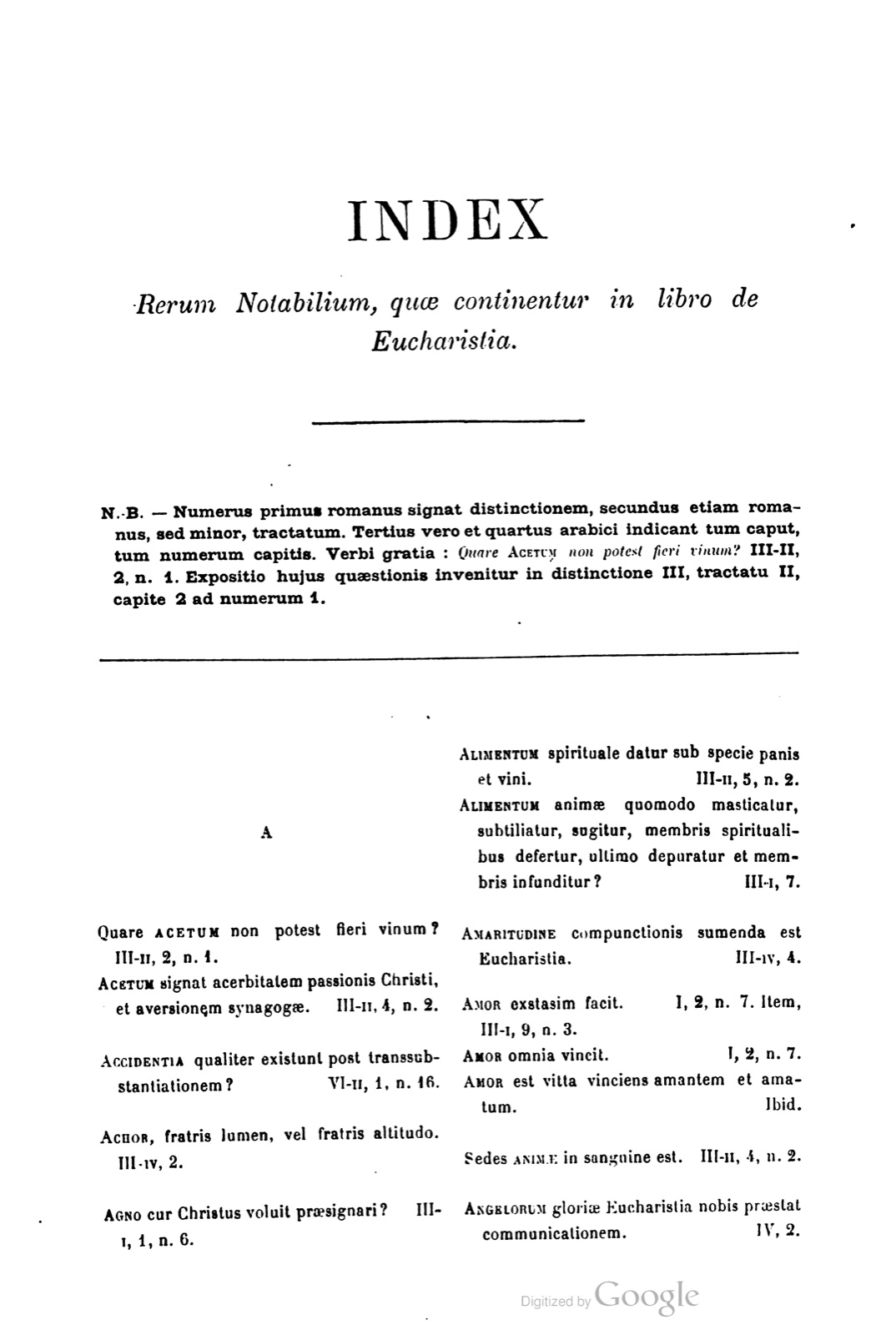
INDEX
Rerum Notabilium, quae continentur in libro de Eucharistia.
N.-B. - Numerus primus romanus signat distinctionem, secundus etiam romanus, sed minor, tractatum. Tertius vero et quartus arabici indicant tum caput, tum numerum capitis. Verbi gratia: Quare ACETUM non potest fieri vinum? III-II, 2, n. 1. Expositio hujus quaestionis invenitur in distinctione III, tractatu II, capite 2 ad numerum 1.
A.
Quare ACETUM non potest fieri vinum? III-II, 2, n. 1.
ACETUM signat acerbitatem passionis Christi, et aversionem synagogae. III-II, 4, n. 2.
ACCIDENTIA qualiter existunt post transsubstantiationem? VI-II, 1, n. 16.
ACHOR, fratris lumen, vel fratris altitudo. III-IV, 2.
AGNO cur Christus voluit praesignari? III-I, 1, n. 6.
ALIMENTUM spirituale datur sub specie panis et vini. III-II, 5, n. 2.
ALIMENTUM animae quomodo masticatur, subtiliatur, sugitur, membris spiritualibus defertur, ultimo depuratur et membris infunditur? III-I, 7.
AMARITUDINE compunctionis sumenda est Eucharistia. III-IV, 4.
AMOR exstasim facit. I, 2, n. 7. Item, III-I, 9, n. 3.
AMOR omnia vincit. I, 2, n. 7.
AMOR est vitta vinciens amantem et amatum. Ibid.
Sedes ANIMAE in sanguine est. III-II, 4, n. 2.
ANGELORUM gloriae Eucharistia nobis praestat communicationem. IV, 2.
ANGELI quomodo flere et tristari dicantur? IV, 2.
ANGELI assistunt in omni Christi corporis confectione. I, 2, n. 4.
ANNA, gratia. III-I, 1, n. 5.
AQUAE fluentis quatuor commoditates. IV, 1.
AQUA non desideratur in potu, nisi a natura corrupta et nimis incensa. III-I, 1, n. 2.
INDEX
Of Notable Things which are contained in the book on the Eucharist.
N.-B. - The first Roman numeral signifies the distinction; the second, also Roman but smaller, signifies the tractate. But the third and fourth Arabic numerals indicate both the chapter and the number of the chapter. For example: Why can VINEGAR not become wine? III-II, 2, n. 1. The exposition of this question is found in distinction III, tractate II, chapter 2 at number 1.
A.
Why can VINEGAR not become wine? III-II, 2, n. 1.
VINEGAR signifies the bitterness of Christ's passion and the aversion of the synagogue. III-II, 4, n. 2.
ACCIDENTS, how do they exist after transubstantiation? VI-II, 1, n. 16.
ACHOR, light of the brother, or height of the brother. III-IV, 2.
Why did Christ wish to be pre-signified by a LAMB? III-I, 1, n. 6.
Spiritual NOURISHMENT is given under the species of bread and wine. III-II, 5, n. 2.
How is the NOURISHMENT of the soul chewed, refined, sucked, carried to spiritual members, finally purified and infused into the members? III-I, 7.
The Eucharist is to be received in the BITTERNESS of compunction. III-IV, 4.
LOVE makes ecstasy. I, 2, n. 7. Likewise, III-I, 9, n. 3.
LOVE conquers all things. I, 2, n. 7.
LOVE is the band binding the lover and the beloved. In the same place.
The seat of the SOUL is in blood. III-II, 4, n. 2.
The Eucharist furnishes to us communication of the glory of the ANGELS. IV, 2.
How are ANGELS said to weep and be saddened? IV, 2.
ANGELS assist in every confection of the body of Christ. I, 2, n. 4.
ANNA, grace. III-I, 1, n. 5.
Four advantages of flowing WATER. IV, 1.
WATER is not desired in drink except by a corrupt and excessively inflamed nature. III-I, 1, n. 2.
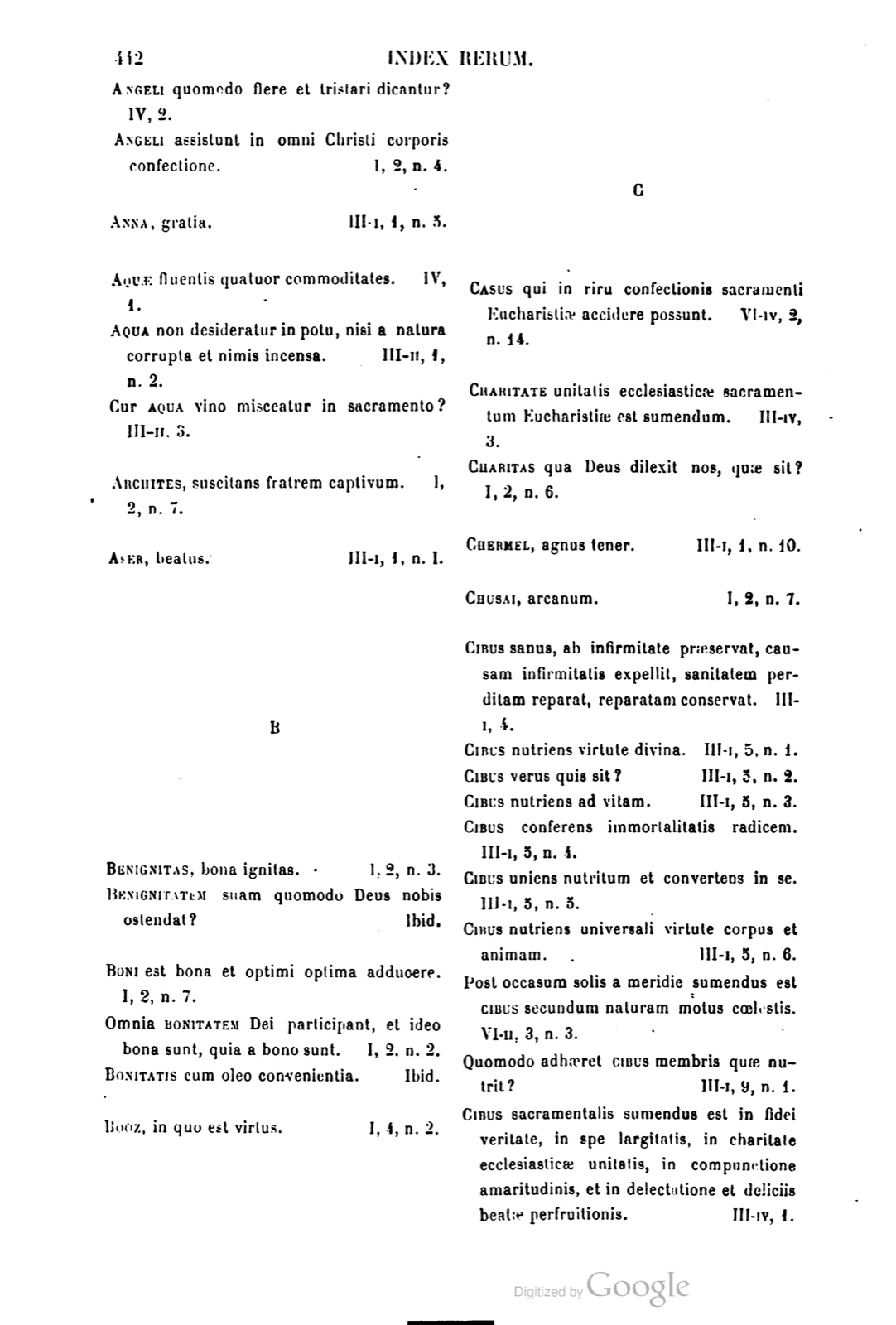
Cur AQUA vino misceatur in sacramento? III-II, 3.
ARCHITES, suscitans fratrem captivum. I, 2, n. 7.
ASER, beatus. III-I, 1, n. 1.
B.
BENIGNITAS, bona ignitas. I, 2, n. 3.
BENIGNITATEM suam quomodo Deus nobis ostendat? Ibid.
BONI est bona et optimi optima adducere. I, 2, n. 7.
Omnia BONITATEM Dei participant, et ideo bona sunt, quia a bono sunt. I, 2, n. 2.
BONITATIS cum oleo convenientia. Ibid.
BOOZ, in quo est virtus. I, 4, n. 2.
C.
Casus qui in ritu confectionis sacramenti Eucharistiae accidere possunt. VI-IV, 2, n. 14.
CHARITATE unitatis ecclesiasticae sacramentum Eucharistiae est sumendum. III-IV, 3.
CHARITAS qua Deus dilexit nos, quae sit? I, 2, n. 6.
CHERMEL, agnus tener. III-I, 1, n. 10.
CHUSAI, arcanum. I, 2, n. 7.
CIBUS sanus, ab infirmitate praeservat, causam infirmitatis expellit, sanitatem perditam reparat, reparatam conservat. III-I, 4.
CIBUS nutriens virtute divina. III-I, 5, n. 1.
CIBUS verus quis sit? III-I, 5, n. 2.
CIBUS nutriens ad vitam. III-I, 5, n. 3.
CIBUS conferens immortalitatis radicem. III-I, 5, n. 4.
CIBUS uniens nutritum et convertens in se. III-I, 5, n. 5.
CIBUS nutriens universali virtute corpus et animam. III-I, 5, n. 6.
Post occasum solis a meridie sumendus est CIBUS secundum naturam motus coelestis. VI-II, 3, n. 3.
Quomodo adhaeret CIBUS membris quae nutrit? III-I, 9, n. 1.
CIBUS sacramentalis sumendus est in fidei veritate, in spe largitatis, in charitate ecclesiasticae unitatis, in compunctione amaritudinis, et in delectatione et deliciis beatae perfruitionis. III-IV, 1.
Why is WATER mixed with wine in the sacrament? III-II, 3.
ARCHITES, raising up the captive brother. I, 2, n. 7.
ASER, blessed. III-I, 1, n. 1.
B.
BENIGNITY, good fieriness. I, 2, n. 3.
How does God show his BENIGNITY to us? In the same place.
It belongs to the GOOD to bring good things, and to the best to bring the best things. I, 2, n. 7.
All things participate in the GOODNESS of God, and therefore they are good, because they are from the good. I, 2, n. 2.
The fittingness of GOODNESS with oil. In the same place.
BOOZ, in whom there is power. I, 4, n. 2.
C.
Cases which can happen in the rite of confection of the sacrament of the Eucharist. VI-IV, 2, n. 14.
The sacrament of the Eucharist is to be received in the CHARITY of ecclesiastical unity. III-IV, 3.
What is the CHARITY by which God loved us? I, 2, n. 6.
CHERMEL, tender lamb. III-I, 1, n. 10.
CHUSAI, secret thing. I, 2, n. 7.
Healthy FOOD preserves from infirmity, expels the cause of infirmity, repairs lost health, conserves repaired health. III-I, 4.
FOOD nourishing by divine power. III-I, 5, n. 1.
Who is true FOOD? III-I, 5, n. 2.
FOOD nourishing unto life. III-I, 5, n. 3.
FOOD conferring the root of immortality. III-I, 5, n. 4.
FOOD uniting the nourished thing and converting it into itself. III-I, 5, n. 5.
FOOD nourishing body and soul by universal power. III-I, 5, n. 6.
After sunset from midday, FOOD is to be received according to the nature of celestial motion. VI-II, 3, n. 3.
How does FOOD adhere to the members which it nourishes? III-I, 9, n. 1.
Sacramental FOOD is to be received in the truth of faith, in hope of largess, in charity of ecclesiastical unity, in compunction of bitterness, and in delight and delights of blessed enjoyment. III-IV, 1.
If a page does not appear, its photograph has not been uploaded yet.