Works › The Book on the Sacrament of the Eucharist
Volume 38 · p. 322
Tractate IV, Chapter I: That this food must be received in the truth of faith
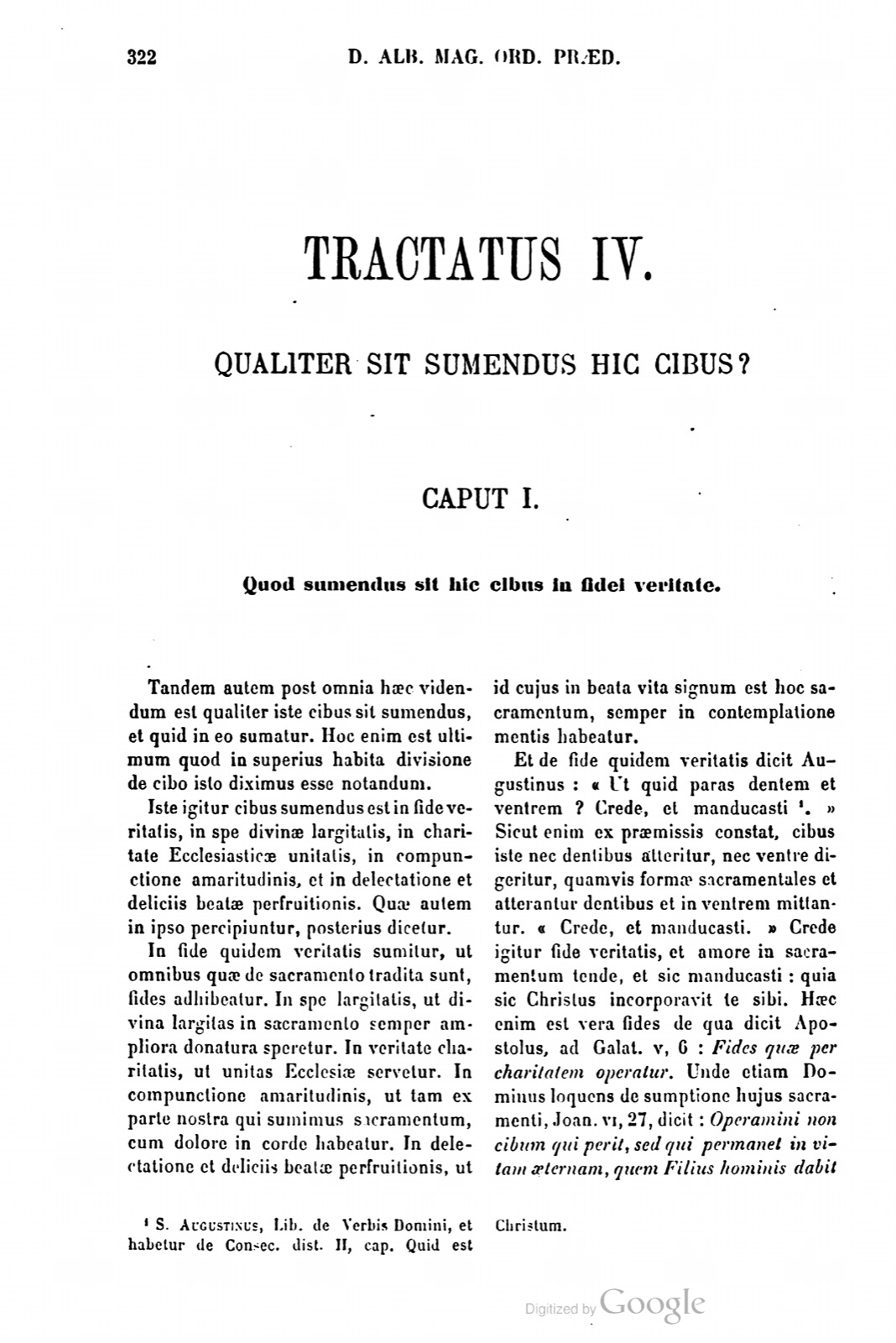
TRACTATUS IV. QUALITER SIT SUMENDUS HIC CIBUS?
CAPUT I. Quod sumendus sit hic cibus in fidei veritate.
Tandem autem post omnia haec videndum est qualiter iste cibus sit sumendus, et quid in eo sumatur. Hoc enim est ultimum quod in superius habita divisione de cibo isto diximus esse notandum.
Iste igitur cibus sumendus est in fide veritatis, in spe divinae largitatis, in charitate Ecclesiasticae unitatis, in compunctione amaritudinis, et in delectatione et deliciis beatae perfruitionis. Quae autem in ipso percipiuntur, posterius dicetur.
In fide quidem veritatis sumitur, ut omnibus quae de sacramento tradita sunt, fides adhibeatur. In spe largitatis, ut divina largitas in sacramento semper ampliora donatura speretur. In veritate charitatis, ut unitas Ecclesiae servetur. In compunctione amaritudinis, ut tam ex parte nostra qui sumimus sacramentum, cum dolore in corde habeatur. In delectatione et deliciis beatae perfruitionis, ut id cujus in beata vita signum est hoc sacramentum, semper in contemplatione mentis habeatur.
Et de fide quidem veritatis dicit Augustinus: « Ut quid paras dentem et ventrem? Crede, et manducasti.1 » Sicut enim ex praemissis constat, cibus iste nec dentibus alteritur, nec ventre digeritur, quamvis formae sacramentales et atterantur dentibus et in ventrem mittantur. « Crede, et manducasti. » Crede igitur fide veritatis, et amore in sacramentum tende, et sic manducasti: quia sic Christus incorporavit te sibi. Haec enim est vera fides de qua dicit Apostolus, ad Galat. V, 6: Fides quae per charitatem operatur. Unde etiam Dominus loquens de sumptione hujus sacramenti, Joan. VI, 27, dicit: Operamini non cibum qui perit, sed qui permanet in vitam aeternam, quem Filius hominis dabit
TRACTATE IV. HOW MUST THIS FOOD BE RECEIVED?
CHAPTER I. That this food must be received in the truth of faith.
But finally, after all these things, it must be seen how that food must be received, and what is received in it. For this is the last thing which in the division held above concerning this food we said must be noted.
Therefore this food must be received in the faith of truth, in the hope of divine largesse, in the charity of ecclesiastical unity, in the compunction of bitterness, and in the delight and delights of blessed enjoyment. But what things are perceived in it will be said later.
Indeed it is received in the faith of truth, so that faith may be applied to all the things which have been handed down concerning the sacrament. In the hope of largesse, so that divine largesse in the sacrament may be hoped as always about to give greater things. In the truth of charity, so that the unity of the Church may be preserved. In the compunction of bitterness, so that on the part of us who receive the sacrament it may be held with sorrow in the heart. In the delight and delights of blessed enjoyment, so that that of which this sacrament is the sign in the blessed life may always be held in the contemplation of the mind.
And concerning the faith of truth Augustine indeed says: "Why do you prepare tooth and stomach? Believe, and you have eaten.1" For as is established from the things said before, this food is neither ground by teeth nor digested by the stomach, although the sacramental forms both are ground by teeth and are sent into the stomach. "Believe, and you have eaten." Therefore believe by the faith of truth, and tend with love into the sacrament, and thus you have eaten, because thus Christ has incorporated you into himself. For this is true faith, concerning which the Apostle says, to Galatians 5:6: "Faith which works through charity." Hence also the Lord, speaking of the reception of this sacrament, John 6:27, says: "Work not for the food which perishes, but for that which remains unto eternal life, which the Son of man will give"
Notes
- St. Augustine, book On the Words of the Lord, and it is found in On Consecration, distinction II, chapter Quid est Christum. (S. Augustinus, Lib. de Verbis Domini, et habetur de Consec. dist. II, cap. Quid est Christum.) ↩
If a page does not appear, its photograph has not been uploaded yet.