Works › The Book on the Sacrament of the Eucharist
Volume 38 · pp. 330–332
Distinction IV and Chapter I
A marker with ≈ is an approximate page boundary, placed by measure of the text; the page photographs remain the authority. In the paired views, clicking a page marker brings that page into view.
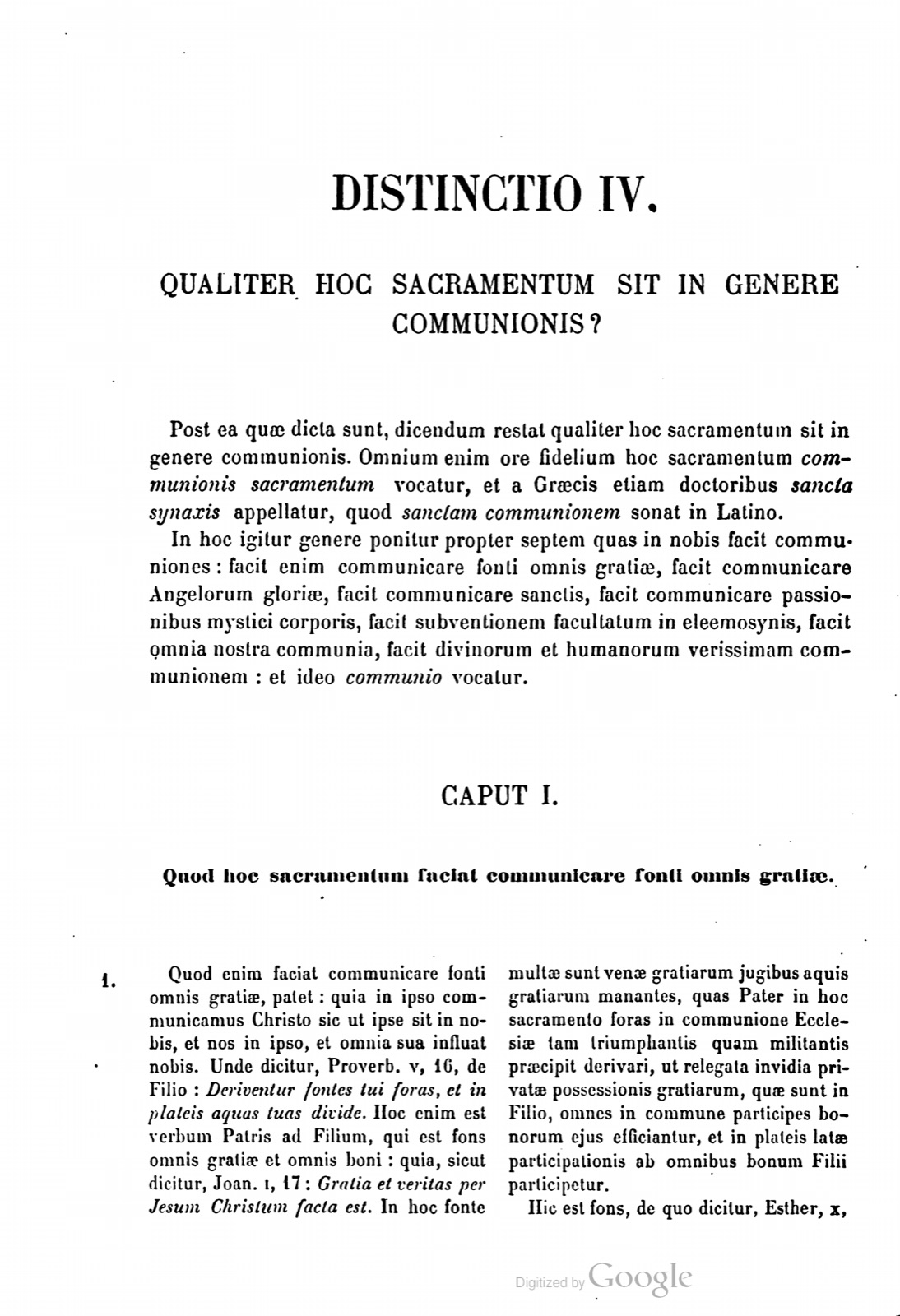
DISTINCTIO IV. QUALITER HOC SACRAMENTUM SIT IN GENERE COMMUNIONIS?
Post ea quae dicta sunt, dicendum restat qualiter hoc sacramentum sit in genere communionis. Omnium enim ore fidelium hoc sacramentum communionis sacramentum vocatur, et a Graecis etiam doctoribus sancta synaxis appellatur, quod sanctam communionem sonat in Latino.
In hoc igitur genere ponitur propter septem quas in nobis facit communiones: facit enim communicare fonti omnis gratiae, facit communicare Angelorum gloriae, facit communicare sanctis, facit communicare passionibus mystici corporis, facit subventionem facultatum in eleemosynis, facit omnia nostra communia, facit divinorum et humanorum verissimam communionem: et ideo communio vocatur.
CAPUT I. Quod hoc sacramentum faciat communicare fonti omnis gratiae.
1. Quod enim faciat communicare fonti omnis gratiae, patet: quia in ipso communicamus Christo sic ut ipse sit in nobis, et nos in ipso, et omnia sua influat nobis. Unde dicitur, Proverb. V, 16, de Filio: Deriventur fontes tui foras, et in plateis aquas tuas divide. Hoc enim est verbum Patris ad Filium, qui est fons omnis gratiae et omnis boni: quia, sicut dicitur, Joan. I, 17: Gratia et veritas per Jesum Christum facta est. In hoc fonte multae sunt venae gratiarum jugibus aquis gratiarum manantes, quas Pater in hoc sacramento foras in communione Ecclesiae tam triumphantis quam militantis praecipit derivari, ut relegata invidia privatae possessionis gratiarum, quae sunt in Filio, omnes in commune participes bonorum ejus efficiantur, et in plateis latae participationis ab omnibus bonum Filii participetur.
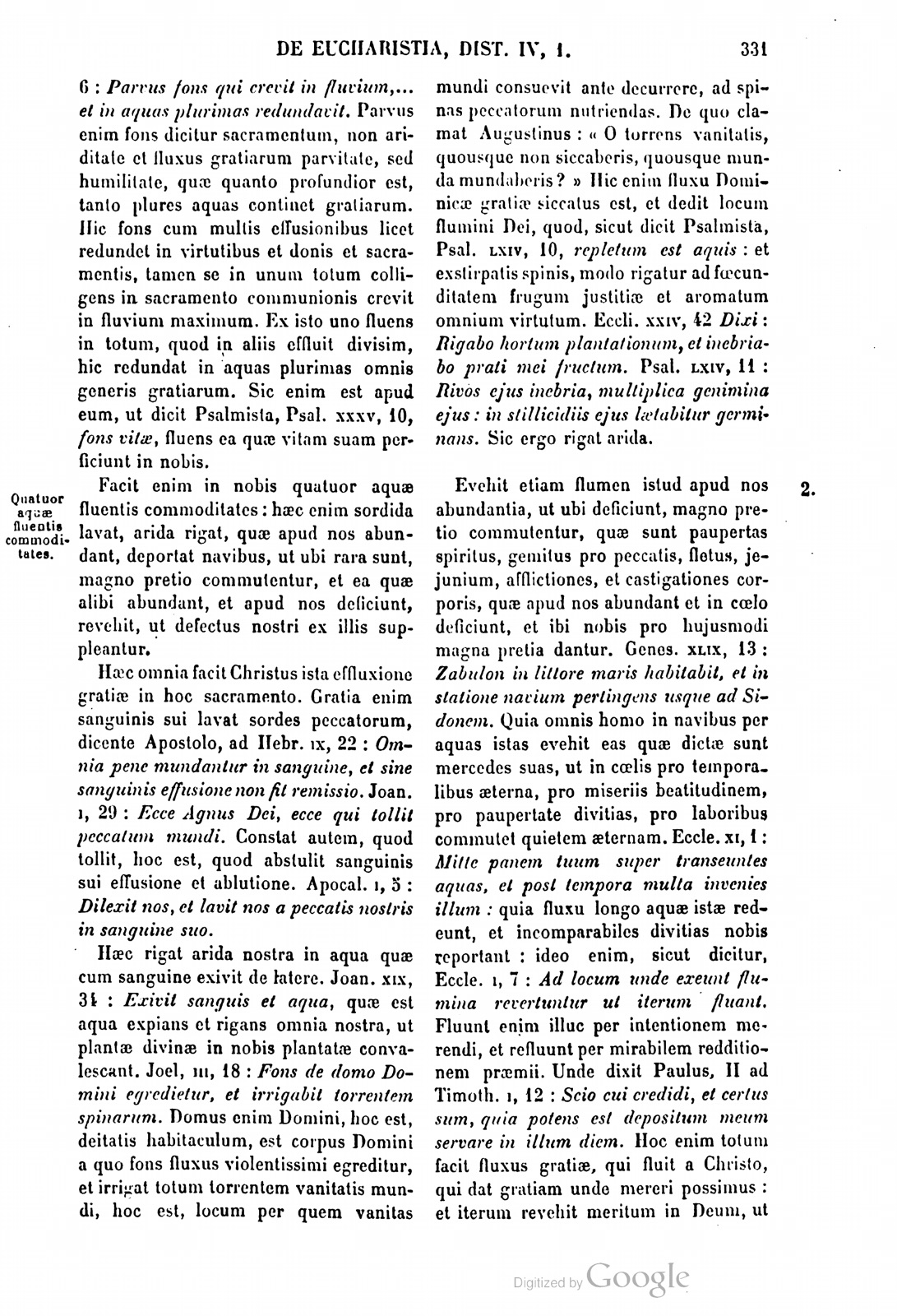
Hic est fons, de quo dicitur, Esther, X, 6: Parvus fons qui crevit in fluvium, ... et in aquas plurimas redundavit. Parvus enim fons dicitur sacramentum, non ariditate et fluxus gratiarum parvitate, sed humilitate, quae quanto profundior est, tanto plures aquas continet gratiarum. Hic fons cum multis effusionibus licet redundet in virtutibus et donis et sacramentis, tamen se in unum totum colligens in sacramento communionis crevit in fluvium maximum. Ex isto uno fluens in totum, quod in aliis effluit divisim, hic redundat in aquas plurimas omnis generis gratiarum. Sic enim est apud eum, ut dicit Psalmista, Psal. XXXV, 10, fons vitae, fluens ea quae vitam suam perficiunt in nobis.
DISTINCTION IV. HOW IS THIS SACRAMENT IN THE GENUS OF COMMUNION?
After those things which have been said, it remains to be said how this sacrament is in the genus of communion. For by the mouth of all the faithful this sacrament is called the sacrament of communion, and by Greek doctors it is also called holy synaxis, which sounds as holy communion in Latin.
Therefore it is placed in this genus on account of the seven communions which it makes in us: for it makes us communicate with the fountain of all grace, it makes us communicate with the glory of Angels, it makes us communicate with the saints, it makes us communicate with the sufferings of the mystical body, it makes a supplying of faculties in alms, it makes all our things common, it makes the truest communion of divine and human things; and therefore it is called communion.
CHAPTER I. That this sacrament makes one communicate with the fountain of all grace.
1. For that it makes one communicate with the fountain of all grace is clear, because in it we communicate with Christ so that he himself is in us, and we in him, and he flows all his things into us. Hence it is said, Proverbs 5:16, concerning the Son: "Let your fountains be derived outside, and divide your waters in the streets." For this is the word of the Father to the Son, who is the fountain of all grace and of every good, because, as is said, John 1:17: "Grace and truth were made through Jesus Christ." In this fountain there are many veins of graces flowing with continual waters of graces, which the Father in this sacrament commands to be derived outside in the communion of the Church both triumphant and militant, so that, after envy of private possession of the graces which are in the Son has been banished, all may be made common participants of his goods, and in the streets of broad participation the good of the Son may be participated by all.
This is the fountain concerning which it is said, Esther 10:6: "A small fountain which grew into a river, ... and overflowed into very many waters." For the sacrament is called a small fountain, not by dryness and smallness of the flow of graces, but by humility; and the deeper humility is, the more waters of graces it contains. Although this fountain overflows with many outpourings in virtues and gifts and sacraments, nevertheless gathering itself into one whole in the sacrament of communion, it grew into the greatest river. From this one flowing into the whole, what flows out dividedly in others, here overflows into very many waters of every kind of graces. For thus with him, as the Psalmist says, Psalm 35:10, is the fountain of life, flowing those things which perfect his life in us.
2. Facit enim in nobis quatuor aquae fluentis commoditates: haec enim sordida lavat, arida rigat, quae apud nos abundant, deportat navibus, ut ubi rara sunt, magno pretio commutentur, et ea quae alibi abundant, et apud nos deficiunt, revehit, ut defectus nostri ex illis suppleantur.
Haec omnia facit Christus ista effluxione gratiae in hoc sacramento. Gratia enim sanguinis sui lavat sordes peccatorum, dicente Apostolo, ad Hebr. IX, 22: Omnia pene mundantur in sanguine, et sine sanguinis effusione non fit remissio. Joan. I, 29: Ecce Agnus Dei, ecce qui tollit peccatum mundi. Constat autem, quod tollit, hoc est, quod abstulit sanguinis sui effusione et ablutione. Apocal. I, 5: Dilexit nos, et lavit nos a peccatis nostris in sanguine suo.
Haec rigat arida nostra in aqua quae cum sanguine exivit de latere. Joan. XIX, 34: Exivit sanguis et aqua, quae est aqua expians et rigans omnia nostra, ut plantae divinae in nobis plantatae convalescant. Joel, III, 18: Fons de domo Domini egredietur, et irrigabit torrentem spinarum. Domus enim Domini, hoc est, deitatis habitaculum, est corpus Domini a quo fons fluxus violentissimi egreditur, et irrigat totum torrentem vanitatis mundi, hoc est, locum per quem vanitas mundi consuevit ante decurrere, ad spinas peccatorum nutriendas. De quo clamat Augustinus: « O torrens vanitatis, quousque non siccaberis, quousque mundaberis? » Hic enim fluxu Dominicae gratiae siccatus est, et dedit locum flumini Dei, quod, sicut dicit Psalmista, Psal. LXIV, 10, repletum est aquis: et exstirpatis spinis, modo rigatur ad faecunditatem frugum justitiae et aromatum omnium virtutum. Eccli. XXIV, 42: Dixi: Rigabo hortum plantationum, et inebriabo prati mei fructum. Psal. LXIV, 11: Rivos ejus inebria, multiplica genimina ejus: in stillicidiis ejus laetabitur germinans. Sic ergo rigat arida.
Evehit etiam flumen istud apud nos abundantia, ut ubi deficiunt, magno pretio commutentur, quae sunt paupertas spiritus, gemitus pro peccatis, fletus, jejunium, afflictiones, et castigationes corporis, quae apud nos abundant et in caelo deficiunt, et ibi nobis pro hujusmodi magna pretia dantur. Genes. XLIX, 13: Zabulon in littore maris habitabit, et in statione navium pertingens usque ad Sidonem. Quia omnis homo in navibus per aquas istas evehit eas quae dictae sunt mercedes suas, ut in caelis pro temporalibus aeterna, pro miseriis beatitudinem, pro paupertate divitias, pro laboribus commutet quietem aeternam. Eccle. XI, 1: Mitte panem tuum super transeuntes aquas, et post tempora multa invenies illum: quia fluxu longo aquae istae redeunt, et incomparabiles divitias nobis reportant: ideo enim, sicut dicitur, Eccle. I, 7: Ad locum unde exeunt flumina revertuntur ut iterum fluant. Fluunt enim illuc per intentionem merendi, et refluunt per mirabilem redditionem praemii. Unde dixit Paulus, II ad Timoth. I, 12: Scio cui credidi, et certus sum, quia potens est depositum meum servare in illum diem. Hoc enim totum facit fluxus gratiae, qui fluit a Christo, qui dat gratiam unde mereri possimus: et iterum revehit meritum in Deum, ut semper abundanti praemio meritum nostrum commutetur.
2. For it makes in us four advantages of flowing water: for this water washes filthy things, waters dry things, carries away by ships the things which abound among us so that where they are rare they may be exchanged at a great price, and brings back the things which abound elsewhere and are lacking among us, so that our defects may be supplied from them.
Christ does all these things by that outflow of grace in this sacrament. For the grace of his blood washes the filths of sins, the Apostle saying, Hebrews 9:22: "Almost all things are cleansed in blood, and without the outpouring of blood remission is not made." John 1:29: "Behold the Lamb of God, behold him who takes away the sin of the world." But it is established that he takes away, that is, that he removed it by the outpouring and washing of his blood. Apocalypse 1:5: "He loved us and washed us from our sins in his blood."
This waters our dry things in the water which came out with blood from the side. John 19:34: "Blood and water came out," which is water expiating and watering all our things, so that the divine plants planted in us may grow strong. Joel 3:18: "A fountain will go forth from the house of the Lord and will water the torrent of thorns." For the house of the Lord, that is, the dwelling place of deity, is the body of the Lord, from which the fountain of most violent flow goes forth and waters the whole torrent of the vanity of the world, that is, the place through which the vanity of the world was accustomed before to run, for nourishing the thorns of sins. Concerning this Augustine cries out: "O torrent of vanity, how long will you not be dried, how long will you be cleansed?" For this torrent, dried by the flow of the Lord's grace, gave place to the river of God, which, as the Psalmist says, Psalm 64:10, is filled with waters; and with the thorns uprooted, it is now watered for the fruitfulness of the fruits of justice and the spices of all virtues. Ecclesiasticus 24:42: "I said: I will water the garden of plantings, and I will make the fruit of my meadow drunk." Psalm 64:11: "Make its streams drunk, multiply its shoots; in its drops the sprouting thing will rejoice." Thus therefore it waters dry things.
This river also carries away from among us abundant things, so that where they are lacking they may be exchanged at a great price, which are poverty of spirit, groaning for sins, weeping, fasting, afflictions, and chastisements of the body, which abound among us and are lacking in heaven, and there great prices are given to us for things of this sort. Genesis 49:13: "Zabulon will dwell on the shore of the sea, and reaching to Sidon at the station of ships." Because every man in ships through these waters carries away those things which have been called his wages, so that in the heavens he may exchange eternal things for temporal things, blessedness for miseries, riches for poverty, eternal rest for labors. Ecclesiastes 11:1: "Cast your bread upon passing waters, and after many times you will find it," because by a long flow these waters return and bring back incomparable riches to us. For therefore, as is said, Ecclesiastes 1:7: "To the place whence rivers go out, they return that they may flow again." For they flow there through intention of meriting, and flow back through the marvelous repayment of reward. Hence Paul said, II Timothy 1:12: "I know whom I have believed, and I am certain that he is able to keep my deposit unto that day." For the flow of grace, which flows from Christ, does all this, which gives grace whence we may merit; and again it carries merit back into God, so that our merit may always be exchanged with abundant reward.
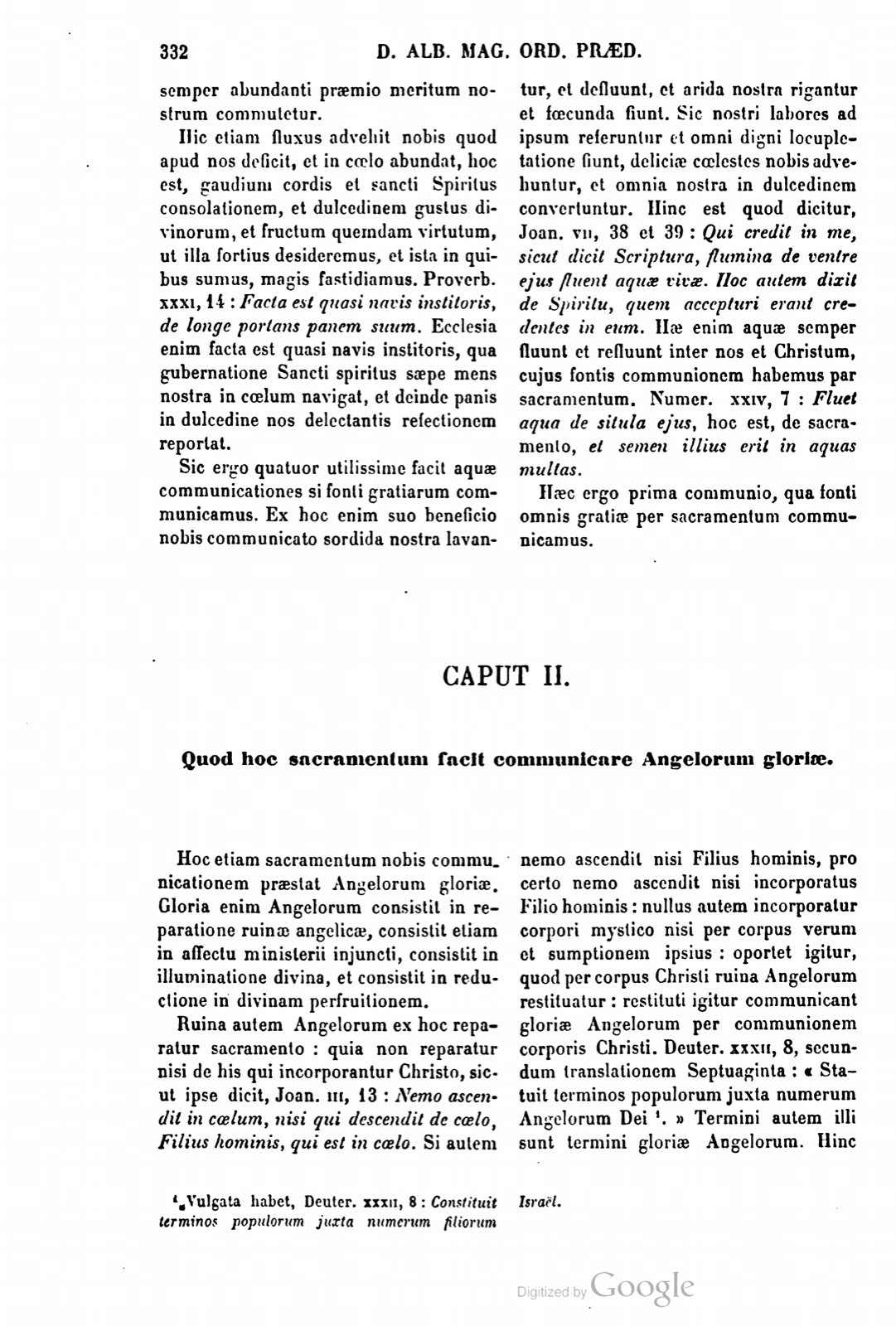
Hic etiam fluxus advehit nobis quod apud nos deficit, et in caelo abundat, hoc est, gaudium cordis et sancti Spiritus consolationem, et dulcedinem gustus divinorum, et fructum quemdam virtutum, ut illa fortius desideremus, et ista in quibus sumus, magis fastidiamus. Proverb. XXXI, 14: Facta est quasi navis institoris, de longe portans panem suum. Ecclesia enim facta est quasi navis institoris, qua gubernatione Sancti spiritus saepe mens nostra in caelum navigat, et deinde panis in dulcedine nos delectantis refectionem reportat.
Sic ergo quatuor utilissime facit aquae communicationes si fonti gratiarum communicamus. Ex hoc enim suo beneficio nobis communicato sordida nostra lavantur, et defluunt, et arida nostra rigantur et foecunda fiunt. Sic nostri labores ad ipsum referuntur et omni digni locupletatione fiunt, deliciae coelestes nobis advehuntur, et omnia nostra in dulcedinem convertuntur. Hinc est quod dicitur, Joan. VII, 38 et 39: Qui credit in me, sicut dicit Scriptura, flumina de ventre ejus fluent aquae vivae. Hoc autem dixit de Spiritu, quem accepturi erant credentes in eum. Hae enim aquae semper fluunt et refluunt inter nos et Christum, cujus fontis communionem habemus per sacramentum. Numer. XXIV, 7: Fluet aqua de situla ejus, hoc est, de sacramento, et semen illius erit in aquas multas.
Haec ergo prima communio, qua fonti omnis gratiae per sacramentum communicamus.
This flow also brings to us what is lacking among us and abounds in heaven, that is, joy of heart and consolation of the Holy Spirit, and sweetness of the taste of divine things, and a certain fruit of virtues, so that we may desire those things more strongly and may more loathe those things in which we are. Proverbs 31:14: "She was made like the ship of a merchant, carrying her bread from afar." For the Church was made like the ship of a merchant, by which, under the governance of the Holy Spirit, our mind often sails into heaven, and then brings back the refreshment of bread delighting us in sweetness.
Thus therefore water makes four most useful communications if we communicate with the fountain of graces. For from this benefit of his communicated to us, our filthy things are washed and flow away, and our dry things are watered and made fruitful. Thus our labors are referred to him and are made worthy of every enrichment; heavenly delights are brought to us, and all our things are turned into sweetness. Hence it is said, John 7:38 and 39: "He who believes in me, as Scripture says, rivers of living water will flow from his belly." But he said this concerning the Spirit, whom those believing in him were going to receive. For these waters always flow and flow back between us and Christ, whose fountain's communion we have through the sacrament. Numbers 24:7: "Water will flow from his bucket," that is, from the sacrament, "and his seed will be into many waters."
This therefore is the first communion, by which through the sacrament we communicate with the fountain of all grace.
If a page does not appear, its photograph has not been uploaded yet.