Works › The Book on the Sacrament of the Eucharist
Volume 38 · pp. 202–205
Chapter III. This Sacrament Is Given Only to the Most Beloved Friends.
A marker with ≈ is an approximate page boundary, placed by measure of the text; the page photographs remain the authority. In the paired views, clicking a page marker brings that page into view.
Marginal label (printed p. 202): Quatuor de causis Eucharistia gratissimis praeparatur.
Caput III. Hoc sacramentum non datur nisi gratissimis amicis.
1. Est autem adhuc bona gratia vocatum: quia sicut a gratissimo Deo, ita et gratissimis amicis est praeparatum. Quod autem gratissimis paratur, optimae gratiae digne nomen accepit: quia gratissimis optima cupimus et paramus.
Hujus autem quatuor causas aliquis potest assignare. Una quidem, quia charissimi sunt et intimi, et ideo intima ad dilectum gaudent conjunctione: et hoc per optimam gratiam perficitur. Alia autem, quia gratissimi majori conjunctione sunt digni: dignitas autem haec et electio per optimam perfici habet gratiam. Tertia autem, quia gratissimi in superabundantia non possunt esse gratissimi, nisi per optimam gratiam, et illam Eucharistiam esse oportet. Quarta autem,
Marginal label (printed p. 202): For four causes the Eucharist is prepared for those most dear.
Chapter III. This sacrament is given only to the most beloved friends.
1. But it is still called good grace because, just as it has been prepared by the most gracious God, so also it has been prepared for the most beloved friends. But what is prepared for the most beloved has fittingly received the name of the best grace, because for those most beloved we desire and prepare the best things.
Someone can assign four causes of this. One, indeed, is that they are most dear and intimate, and therefore they rejoice in an intimate conjunction to the beloved; and this is accomplished through the best grace. Another is that those most beloved are worthy of a greater conjunction; but this dignity and election has to be perfected through the best grace. The third is that the most beloved in superabundance cannot be most beloved except through the best grace, and that grace must be the Eucharist. But the fourth,
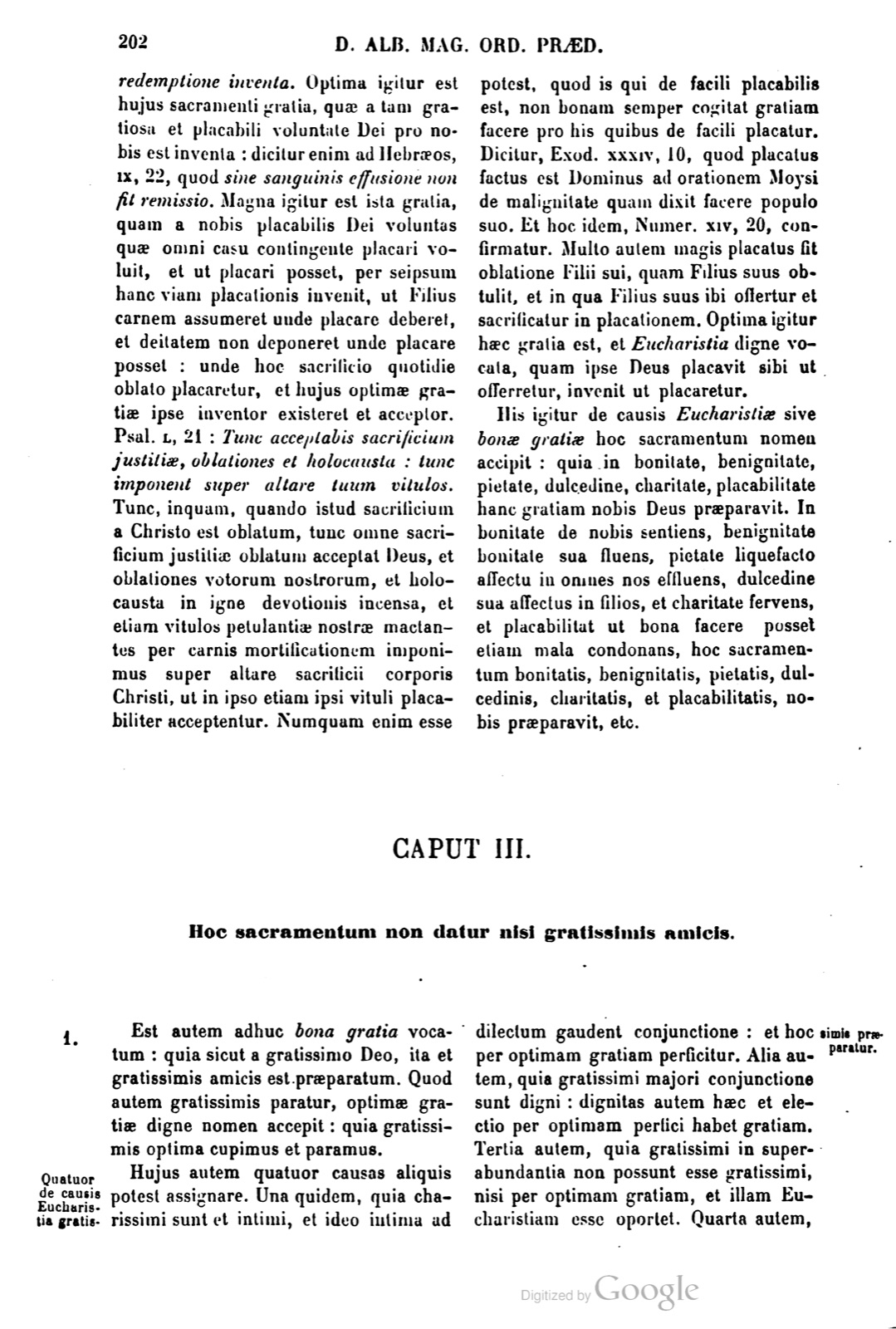
quia gratissimi fonti gratiarum sunt simillimi, et ideo εὐχαρεῖς Graece vocantur Eucharistia, hoc est, bona gratia potientes.
Et de prima quidem harum causarum dicitur, Cantic. v, 1: Comedite, amici, et bibite, et inebriamini, charissimi. Cum enim charorum sit in se invicem habitare per desiderium, non diceret: Comedite, amici, et bibite, nisi per suum corpus et suum sanguinem et animam et deitatem in eos penetrare quaereret. Nec diceret: Inebriamini, charissimi, nisi vellet, quod obliti suiipsius in ipsum Deum viceversa, etiam ipsi quaererent penetrare per incorporationem, sicut dicitur, Genes. xliii, 16, de Joseph et fratribus suis: Introduc viros domum, et occide victimas, et instrue convivium, quoniam mecum sunt comesturi meridie1, hoc est, in pleno fervore lucis, veritatis, et caloris charitatis. Mecum, inquam, comesturi sunt, et perfecte mecum, ut ego, dicit Christus, sim et commensalis et cibus. Unde versus: Rex sedet in cena turba cinctus duodena, se tenet in manibus, se cibat ipse cibus. Seipsum enim et manibus tenuit, et de seipso intimos cibavit: et ideo quasi ebrius dulcedine et charitate suorum, nihil sui fuit in quo dilectissimi sibi non communicaverint, sicut et Joseph in fervore meridiano comedens cum fratribus suis, coram eis legitur fuisse inebriatus. Sic ergo dilectissimorum est praeparatio optimae gratiae.
2. Sunt autem secundo gratissimi et dignissimi ut gratia potiantur optima: et hoc Eucharistia Graece vocatur. Hoc signatum est, Daniel. i, 3 et 4, ubi summus rex et monarcha mundi praecepit Asphenez, praeposito eunuchorum, ut introduceret de filiis Israel pueros, in quibus nulla esset macula, decoros forma, et eruditos omni sapientia, cautos scientia, et doctos disciplina, et qui possent stare in palatio regis. Et post pauca, v. 5: Et constituit eis rex annonam per singulos dies de cibis suis, et de vino unde bibebat ipse. Tales enim charissimi gratia optima digni sunt, qui filii sunt per imitationem rectissimi in omni virtutis rectitudine: pueri in omni puritate sine macula innocentiae2, candore decori in omni forma compositionis gratiae, eruditi, hoc est, extra ruditatem positi caelesti sapore cognitionis divinae, cauti ad omnem astutiam diaboli et mundi per scientiam, quae bene docet conversari in medio pravae et perversae nationis: docti doctrina Spiritus sancti in omni disciplina spirituali per unctionem quae docet de omnibus, qui omni dignitate praecellentes sunt egregii, stare erecti ad caelum possint in palatio templi gratiae et templi gloriae, contemplando vultum regis. His ut optima gratia dignissimis constituit rex annonam Eucharistiae per singulos dies accipiendam, et de vino regali sanguinis sui. Unde ipse rex per omnia membra sua bibit et infunditur, ut eadem sagina corporis unde rex viveret, et eadem vindemia sanguinis quo membra ejus infunduntur, nutriantur, et regerentur ad beatitudinem.
Hoc etiam significatur, Esther, i, 3, quod Assuerus, tertio anno imperii sui, fecit grande convivium cunctis principibus et pueris suis, fortissimis Persarum, et Medorum inclytis, et praefectis provinciarum coram se. Sic enim noster Assuerus qui beatus interpretatur, tertio anno, hoc est, tempore gratiae, quod antecesserat annus naturalis legis, in quo hoc sacrificium in oblatione Melchisedech fuit praefiguratum, et annus legis Moysi, in quo in agno paschali fuit pressius significatum in conspersa farina et azymis3: hic igitur tertio anno imperii sui perfecit grande convivium Dei gratia et veritate perfectum. Fecit autem dignis dignum convivium: quia et principes sunt, nulla nisi ea quae sunt digna principe cogitantes, sicut dicit Isaias, xxxi, 8: et pueris suis omni puritate cordis et corporis dignissimis: inclytis Medorum, qui mensurantes et adaequantes interpretantur: quia tales semper se mensurantes intra fines suos consistunt, in nullo se super se elevantes: quia, sicut dicit Philosophus, insipiens est qui suiipsius ignorat quantitatem, semper se carius vendens quam sit propria aestimatio ipsius. Hi sunt Persarum qui tentati interpretantur fortissimi: quia ipsi sunt de quibus dicitur, Luc. xxii, 28: Vos estis qui permansistis mecum in tentationibus meis. Interpretantur etiam Persae latera sua deserentes, quod optime tantae dignitatis competit viris, qui latera sua, id est, carnalium amicorum omnino deserunt, Patrem spirituum sequentes: et hac fortitudine confortati, digni habiti sunt tanto convivio. Hi sunt praefecti provinciarum Dei sui, quia quasi pro speculo positi sunt in quibus se dijudicent inferiores, et inveniant in eis quid imitentur. Dignissimis ergo praeparatum hoc convivium optima gratia est vocatum.
because those most beloved in grace are most like the fountain of graces, and therefore in Greek they are called εὐχαρεῖς, possessing Eucharistia, that is, good grace.
Concerning the first of these causes it is said in Canticles 5:1: Eat, friends, and drink, and be inebriated, dearest ones. For since it belongs to dear ones to dwell in one another through desire, he would not say, Eat, friends, and drink, unless through his body and his blood and soul and deity he sought to penetrate into them. Nor would he say, Be inebriated, dearest ones, unless he wished that, forgetful of themselves, in turn they themselves also should seek to penetrate into God himself through incorporation, as is said in Genesis 43:16 concerning Joseph and his brothers: Bring the men into the house, and kill victims, and prepare the banquet, because they will eat with me at midday1, that is, in the full fervor of light, truth, and the heat of charity. They will eat with me, I say, and perfectly with me, so that I, says Christ, may be both fellow-diner and food. Hence the verse: The King sits at supper surrounded by the twelvefold crowd; he holds himself in his hands; he, food himself, feeds himself. For he both held himself in his hands and fed his intimates from himself; and therefore, as if drunk with the sweetness and charity of his own, there was nothing of himself in which those most beloved to him did not communicate, just as Joseph, eating with his brothers in the noonday fervor, is read to have been drunk before them. Thus, therefore, the preparation of the best grace belongs to the most beloved.
2. Second, they are most beloved and most worthy to possess the best grace, and this is called Eucharistia in Greek. This was signified in Daniel 1:3 and 4, where the highest king and monarch of the world commanded Ashpenaz, the prefect of the eunuchs, to bring in from the sons of Israel boys in whom there was no blemish, comely in form, instructed in all wisdom, wary in knowledge, taught in discipline, and able to stand in the palace of the king. And a little later, verse 5: And the king appointed for them an allowance for each day from his foods and from the wine from which he himself drank. For such dearest ones are worthy of the best grace: sons by imitation, most upright in every rectitude of virtue; boys in every purity without stain of innocence2, comely with brightness in every form of the composition of grace; instructed, that is, placed outside rudeness by the heavenly taste of divine knowledge; wary against every cunning of the devil and the world through knowledge, which teaches one to converse well in the midst of a crooked and perverse nation; taught by the doctrine of the Holy Spirit in every spiritual discipline through the anointing which teaches concerning all things; outstanding by every dignity, able to stand upright toward heaven in the palace of the temple of grace and the temple of glory, contemplating the face of the king. For these, as most worthy of the best grace, the king appointed the allowance of the Eucharist to be received each day, and from the royal wine of his blood. Hence the king himself drinks and is poured into all his members, so that by the same fattening of the body from which the king would live, and by the same vintage of blood with which his members are poured full, they may be nourished and ruled unto beatitude.
This also is signified in Esther 1:3, that Ahasuerus in the third year of his reign made a great banquet for all his princes and servants, the strongest of the Persians, the renowned of the Medes, and the prefects of the provinces before himself. Thus our Ahasuerus, who is interpreted blessed, in the third year, that is, the time of grace, which was preceded by the year of the natural law, in which this sacrifice was prefigured in the oblation of Melchizedek, and by the year of the law of Moses, in which it was more expressly signified in the paschal lamb, in sprinkled flour and unleavened breads3, thus in the third year of his reign perfected the great banquet of God made perfect by grace and truth. But he made a worthy banquet for the worthy, because they are both princes, thinking only those things which are worthy of a prince, as Isaiah 31:8 says, and his servants, most worthy by every purity of heart and body; renowned Medes, who are interpreted measuring and equaling, because such men always measure themselves and stand within their own limits, in nothing lifting themselves above themselves, because, as the Philosopher says, foolish is the one who does not know the measure of himself, always selling himself more dearly than his own proper valuation is. These are Persians, who are interpreted strongest when tested, because they are the ones of whom it is said in Luke 22:28: You are those who have remained with me in my temptations. Persians are also interpreted those deserting their own sides, which very well belongs to men of so great a dignity, who entirely desert their sides, that is, their fleshly friends, following the Father of spirits; and strengthened by this fortitude they have been held worthy of so great a banquet. These are the prefects of the provinces of their God, because they have been placed as it were for a mirror in which inferiors may judge themselves and find in them what they may imitate. Therefore this banquet prepared for the most worthy has been called the best grace.
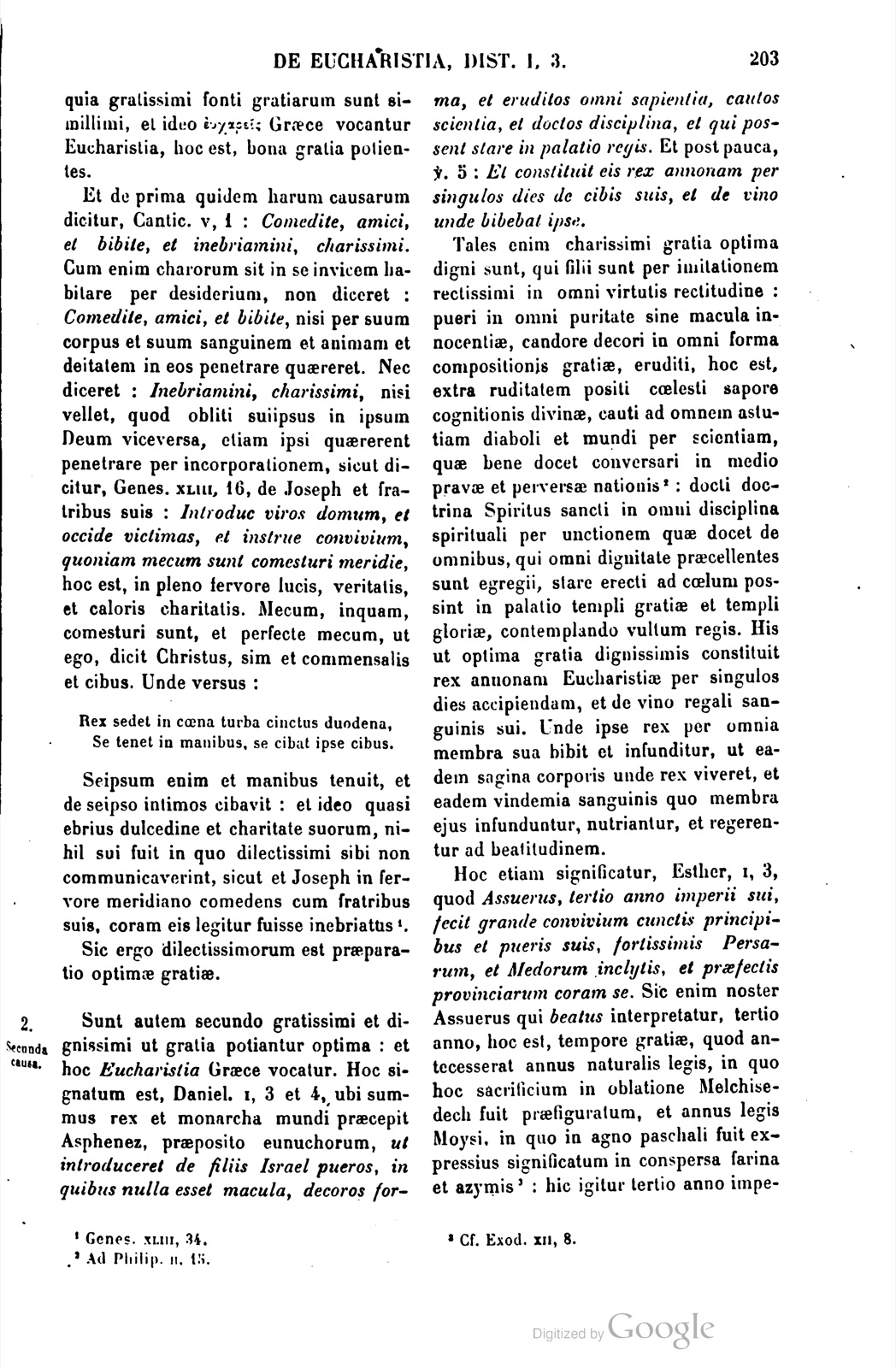
3. Adhuc autem tertia causa est: quia gratissimi per superabundantiam dicti, gratissimi esse non possunt, nisi per optimam gratiam digni sint effecti. Haec autem optima gratia non vocatur nisi Eucharistia: quia per sumptionem hujus gratiae omnino εὐχαρεῖς sunt facti et appellati. Unde Apostolus dicit, ad Hebr. xiii, 9 et 10, loquens de gratia hac: Optimum est gratia stabilire cor, non escis, quae non profuerunt ambulantibus in eis. Habemus altare, de quo edere non habent potestatem qui tabernaculo deserviunt. Optima enim gratia potiuntur per superabundantiam, qui hac gratia cor stabiliunt a carnalibus, gastrimargiae escis se penitus avertentes: quia illae nihil gulosis profuerunt nisi ad corruptionem: et ideo qui tabernaculo corporis deserviunt, de altari Eucharisticae edere non habent potestatem. Unde hanc optimam gratiam qua gratissimi Deo potiuntur commendans Isaias, dixit, Isa. xxv, 6: Et faciet Dominus exercituum omnibus populis in monte hoc convivium pinguium, convivium vindemiae, convivium pinguium medullatorum, vindemiae defaecatae. Nullus enim nisi Dominus exercituum, Deus Sabaoth, cujus plena est omnis terra gloria ejus4, posset hoc perficere. In monte, hoc est, tam excellentis gratiae altitudine omnibus quidem paratum, sed gratissimis exhibitum, convivium pinguium omni pinguedine gratiae et devotionis saginatum: convivium medullatorum pinguium quae medullae dulcissimae consolationes sunt saporum Spiritus sancti per totum convivium diffusi. Vindemiae autem est convivium in gaudio cordis. Et vindemiae defaecatae: quia hoc gaudium Spiritus sancti nihil impuritatis habet admixtum. Hic enim est calix in manu Domini gratissimis porrectus, calix, inquam, vini meri, hoc est, defaecati, qui calix semper est plenus mixto5: quia aquam quae populum signat, semper habet admixtam, ut nec nos sine ipso, nec ipse sit sine nobis.
3. Still further, the third cause is that those called most beloved by superabundance cannot be most beloved unless they have been made worthy through the best grace. But this best grace is called nothing except Eucharistia, because through the reception of this grace they have been wholly made and named εὐχαρεῖς. Hence the Apostle says in Hebrews 13:9 and 10, speaking about this grace: It is best for the heart to be established by grace, not by foods, which have not profited those walking in them. We have an altar from which those who serve the tabernacle have no power to eat. For those possess the best grace by superabundance who by this grace establish the heart away from carnal things, turning themselves entirely from the foods of gluttony, because those foods profited the greedy in nothing except unto corruption; and therefore those who serve the tabernacle of the body do not have power to eat from the Eucharistic altar. Hence Isaiah, commending this best grace by which those most beloved possess God, said in Isaiah 25:6: And the Lord of hosts will make for all peoples on this mountain a banquet of fat things, a banquet of vintage, a banquet of marrowy fat things, of refined vintage. For no one except the Lord of hosts, God Sabaoth, of whose glory the whole earth is full4, could accomplish this. On the mountain, that is, on the height of so excellent a grace, prepared indeed for all but exhibited to the most beloved, it is a banquet of fat things, fattened with every fatness of grace and devotion; a banquet of marrowy fat things, whose marrowy things are the sweetest consolations of the tastes of the Holy Spirit diffused through the whole banquet. It is also a banquet of vintage in the joy of heart; and of refined vintage, because this joy of the Holy Spirit has nothing of impurity mixed in. For this is the chalice in the hand of the Lord stretched out to the most beloved, a chalice, I say, of pure wine, that is, refined wine, which chalice is always full of mixture5, because it always has water mixed in, which signifies the people, so that neither we may be without him nor he without us.
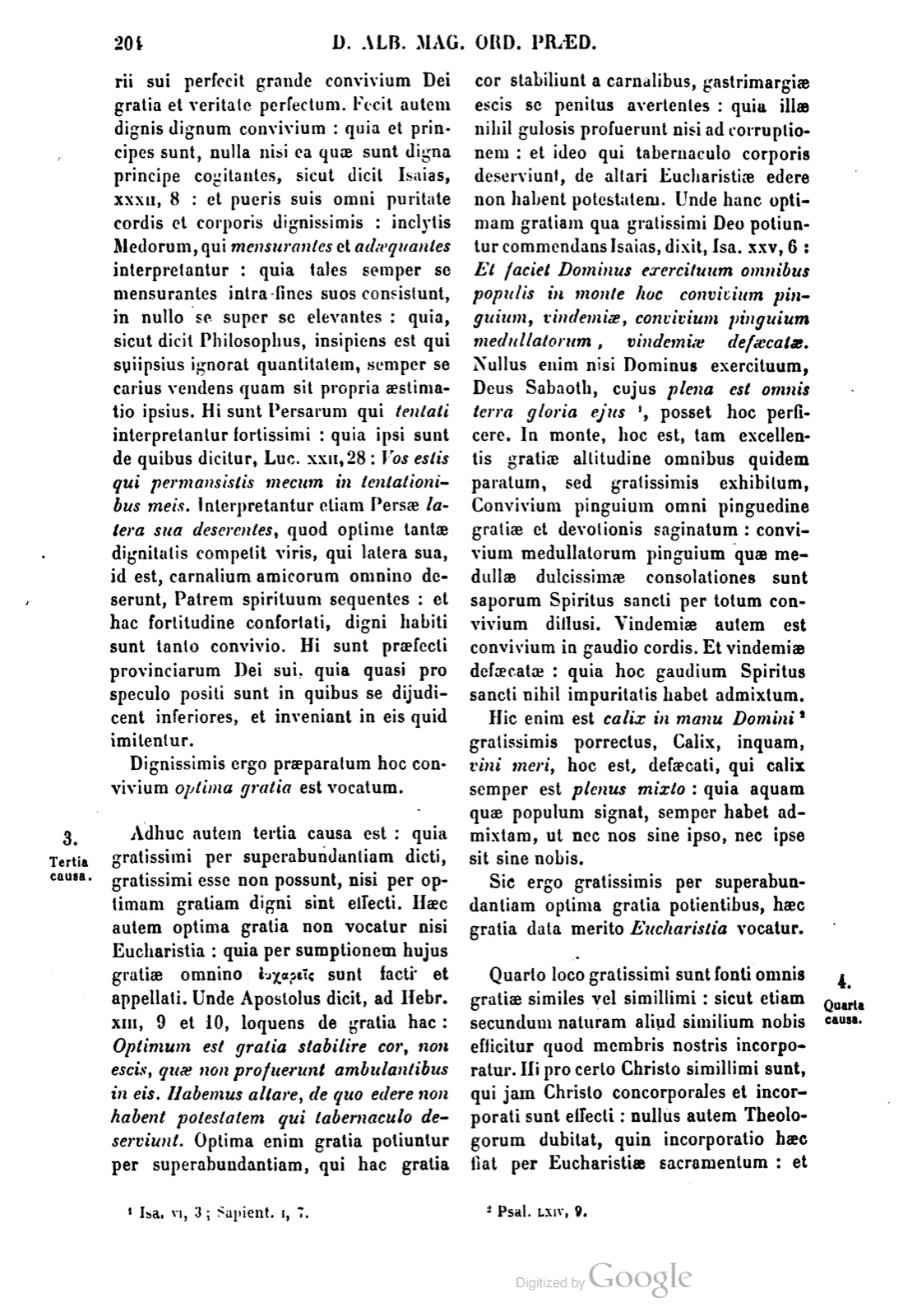
Sic ergo gratissimis per superabundantiam optima gratia potientibus, haec gratia data merito Eucharistia vocatur.
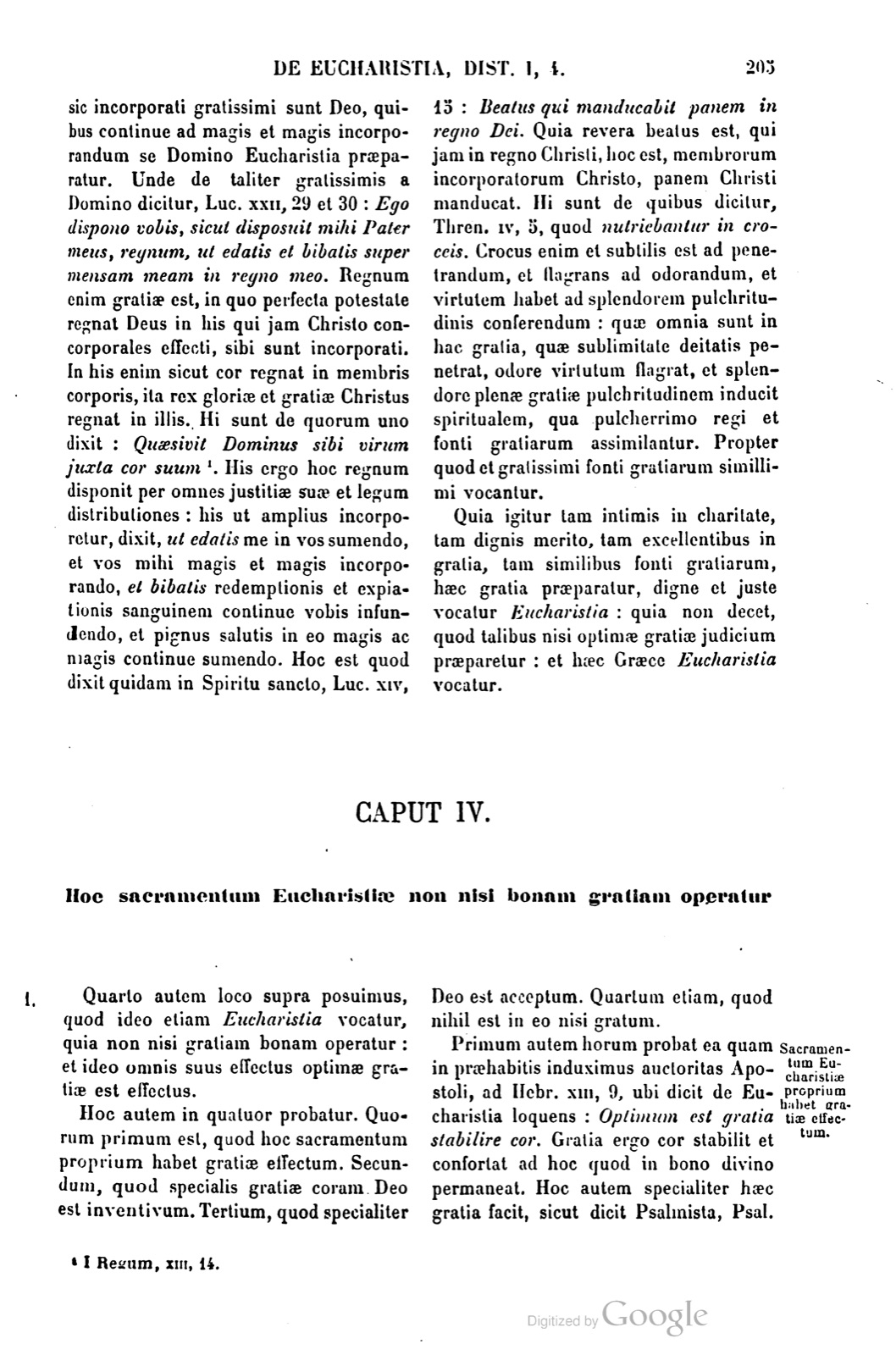
4. Quarto loco gratissimi sunt fonti omnis gratiae similes vel simillimi: sicut etiam secundum naturam aliud similium nobis efficitur quod membris nostris incorporatur. Hi pro certo Christo simillimi sunt, qui jam Christo concorporales et incorporati sunt effecti: nullus autem Theologorum dubitat, quin incorporatio haec fiat per Eucharistiae sacramentum: et sic incorporati gratissimi sunt Deo, quibus continue ad magis et magis incorporandum se Domino Eucharistia praeparatur. Unde de taliter gratissimis a Domino dicitur, Luc. xxii, 29 et 30: Ego dispono vobis, sicut disposuit mihi Pater meus, regnum, ut edatis et bibatis super mensam meam in regno meo. Regnum enim gratiae est, in quo perfecta potestate regnat Deus in his qui jam Christo concorporales effecti, sibi sunt incorporati. In his enim sicut cor regnat in membris corporis, ita rex gloriae et gratiae Christus regnat in illis. Hi sunt de quorum uno dixit: Quaesivit Dominus sibi virum juxta cor suum6. His ergo hoc regnum disponit per omnes justitiae suae et legum distributiones: his ut amplius incorporetur, dixit, ut edatis me in vos sumendo, et vos mihi magis et magis incorporando, et bibatis redemptionis et expiationis sanguinem continue vobis infundendo, et pignus salutis in eo magis ac magis continue sumendo. Hoc est quod dixit quidam in Spiritu sancto, Luc. xiv, 15: Beatus qui manducabit panem in regno Dei. Quia revera beatus est, qui jam in regno Christi, hoc est, membrorum incorporatorum Christo, panem Christi manducat. Hi sunt de quibus dicitur, Thren. iv, 5, quod nutriebantur in croceis. Crocus enim et subtilis est ad penetrandum, et flagrans ad odorandum, et virtutem habet ad splendorem pulchritudinis conferendum: quae omnia sunt in hac gratia, quae sublimitate deitatis penetrat, odore virtutum flagrat, et splendore plenae gratiae pulchritudinem inducit spiritualem, qua pulcherrimo regi et fonti gratiarum assimilantur. Propter quod et gratissimi fonti gratiarum simillimi vocantur.
Quia igitur tam intimis in charitate, tam dignis merito, tam excellentibus in gratia, tam similibus fonti gratiarum, haec gratia praeparatur, digne et juste vocatur Eucharistia: quia non decet, quod talibus nisi optimae gratiae judicium praeparetur: et haec Graece Eucharistia vocatur.
Thus therefore, when this grace is given to the most beloved, who by superabundance possess the best grace, it is deservedly called Eucharist.
4. In the fourth place, those most beloved are like or most like the fountain of every grace, just as also according to nature what is incorporated into our members is made something of things like us. These, for certain, are most like Christ, who have already been made members of the same body with Christ and incorporated into Christ. No theologian doubts that this incorporation takes place through the sacrament of the Eucharist; and those thus incorporated are most beloved to God, for whom the Eucharist is continually prepared by the Lord for incorporating them more and more to himself. Hence concerning such most beloved ones it is said by the Lord in Luke 22:29 and 30: I dispose for you, as my Father has disposed for me, a kingdom, that you may eat and drink at my table in my kingdom. For it is the kingdom of grace in which God reigns with perfect power in those who, already made members of the same body with Christ, have been incorporated into him. For in these, as the heart reigns in the members of the body, so Christ, the king of glory and grace, reigns in them. These are those concerning one of whom he said: The Lord has sought for himself a man according to his own heart6. Therefore he disposes this kingdom for them through all the distributions of his justice and laws; for these, so that he may be incorporated more fully, he said that you may eat me by taking me into yourselves and by incorporating yourselves more and more to me, and that you may drink the blood of redemption and expiation by continually pouring it into yourselves, and by taking in it the pledge of salvation more and more continually. This is what someone said in the Holy Spirit in Luke 14:15: Blessed is he who shall eat bread in the kingdom of God. For truly blessed is he who now in the kingdom of Christ, that is, of the members incorporated into Christ, eats the bread of Christ. These are those of whom it is said in Lamentations 4:5 that they were nourished in saffron-colored things. For saffron is subtle for penetrating, fragrant for smelling, and has power for conferring the splendor of beauty; all these are in this grace, which penetrates by the sublimity of deity, is fragrant with the odor of virtues, and brings in the spiritual beauty of full grace, by which they are assimilated to the most beautiful king and fountain of graces. Therefore they are also called most beloved, most like the fountain of graces.
Therefore, because this grace is prepared for those so intimate in charity, so worthy in merit, so excellent in grace, so like the fountain of graces, it is fittingly and justly called Eucharistia, because it is not fitting that anything except the judgment of the best grace be prepared for such persons; and this in Greek is called Eucharistia.
If a page does not appear, its photograph has not been uploaded yet.