Works › The Book on the Sacrament of the Eucharist
Volume 38 · pp. 395–396
Chapter II, 19-21
A marker with ≈ is an approximate page boundary, placed by measure of the text; the page photographs remain the authority. In the paired views, clicking a page marker brings that page into view.
Marginal label (printed p. 395): Qualis sit modus formae hujus sacramenti?
sic est transmutativum et constitutivum: noster autem intellectus est materialis et receptivus: et ideo non est rerum causativus, sed potius a rebus causatus: et ideo etiam verbum ipsius conceptum designat, quem praeaccepit intellectus, et non est alicujus rei causativus. Verbum autem increatum nuntiat intellectum agentem et constituentem: et ideo, ut dicit Ambrosius, est rerum transsubstantiativum: et ideo cum tali verbo creaturas constituente et reparante loqueretur Christus Judaeis, Joan. VIII, 43, 42, et ipsi non caperent, arguens eos, dixit: Quare loquelam meam non cognoscitis? Ego enim ex Deo processi et veni. Ac si dicat: In ipso verbo quo muto et reparo creaturas sicut volo, potestis scire, si vultis, quod Verbum aeternum procedens ab intellectu qui universale principium est agendi et creaturas instituendi et reparandi: quia tales supernaturales operationes per seipsum non habet, nisi Deus sive intellectus divinus: quia nullus est rerum universaliter constitutivus: haec enim operatio propria est Deo et nulli alii conveniens. Et si sancti aliqui tales leguntur fecisse operationes, has fecerunt per invocationes vel supplicationes vel per merita sanctitatis, et non per seipsos virtute propria. Istae enim operationes supernaturales in quantum sunt supernaturales, sunt omnes unius rationis: et ideo ad unum agens supernaturale habent reduci.
20. Ultimo tandem considerandum est de hujus formae qualitate: non enim haec forma est ad modum formarum aliorum sacramentorum, quae omnes sunt per invocationem sanctae Trinitatis, sicut in baptismo, ubi dicitur: « Ego te baptizo in nomine Patris, et Filii, et Spiritus sancti. » Hic autem nulla fit Trinitatis invocatio, cum tamen operationes gratiarum sacramentalium sint indivisa opera Trinitatis.
Adhuc autem, in omnibus aliis formis actum vel gratiam sacramentalem signat se operari minister, sicut in baptismo dicit: « Ego te baptizo. » Et in confirmatione dicit: « Ego te confirmo. » Et in unctione dicit: « Ungo hos oculos de oleo sanctificato. » Et sic de aliis. Videtur ergo, quod etiam in isto sacramento in persona ministri dici deberet: Transsubstantio hunc panem in corpus Domini nostri Jesu Christi.
Adhuc autem, cum fit transsubstantiatio panis ibi, videtur quod deberet significari per modum mutationis, quod sic diceretur: Hic panis fiat corpus Domini. Vel, hic panis mutetur in corpus Domini. Vel saltem sic: Hic panis transsubstantietur in corpus Domini. Et non sic: Hoc est corpus meum, quia verbum substantivum quod est est, nullam dicit mutationem.
Marginal label (printed p. 395): What is the mode of the form of this sacrament?
so it is transmutative and constitutive; but our intellect is material and receptive, and therefore it is not causative of things, but rather caused by things; and therefore also its conceived word designates that which the intellect has received beforehand, and is not causative of any thing. But the uncreated Word announces an intellect that acts and constitutes; and therefore, as Ambrose says, it is transubstantiative of things; and therefore, when Christ was speaking to the Jews with such a word constituting and repairing creatures, John 8:43, 42, and they did not grasp it, reproving them he said: Why do you not know my speech? For I proceeded and came from God. As if he were saying: In the very word by which I change and repair creatures as I will, you can know, if you wish, that the eternal Word proceeds from an intellect which is the universal principle of acting and of establishing and repairing creatures; because no one has such supernatural operations through himself except God or the divine intellect, because no one is universally constitutive of things. For this operation is proper to God and belongs to no other. And if some saints are read to have done such operations, they did these through invocations or supplications or through merits of sanctity, and not through themselves by their own power. For these supernatural operations, insofar as they are supernatural, are all of one account; and therefore they have to be reduced to one supernatural agent.
20. Finally, then, the quality of this form must be considered. For this form is not according to the mode of the forms of the other sacraments, all of which are through invocation of the Holy Trinity, as in baptism, where it is said: "I baptize you in the name of the Father and of the Son and of the Holy Spirit." But here no invocation of the Trinity is made, although the operations of sacramental graces are undivided works of the Trinity.
Moreover, in all the other forms the minister signifies that he operates the sacramental act or grace, as in baptism he says, "I baptize you." And in confirmation he says, "I confirm you." And in anointing he says, "I anoint these eyes with sanctified oil." And so concerning the others. Therefore it seems that also in this sacrament it ought to be said in the person of the minister: I transubstantiate this bread into the body of our Lord Jesus Christ.
Moreover, since transubstantiation of bread is made there, it seems that it ought to be signified by the mode of change, so that it would be said thus: Let this bread become the body of the Lord. Or, let this bread be changed into the body of the Lord. Or at least thus: Let this bread be transubstantiated into the body of the Lord. And not thus: This is my body, because the substantive verb which is is says no change.
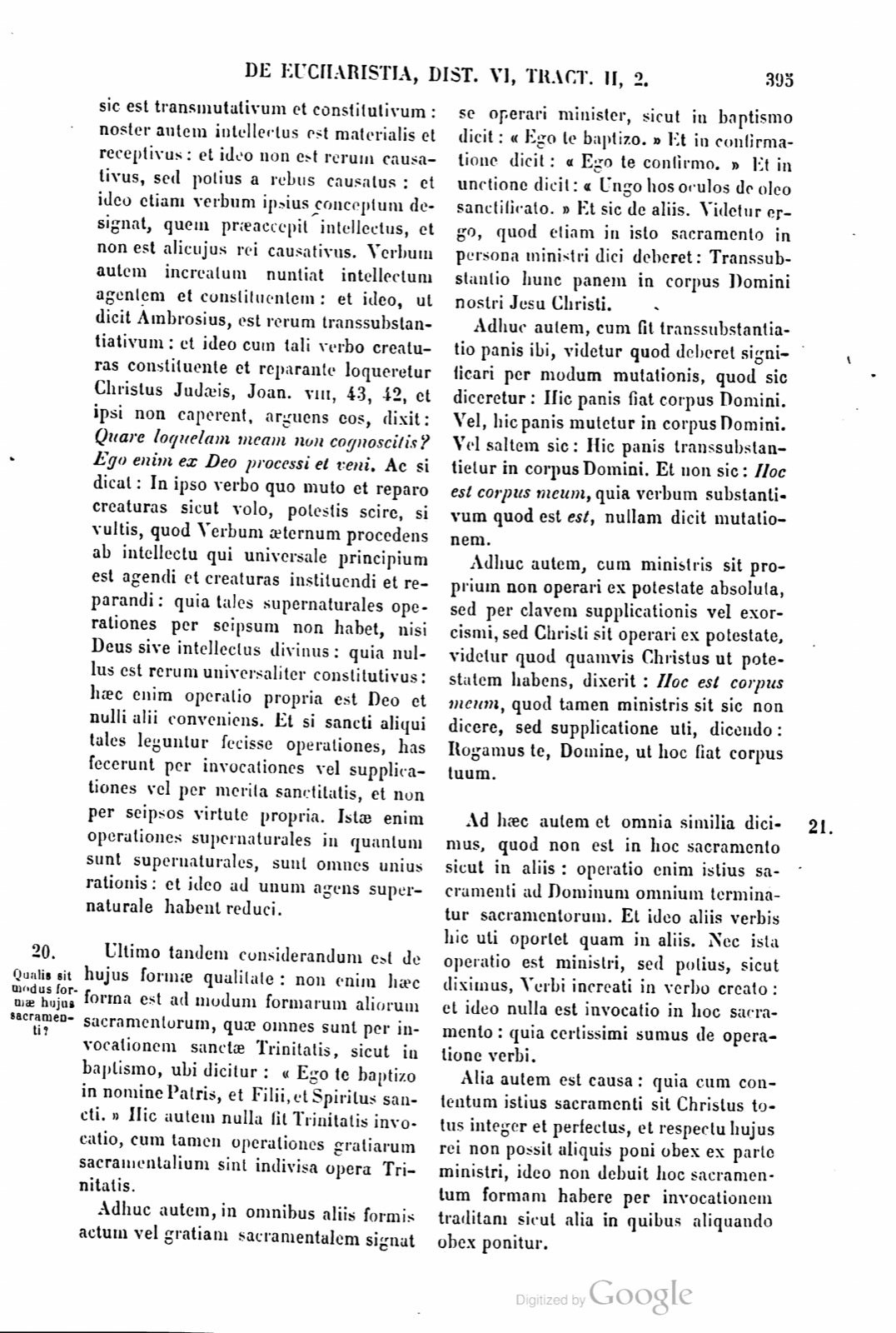
Adhuc autem, cum ministris sit proprium non operari ex potestate absoluta, sed per clavem supplicationis vel exorcismi, sed Christi sit operari ex potestate, videtur quod quamvis Christus ut potestatem habens, dixerit: Hoc est corpus meum, quod tamen ministris sit sic non dicere, sed supplicatione uti, dicendo: Rogamus te, Domine, ut hoc fiat corpus tuum.
21. Ad haec autem et omnia similia dicimus, quod non est in hoc sacramento sicut in aliis: operatio enim istius sacramenti ad Dominum omnium terminatur sacramentorum. Et ideo aliis verbis hic uti oportet quam in aliis. Nec ista operatio est ministri, sed potius, sicut diximus, Verbi increati in verbo creato: et ideo nulla est invocatio in hoc sacramento: quia certissimi sumus de operatione verbi.
Alia autem est causa: quia cum contentum istius sacramenti sit Christus totus integer et perfectus, et respectu hujus rei non possit aliquis poni obex ex parte ministri, ideo non debuit hoc sacramentum formam habere per invocationem traditam sicut alia in quibus aliquando obex ponitur.
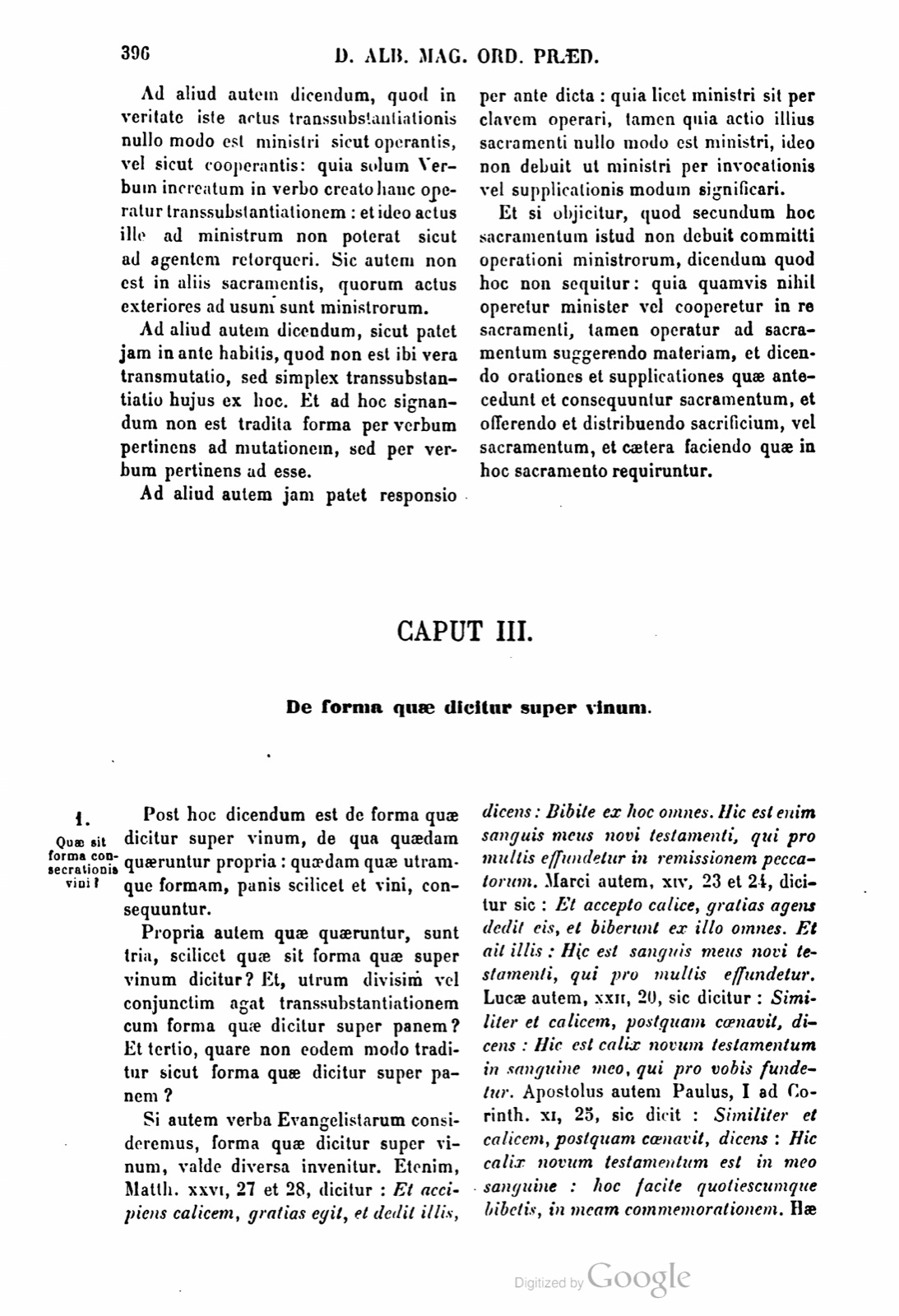
Ad aliud autem dicendum, quod in veritate iste actus transsubstantiationis nullo modo est ministri sicut operantis, vel sicut cooperantis: quia solum Verbum increatum in verbo creato hanc operatur transsubstantiationem: et ideo actus ille ad ministrum non poterat sicut ad agentem retorqueri. Sic autem non est in aliis sacramentis, quorum actus exteriores ad usum sunt ministrorum.
Ad aliud autem dicendum, sicut patet jam in ante habitis, quod non est ibi vera transmutatio, sed simplex transsubstantiatio hujus ex hoc. Et ad hoc signandum non est tradita forma per verbum pertinens ad mutationem, sed per verbum pertinens ad esse.
Ad aliud autem jam patet responsio per ante dicta: quia licet ministri sit per clavem operari, tamen quia actio illius sacramenti nullo modo est ministri, ideo non debuit ut ministri per invocationis vel supplicationis modum significari.
Et si objicitur, quod secundum hoc sacramentum istud non debuit committi operationi ministrorum, dicendum quod hoc non sequitur: quia quamvis nihil operetur minister vel cooperetur in re sacramenti, tamen operatur ad sacramentum suggerendo materiam, et dicendo orationes et supplicationes quae antecedunt et consequuntur sacramentum, et offerendo et distribuendo sacrificium, vel sacramentum, et caetera faciendo quae in hoc sacramento requiruntur.
Moreover, since it is proper to ministers not to operate from absolute power but through the key of supplication or exorcism, but it belongs to Christ to operate from power, it seems that although Christ, as having power, said, This is my body, nevertheless it belongs to ministers not to say thus, but to use supplication, saying: We ask you, Lord, that this become your body.
21. But to these and all similar things we say that it is not in this sacrament as in the others; for the operation of this sacrament is terminated at the Lord of all the sacraments. And therefore here it is necessary to use other words than in the others. Nor is this operation the minister's, but rather, as we have said, the operation of the uncreated Word in the created word; and therefore there is no invocation in this sacrament, because we are most certain concerning the operation of the word.
But there is another cause: because, since the content of this sacrament is Christ whole, entire, and perfect, and with respect to this thing no obstacle can be placed on the part of the minister, therefore this sacrament ought not to have a form handed down through invocation, as the others do, in which sometimes an obstacle is placed.
But to the other point it must be said that in truth this act of transubstantiation is in no way the minister's as one operating or as one cooperating, because only the uncreated Word in the created word operates this transubstantiation; and therefore that act could not be turned back to the minister as to an agent. But it is not so in the other sacraments, whose exterior acts belong to the ministers for use.
But to the other point it must be said, as is already clear in the preceding matters, that there is not there a true transmutation, but a simple transubstantiation of this from this. And to signify this the form has not been handed down through a word pertaining to change, but through a word pertaining to being.
But to the other point the response is already clear through the things said before: because although it belongs to the minister to operate through a key, nevertheless, because the action of that sacrament is in no way the minister's, therefore it ought not to be signified as the minister's through the mode of invocation or supplication.
And if it is objected that according to this that sacrament ought not to have been committed to the operation of ministers, it must be said that this does not follow, because although the minister operates or cooperates nothing in the thing of the sacrament, nevertheless he operates toward the sacrament by supplying the matter, and by saying the prayers and supplications which precede and follow the sacrament, and by offering and distributing the sacrifice or sacrament, and by doing the other things which are required in this sacrament.
If a page does not appear, its photograph has not been uploaded yet.