Volume III, pages 101–120 of the 1732 edition, from TR to VE: everything printed on these pages, in order.
Continued from Tripolis
Length of a Stadium, or Furlong. One of these Cities belonged to the Arabians, another to the Sidonians, and the third to the Tyrians.a It is still to this Day a considerable Place, because of its Harbour.
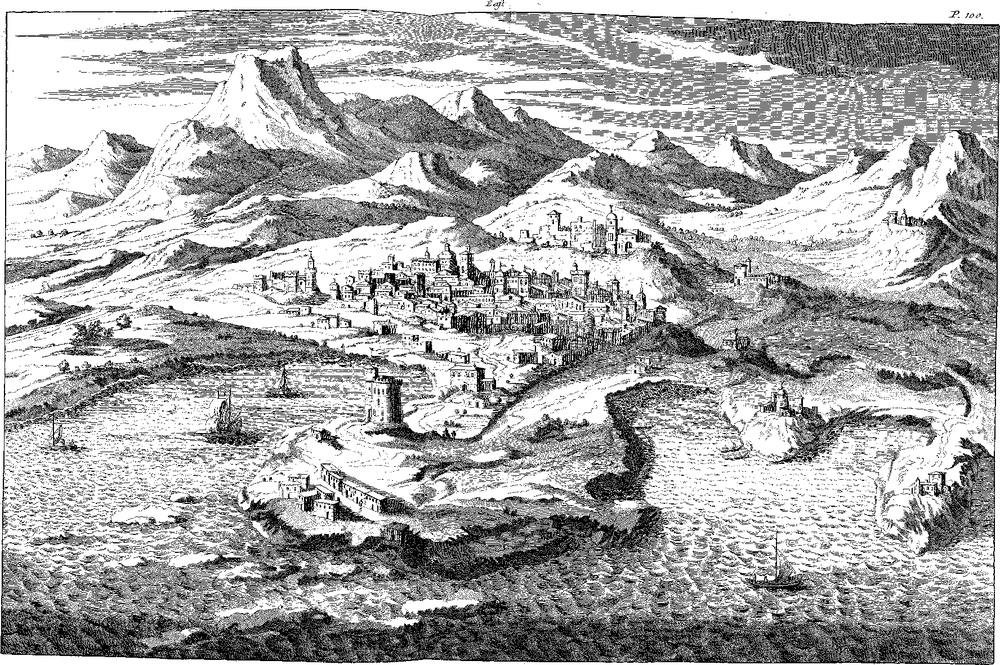
TRIPOLIS of Syria: Its Harbour being in the Form of a Peninsula, pretty much resembles that of Jaffa, having a vast number of small Rocks or Shallows at its Entrance, which oblige Ships to keep off, and to cast Anchor out of the Road. The City has no Fortifications, the Buildings and Houses are instead of Walls, and its Streets are very narrow. At the foot of the Castle runs the River called Nahar-kadisha, or the Holy River. It has its Source from the Springs and melted Snow that run down from Libanus, and particularly from the Fountain called in Scripture The Fountain of Gardens.1 The City is watered by the Waters of this River, which the Inhabitants convey as they please, by little Canals, and stop up the Outlets to overflow the Land and the neighbouring Gardens. This City is still famous for its extensive Trade, which is carried on there, for Merchandises which are brought thither both by Sea and Land.
TRITURATION, Threshing, treading out of Corn; or rather, treading the Straw under the Feet of Beasts, to make the Corn 1 Cor. ix. 9. 1 Tim. v. 18. Deut. xxv. 4.come out. St. Paul says, after Moses, Thou shalt not muzzle the mouth of the ox that treadeth out the corn. They used to muzzle these Animals, or they rubbed their Snouts with Cow-dung, that they might not eat the Corn as they trod it. The Business of Trituration was performed after this manner: They provided a Floor in the Fields, that was well beat, and very clean, about a Tree, as near as possible. They set up Sheaves one by another, very thick, round about the Body of the Tree. Then, by whipping the Oxen or Horses, they made them to mount up upon the Sheaves so set up, and made them run all together about the Tree, to bruise the Sheaves, to reduce them to Chaff, and to make the Corn fall out of the Ears. This was generally done at the hottest time of the Day; and at Evening they cleansed the Floor, by tossing up the Corn and Chaff together into the Air, by which the Chaff was driven by the Wind without the Floor, and the Corn fell down again within it.
The Scripture often alludes to this manner of threshing and winnowing Corn. Mic. iv. 13.Arise, and thresh, O daughter of Sion; for I will make thine horn iron, and I will make thine hoofs brass; and thou shalt beat in pieces many people; thou shalt bruise them Isai. xxi. 10. to dust. Isaiah calls Babylon, at the time of its Destruction, O my threshing, and the corn of my floor: You are, as it were, my Harvest, gathered into the Floor, and prepared to be trod out by Beasts: Your Enemies are going to begin their Trituration, and you shall be reduced to Chaff. Jeremiah makes use of the same Similitude, in Jerem. li, 33. speaking of the same thing. Filia Babylonis quasi area, tempus triturae ejus. Adhuc modicum, & venit tempus messionis ejus. The Author of the Second Book of Kings says, that the King of Syria had reduced Judea to the Condition of a Floor, where 2 Kings xiii. 7. Corn was threshed: He had brought it to Dust. Redegerat quasi pulverem in tritura areæ.
The Business of Trituration was very laborious; whence it is that God forbad the muzzling of those Creatures that were employed in this Work, to teach Men Lessons of Humanity and Compassion towards others. The Prophet Hosea compares Ephraim Hos. x. 11.to a Heifer accustomed to Trituration, full fed, and that would not submit to the Yoke: Ephraim vitula docta diligere trituram: But the Lord says, I will tame her; I will take her by the Neck, and put on her Yoke: Transivi super pulchritudinem colli ejus.
There was another manner of Trituration, which was performed with Sledges or Carriages shod with Iron. See before, the Article FLOOR.
TROAS, a City of Phrygia, or of Mysia, upon the Hellespont, between the City of Troy to the North, and the City of Assos to the South. Sometimes the Name of Troas signifies the whole Country of the Trojans, the Province where the City of Troy stood. But in the New Testament, wherein the Word Troas is found, it always signifies a particular City of that Name, which also sometimes is called by the Names of Antigonia, and Alexandria: Ipsa Troas, Antigonia dicta, nunc Alexandria, Plin. l. 5. c. 30.says Pliny. Sometimes both Names are joined, Alexandria-Troas. St. Paul was at Acts xvi. 8, &c.Troas in the Year 52 of the Vulgar Æra, and had this Vision in the Night: A Man of Macedonia stood before him, and made this Request to him: Come over to Macedonia, and assist us. He embarked therefore at Troas, and passed over into Macedonia. This Man that appeared to him, is supposed to be the Guardian Angel of Macedonia, who invited him to preach in that Kingdom. Besides this, the Apostle was several other times at Troas; but we know nothing particular of his Transactions there. See Acts xx. 5, 6. 2 Cor. ii. 14. He left behind2
hind him at Troas, in the custody of one Carpus, some Cloaths and Books, which he desired Timothy to bring along with him to Rome, when he came thither, in the Year 65 of the Vulgar Æra, a little before St. Paul’s Death, which happened in the Year 66. See 2 Tim. iv. 13.
TROGLODYTES. This Word, in Greek,3 signifies those that have their Abode in Holes and Caverns. There are many of this sort of People about Palestine, in Arabia, upon the Coasts of the Red Sea, and the Persian Gulph, and in Egypt. The Scripture mentions the Troglodytes only in one Place, which is 2 Chron. xii. 3. Lybies & Troglodytæ, & Æthiopes. The Hebrew says,b the Lubims, the Sukkims, Cushims, or Æthiopians.
The greatest part of Interpreters agree, that the Sukkim, in reality signifies the Troglodytes. Bochart is of this Opinion, Phaleg. l. 4. c. 29. where he shews, that Sukkah in Hebrew signifies a Hole or Cave; and that Plin. l. 6. c. 29.Pliny places the City of Succha upon the Shore of the Red Sea, in the Country of the Troglodytes. Grotius, and some others, chuse rather to suppose that the Sukkims, mentioned in the Chronicles, and which were in the Army of Shishack King of Egypt, stand for People that dwell in Tents, as the Arabian Scenites. There were many of these sorts of Arabians in Arabia Petrea, and about Egypt, who did not take the trouble of cultivating their Lands, or of building Houses.
TROPHIMUS, a Disciple of St. Paul, a Gentile by Religion, and an Ephesian by Birth. After St. Paul had converted him, he adhered constantly to him, nor quitted him ever after. He came from Ephesus to Corinth with the Apostle, and kept him company in his whole Journey from Corinth to Jerusalem, in the Year of our Lord 58. When St. Paul was in the Temple there, the Jews laid hold of him, crying out, Men of Israel, help; this is the man that teacheth all men every where against the people, and the Acts xxi. 28, 29.law, and this place; and farther, brought Greeks also into the temple, and hath polluted this holy place. And this they said, because certain Jews of Ephesus having seen Trophimus with St. Paul in the City, whom they looked upon as a Gentile, imagined that St. Paul had introduced him into the Temple. The whole City was immediately in an Uproar, and St. Paul was secured, as we have said before, under his Article. It is very probable that Trophimus followed him to Rome, and forsook him not in his Bonds. It is pretended, that after the Apostle had obtained his Liberty, in the Year 63, he went into Spain; and that passing through the Country of the Gauls, he left Trophimus at Arles, as Bishop there. See Baronius in the Year 62, Sect. 4. But this is very difficult to reconcile with what St. Paul writes to 2 Tim. iv. 20.Timothy, that he had left Trophimus sick at Miletus. Trophimus must necessarily have gone back into Asia, about a Year after that St. Paul had left him at Arles. The Greeks keep April 14. in honour of Trophimus, and say he had his Head cut off by the Command of Nero, along with St. Paul. Those of Arles keep his Feast on the 29th Day of December.
TRUMPET. The Lord commanded Numb. x. 2, 3, 4, 5, &c.Moses to make two Trumpets of beaten Silver, to be made use of to call the People together, when they were to decamp. He adds, “ After you shall “ have sounded these Trumpets, all the “ People shall assemble to you at the Entry of the Tabernacle of the Covenant. “ If you sound but once, the Princes “ and chief of the People of Israel, shall “ come to you: But if the Sound of the “ Trumpet is longer, and more interrupted, then those that are on the East “ side shall decamp first. At the second “ Sound of the Trumpet, those that are “ to the South shall take down their “ Tents. At the third Sounding, those “ that are to the West: And at the “ fourth, those that are to the North “ shall decamp. But when it is only to “ assemble the People, the Trumpets “ shall sound with a more simple and “ uniform Blast, and not with an interrupted or discontinued Sound.
“The Priests the Sons of Aaron shall only have the Privilege of sounding the Trumpets, and this shall be an immutable Law throughout all your Generations. They shall sound when you go forth to War against your Enemies, and the Lord your God shall remember you to succour you. They shall also sound when you are to keep your religious Festivals, when you celebrate your solemn Feasts; when you offer your Burnt-Offerings, and your Peace-Offerings; and on the first Day of every Month.” They also chiefly made use of these Trumpets, to proclaim the Beginning of the Civil Year, the Beginning of the Sabbatical Year,4 and the Beginning of the Jubilee. Levit. xxv. 9, 10. Joseph. Antiq. l. 3. c. 11.Josephus says, that these Trumpets were near a Cubit long, and had a Tube or Pipe of the Thickness of a common Flute. Their Mouths were no wider than just to blow into them, and their
Ends were like those of a modern Trumpet. At first there were but two in the Camp, but afterwards they made a greater number. Even in the time of Joshua there Josh. vi. 4. 2 Chron. v. 12.were seven of them. At the Dedication of the Temple of Solomon there were six score Priests that sounded the Trumpets. Josephus will have it, that this Prince made two hundred thousand Trumpets, as Moses had commanded. I know not from whence he took this Account, of so great number of Trumpets.
Besides the sacred Trumpets of the Temple, the use of which was restrained to the Priests only, even in War and in the Battel, there were others, which the Generals made use of sometimes, to gather their Troops together. For example, Ehud Judg. vi. 27.sounded the Trumpet, to assemble the Israelites against the Moabites, who oppressed them, and whose King Eglon he had lately slain. Gideon took a Trumpet in his Hand, and gave every one of his People Judg. vii. 2, 16.one, when he assaulted the Midianites. Joab sounded the Trumpet, to give the Signal of Retreat to his Soldiers, in the 2 Sam. ii. 28. 2 Sam. xviii. 16.Battel against those of Abner’s Party, and in that against Absalom; and lastly, in the Pursuit of Sheba the Son of Bichri. We may see the same thing in twenty other Places of the History of the Hebrews.
The Feast of Trumpets: It was kept on the first Day of the seventh Month of the Sacred Year, which was the first of the Civil Year. This Month was called Tizri, and answered to the Moon of September. The Beginning of the Year was proclaimed by Sound of Trumpet: This Day was kept solemn; all servile Business was forbid to be done upon it. They offered a solemn Holocaust upon it, in the name of the whole Nation, of a Calf, two Rams, and seven Lambs, of the same Year, with the Offerings of Flour and Wine, that were usual with these Sacrifices. The Scripture does not acquaint us with the Occasion of appointing this Feast. Theodoret believes, it was in memory of the Thunder and Lightning upon Mount Sinai, when God gave his Law from thence. The Rabbins will have it, that it was in Remembrance of the Deliverance of Isaac, in whose stead a Ram was sacrificed by Abraham.
At present the Jews are accustomed upon this Evening to wish one another a good Year, to make better Chear than ordinary, and to sound the Trumpet thirty times successively. Leo of Modena observes, that heretofore there was a Dispute among the Rabbins concerning the Time at which the World began. Some maintained it was at the Beginning of the Spring, and others at Autumn. But the Opinion prevailed that placed the Beginning in Autumn; and ‘twas upon this Occasion that the Feast of Trumpets was founded, which is kept on the Beginning of Tizri, which answers to our September. During this Feast, which lasts the two first Days of the Month, all Labour and Business are suspended. The Jews hold it from Tradition, that on this Day God particularly judges of the Actions of the foregoing Year, and disposes of the Events of the Year following. Wherefore, on the first Days of the foregoing Month, or at least, eight Days before the Feast of Trumpets, they generally apply themselves to Works of Penitence and Mortification; and the Evening before, many of them cause to be given them thirty -nine blows with a Whip, by way of Discipline.
On the first Evening that begins the Year, and which precedes the first Day of Tizri, as they return from the Synagogue they say to one another, May you be written in a good Year; the other answers, And you also. Being returned into their Houses, they serve at Table Honey and leavened Bread, and whatever may betoken a happy and plentiful Year. Some of them on the Morning of these two Feasts go to the Synagogue cloathed in White, as a Token of Purity and Penitence. Among the Germans, some of ‘em then wear the Habit that they have appointed for their Burial; and this in a sense of Mortification. This Day they repeat in the Synagogue several particular Prayers and Benedictions. They take the Pentateuch very solemnly out of the Chest, and they read to five Persons the Sacrifice that was performed on that Day. Then they sound twenty times upon a Horn, sometimes after a very slow manner, and then very briskly. They say it is to make them think of the Judgments of God, to intimidate Sinners, and to induce them to repent. After some Prayers they return to their Houses, sit down at Table, and pass the rest of the Day in hearing some Sermons, and in other Exercises of Devotion. The two Days of the Feast are just alike.
To prepare themselves for the Feast of Trumpets, or for the Beginning of the Civil Year, many Jews plunge themselves into cold Water, and as they sink in they confess their Sins, and beat their Breasts. They plunge over Head
and Ears, that they may appear entirely clean to the Eyes of God. They think that on this Day God assembles his Council, or his Angels, and that he opens his Books to judge all Men. Three sorts of Books are opened; the Book of Life, for the Just; the Book of Death, for the Wicked, and the Book of a Middle State, for such Men as are neither entirely good, nor entirely bad. In the two Books of Life and of Death, there are two kinds of Pages; one for this Life, and the other for Eternity. For it often happens, that the Wicked are not punished in this Life according to their Demerits, and that the Just are used with Severity, as if they had incurred the Anger of God. This Conduct of God is the Occasion that no one can be sure of his Condition, but is always uncertain, whether he is worthy to be loved or hated. As for the middling ones, who are neither quite good, nor quite bad, they are not written down any where, as the Jews say; God stays till the Day of Expiation, which is the tenth of the Year, to try if they will be converted. On this Day their Sentence passes, and their Fate is determined, whether for Life or Death, according to their Merits.
TRUTH, Veritas, is used in several Senses in the Scriptures. First, for what is opposed to Falshood, a Lye, a Mistake, a Deceit. For example, There shall be none among you that shall consult the Dead, to learn the Truth from them; aut quæras à Deut. xviii. 11. Psal. v. 5. Rom. ix. 1.mortuis veritatem. And the Psalmist, speaking of the Wicked, Non est in ore eorum veritas. And St. Paul, I speak the truth in Christ, I lye not.
Secondly, Truth is put for Fidelity, Sincerity, and Punctuality in keeping Promises. Generally to Truth, taken in this Sense, is joined Mercy or Kindness. For example, Gen. xxiv. 27. Eliezer, the Servant of Abraham gives Thanks to God, that he had shewed Kindness and Truth to his Master Abraham: Benedictus Dominus, qui non abstulit misericordiam & veritatem suam à Domino meo: He has given him plenty of good things by his Mercy, and has compleatly fulfilled all his Promises to him. Misericordia & veritas, may also express a stable, constant, and permanent Mercy or Kindness: The Lord be praised, who has favoured my Lord and Master Abraham in so constant and uniform a manner.
Those Expressions, Misericordia & veritas, are very frequent in Scripture. Gen. xxiv. 29. Si facitis misericordiam & veritatem cum Domino meo, judicate mihi. And Gen. xlvii. 49. Jacob says to his Son Joseph, If now I have found grace in thy sight, put, I pray thee, thy hand under my thigh, and deal kindly and truly with me; bury me not, I pray thee, in Egypt: You shall promise this Favour, and you shall faithfully perform it. And in Joshua, ii. 14. the Spies of the Israelites promised Rahab, to deal with her kindly and truly, that they would faithfully perform what they had promised. And 2 Samuel ii. 6. David sent to tell the Inhabitants of Jabesh-Gilead, that the Lord would shew kindness and truth to them, for their Piety in burying the Bones of Saul, and that he himself would requite it to them. Lastly, as this manner of speaking occurs in almost every Page of the Scripture, in my opinion it may signify, that God will bestow his Kindness and Favour to all those to whom he promises Mercy and Truth; and that he will do it in a fixed and permanent manner.
There are some to whom he makes Promises, but they are only conditional; others on whom he confers Favours, but they are only for a season; others are prevented with his first Blessings, but do not obtain the Favour of a final Perseverance. God made many Promises to the Israelites, but merely on condition that they should continue faithful to him. He gave the Royal Dignity to Saul, but it was only for a time. Solomon partook plentifully of his first Favours, but it is doubted whether he had the Gift of Perseverance. In this Sense God may be said to have granted them his Kindness, but not his Truth. On the contrary, he granted both to David, in a still particular manner, and in a more perfect manner to the Messiah. David says of himself, Psalm xxxix. 12.Misericordia tua & veritas tua semper susceperunt me. And again, Psal. lvi. 4. Misit Deus misericordiam suam & veritatem suam, eripuit animam meam de medio catulorum leonum, &c. And elsewhere, Psal. lxxxviii. 34.speaking of the Messiah, Misericordiam autem meam non dispergam ab eo, neque nocebo in veritate mea, &c.
The Septuagint generally translate the Hebrew Word Chesed by Justice, which the Vulgate renders by Mercy. Blessed be the Lord, who hath not withdrawn his Justice and Truth from my Master. But in these Passages, as in many others, the Words Mercy and Justice are synonymous, even in the Hebrew.
Isaiah desires of the Lord, that Peace and Truth may be established for his Days: 2 Kings xx. 19. Isaiah xxxix. 8.Sit pax & veritas in diebus meis, where the Hebrew hath it, Shall there be Peace and Truth for my Life? May I flatter myself, that God will suspend the terrible Effects of his Vengeance till after my Death? Peace and Truth stand here for a constant and continual Prosperity. Jeremiah xxxiii.6. makes use of almost the same Expression: Revelabo illis deprecationem pacis & veritatis: I will discover to them
John xiv. 6. John i. 14.an effectual manner of Prayer, to obtain Peace and Truth, or a fixed and durable Peace. Otherwise, I will make them to taste that solid Happiness they wish for. Deprecationem pacis, is as much as to say, Pacem quam enixè precantur. And Zechariah, viii. 19. Pacem & veritatem diligite, which relates to what he said a little before, Verse 16. Veritatem & judicium pacis judicate; Judge in Truth and Peace; live in Peace, and exercise Justice over your Brethren: Let the Judges and Magistrates do Justice to their Inferiors, in Truth and Equity, and let them preserve Peace among them. Or else, Judicium veritatis & pacis, is put for Judgment that procures Peace to them, a constant Prosperity. Or, lastly, it is put for Judicium verum & perfectum, Judgment attended by perfect Equity. The Hebrew Word Shalom, which signifies Peace, stands also for Perfection.
Jesus Christ is the eternal and essential Truth: Ego sum via, veritas, & vita. And again, in the First Epistle of St. John, v. 6. Quoniam Christus est veritas: He is the Word, full of Grace and Truth. Plenum gratiæ & veritatis: ‘Tis he that has granted and communicated to us a Plenitude of both Ibid. 17.of these. Gratia & veritas per Jesum John iv. 26Christum facta est. ‘Tis he that has sent to his Apostles the Spirit of Truth: Spiritum veritas qui à Patre procedit.
The Word of Truth, the Way of Truth, the Knowledge of Truth, to walk in the Truth, to speak in Truth, to give Testimony to the Truth, in the sacred Authors of the New Testament, import the Truth of the Gospel, the holy Truths of Christianity.
Psal. xxxv. 6. lvi. 11.The Psalmist says, that the Mercy of the Lord reaches to the Heavens, and his Truth to the Clouds; to express their Greatness, Immensity, and Extent; and that all Creatures partake of them. Elsewhere he says, Psalm lxxxv. 10, 11.Mercy and Truth are met together; righteousness and peace have kissed each other. Truth shall spring out of the earth, and righteousness shall look down from heaven. In this Place the Prophet describes the Happiness of the Land of Judah, after the Return from the Captivity; and in a more exalted Sense, the Advantages the Church was to enjoy after the Coming of the Messiah. Mercy and Justice, Peace and Truth, in these Places may be considered as synonymous Terms. In Judah shall be seen to flourish Mercy, Justice, Peace and Truth; a constant and permanent Mercy, a full and perfect Justice. Certain it is, that Justice is often put for Clemency, Benignity, Mercy.
David, in Psalm lxxxviii. in several manners extols the Truth of God, or his Fidelity in his Promises. ‘Tis a Song of Thanksgiving for the Mercies that God had vouchsafed to the House of David. The fruitful Invention of the Prophet has furnished him with great Variety of Ways to declare the Greatness of God’s Favour, and the Effectualness of his Promises. “I will for ever shew forth “ his Mercies; I will publish his Truth “ from Generation to Generation.- — His “ Mercy is founded in Heaven, he has “ confirmed his Truth. ---- His Truth “ shall be magnified in the Congregation “ of the Saints. ---- His Power is infinite, and his Truth surrounds it on “ all sides. ---- Justice and Equity are “ the Supporters of his Throne. ----- “ Mercy and Truth march before him.--- “ His Mercy and his Truth shall be always displayed to David.” All these Expressions and different Turns amount to this, that it is his Mercy that prevents and promises, and it is his Truth that executes and performs.
Rom. xvi. 12.TRYPHENA and TRYPHOSA, Christian Women, whom St. Paul mentions in his Epistle to the Romans. Salute Tryphena and Tryphosa, who labour in the Lord. Much mention is made of these two Women in the History of St. Thecla; but as this History is thought to have been corrupted, it can give no Authority to the Actions of these holy Women. The Roman Martyrology puts down their Feasts on the 10th of November. ‘Tis said they went to Rome to be serviceable to the Saints, and to obtain a Crown of Martyrdom there; but God did not permit that their Desires should be gratified in this City. They returned into the East, where their Blood was spilt for the sake of Jesus Christ.
TRYPHON, a King of Syria. See DIODOTUS, before, and 1 Macc. xi. 39, 54, &c. xii. 42, 49. xiii. 1, 12, &c. xv. 10, 15, &c.
TUBAL, or Thubal, the fifth Son of Japheth. The Scripture commonly joins together Tubal and Meshech, which makes it thought that they peopled Countries bordering upon each other. The Chaldee Interpreters, by Tubal and Meshech understand Italy and Asia, or rather Ausonia. Josephus thinks Iberia and Cappadocia. St. Jerome will have it, that Tubal represents the Spaniards, heretofore called Iberians. Bochart is very copious to prove, that by Meshech and Tubal are intended the Muscovites and the Tibarenians. See the Commentators upon Gen. x. 2.
TUBAL-CAIN, or Thubal-cain, Son of Lamech the Bigamous, and of Zillah. The Scripture tells us, that he was the Father Genesis iv. 22.and Inventor, or Master of the Art of forging and managing Iron, and of making all kinds of Iron-work. It is not doubted but it was he that gave E e
occasion to the Vulcan of the Heathens. The Name Tubal-cain, is not very remote from Vulcan.
TUBINS, or the Tubianians, or Tubienians, 1 Macc. v. 13. are the same as the People of the Land of Tob, to the North of Batanea. See TOB.
TURTLE, a clean Bird which is often mentioned in Scripture, and which was sometimes offered in Sacrifice. They might offer either Turtles or young Pigeons. These Sacrifices were appointed in favour of the Poor, who could not go to the Charge of more substantial Sacrifices. Before the giving of the Law, Abraham offered to God a Burnt-offering of an Heifer, a she Goat, a Ram, each of three Gen. xv. 9.Years old, and of two Birds, which were a Turtle and a Pigeon; and when he cut the other Victims into two Parts, he left the two Birds entire. Moses appointed, that when a Woman came to the Tabernacle, in order to her Purification after Child-birth, if she had Levit. xii. 6, 7, 8.not wherewithal to offer a Lamb for a Sin-Offering, and another for a Burnt-Offering, she should bring two Turtles, or two young Pigeons, one for a Burnt-Offering, and the other for a Sin-Offering. ‘Twas thus that the Holy Virgin did at the time of her Purification, Luke ii. 24.
Numb. vi. 10.The Nazarites offered two Turtles, or two young Pigeons, at the Door of the Tabernacle; one to be sacrificed for Sin, and the other for a Burnt-offering, when during the time of their Nazariteship, they had been accidentally defiled by the Presence of a dead Body. When a Leper was poor, and could Levit. xiv. 22.not afford to offer the larger Sacrifices, the Law appointed him, on the Day of his Purification, to offer two Turtles, or two young Pigeons, one for a Sin-Offering, and the other for a Burnt-Offering. A Man troubled with a Genorrhea, or a Woman that had an irregular Flux, were each obliged to offer two Turtles, or two young Pigeons, one for Sin, and the other for a Holocaust, and that on the eighth Day that followed their Cure. A Man that had unadvisedly touched any impure Animal, or had rashly made any inconsiderate Vows or Promises, when he was sensible of his Error, if he was poor, he was to offer to the Lord two Turtles, or two young Pigeons, one for Sin, and the other for an Holocaust. These are the Cases in which they offered Turtles in Sacrifice.
Jerem. viii. 7.Jeremiah says, that the stork in the heaven knoweth her appointed times, and the turtle, and the crane, and the swallow observe the time of their coming. And indeed the Turtle is a Bird of Passage, as well as the Swallow and the Stork: The Spouse in the Canticles compares the Cheeks of his Spouse,5 to the Beauty of the Turtle: Pulchræ sunt genæ tuæ sicut Turturis. But the Hebrew intimates, Thy cheeks are comely with rows of Jewels. The Women of that Country wore a kind of Bracelets about their Faces. See the Travels of M. D’Arvieux to the Camp of the Grand Emir, p. 27, 28.
Acts xx. 4. Tit. iii. 12.TYCHICUS, a Disciple of St. Paul, whom the Apostle often made use of, to carry his Letters to the several Churches. He was of the Province of Asia, and accompanied St. Paul, when in the Year 58 he made his Journey from Corinth to Jerusalem. ‘Twas he that carried the Epistle to the Colossians, written in 61; and that to the Ephesians, written in 65; and the First to Timothy, written in 64. St. Paul did not send him merely to carry his Letters, but also to learn the State of the Churches, and to bring him an Account of them. Wherefore he calls him his dear Brother, a faithful Minister of the Lord, and his Companion in the Service of God.6 He had Thoughts also of sending him into Crete, to preside over that Church in the absence of Titus. ‘Tis thought also,7 that he was deputed to Ephesus, to govern this Church while Timothy should be at Rome, when he carried a Letter to the Ephesians from this Apostle. The Greeks celebrate the Feast of St. Tychicus on the 8th or 9th of December, and give him the Title of one of the Seventy Disciples, and Bishop of Colophon in the Province of Asia. Usuard, Adod, and the other Martyrologists, mark his Feast at Paphos in Cyprus, on the 19th of April. Usuard only gives him the Title of Deacon.
TYMPANUM, a Timbrel, or Instrument of Musick, which is often mentioned in Scripture. The Hebrews call it Toph;8 and I suppose under this Name they comprehend all kinds of Drums, Tabors, and Timbrels. I do not find the Hebrews made use of it in their Wars, but only at their publick Rejoicings; and it was commonly put into the Hands of Women. After the Passage of the Red Sea, Miriam, the Sister of Moses took a Tympanum, or Timbrel, and began to play and dance with the Women. The Daughter Exod. xv. 20.of Jephthah came to meet her Father with Timbrels, and other Musical Instruments. Judg. xi. 34.‘Twas probably of the same kind as those ancient Tympana, which are put into the Hands of Cybele the Mother of the Gods. Tympana habet Cybele, sunt & mihi Tympana cribri.
The ancient Marbles generally represent Cybele with a Tympanum. They used also to play on this Instrument at the Feast of Bacchus. Its Figure is not uniform, but is sometimes represented as a Tabor, with little Bells;9 and at other times as an Instrument of hollow Brass, with Bells also, and a Stick to play upon it. But there does not appear to be any Skin stretched upon its Opening. At other times they are two sorts of Brazen Caps, which were struck against one another on the Sides that were open.
Tympanum, in the Sense of an Instrument of Punishment, is met with in the Greek of St. Paul to the Hebrews, xi. 35.10 Both ancient and modern Interpreters are much divided about the Sense of this Word. Some have explained it of the Tressel, or Chivalet, a Punishment very frequent in Antiquity, but very much unknown at this Day. St. Chrysostom, and the other Greek Interpreters that have followed him, and who ought to have understood the Meaning of this Word better than the Latins, thought that the Apostle, in the Place where he speaks of Tympanum, alludes to the Death of John the Baptist, and to that of St. James, who were both beheaded. Hesychius, Suidas and Oecumenius, think the Verb Tympanizin signifies to flea alive. Others,11 more modern, take it in a generical Sense, for all kinds of capital Punishments and violent Deaths. And it is true that the Greek Verb we are speaking of, is sometimes used in this manner.
But we think the Apostle, in the Place we are speaking of, means the Bastinado, or Punishment of the Whip, and that he makes Allusion to the Cruelties exercised upon old Eliazar, and the seven Brethren the Maccabees. The Second Book of the Maccabees,12 speaking of the Martyrdom of Eleazar, says, that he went to the Tympanum, and that being at the Point of expiring under the Blows of the Switches or Rods, he said, groaning; The Lord, who knows all things, knows this, that tho’ I could escape Death, yet I chuse to suffer these violent Pains in my Body, being torn with the Rods. St. Paul seems plainly to allude to this Passage, when he says, Some have suffered the Punishment of the Tympanum, not desiring to rescue themselves from this Torture, in hopes of a better Resurrection. 2 Macc. vii. 1.The seven Brethren Maccabees were also tormented with Stripes and Rods: Flagris
& tauris cruciatos. The Scholiast of Aristophanes,13 speaking of the Punishment of the Tympanum, says, that they called Tympana those Instruments of Wood, upon which such Criminals were whipt as were condemned by the Judges to suffer the Bastinado. This Punishment is still in use among the Eastern Countries. See the Article PUNISHMENTS.
TYPHON, an Egyptian Deity. This People admitted of two Principles, one Good, and the other Bad.14 From the good Principle proceeded Generation, and from the bad one proceeded the Corruption of every thing. The good Principle had a Superiority over the evil one; but not so far as to destroy it, and to hinder its Operations. Isis, Osiris, and Orus, were the good Principles; Typhon was the bad Principle. Osiris was in the Universe what Reason is in Man, and Typhon was analogous to the Passions that are contrary to Reason. In the Human Body a good Temperament proceeded from Osiris; but Diseases and Indispositions came from Tryphon. To him also were imputed Tempests, Inundations, Earthquakes, Eclipses of the Sun and Moon, and every thing that passed for an Irregularity in Nature. The Ass was his Symbol, as also the Crocodile. He had divine Honours paid to him in the Canton of Egypt called Papremis.
Typhon was Brother to Osiris,15 who reigned in Egypt with Equity and Justice. But Typhon was a violent and cruel Man, killed his Brother, and cut his Body into twenty-six Parts, of which he gave one to every one of those who had conspired along with him, to engage them farther by that, in making them equally obliged to support him in his Usurpation of the Kingdom of Egypt. But Isis, the Wife and Sister of Osiris, and Orus, their Son, revenged his Death upon Typhon, put him to death, and all that had conspired with him. He was drowned in the River Orontes.
He is said to have been buried under the Island of Sicily; which Island was hardly sufficient to cover his Body, it being of so enormous a Size.
We should not here have spoke of Typhon, who is not mentioned in Scripture, had not some Criticks maintained, that Typhon is the same as Shem the Son of Noah; and that several Particulars of his Life and Death have great Resemblance with those of the King of Basan. The Egyptians give to Typhon the Name of Seth,
Seth, a or of Smy, which has a good deal of relation to that of Shem. Marsham thinks,16 that the City of Pithom, mentioned in Exodus,Exod. i. 11. takes its Name from Typhon; the Hebrews having purposely changed and disguised the Name, because it was forbid them to name the Name of strange Gods. The Egyptians gave to Shem, who was blessed by Noah,17 the odious Names of the Evil Principle, and of an Usurper, which would much better agree to their Founder, Ham.
Typhon is said to have been drowned in the River Orontes, or in the Lake Sirbon, Herodot. l. 3. c. 5.near to Egypt. The Egyptians accuse this Deity of Outrage in several of their Ceremonies. Plutarch. de Iside.Those of the Coptæ throw an Ass down a Precipice, in contempt of Typhon, because this God was ruddy, and of the Colour of an Ass. Typhon is commonly described Homer. Iliad. 2.with Serpents. Homer says, that the Bed of Typhon was at Arymes, or Arame, that is to say, in Syria. The same Homer says, that Typhon was killed at Ydes, in a Country full of Oaks, in the midst of a very fat People. The greatest part of these Characters agree to King Og; he was a Giant of a great Stature. Typhon was so large, as that the Island of Sicily was hardly sufficient to cover him. He was cast into the Lake Sirbon. Job says, that the ancient Giants groan under the Waters. Og persecuted the Hebrews, and made War against them; he died in Syria, in the Country of Aram, beyond Jordan, in a fat and fruitful Land, the Land of Basan. The Ydes of Homer may stand for Judea. The Name Hivites signifies Serpents. Og was of the number of the Giants of the Hivites and Amorites. But we must own, that all this is far-fetched, and can give but little Assistance, in clearing up, or illustrating the sacred History.
TYRANNUS. ‘Tis said in the Acts of the Apostles,18 that St. Paul being at Ephesus, and seeing that the Jews to whom he preached, instead of being converted, were rather more hardened and obstinate, he withdrew from their Society nor went to preach in their Synagogue, but taught every Day in the School of one Tyrannus. ‘Tis enquired, who this Tyrannus was? Some think19 him to have been a Prince or great Lord, who accommodated him with his House, in which to receive and instruct his Disciples. But the generality conclude, that Tyrannus was a converted Gentile, a Friend of St. Paul’s, to whom he withdrew. The Name of one Tyrannus may be said, either of a Man of this Name, or of some sovereign Prince. But, besides, the Name Tyrannus was then become so odious, that it would not have been given to a Man that deserved nothing but what was good to be said of him, without some kind of Softening or Mitigation. Some Greek Manuscripts have Tyrannios instead of Tyrannos; and other Copies intimate, that he taught from the fifth to the tenth Hour. We find in History more Men than one by the Name of Tyrannus.
TYRANT. This Word is commonly taken in an odious Sense in most modern Languages, for a Prince that abuses his Authority to oppress his Subjects, and to disturb his Neighbours. But in the Greek and Latin, Tyrannus is often taken in a good Sense, and formerly there was no Distinction or Difference of Signification between Tyrannus and Rex: Nihil intererat apud majores inter Tyrannum & Regem.20 Afterwards the Word Tyrant became a Word of Reproach and Detestation, especially in free Cities.
The sacred Authors sometimes make use of the Word Tyrannus, to express a Prince or King. For example, Esth. vi. 9. Primus de Regiis Principibus ac Tyrannis. The Hebrew reads it Parthumim,21 which seems to answer to the Greek Word Paratimios, an illustrious Man. We read the same Word Parthumim in Daniel, i. 3. where it is also translated by Tyrannus in the Vulgate. But in the same Daniel, iii. 2, 3. we read in the Hebrew, Gedabræ22, instead of Tyrannus, as it is in the Greek and Latin. In Job, xxxiv. 19. Tyrannus answers to the Hebrew Word Shar, a Prince; and in xxxv. 9. it answers to Rabbim, great Men. In Ezekiel, xxiii. 23. Tyrannus is put for the Hebrew Word Shuah.23 In Habakkuk, i. 10. Tyrannus is put for the Hebrew Word Rasen, which signifies a Lord, a Governor; and is probably the same as Saren or Suren, a great Lord. I shall not speak of the Books that are written in Greek, as the Book of Wisdom, Ecclesiasticus, and the Maccabees, where the Word Tyrannus is used sometimes in a good Sense, and sometimes in a bad one, as by other Greek Authors.
TYRATABA, a Village near the Mountain Gerizim, i where a great number of the Samaritans being gathered together in Arms, after an Impostor that pretended to discover certain sacred Vessels that had been hid there by Moses, under Ground; Pilate having Intelligence of it, marched24
marched a Party against them, gave them Battel, put them to Flight, killed a great number of them, and took several Prisoners, the chief of which he afterwards beheaded. This happened in the Year of Christ, or of the Vulgar Æra 36.
TYRE, or Tyrus, a famous City of Phœnicia. Its Hebrew Name is Tsor, or Zor,25 which signifies a Rock. Aulus Gellius says,26 that its ancient Name was Sarra. Plautus27 calls it Sara: Purpuram tibi ex Sara attuli. And Silius Italicus28 puts Sarranus murex for Tyrius: Sarrano murice fulgens. The City of Tyre was allotted to the Tribe of Asher,29 as also the other Maritime Cities of the same Canton; but it does not appear that the Asherites ever drove out the Canaanites that possessed them. Yet there are very learned Men that maintain, that in Joshua’s time Tyre was not yet built, and that Mibzar-zor, which the Author of the Vulgate translates by Urbem munitissimam Tyrum, is not the City of Tyre. Isaiah30 calls Sidon the Daughter of Tyre, that is, a Colony derived from it. Homer never speaks of Tyre, but only of Sidon. Josephus says,31 that Tyre was built not above two hundred and forty Years before the Temple of Solomon; which falls in with the Year of the World 2760, two hundred Years after Joshua. Herodotus says,32 that it was affirmed by the Priests of Tyre, that the Temple of Hercules in this City was built at the same time as the City itself, which was two thousand three hundred Years before the time of his Writing; that is, before the Year 3596.33 By which Account Tyre must have been built 656 Years before the Deluge; which by no means can be admitted.
But there seems to be a way of reconciling these Variations, by allowing two Cities of Tyre; the old one known to the Ancients by the Name of Palæ-Tyrus; the other a more modern City, called only Tzor, or Tyre. The first was built upon the Continent, and there stood the Temple of Hercules, of the Antiquity of which the Priests of Tyre made such an extravagant Boasting to Herodotus. ‘Twas to this Temple the Tyrians would have sent Alexander to sacrifice, when he sent them word he had a Desire to come into their City, under Pretence of offering Sacrifices to Hercules.34 Tyrum se ire velle ad vota Herculi reddenda dixit. Legati responderunt, esse Templum Herculis extra urbem, in ea sede quam Palæ-tyron, sive vete-
Vol. III. rem Tyrum ipsi vocant, ibique in antiquiore templo rectius id eum esse facturum, &c. The other Tyre was in an Island, over-against the old one, from which it was divided but by a narrow Slip of the Sea. Pliny says,35 that the Distance of the Island from the main Land was not above seven hundred Paces. Alexander the Great filled up all this Space, in order to take the City; and the Island was still joined to the Continent in Pliny’s time: Tyrus quondam Insula præalto mari septingentis passibus divisa; nunc verò Alexandri oppugnantis operibus continens.
‘Twas therefore of the ancient Tyre that Joshua must be understood. The new one was not yet built, even in the time of Solomon; there was only a Temple in the Island, dedicated to Jupiter Olympius. Dius, and Menander the Ephesian,36 who wrote the Phœnician History, relate, that Hiram, the Friend of Solomon, joined to the City of Tyre the Temple of Hercules, which stood by itself in the Island, by a Mole that he made, by throwing Earth and other Materials into the Sea. It is true, that when Hiram wrote to Solomon, he asked Corn of him; because, says he, we have need of it, living in an Island wherein our City is built. But there is great Probability that this Circumstance was added by Josephus,37 since we read the same Letters in Eupolemus38 in a very different Style, and where this Circumstance is not to be found. There are still seen to this Day many Footsteps of the ancient Tyre, as large Cisterns, and the Remains of an Aquaduct, which conveyed the Water from the main Land into the Island. This Island was 22 Stadia, or 3190 Paces in Circumference, and the old Tyre was 19000 Paces.
Menander of Ephesus relates,39 that Shalmaneser, King of Assyria, subdued all Phœnicia. For the Inhabitants of Sidon, of Ace, and of some other Cities of this Country, having renounced their Alliance with the Tyrians, and having surrender’d themselves to the King of Assyria, Shalmaneser made War against the Tyrians, who refused to submit to his Government, with a Fleet of sixty Ships, and eight hundred Rowers. The Tyrians had but twelve Ships, yet they gave him Battel, and obtained the Victory, dispersing the King’s Fleet, and taking five hundred Prisoners. Shalmaneser was then obliged to return to Nineveh, but he left his Land Forces before F f
fore Tyre, who took possession of the Waters of the River, and of the Aqueducts. This continuing for five Years, the Tyrians were forced to dig Wells in their own City. Usher places this Expedition of Shalmaneser in the Year of the World 3287, under the Reign of Hezekiah King of Judah, before Christ 713, before the Vulgar Æra 717.
Ezekiel describes at length the Siege of Ezek. xxvii, xxviii.Tyre, formed by Nebuchadnezzar in the Year of the World 3419, before Christ 381, before the Vulgar Æra 385. The Learned are not agreed, whether he speaks of old or new Tyre. St. Jerome40 thinks it to be new Tyre, because he says Nebuchadnezzar joined the Isle to the Continent, by Earth, Stones, and Wood, which he cast into the Water. Marsham,41 Perisonius,42 and some others, think, on the contrary, that it was old Tyre. It must be owned that there are Expressions in Ezekiel that will favour either Opinion, for which reason we shall not Genesis xxvii. 22take upon us to decide any thing in this matter. But, however this be, Nebuchadnezzar ruined the City of Tyre; and the Prophets shew clearly enough43 that it was never rebuilt. This cannot be strictly understood of any other but of old Tyre; for it is known that new Tyre flourished afterwards, long since the time of Nebuchadnezzar. It even raised itself up again, after its Fall by Alexander.
Isa. xxiii. 15,17,18.Isaiah says, that It shall come to pass in that day, that Tyre shall be forgotten seventy years, according to the days of one king; after the end of seventy years shall Tyre sing as an harlot. And it shall come to pass after the end of seventy years, that the Lord will visit Tyre, and she shall turn to her hire, and shall commit fornication with the kingdoms of the world upon the face of the earth. And her merchandize, and her hire shall be holiness to Matth. xi. xxiii. 23. Luke xi. 42.the Lord, it shall not be treasured nor laid up; for her merchandize shall be for them that dwell before the Lord, to eat sufficiently, and for durable cloathing. It is not easy to fix either the Beginning or the End of these seventy Years of Oblivion of the City of Tyre. For if we put its Beginning at the taking of this City by Nebuchadnezzar, or by Alexander the Great, we must take the Word Oblivion, in an unusual Sense, since we read that Nebuchadnezzar left Ithobal44 for King of Tyre, and that Alexander left therein Abdalonymus, or Ballonymus, or Strato; for all these Names are found in the Ancients:45 And that these Princes and their Successors reigned there for a long time. And we do not perceive that the Tyrians, before the time of Jesus Christ, shewed any Zeal for the Lord, or for his Worship. Therefore, to reconcile these Prophecies together, it must be supposed, that when the Prophets speak of the total Destruction of Tyre, they mean the ancient Tyre, which was never rebuilt. And that when they foretel the Re-establishment of the same City, they must be understood of the New one, which became very flourishing, and always extricated itself out of its Misfortunes. And that when finally it embraced the Christian Religion, it offered to the Lord the Fruits of its Labours and Traffick. Even in the time of St. Paul, there were already a great number Acts xxi. 3, 4, &c.of Believers in Tyre; and afterwards the Church of Tyre became very famous. It afforded a great number of Martyrs for the Christian Faith, and several illustrious Bishops; and also Councils have been held there.
TYTHES. We have nothing more ancient concerning Tythes, than what we find Gen. xiv. 20. that Abraham gave Tythes to Melchisedech, King of Salem, at his Return from his Expedition against Chedorlaomer, and the four Kings in Confederacy with him. Abraham gave him Tythe of all the Booty he had taken from the Enemy. Jacob imitated this Piety of his Grandfather, when he vowed to the Lord the Tythe of all the Substance he might acquire in Mesopotamia. Under the Law, Moses ordained, All the tythe of the land, whether of the seed of the Levit. xxvii. 30. 31, 32.land, or of the fruit of the tree, is the Lord’s; it is holy unto the Lord. And if a man will at all redeem ought of his tythes, he shall add thereto the fifth part thereof. And concerning the tythe of the herd, or of the flock, even of whatsoever passeth under the rod, the Tenth shall be holy unto the Lord.
The Pharisees, in the time of Jesus Christ, to distinguish themselves by a more scrupulous Observance of the Law, did not content themselves with paying the Tythe of the Grain and Fruits growing in the Fields, which are comprehended under the general Word Proventus, or Revenue; but they also paid Tythe of the Pulse and Herbs growing in their Gardens, which was more than the Law required of them. Our Saviour did not disapprove of this Exactness of theirs; but he blames them for their Hypocrisy and Pride. We read also in their Talmud,46 that whatever is eaten or laid up in reserve, and
which is produced from the Earth, is liable to First-fruits and Tythes.
The Tythes were taken from what remained, after the Offerings and First-fruits were paid. They brought the Tythes to the Levites in the City of Jerusalem, as appears by Josephus and Tobit. The Levites set apart the tenth part of their Tythes for the Priest; for the Priests did not receive them immediately from the People, and the Levites were not to meddle with the Tythes they had received, before they had given the Priests such a part as the Law assigned them.
Of those nine Parts that remained to the Proprietors, after the Tythe was paid to the Levites, they took still another Tenth Part, which was either sent to Jerusalem in Kind, or, if it was too far, they sent the Value in Money, adding thereto a Fifth from the whole, as the Rabbins inform us. Vide Lyran. Deut. xxvi. 12.This Tenth Part was applied towards the celebrating the Festivals in the Temple, and was nearly resembled by the Agapæ, or Love-Feasts of the first Christians. Thus are those Words of Deuteronomy understood by the Rabbins: Thou shalt truly tithe Deut. xiv. 22, 23.all the increase of thy seed, that the field bringeth forth year by year. And thou shalt eat before the Lord thy God, in the place which he shall chuse to place his Name there, the tythe of thy corn, of thy wine, and of thy Oil, and the firstlings of thy herds and of thy flocks: that thou mayst learn to fear the Lord thy God always. Josephus Joseph. Antiq. l. 4. c. 8. Tob. i 6.also speaks of these Feasts which were made in the Temple, and in the holy City.
Tobit says, that every three Years he paid punctually his Tythe to Strangers and Proselytes. This was probably because there were neither Priests nor Levites in the City wherein he dwelt. Moses speaks of this last Deut. xiv. 28. xxvi. 12.kind of Tythe: At the end of three years thou shalt bring forth all the tythe of thine increase the same year, and shalt lay it up within thy gates. And the Levite, (because he hath no part nor inheritance with thee,) and the stranger, and the fatherless, and the widow, which are within thy gates, shall come, and shall eat and be satisfied; that the Lord thy God may bless thee in all the work of thine hand which thou dost. We think this third Tythe not to be different from the second before taken notice of, except that in the third Year it was not brought to the Temple, but was used upon the Spot by every one in the City of his Habitation. So, properly speaking, there were only two sorts of Tythes, that which was given to the Levites and Priests, and that which was apply’d to making Feasts of Charity, either in the Temple of Jerusalem, or in other Cities.
Samuel tells the Children of Israel, that Joseph. Antiq. 1.
- c. 8. Tob. i. 6. the King they had a mind to have over
1 Sam. viii. 15, them would take the tenth of their seed, 16. and of their vineyards, and give to his officers, and his servants. He will take the tenth of your sheep, and ye shall be his servants. Yet it does not clearly appear from the History of the Jews, that they regularly paid any Tythe to their Princes. But the manner in which Samuel expresses himself seems to insinuate, that it was looked upon as a common Right among the Kings of the East. The Reader may see our Commentary upon Leviticus xxvii. 30.
At this Day the Jews no longer pay Leo of Modena, p. 1. c. 12.any Tythe, at least they do not think themselves obliged to do it, except it be those that are settled in the Territory of Jerusalem, and the ancient Judea. For there are few Jews now that have any Lands of their own, or any Flocks. They only give something for the Redemption of the First-born, to those that have any Proofs of their being descended from the Race of the Priests or Levites. However, we are assured, that such among the Jews as would be thought to be very strict and religious, give the Tenth Part of their whole Income to the Poor.
The Christians also pay the Tythe of the Produce of their Estates to the Ministers of the Lord. But this is not by vertue of any Law that either Jesus Christ or his Apostles have enacted. Our Saviour has commanded nothing in this Affair; only when he sent his Apostles to preach in the Cities of Israel, he Matth. x. 10. Luke x. 7, 8.forbad them to carry either Purse or Provisions along with them, but to enter into the Houses of those that were willing to receive them, and to eat what should be set before them: For, as he adds, the Labourer is worthy of his Hire, and of his Maintenance. And St. Paul would have it, that he that receives Instruction, should adminster some of his good things to him that gives it him. It is agreeable to Nature and Reason, that Galat. vi. 6.they which wait at the Altar should live by the Altar; and who ever undertook a Warfare 1 Cor. ix. 13at his own Expence?
But in the Infancy of the Church, the Ministers of the Altars lived only upon the Alms and Oblations of the Faithful. Afterwards Lands and fixt Revenues were given to Churches, and to the Ministers of the Lord. Good People began betimes to give them a certain Portion of their Substance, which was called Tythe, in imitation of that which was paid to the Priests of the Old Covenant, tho’ every one gave only as his Devotion prompted him, without any express Obligation, either as to Quantity or Quality. Lastly, the Bishops, in concurrence with Secular Princes, made a Law for this Occasion, and obliged Christians
Christians to give to the Ecclesiasticks the Tythe of their Revenues, and of the Fruits which they produced from the Earth. As these Regulations were not all made at the same time, nor in an uniform manner, we cannot precisely fix the Time of the Establishment of Tythes. But it is far in Antiquity, and it was paid as far up as the sixth Century; tho’ not in an uniform manner, nor every where under the Origen. Homil. xi. in Numeros.same Obligations. Origen thinks, that the Laws of Moses concerning Tythes and First-fruits are not repealed by the Gospel, and that they ought still to be observed under the New Law. F. Paul, in his Treatise of Benefices, observes, that before the Eighth and Ninth Century, they did not pay Tythes in the East, and in Africa. But those that have treated on this Matter with greater Accuracy, shew that Tythes had been paid even from the earliest Times. All the East being at present under the Dominion of Infidel Princes, the Custom of paying Tythes must needs be discontinued there.
The most barbarous Nations, the Heathen Greeks and Romans, out of a Principle of Religion, common to all Men, have often dedicated their Tythes to their Gods. Some have made it a
VALE, or Valley. There are several Vallies mentioned in Scripture. For example, the Valley of Berachah, or of Blessing, in the Tribe of Judah, to the West of the Dead Sea, 2 Chron. xx. 26.
The Vale of Siddim, the Vale of the Wood, Vallis Sylvestris, Gen. xiv. 3, 8, 20. The Hebrew has it, a The Valley of Hashedim, which some translate, the Vale of the Fields, others the Vale of Chalk; the Septuagint, the Vale of Salt. ‘Twas in this Vale that the Cities of Sodom and Gomorrah were built, and where, afterwards, the Lake Asphaltites, or the Dead Sea was formed.
The Vale of Shaveh, or, otherwise, the King’s Dale, Gen. xiv. 17. 2 Sam. xviii. 18. Shevah is a City lying in the King’s Dale, over-against Jerusalem, according to Eusebius. ‘Twas in this Vale that Melchisedech met Abraham, at his Return from his Victory over the five Kings. But some think this Interview was at the Foot of Mount Tabor.47 standing Obligation, others have done it upon particular Occasions, and by the Impulse of a transient Devotion. The Arabian Merchants who traded in Spices, durst not sell any till they had paid the Tythe to their God Sabis. The Persians Plin. l. 12. c. 14. Xenoph. Cyropæd. l. 4, 5, 7. Solin. c. 27. Mela. l. 2. c. 5. Diodor. l. 20. Justin. l. 18.were very exact in offering to their Gods the Tythe of the Spoils that they had taken from their Enemies. The Scythians themselves sent their Tythes to Apollo. The Carthaginians were used to send to Tyre, of which they were a Colony, the Tythe of all their Goods; and they sent to Hercules Tyrius the Tenth of the Spoils that they took in Sicily. The Ship that brought the usual Tythe of the Carthaginians to Tyre, happened to arrive Q. Curt. l. 4. c. 2. Laert. l. 1.there a little before Alexander made the Siege of that City. When Pisistratus wrote to Solon, to persuade him to return to Athens, he tells him, that every one there pays the Tythe of his Goods for the offering of Sacrifices to the Gods. The Pelasgians that were settled in Italy, received a Command from the Oracle, to Dionys. Halicarn.send their Tythes to Apollo of Delphos. Plutarch, in more Places than one, mentions a Custom of the Romans of offering to Hercules the Tythe of what they took from their Enemies.
V , o r U .
The Valley of Salt, Vallis Salinarum, 2 Sam. viii. 13. 2 Kings xiv. 7. This Valley is generally placed in the Southern Parts of Idumea, to the South of the Dead -Sea. ‘Twas there, they say, that the Idumeans were defeated by David, or by Joab; and again by Amasiah, the Son of Joash King of Judah. We place it in the Eastern Parts of Idumea, between Tadmor and Bozrah. See SALT.
The Valley of Raphaim, or the Valley of the Giants, 2 Sam. v. 18. xxiii. 13. See the Article RAPHAIM.
The Valley of Eshcol, or the Valley of Grapes, Vallis Botri, Numb. xxxii. 9. See NEHEL ESHCOL, before.
The Valley of Jezreel. This is the same as the Vale of Esdrelon, or the Plain that extends itself East and West, from Scythopolis to the foot of Mount Carmel.
The Valley of Mamre near Hebron. See MAMRE.
The Valley of Moreh near Sichem. See MOREH. ‘Tis also called the Plain of Moreh, Gen. xii. 6.
The48
The Valley of Achor, Josh. vii. 24. 26. Isai. lxv. 10. Hos. ii. 15. to the North of Jericho, according to St. Jerome. ‘Twas there that the unfortunate Achan was stoned. See ACHOR.
The Valley of Ajalon. See AJALON. ‘Twas this City that gave its Name to the Valley.
The Valley of Reeds, Vallis Arundinis, Josh. xvi. 8. xvii. 9. The Hebrew reads, the Valley, Brook, or River of Kanah.49 It was not far from the Dead Sea, nor from Tapuah.
The Valley of Jehoshaphat. It is generally understood to be the Valley wherein the Brook Kidron runs, to the East and South of Jerusalem. See JEHOSHAPHAT, and Joel, iii. 12.
The Valley of Hinnom, or the Valley of the Sons of Hinnom. In Hebrew,50 ‘tis Gehennon, or Ge-bene-hennon, whence comes the Word Gehenna. It was to the East and South of Jerusalem. See HINNOM, HENNON, or TOPHET.
The King’s Dale or Valley. See before, the Valley of Shaveh.
The Valley of Charashim, or of Craftsmen, Vallis Artificum. See 1 Chron. iv. 14. Nehem. xi. 35. In Hebrew51 Ge-charashim. It is placed upon the side of the Jordan, in the Tribe of Benjamin.
The Valley of Keziz,52 in the Tribe of Benjamin. Its Situation is not exactly known. Some translate the Hebrew by the Valley of Incision. ‘Tis conjectured that this Name was given it, because, perhaps, they here cultivated Balm, which is drawn out by Incision. But I cannot think this Plant was cultivated there so early as the Times of Joshua.
Josh. xix. 14, 27.The Valley of Jipkthah-el. It probably took its Name from the City of Jiphthahel, on the Frontiers of Zebulun. The true Situation is unknown.
Judg. xvi. 4.The Valley of Sorek, in which was the City of Sorek, in the Tribe of Dan. Perhaps it may be the same as the Valley of Eshcol, or the Valley of the Grape. See SOREK.
1 Sam. xiii. 18. Gen. x. xviii. xix.The Valley of Zeboim. Zeboim was one of the four Cities that were consumed with Sodom by Fire from Heaven. The Valley of Zeboim was therefore upon the Dead Sea, but its Situation is not known. Perhaps afterwards Zeboim was rebuilt; see Nehemiah, xi. 34. as also Sodom. Some53 take Zeboim, or Tzeboim, in a generical Sense, for Serpents, Basilisks, or Dragons.
2 Sam. xxiv. 5.The Valley of Gad; a Valley lying beyond Jordan, in the Portion of Gad, and probably along the Arnon.
Psalm lxxxiv. 6. The Vale of Baca, or of Tears, probably the same as the Valley of Tears, or Weepers, or Bochim. See Judges ii. 1. 2 Sam. v. 23. See also the Article BOCHIM, before, or CLAUTHMON. This Valley was to the South of Jerusalem. Isa. xxii.
The Valley of Vision, in the Prophetical 1 ---- 5.
Gen. xxii. and Figurative Style, signifies Jerusalem. 14. It is called a Valley by Antiphrasis, because it stood upon a Mountain. And the additional Name of Vision was given to it, because it is the Subject of the Prophecy of Isaiah; or because the Temple of Jerusalem was built upon Mount Moriah, which is the Mountain of Vision. Isa. xxviii. 1, 4. The fat Valley, Vallis Pinguium. This is the Valley which lies below and about the City of Samaria. This Country was very fat and fruitful. Samaria stood upon a rising Ground that commanded this Valley:
The Valley of Slaughter, Vallis inter- In vertice vallis pinguissimæ. fectionis. This is the Name that according to the Prophet Jeremiah’s Prediction, should be given to the Valley of Hinnom, or Tophet. See TOPHET, and Jerem. vii. 32. xix. 6. xxxi. 40. It is called the Valley of Decision, or Concision, in Joel, iii. 14. and in the same Chapter, the Valley of Jehoshaphat,Jerem. vii. 32. Jerem. xxxi. 40. Ezek. xxxix. 11. Ezek. xxxix. 11, 15. or of the Judgment of God.
The Valley of the dead Bodies, Vallis Cadaverum. The same as Topheth, which was the Slaughter-house of Jerusalem.
The Valley of the Passengers, or Travellers, Vallis Viatorum ad orientem maris. We think this stands for the great Road, which was at the foot of Mount Carmel, to go from Judea, Egypt, and the Country of the Philistines, into Phœnicia; and back from Phœnicia into those Countries. This Road was to the East of the Mediterranean Sea.
The Valley of Hamon-gog, or the Burying-place of the Army of Gog. ‘Twas probably the Valley of Jezreel, in which we think the Army of Cambyses was defeated, after the Death of that Prince. See the Commentary upon Ezek. xxxix. and the Articles CAMBYSES and GOG, in this Zech. xiv. 5.Dictionary.
The Valley of the Mountains, Vallis Montium. The Prophet Zechariah thus calls the Vallies which were round about Jerusalem, and where the Inhabitants of this City took shelter in their last Misfortunes, when the City was besieged by the Romans.
The Illustrious Valley, near Sichem. The same as the Vale or Plain of Moreh. The Hebrew calls it54 Elon-Moreh, the Oak or Grove of Moreh. The
The Vale of Kidron, or the Fields of the 2 Kings xxiii. 4, 6.Brook Kidron, to the East of Jerusalem, between this City and the Mount of Olives.
2 Chron. xxxiii. 14.The Valley of Gihon, to the West of Jerusalem. It took its Name from the Fountain of Gihon, whose Spring is in this Place, and which runs from West to South, to discharge itself into the Brook Kidron.
Psal. lx. 6. cviii. 7.The Valley of Succoth, or, the Valley of Tents, Convallis Tabernaculorum. It was beyond Jordan, and near the City of Succoth. The Psalmist puts the Valley of Succoth for the whole Country beyond Jordan.
Judg. iv. 11.The Valley, or Plain, of Zaanaim, where dwelt Heber the Kenite. It was in Galilee, near Zaanaim, and Kedesh of Naphthali.
The Valley of Elah,55 of the Oak, or of the Terebinthus. Saul was here encamped with the Army of Israel, when the Giant Goliah came to insult the Troops of the Hebrews. This Valley was to the South of Jerusalem, towards Socoh and Azeka. Also the Name of the Valley of the Terebinthus is given to the Valley of Mamre, because of the Terebinthus under which Abraham entertained the three Angels. See the Article TEREBINTHUS, before.
The Valley of Zephathah, at Mareshah. 2 Chron. xiv. 10.‘Twas here that Asa King of Judah defeated a great Army of Ethiopians or Cushims. This Valley was towards Mareshah and Eleutheropolis.
VANIAH. He was one of those that put away their strange Wives, after the Return from the Captivity of Babylon, Ezra x. 36.
VANITY. The Interpreters of Scripture generally translate by Vanitas and Vanum, the Hebrew Words56 Shave and Habel, the first of which rather signifies what is opposite to Truth, and the second what is opposite to Reality and Solidity. Thus the Word Vanity comes to be taken in several Senses in the Sacred Writers.
1. VANITY is put for Vain-glory, or Pride, which makes Men entertain a great Opinion of themselves, to boast, or be selfconceited. Psal. cxix. 37. 2 Pet. ii. 18.For example, Turn away mine eyes from beholding vanity: And They speak great swelling words of vanity: Superba vanitatis loquentes.
2. VANITY is taken for Lying: Psal. iv. 2. Exod. xx. 7.How long will ye love vanity, and seek after leasing? And thou shalt not take the name of the Lord thy God in vain; or, thou Eccles. i. 2, 3.shalt not swear to confirm a thing that is false; thou shalt not appeal to the Lord as a Witness of thy Lies. Visions of Vanity, Words of Vanity, signify false and deceitful Discourses, or Lyes.
Psal. cxliv. 4. Deut. xxxii. 21.3. VANITY is taken for mere Nothing, or Emptiness. As, for example, Vanity of vanities, saith the preacher, vanity of vanities, all is vanity: I have seen nothing but Vanity and Vexation of Spirit, in every thing that is done in this World, or under the Sun. Every Man living is but altogether vanity: Universa vanitas, omnis homo vivens. Man is like to vanity, his days are as a shadow that passeth away: Homo vanitati similis factus est; dies ejus sicut umbra prætereunt.
Jerem. xviii. 19.4. VANITY is taken for Idols: They have moved me to jealousy with that which is not God, they have provoked me to anger with their vanities: They followed 2 Kings xvii. 15. Jerem. ii. 5.vanity, and became vain: Secuti sunt vanitates & vane egerunt: The Hebrew says, & vani facti sunt. Is not the Lord in Sion? Is not her king in her? Why have they provoked me to anger with their graven images, and with strange vanities.
Psal. v. 10.Vain is often put for false: Thou shalt not take the name of the Lord thy God in vain:57 Thou shalt not swear falsly;58 or, thou shalt not take uselesly, needlesly, and without very good and substantial Reasons, the Name of God to witness what thou affirmest. The Hebrew Word Shave, which is here translated by vain, is put for false in many Places of Scripture; as Deut. v. 20. Exod. xx. 16. Levit. xix. 12. Psalm iv. 3. xxxvii. 13. lxi. 10. Ezek. xii. 24. xiii. 6. Hos. x. 4. xii. 11. Jonah, ii. 9. Zech. x. 2. Matth. v. 33. Tertullian,59 and some other of the ancient Fathers, were of opinion, that this Passage forbad to give the Name of God to false Gods, to Idols. It is certain, that vana is often taken for false Gods: But this is not the literal Meaning of this Place.
Vain is opposed to true, real, substantial. Their Heart is vain, or full of Vanity and Psal. xi. 3.Lying: Vana locuti sunt unusquisque ad proximum suum: They have deceived their Neighbour by vain Discourses, by Words full of Deceit and Lyes. The false Ezek. xiii. 6.Prophets, vident vana & divinant mendacium, have only idle Dreams, and empty Visions: They pronounce only vain and false Predictions. See also Isai. lvi. 10. Speculatores ejus cæci - - - - videntes vana, dormientes & amantes somnia. They are mere Dreamers.
Vain
1 Sam. xii. 21.Vain things, are Idols: Nolite declinare post vana: Do not run after Idols, that cannot protect you; for they are nothing at all. See Acts xiv. 14. Annunciantes vobis ab his vanis converti ad Deum vivum.
Psal. xxiv. 4. Psal. lxii. 10.To lift up the Soul to Vanity; that is to say, to swear by his own Life, and to swear vainly and falsly. They have sought my Soul in vain; they have unsuccessfully endeavoured to take away my Life; God has preserved me, and defended me from their Snares; or, rather, they have sought, without any reason, and under false and vain Pretences, to put me to death.
Vain Men, does not only signify Men puffed up with Pride, and full of Vanity, but also worthless and insignificant Persons, without Religion, without Rule or Conduct, brainless Fellows. For example;60 Viri vanissimi, & filii Belial. The Hebrew says, Men void of Sense, or Beggars, miserable Children, without a Yoke, worthless Children. Rekim, which the Vulgate translates by vanissimi, is the same as Raca, which we find in the Gospel: Qui dixerit Matth. v. 22.fratri sua Raka, instead of Vanissimi. The Septuagint renders it it pestilential and dangerous Fellows.
He that heaps up Riches by lying is vain, and without Understanding;61 Vanus est & excors. The Hebrew says, Vanity is driven by the Wind; is as Chaff, which is the Sport of the Winds. And elsewhere,62 Qui vanis est & excors patebit contemtui: He that is vain, and without Understanding, shall be exposed to Contempt. The Hebrew says, He that hath a perverse and corrupted Heart, &c. Vani sunt omnes hominos in quibus non subest scientia Dei: Those that have no Knowledge of God, are only Vanity; all their other Qualities, their Science, their Skill, is nothing but Ignorance, without this Knowledge of the Saints. The Greek intimates, All Men are by Nature vain; they can do nothing of themselves, they tend to nothing, &c.
VAPHRES. This is the same as Pharaoh Hophra, of whom we have spoke elsewhere. See HOPHRA, and Jerem. xliv. 30. We find a Greek Letter of Solomon to Vaphres King of Egypt, in which Solomon notifies to him his succeeding to the Crown, and asks Workmen of him, to assist him in building a Temple to God. Vaphres returns an Answer to Solomon, congratulates him upon his Elevation to the Throne of Israel, and informs him, that he sent him fourscore thousand Artificers, to perform such Works as he should require. He tells him also the Names of the Provinces, from whence he had taken these Workmen. But these two Pieces do not deserve any Credit, tho’ they are taken out of Eupolemus, from whom Eusebius quotes them, and has inserted them in his Gospel-Preparation, ix. 31.
VASHNI, or Vasseni, the eldest Son of Samuel, according to this Text of the Chronicles; And the Sons of Samuel, the first-born, 1 Chron. vi. 28.Vashni, and Abiah. Some Latin Copies have Vashni, Joel, and Abiah. But this Passage is visibly corrupted. Vashni, which is put for a proper Name in Hebrew, signifies The Second; so that it should be thus supplied, The Sons of Samuel were Joel the first-born, and the second Abiah. See 1 Chron. vi. 33.
Esth. i. 9, &c.VASHTI, or Vashti, the Wife of King Ahasuerus. This Prince made a great Feast for all the Nobles of his Kingdom, and even for his whole People; and Queen Vashti also made a Feast to entertain the Women in her Palace. On the seventh Day of the Feast, when the King was more merry than usual, being warm’d with Wine, he ordered his principal Officers to fetch Queen Vashti, with the Crown Royal upon her Head, that he might shew her extraordinary Beauty to his Nobles, and to all his Subjects: But she, in a haughty Fit, refused to come. This publick Repulse and Affront put the King in a great Passion; and he consulted with his chief Counsellors and Statesmen, asking their Opinion, what Punishment Vashti had deserved, for thus disobeying the King’s Commands. Memucan, the first of the Counsellors, answered, that the King’s Anger was very just; that the example of Vashti might have mischievous Effects through the whole Kingdom, by encouraging all other Wives to be disobedient to their Husbands. He concluded with this Advice to the King, that she should be divorced, her Crown taken from her, and given to another, who might be more worthy of it. This Advice prevailed, Vashti was repudiated, and Esther taken into her Place. See the Article ESTHER. This happened in the Year of the World 3486, before Christ 514, before the Vulgar Æra 518.
‘Tis enquired, who this Queen Vashti was? Some have thought her to be the same as Athessa the Daughter of Cyrus, who was first married to Cambyses, her own Brother, afterwards to the Magian, who endeavoured to be taken for Smerdis; and, lastly, to Darius the Son of Hystaspis, whom we take to be the same as Abasuerus. She was of very exquisite Beauty; Herodot. l. 7. c. 3.and Herodotus assures us, that Darius had four Sons by her, and that she had for a long time a Share in the Ma
nagement of his Affairs. Therefore she could not be Vashti, who was divorced in the third Year of this Prince. Others think her to have been Abasuerus’s own Daughter. The Persians made no scruple of this kind of Marriages, and Polygamy was customary among them. But History gives us no Warrant for this Conjecture. Herodotus speaks likewise Herodot. l. 7. c. 59.of Aristone, the Wife of Darius Son of Hystaspes; we think it probable that she may be Esther.
The Hebrews tells us, that what made Vashti refuse to obey the King, was, because he required her to shew herself naked before all the People; which she peremptorily refused to do.
VECTIS, a sort of Fish, of which mention is made in Isaiah; a Super Leviathan serpentem Vectem. This is thought to be the Zygæna of the Greeks. See LEVIATHAN.
VENGEANCE. See REVENGE.
VENTRILOQUUS, in Greek, Engastrimythos, he that speaks out of his Belly, or from the bottom of his Stomach. A Sorcerer, or Witch, who either had, or pretended to have, a Familiar Spirit, a Spirit of Python, that returned Answers from the bottom of his Stomach. See PYTHON.
Valer. Max. l. 2. c. 6.VENUS, the Goddess of Lasciviousness, worshipped by the Heathen. Some think that her Name is derived from the Hebrew 2 Kings xvii. 30.Word Succoth-benoth, or Venos, according to another Pronunciation. See what has been observed upon these Words. She was adored under several Apellations: The Egyptians called her Nephtis; the Assyrians, Militta; the Arabians, Alitta; the Persians, Mitra: She was also known by the Name of Tanais, at Babylon; of Erycina, in Sicily, of Aphrodite, among the Greeks. I believe she was generally worshipped in the Territories of Israel by the Name of Astarte, or Astaroth, or Averah, or the Goddess of the Groves. She is confounded with the Moon, whom the Pagans called the Heavenly Venus, and the Hebrews the Queen of Heaven, or the Goddess Meni. The God Dagon was also very probably Venus. The Dove was consecrated to this false Deity.
Three Leagues from Carthage was to be seen a Temple called Sicca Veneria, which had so much the more relation to the Succoth -benoth of the Scripture, as that Women there sacrificed their Virginity in honour of Venus, and there obtained Portions to place them out in Matrimony afterwards. Siccæ enim fanum est Veneris, in quod se matronæ conferebant, atque inde procedentes ad quæstum, dotes corporis injuria contrahebant: honesta nimirum tam inhonesto vinculo conjugia juncturæ.
Wisd. xiii. 14. Vitruv. l. 7. c. 5.VERMILION. This Word comes from the Latin, Vermis, or Vermiculus, a Worm; because Crimson and Scarlet are dyed with those little Worms that are gathered from a kind of green Oak, which affords the Kermes, or Grain of Scarlet. See WORM. But the true Vermilion is quite another thing, and has no relation to the Vermiculus, but in point of Colour. The Vermilion that was known to the Ancients63 was found in Spain, upon inaccessible Rocks. They were Stones that were beat down with Arrows. They were found also in Cholchis. The Artificial was made of a red Sand, which was got near Ephesus, after it was washed several times. The Vermilion made use of at present is composed of an artificial Cinnaber, which has been levigated for a long time upon Porphyry, and reduced to an impalpable Powder.
T he Book of Wisdom speaks of Vermilion, with which they formerly painted the Statues of the Gods: Laying it over with vermilion and with paint, colouring it red, and covering every spot therein. When the Statuary had formed a Statue of crooked and knotty Wood, he rubbed it with Vermilion and red Paint, to give it a borrowed Colour, and by the Paint to hide the Deformities of the Wood. The Ancients much esteemed Vermilion, and were very thrifty in the use of it, because of its Scarcity and great Price. In the time of Vitruvius, it was grown pretty common, and whole Walls were to be seen that were painted with it. Verrius, quoted in Pliny, Plin. l. 33. c. 6.informs us, that on high Festival Days, there was a Ceremony, and a kind of Prodigality, in daubing the Face of Jupiter with Vermilion. I have seen a Diana’s Head, wherein the Vermilion might still be perceived, if it were rubbed with a little Water. The Censors in Pliny’s time, hired out to Undertakers, the care of painting Jupiter’s Statue with Vermilion: A Censoribus Jovem miniandum locari. Camillus triumphed all daubed over with Vermilion. Such was the Taste and Delicacy of the ancient Romans. Among the Ethiopians, they painted the Statues of their Gods with this Colour; and great Men daubed their whole Bodies with it.
VERONICA. The popular Tradition is this; that as Jesus Christ was going to Calvary, a Woman, called Veronica, or, perhaps, Berenice, lent him her Handkerchief to wipe his Face; which when our Saviour had done, he left the Image of his Face imprinted upon the Handkerchief. This is the Representation of the Head of Jesus Christ, which is called The Holy Face, or The Veronica.
One b Vide Plin. Theophrast. Dioscorid. Vitruv.
One of them is preserved at Rome, one at Jerusalem, and another at Jernes in Spain: Probably one of ‘em has been taken from the other. Some of the Moderns have put Veronica into the List of the Saints, on the fourth of February; but she is not in the Roman Martyrology, tho’ it is pretended she died at Rome, and that her Body is still there. Marianus Scotus, who wrote about the End of the eleventh Century, says several things of her, which he quotes from one Methodius, whom some have taken for St. Methodius of Tyre. But others maintain, that the Author we now have under the Name of Methodius, is much more modern. ‘Tis plain, he tells a great many Stories, and that St. Veronica was unknown to the more genuine Ancients, before the Tenth Century. There are also some of opinion, that the very Name is fictitious, being taken by way of Anagram from vera icon, the true Image of our Saviour, of which they have made the Name of a Woman. See Bollandus upon the 4th of February, p. 449, &c. and M. De Tillemont, Note 33, upon Jesus Christ.
VERSES. Several have been of opinion, that the Hebrews had measured Verses, after the Manner of the Greeks and Romans; others think, that all their Poetry consisted of Rhymes: Lastly, it is the Sentiment of some, that their Poetry was composed of a free kind of Verse, the Beauty of which consisted in the Boldness of the Thoughts and Expressions, and in certain agreeable Cadences. See our Dissertation upon the Poetry of the Hebrews before Exodus, and the Article POETRY, before.
VERSIONS of Scripture. It was late before the Books of the Old Testament were translated into a foreign Tongue. The Hebrews were always jealous of their Privileges, and of being distinguished from all other Nations of the World, as the only Depositaries of the Oracles of the Prophets, and of the Laws of God. They did not readily converse with Strangers, but kept shut up in their own Country, which they looked upon as the finest and best of the whole World. They made Excursions from hence as little as they could; and, contenting themselves with their own Language, and the Study of their Laws, they despised the Study of profane Sciences, and the Conversation of Foreigners. This is the Observation of their Historian Josephus.64
They did not think of translating their Books into Greek, till the time of the Reign of the Successors of Alexander the Great. Before then, tho’ many of them were scattered in Persia, Media, Assyria,
1038, 1039. and Chaldea; yet they had no Thoughts of translating their Sacred Books into other Tongues; the Proximity and Relation of the Languages of these Countries with the Hebrew, or, rather, the Care they took to preserve the use of their own Tongue, in the midst of those People, was the Reason that they found no Necessity of translating the Hebrew Books into other Tongues. They satisfied themselves with expounding them, vivâ voce, to such as did not understand the Hebrew. This was the Method of Esdras after the Return from the Captivity, and this was continued by his Successors, or such as undertook to read and explain the Law to the People. Nothing of these Chaldee Paraphrases or Interpretations was committed to Writing till about the time of our Saviour, when Onkelos and Jonathan composed their Targums. See their several Articles.
But after the Conquests of Alexander the Great, when the Jews were dispersed through all the vast Empire of this Conqueror, and the Greek Tongue being now become the universal Language for all those Provinces, which had no relation to the Hebrew, many of the Jews were no longer in a Capacity of understanding the Sacred Books, and consequently were under a Necessity of having recourse to some Greek Translation. This first produced that Version said to be of the Seventy Interpreters, whose History and Criticism we have given under the Article SEPTUAGINT; then those of Aquila, Symmachus, and Theodotion, of which we have also treated under the Names of those Writers.
The other Versions of the Scriptures, both of the Old and New Testament, made into Latin, Syriac, Arabick, and into the Vulgar Tongues of Europe, Asia, and Africa, were procured and performed chiefly by Christians. These were urged by a Spirit very different from that of the Jews, and desired nothing more eagerly than to publish to the whole World the Truths belonging to Salvation, and to spread every where the Light of the Law and of the Gospel. We shall not here enlarge upon the several Translations of the Scriptures, because we have already done this under the Word BIBLE.
VIRTUE. This Word is very equivocal. It is used, first, for that Virtue which makes us acceptable both to God and Man, and which answers to the Greek Word Arete. Secondly, for Power, Valour, and agrees with the Greek Word Dynamis. Thirdly, for a Miracle, or a supernatural Power. Fourthly, for the Cœlestial Powers or Virtues. We shall
give Examples of these several Significations.
First, Virtue, in the Sense of a moral Virtue, is rarely found in Scripture. I know no Hebrew Word that answers to it in this Sense; and even Arete, which the Greeks use to express Moral Virtue by, is often put to signify Force or Strength in the New Testament. For instance, 1 Pet. ii. 9. Ut virtutes annuncietis ejus, qui de tenebris vos vocavit. The Greek Word Aretas plainly in this Place signifies Power; as also 2 Pet. i. 3. Qui vocavit nos propria gloria & virtute. But at the fifth Verse of the same Chapter, Virtus is used for Virtue: Ministrate in fide vestra virtutem, in virtute autem scientiam.
Secondly, nothing is more common in the Old and New Testament, than the Word Virtue, for Power, Valour, Strength, Army. This Term answers to the Hebrew Words,a On, Ail, Geburah, Chail, Coach, and to the Greek Words Dynamis and Arete, Ruth iii. 11. Scit omnis populus mulierem te esse virtutis: A Woman of Courage, a stout Woman. And 2 Chron. ix. 5. In manu tua virtus & potentia: Strength and Power are within your Hands. Judith ii. 7. Virtus Assyriorum, the Armies of the Assyrians. 1 Macc. i. 4. Congregavit virtutem, he assembled an Army, he got Forces together.
Rom. viii. 38.Thirdly, Virtue is put for Miracles. Matth. vii. 22. Nonne in nomine tuo virtutes multas fecimus? Have we not wrought many Wonders in your Name? And xiii. 58. Non fecit ibi virtutes multas: And Acts xix. 11. Virtutes non quaslibet faciebat Deus per manum Pauli.
Lastly, the Word Virtue, Virtutes, is put to signify the Heavenly Host, or Powers: Thus St. Paul: Certus sum quia neque virtutes, neque instantia, neque futura---neque creatura alia poterit nos separare à 1 Pet. iii. 22.charitate Dei. And St. Peter, Jesus Christ ascending into Heaven, has subdued to his Majesty, the Angels, the Powers, and the Virtues.
VESPASIAN was nominated by the Emperor Nero, to manage the War against the Jews,65 in the 66th Year of the Vulgar Æra. He was then in Achaia with the Emperor, and began immediately to get together such Troops as he should have occasion for, knowing the great Importance of this Undertaking. He did not come into Judea till the Year 67, and began the War in Galilee, where he took Gadara and Jotapata, the latter of which Places was defended by Josephus in Person. Thence he returned to Ptolemais, and thence to Cæsarea, where he gave his Army some Refreshment for a time. Then he began the War again, and took Tiberias, Tarichea, and Gamala, and thus made himself Master of all Galilee. The Year following, which was the 68th of Jesus Christ, in order to prepare for the Siege of Jerusalem, Vespasian took care to make himself Master of all the Posts and strong Places round about.
In the mean time Nero dies, in this Year 68, and Galba was declared Emperor; but was killed at the Beginning of the Year following. Vitellius was proclaimed Emperor at Cologn, and at the same time Otho was made Emperor at Rome. Otho losing the Battel at Bebriac, slew himself on the 15th of April, in the Year 69, and Vitellius was acknowledged Emperor alone, and reigned about eight Months. While this was doing, Vespasian was declared Emperor by the Army then at Alexandria, on the first of July, in the same Year; and by his own Army at Cæsarea, on the third of the same Month. Immediately all the East declared for him, and soon after all the West also acknowledged him as Emperor. His more necessary Affairs calling him to Italy, he left his Son Titus to manage the War of the Jews; who besieged Jerusalem, and took it in the 70th Year of the Vulgar Æra, or in the 73 Year of Christ.
Vitellius came to Rome with his Army about the middle of July, in the Year 69; and the Legions of Illyrium, who had espoused the Side of Vespasian, under the Conduct of Antonius Primus, defeated the Army of Vitellius in two Battels, near Cremona. This Prince himself was killed on the 20th of December, and Vespasian came to Rome some Time after. His Son Titus came thither also, in the Year of Christ 71. after he had reduced Judæa, and demolished Jerusalem; upon which occasion they had both together a Triumph over the Jews.66 Vespasian sold all the Lands of Judæa,67 sent a Colony to Emmaus which he called Nicopolis, and obliged the Jews to pay the Half-shekel a Head to the Capitol, which before they had paid to the Temple of Jerusalem.68 Lastly, he made a strict Enquiry for all those that were of the Lineage of David,69 in order to extirpate the whole Race, if it had been in his Power. But tho’ these Commands of his were executed with a great deal of Rigour, yet he could never succeed in destroying that illustrious Family. And this is as much of the History of this Prince, as falls in with our Design. He died on the 24th of June, in the 79th Year of Jesus Christ, at the Age
of sixty-nine Years, seven Months, and seven Days, after he had reigned ten Years all but six Days. He was succeeded by his Son Titus.
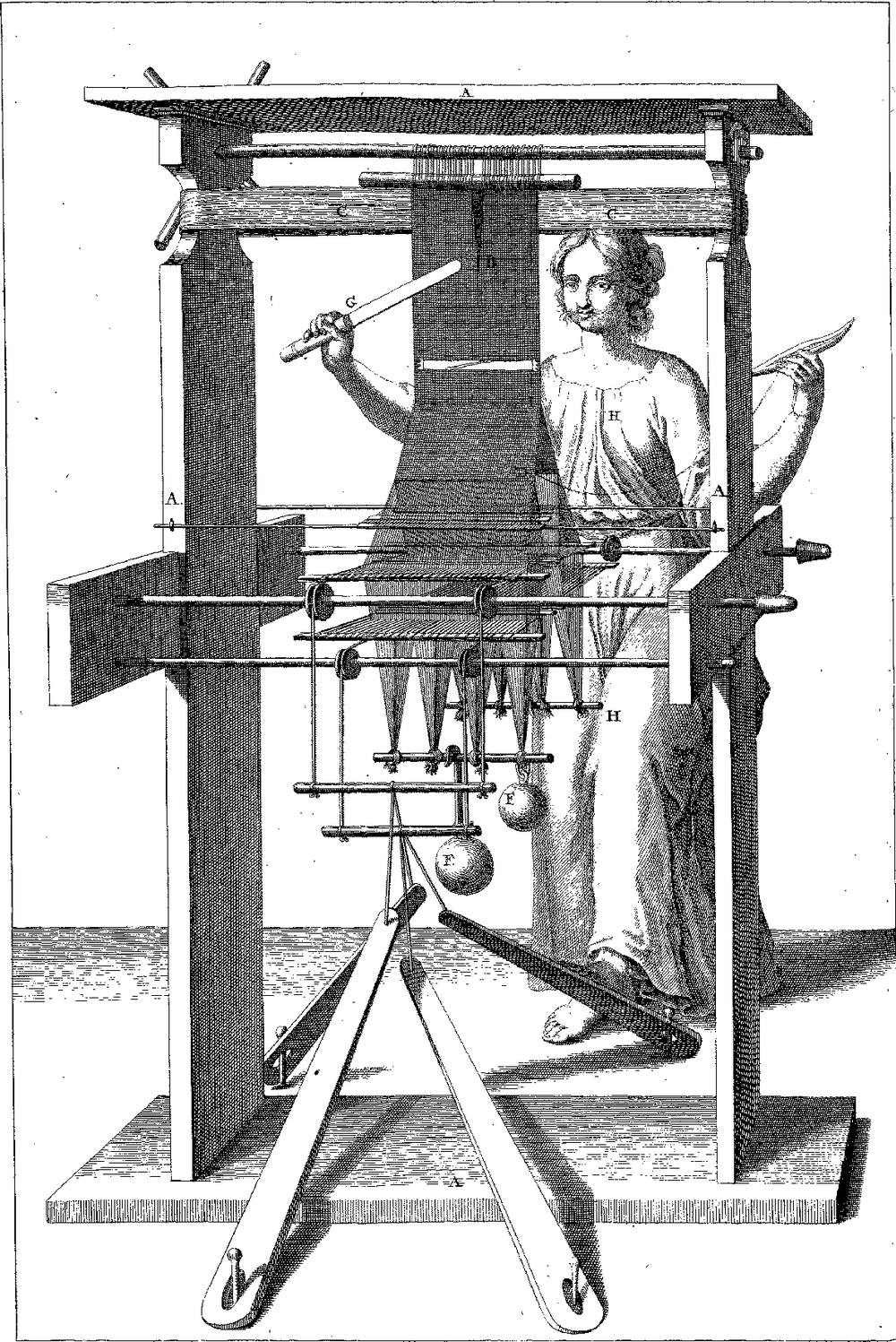
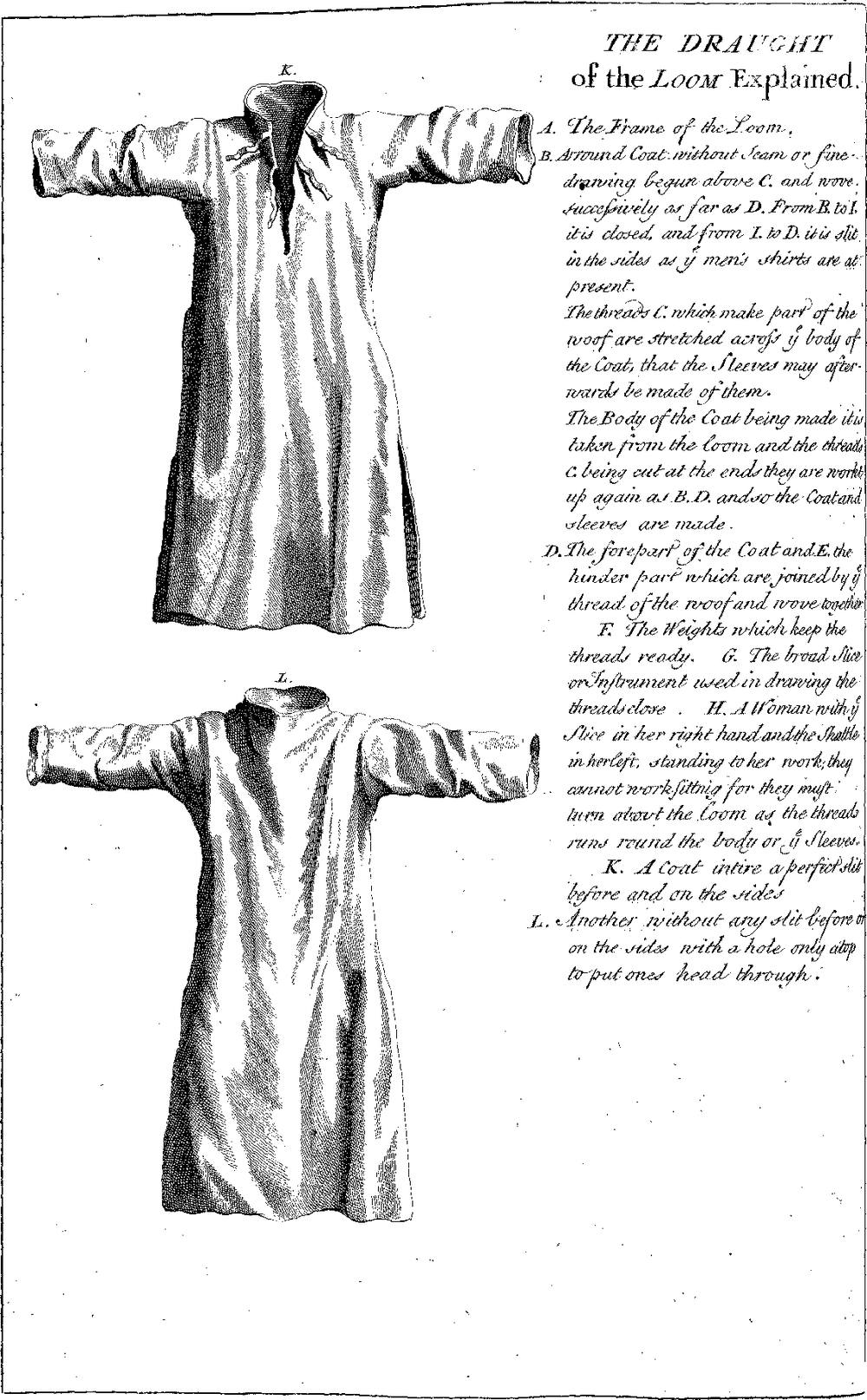
Eccles. ix. 8.VESTMENTS, or Garments. The Hebrews wore no other Cloaths but a Coat, or Wastcoat, called Chetonet,70 and a Cloak, called in Hebrew, Mebil. The Coat was their under Garment, which they wore next their Skin, and the Cloak over this. These two Garments together made what the Scripture calls a Change of Raiment; Mutatorias vestes, or mutatoria vestium, 2 Kings v. 15.which Naaman brought as a Present to the Prophet Elisha. The Coat was commonly of Linnen, and the Cloak of Stuff, or Woolen. As the Cloaks were only a great piece of Stuff, that was not cut; there were often Remnants of it, of which they used to make Presents. The Hebrews never changed the Fashion of their Cloaths, as we know of; but they dressed themselves after the Manner of the Country wherein they dwelt. A white Colour, or a Purple, were in most Esteem among them. Solomon, in his Ecclesiastes advises him that would live agreeably, Let thy Garments be always white. Josephus observes of this Prince, that being the most splendid and magnificent of all Kings, he was commonly Joseph. Antiq. l. 8. c. 2.cloathed in bright and white Garments. The Angels generally appeared in this Colour; and in our Saviour’s Transfiguration, his Cloaths appeared as white as Snow. Moses appoints none but white Coats to the Priests.
Mention is made in the Scripture,71 of a Coat of many Colours, Chetonet passim, with which Joseph was cloathed. Tamar, 2 Sam. xiii. 18.the Daughter of David, wore one also. Interpreters are divided about the Signification of this Word. Some translate it by a long Gown; others, by a Gown striped with several Colours; and others by a Gown with large Sleeves. The Arabians wore very great Sleeves to their Coats. These Sleeves have a very wide Opening at the End, which hangs sometimes down to the Ground, but at the Shoulder they are much narrower. In their Houses this Coat or Gown dragged upon the Ground, but abroad they tucked it up, that they might walk at more liberty; or else they tied it up with a Girdle.
We shall not here speak of the Women’s Veils or Gowns, with which they covered themselves when they appeared in Publick: We have already said something of it, under the Article THERISTRUM. Isaiah, iii. 16. - - - 25, makes a long Enumeration of the Dresses of the Women of his time. We shall not undertake to explain them, because the greatest part of the Terms which the Hebrew uses are unknown to Interpreters. The Reader may have recourse to the Commentators upon this Chapter.
Exod. xxviiii. 32.The Coats were often without Seams, and wove in a Loom, and had no Slit either at the Breast or on the sides; but only at the top, to let the Head through. Such, probably, were the Coats of the Priests, and that of our Lord Jesus Christ, which the John xix. 23.Soldiers would not divide, but chose rather to cast Lots, to determine the Possession of the whole. St. Chrysostom, Theophylact, and Theophanes, are of opinion, that it was made of two pieces of Woollen Stuff, wove in a Loom, and fine drawn together with a Needle and Woolen Yarn, as the Pieces of a wove Stocking are joined together; so that it seems to be but one Piece. Others will have it to be all needle Work from top to bottom. But the Reader may only turn to our Commentary upon St. John, xix. 23. or read Braunius de vestitu Sacerdotum Hæbræorum, l. 1. c. 16. in order to be convinced, that it was all wove in a Loom. They still make ‘em after the same manner in the Eastern Countries.
‘Tis an ancient Tradition,72 that the Holy Virgin herself wove her Son’s Coat. ‘Twas the Women formerly that made the Stuffs and the Cloth, not only for their own Cloaths, but also for their Husbands and Children. This appears from the Example of the virtuous Woman, whose Prov. xxxi. 13.Character Solomon gives us in his Proverbs, and also from that of Queen Penelope, the Wife of Ulysses. Alexander the Great, Augustus, and Charlemaign, wore Cloaths made by the Hands of their Mothers, their Wives, or their Daughters. ‘Tis another popular Tradition, that the Coat of Jesus Christ, for which the Soldiers drew Lots, was the same he had received from the Virgin Mary, while he was yet a Child, which had continually grown with him, without being wore out. But this Tradition is not vouched for by Antiquity. They preserve still the Holy Coat of our Saviour in the Cathedral Church of Treves. That which is to be seen at the Priory of Argeneüil, near Paris, is not a Coat, but a Cloak of a Purple Colour.
Deut. viii. 4.Moses informs us, that the Cloaths which the Hebrews used in the Wilderness did not wear out. Thy raiment waxed not old upon thee, neither did thy foot swell these forty years. Justin Martyr,73 and some Interpreters,74 following the Rabbins, take
these Words in a literal Sense, and think that not only the Cloaths of the Israelites did not grow old, or wear out, but also that those of the Children grew along with them, and were always fit for them, at every Age. St. Jerome75 asserts, that so much as their Hair or Nails did not grow too long: Frustra tonsores & artificia didicerunt, scientes Israelitarum populum per quadraginta annos nec unguium, nec capilitiorum incrementa sensisse. But others76 think, with much more Probability, that Moses intended no more, than that God so provided them with Necessaries, that they did not so much as want Cloaths in all their Journey.
To distinguish the Israelites from other People, the Lord commanded them to wear Tufts or Fringes at the four Corners of their upper Garments, of a blue Colour, and a Border of Galoon upon the Edges.77 ‘Tis Matth. ix. 20.seen by the Gospel, that our Saviour wore these sorts of Fringes at the bottom of his Cloak. For the Woman that had the Issue of Blood for twelve Years, promised herself a Cure, if she could but touch the Hem or Fringe of his Garment. The Pharisees, the more to distinguish themselves, wore these Matth. xxiii. 5.Borders or Fringes longer than others: Magnificent fimbrias. St. Jerome adds,78 that to make a shew of greater Austerity, they fastened Thorns to them, that when they struck against their naked Legs, they might be put in mind of the Law of God.
The Jews at this Day,79 that they may comply with the Law,80 that says, neither shall a garment mingled of linnen and woollen come upon thee, do not so much as sew a woollen Garment with Thread, nor a linnen Garment with Yarn. They take care also not to dress themselves up in the Cloaths of a different Sex, according to the Command of the Law, The Woman shall not Deut. xxii. 5.wear that which appertaineth unto a Man, neither shall a Man put on a Woman’s Garment. As to the Tufts and Fringes which we have mentioned before, and which only belonged to Men to wear, the present Jews, that they may not appear ridiculous to other People, dress themselves outwardly as other Nations do, with whom they live: But under their Cloaths they wear a square piece of Stuff, with four Tufts, or Zirit. These Tufts are made of eight Woollen Threads, wove on purpose, each with five Knots that take up half the Length. That which is not knotted, is unravelled, and makes a kind of Tuft. But at the time of Prayers in their Synagogue, they cover themselves with a Wollen Veil called Taled, which has these Tufts at the four Corners. See TALED.
The Garments of Mourning among the Hebrews were Sackcloth and Hair-cloth; their Colour was dark Brown, or Black. As the Prophets were continual Penitents by Profession, their common Cloathing was Mourning. Widows also dressed themselves much in the same manner. Judith fasted every Day, except on Festival Days, and the Sabbath-day, and wore a Hair-cloth next her Skin. The Prophets Elias, and John the Baptist, were cloathed in Skins, or coarse Stuffs, Judith viii. 6. 2 Kings i. 7, 8. Matth. iii. 4. Heb. xi. 37. Zech. xiii. 4.and wore Girdles of Leather. St. Paul says, that the Prophets wore Melotes, Sheep-skins, or Goat-skins. The false Prophets put on Habits of Mourning and Penitence, the better to deceive the People: Non operientur pallio saccino ut mentiantur, says Zechariah. Leo of Modena tells us,81 that the modern Jews dress themselves in Mourning, after the Manner of the Country they dwell in, without any Commandment for it.
Judg. xvii. 10. 2 Kings v. 22. Prov. xxxi. 21.‘Tis disputed, whether the ancient Hebrews lined their Cloaths. Doubled or lined Garments are pretty often mentioned in Scripture. Micah offers his Levite ten Pieces of Money a Year, & vestem duplicem. Gehazi asks Naaman for a Talent of Silver, and doubled or lined Garments; Vestes mutatorias duplices. The Houshold of the virtuous Woman in the Proverbs, are cloathed with lined Garments: Vestiti sunt duplicibus. But it is imagined from these Expressions, that Changes of Raiment are to be understood, a Pair of Garments, two Coats, and two Cloaks; or, simply, a Coat and a Cloak, a compleat Suit; or, perhaps, a Garment so large, as that it may be doubled about one. But yet it must be owned, that Duplex, in speaking of Cloaths, is sometimes taken for a Garment that is really doubled, or lined. For example, Moses appoints that the Pectoral, or Breast-piece of the High-Priest shall be made square and lined; Quadrangulum & Duplex82.
To see Garments or Frocks entire without Seam, with Sleeves and Quarters of the same Piece, wove together in the Loom, is no rarity in the East. We are told, that in the Maldivee Islands,83 there are Workmen and Weavers so ingenious,
Vestments continues on the next page
Footnotes
-
Cant. iv. 15. Fons hortorum, puteus aquarum viventium, quæ fluunt impetu de Libano. ↩
-
Diodor. Sicul. l. 16. c. 41. Strab. l. 16. p. 519. Plin. l. 5. c. 20. ↩
-
Τρωγλοδύται*, Troglodytæ*, à τρώγλη*, foramen*; δύω*, or* δύμι*, subeo*. ↩
-
Levit. xxiii. 24. Numb. xxix. 1. Joseph. Antiq. l. 2. c. 8. p. 262. Levit. xxiii. 2. Numb. xxix. 1, 2, 3, 4, &c. Theodoret. qu. 32. in Levit. Buxtorf. Synag. Jud. c. 19. Leo of Mod- ena, his Cerem. of the Jews; p. 3. c. 5. ↩
-
Cant. i. 9. לחיין בתורים ↩
-
Ephes. vi. 21, 22. Colos. iv. 7, 8. ↩
-
Vide Est. in Ephes. p. 855. ↩
-
Toph. ↩
-
See the Supplement to Antiquitée Expliquée, T. 3. p. 197, 198. ↩
-
Distenti sunt. Græc. ‘Ετυμπανίσθησαν. ↩
-
Camerar. Castal. Grot. Gataker. &c. ↩
-
2 Macc. vi. 19. ‘Ελεάζαρος ἀνθαιρέτως ὅτι τὸ τύμπανον προσῆγε. Verse 28. Τοιαῦτα ἢ εἰπὼν ἐπὶ τὸ τύμπανον ἐνθέως ἦλθε. ↩
-
Aristophan. Scoliast. in Plutum. Τύμπαν’ ἀξύλα ἐφ’ οἷς ἐτυμπάνιζον. ↩
-
Vide Plutarch de Iside & Osiride. ↩
-
Diodor. Sicul. Bibl. l. 1. p. 18 ↩
-
Marsham. Can. chr. Egypt. secul. viii. ↩
-
Dickinson, Delphi Phænicisantes. c. 1. 2. Fascic. 1. Cremi. ↩
-
Acts xix. 9. In the Year of Christ 54 or 55. ↩
-
Lyr. Erasm. Cajet. Gagn. Knatchbull. &c. ↩
-
Servius in Æneid. l. 4. ↩
-
Esth. vi. 9. פרתמיםParthumim, Παρθίμιος. ↩
-
Joseph. Antiq. l. 18. c. 5. p. 623. ↩
-
Ezek. xxiii. 23. שועShuah. ↩
-
Plutarch. de Iside & Osiride. ↩
-
צורor .צרTheodoret. in Ezek. xxvi. Σορ. Sor. ↩
-
Aul. Gel. l. 14. c. 6. ↩
-
Plaut. in Trucul. ↩
-
Sil. Italic. l. 15. ↩
-
Josh. xix. 29. מבצר צרUrbem munitissimam Tyrum. ↩
-
Isaiah xxiii. 12. ↩
-
Joseph. Antiq. l. 8. c. 2. ↩
-
Herodot. l. 2. c. 44. ↩
-
Vide Usser. ad An. Mund. 3559. ↩
-
Quint. Curt. l. 4. c. 5. Justin. l. 11. c. 1. ↩
-
Plin. l. 5. c. 19. ↩
-
Dius & Menand. apud Joseph. contra Appion. l. 1. p. 1042, 1043, l. 8. p. 267. ↩
-
Joseph. Antiq. l. 8. c. 2. p. 258. ↩
-
Euseb. præpar. l. 10. c. 33, 34. ↩
-
Joseph. Antiq. l. 9. c. ult. ↩
-
Hieron. in Ezech. xxvii. xxviii. & in Amos i. ↩
-
Marsham. Canon. Chron. Sæcul. 18. p. 578. ↩
-
Perison. Orig. Babylon. ↩
-
Isa. xxiii. Jerem xxvii. 3. xlvii. 4. Ezek. xxvi. xxvii. xxviii. ↩
-
Joseph. cont. Appion. l. 1. ↩
-
Diodor. Sicul. Justin. &c. ↩
-
Talmud. Seder. Serain Massec. ↩
-
Vide vit. Melchisedech. T. 3. Oper. S. Athanas. p. 239. & Brochard. descript. Ter. Sanct. ↩
-
Gen. xiv. 3. גיא השדים ↩
-
גיא קנהGe-Kana. ↩
-
Josh. xv. 8. גיא הנוםGe-hennon. ↩
-
גיא חרשיםGe-charashim. ↩
-
Josh. xviii. 21. עמק קציץ ↩
-
Ita Chald. Hebr. Vatab. ↩
-
Gen. xii. 6. אלון מורהElon-Moreh. ↩
-
1 Sam. xvii. 2. עמק אלהThe Vale of Elah, or of the Oak. ↩
-
שואVanitas, Mendacium. הבלVanitas, in- utilitas. ↩
-
Exod. xx. 7. לשוא ↩
-
Ita plerique Interpretes. שואpro falso sumitur, Deut. v. 20. Exod. xx. 16, &c. ↩
-
Tertull. de Idololat. c. 20. Cyrill. Clem. Alex. &c. ↩
-
2 Chron. xiii. 7. 70 .אנשי רקים בני בליעלἄνδρες λοίμοι. ↩
-
Prov. xxi. 6. הבל נדף ↩
-
Prov. xii. 8. נעוה לבPerversus corde. ↩
-
Vide Plin. Theophrast. Dioscorid. Vitruv. ↩
-
Joseph. contr. Appian. l. p. 2. ↩
-
Sueton. in Vespas. c. 4. Tacit. Hist. l. 5. Joseph. de Bell. l. 3. c. 1. ↩
-
Joseph. de Bell. l. 7. c. 16. ↩
-
Joseph de Bell. l. 7. c. 27. ↩
-
Dio. l. 66. p. 748. Vide Origen. ad African. ↩
-
Euseb. Hist. Eccles. l. 3. c. 12. Ex Hegisippo. ↩
-
כתנתChetonet; מעילMebil. ↩
-
Gen. xxxvii. 3. כתנת פסים ↩
-
Vide Euthym. in Joan. xx. ↩
-
Just Martyr. Dialog. cum Tryphon. ↩
-
Vide Grot. Bonfr. Jansen. &c. ↩
-
Hieronym. Ep. 38. p. 325. nov. Edit. ↩
-
Abenezra, Cesm. Monach. l. 5. p. 205. Vidu Est. Jun. Druf. Joan. Cleric. ↩
-
Numb. xv. 38. Deut. xxii. 12. ↩
-
Hieronym. in Matth. xxiii. ↩
-
Leo of Modena, Ceremonies of the Jews, p. 1. c. 5. ↩
-
Levit. xix. 19. Deut. xxii. 11. ↩
-
Leo of Modena, Ceremonies of the Jews, par. 5. c. 9. ↩
-
Exod. xxviii 16. xxxix. 9. ↩
-
Voyage to China, by two Arabians, in the Ninth Century. At Paris, 1718, in octavo, p. 2. ↩