Volume III, pages 121–139 of the 1732 edition, from VI to UR: everything printed on these pages, in order.
Continued from Vestments
that they make entire Shirts and Wastcoats of the Tow of the Cocoa-tree, after the manner before described. And in other Places a we hear of Cloaths wove of Cotton after so particular a manner, that the like is not to be found elsewhere. These are generally round Garments, wove so fine, that they may be drawn through the Eye of a moderate Needle.
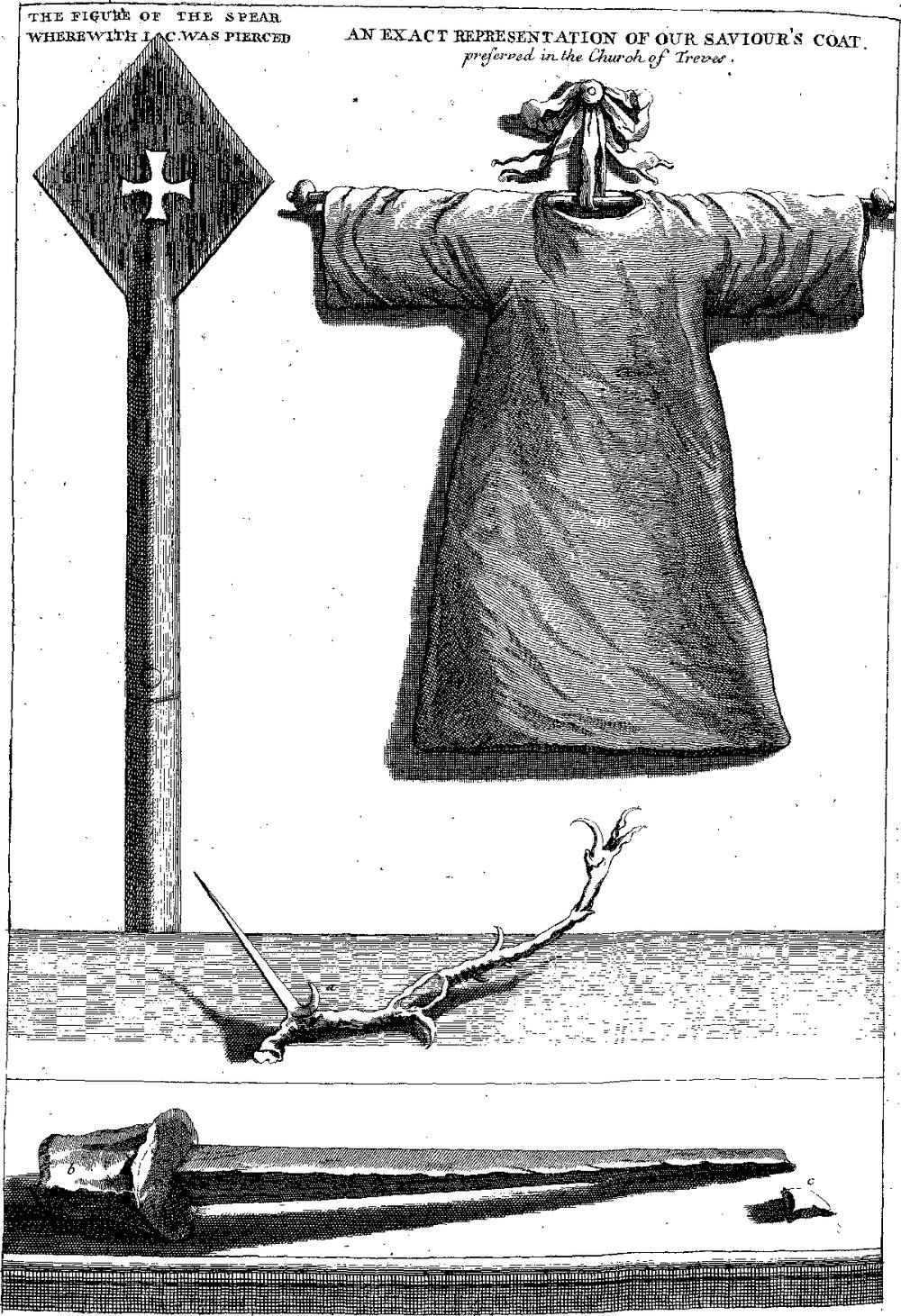
The Sacred Tunick which is preserved at Treves, and which is without Seam, is five Foot all but half a Finger:1 Its Wideness, from the End of one Sleeve to the other, is five Foot four Fingers. Each Sleeve is half a Foot long, and of the breadth of one Foot. And as the Tunick is narrower below the Sleeves, and then goes on widening downwards, its Wideness below the Sleeves is but two Foot three Inches. See its Figure, annexed, taken from the Additions of Mazenius to the Annals of Father Bronverus.
VETCHES, or Fitches, Vicia; a Plant that creeps close to the Ground, and has several Stalks, which entangle one in another, and put out small, narrow, longish Leaves; less than those of a Lentil. Its Flower is small, reddish, and sometimes white. Its Pods are like those of Pease, but that they are shorter and slenderer. The Grain they enclose is round and blackish, and they are used for feeding Pigeons, who are very greedy of them.
Isaiah xxviii. 25. speaks of Fitches. Doth he not cast abroad the Fitches? The Hebrew has Cusmeth,2 which some translate by Spelta, others by Zea, a kind of Wheat. Ezek. iv. 9. uses the same Word, and the Seventy render it by Olyra, a kind of Wheat. We have given Notice, more than once, that we can have no certainty in what relates to the Plants mentioned in Scripture.
VINES, Vineyards, Vintage. There were in Palestine many excellent Vineyards. The Scripture celebrates the Vines of Sorek, of Sebamah, of Jazer, of Abel. Profane Authors mention the excellent Wines of Gaza, Sarepta, Libanus, Saron, Coripp. l. 3.Ascalon, and Tyre,
—— Dulcia Bachi
Gen. xlix. 11.Munera, quæ Sarepta ferax, quæ Gaza creârat.
Jacob, in the Blessing he gave to Judah, says, binding his foal unto the vine, and his asses colt unto the choice vine; he washed his garments in wine, and his cloaths in the
VOL. III. blood of grapes. And this was to shew the Cant. i. 13.abundance of Vines, that should fall to his Lot. The Spouse in the Canticles, compares her beloved to a Cluster of Cypress that grew in the Vineyards of En-gedi. The Cypress is a Shrub that bears Grapes that are very sweet-scented. See the Articles COPHER and CYPRESS, before. Those that came from En-gedi were of great Reputation. These Vineyards of En-gedi were not therefore Vineyards of Grapes to make Wine, but of Plants of Cypress. ‘Twas at the same Place that the Plants of Balsam grew, which may be put into the Rank of Vineyards.
Gen. ix. 20.Noah planted the Vine after the Deluge, and was the first that cultivated it. Many are of opinion, that Wine was not unknown before the Deluge, and that this Patriarch only continued to cultivate the Vine after this great Catastrophe, as he had done before. But the Fathers think3 that he knew not the Force of Wine, having never used it before, nor having ever seen any one use it. He was the first that gathered the Juice of the Grape, and reduced it to a potable Liquor. Before him, Men only eat the Grapes, like other Fruit.
John xv. 1, 2, 3, &c.God often compares his People to a Vine,4 which he had brought out of Egypt, and planted in Palestine, as a good Soil, but which, instead of bringing forth good Fruit, brought forth only bitter Fruit, and wild Grapes. Jesus Christ tells us, that the Housholder having lett this Vine to Tenants, who ought to have rendered him the Fruit of it, instead of that, they abused his Servants, and killed his own Son, who went to require the Payment of what was owing to him. In another Place our Saviour says to his Disciples, I am the true vine, and my Father is the husbandman. Every branch in me that beareth not fruit, he taketh away; and every branch that beareth fruit, he purgeth it, that it may bring forth more fruit.
The Law of Moses did not allow, that whoever planted a Vine should eat of the Deut. xx. 6. Levit.xix. 24, 25. Levit.xxv. 3, 4. Deut. xxiii. 14.Fruit of it before the fifth Year. They also did not gather their Grapes on the seventh Year; the Fruit was then left for the Poor, the Orphan, and the Stranger. A Traveller was allowed to gather and eat Grapes in a Vineyard as he passed along, but he was not permitted to carry away. It was also forbidden to sow any thing else in a Vineyard: Thou shalt not Deut. xxii. 9.sow thy vineyard with olive seeds.
Wild5
Wild VINE, Labrusca. It grew without any Culture, near the Highways and Hedges. Its Fruit was a very small Grape, which became black when it was ripe: But often it did not ripen at all. See WILD GRAPE, and Isai. v. 2, 4.
The Wild Vine mentioned 2 Kings iv. 39. was not the Labrusca, but the wild Gourd, a Plant that produced the Coloquintida, a Fruit of a deadly Bitterness. See COLOQUINTIDA.
The Vine of Sodom, mentioned by Moses, Deut. xxxii. 32.is a Vine of a Plant from Sodom, which brings forth only bitter Grapes, and of which no use can be made: Wine as bad as the Gall of a Dragon; Grapes as bitter as Gall: Fel draconum vinum eorum. Uva eorum uva fellis, & botri amarissimi. It is well known that the Fruits which grow about the Dead Sea are all rotten within; and when they are open are only full of Dust: Cuncta sponte edita aut manu sata sive herbâ tenus aut flore, seu solitam in speciem adolevêre, atra & inania velut in cinerem vanescunt.6
Naboth’s Vineyard is passed into a Proverb, to express an Inheritance usurped by an high Hand from a poor Man, who is unable to defend it. See the Story, 1 Kings xxi. 1, 2, &c.
To express a Time of publick Tranquility, of profound Peace, ‘tis said that every one lives in quiet under his own Vine, and under his own Fig-tree. All the Time of the Reign 1 Kings iv. 25.of Solomon, Judah and Israel dwelt safely, every man under his vine, and under his fig-tree, from Dan even to Beersheba. And the Prophet Micah; They shall sit every man under Mic. iv. 4.his vine, and under his fig-tree, and none shall make them afraid; for the mouth of the Lord of hosts hath spoken it. And under the Government of Simon the High-Priest, Then 1 Macc. xv. 8,-12.did they till their ground in peace, and the earth gave her increase, and the trees of the field their fruit. The ancient men sat all in the streets, communing together of good things, and the young men put on glorious and warlike apparel. He provided victuals for the cities, and set in them all manner of munition, so that his honourable name was renowned unto the end of the world. He made peace in the land, and Israel rejoiced with great joy. For every man sat under his vine, and his fig-tree, and there were none to fray them.
VINTAGE. We have reserved this Place, to speak of the Vintages of the Hebrews. This Season was accompanied with Feasts and great Rejoicings. Isaiah says, In Isai. xxv. 6.this mountain shall the Lord of Hosts make unto all people, a feast of fat things, a feast of wines on the lees, of fat things full of marrow, of wines on the lees, well refined. The Hebrew says, literally, a Feast of Fatness, a Feast of Lees, of marrowy Fatnesses, of clarified Lees. And elsewhere; Gladness is taken away, and joy out Isaiah of the plentiful field; and in the vineyards xvi. 10. there shall be no singing, neither shall there be shouting; the treaders shall tread out no wine in their presses: I have made their vintageshouting to cease. The Hebrew says, out of Carmel. Now Carmel signifies an excellent Vineyard. And Jeremiah says, Joy and Jerem. gladness is taken from the plentiful field xlviii. (from the Carmel) and from the land of 33. Moab, (which was fruitful in Vines) and I Psal.
lxxx. have caused wine to fail from the wine press- 13. es, none shall tread with shouting, their shouting shall be no shouting. The Hebrew says, literally, they shall no longer tread the Grape, and he that crys Hedad, shall no more cry Hedad, Hedad. This last Term is the Cry of the Vintagers, from whence is formed, Heth, and de Heth, a way of speaking which is as much as to say, with Vigor, with Courage, chearfully.
In a figurative Sense, Vintager is often taken for one that ravages a Country, or carries on a bloody War in it. The Prophets frequently make use of this Metaphor, to express the Vengeance which the Lord takes of his Enemies. Thou hast planted thy People as a Vine, and now all that pass by partake of the Vintage: Et vindemiant eam omnes qui prætergrediuntur viam. And Jeremiah, in his Lamentations, makes Jerusalem speak Lam. i. 12. Isai. lxiii. 2.in this manner; Vindemiavit me sicut locutus est Dominus, in die furoris sui. To which is added, Deal with them, O Lord, as thou hast dealt with me; tread them in a Wine-press as thou hast trod me, because of my Iniquities. And Isaiah, speaking of a Conqueror returning from a great Expedition, having his Cloaths all besmeared with Blood, describes him thus: Who is this that cometh from Edom, with dyed garments from Bozrah? This that is glorious in his apparel, travelling in the greatness of his Strength? I that speak in righteousness, mighty to save. Wherefore art thou red in thine apparel, and thy garments like him that treadeth in the wine-fat? I have trodden the wine-press alone, and of the people there was none with me. For I will tread them in mine anger, and trample them in my fury; and their blood shall be sprinkled upon my garments, and I will stain all my raiments. See also the Lamentations of Jeremiah, l. 15. Revelations, xiv. 20. xix. 15, &c. See WINE.
VINEGAR, Acetum. Vinegar is made of Wine, Beer, Cyder, and even of Water. The Wine of the Palm-tree turns into Vinegar, if it be kept but two
or three Days. The Ancients had several kinds of Vinegar, which they made use of for Drink. The Emperor Pescennius Niger gave Ordersa that his Soldiers should drink nothing but Vinegar on their Marches: Neminem in expeditione vinum bibere, sed aceto universos esse contentos. Ruth ii. 14.Booz told Ruth, That she might come and dip her Bread in Vinegar, along with his People: Intinge buccellam tuam in aceto: At meal-time come thou hither, and eat of the bread, and dip thy morsel in the vinegar. Harvesters made use of this Liquor for their Refreshment. Aceto summa vis in refrigerendo,Plin. l. 23. c. 1. says Pliny. There is great Probability that the Vinegar which the Roman Soldiers offered to our Saviour at his Crucifixion, Matth. xxvii. 48.was the Vinegar they made use of for their own drinking. Constantine the Great allowed them Wine and Vinegar alternately, every Day.
This Vinegar was not of that sort that we make use for Salads and Sauces, but a small Wine called Pesca, or Sera, of which the Authors De re Rustica,7 have given us the Composition. They make great use of it in Spain and Italy, in Harvest-time. They use it also in Holland, and on Ship-board, to correct the ill Taste of Water. The Scripture forbids the Nazarites to use Vinegar,8 and all sorts of Liquor that come from the Vine, and which are capable of inebriating. The Hebrew has it, Vinegar made of Wine, and Vinegar made of Secar, or the Wine of the Palm-tree. Pliny speaks of several sorts of Vinegar which might be drank.
It must be allowed however that there was a kind of strong Vinegar, which was not proper for drinking, or which was not used till it was well diluted. The Psalmist complains, that his Enemies had given him Vinegar to drink; Et in siti mea Psalm lxviii. 26.potaverunt me aceto. And Jesus Christ, to fulfil this Prophecy in his own Person, would not drink the Vinegar that was offered to him. And Solomon, in his Proverbs; As vinegar to the teeth; and as Prov. x. 26.smoke to the eyes, so is the sluggard to them that send him. Vinegar then was looked upon as a Liquor that was very agreeable to drink; but, as said before, we must distinguish between that Vinegar, or small Wine, which was used as a Drink, and in which the Harvesters dipt their Bread, and that Vinegar that was made use of in Sauces. The same Solomon says, in another Place, Prov. xxv. 20. As vinegar upon nitre, so is he that singeth songs to an heavy Heart. Nitre dissolved in Vinegar increases its detersive Virtue, and makes it fitter to take away Spots from the Skin, or Grease or Dirt from Linnen. To sing Songs before a Man of a corrupt Heart, is to increase his Corruption; ‘tis to inflame the Fire of his Passions; and Tunes that are moving and passionate, are so far from curing him, that they make him worse.
VIPER, a sort of Serpent, called Vipera quasi vivipara, because it brings forth its young alive. Generally the Viper is not very long, the largest being not above half an Ell long, and its Thickness not above an Inch. It has a flat Head, with a Snout rising up, like that of a Pig. The Male has only two Teeth, but the Female has several; and the Male is commonly blacker than the Female. ‘Tis said, that when the Viper brings forth, the young ones kill their Dam; but this is contradicted by Experience. She brings forth her Young alive, but they are inclosed in little Skins, that break open on the third Day. The Poison of the Viper is very dangerous, but its Flesh is good in many Distempers.
The Viper is mentioned in several Places of Scripture. Job says,9 The Viper’s Tongue shall slay him. The Hebrew Word Peten, they say, rather signifies the Asp, than the Viper. Isaiah10 speaks also of the Viper, where the Hebrew has Ephee; which is thought to be the true Name of the Viper. See Bochart. de Animal. Sacr. p. 2. l. 3. c. 1. p. 358, &c. St. Jerome, in Isaiah lix. 5. translates Ephee by Regulus, or the Basilisk: The Septuagint do the same.
VIRGIN, Virgo; in Greek, Pathenos; in Hebrew, Almah.11 These Words properly signify an unmarried Woman, that has preserved the Purity of her Body; but sometimes, by Abuse, they are made use of to express a young Woman, whether she has kept her Virginity, or no; and the more precisely to express the State of Virginity, the Scripture often adds to the Words Maid or Virgin, these, or such like Words,12 neither had any man known her. Sometimes Virgin signifies only a young Woman: Lament like a virgin girded with sackcloth for the husband of her youth: And in the Proverbs,13 Solomon acknowledges the Tokens of Virginity to be very fallacious: Quartum penitus ignoro. ---viam viri in adolescentia. The Hebrew says, in adolescentula. Joel i. 8.
The Hebrew Word Almah signifies a Person concealed; for young unmarried Women lived in retired Apartments, where the Men did not use to go. And when14
young Women were obliged to go out, they were always veiled, and never appeared uncovered, but before their nearest Relations. When Amnon the Son of David had conceived a violent Passion for his Sister Tamar, he could not so much as see her, because she was a Virgin, and kept up very close: For she was a virgin, and 2 Sam. xiii. 2.Amnon thought it hard for him to do any thing to her. When Heliodorus came to Jerusalem, to take away the Treasures of the Temple, the most recluse Virgins came out of their Retirements; some appeared in 2 Macc. iii. 19.the Streets, some at their Windows, and others upon their Walls.
VIRGIN is often used in Scripture, for a People, a City, a Nation. The Virgin the Daughter of Babylon, the Virgin the Daughter of Sion, the Virgin the Daughter of Israel, the Virgin the Daughter of Egypt, the Virgin the Daughter of Sidon, &c. All these Phrases signify the Province, the Land, the People, of Babylon, Sion, Israel, Egypt, Sidon, &c.
The Virgin, by way of Eminence or Excellence, is said of the Holy Virgin Mary, the Mother of Jesus Christ, a Virgin as well after as before her bringing forth: A Virgin marked out by those Words of Isaiah, Isai. vii. 14. Matth. i. 23.A virgin shall conceive and bear a son, and shall call his Name Immanuel.
The State of Virginity was not thought an honourable State, in the Times of the Old Testament. When the Daughter of Jephthah found she was going to be sacrificed by her Father, before she could be Judg. x. 37, 38.married, she goes to bewail her Virginity upon the Mountains. Sterility was a Reproach in Israel: Isaiah, intending to shew Isai. iv. 1. Isai. liv. 4.the Scarcity of Men that should happen in Israel, says that this Scarcity should be such, that seven Women should offer themselves in marriage to one Man, and say to him, We shall be no Charge to you; we will maintain ourselves in Food and Cloaths; only take us for Wives, and deliver us from the Reproach of Barrenness that we are now under: Aufer opprobrium nostrum. The same Prophet comforts Jerusalem, saying, Thou shalt forget the shame of thy youth, and shall not remember the reproach of thy widowhood any more.
But under the New Testament, Jesus Christ recommends the State of Virginity, Matth. xix. 12.saying, There be eunuchs which have made themselves eunuchs for the kingdom of heaven sake. He that is able to receive it, let him receive it. St. Paul hath set 2 Cor. vii. 25, &c.this Advice of our Lord in a clear Light: Now concerning Virgins, I have no commandment of the Lord; yet I give my judgment, as one that hath obtained mercy of the Lord to be faithful. I suppose therefore, that this is good for the present distress; I say, that it is good for a man so to be. Art thou bound unto a wife? seek not to be loosed. Art thou loosed from a wife? seek not a wife. But and if thou marry, thou hast not sinned; and if a virgin marry, she hath not sinned: Nevertheless, such shall have trouble in the flesh; but I spare you. But this I say, Brethren, the time is short: It remaineth that both they that have wives be as though they had none; and they that weep as though they wept not; and they that rejoice as though they rejoiced not; and they that buy as though they possessed not: And they that use this World as not abusing it; for the fashion of this world passeth away. But I would have you without carefulness. He that is unmarried, careth for the things that belong to the Lord, how he may please the Lord. But he that is married careth for the things that are of the world, how he may please his wife. There is difference also between a wife and a virgin: The unmarried woman careth for the things of the Lord, that she may be holy both in body and in spirit. But she that is married careth for the things of the world, how she may please her husband, &c.
VISION. This is said of the several ways by which God manifested himself to the Patriarchs, the Prophets, and the other Saints. He sent them prophetick Angels, he appeared to them by Night in Dreams, he illuminated their Minds, he made his Voice to be heard by them, he sent them Ecstasies, and transported them beyond themselves, and made them hear things that Eye had not seen, nor Ear heard, nor had it entered into the Heart of Man to conceive. The Lord shews himself to Moses, and speaks to him when he was at the Mouth of the Cave. Jesus Christ manifests himself to his Apostles, in his Transfiguration upon Tabor, and on several other Occasions, after his Resurrection. God appeared to Abraham under the Form of three Travellers; he shewed himself to Esaias and to Ezekiel, in the Splendor of his Glory. And all this, in Scripture-style, goes by the Name of Vision.
The Lord appeared to Abraham in a Gen. xv. 1, 2, 5. Gen. xlvi. 2.Vision, and said to him, Fear not, Abram, I am thy shield, and thy exceeding great reward. This happened in the Night, for he brought him forth abroad, and said, Look now towards heaven, and tell the stars, if thou be able to number them. And he said unto him, So shall thy seed be. The Lord also appeared to Jacob by Night, and spoke to him; Audivit eum per visionem noctis vocantem se, &c. He told him, he need not scruple to go down into Egypt. When Moses perceived the Bush burnburn
without being consumed, he said, I Exod. iii. 3. Numb. xii. 6, 7, 8.will now turn aside, and see this great sight, [or Vision] why the bush is not burnt. When Aaron and Miriam murmured against Moses, the Lord said, Hear now my words: If there be a prophet among you, I, the Lord, will make myself known unto him in a vision, and will speak unto him in a dream. My servant Moses is not so, who is faithful in all mine house: With him will I speak, mouth to mouth, even apparently, and not in dark speeches; and the similitude of the Lord shall he behold. The false Prophet Balaam, whose Heart was so perverse, saith of himself, that he sees the Numb. xxiv. 14, 16.Visions of the Almighty: Qui visionem altissimi intuitus est. And indeed, God caused his Angel to appear to him, to stop him in his way, and to put in his Mouth several excellent Prophecies concerning the Coming of our Saviour. In the time of the 1 Sam. iii. 1. Luke i. 48. 1 Sam. ii. 21.High-Priest Eli, The Word of the Lord was precious in those days, there was no open vision: There was no acknowledged Prophet. And this may suffice to give a just Notion of what in Scripture is understood by Vision.
Visions are used for the Prophecies written by the Prophets. The Visions of Obadiah. Liber visionis Nahum, Visio Isaiæ filii Amos. Scriptum est in visione Addo videntis, &c.
Vision is also put for the Instructions or Maxims of Wisdom, contained in the thirtieth and thirty-first Book of the Proverbs. The first is ascribed to Agur, and the second to Lemuel. Verba congregantis (Heb. Agur.) filii vomentis, visio Prov. xxx. 1. xxxi. 1.quam locutus est vir cum quo est Deus. And Chap. xxxi. 1. Verba Lamuelis Regis, visio quâ erudivit eum mater sua.
Visio often signifies the bare Appearance of an Object, or what is seen by the Eyes. The Messiah will not judge according to Isai. xi. 3.Appearances: Non secundam visionem, oculorum judicabit. Ezekiel, describing the Throne of God, says, that the Wheels upon which it moved, resembled the Sea: Ezek. i. 16.Opus earum quasi visio maris. And elsewhere he says, that the Majesty of God appeared to him from the Back to the Feet, Ezek. viii. 2. Rev. iv. 3.as a Metal all in Fusion: Quasi visio electri. St. John, in his Revelations, says, that he saw about the Lord as it were a Rainbow, of the Colour of an Emerald: Similis visioni smaragdinæ.
Vision sometimes stands for the vain Prophecies of visionary People. The false Prophets had only deceitful Visions: Visionem Jerem. xxiii. 16. Mic. iii. 7.mendacem loquentur. Those that see Visions, or the Visionary, shall be confounded.
In some Passages Visions stand for the Spectres and Phantoms, that sometimes appear and frighten the Wicked. Moses Gen. xxi. 1. Deut. iv. 34.seems to hint at the dreadful Visions of this Nature which the Egyptians had, while their Country was involved in Darkness: Horribiles visiones juxta omnia quæ fecit Dominus in Ægypto. The Author Job iv. 13, &c.of the Book of Wisdom speaks plainly of them, Wisd. xvii. 9, 10. xviii. 19. Visiones enim quæ illos turbaverunt, hæc præmonebant, ne inscii quare mala patiebantur perirent. Eliphaz, in Job, describes the Fear with which he was seized, when the Spirit spoke to him in the Night. “In Thoughts “from the Visions of the Night, when “deep Sleep falleth upon Men; Fear “came upon me, and Trembling, which “made all my Bones to shake. Then a “Spirit passed before my Face, the Hair “of my Flesh stood up. It stood still, “but I could not discern the Form thereof; an Image was before mine Eyes, “there was Silence, and I heard a Voice.” See also JOB vii. 14.
VISIT. The Term, to visit, is taken either in a good or an evil Sense. God visited Sarah in his Mercy, and gave her a Son. He visited the Israelites in Egypt, and Exod. iii. 16.sent them Moses to deliver them. He visited Hannah the Mother of Samuel. Lastly, he visited and redeemed his People by the Coming of the Messiah.
Ezek. xxxiv. 11, 12. Exod. xx. 5. Exod. xxxii. 34. Levit. xviii. 25.He visits us also in his Wrath, and in his Vengeance. He visits the Iniquity of the Fathers upon the Children, to the third and fourth Generation. He threatens to visit the Iniquity of the Worshippers of the Golden Calf, in the Day of his Vengeance. He says, he will visit the Land of Canaan, whose Crimes are come up to the full Pitch. Lastly, nothing is more frequent in the Language of the Prophets, than the Verb to visit, taken in the Sense of punishing, chastising, and revenging.
To visit, is also used instead of taking a Review of; for example, of an Army, or of a Flock: Ego requiram oves meas, & visitabo eas, sicut visitat pastor gregem suum. And Zechariah; Mine anger was kindled Zech. x. 3.against the shepherds, and I punished the goats; for the Lord of Hosts hath visited Ecclus. xlix. 18.his flock, the house of Judah. The Author of Ecclesiasticus has made use of the Term to visit, in a very extraordinary Sense, when he said, that the Bones of the Patriarch Joseph have been visited, and have prophesied after his Death: Ossa ipsius visitata sunt, & post mortem prophetaverunt. But in the Greek we do not read Et post mortem prophetaverunt. Joseph had foretold Gen. l. 42.to his Brethren, that the Lord would visit them after his Death; and he conjured them, that they should not leave his Body behind them in Egypt, but carry it with them into the Land of Canaan.
This was performed by Moses: His Bones were visited; they were taken out of his Tomb; and they may be said in some sense to have prophesied, by verifying the Prophecy of Joseph. Visitans speciem tuam non peccabis, says Job, v. 14. Some have understood this of the lawful use of Marriage: But the Hebrew imports, you shall visit, you shall take a Review of, you shall govern your Dwelling, and you shall not sin. Eliphaz speaks of the Conduct of a wise and prudent Man.
To visit is also taken for paying Visits of Civility, Friendship, or Duty; as when Jesse sent his Son David to visit his Brethren in the Army to know how they 1 Sam. xvii. 18. 2 Sam. xiii. 6. 2 Kings ix. 16.did. And when David went to visit his Son Ammon, who was sick; and when Abaziah, King of Judah, went to pay a Visit to Jehoram King of Israel. Or when St. Paul and Barnabas went to visit the Acts xv. 36.Churches they had planted.
A Visit, Visitatio, as well as the Verb to visit, is sometimes taken for a Visit of Mercy from God, but oftner for a Visit of Rigor and Vengeance: Dies visitationis, annus visitationis, tempus visitationis, or simply, visitatio, generally signifies, the Time of Affliction, and the Vengeance of God.
VITELLIUS. Lucius Vitellius, the Censor, Father of the Emperor A. Vitellius, was made Governor of Syria, at the Expiration of his Consulate, in the 35th Year of the Vulgar Æra; and the Emperor Tiberius intrusted him with the Management of the Affairs of the East, which were then very much embarrassed. The same Year, or the Year following at farthest, he came to Jerusalem at the Feast Joseph. Antiq. l. 8. c. 6.of the Passover, and was very magnificently entertained there. As an Acknowledgment of this Affection of the Jews for him, he released the City from paying a Tax for the Fruits sold there, which, till then, had used to be paid. He also committed to the Care of the Jews the High-Priest’s Habit, and all the Pontifical Ornaments, which Herod and the Romans had kept till then in the Tower Antonia. He deposed Joseph Caiphas from the High-Priesthood, and put into his Place Jonathan Son of Ananus; after which he returned to Antioch.
When the Emperor Tiberius had given him Orders to make War upon the Arabians; he marched as far as Ptolemais,15 with an Intention to pass through Judea with his Troops, on his way to Petra. But the chief of the Jews came to wait on him, and intreated him to take another Rout; because their Law did not allow them to suffer strange Gods in their Country, and Images, such as were upon the Roman Ensigns. He comply’d with them in this, sent his Army another way, and came himself to Jerusalem, accompanied only with a few Friends, and Herod the Tetrarch. He there offered Sacrifices, and took away the Priesthood from Jonathan, whom he had made High-Priest but two Years before, and gave it to Theophilus, the Brother of Jonathan. He was again at Jerusalem, when he heard of the Death of the Emperor Tiberius; he then gave the Oath of Fidelity to the Jews, in the Name of the new Emperor Caligula, for whom he offered solemn Sacrifices to the Philo Legat. p. 1041. Joseph. Antiq. l. 18. c. 7.Lord.
In the foregoing Year, or 36th of Jesus Christ, he had sent Pilate the Governor of Judea, to Rome, in order to justify himself to the Emperor, for the Violence he had offered against some Samaritans, who had assembled together at Tyrataba, without any Design to revolt. This is the Sum of what we know concerning this L. Vitellius, Governor of Syria, who got as much Esteem in this Province, for his good Government of it, as he deserved Contempt at Rome, for his servile Flattery to Caius and Tacit. Annal. l. 6. c. 32. Plin. l. 36. c. 26.Claudius.
VITRUM, Glass, which see. This is now very common, and every one knows what it is; but its Original is not so well known, or who was its first Inventor. Pliny tells us, that some Merchants arriving by Sea on the Shore of Ptolemais, and intending to light a Fire, that they might prepare their Victuals, they took into their Ship some Clods of Nitre, because they could find no Stones that were proper for their Purpose. When they had made a good Fire, they perceived, to their Surprize, that the Sand melted, and ran into a transparent Liquor, which became Glass. This Discovery was soon carried to perfection, and the Phœnicians, who were ever laborious and industrious, introduced the use of Glass where-ever they had any Commerce; that is, over all the Coasts, and in all the Islands of the Mediterranean Sea. We are not told when this happened, nor have we this History transmitted to us as a Certainty; but it appears to be out of doubt that it was in Palestine, and about Ptolemais and Sidon, that the Way of making Glass was found out.
Moses seems to have pointed out to Deut. xxxiii. 19.this Invention, and to the great Trade that was afterwards carried on with it, in the Places we have mentioned, when, giving his last Benediction to Zebulun, whose Settlement was in that Country, he uses this Expression, They shall suck of the abundance of the seas, and of treasures hid in
Plin. 36. c. 26.the sand. Now those Riches of the Sea, and these Treasures hid in the Sand, are nothing else, according to the Paraphrast Jonathan, and Rabbi Solomon, and some other Interpreters, but the Purple that was dyed at Tyre, and the Sand, of which Glass was made in the same Country. Joseph. de Bell. l. 2. c. 17.Josephus speaks of the Tomb of Memnon near Ptolemais, and of the River Belus, the Sand of which was very proper for making Glass. There is a kind of Valley, says he, of about an hundred Cubits, where great quantities of Sand are gathered fit for the making of Glass. And tho’ they carry away whole Vessels full at a time; yet it is not exhausted, but is still filled with new Sand. Pliny speaks of the same River Belus, which empties itself into the Sea near Ptolemais. The Sand which lies at its Mouth for the Space of five hundred Paces, has furnished Matter for making Glass for many Ages: Quingentorum est passuum non amplius littoris spatium, idque tantum multa per sæcula gignendo fuit vitro. Strabo assures us however, Strab. l. 16.that all the Sand upon the Sea-shore, from Ptolemais as far as Tyre, is proper for this Work. However this be, the Hebrew Word Chol, or Hol, or Hull,16 which signifies Sand, is evidently the Root of the Greek Word Hyalas,17 which signifies Glass.
Job also speaks of Glass by the Name Sechochit:c Non adæquabitur ei aurum vel vitrum. Neither Gold or Glass (or Crystal) are of equal Value with Wisdom. The Word Sechochit comes from a Root that signifies to shine, to be pure, clean, transparent; which agrees perfectly well with Glass or Crystal. These Substances heretofore were much more valuable and sought after than they are at present. These two Passages out of Moses and Job shew the Antiquity of Glass.
We find often in Scripture the Word Crystallus; but it commonly signifies no more than Ice. For example,18 Mittit crystallum suum sicut buccellas: God sends forth Ice or Hail, as Morsels, as pieces of Bread. The Hebrew says, he sends Ice as by Mouthfuls. Hail is Ice, or Water frozen, and, as it were, cut into Bits. Ecclesiasticus also speaks of Crystal, or rather of Ice. Gelavit Crystallus ab aqua. And Ezekiel; quasi aspectus crystalli: Over the Ezek. i. 22.four Beasts there was a kind of Heaven of Crystal, or of Glass, according to the Hebrew. And St. John, in his Revelations, describes a Sea of Glass like Crystal, or Ice: Mare vitreum simile crystallo. As in the Greek Tongue Crystallus is used indifferently both for Ice and Crystal, it cannot be determined in which Sense this Place ought to be understood.
VIVIFICO, to make alive, to raise to life, is taken in a literal Sense: For example, Dominus mortificat & vivificat, deducit ad inferos & reducit. And Hosea, Hos. vi. 3.Ipse percutiet & curabit nos; vivificabit nos post duos dies, in die tertia suscitabit nos. He will restore us to Life, after two Days; he will raise us up on the third Day. Elisha had restored the Widow’s Son to Life: Cujus vivificaverat filium.
To vivify is also put for preserving 1 Sam. ii. 6. 1 Sam. xxvii. 11.Life. David spared neither Man nor Woman of those he took in the Enemy’s Country: He gave Life to none: Virum & mulierem non vivificabat David.
Pharaoh commanded the Israelites to expose their Children, and not to bring Acts vii. 19. 2 Kings viii. 5.them up, nor to preserve their Lives: Ut exponerent infantes suos ne vivificarentur: When the Wicked shall be converted, and do that which is right, he shall save Ezek. xvii. 27. Psal. xl. 3.his Soul alive. Ipse animam suam vivificabit: Let the Lord preserve him, and vivify him; may he grant him Health and long Life.
In a figurative Sense, to vivify, is used for delivering from a great Danger, to bring out of Captivity, to heal of a great Sickness, to defend in a great Peril. The Captives of Babylon often asked of God in the Psalms19 to restore them to Life, to deliver them from a State of Death, of Oppression, of Trouble, under which they groaned. Vivify me by thy Mercy, restore me to Life, according to thy Word, &c.
To restore to Life, is used often in the Hebrew to express the repairing of a City, of a House, of a Wall: For example,20 Will they revive the stones out of the heaps of the rubbish which are burnt? Will they rebuild the Walls of Jerusalem? David built the Walls of Jerusalem from Millo all round:21 And Joab repaired (or revived) the rest of the City. He rebuilt all the rest of the Walls. Habbakkuk desires the Lord to cause his old Wonders to be shewn Habak. iii. 2. 1 Cor. xv. 36.forth anew. In medio annorum vivifica illud. And St. Paul says, Thou fool, that which thou sowest is not quickned except it die.
In the Writings of the Apostles, to vivify, to quicken or to revive, is often used for giving Life to the Soul, in a spiritual Sense; which Life consists in Faith, Charity,
rity, Justice, Grace, Innocence. He that would save his Life at the expence of Truth, will lose his Soul; and he that shall lose his Life to preserve his Faith, and to maintain the Truth, shall save his Soul: Vivificabit eam. The Letter kills, but the Spirit makes alive. The Law cannot 2 Cor. iii. 6. Galat. iii. 21.make alive: It cannot communicate Righteousness, without Faith, animated by Charity.
ULAI. This is the River Euleus, that runs by the City Shushan in Persia. Daniel had a famous Vision upon the Dan. viii. 2, 16.River Ulai, and at the Gate of this River; that is, towards the Gate of the City that looked towards the Ulai. He had this Vision in the third Year of Belteshazzer, King of Persia, which is of the World 3447, before Christ 553, before the Vulgar Æra 557.
1. ULAM, Son of Machir, and of Maachah, and Father of Bedan, of the Tribe of Benjamin, 1 Chron. vii. 16.
2. ULAM, Son of Eshek, of the same Tribe, 1 Chron. viii. 39.
3. ULAM, the Name of a Place. Eusebius says,22 that there is a Village called Ulamma, twelve Miles from Diocæsarea, towards the East.
ULAMAIS. The Septuagint say, that the ancient Name of the City of Dan was Ulamais; but in the Hebrew ‘tis Ulamlaish,23 which is to be translated heretofore Laish. And the true old Name of Dan was certainly Laish, as appears by Judges xviii. 7. 14.
ULAM-US, or Ulam-Luz: The Septuagint have taken it as if it were the old Name of Bethel; but the Hebrew says, Ulam-Luz,24 that is, heretofore Luz. The City that was afterwards called Bethel, was formerly named Luz.25
ULATHA, a City between Galilee and Trachonitis, Joseph. Antiq. l. 15. c. 13.
ULLA, or Olla, of the Tribe of Asher. He had three Sons, whose Names were Arab, Haniel, and Rezia, 1 Chron. vii. 39.
UMMAH, or Amma, a City of the Tribe of Asher. Josh. xix. 30.
UNCTION. Unctions were very frequent among the Hebrews. They anointed and perfumed, both out of a Principle of Health and Neatness. They anointed their Psal. cxxxiii. 2.Hair, Head, and Beard. At their Feasts, and other times of Rejoicing, they anointed their whole Body, and sometimes only their Head or Feet.26 The anointing of dead Bodies was also in use, to preserve them from Corruption and Stinking.27 They anointed their Kings and High-Priests, at the Ceremony of their Inauguration.28 They also anointed the sacred Vessels of the Tabernacle and Temple, Exod. xxx. 26, &c.to sanctify them, and consecrate them to the Service of the Lord.
The Word Unction in general signifies a particular Sanctification, a Designation to the Service of God, to an holy and sacred Use. For example, as Jacob went to Mesopotamia, he anointed with Oil the Stone upon which he had rested, and Gen. xxviii. 18.whereon God had caused him to see a Vision. This Unction was a kind of Dedication of this Stone, to become an Altar consecrated to the Lord. Some Years afterwards he came to the same Place, and consecrated this Stone a-new by an holy Gen. xxxvi. 14. Exod. xxx. 23, &c.Unction. God himself reveals to Moses the Manner of making the Oil, or the perfumed Ointment, which the Priests and the Vessels of the Tabernacle were to be anointed with. The most exquisite Perfumes and Balsams were Ingredients in it. He adds, This shall be an holy anointing oil unto me, throughout your generations; upon man’s flesh shall it not be poured; neither shall ye make any other like it, after the composition of it; it is holy, and it shall be holy unto you. Whosoever compoundeth any like it, or whosoever putteth any of it upon a stranger, shall even be cut off from his people. Ezekiel upbraids his People with having made a like Perfume for their own Use.29
The Unction that was given to Persons consecrated to God, and to the sacred Ornaments and Utensils of the Temple or Tabernacle, to the Altars, and Basins, removed them from ordinary and common Use; and raised them to a new Dignity, rendered them holy, sacred, and inviolable. The Unction that Aaron then received with his Sons, devolved upon his whole Race, which by that became totally devoted to the Service of the Lord, Levit. viii. 1, 2, 3, &c.and consecrated to his Worship. These were the Ceremonies that were used in the Consecration of Aaron and his Sons: Moses brought them to the Door of the Tabernacle, before all the People, where he washed them, and presented them to the Lord, as it were to make them acceptable to him. Then he adorned Aaron with all his Pontifical Ornaments, and See Exod. xxix. 7. Psalm cxxxiii. 2.anointed him with the sacred Oil, by pouring it upon his Head. He poured it upon his Hairs, and it ran down upon his Beard and upon his Garment. His Cloaths also were anointed. The Rabbins think
Tost. Janf. Menoch.the Oil was poured upon his Head in the Form of an X, or of St. Andrew’s Cross, or, according to others in the Form of a Caph, or .כ Many are of opinion, that as to the ordinary Priests, the Sons of Aaron, their Hands only were anointed. The Levites did not receive any Unction at all.
These Ceremonies were continued for seven Days successively. The Rabbins inform us,30 that as long as the Ointment or Perfume lasted, that was composed by Moses, they thus anointed all the High-Priests that succeeded, for seven Days. But when this Perfume was all used, they contented themselves with installing the High-Priest for seven Days together, adorned in his sacred Habit. The High-Priests anointed after the foregoing Manner were called High-Priests anointed; and they that were only installed by the Ceremony of the Levit. iv. 3. v. 16.Habit, were said to be initiated in their Habits. They say that there was never made any new Oil, after that of Moses was spent; which they think lasted to the Captivity of Babylon. But the Fathers of the Church31 believe, that the Unction of the High-Priests continued to the Coming of the true Anointed, the Messiah, which is Jesus Christ. Besides, Moses no where forbids to renew or compose again this Ointment. It even appears, that he intended it should be repeated as Occasion required, by his setting down so punctually the manner of its Composition.
As to the Unction of Kings, it is not commanded by Moses; but we plainly see the Practice of it in the sacred History. Samuel gave 1 Sam. x. 1.the Unction to Saul. Samuel took a Vial of Oil, and poured it upon his head, and kissed him, and said; is it not because the Lord hath anointed thee to be captain over his inheritance? This Anointing was renewed some time after at Gilgal32 when Saul had delivered Jabesh-gilead from the Violence of Nahash King of the Ammonites. The same Samuel received Orders from the Lord, to give the Royal Unction to young David: Samuel took the horn of oil, and anointed him in the midst of his brethren; and 1 Sam. xvi. 13.the Spirit of the Lord came upon David from that day forward. And as his Title to the Crown was much disputed by the House of Saul, his Unction was renewed three times; reckoning this first Unction we are now speaking of. He was afterwards consecrated at Hebron, by the Tribe of Judah, after the Death of Saul; and, lastly, at Hebron, by all Israel,
2 Sam. ii. 4.Vol. III. 2 Sam. v. 1, 2, 3, &c. 2 Sam. xix. 10.after the Death of Abner. When Absalom rebelled against the King his Father, he caused himself also to be anointed with the holy Oil: And Solomon was anointed by the High-Priest Zadok, and by the Prophet Nathan, at the time that he had for a Competitor to the Crown his Brother Adonijah.
1 Kings xix. 15, 16. 2 Kings xi. 12.We do not find that the Kings of Israel generally practised this Ceremony. The Prophet Elijah received an Order from the Lord to give the Royal Unction to Hazael, for his ruling over Syria; and to Jehu the Son of Nimshi, for his reigning over Israel. Elijah did not execute this Commission himself, but his Disciple Elisha performed it for him on the Person of Jehu. He was the only King of Israel whose Unction is expressly mentioned in Scripture. But as to the Kings of Judah, we find many Examples of it, even to the fall of this Kingdom, especially when there was any Difficulty about the Succession to the Crown. For example, under Joash, and under Jehoahaz, Sons of Josiah, who was not the eldest Son of this Prince. After the return from the Captivity, Unction was no longer practised as to the Kings, nor even as to the Priests; if the Jews may be believed.
2 Kings xxiii. 30. 1 Kings xix. 16.Lastly, It is said in Scripture, that the Prophets were also anointed; but we have no Particulars of the Manner in which this Unction was performed. It is even doubted, whether they did indeed receive any real Unction. Elijah is sent to anoint Elisha to the Prophetick Office in his Place. Elisha the Son of Shaphat of Abelmeholah, shalt thou anoint to be Prophet in thy room. But as to the Execution of this Command, Elijah does nothing else to Elisha but put his Cloak upon his Shoulders, when presently Elisha leaves his Oxen and his Plough, and begins to follow Elijah. It is therefore very probable that the Word Unction in this Place only stands for a particular Appointment, Designation, or Call, to the Office of a Prophet.
Psal. xlv. 7. Isai. lxi. 1.The Unction of Christ the Messiah, the Anointed of the Lord, by way of excellence, was represented by all these we have now mentioned. It was foretold in the Psalms, Thou lovest righteousness; and hatest iniquity; therefore God, thy God, hath anointed thee with oil of gladness, above all thy fellows. And in Isaiah, The Spirit of the Lord God is upon me, because the Lord hath anointed me, &c. And
Dan. ix. 24. Seventy weeks are determined upon thy people, and upon thy holy city, to finish the transgression, and to make an end of sins, and to make reconciliation for iniquity, and to bring in everlasting righteousness, and to seal up the vision and prophecy, and to anoint the most holy. In the Christian Dispensation we acknowledge the Spiritual Unction of Jesus Christ, the true Anointed of the Father,a who has 2 Cor. i. 21.anointed us by his Grace, who hath sealed us with his Seal, and hath given us the Pledge of the Holy Spirit, which dwells in our Hearts. We therein also find the natural Unction. St. Mark informs us, that Mark vi. 13.when the Apostles were sent out by Jesus Christ, to preach throughout all Judea, they worked many Miracles, they anointed the Sick, and healed them in the Name of the Lord. St. James gives Directions, that when any one shall be sick among the Faithful, they shall cause the Priests of the Church to come to him, who shall pray for him, and give him Unction with Oil, in the Name of the Lord. He says that Prayer, accompanied with Faith, shall heal the Sick; that the Lord will comfort him, and if he is in a State of Sin, it shall be remitted to him. Upon this it is that the Church [of Rome] founds her Extreme Unction, and acknowledges it as an Institution of Jesus Christ, and receives it as one of her Seven Sacraments, to which the sanctifying Grace is promised.33
UNICORN, Greek, Monoceros; Latin, Unicornis; Hebrew, Reem.34 This Animal is well known both in sacred and profane Authors: But these latter have given such odd and extraordinary Descriptions of it, as to have brought it into Question, whether ever there were true Unicorns or true Rhinoceros’s, or no. Travellers, even to this Day, are but little agreed as to their Descriptions of the Unicorn. Marmol says, that it is like a Foal of two Years old, except that it has a Beard like a Goat, and in the middle of its Forehead a Horn three Foot long, smooth, white, and streaked with Stripes of Yellow. Father Jerome Lobo says, that in Ethiopia there is an Animal called Arvocharis, which is extremely swift, has but one Horn, and much resembles a Roebuck. John Gabriel, a Portugese, tells us, that in the Kingdom of Damor he saw an Unicorn, which had a beautiful white Horn on his Forehead, of the length of a foot and a half: The Hair of his Neck and of his Tail was black and short, and the Animal was of the Shape and Bigness of a Bayard. Vincent le Blanc relates, that he saw a Unicorn in the Seraglio of the King of Pegu, whose Tongue was very long and rugged. Its Head was rather like that of a Stag than of a Horse. Louis de Bartheme says, that at the Soldan’s of Mecca in Arabia, he saw two Unicorns, which had been sent him for a Present by a King of Ethiopia. They were as large as a Colt of thirty Months old, of a dark Colour, and had Heads much like that of a Deer, a Horn of three Fathoms long, short Mains, small Legs, the Feet cloven, and Hoofs like a Goat. ‘Tis said also, that there are Sea-Unicorns, one of which came to Shore in 1644, at the Island of Tortua, near that of San Domingo. See the Dictionary of Arts and Sciences. It follows plainly from all that has been said, either that the generality of such Accounts that mention Unicorns must be false, or that Travellers have blended and confounded several Species of Animals into one. We know that there are several Kinds of Animals in Ethiopia and the Indies, which have a single Horn, some upon the Nose, others upon the Forehead, and others upon the Head. There are found Cows, Bulls, Horses, Asses, Deer, Goats, and other Animals, which have but one Horn. Dalechamp35 has observed as far as seven Species of this Sort. Pliny speaks of Asses, of the Oryx, of Bulls, which have but one Horn. Cosmas36 the Egyptian Monk has given us the Description of a Rhinoceros, as of an Animal well known in Ethiopia. The Portuguese Jesuits, who dwelt a long Time in this Country, assure us, they had not only seen of them, but that they had kept them. Mr. Chardin37 saw a Rhinoceros in Persia, which had an Horn upon his Nose, nearly of the Bigness and Shape of a Sugar-loaf, that weighs about two Pound. The Colour of this Horn was a dark Grey, as also the Skin of the Animal above his Nostrils. The Snout of the Rhinoceros is round, turned like an Eagle’s Beak. He has but four Teeth, two above, and two below. His Eyes are set very low, almost over-against his Lips. His Tail is small, and made up of nine or ten Joints. His whole Hide, except his Back and Head, is covered with little Knots or Protuberances, like those of a Tortoise-shell. His Feet are short and thick, having three Forks, or stubbed Horns before, and a Callus behind.38
Job xxxix. 9, 10.We are assured that the Abyssines make use of the Rhinocoros; that they make them tame, and accustom them to Labour, as they do their Elephants. They shew us several Horns of Unicorns, of the Monoceros or Rhinoceros, in the Cabinets of the Curious; but they are neither equal in Magnitude, nor uniform as to Colour, Thickness, or Figure. The Horn of the Unicorn is white, as they pretend, and about five Spans long: That of the Fish Monoceros is pretty near of the same Colour, but something longer. Those of the Rhinoceros are brown, solid, something crooked, and a little shorter, than those of the Unicorn. I have seen several Kinds of them, and of different Thicknesses and Lengths; which persuades me, they do not belong to Animals of the same Species.
As to those mentioned in the Bible, Interpreters are not agreed that the Hebrew Word Rheem signifies either an Unicorn, a Rhinoceros, or a Monoceros. Some think it to stand for the Urus, a kind of wild Ox: Others understand by it a Deer, or the Roebuck; or the Oryx, which is a kind of Roebuck of Arabia, very large, of a white Skin, and which has very large Horns. Aristotle says, the Oryx has but one Horn; but the Arabians, who call it Rim, say it has two Horns. The Rheem was very wild; for God asks Job, if he could tame the Rheem? if this Creature would eat Meat in his Stables, like a domestick Animal? and if he could put a Yoke upon it? Moses, magnifying the Strength of Joseph, says, that his horns are Deut. xxxiii. 17. Psal. xxii. 21.like the horns of Unicorns, or of the Rheem; and the Psalmist desires of God, to preserve him from the Mouth of the Lion, and from the Horn of the Rheem. See Bochart. de Animal. sacr. p. 1. l. 3. c. 27.
Father Lobo says, that the Unicorn has a white Horn; but Father Lucas says it is black. The Animal that wears it is much less than an Elephant, but of an extraordinary Strength. See the Notes of Abbot Renaudot upon the Travels of the two Arabians to China. From the Neck downwards it much resembles a Buffalo. The Hoof of its Foot is not cloven, but all of a piece. Elephants fly away from the Unicorn. Its Bellowing is almost like that of an Ox, and something approaches also to the Cry of a Camel. They are seen in great Numbers in the Marshes of the Indies. In the Papers belonging to the House of Lorrain, towards the End of the sixteenth Century, under the Reign of the Grand Duke Charles, I find there were sixty thousand Florins given for the Purchase of an Unicorn.
UNNI, or Ani, a Musician, 1 Chron. xv. 18.
VOCATION. This Term has been appropriated 2 Tim. chiefly to denote the Grace of i. 9. our Calling to the Christian Faith and Reli-Rom. viii. 30. gion; a Vocation which is entirely gratuitous on the part of God; since, as St. Paul says, He hath saved us, and called us with an holy Calling, not according to our works, but according to his own purpose and grace which was given us in Jesus Christ, before the world began. The Grace of Predistination precedes that of Vocation, and that of Vocation goes before that of Justification. Such is the Chain and Connexion of the Graces that God vouchsafes us, to bring us to Salvation: Whom he did predestinate, them he also called; and whom he called, them he also justified; and whom he justified, them be also glorified. It is our part, being assisted by the help of God, to make our Calling sure, by the Practice of good Works; and to live in a Manner that may 1 Pet. i. be suitable to that State to which we have 20. been called; for our Saviour tells us, that 2 Thess. there are many called, but few chosen. i. 11.
Matth. xxii. 24.VOICE. The Daughter of the Voice, called in Hebrew, Bath-col, was a preternatural Way in which God discovered his Will to the Jews, after that Prophecy had ceased in Israel. See BATH-COL.
By the Word Voice is not only understood the Voice of a Man, or Beast, but all other sorts of Sounds, Noises, or Cries: And even Thunder has often the Name of the Voice of God given to it. Moses says, for example, Exod. xx. 18.that all the People saw or heard the Voice which was uttered from Sinai. That is to say, the Noise of the Thunder. Samuel says to the assembled Israelites, Is it not 1 Sam. xii. 17.wheat-harvest to day? I will call unto the Lord, and he will send thunder [Heb. a Voice,] and Rain. Job says, Hear attentively Job xxxvii. 2, 3, &c. Psal. xxviii. 3.the noise of his voice, and the sound that goeth out of his Mouth. He directeth it under the whole heaven, and his Lightning unto the ends of the earth. After it a voice roareth, he thundereth with the voice of his excellency, and he will not stay them when his voice is heard. God thundereth marvelously with his voice; great things doth he, which we cannot comprehend. And the Psalmist; Vox Domini super aquas, Deus majestatis intonuit, vox Domini in virtute; vox Domini in magnificentia; vox Domini confringentis cedros; vox Domini intercidentis flammam ignis; vox Domini concutientis desertum; vox Domini præparantis cervos, &c.
To hear the Voice of any one, is to obey him. Psal. lxxxi. 13. O that my people had hearkened unto me, and Israel had walked in my ways! Exod. xv. 26. If thou wilt diligently hearken to the voice of the Lord thy God, and wilt do that which is
right in his sight, and wilt give ear to his commandments, and keep all his statutes; I will put none of these diseases upon thee, which I have brought upon the Egyptians. Deut. xxviii. 15.But, on the contrary; If thou wilt not hearken unto the voice of the Lord thy God, to observe to do all his commandments, and his statutes, which I command thee this day, then all these curses shall come upon thee, and overtake thee.
The Mother of the seven Brethren 2 Macc. vii. 8, 21, &c.Maccabees spoke to them patria voce, that is, in Hebrew, or in Syriac; for they were examined in Greek, and this whole Scene of their Martyrdom was transacted at Antioch, where Greek was the vulgar Tongue. She therefore spoke to them in Hebrew, which was their natural Language, that the By-standers might not know what she said to them.
St. Paul says, that there is nothing in 1 Cor. xiii. 7, 8, 10.the World but what has its Voice: Nihil sine voce est: Instruments of Musick, the Trumpet, the Harp, &c. Quæ sine anima sunt vocem dantia, sive tibia, sive cithara, - --- si incertam vocem det tuba, quis parabit se ad bellum?
The Voice of the Blood of Abel cries to the Lord from the Earth. Judas MaccabeusGen. iv. 10. intreats of the Lord to have Compassion of the Holy City, and to hear the 1 Macc. viii. 3.Voice of the Blood that cried to him for Vengeance.
VOLUNTARY. In Scripture, Voluntarius is generally put for one that willingly undertakes to do any thing; that of his own mere motion, and only prompted by his own Zeal, attempts any thing for the Glory of God: Omnis voluntarius & prono animo offerat primitias Domino: Let Exod. xxxv. 5.every one offer voluntarily, and with a chearful Mind, what he intends to offer to God. And elsewhere; Voluntaria oris mei Psalm xix. 108.beneplacita fac Domino: The Vows which I have made willingly; or, the Praises which I give Thee, by the mere Motion of my own Heart. And Amos says, Vocate Amos iv. 5.voluntarias oblationes: The Alms collected by Sound of Trumpet, the voluntary Offerings, the pacifick Sacrifices, which were to be offered to the Lord. And St. Paul says; the Churches of Macedonia were liberal beyond their Ability. Supra 2 Cor. viii. 3.virtutem voluntarii fuere.
The Psalmist says; Pluviam voluntariam Psal. lxvii. 10.segregatis, Deus, hæreditati tuæ: Thou hast appointed for thy People a voluntary, a liberal, an abundant Rain. This may be understood of the Manna which God caused to fall in great abundance upon his People in the Wilderness; And Psal. liii. 8.elsewhere, Voluntarie sacrificabo tibi: I will offer Thee a Thanksgiving, a pacifick Sacrifice. See Levit. iii. 1, 2, 3, &c. Genesis xxviii. 22. Heb. x. 26.And St. Paul: Voluntariè peccantibus nobis, post acceptam notitiam veritatis, jam non relinquitur pro peccatis hostia. In the old Law, the Sacrifices for the Expiation of Offences committed against the Ceremonies of the Law, were repeated as often as those Offences were committed. But under the New Law, those that fall voluntarily and wilfully into great Crimes, are not to expect that Jesus Christ will come to die for them again: He died but once, and is not to die any more. Those that fall into the Commission of great Crimes, ‘tis true, may always hope for Pardon, if they have recourse to the Remedy of Repentance; but this Remedy and this Return are not easy to be had. They are of a very different Nature from Baptism, which is to be received no more than once. By those voluntary Crimes mentioned by St. Paul, many understand final Impenitence, Hardness of Heart, Despair of Mercy, or the Sin against the Holy Ghost. For this the Commentators may be consulted.
VOW, Votum; a Promise made to God, of doing some good thing hereafter. The Use of Vows is observable through the whole Scripture. When Jacob went into Mesopotamia, he vowed to God the Tenth of his Estate, and promised to offer it at Bethel, to the honour of God. Moses enacts several Laws for the Regulation and due Execution of Vows. A Man might devote himself, or his Children, to the Lord. Jephthah devoted his Daughter, Judg. xi. 30, 31. 1 Sam. i. 21, 22, &c. Levit. xxvii. 3.and ‘tis thought he offered her in Sacrifice. Samuel was vowed and consecrated to the Service of the Lord, and was really offered to him, to serve in the Tabernacle. If a Man or Woman vowed themselves to the Lord, they were obliged to adhere strictly to his Service, according to the Conditions of his Vow; if not, he was to redeem himself. A Man from twenty Years of Age till sixty, gave fifty Shekels of Silver, and a Woman thirty. From the Age of five Years to twenty, a Man gave twenty Shekels, and a Woman ten: From a Month old to five Years, they gave for a Boy five Shekels, and for a Girl three. A Man of sixty Years old, or upwards, gave fifteen Shekels, and a Woman of the same Age gave ten. If the Person was poor, and could not procure this Sum, the Priest imposed a Ransom upon him, according to his Abilities.
If any one had vowed an Animal that was clean, they had not the liberty of redeeming it, or of exchanging it, but were obliged to sacrifice it to the Lord. If it was an unclean Animal, and such as was not allowed to be sacrificed, the Priest made a Valuation of it; and if the Proprietor
prietor would redeem it, he added a fifth Part to the Value, by way of Forfeit. They did the same in proportion, when the thing vowed was a House, or a Field. They could not devote the First-born, because of their own Nature they belonged to the Lord. Whatever was devoted by way of AnathemaLevit. xxvii. 28, 29., could not be redeemed, of whatever Nature or Quality it was. An Animal was put to death, and other things were devoted for ever to the Lord. The Consecration of Nazarites was a particular kind of Vow, of which we have already treated at length, under the Article NAZARITES, and in the Commentary upon Numbers, Chap. vi.
The Vows and Promises of Children were void of course, except they were ratified, either by the express or tacit Consent of Numb. xxx. 1, 2, 3, &c.their Parents. And it was the same with the Vows of married Women; they were of no Validity, except they were confirmed by the express or tacit Consents of their Husbands. But Widows, or repudiated Wives, were obliged to comply with their Vows, whatever they were: When thou shalt vow a vow Deut. xxiii. 21, 22.unto the Lord thy God, thou shalt not slack to pay it; for the Lord thy God will surely require it of thee, and it would be sin in thee. But if thou shalt forbear to vow, it shall be no sin in thee. See Eccles. v. 3, 4, &c.
Under the New Testament we see also the Practice of Vows. ‘Tis thought the Holy Virgin had made a Vow of perpetual Virginity, because she answered the Angel, Luke i. 34. Acts xviii. 18.How shall this be, seeing I know not a man? St. Paul made a Vow of Nazariteship, when he left the Harbour of Cenchrea, in order to go to Jerusalem. When he was arrived Acts xxi. 18, 19, &c.at Jerusalem, St. James the Apostle and the Brethren advised him to join himself to four Judaizing Christians, who had made a Vow of Nazariteship, and to present himself in the Temple, to contribute to the
2 Charge of their Purification. The same Apostle advises Timothy, to avoid the 1 Tim. v. younger Widows; because, (says he) after 11.they have lived a luxurious and wanton Life in the Church, they will marry again, having damnation because they have cast off their first faith. Lastly, we have seen in all Ages a great Number of Christian Men and Women, who have obliged themselves by Promises, either publick or particular, to the Observation of Evangelical Precepts, and particularly to that of Chastity.
The Vows which the Jews made, and which always included, at least implicitly, a kind of Imprecation against themselves, if they failed in the Performance of such Vows; they were generally expressed after a distinct and plain manner. But the Penalty was declared in a conditional and hypothetical manner. For Psal. xcv.example, I have sworn in my Wrath, if they Psalm cxxxii. 2, 3, 4, 5.shall enter into my Rest. I have sworn that they shall not enter into the Land of Promise, and I have said, Let me be a Liar, or something else, not expressed, if they enter into that Place that I had prepared for them. And David makes a Vow to the Lord, to build him a Temple, saying, Surely I will not come [ or, if I come,] into the tabernacle of my house, nor go up into my bed. I will not give sleep to mine eyes, or slumber to my eye-lids, until I find out a place for the Lord, an habitation for the mighty God of Jacob. Where it may be observed, that he does not mention the Penalty to which he devotes himself, if he should neglect to perform his Vow: As if he had said, Let God treat me with the utmost Rigor, if I allow myself the least Respite, till I have found a Place proper for my Design.
Sometimes they expressed the Penalty, or Imprecation; but then it was against their Enemies, or against brute Beasts. For example, 1 Sam. xxv. 22.So, and more also, do God unto the Enemies of David, if I leave of all that pertain to him by the morning light, any that pisseth against the wall. He does not say, that God may treat me as a forsworn Person, if I leave any one alive of the Family of Nabal; but, may God do so to the Enemies of David, if I leave so much as a Dog alive. Generally the Scripture expresses the Imprecations by these Words only; hoc faciat mihi Deus, & hæc addit, &c. without specifying any particular Penalty or Imprecation; whether it be that the Person who makes the Vow did not express any, or that out of Discretion he forbore to mention any. See the Articles DEVOTING, and IMPRECATION.
At the time of our Saviour the Pharisees had strangely altered the Laws of a Vow and an Oath, by their vain Explications, and by their evasive Subtilities. See what is said Leo of Modena, p. 2. c. 4.upon CORBAN.
This is what Leo of Modena tells us, concerning the Practice of the modern Jews in relation to Vows. “ Vows are “ not much approved of among them; “ but when they are made, they ought “ to be performed. Yet a Husband may “ acquit his Wife, even tho’ against her “ Inclinations, of any Vow about Abstinence, to which she may have engaged “ herself: But this must be done within “ the first four and twenty hours that he “ has Knowledge of it. A Father also may “ annul the Vow of his Daughter, if she “ is unmarried, as is said, Numb. xxx. 4. “ They
“ They hold also, by a Tradition, that a Man or Woman that makes an Oath, or a Vow, provided it is no Prejudice to any third Person, and that they have good reason to revoke it; they maintain, I say, that they may be dispensed with for not performing it, by a Rabbin of Authority, or by three other Men, tho’ of no Distinction. He therefore that would be delivered from the Obligation of his Vow, represents his Reasons to a Rabbin, or to three private Persons, who, if they find them sufficient, may say three times, Be thou discharged from thy Vow. And by this means he obtains his Liberty.
UPHARSIN. See MENE, or TEKEL.
UPHAZ, or Ophaz, or Phaz. a The Gold of Uphaz and of Ophir is the same. ‘Tis probably the Gold that was brought from Phasis in Colchis, and which was sold, or anciently exchanged, in some City in the Country of Ophir. See our Dissertation upon the Land of Ophir, before the Commentary upon Genesis, p. 42, 43, of the second Edit.
UR, a City of Chaldea, the Country of Terah, and of Abraham. God ordered Gen. xi. 28.Abraham to leave the City of Ur, that he might bring him into the Land of Canaan, which he intended to give him, and his Posterity for an Inheritance. But as he was going thither, along with Terah his Father, and Lot his Nephew, when they were come as far as Haran, a City of Mesopotamia, Terah fell sick, and died there. After Abraham had paid his last Duties to him, he continued his Journey, and went into the Land of Canaan. This Calling of Abraham happened in the Year of the World 2082, before Christ 1918, before the Vulgar Æra 1922.
The City of Ur was in Chaldea, as the Scripture assures us in more Places than one; but its true Situation is unknown. Some39 think it to be the same as Camarina in Babylonia. Others confound it with Orcha, or Orchoe, in Chaldea, according to Ptolemy and Strabo. Others take it to be Ura, or Sura, in Syria, upon the Euphrates. Bochart and Grotius maintain, that it is Ura in Mesopotamia, two Days Ammian. l. 25. c.26.Journey from Nisibe. ‘Tis observed, that Chaldea and Mesopotamia are often confounded together, and that it is said indifferently, that this City is in one or the other of these two Provinces.
The Word Ur in Hebrew signifies Fire;40 and some Authors have pretended, that when Moses says God brought Abraham out of Ur of the Chaldees, he only intends to say, that God delivered him out of the Fire wherein the Chaldees had cast him, for shewing Contempt to their Idols, and reproaching them with Idolatry. See what has been said upon the Articles ABRAHAM and TERAH. St. Jerome gave in to this Opinion, when he thus translated Nehem. ix. 7. Thou broughtest Abraham out of the fire of the Chaldees, instead of saying, out of Ur of the Chaldees. But in his Hebraical Questions,41 he looks upon that as a mere Fable; which the Jews tell of Abraham’s pretended Deliverance from the Fire of the Chaldees. See the Commentators upon Gen. xi. 31.
‘Tis pretended that the Name Ur, which signifies Fire, was given to this City, because the Element of Fire was worshipped therein. Fire was the Symbol of the Sun, and it is known that this Luminary was adored through all the Eastern Countries. They kept a sacred and perpetual Fire to his honour in certain Temples or Enclosures, which were shut up on every side, but were not covered at the top. We have spoke of them under the Articles CHAMANIM and PYRÆIA; as also of the Manner in which the ancient Persians kept up these Fires, and sacrificed to the Sun.
Rufinus relates,42 that the Chaldeans heretofore used to carry Fire, which was their Deity, through all the Provinces where they came, to fight with all the other Gods worshipped therein; that which ever should have the Superiority in this Conflict might be esteemed the true God. The Gods of Brass, Gold, Silver, Wood, and Stone, were easily overcome by the Fire, which every where obtained the Victory. A Priest of Canopus in Egypt bethought himself of this Stratagem. The Egyptians have certain earthen Vessels with little Holes on all sides, intended to filtrate the Water of the Nile: He filled one of these Vessels with Water, and stopt up all the Holes with Wax. He fastened a Head to it, which was said to be the Head of Menelas, and set it up for a God. The Chaldeans had a mind to make a Trial of the Power of their God Canopus; they lighted a Fire about Canopus, that these two Deities might contend with each other. But no sooner had the Fire melted the Wax that stopt up the Holes of the Pitcher, than the Water gushed out, and quenched the Fire. So that the Priest of Canopus obtained the Victory.
URAI, Son of Bela, of the Tribe of Benjamin, 1 Chron. vii. 7.
Rom. xvi. 9.URBANE, thus mentioned by St. Paul in his Epistle to the Romans: Sa43
lute Urbane, our helper in Christ. The Greeks keep his Feast on the 31st of October, and say, he was ordained Bishop of Macedonia by St. Andrew. The Latins put St. Urbane’s Feast upon the 30th of October. We know nothing particular of him. The Greeks will have him to have been of the Number of the seventy Disciples.
URI, Father of the famous Bezaleel, of the Tribe of Judah, Exod. xxxi. 2.
URIAH, celebrated for his Misfortune; a Hittite originally, and Husband to Bathsheba. After Bathsheba had consented to commit Adultery with David, she found herself with Child by him, and gave notice of it to David, that he might provide for her Reputation.a Then David wrote to Joab, to send him Uriah the Hittite. Joab sent him, and when he was come, David asked him News concerning the Army, and bid him go home, and wash his Feet, and rest himself; he also sent him Meat from his own Table. Uriah went away from the Palace, but did not go home to his own House, chusing rather to pass the Night with the Officers of the Kings Guard. David being informed of this, asked him, saying, why did you not go home to refresh yourself after your Journey? Uriah made answer, While the Ark of the Lord, while Israel and Judah are under Tents, and while my Lord Joab and his Servants are lying upon the Ground, should I go to my House, to eat and drink, and sleep with my Wife? No, by the Life of the King, I will not do it. David bid him stay a Day longer, and he would send him away to the Army the Day following. David made him come this Day, and eat with him at his Table, making him drink plentifully: Yet when he went from him, he went, as before, to sleep with the Officers of the Guards, out of the Palace.
The Day following David sent him back to the Camp, with a Letter written to Joab to this Purpose. ” Place Uriah in ” the Front of the Battel, and contrive to ” have him left by himself, that he may ” die by the Hand of the Enemy.” Joab punctually executed these Orders, and the Inhabitants of Rabbah making a vigorous Salley, Uriah was exposed to all the Heat of the Battel, and was there killed. Joab soon gave David notice of it; who sent word back again to Joab that he should persist in the Siege till he should be able to carry the Place. When Bathsheba knew the Death of Uriah, she lamented for him; and after the time of her Mourning was over, David took her to his own House, and married her. The Rabbins undertake to justify David and Bathsheba, by saying, that it was a Law in Israel, that when a Man went to the Wars, he left a Bill of Divorce with his Wife, that she might freely marry whom she pleased in his absence: That Bathsheba took the Advantage of this Liberty, and married David. But why should they excuse a Crime, which the Scripture condemns in so many Places, and which David himself confessed, and bewailed with so many bitter Tears? This happened in the Year of the World 2969, before Christ 1031, before the Vulgar Æra 1035.
1. URIJAH, Chief Priest of the Jews under Ahaz. This King of Judah going to Damascus, to meet Tiglath-Pilneser King of Assyria, who came to his assistance, saw in this City a profane Altar, the Form of which pleased him so much, that he sent a Model of it to the High-Priest Urijah, with orders to set up such an one in the Temple of Jerusalem. Urijah too well performed the King’s Orders; and when Ahaz 2 Kings xvi. 10, 11, 12.returned from Damascus, he saw this Altar, paid Reverence to it, offered Victims and Libations upon it, and ordered the High-Priest to remove the Brazen Altar which was then before the Lord, and to set up this new Altar in its place; and on this to offer the Morning and Evening Sacrifices, and the Sacrifices for the King and the People; reserving to himself to dispose of the great Brazen Altar at his Pleasure. Urijah obeyed the Orders of this wicked King in every thing. This happened in the Year of the World 3264, before Christ 736, before the Vulgar Æra 740. Urijah succeeded Zadoch the Second, and was succeeded by Shallum.
2. URIJAH, a Prophet of the Lord, Jerem. xxvi. 20, 21.Son of Shemaiah of Kirjath-jearim, who prophesied in the Name of the Lord at the same time as Jeremiah, and declared the same things as this Prophet against Jerusalem, and against the whole Country round about. Jehoiakim King of Judah, and the great Men of his Court, when they had heard him, were resolved to secure him, and put him to Death. But Urijah knowing their Intentions, made his Escape into Egypt. Jehoiakim sent Messengers after him, who brought him back out of Egypt. He then put him to death by the Sword, and ordered him to be buried dishonourably, in the Graves of the meanest of the People. This hap- in the Year of the World 3395, before Christ 605, before the Vulgar Æra 609.
1. URIEL. This is the Name of an Angel, and signifies in Hebrew,44 God45
is my Light. The Jews, and some Christians, take him to be an Angel of Light. His Name is read in an Apocryphal Book of the Jews, called, The Prayer of Joseph, in which the Patriarch Jacob is introduced having a Conversation with the Angels Uriel and Raphael. The Second Book of Esdras46 speaks of Uriel as of a good Angel; as also St. Ambrose, l. 3. c. 3. de Fide: Non moritur Gabriel, non moritur Raphael, non moritur Uriel. The Oriental Liturgies, and the Prayer-books of the Greeks, often mention the Angel Uriel, or Suriel, and he is there invoked as a good Angel: Honoremus Surielem quartum inter Angelos, says the Coptick Prayer -book; and in the Ethiopick Edition of the New Testament, is to be seen the Picture of the Angel Uriel, with this Inscription, St. Uriel, who was with Adam and Eve when they went out of Paradise. He is also found in several ancient Litanies, and among others in those that F. Mabillon has published, in the second Tome of his Analecta, and which he names Carolina, as being in the time of Charlemaign. Surius relates, that in Year 1544 was discovered at Rome, in the Tomb of the Empress Mary, Wife to the Emperor Honorius, a Plate of Gold, upon which was read, in Greek Characters, the Names of Michael, Gabriel, Raphael, and Uriel. The Reader may see the Notes of M. Baluze upon the Capitulars, and those of Abbot Renaudot upon the Oriental Liturgies, Tom. 2. p. 299. and Glycas, Annal. Part 2. p. 171. M. Thiers, in his Epistle Dedicatory to F. Luke Dachery, before his Treatise De retinenda voce Paraclitus, printed at Lions in 1669, maintains that Uriel is the Name of an evil Angel. He acknowledges that his Name is invoked in the Ritual of Chartres; but he says, he never recites the Litanies in which his Name is found, without being shocked at it. He shews, that the Councils and Fathers never speak of more than three good Angels, which are Gabriel, Raphael, and Michael; and that the second Roman Council, held in 745, Art. 3. condemns a Prayer that one Adalbert made use of, wherein he invoked the holy Angels Uriel, Raguel, Tubuel, Michael, Inias, &c. The Fathers of this Council maintain,47 that all the Names now mentioned, excepting that of St. Michael, are not Names of Angels, but rather of Dæmons; Non enim nomina Angelorum, præter nomen Michaelis, sed nomina Dæmonum sunt; and that the Church acknowledges but the Names of three Angels, viz. Michael, Gabriel, and Raphael. This is what we read in the Acts of this Assembly. However, it is proper to observe, that the Intention of this Council was to reject all the new and unusual Names of Angels, which this Man endeavoured to introduce into the Church. But that of Uriel was no modern Name; and it has been a long time admitted, even among the Latins, as may be seen, Lib. 4. c. 33. n. 20. of William Durand, Bishop of Mendes, who lived in the Thirteenth Century, and died in 1296.
Some Apocryphal Books assure us,48 that from the Beginning of the World, to the hundred and sixtieth Year of Enoch, they did not reckon by Years, but by Weeks; and that it was the Archangel Uriel that revealed to Enoch what were Months, Years, and the Revolutions of the Seasons, or of the Heavenly Bodies.
2. URIEL, Son of Tabash, and Father of Uzziah, of the Race of the Levites, of the Family of Kobath, in the time of David, 1 Chron. vi. 24. xv. 5, 11.
3. URIEL, of Gibeah; he was Father of Michaiah, the Wife of King Reboboam2 Chron. xiii. 2., and Mother of King Abijah, who succeeded his Father, in the Year of the World 3046, before Christ 954, before the Vulgar Æra 958.
URIM and Thummim:49 The literal Signification of these two Words is, according to the Hebrew, Exod. xxviii. 30. Light and Perfection, or, The shining, and the perfect. According to St. Jerome, Doctrine and Judgment: According to the Seventy, Declaration (or Manifestation) and Truth.50 Some will have it, that the Urim and Thummim are only Epithets or Explanations of the Stones of the Breast-plate of the High-Priest: As if it were said, ” Thou shalt put therein Stones ” that are shining and perfect.” Others believe that these two Words are rather Egyptian than Hebrew, and that the Seventy have given their true Signification, by rendering them Manifestation and Truth. The Author of Ecclesiasticus expresses himself, Chap. xlv. 12. Vulgat. as if Manifestation and Truth were the Qualities of the High-Priest, who was cloathed with the Ephod: Viri sapientis, judicio & veritate prœditi. The same thing may be seen still more plainly, in the Book of Ezra, Chap. ii. v. 63. according to the Vulgate, Donec surgeret sacerdos doctus atque perfectus; where the Hebrew, and our English Translation, read it, Till there stood up a Priest with Urim and with Thummim.
But Josephus (Antiq. l. 3. c. 8.) and after him several others, as well ancient as modern Authors, maintain, that the Urim and Thummim were nothing else but the precious Stones themselves of the High-Priest’s Breast-plate, which made known the Will of God, by casting an extraordinary Lustre, and thereby manifested the Success of Events to those that consulted them. For when these Stones gave no Lustre, or at least none that was extraordinary, it was then concluded that God did not approve of the Matter in question. Josephus adds, that it was then two hundred Years, at the time of writing his History, since these Stones had left off to shew this Lustre; so that this Oracle had ceased only one hundred and ten or twelve Years before the Birth of Jesus Christ.
Others believe that the Urim and Thummim was something belonging to the Breast-plate, but they are not agreed what it was; and, which is very extraordinary, neither Moses, nor any other sacred Writer, have distinctly expressed what it might be. Epiphanius51 and Suidas think, that besides the twelve Stones of the Breast-plate, there was a Diamond of an extraordinary Beauty; which by the Liveliness of its Lustre, made known to the High-Priest whether the Enterprize in hand was pleasing to God, or no. Procopius, Arias Montanus, and some others, place two Stones therein, besides the twelve mentioned by Moses. But St. Austin52 does not approve of these additional Stones, that have been thus foisted into the Breast-plate, without any Proof or Authority. Nor likewise does he admit of that pretended miraculous splendor of these Stones, since the Scripture informs us nothing about the Matter.
St. Cyrill53 seems to say, that Manifestation and Truth were written upon two precious Stones, or upon a Plate of Gold; which is an Opinion pretty much followed both by Ancients and Moderns. Others held, that the Words Urim and Thummim were written in Embroidery upon the Breast-plate, between the Rows of the Stones, or upon two Borders; one above, and the other below the Pectoral. The Rabbi Solomon, followed in this by Eugubinus, believes that the Name Jehovah, written upon a Plate of Gold, was what the Scripture here calls Urim and Thummim. Spencer, in his Dissertation upon these Words, believes they were two little Golden Figures which gave Responses,
Vol. III. which were shut up in the Pectoral as in a Purse, and which answered with an articulate Voice, to all such Questions as were put to them by the High-Priest. He supports his opinion by the Authority of St. Jerome, and of Cedrenus among the Ancients; and of some Rabbins, of Cornelius à Lapide, and of Louis de Dieu, among the Moderns. Philo54 seems to have had the same Thought: He says, there were upon the Breast-plate two Figures in Embroidery of great Virtue, one of which represented Truth, and the other Manifestation. M. Le Clerc will have it, that Urim and Thummim were the Names of some precious Stones that composed a great Collar, which hung down upon the Breast of the High-Priest; which might be imitated from the Egyptians, among whom the chief Officer of Justice wore about his Neck a Figure of Truth, engraven upon precious Stones, and hanging by a Golden Chain.55 Petrus Vallensis,56 in a Letter written from Cairo, says, that he saw in Egypt a very ancient Mummy, with a great Collar hanging upon its Breast, the End of which was a Tablet of Gold, whereon might be perceived the Image of a Bird engraven.
It is not easy to say, whether the Hebrews had imitated this from the Egyptians, or whether the Egyptians had taken their Model from the Hebrews; but it may be conjectured, that the Urim and Thummim of the Hebrews might have some relation to this Image of Truth of the Egyptians. However, it is not probable that Moses represented, either in Relief or Embroidery, or Engraving, any Figure of a Man or other Animal: But no ill Consequence can follow from supposing, that he might represent there some mysterious Figure or Hieroglyphick, such as the Cherubims were.
There is a great Diversity of Opinions concerning the Manner in which God was consulted by Urim and Thummim.57 It is agreed, first, that this Way of Consultation was used only in Affairs of very great Importance. Secondly, that the High-Priest was the only officiating Minister in this Ceremony; and that for this he was to be cloathed in all his Pontifical Habit; particularly, he was to have on his Pectoral or Rational, to which the Urim and Thummim was affixed. And, thirdly, that he was not allowed to perform this solemn Consultation for a private Person,58 but only for the King, for the President of the Sanhedrim, for the General of the Ar-
N n
my of Israel, or for other publick Persons. And even then not upon any Affair of a private Nature,59 but for things that relate to the publick Welfare of Church or State; in a word, for the common Interest of the twelve Tribes, the Names of which the High-Priest wore in his Pectoral.
When the Urim and Thummim was to be consulted, the High-Priest put on his Robes, and presented himself, not in the Sanctuary, where he could enter but once a Year, but in the Holy Place,60 before the Curtain that parted the Sanctum from the Sanctuary. There, standing upright, and turning his Face toward the Ark of the Covenant, upon which the Divine Presence reposed, he proposed the Matter for which he had been consulted. Behind him, in a direct Line, at some Distance out of the Sanctum, stood the Person for whom he was consulted, expecting with Humility and Reverence, the Answer that it should please the Lord to give him. The Rabbins think,61 that the High-Priest having then his Eyes fixed upon the Stone of the Rational, which was before him, he there read the Answer of the Lord. The Letters that raised themselves out of their Places, and that shined with more than ordinary Lustre, were formed into the Answer desired. For example; when David enquired of God, Whether he should go up to one of the Cities of Judah,62 it was answered him, Alah, Go up. The three Letters, Ain, Lamed, and He, came out of their Places, as we may say, and raised themselves above the rest, to compose that Word that contained the Answer.
This Notion is very old among the Jews, since Josephus,63 and Philo,64 understood it in this Manner, and it was upon their Authority that several of the ancient Fathers65 have thus explained the Responses that were made by Urim and Thummim. But yet there are some Difficulties herein. First, All the Letters of the Hebrew Alphabet were not found in the Pectoral; there were four wanting, Heth, Teth, Zade, and Koph. To supply these, the Rabbins pretend, that the Names of Abraham, Isaac, and Jacob were also upon the Pectoral; but for all that, Teth would be still wanting. Therefore they say, that this Title also was read there, Colelle-schibte-Israel: See here all the Tribes of Israel. But all this is advanced without Proof, and without the least Probability.
A second Difficulty is this, that tho’ we should admit all that the Hebrew Doctors suggest in this Affair, yet still another thing remains to be explained, which is, by what Rules the High-Priest made a Combination of these Letters, and how he put them together. For it is not said that they came out of their Places, but that they only raised themselves above the rest. Suppose, for example, that any six of the Letters should have swelled and shined with more than ordinary Lustre; how must the High-Priest dispose them, which must be first or last? ‘Tis answer’d, that in this Circumstance he was always inspired and filled with the Spirit of Prophecy; and if it were so, then the Urim and Thummim would have been unnecessary. For why must Miracles be multiplied without any Occasion? The High-Priest need only speak himself, and perhaps the whole Effect of the Urim and Thummim was this, to replenish him with an internal and supernatural Light, which discovered future Events to him, and made him know the Will of God in what was enquired after.
Others think, with a great deal of Probability, that God then gave his Answers in articulate Voices, which were heard within the Sanctuary, and from between the Cherubims, which covered the Ark of the Propitiatory, which is often called The Oracle in Scripture.66 When the Israelites made Peace with the Gibeonites, they were blamed for not having enquired at the Mouth of the Lord; which insinuates, that he had been used to make his Voice heard, when he was consulted.
2 Sam. xi. 11. 1 Sam. xiv. 18.This Method was probably observed in the Army, and in the Camp of Israel, as well as in the Tabernacle and in the Temple. They took care to carry the Ark of the Covenant along with them in their Military Expeditions, a Tent was pitched for it, and it was consulted in the same manner as in the Tabernacle. The Ark is known to have been in the Camp, with the two Sons of the High-Priest Eli, when it was taken by the Philistines.67 It was also in Joab’s Army before the City of Rabbah; for Uriah said, The Ark, and Israel, and Judah, abide in Tents, and my Lord Joab, and the Servants of my Lord are encamped in the open Fields. And Saul had doubtless the Ark along with him
when he said to Abijah, Bring hither the Ark of God; for the Ark of God was at that time with the Children of Israel.
But the Rabbins have other Notions of it: They maintain, that the Ark of God was never removed out of the Sanctuary; that this happened at that time only, which was so fatal to the Israelites, when the Philistines took it; that upon all other Occasions, where it is said, that the Ark was in the Army, it must be understood of a Chest, wherein they used to put the Ephod, and the Pectoral of the High-Priest, from whence they took them out, when they were to enquire of the Lord by Urim and Thummim. ‘Twas thus that Moses sent Phinehas to make War against the Midiantes, and gave him the Vessels of the Sanctuary along with him, and the Numb. xxxi. 6.sacred Trumpets: That is to say, as Jonathan the Son of Uziel acquaints us, he put into his Hands the Urim and Thummim, that he might consult the Lord upon occasion. So when David says to Abiathar, Applica Ephod, Dress yourself 1 Sam. xxiii. 9.with the Ephod, to consult the Lord for me. Take the Ephod out of the Chest, and begin to enquire of the Lord. They also understand it of that Chest, wherein the holy Ornaments were put, what Uriah says of the Ark of the Lord being under Tents.
To which they add, that in such Cases it was not the High-Priest that went to the Camp, or that consulted God in the Army, but some other Priest. And that he might be qualified for this high Function, he received the holy Unction as well as the High-Priest,68 and was called, The Anointed for the War. This is what the Hebrew Doctors pretend.
But all these Particulars are very much to be suspected. We find no Footsteps in Scripture of any such Chest, or of an Ark sent into the Camp to be the Depository of the High-Priest’s Vestments. We observe there no Traces of that pretended Priest, who was anointed for the War, nor any Prohibition of carrying the Ark into the Army. Besides the two Examples we have produced, the first when it was taken by the Philistines, and the second when Joab was at the Siege of Rabbah; it was also at Gilgal, when Saul sacrificed there,69 and bid Abiah to consult the Lord before his Ark. For the sacred Historian adds, The Ark was there with the Children of Israel. When David was forced to quit Jerusalem before the Face of Absalom, the High-Priest Zadok followed him with the Ark; but David sent them back. In the time of King Josiah, the Priests carried the 1 Sam. xv. 24. 2 Chron. xxxv. 2.Ark from Place to Place; but this Prince gave Orders, that it should be laid up in the Sanctuary, and not stirred from thence any more.
Yet we must not pretend that it was absolutely necessary that the Ark should be present, when God was consulted by Urim and Thummim. We know, that David, during the time of his Flight from Saul, consulted the Lord on three different Occasions,70 tho’ the Ark was not in his little Army: That is to say, twice at Keilath, and once at Ziglag. I also think, that the Ark was not in his Custody, when he consulted God a fourth time, after the Death of Saul, to know whether he should go up to make his abode in one of the Cities of Judah? But the Business is to know upon these Occasions, how the Lord was consulted by Urim and Thummim?
The Scripture insinuates, that sometimes this was done in a hurry. Saul seeing all the Camp of the Philistines in a Tumult, and not knowing what Jonathan his Son had done therein, says to the High -Priest,71 Applica arcam Dei. And as the Priest stretched out his Hands probably to offer up his Petition, and to consult the Lord, Saul says to him, Let down your Hand. And, without staying for an Answer, they cried out, To Arms, and marched against the Enemy. In all this there seems to be but little of Prepation, and but little Ceremony, tho’ the Ark was at hand. But when it was not upon the Spot, probably the Lord was consulted in the King’s domestick Chapel, or in the most private Part of his Tent; and then the Lord made known his Will to the Priest, either by an articulate Voice, as was said before, or by some inward Illumination which enlightened the Mind of the Priest, and inspired him with what he was to say.
It remains to enquire, how long the Custom of consulting God by Urim and Thummim subsisted in Israel. The Rabbins think, that it continued no longer than under the Tabernacle. ‘Tis a Maxim among them, that the Holy Spirit spoke to the Children of Israel by Urim and Thummim while the Tabernacle remained; and under the first Temple, that is, the Temple of Solomon, by the Prophets; and under the second Temple, or after the Captivity of Babylon, by the Bath-col, or the Daughter of the Voice. By this they mean a Voice sent from Heaven, as that which was heard at the Matth. iii. 7.Baptism of Jesus Christ, and at his Transfiguration72
Urim continues on the next page
Footnotes
-
Masen. Addit. ad Annal. Bronveri. Tom. 1. p. 583. ↩
-
וכסמת גבלתו ↩
-
Hieron. l.1. contr. Jovian. Chrysostom. Homil. 29. in Genes. Theodoret. Qu. 56. Basil. de jejunio, Homil. 1. Ambros. de Noë, & Arca, c. 29. ↩
-
Psal. lxxx. 8. Isai. v. 1, &c. Jerem. ii, 21. Ezek. xvii. Joel. i. 7. Matth. xx. 1. ↩
-
Voyage to China, &c. p. 21. ↩
-
Tacit. Hist. l. 5. Vide & Joseph. de Bell. l. 5. c. 5. Solin. c. 44. ↩
-
Columel. l. 1. de re rust. & lib. 12. c. 40. Cato, Plin. &c. ↩
-
Numb. vi. 3. חמץ יין וחמש שכר ↩
-
Job xx. 16. ראש פתן ↩
-
Isai. xxx. 6. אפעה Ephee 70. Ἀσπίδες. ↩
-
עלמהAlmah, Παρθένος, Virgo. ↩
-
Gen. xxiv. 16. Numb. xxxi. 17. ↩
-
Prov. xxx. 19. בעלמה ↩
-
Spartian. in Pescennio. ↩
-
Joseph. Antiq. l. 18. c. 7. p. 627. In the Year 37 of the Vulgar Æra. ↩
-
חולChol, Arena. ↩
-
ὕαλος, vitrum. ↩
-
Psal. cxlvii. 17. ↩
-
Psal. lxxix. 19. cxviii. 17, 25, 107, 159, &c. ↩
-
Nehem. iv. 2. ↩
-
1 Chron. xi. 8. ↩
-
Euseb. in Οὐλαμῦς. ↩
-
Judg. xviii. 29. .אולם לוש ↩
-
Gen. xxviii. 19. אולם לון ↩
-
Vid. Hieron. in Bethel. ↩
-
John xii. 3. Luke vii. 37, 38. Matth. vi. 17. ↩
-
Mark xiv. 8. xvi. 1. Luke xxiii. 56. ↩
-
Exod. xxix. 29. Levit. iv. 3. Judg. ix. 8. 1 Sam. ix. 16. 1 Kings xix. 15, 16. ↩
-
Ezek. xxiii. 41. Thymiama meum & unguentum meum posuisti super eam. [mensam tuam] ↩
-
Selden. de Succession. in Pontif. l. 2. c. 9. & Cunæus de Rep. Heb. ↩
-
Vid. Euseb. l. 4. Demonst. c. 4. Chrysost. Orat. 2. contra Judæos. Cyril. Hierosol. Cathech. Mystagog. 3. contra Jud. Anastas. de Incarnat. Verbi, &c. ↩
-
1 Sam. xi. 15. Vulg. & Heb. Fecerunt ibi Regem Saul. 70. & Joseph. Unxit ibi Samuel Saulem in Regem. Καὶ ἔχεισε Σαμουὴλ ἐκεῖ τὸν Σαοὺλ εἰς βασιλέα, &c. ↩
-
Concil. Trident. Sess. 14. c. 1, 2, 3, 4. de Sacram. Extremæ Unctionis. ↩
-
Numb. xxiii. 22. Deut. xxxiii. 17. Job xxxix. 9. xxix. 6, 11. Isai. xxxiv. 7. ראםRheem. ↩
-
Dalechamp. in Plin. l. 8. 21. l. 11. c. 46. ↩
-
Cosmas Monach. t. 2. Collect. SS. PP. p. 338. ↩
-
Chardin’s Travels into Persia, t. 3. p. 45. ↩
-
Luke iv. 18. Acts iv. 27. x. 18. ↩
-
Eupolem. apud Euseb. Præpar. l. 9. c. 17. ↩
-
Ur אורLux, Ignis. ↩
-
Hieron. qu. Heb. in Genes. ↩
-
Rufin. Hist. Eccles. l. 2. c. 26. See also Suidas, under the Name Canopus. ↩
-
Cant. v. 11. Dan. x. 5. Jerem. x. 9. ↩
-
אוריאלUri-el, Lux, mea Deus. ↩
-
2 Sam. xi. 5, 6. In the Year of the World 2969, before Christ 1031, before the Vulgar Æra 1035. ↩
-
2 Esdr. iv. 36. Jeremiel Archangelus, 2 Esdr. v. 20. sicut mandavit mihi Uriel Angelus. ↩
-
Tom. 6. Concil. Labb. p. 1561. ↩
-
Vide Salmas. lib. de annis cli- mactericis. ↩
-
האוריםוהתמיםExod. xxviii. 30. ↩
-
Δήλωσιν καὶ ἀλήθειαν. ↩
-
Epiphan. tract. de 12 gemmis. Suid. in ἱερεύς. ↩
-
Aug. qu. 117. in Exod. ↩
-
Cyril. in Expofit. Symboli. ↩
-
Philo de vitâ Mos. l. 3. de Monarch. l. 2. ↩
-
Diodor. Sicul. l. 2. c. 3. Biblioth. Ælian. var. hist. l. 14. c. 34. ↩
-
Petr. Vall. Epist. x. ↩
-
See Spencer de Urim & Thummim, c. 6. Sect. 1, 2, 3, &c. ↩
-
Mishna in Joma. c. 7. Sect. 5. Maimon. in Cœle Hammikdasch. c. 10. ↩
-
Abarbanel, in Exod. xxviii. & in Deut. xxxiii. Rab. Levi Ben Gerson & Maimon. ibid. ↩
-
Maimon. ibid Jalkuth. fol. 248. ↩
-
Maimon. in Cele Hammikdasch. c. 10. Zohar. in Exod. Jalkuth. ex lib. Siphre. R. Bechai in Deut. xxxiii. 8. Ramban. Alii. ↩
-
2 Sam. ii. 1. עלהAscende. ↩
-
Joseph. Antiq. l. 3. c. 9. ↩
-
Philo, l. de Monarchia. 2. ↩
-
Vid. Chrysost. Homil. 37. in Judæos. Aug. l. 2. Quæst. in Exod. alii plures. ↩
-
Exod. xxv. 18, 20. xxxvii. 6. xl. 18. Levit. xvi. 2. & passim. ↩
-
1 Sam. iv. 3, 5, &c. v. 1, 2, &c. ↩
-
Maimon. in Cœle Hammikdasch. c. 1. §. 7. & in Melachim. c. 7. ↩
-
1 Sam. xiii. 9. xiv. 18, 19. ↩
-
1 Sam. xxiii. 2, 4. xxx. 8. ↩
-
1 Sam. xiv. 18, 19, 20. ↩
-
Matth. xvii. 7. 2 Pet. i. 17. ↩