Volume III, pages 81–100 of the 1732 edition, from TO to TR: everything printed on these pages, in order.
Continued from Togarmah
to us to stand upon the best Foundation. See our Commentary upon Gen. x. 3.
TOHU, or Thohu, Son of Zuph, or Suph, Father of Elihu, and Grandfather of Samuel, 1 Sam. i. 1. 1 Chron. vi. 34.
TOI, or Thou, King of Hamath in Syria. When he heard that David had conquered King Hadadezer, he sent his Son Joram, to congratulate him upon that Occasion, and to offer him Vessels of Gold, Silver, and Brass. a
1. TOLA, or Thola, the tenth Judge of Israel. He succeeded Abimelech, and died after he had judged Israel for twenty-three Years; from the Year of the World 2771, to 2794; before Christ 1306, before the Vulgar Æra 1310. The Scripture says, Tola was the Son of Puah, Uncle to Abimelech by the Father’s side, and consequently Brother to Gideon; and yet Tola was of the Tribe of Issachar, and Gideon of that of Manasseh. To reconcile this, it is said, that Gideon and Puah might be uterine Brothers, born of the same Mother, who might successively have married two Husbands, one of the Tribe of Manasseh, from which Marriage Gideon proceeded, and another of the Tribe of Issachar, who was Father of Puah. See St. Austin, Quest. 47. in Judic. and the other Commentators upon Judg. x. 1. Tola was buried at Shamir, a City in the Mountain of Ephraim, where he dwelt, and had for Successor Jair of Gilead.
2. TOLA, the eldest Son of Issachar, and Chief of the Family of the Tolaites, Numb. xxvi. 23. Gen. xlvi. 13.
TOLAD, or Tholad, a City of Simeon, 1 Chron. iv. 29. probably the same as Eltolad, Josh. xv. 30. xix. 4. It was yielded by the Tribe of Judah to that of Simeon. The Greeks call it by the Name of Molada.
TOMB. See SEPULCHRE.
TO-MORROW, is used in Scripture indefinitely for any Time to come. For example, Exod. xiii. 14. Deut. vi. 20. Josh. iv. 6, 21. Josh. xxii. 24.when thy Son asketh thee in time to come; the Hebrew says, to-morrow. And, elsewhere, In time to come, your children might speak to our children; Heb. to-morrow. In the Style of the Orientals, to-day often signified the present Life, and to-morrow, the Life to come. Jesus Christ forbids his Disciples to trouble themselves about to-morrow, and tells them that the Morrow will take care for itself: For sufficient for the Day is the Evil thereof.
TONGUE. This Word is taken in three different Senses. 1. For the material Tongue, or Organ of Speech. 2. For the Tongue or Language that is spoken in any Country. 3. For good or bad Discourse: Thus we say a bad Tongue, a slanderous Tongue, or, simply to have a Tongue is to speak much. Many Questions are proposed about Tongues, taken in the second Sense, or for Language. For example, ‘tis asked, 1. If God was the Author of the first Tongue, and if he gave it to Adam by Infusion; or if Adam invented it, and acquired it by Industry and Labour? 2. If this Tongue is still in Being? 3. If so, then which is it?
Profane Authors,1 and such as had no Knowledge of the holy Scriptures, or of the History of the Creation of the World, imagined that Men were produced by Chance, in different Parts of the World, and came out of the Ground, as also all other Animals besides; that at first they had no Language, nor any Notions of things; that first of all mere Necessity, and afterwards Conveniency, taught them to invent certain Sounds, or Words, by which to communicate their Notions to one another: That hence Languages were formed, which became different from each other, because they were invented seperately, and their Authors had no Communication with one another.
But the Knowledge we have now of the Origin of Mankind, does not leave us any room to doubt, but as God created Adam perfect, so he endued him with Language to express his Thoughts and Conceptions. Therefore we find, that the first Man, presently after his Creation, returns Answers to God, speaks to his Wife, and gives Names to the Brute Creatures. His Children and Successors probably spoke the same Language as himself, down to the Deluge, and after the Deluge till the Confusion of Tongues that happened at Babel. See BABEL.
Men are not agreed as to the Manner in which this famous Confusion was brought about. ‘Tis doubted whether all of a sudden God might not make all Men forget their own Language, and give them a new one, entirely different from the former; or whether, by confounding their Ideas, and disturbing their Imaginations, he put into their Mouths different Dialects of the first Language: So that the primitive Tongue remaining uncorrupt in some Families, became at once a foreign Tongue to those that spoke it before; as also that the Dialects of the primitive Language became barbarous and unknown to those who were the Depositaries (as it were) of the ancient Language. Or, lastly,
Y2
lastly, whether God might not permit, that Men should be perplexed, and become unintelligible to each other, and therefore separate, and that their Separation should give occasion to this Change of Language, by the necessary Consequence of distance of Place, and want of Communication with each other. These several Opinions have each had their Patrons and Maintainers, as may be seen by the great number of Books3 that have been published on this Subject; and particularly by the New Dissertation on the Confusion of Languages, which we have lately published, in the Collection of our Dissertations and Prefaces, printed by themselves at Paris.
As to the first Tongue which God communicated to Adam at his Creation, some learned Men maintain, that it is absolutely lost, and that no Knowledge of it now remains among Men. Others pretend, that there still remain some Ruins of it in the Hebrew Tongue, and in the other Oriental Languages; but that there is now no Monument remaining, where it can be found entire, and in its original Purity; and that there are no People that speak it, or that at any time have spoke it, since the Confusion of Babel. Others again maintain, that the Hebrew Tongue was the Tongue of Adam, and of the first Men; but others give this Honour to the Chaldee or Syriac Tongues, or to the Arabick, or to some other Languages; as the Armenian, the Persian, the Chinese, the Tudesk; there having been but few Nations in the World, which had not the Ambition of having their own Tongue to be thought the Language of Adam, and the most perfect of all Languages.
But the Opinion the most generally followed is this; That the first Language continued in some Families, which either had no share in the Undertaking of Babel, or at least had not those Views of Pride and Rebellion, which God punished by the Confusion of the Language of those that were found guilty. ‘Tis thought that Heber, the Father of Peleg, one of the Ancestors of Abraham, had the Privilege of preserving the first Language, and took great care to perpetuate it in his Family. This Opinion lies under great Difficulties, concerning which the Reader may consult the Article HEBER. But what is the most favourable Circumstance to the Hebrew Tongue, and which gives it some Probability of its having been the Language of Adam, are the Etymologies which it furnishes of the ancient Names of Men, of Countries, of Rivers, of Deities, which are the most ancient things now remaining in the World, and which are the least liable to Change; a Prerogative which is not to be met with so extensively in any other Language. For tho’ the Arabick, Syriac, Chaldean, and, perhaps, some other Languages, may supply us with the like Etymologies; yet they are neither so numerous, nor so natural: They often fail in the easiest and most obvious Cases. Lastly, the Chaldee, Syriac, and Arabick Tongues, being to be regarded only as Daughters and Branches of the Hebrew, the Evidences that can be produced to their advantage will bring no Prejudice to the Hebrew, but rather support and confirm what may be said in its favour.
Rev. xvi. 10.To gnaw ones Tongue, is a Token of Fury, Despair, and Torment. The Men that were Worshippers of the Beast, gnawed their tongues for pain; and blasphemed the God of Heaven, because of their pains and their sores, and repented not of their deeds.
Josh. xv. 2, 5. xviii. 19.Tongue of the sea, tongue of land, are Terms used in Scripture for the Extremity or Point of the Dead Sea. For example, Initium ejus à summitate maris salsissimi, & à linguâ ejus quæ respicit meridiem: Or, a Peninsula, a Cape, a Promontory of Eccles. vi. 5.Land, stretching out into the Sea.
Lingua eucharis, a Tongue of Blessing and Kindness, put in opposition to an ill Tongue, a Tongue of Reproach and Scandal: The first promotes Friendship, and maintains Love and Concord among Men; the other is the Cause of Destruction, and creates Hatred, Dissention, and Misunderstanding.Ecclus. xxvi. 9.
Flagellum linguæ, the Flail, the Lash of the Tongue, are malicious Discourses, Scandal, Calumny, insulting and offensive Speeches. The Wise Man says, that a jealous Woman is a scourge of the tongue: In muliere zelotypa flagellum linguæ omnibus communicans. In Hebrew Families, where Polygamy was frequent, Jealousy among Women was the Foundation of an infinite number of evil Discourses and Backbitings. Ecclus. xxviii. 17, 18.The same Author says elsewhere, The stroke of the whip maketh marks in the flesh, but the stroke of the tongue breaketh the bone. Many have fallen by the edge of the sword, Job v. 21but not so many as have fallen by the tongue. And Job says, A flagello linguæ absconderis: God shall defend you from the Lash of the Tongue; you shall not be exposed to its Strokes.
The Gift of Tongues, which God granted Acts ii. 3, 4, 5, &to the Apostles and Disciples assembled at Jerusalem, on the Day of Pentecost, was communicated to the Faithful, as may be seen by the Epistles of St. Paul,
which regulate the Manner in which this great Privilege was to be made use of in their 1 Cor. xii. 10. xiv. 2, &c.Assemblies: And it continued in the Church as long as God thought it necessary, for the Conversion of the Heathen, and the confirming of the Believers. St. Irenæus testifies, Iren. l. 5. c. 6.that it was still subsisting in the Church in his time.
The Rabbins teach,4 that the Judges of the Sanhedrim ought to know several Tongues. Some extend the Number as far as Seventy, supposing there is only this Number of them in the World. It would be a shame to make use of an Interpreter before this famous Tribunal. Every one might present themselves here, either to accuse or to defend, without fear of not finding a Judge that could not understand his Language. This is what the Jewish Doctors pretend; but Josephus5 informs us, that the Jews made but little account of the Study of Languages, because they looked upon it as a thing in common both to Freemen and Slaves; and which any one might acquire, if he pleased, by a little Labour. They reserve their Esteem for such only as study the Law and the holy Writings, and that have a Knowledge of them extensive and profound enough to interpret them to others: Which is an Acquisition to which very few Persons arrive.
They bring the Example of a Jew, the Son of Duma, who consulting his Master about the Study of foreign Languages, received this Answer: That he must meditate upon the Law of God both Day and Night: If you can find an Hour, said the Master, that is neither Night nor Day, you may then leave the Study of the Law, and read Greek. We are also told, that when Jerusalem was besieged Mishnah, in Sota. c. 9.by a King of the Asmoneans, they let down every Day in a Basket, over the Walls, so much Money as was necessary for buying Lambs for the daily Sacrifices, which Lambs they drew up again in the same Basket. But a Man that spoke Greek having acquainted the Besiegers, that as long as they offered the Sacrifices the City could not be taken, they sent up a Hog in the Basket, instead of the usual Victim: And from that time they cursed every one that could speak Greek.
1 Cor. xiii. 1.The Tongue of Angels. St. Paul says, Though I speak with the tongues of men, and of angels, and have not charity, I am become as sounding brass, or a tinkling cymbal. Some of the Ancients have thought,6 that the Angels had an audible Language, founding themselves upon this, that the Scripture says, they speak to God, and discourse with one another. Others have pretended7 that they make use of the Hebrew Tongue among one another, as being the shortest and most expressive of all Languages. A Rabbin called Sochanan boasted8 that he knew the Language of Angels and of Devils, because he could exorcise the one, and conjure the other.
But these Opinions are now rejected by all the World. It is agreed that the Angels have no sensible Tongue, neither common, nor particular. If they speak to God, if they commune among one another, ‘tis by an Operation of their Spirit and Will, by which they reciprocally communicate their Thoughts. Souls and Spirits speak by their Desires, says Gregory the Great:9 Animarum verba ipsa sunt desideria.
When therefore St. Paul says, that tho’ he should speak with the Tongue of Men and of Angels, it would be nothing without Charity; he intends to use a kind of Hyperbole, like as when we frequently say, a Divine Beauty, an Angelical Voice, and such like. I would have every one set a due Value upon the Gift of Tongues, says St. Paul; but though a Man should have all the Eloquence that can be imagined, could he speak as well as Angels themselves, this inestimable Gift would be of little use to him as to Salvation, if he is without Charity.
TONSURE, Shearing, or Shaving. This is used both for the Shearing of Sheep, and for shaving the Hair or Beard of a Man. The shearing of Sheep was performed with great Joy and Mirth, and was a Festival to which they invited their Friends. When Nabal, the Husband of Abigail, kept his Sheep-shearing, he prepared a Feast like a Royal Banquet. 2 Sam. xxxv. 2, &c.David thought that on this Occasion he could not scruple to give him and his Company some Refreshment. Absalom invited the whole Royal Family to his Sheep-shearing.
2 Sam. xiii. 13, &c. Job i. 20.In the time of Mourning, the Hebrews cut their Hair, and let their Beards grow. When Job was informed of the Death of his Sons and Daughters, and of the loss of his Substance, he rent his Cloaths, he cut off his Hair, and prostrated himself to worship God. Jeremiah received a Command from the Lord, to cut off his Hair, to cast it away, and to put on Jerem. vii. 29.Mourning.
Micah bids the Daughter of Sion to cut off her Hair, and to mourn for her Children: Mic. i. 16.Decalvare & tondere super filio deliciarum tuarum; dilata calvitium tuum.
God forbad the Israelites to cut their Hair after the manner of the Arabians, Levit. xix. 27.who cut in a circular Form: Neque in rotundum attondebitis comam. Jeremiah, in several Places, describes this People by the manner of their Tonsure:10 Qui attonsi sunt in comam.
The Priests in the Temple wore their Hair short; but they did not shave it with a Razor.11 They cut it from time to time with Scissars, but did not cut it close to the Skin, according to the Septuagint.c But several understand the Hebrew, which says literally, they shall not send their Hair, as if it were, they shall not let it grow.12 In LeviticusLevit. x. 6. God forbids Aaron to uncover his Head, after the Misfortune that happened to his Sons Nadab and Abihu; that is to say, he was not to shave his Hair, as the other Israelites used to do in Mourning. The Talmudists observe, that the Priests who were actually employed in the Service of the Temple, cut their Hair with Scissars every thirty Days, and that the High-Priest was obliged to have his cut also every Friday Evening, so that the Skin of his Head might not be entirely uncovered. St. Jerome upon Ezekiel observes, that in this Passage God prohibits two things to his Priests; one was in regard to Superstition, that they should not shave their Heads with a Razor, after the manner of the Priests of Isis;13 the other was, not to wear them too long, as effeminate Men, who curl their Hair, and strive to have them as long as they can.
When Joseph was fetched out of Prison Genesis xli. 14.by the King’s Order, they shaved him, and made him change his Cloaths, and then presented him before Pharoah. In his Prison he had let his Hair grow, but it was cut when he was to appear at Court: For the Egyptians shave or cut their Hair from their very Herodot. l. 3. c. 12. Idem l. 2. c. 36.Childhood, as Herodotus tells us; they only let it grow at their times of Mourning. It was not paying that Respect which was due to the King, to appear in his Presence in a negligent and mournful Garb. The same Joseph, when he was in the greatest favour, did not go himself to ask leave of Pharaoh to go to bury his Father in the Land of Canaan; he spoke to him by another Person, Gen. l. 4.because he was then in Mourning.
1 Sam. xiv. 24, 26.We read in the Books of Samuel, that Absalom, who had the finest Head of Hair in all Israel, had his Hair cut off once a Year, because its Weight and Quantity were troublesome to him. It weighed two hundred Shekels by the King’s Weight. Without doubt this Prince did not cut off all his Hair, for that would have been a Deformity. The Hebrews cut it off only in the time of Mourning, as we have seen before. He only cut so much of it off as might free him from the Trouble and Perplexity of the Heat, which so much Hair must needs create to him. And yet notwithstanding it weighed two hundred Shekels; and this evidently must be understood, as well of that part of it that was left on, as of that which was cut off, one making amends for the other. For this the Article ABSALOM may be consulted.
1 Kings x. 22.TOO-MUCH, nimis. The Adverb nimis, which signifies too much, is commonly put for a great deal, or to enlarge upon any thing. It answers to the Hebrew Word Meod, valdè*, multùm*. And as in the Hebrew there is sometimes meod meod, so in the Vulgate, by way of Exaggeration, there is put nimis valde, or vehementer nimis.
TOOTH. The Hebrews call Ivory, Tooth, or the Elephant’s Tooth: They sometimes also called naked and craggy 1 Sam. xiv. 4.Rocks by the Name of Teeth: Quasi in modum dentium scopuli. And the Rock from which God caused the Water to gush out, for quenching Samson’s Thirst, is called Maktesh, that is to say, the Jaw-Tooth. Judg. xv. 19. Exod. xxi. 24.When Moses appointed the Law of Retribution, Legem Talionis, he ordered they should have Tooth for Tooth. To grind the Teeth, to gnash the Teeth, are Tokens of Sorrow, Despair, and Passion: Frenduerunt super me dentibus suis, says the Psalmist. Psal. xxxiv. 16. Psal. lvii. 7. Ezek. xviii. 2.God breaks the Teeth of the Wicked; he puts it out of their power to injure good Men. The Wicked complain, that the Fathers have eaten sowre Grapes, by which their Childrens Teeth have been set on edge: As if they would accuse God of Injustice, for punishing the Innocent, and sparing the Guilty. Amos tells the prevaricating Jews,14 that God had sent them cleanness of teeth, that is to say, Famine: They should not have wherewithal to defile their Teeth. St. Jerome translates it, stuporem dentium. The Gospel in several Places speaks of the gnashing of the Teeth of the Damned, out of Rage and Despair. David says, that his Enemies have their Teeth as sharp and Psal. lvi. 5.piercing as Swords, or Arrows. Dentes eorum arma & sagittæ.
TOPARCHY, a Word from the Greek, Toparchia, which signifies a Lordship,
3
ship, a Government of a Place or Canton, which gives to the Person that possesses it no particular Title, either of Governor or President, or Ethnarch, or Tetrarch, or King. There is often mention made in the 1 Mac. xi. 28. x. 30, 38.Maccabees, of the three Toparchies (or Governments) of Apherema, Lydda, and Ramashem. Pliny sets down ten Toparchies Plin. l. 4. c. 14.of Judea; which are, Jericho, Emmaus, Lydda, Joppa, Acrabatene, Gophnitica, Thamnitica, Betholene, Tephene, Orine, wherein was Jerusalem, and, lastly, Joseph. de Bell. l. 3. c. 4.Herodium. Josephus also names ten, of which Jerusalem was as it were the chief; Gophna, Acrabate, Thamna, Lydda, Ammaus, Pella, Idumea, Engaddi, Herodium, Joseph. Antiq. l. 13. c. 5.Jericho. Elsewhere he mentions three Toparchies added to Judea; that is, Samaria, Galilee, and Perea. In another Joseph. Antiq. l. 13. c. 8.Place he speaks of three Toparchies, Samaria, Joppa, and Galilee.
TOPAZ, Topasius, in Hebrew, Pitdath. a The Seventy, St. Jerome, Pagnínus, Leo of Juda, Junius, and the greatest part of the modern Interpreters, translate Pitdath by Topaz; the Paraphrasts Onkelos and Jonathan by a green Stone: Kimchi translates it in the same manner; which agrees perfectly well with the Topaz; of Plin. l. 37. c. 8.which the finest are green. Pliny says, Egregia Topazio gloria est, suo virenti genere. Yet others maintain,15 that the most beautiful Topaz’s are of the Colour of Gold. However this be, it is probable enough that Moses intended to express the Topaz by the Hebrew Word Pitdath, which has a good deal of Resemblance to Topazios, by reading the Word backwards. ‘Tis pretended this Stone took its Name of Topaz from an Island in the Red Sea, which has the same Name. Pliny will have Juba King of Mauritania to have been the first that found them: But if it was known to Moses, it must be much Job xxviii. 19.more ancient than Juba. Job speaks of the Pitdath of Cush; which may confirm their Opinion who make the Topaz to come from the Red Sea; because there was a Country of Cush lying upon the Eastern Shore of this Sea.
Others16 will have it, that the Pitdath signifies an Emerald. Pliny says that the Emerald is of a fine green, and comes out of Ethiopia. The Land of Cush often signifies Plin. l. 37. c. 5.Ethiopia; and Job speaks of the Pitdath of Cush, as observed before. This Stone was the second of the first Row in the Breast-plate, and had the Name of Simeon upon Exod. xxviii. 18.it.
The Septuagint, in Psalm cxix. 127. translate by Topazion the Hebrew Word Pas, or Phaz,17 which rather signifies the purest Gold, the Gold of Phaz; or Pison. Compare Jerem. x. 9. 1 Kings ix. 28. Dan. x. 5. Psalm x. 4. Job xxviii. 17.
TOPHET. ‘Tis thought that Tophet was the Butchery, or Place of Slaughter at Jerusalem, lying to the South of the City, in the Valley of the Children of Hinnon. ‘Tis also said, that a constant Fire was used to be kept there, for burning the Carcasses, and other Filthiness, that was brought thither from the City. ‘Twas in the same Place that they cast away the Ashes and Remains of the Images of false Gods, when they demolished their Altars, and broke down their Statues. Isaiah18 seems to allude to this Custom, of burning dead Carcasses in Tophet, when, speaking of the Defeat of the Army of Sennacherib, he says; For Tophet is ordained of old; yea, for the king it is prepared; he hath made it deep and large. The Pile thereof is fire, and much wood; the breath of the Lord, like a stream of brimstone, doth kindle it.
Others think the Name of Tophet is given to the Valley of Hinnon, because of the Sacrifices that were offered there to the God Moloch, by beat of Drum, which in Hebrew is called Toph. ‘Twas in this manner that these Sacrifices were offered: The Statue of Moloch was of Brass, hollow within, with its Arms extended, and stooping a little forward. They lighted a great Fire within the Statue, and another before it: They put upon its Arms the Child they intended to sacrifice, which soon fell into the Fire at the foot of the Statue, putting forth Cries, as may easily be imagined. To stifle the Noise of these Cries and Howlings, they made a great rattling of Drums and other Instruments, that the Spectators might not be moved with Compassion at the Clamours of these miserable Victims. And this, as they say, was the manner of sacrificing in Tophet.
Jerem. vii. 31.Jeremiah upbraids the Israelites with having built Temples to Moloch, in the Valley of Hinnon, in Tophet, to burn their Children there in the Fire: And they have built the high places of Tophet, which is in the Valley of the son of Hinnon, to burn their sons and their daughters in the fire. We may see, by the same Prophet, that Jerem. vii. 32. xix. 11, 12, 13.Tophet was a polluted and unclean Place, where they used to throw the Carcasses, to which they refused Burial. King Josiah defiled the Place of Tophet, where the
Z19
Temple of Moloch stood, that no body 2 Kings xxiii. 10, 11.might go thither any more, to sacrifice their Children to that cruel Deity.
TORRENT, or Brook. In Palestine, in Arabia, and in the neighbouring Countries, where Water was scarce, and the Heats excessive, to find a Torrent, Brook, or Rivulet, in the Wilderness, or upon a Journey, was a very agreeable and acceptable thing. God promises his People, that at their Return from the Captivity of Babylon, he would provide them Streams of Waters in the Desarts, through which they Isaiah xxxv. 6.should be obliged to pass: Scissæ sunt in deserto aquæ & torrentes in solitudine. And Jerem. xxx. 9.Jeremiah says, Adducam eos per torrentes aquarum in viâ rectâ. And the Psalmist describes the Messiah to us, as a Conqueror at the Head of his Army, who finds Water Psal. cix. 7.in abundance upon his March: De torrente in viâ bibet.
In a figurative Sense a Torrent generally Lam. ii. 18. Psal. xvii. 5.signifies Plenty and Abundance, whether it be Good or Evil. A Torrent or River of Tears, a Torrent of Iniquity, or Torrents of Belial, according to the Hebrew. My Soul Psal. cxxii. 5.has passed through the Torrent, it has been as it were plunged in the Waters, but God has preserved it. A Torrent of Sulphur, Isai. lxvi. 12. Job xxii. 24. Job xx. 15.&c. and in a contrary Sense, a Torrent or River of Delights, of Peace, Rivers of Gold, of Butter and Honey.
TORTA PANIS. These two Latin Words signify a Biscuit, or Cake, made of Flour and Figgs, kneaded up with Water: Panis ex pinguibus palmulis, farina, & Erotian. in Onomatico.aqua confectus. Others think it to be a Cake, a Tart, or Pye; in general, some piece of Pastry.20 But in the Scripture it stands for a Loaf, and answers to the Hebrew Word Ciccar,21 which signifies a great and massy Lump, and which is also used to stand for a Talent, which is the heaviest piece of Metal, and of the greatest Value, that was used in Traffick. Some will have it, that Ciccar in Hebrew, and Torta in Latin, stand for a Piece of Bread: But we think it always signifies a whole Loaf.
TOTAPHOTH.22 This Word is found in Exod. xiii. 16. and Deut. vi. 8. xi. 18. St. Jerome translates it by appensum quid, an Appendage, and elsewhere, by a Sign. Several Commentators think, that Totaphoth is an Egyptian Word, and that it stands for some sort of Ornament which we do not well know. The Septuagint generally translate it by things immoveable, Aquila by things that are appendant. The Chaldee Paraphrasts sometimes translate it by Thephelim, Preservatives, and sometimes by a Tiara, a Crown, a Bracelet, probably in respect to the Custom of the Jews of that Time, who took the Totaphoth for Rolls of Parchment, which they wore upon their Foreheads. The Syriac has it, a Memorial before your Eyes; Paguinus, Bandages before the Eyes.
Some Rabbins will have it, that Totaphot signifies a Looking-glass; and several learned Men pretend,23 that in Egyptian it signifies Spectacles. Scaliger and Lightfoot24 explain it by amuleta, Phylacteries, Preservatives: Samuel Petit25 by those obscene Figures that the Pagans carried about them by way of Preservative. St. Jerome imagined, that they were Rolls of Parchment that were moveable before, or between the Eyes of the Jews. Deut. vi. 8. Movebuntur ante oculos tuos: And Ch. xi. 18. Inter oculos vestros collocate. And Exod. xiii. 16. Quasi appensum quid. And in his Commentary upon St. Matthew xxiii. though he quotes the Septuagint, who translate Totaphoth by immoveable things, yet he does not omit to observe, that the Pharisees explained the Words of Moses too literally, and wrote the Decalogue upon Slips of Parchment, folded them up, put them upon their Foreheads, and made as it were a Crown of them, which was in motion upon their Eyes. He takes notice, that the Jews of India, Babylonia, and Persia, still retained this Custom in his Time; and those that wore those Rolls were esteemed as the most devout.
To conclude; I should think that the Word Totaphoth signifies Pendants, which they wore upon their Foreheads, and which hung down between their Eyes. See Gen. xxiv. 22. And that Moses requires that the Law of God should be always present to the Mind of the Israelites, as those Ornaments for the Foreheads were always before the Eyes of those that wore them. The Word Totaphoth might perhaps be Egyptian. I observe in most of the Figures of Priests, represented in the Pictures of Isis, a little Ornament raised upon the Forehead, fixed to their Bonnet. This Ornament does not seem to be floting upon the Forehead, but as a turned up Leaf. By the Words of Moses, it should be an Ornament peculiar to Men, because he exhorts Men not to forget the Com
mandments of God, and not to lose sight of them, no more than they do of the Totaphoth, which they hang upon their Foreheads.
TOUCHING, Tangere, to take. Of the fruit of the tree which is in the midst of the garden, God hath said, ye shall not eat of it, neither shall ye touch it, lest ye die. That is Gen. iii. 3.to say, ye shall not take it, to eat of it. To touch a Woman, Non permisi ut tangeres eam: I did not suffer you to marry her. And St. Paul, Bonum est homini mulierem non tangere: It best for a Man to live in a State of Continence. Pollutum nolite tangere:Isai. lii. 11. Do not touch or eat any thing unclean. The touching of unclean things defiled those that were clean, and the touching of holy things defiled those that were unclean, or who were not qualified to touch them. See Levit. v. 2, 3. vi. 18, 27, &c. God forbids to build an Altar to him of such Stones as had been touched by an Iron Tool: De lapidibus quos ferrum non tetigit.a It was thought that an Iron Chissel communicated some kind of Impurity to them.
To touch, is also used for to punish, or to put to death. We shall know that it is not 1 Sam. vi. 9.his hand that smote us, that sent this Misfortune to us: Nolite tangere Christos Job. i. 11. Wisd. iii. 1.meos.26 And in Job, Tange cuncta quæ possidet. And in Wisdom, Non tanget illos tormentum mortis. And elsewhere, Tetigit Wisd. xviii. 20.& justos tentatio mortis. Even the Just themselves, the Israelites, were struck with Death.
God touches the Heart of those to whom he inspires Sentiments of Conversion and Repentance, Jerem. iv. 18. 1 Sam. x. 26. God himself is touched with Repentance and Grief: Tactus dolore cordis intrinsecus:Genesis vi. 6. Or rather, he acts as if he really repented.
Jesus Christ upbraids the Pharisees with refusing so much as to touch with their Finger, those Burdens which they lay Luke xi. 46.upon others. And God says, that the wicked Israelites do not stay to be purified from their first Murders, before they commit fresh ones: Sanguis sanguinum tetigit.
To touch the Feet, is put for supplicating. See Exod. iv. 25. 2 Kings iv. 27. 37.
TOWER, Turris; in Greek, Pyrgos; in Hebrew, Migdal.27 The Scripture mentions several Towers, of which we have hinted something under the Article MIGDAL.
The Tower of Strato. This is the Place where afterwards was built the City of Cæsarea of Palestine. See STRATO.
The Tower of Siloam. ‘Twas probably near the Fountain of that Name, to the East of Jerusalem.
The Tower of the Flock, or the Tower of Ader. ‘Tis said this Tower was in the Neighbourhood of Bethlehem, Gen. xxxv. 21. and that the Shepherds, to whom the Angel revealed the Birth of our Saviour, were near to this Tower, where afterwards a Church was built. Many Interpreters assert,28 that the Passage of Micah, wherein mention is made of the Tower of the Flock; And thou tower of the flock, the strong hold of the daughter of Zion, stood for the City of Bethlehem, out of which our Saviour was to come. Others maintain, that the Prophet intended it for the City of Jerusalem. See the Commentators upon this Passage.
2 Kings xvii. 9: xviii. 8:The Tower of the Watchmen. We often find this Form of speaking in the Scripture. From the Tower of the watchmen to the fenced city, to express in general all the Places of the Country, from the least to the greatest. The Towers of the Watchmen, or of the Shepherds, stood alone in the midst of the Plain, to lodge the Shepherds and Herdsmen, who look’d after the Flocks, or to set Watchmen in. King Uzziah caused several Towers to be built for the Shepherds in the Desart, and made many Cisterns there, because he had a great number of Flocks. The Tower of the Flock 2 Chron. xxvi. 10. Isaiah v. 2.mentioned before, and that which Isaiah takes notice of, which was built in the midst of a Vineyard, were of the same kind.
The Scripture speaks of the Tower of Phanuel, of that of Succoth, of Shechem, and of some others, which were kind of Citadels and Fortresses of these Cities. The Tower of Babel, of which we have spoken under Babel, was also as it were the Fortress of Babylon. Faciamus Civitatem & Turrim, Gen. xi. 4, 5. St. Jerome observes, Hieron. ad Princ.that the Septuagint often make use of the Greek Word Baris, which is a Word proper to Palestine, where they called by this Name Houses that were shut up on all sides, and made in the manner of Towers. And this is probably what he would express in the Chronicles, when he says, Jehoshaphat built in Judah Houses in the Form of Towers. Ædificavit in Judah Domos ad instar turrium. The Hebrew has Biranioth, which comes from the Chaldee Word Bira, a Palace.
Mention is also made of several other Towers of the City of Jerusalem, which may be seen in the Plan of this City, of which generally the true Situation is but little known. Wherefore we shall not venture29
venture to determine here any thing of that matter.
Ezekiel, in two Places,30 speaks of the Tower of Syene: A turre Syenes, usque ad terminos Æthiopiæ. But we have shewn, under the Article SYENE, that the Hebrew ought to be thus translated; From Migdol, or Magdolum, a City in the Lower Egypt, to the City of Syene, which is at the Extremity of Egypt, and upon the Frontiers of Ethiopia.
The Tower of Babel. See BABEL, before. The Septuagint read in Isaiah,31 Did not I take the Country which is above Babylon, and Chalaneh, where the Tower was built? The Greek Fathers,32 who made use of this Version, and thought it to be agreeable to the Hebrew, were really persuaded that this famous Tower was built above Babylon, and that Chalaneh was the Place where it was raised. But the Hebrew Text implies, Is not Calaneh as Carchemish, Hamath as Arpud, and Samaria as Damascus? Have not I subdued all these Cities?
The Tower of Shechem. This Tower was as a Citadel or Fortress, standing upon higher Ground than the rest of the City, and capacious enough to receive above a Judg. ix. 46, &c.thousand Persons. After Abimelech had taken and razed the City of Shechem, he endeavoured also to take possession of this Tower, to which a great part of the Inhabitants of the City had retired; but as he could not take it, because it was extremely strong, he resolved to set it on fire. To this purpose, he went to the neighbouring Mountain, cut down an Arm of a Tree, and laid it upon his Shoulders, and commanded all his People to follow his Example. They therefore brought with them a great Quantity of Fewel, filled the Ditch with it, and set it on fire: So that all those who had taken refuge in the Tower, either perished by the Flames, or were stifled by the Smoke.
Observations upon the taking of Shechem, and upon the burning of the Tower of that City, wherein many of the Inhabitants had shut up themselves, Judges ix. 45, 46.
We need not be very particular concerning the taking and destroying the City of Shechem, because Examples of this are so obvious, both in ancient and modern History, that we cannot be surprized at it. The City of Shechem was strong, yet Abimelech, in the Heat of the Victory which he had just obtained over the Shechemites; in this Heat, I say, which generally makes us blind to all Danger, he stormed the City; that is, he scaled the Walls, and having taken it Sword in Hand, he killed all the Inhabitants, and demolished it in such a manner, that he sowed Salt on the Place where it had stood. The Salt which the Conqueror scattered upon the Ruins of this City, was rather (as Father Calmet says) to shew the Indignation of Abimelech, and the Desire he had that the City should for ever be uninhabitable, if possible, than really to make the Soil barren and accursed. History will furnish us with many Examples of a Vengeance of this kind. In the Year 1162, the City of Milan was besieged, taken by Storm, sacked, burnt, and totally demolished. Sigonius says,33 that the Plough was drawn over it, and that Salt was sown upon it. Brantome reports, that formerly in France, they sowed Salt in the House of a Man that was declared a Traitor to his King, as was done in that of the Admiral de Chatillon.
The Attack of the Castle of Shechem, or, to speak more properly, of the Fortress, because so great a number of the Inhabitants had retired thither, was with much more Difficulty than that of the City. For the sacred Author says expressly, that this Place was exceeding strong. To take it by Storm, as he had done the City, was an Enterprize by no Means practicable, as well upon account of the Strength of the Place, as of the Number of those that defended it, and who were become desperate. To block it up, and to starve it out, would have drawn the matter to too great a Length. Abimelech therefore thought of an Expedient of greater Dispatch. He and all his People went up to Mount Zalmon; he cut down an Arm from a Tree with an Ax, laid it upon his Shoulder, and said to his Companions, What ye have seen me do, make haste, and do as I have done. And all the people likewise cut down every man his bough, and followed Abimelech, and put them to the hold, and set the hold on fire upon them; so that all the men of the tower of Shechem died also, about a thousand men and women.
This Stratagem was not difficult to be put in execution; and, provided the Wind be but favourable, it seldom fails of Success, especially against a Tower or Fort that takes up no great Space. As witness the Example of Plataa. The Lacedæmonians besieged it; but not being able to carry it, by means of the Valour of the Besieged, and the Skill of their Commanders, “ they despaired of forcing the “ place, (as Thucydides informs us), and “ therefore resolved to change their Siege “
into a Blockade. But first they attempted to put fire to it, thinking they might easily burn it because of its Smallness, by taking the opportunity of some high Wind: For they tried all Ways imaginable to become Masters of it as soon, and at as little Expence as was possible. They therefore threw Fascines between the Platform and the Wall, and soon filled up this Space by the multitude of Hands they employed. They did the same in several Places of the Ditch, where the Height of the Ground afforded them the greatest opportunity of doing it, so that they might set it on fire in several Places at once. Then they lighted it with Pitch and Sulphur, which on a sudden made such a Conflagration, that the like had not been seen before, except perhaps in some Mountains, which take fire sometimes by the Violence of the Wind, that makes the Trees justle against one another. This Contrivance did not succeed, and the City withstood this, as well as all other Attacks: For in many Places they could not approach to it, and if the Weather had been as favourable as the Besiegers expected, the Place must have been quite destroyed. But a great Shower of Rain happened just at that instant, which quenched the Fire.”
This Example is however remarkable, and beyond that of the Tower of Shechem. Here is another which I shall also relate, and which in nothing gives place to that of Plataea, which is taken out of Quintus Curtius, at the Attack of a craggy Rock, whither the Persians had retired, as to an impregnable Fortress, after the Defeat of Satibarzanes. “This Rock was steep and Quint. Curt. l. 6.craggy, (as the Author says) towards the West, but Eastward had an easy Ascent, which was all covered with Trees and thick Brambles, and from whence there ran down a large quantity of Water. It was thirty Furlongs round, with a Plain on the top, which was only Fields, where the Barbarians disposed such People as were not able to fight; and as for the rest, which were thirteen thousand armed Men, they intrenched themselves upon the Avenues, with Trunks of Trees, and with Pieces of the Rock. The King left Craterus here to block them up, and betook himself to pursue Satibarzanes, till being informed that he was already got at too great a distance, he turned short to the Siege of the Mountain, where he first cleared away whatever might hinder his Approaches. But after this, when he found nothing but Precipices and steep Rocks, it seemed as if he had been infatuated thus to endeavour to force Nature. However, as his Courage always grew more resolute as the Difficulties increased, seeing it was impossible to advance any farther, and very dangerous to go back, he considered in his Mind upon all sorts of Expedients, which he rejected as fast one after another, as is commonly the case of Irresolution. And in this Perplexity, Fortune brought that about which Ingenuity could not attain. A tempestuous Wind arose from the West; and it happened that the Soldiers, in order to open themselves a Way through the Rocks, had cut down much Wood, which the Sun had dried. So that he commanded them to heap up Logs upon Logs, which soon became as high as the Mountain itself, and then they set fire to them, which spread itself every where presently, even to the neighbouring Forests. The Wind carried the Flame directly into the Faces of the Barbarians, together with so thick a Smoke, that they could no longer either see or breathe; so that to avoid a greater Calamity, they endeavoured to fly where the Flame was least violent: But no sooner had they escaped through the Flames, but they met with the Enemy; and thus they all perished miserably, though in different Manners.”
Abimelech was not equally fortunate at the Tower of Thebez, as he had been before at that of Shechem. He endeavoured to carry it by Storm, being in the middle of the City, of which he had made himself Master, though the sacred Author does not expresly say so. He was at the foot of the Tower, fighting valiantly, and coming near to the Gate, he attempted to set fire to it. At the same time a Woman that was above threw down a piece of a Millstone upon him, which broke Abimelech’s Head, insomuch that his Brains came out. He presently called his Armour-bearer, and said to him, Draw your Sword, and kill me, that it may not be said, I was slain by a Woman. The Armour-bearer did as he bid him, and flew him outright. I know not whether a Man when he has received such a Wound as Abimelech had, is in a condition to speak to his Armour-bearer to rescue him from the Disgrace of being killed by the hand of a Woman. And supposing him to be so, could he know whether he had received this Wound from a Man or from a Woman? King Pyrrhus had a like Fate with this of Abimelech: He was killed by a Tyle that a Woman threw
at him from the top of a House, without knowing from what Hand he had received his Deaths Wound. And had he known it, he would have had no other Concern about it, than how to cure it. For it happens every Day, that the bravest Men often fall by the Hands of the most contemptible Adversary.
TRACHONITIS, Trachonite, or Drachonite.Luke iii. 1, St. Luke speaks of Trachonitis: He says, that in the fifteenth Year of Tiberius, Philip, Son of Herod the Great, was Tetrarch of Iturea, and of Trachonitis. This Province had Arabia deserta to the East, Batanea to the West, Iturea to the South, and the Country of Damascus to the North. Trachonitis is often ascribed to Arabia, and rather belongs to it than to Joseph. Antiq. l. 1. c. 7.Palestine. Josephus says, it is situate between Palestine and Cœlo-Syria, and that it was peopled by Hush, or Chush, the Son of Aram. The Road to Trachonitis lay towards the Lake Phiala, where were the Sources of the River Jordan. This Province was full of Rocks, which served as a Harbour for a great number of Thieves and Robbers, who often found Employment for Herod the Great, as may be seen in Josephus. Eusebius says,34 that the Tribe of Manasseh extended itself into Trachonitis, towards Bostra; and elsewhere, that Iturea penetrated also into Trachonitis, and into the Desart that was near Bostra. Lastly, St. Jerome says, that Trachonitis is beyond Bostra, inclining towards Damascus. Strabo speaks of two Mountains called Trachones, which were above Damascus, towards Arabia and Iturea, where steep Mountains with Caves in them are to be seen, that would afford a Retreat for a thousand Men.
TRADITION, is the Word of God not written in the Holy Books, but is delivered down by uninterrupted Succession, and as it were from hand to hand, from the time of the Apostles. The certain and infallible Rule of the Church, to distinguish between true and false Traditions, is, that the Church receives as Apostolical Traditions, only such as are generally taught and practised by the whole Church, and of which the Beginning is not known.
The Jews did not commit their Traditions to Writing, before the Wars that the Romans made against them, first under Vespasian, and afterwards under Adrian and Severus. Then the Rabbin Judas, surnamed the Holy, composed the Mishna; which is as much as to say, the second Law; which is the most ancient Collection of Traditions that the Jews have.
To this were added the Gemara of Jerusalem, and that of Babylon, which, together with the Mishna, form the Talmud of Jerusalem, and that of Babylon; which are as the Supplement and the Explication of the Mishna, or of the principal Code of their Traditions.
Jesus Christ, in the Gospel, has often declared against the false Traditions of the Pharisees. He reproaches them with preferring these Traditions to the Law itself; and that for the Observation of these they even violated the Commandments of God.35 For, laying aside the commandment of God, ye hold the tradition of men. ---- Full well ye reject the commandment of God, that ye may keep your own tradition. He gives several Examples of their Falsifications of the Law, of their superstitious adherence to vain Observances, while they neglected more essential things. He tells them, that they might indeed observe those smaller matters, provided for this they did not omit the more important Precepts. From this time ever since, the Pharisees and other Jews have not at all abated of their supercilious Zeal for the Traditions of their Fathers; and those that have not a blind Respect for them, and an unlimited Submission to them, are looked upon as Hereticks among them. ‘Tis thus they behave towards the Caraites, who adhere only to the Text of Scripture, and who admit of no Traditions, but such as are well approved, and are found agreeable to the Words and Intention of the Lawgiver.
The Jews call their Traditions The Oral Law, pretending that God delivered them to Moses by word of mouth upon Mount Sinai, at the same time that he gave him the written Law; that this Lawgiver taught them to the Elders of the People, and committed them to them as a Trust, which they were to convey down to their Successors, and so on. ‘Tis through this Canal that the Jews pretend to have received all the Traditions, which are read at this Day in their Talmuds. And from hence proceeds that extravagant Veneration they have for them; and which is carried so far, as to make them prefer them before the most express Texts of Scripture.
The Christians also have their Traditions, which they have received from Jesus Christ and his Apostles. They look upon them, with good Reason, as a sacred and inviolable Depositum, and as an infallible Rule of Faith and Obedience, since they are derived from the same Fountain, and from the same Spirit that
dictated the Scriptures themselves. St. Paul in his Second Epistle to the Thessalonians, ii. 15. says, Therefore, brethren, stand fast, and hold the traditions which ye have been taught, whether by word, or our epistle. The Council of Trent has plainly shewed the Respect wich is due to Traditions,a when it says, that the Truth and Discipline of the Catholick Church are comprehended, both in the sacred Books, and in the Traditions which have been received from the Mouth of Jesus Christ himself, or of his Apostles, and which have been preserved and transmitted to us, by an uninterrupted Chain and Succession. The ancient Fathers36 have spoke of them in the same manner: They have acknowleged the Truth and Authority of the Apostolical Traditions, as well written as not. But they have not pretended that we must blindly receive as Apostolical Traditions all that may be put upon us as such. The Use of Reason and Discretion is given us to distinguish the true from the false. We are obliged to admit of none, but such as are approved of and authorized by the Church, and by the general Consent of the Body of Pastors.
TRAGELAPHUS, or a Wild-Goat, which partakes of a Goat and a Stag, as its Name shews, which is derived from Tragos, a Goat, and Elaphos, a Stag or Hart. Moses37 places it in the number of clean Animals, or such as might be eaten. Pliny says,38 that the Tragelaphus is only found upon the Phasis, and differs from a Stag only by the Beard, and by the Length of his Hair. Diodorus Siculus assures us,39 that there are some of them also in Arabia. Some Ancients have thought this to be only a fabulous Animal. Bochart40 shews from the Arabick, that the Hebrew Word Akko signifies a Wild Goat.
TRANSFIGURATION. After our Saviour had enquired of his Disciples, what other Men thought of him, and what they themselves thought of him, St. Peter told him, that he was the Son of the living God. Then Jesus Christ began to speak of his Passion, which was then at hand. To which he added, Verily, I say unto you, there be some standing here, which shall not taste of death, till they see the Son of man coming in his kingdom. Six Days after this Promise,41 Jesus taketh Peter, James, and John his brother, and bringeth them up into an high Mountain apart, and was transfigured before them, and his face did shine as the sun, and his raiment was white as the light: And behold there appeared unto them Moses and Elias talking with them.
The Subject of their Conversation, says St. Luke, was the Sufferings and Death that he was to undergo at Jerusalem. He adds, that St. Peter and his two Companions were fallen asleep, and that when they awoke, they perceived the Son of God in his Majesty. Then Peter said to Jesus, Master, it is good for us to be here; and let us make three tabernacles, one for thee, and one for Moses, and one for Elias; not knowing what he said. While he thus spake, there came a cloud, and overshadowed them; and they feared as they entered into the cloud. And there came a voice out of the cloud, saying, This is my beloved Son, hear him. And when the voice was past, Jesus was found alone, And they kept it close, and told no man in those days any of those things which they had seen.
We conceive this Transfiguration to have happened in the Night; and from thence proceeded the Sleep, with which the Apostles were oppressed. Moreover St. Luke observes that the next day they came down from the Mountain. Therefore they had passed the preceding Night there. The chief Design of the Son of God in this Transfiguration, was, according to the Fathers, to fulfil the Promise he had made some Days before, that he would let some of his Disciples see a Glimpse of his Glory before their Death; and to fortify them against the Scandal of the Cross, and of the Death he was to suffer, by giving them this convincing Proof that he was the Messiah. ‘Tis observed, with a great deal of Reason, that the Condition in which Jesus Christ appeared among Men, humble, weak, poor, despised, was a true and continual Transfiguration; whereas the Transfiguration itself, in which he shewed himself in the real Splendor of his Glory, was his true and natural Condition.
‘Tis the common Opinion of Interpreters, that this Transfiguration was celebrated42
brated upon Mount Tabor: But this Opinion is attended with great Difficulties, as we have shewn in some measure in the Article TABOR.
As to the appearing of Moses and Elias, ‘tis asked, how the Apostles could know them? To which it is answered, that Jesus Christ might call them by their Names, or that he might tell them afterwards, that they were those two great Men. Or, lastly, the Apostles might know them from their Pictures or Descriptions which they had received from their Ancestors: For it cannot be doubted but that among the Jews there was a certain Tradition of these matters, as there is in the Christian Church, concerning the Likeness, for instance, of St. Peter, or St. Paul. The Fathers observe in this Apparition, that the Law, represented by Moses, and the Prophets, represented by Elias, give Testimony to our Saviour. ‘Tis believed that Moses was raised from the Dead on this occasion: As for Elias, he did not die; and he came from the Place where he is now unknown to Men, upon the Mountain of Transfiguration. Some have thought that these two holy Persons did not appear in reality, but in Figure only.
TRANSMIGRATIONS. See CAPTIVITIES, before. Great Difficulties are started concerning the Country whither the Ten Tribes of Israel were transplanted. The Scripture informs us, that Tiglath-Pilneser 2 Kings xv. 29. 1 Chron. v. 26.carried away the Tribes of Naphthali, of Reuben, of Gad, and the half Tribe of Manasseth that dwelt beyond Jordan; and that he transported them to Halah, to Habor, and to Hara, in the Year of the World 3264. About twenty Years after, in 3283, when Salmanasser took Samaria, he took away the rest of the People of Israel into Assyria, to Halah, to Habor, upon the River Gozan, and 2 Kings xvii. 6. xviii. 10.into the Cities of the Medes.
Labela and Halab are certainly the same, and probably stand for the Land of Havilah, or Cholchis. Habor, or Chabor, is the River Chaboras, and the Country watered by it. Gozan, or Gauzan, is the Name of the Province through which the River Chaboras flows, according to 2 Kings xxviii. 10. In Habor fluviis Gozan; and xvii. 6. In Habor juxta fluvium Gozan. There is also a Canton in Media, called Gauzan, between the Rivers Cyrus and Cambyses. Benjamin of Tudela places Gozan in Media, four Days Journey from Hemdam. By the Name Gozan the Jews understand the River Sabbatius, which does not run on the Sabbath-day; and on this Day is all surrounded by Fire, so as not to be passable.
Tob. i. 11, 16. iii. 7. v. 8. Acts ii. 9, 10, 11.Hara, or Ara, is in Media. This is probably the Province of the Areans, known to the ancient Geographers, and lying in Media. Benjamin of Tudela assures us, that there were in Media to the number of fifty Cities that were peopled by Israelites. We see by the Book of Tobit, that there were Israelites at Nineveh, at Rages in Media, at Shushan, or Susa, and at Ecbatana. In our Saviour’s Time there were Israelites scattered through all the Provinces of the East, in Persia, Media, the Country of Elam, Mesopotamia, Cappadocia, Pontus, Asia, Phrygia, Pamphilia, Egypt, Cyrenaica, the Island of Crete and Arabia. St. James writes to the Twelve Tribes that were dispersed. James i. 1.Philo43 places the Jews in great numbers through the whole East, under the Empire of the Persians. Josephus,44 speaking of the Ten Tribes, says, that in his time they were still in great multitudes beyond the Euphrates. And St. Jerome45 assures us, that even in his time the Ten Tribes were still in Captivity, in the Mountains and Cities of Media.
The Author of the Second Book of Esdras2 Esdr. xiii. 41, &c. advances a Notion, that the Israelites who had been carried away captive by Salmanasser, resolved upon withdrawing from among the Nations, that they might serve God with the greater Liberty; and that to this purpose they passed over the Euphrates, God having opened the Channel of this River, and having worked a Miracle in their favour, like that he performed when he gave the Hebrews a safe Passage over the Jordan, under the fafe Passage over the Jordan, under the Conduct of Joshua. They marched a Year and a half before they arrived at the Place they intended. At last they settled at Arzeret, where they are to remain to the latter Ages, and then the Almighty will recall them, and again open a Passage for them through the Euphrates.
But where is this Country of Arzeret? The Hebrews themselves do not know it. Joseph Ben-Gorion says, that when Alexander the Great would have passed over the dark Mountains which separate the Country of the Israelites from the other Nations, he was prevented by a Voice which cried to him, Take care that you enter not into the House of God. Benjamin of Tedula reports, that after a Journey of one and twenty Days, as he travelled towards the North, he arrived at the Kingdom of the Rechabites, the Extent of which was sixteen Days Journey. Of the Cities of this Kingdom he relates many Particulars, but does not say that this was the Kingdom of Arzereth.
Menasses
Menasses Ben-Israel pretends,46 that the Israelites of the Ten Tribes retired soon into Tartary, from whence several of them passed into America; which Opinion is not peculiar to him only. Many learned Men have thought,47 that the Ten Tribes were still in Tartary; and that from thence they have been spread into Russia, Moscovy, Poland, Lithuania, where they are in greater Numbers than in any other Places of Europe. The Tartars have preserved several Jewish Customs. They eat no Swines-flesh, are circumcised at nine Years old, observe the Levitical Law, which requires that the Brother shall marry his Brother’s Wife, if he dies without Children. Davity relates,48 that the King of Thabor in Tartary came into France under the Reign of Francis I. and proposed to this Prince to become a Jew. He made the same Proposal to several other Princes of Europe, who received it with much Contempt.
‘Tis believed that several Jews passed from Tartary into China; we have already mentioned this at length, under the Article CHINA.
As to that Opinion which supposes the Israelites of the Ten Tribes, at least a part of them, to have passed into America, the Foundation of it is this: Montesini, in his Relation addressed to Manasseh Ben-Israel, says, that he found many Israelites concealed behind the Mountains Cordilleron, which are upon the Confines of Chilly in Armenia. He adds, that when he advanced farther into this Country, he arrived at the Banks of a River, and a Signal being given, he saw People appear who pronounced in Hebrew these Words of Deuteronomy, Hear, O Israel, the Lord thy God is the only Lord. They held Abraham, Isaac, and Jacob, to have been their Progenitors, and pretended to be of the Posterity of Reuben. They said they had been brought into this Country by the particular and miraculous Providence of God; that at the Instigation of the Magi, the Indians had three times waged War against them, but that the Israelites had always been victorious. That at last the Magi having escaped the Slaughter, declared that the God of Israel was the only true God, and that at the Consummation of Ages the Israelites should become Masters of the World.
This Relation of Montisini deceived Manasseh, who thereupon composed his Treatise called, The Hope of Israel. In this he maintains, that Asia and America were heretofore but one Continent, which Isa. li. 5. Isa. xlii. 4.God divided at the Streights of Anian: That it was before this Separation that the Israelites passed thither, and fixed themselves there, notwithstanding the Opposition of the Inhabitants of the Country. He supports this Opinion from these Words of the Scripture; The Isles shall wait upon me, and on mine arm shall they trust. And again, The Isles shall wait for his Law. It was America, says Manasseh, that the Prophet Isaiah meant by the Word Isles in these Passages.
Sir William Penn, in his Letter concerning the present State of the Dominions of the English in America, is persuaded, that the Americans originally were derived from the Hebrews. Their Countenances, especially those of their Children, have so exact a Resemblance to those of the Jews, that in looking upon them any one would think that they saw the Jews themselves. Their Eyes are small and black. They reckon by Moons: They offer up their First-fruits: their Altars are said to be composed of twelve Stones: Their Mournings continue for a Year: Their Women observe the same Customs as the Jewessos: Their Language is masculine, short, close, energetical; one Word serves instead of three, the rest being supplied by the Hearers.
Others add, that the Mexicans receive Circumcision; that Giants have been seen heretofore in this Country; that the Americans have some Notion of the Deluge, and of the Passage over the Red Sea: That in some places of Peru they kill a white Lamb, the Blood of which they mingle with Meal, and distribute it to the People, who with this Blood make a Token over the Doors of their Houses. Some of them believe a Resurrection; they keep up a perpetual Fire in honour of their Gods; observe a Year of Jubilee at the end of fifty Years, and a Sabbath every Week. These Marks of Conformity between the Americans and the Israelites, and many other that have been taken notice of, cannot be merely casual. It must therefore be acknowledged, that the Israelites penetrated as far as America, either by China, or some other Way.
There are some Jews who will have them to have passed thither even from Spain or France, and who understand those Words of Obadiah to allude to this Passage, Obad. 20.which are thus in the Hebrew Text: The Captives of Israel who came out of Canaan to go to Zarephath B b (that,
(that is, France) and the Captives taken out of Jerusalem which are at Sepharad, (that is, Spain, according to them,) shall possess the Cities of the South. Upon this may be consulted a French Book called The Conformity of the Customs of the Indians in the East, with those of the Jews; by M. de la C. at Brussels, in 1704. in twelves: And an English Book upon the same Subject, by Thomas Thorowgood, and some other Authors, quoted by M. Fabricius, in his Bibliograph. Antiquar. p. 16, 17, 18.
But when we consider all these Proofs with a little more Attention, and examine into all the Facts that are advanced as the Foundations of this Opinion, we shall find that a great part of these Characters are false, that others are doubtful, and others equivocal. And if we observe among the Americans some Footsteps of Judaism, so may we also observe some Marks of Christianity too, but especially a declared open Paganism and Idolatry. So that nothing can be reasonably concluded about the Original of the Americans, either as proceeding from the Jews or Christians. We shall not enter into a more prolix Discussion of these Matters; the Reader may consult such Authors as have wrote expressly about them; as Mr. Basnage, in his History of the Jews, l. 7. c. 1. our own Dissertation concerning the Country whither the Ten Tribes were transported; Wolfius, Bibliothec. Hist. Hebr. T. 1. Father Lafiteau, of the Manners and Customs of the wild Americans, T. 2. and in general, those that have wrote upon the Customs of the Americans.
It has been said a long time ago, that the Ten Tribes, at least a part of them, are settled in Ethiopia. ‘Tis thought that even from the Time of Solomon many of them followed the Queen of Sheba. The Rabbi Eliezer tells us,49 that in the time of Jeroboam, the Tribe of Dan went into this Country, and that the Tribes of Naphthali, of Gad, of Asher, and of Moses, went thither some time after. The Tribe of Moses, of which the Scripture mentions nothing, according to him, was idolatrous: But being converted, they built themselves Palaces in the Land of their Settlement. These Tribes united themselves together, and had a powerful Monarch of their own Nation, who could bring into the Field an Army of sixscore thousand Horse, and an hundred thousand Foot. But these are Fables. What we may be certain of is this; that in Ethiopia there are many Jews, that they are brave and warlike, and that some of them are powerful enough; since in the middle of the last Age there was one of them who set himself up for a King of a little mountainous Country, which was of very difficult Access; as we are informed by the two Ambassadors of the King of Ethiopia, whom Mr. Bernier50 saw at the Court of the Great Mogul. But these Jews pretended to be descended from Judah, and there is no Proof of their Descent from those other Tribes now mentioned.
Olaus Rudbek, Son of the famous Mr. Rudbek, Author of the Atlantica, in his Laponia illustrata, pretends that we must not expect to find the Remains of the Ten Tribes of Israel either in Asia or in Africa, and much less in America; but that they are to be found in the utmost Northern Climes, even in his own Country of Lapland. And these his Surmises he supports by some general Probabilities, and upon the Conformity there is between the Manners and Ceremonies of the Laplanders and those of the Jews. But, upon this Foundation, there can be no Country in the World in which the Jews, and the Ten Tribes, may not be found.
For certain it is, first, that there is no Place of the Earth known to us, where the Ten Tribes can be found united, and making but one People: Secondly, that there are but few Countries where there are not Jews and Israelites, and consequently some Footsteps of their Religion: Thirdly, that a great number of the captive Israelites returned into their own Country during the times of the Rule of the Persians and Greeks: Fourthly, that the Tribes of Judah and Benjamin, and the ten Tribes of Israel, are at present so blended together, that it is hardly possible to distinguish them, and therefore a needless thing to give our selves trouble in seeking the Ten Tribes in any Part of the World. See CAPTIVITY, &c.
TREASURE, in Latin and Greek Thesaurus; in Hebrew, Ozer.51 The Word Treasure, among the Hebrews, signifies any thing collected together, Provisions, Magazines. So they say, a Treasure of Corn, of Wine, of Oil; Treasures of Gold, Silver, Brass; Treasures of Silver in Money. Snow, Winds, Hail, Rain, Waters, are in the Treasuries of God: He bringeth the wind out of his treasuries, Psal. cxxxv. 7. Jerem. li. 16. We say also, a Treasure of good Works, Treasures of Iniquity; to lay up Treasures in Heaven, to bring forth Good or Evil out of the Treasures of ones Heart. The Wisemen opened their Treasures, Matth. ii.that is, their Pacquets, or Bundles, to
offer Presents to our Saviour. Joseph acquainted his Brethren, when they found Gen. xliii. 23.their Money returned in their Sacks, that God had given them Treasures. The Treasures of the House of God, whether in Silver, Corn, Wine, or Oil, was under the care of the Levites, who were the Porters or Door-keepers of the Temple. The Kings of Judah had also Keepers of the Treasures, both in City and Country;52 and the Places where these Magazines were laid up were called Treasure-Cities.
Pharaoh compelled the Hebrews to build him Treasure-Cities, or Magazines:b Urbes Tabernaculorum, says the Vulgate; but the best Interpreters translate the Hebrew by Treasure. This Word is often used to express any thing whatever in great abundance: For example, In Jesus Christ are hid all the treasures of wisdom and knowledge. The Wiseman says, That Wisdom contains in its Treasuries Understanding, the Knowledge of Religion, &c. And Rom. ii. 25.St. Paul, You heap up to yourself a Treasure of Wrath against the Day of Vengeance, &c. The Prophet Amos says, Amos iii. 10.They treasure up Iniquity, they lay up Iniquity as it were in a Store-house, which will bring them a thousand Calamities.
Prov. x. 2.The Treasures of Impiety or Iniquity, stand for ill-got Riches. The Treasures of Iniquity, says the Wiseman, will bring no Profit; and in the same Sense Christ calls the Riches of Iniquity Mammona iniquitatis, an Estate wickedly acquired.
Faith is the Treasure of the Just; but St. Paul says, We have this treasure in earthen Isaiah xxxiii. 6. Ecclus. xxix. 11.vessels. Isaiah says of a good Man, that the fear of the Lord is his treasure. The Wiseman says, Lay up thy treasure, according to the commandment of the most high, and it will bring thee more profit than gold. Our Saviour tells us, A good man, out of the good treasure of his heart, bringeth forth good things; and an evil man, out of the evil treasure, bringeth forth evil things. Nothing can proceed from us, but what is within us, whether it be Good or Evil.
Under the Name of Treasure, is often understood some secret, unknown, and pre- Deut. xxxvi- cious thing. The Lord shall open unto thee ii. 12.his good treasure, the heaven, to give the rain unto thy land, in his due season. The terrible Effects of the Vengeance of the Lord, Is not this laid up in the store with me, and sealed up among my treasures? Job asks, Have you penetrated into the Treasuries of the Snow, and have you seen the Treasures of the Hail? All these things are unknown to Mortals; God keeps them concealed in his Treasuries.
TREES. There is hardly any thing less certain in Scripture, than the Hebrew Names of Plants and Trees. We shall not attempt to enumerate them here, but rather, as Occasion shall offer, we shall speak of the chief of them that are mentioned in Scripture. When the Jews had planted a Vine or Fruit-tree, they were not allowed to eat of the Fruit for the first three Years: They Levit. xix. 23.offered to God that of the fourth Year, and afterwards might use whatever those Trees produced at their Discretion. The Fruit of the three first Years was accounted unclean: The Scripture says, that for these three Years they gave a sort of Circumcision to the Trees: Auferetis præputia eorum. After this they became common. They profaned (as it were) their Trees,53 after they had offered the First-fruits to the Lord.
TREE of Life: This was a Tree planted in the midst of Paradise, the Fruit of which had the Power of preserving the Life of Adam, if he had continued to be obedient to the Commands of God: But this Tree of Life was to him a Tree of Death, because of his Infidelity and Disobedience.
TREE of the Knowledge of Good and Evil. This was also planted in the midst of Paradise, and which it was forbid Adam to touch on pain of Death, Gen. ii. 17. For in the day that thou eatest thereof, thou shalt surely die. ‘Tis disputed, whether the Tree of Life, and that of the Knowledge of Good and Evil, might not be the same Tree? and Opinions are divided thereupon: But that Opinion that makes them distinct, seems the most probable. See our Commentary upon Gen. ii. 9.
These are the Reasons that are generally alledged, both for and against the Opinion which supposes them to be two Gen. ii. 9.different Trees. Moses says, that God planted the Garden of Eden, and put therein all sorts of good Trees, particularly the Tree of Life in the midst of the Garden, as also the Tree of the Knowledge of Good and Evil. And when he placed Adam in Ibid. 19, 17.Paradise, he said to him, Of every tree of the garden thou mayest freely eat; but of the tree of the knowledge of good and evil, thou shalt not eat of it; for in the day that thou eatest thereof, thou shalt surely die. And when the Serpent tempted Eve, he said to Gen. iii. 1, 2, 3.her, Yea, hath God said, ye shall not eat of every tree of the garden? Eve made Answer, God hath given us leave to eat of the Fruits of Paradise, but of the fruit of the tree which is in the midst of the garden, God hath said, ye shall not eat of it, neither shall ye touch it, lest ye die. To
which the Serpent replied, Ye shall not surely die; for God doth know, that in the day ye eat thereof, then your eyes shall be opened, and ye shall be as gods, knowing good and evil. And after Adam and Eve had transgressed the Commands of God, he drove them out of Paradise, saying to Gen. iii. 22.them, Behold, the man is become as one of us, to know good and evil. And now, lest he put forth his hand, and take also of the tree of life, and eat, and live for ever, therefore the Lord sent him forth from the garden of Eden.
From all these Passages it may be concluded in favour of those who contend for one Tree only, the Use of which was forbid to Adam; First, that there can be no Necessity of admitting two; the same Fruit that could prolong Adam’s Life, might also communicate Knowledge to him. Secondly, the Text of Moses may very well be understood but of one Tree: ” God planted the Tree of Life, or the ” Tree of Knowledge.” Often in the Hebrew the Conjunction and is equivalent to the Disjunctive or; and in like manner, lest he put forth his hand, and take also of the tree of life, and live for ever, may be explained in the same Sense: Lest he should return to it again, to obtain Life also; as he has already eat of it in order to obtain Knowledge. Thirdly, and lastly, the Devil plainly ascribes to the same Tree, the Fruit of Life, and the Fruit of Knowledge: Ye shall not surely die; for God doth know, that in the day ye eat thereof, ye shall know Good and Evil. He confirms them against the Apprehensions of Death, and assures them of Knowledge, by their eating the forbidden Fruit.
But the contrary Opinion seems to have a better Foundation in the Letter of the Text. Moses plainly distinguishes these two Trees, the Tree of Life, and the Tree of Knowledge; and why should we confound them without any Necessity? Life and Knowledge are very different Effects; why should they be produced by one and the same Fruit: Was it too much to forbid Adam the use of two Trees? The Discourse which God holds with Adam after his Fall, seems to me to be very express, to make a Distinction here of two Trees: Lest he take also of the tree of Life, and eat, and live for ever. As if he had said, he has already tasted of the Fruit of Knowledge, he must be drove away from Cant. viii. 5.the Fruit of Life, lest he should take of that also. The Devil indeed assures Eve and Adam against the Fear of Death; but he only offers them the Fruit of Knowledge, telling them, that as soon as they had tasted of it, they should have the Knowledge of Gods. Hence it was, that after their Sin, it is said, that their Eyes were opened. These Reasons incline us to give the Preference to this Opinion, instead of the former, which we had espoused. See St. Austin, l. 6. of his imperfect Work against Julian, c. 30. p. 1359, &c.
‘Tis enquired, What was the Nature of the forbidden Fruit? Some have thought it to have been Wheat, others the Vine, a others, the Fig-tree,54 others the Cherry-tree, others the Apple-tree. This last Sentiment has prevailed, tho’ it is little better founded than the rest. To prove this, they quote this Passage of the Canticles; ” I awakened you under an Apple-” tree; ‘twas there your Mother lost her Innocence;55 as if Solomon had here intended to speak of the Fall of the first Woman.
Gen. xlviii. 5.Many of the Ancients have taken this whole Relation of Moses in a figurative Sense, and were of opinion, that this Account could only be understood as an Allegory. St. Austin thought,56 that the Virtue of the Tree of Life, and of the Knowledge of Good and Evil, were supernatural and miraculous. Others have thought,57 that this Virtue was natural to them. According to Philo,58 the Tree of Life represents Piety, and the Tree of Knowledge, Prudence. God is the Foundation of these Virtues. The Rabbins tells us very incredible and ridiculous Stories concerning the Tree of Life: It was of a prodigious size, and all the Waters of the Earth gushed out at its foot:59 One could hardly go round it in five hundred Years. Perhaps all this is Allegorical; but the secret Meaning is hardly worth the trouble of penetrating into.
TRIBE. Jacob having twelve Sons, who were the Heads of so many great Families, which all together formed a great Nation; every one of these Families was called a Tribe. But Jacob on his Death-bed adopted Ephraim and Manasseh, the Sons of Joseph, and would have them also to constitute two Tribes of Israel. Instead of twelve Tribes, there were now thirteen, that of Joseph being divided into60
two. However, in the Distribution of Lands to the People made by Joshua, by the Order of God, they counted but twelve Tribes, and made but twelve Lots. For the Tribe of Levi, which was appointed to the Service of the Tabernacle of the Lord, had no share in the Distribution of the Land, but only some Cities to dwell in, and the first Fruits, Tythes, and Oblations of the People, which was all their Subsistance.
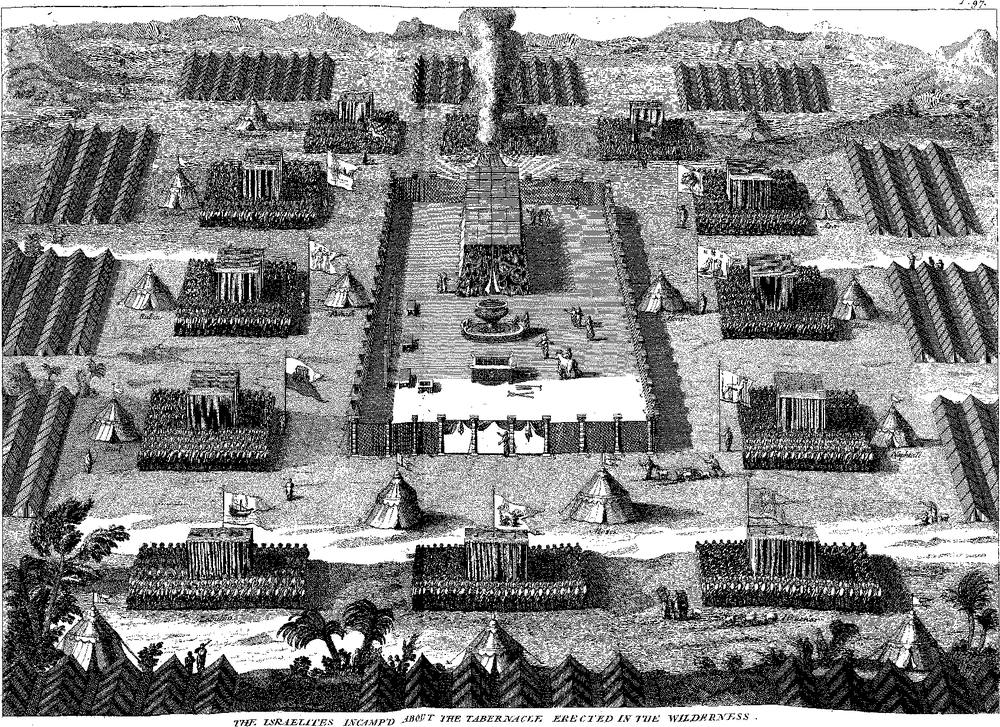
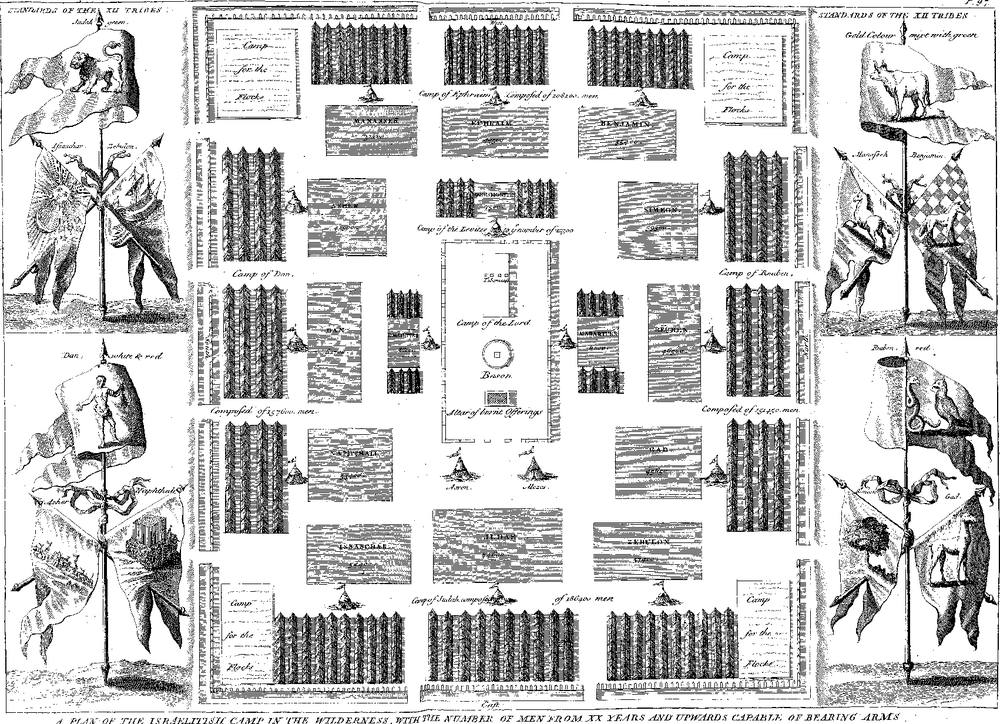
The twelve Tribes, while they were in the Desart, encamped round about the Tabernacle of the Covenant, every one according to its Order. To the East were those of Judah, Zebulun, and Issachar: To the West were Ephraim, Manasseh, and Benjamin: To the South, Reuben, Simeon, and Gad: And to the North were Dan, Asher, and Naphthali. The Levites were distributed round about the Tabernacle, nearer the Holy Place than the other Tribes; so that Moses and Aaron, with their Families, were to the East, Gershom to the West, Kohath to the South, and Merari to the North.
In the Marches of the Army of Israel, the twelve Tribes were divided into four great Bodies, each composed of three Tribes. The first Body, which was the Front of the Army, was made up of the Tribes of Judah, Issachar, and Zebulun: The second was composed of Reuben, Simeon, and Gad. Between the second and third Body of Troops, came the Levites and Priests, with the Ark of the Lord, the Curtain, the Planks, the Pillars, and all the other Furniture of the Tabernacle.
The third Body of the Army of Israel was composed of the Tribes of Ephraim, Manasseh, and Benjamin. The fourth, and last, which brought up the Rear, was made up of the Tribes of Dan, Asher, and Naphthali.
In the Division made by Joshua of the Land of Canaan to the Tribes of Israel, Reuben, Gad, and half of the Tribe of Manasseh, had their Lot beyond Jordan: All the other Tribes, and the other Half of that of Manasseh, had their Distribution on this side the River. Under the Title of each of the twelve Tribes, we have given the History of the Patriarch who was the Head of it, and set down the Particulars relating to his Tribe, their Portion, Adventures, &c. So that the Reader may consult the several Articles of JUDAH, SIMEON, LEVI, BENJAMIN, DAN, EPHRAIM, MANASSEH, REUBEN, GAD, ASHER, ZEBULUN, ISSACHAR, and NAPHTHALI.
The twelve Tribes continued united under one Head, making but one State, one People, and one Monarchy, till after the Death of Solomon. Then ten of the Tribes of Israel revolted from the House of David, and received for their King Jeroboam, the Son of Nebat; and only the Tribes of Judah and Benjamin continued under the Government of Reboboam. This Separation may be looked upon as the chief Cause of those great Misfortunes that afterwards happened to those two Kingdoms, and to the whole Hebrew Nation. For, first, it was the Cause of the Alteration and Change of the old Religion, and of the ancient Worship of their Forefathers. Jeroboam the Son of Nebat substituted the Worship of Golden Calves instead of the Worship of the Lord; which was the Occasion of the ten Tribes forsaking the Temple of the Lord. Secondly, This Schism caused an irreconcileable Hatred between the ten Tribes, and those of Judah and Benjamin, and created an infinite number of Wars and Disputes between them. The Lord being provoked, delivered them up to their Enemies. Tiglath-Pilneser first took away captive the Tribes of Reuben, Gad, Naphthali, and the Half Tribe of Manasseh which were beyond Jordan, and carried them beyond the Euphrates, in the Year of the World 3264, before Christ 736, 2 Kings xv. 29. 1 Chron. v. 26.before the Vulgar Æra 740.
Some Years after, Shalmaneser, King of Assyria, took the City of Samaria, destroyed it, took away the rest of the Inhabitants of Israel, carried them beyond the Euphrates, 2 King xvii. 6. xviii. 10, 11.and sent other Inhabitants into the Country, to cultivate and possess it. Thus ended the Kingdom of the ten Tribes of Israel, in the Year of the World 3283, before Christ 717, before the Vulgar Æra 721. It has been a great Problem among the Fathers and Interpreters to determine whether these ten Tribes still continue in their Settlement beyond the Euphrates, or whether they returned again into their own Country. The greatest part are of opinion, that they never did return; but the contrary Opinion seems to have a better Foundation in Scripture, which in several Places promises the Return of these Tribes, and which represents all Palestine to us as well peopled by the Israelites of all the Tribes, long before the Coming of Christ. However, it must be owned, that this Return is not clearly made out by History, because it was performed by insensible Degrees, and was not so compleat and entire, but that a great number of Israelites still remained beyond the Euphrates; so that St. Peter addresses his First Epistle to the converted Jews that were dispersed in the Provinces of Pontus, of Cappadocia, Bythinia, Asia, &c. The Reader may see our Dissertation upon this Question, Whether or no the ten Tribes C c ever
the Second Book of the Chronicles?
As to the Tribes of Judah and Benjamin, who remained under the Government of the Kings of the Family of David, they continued a much longer time in their own Country: But at last, after they had fulfill’d the Measure of their Iniquity, God delivered them up into the hands of their Enemies. Nebuchadnezzar took the City of Jerusalem, entirely ruined it, and burnt the Temple, and took away all the Inhabitants of Judah and Benjamin to Babylon, and to the other Provinces of his Empire.61 This happened in the Year of the World 3416, before Christ 584, before the Vulgar Æra 588.
The Captivity of Judah continued for seventy Years, as the Prophets had foretold Jerem. xxv. 11, 12. xxix. 10.them. The Beginning of it may be fixed in 3398, and the End in 3468, which is the first Year of Cyrus at Babylon. Or else, by putting the Beginning in the Year 3416, which is that of the taking of Jerusalem, and of its Destruction by Nebuchadnezzar, and the End in 3486, which is the Beginning of the Reign of Darius Son of Hystaspes, the Spouse of Queen Esther, and the Protector of the Jewish Nation. The Return of Judah is plainly assigned at the end of the Second Book of the Chronicles, 2 Chron. xxxvi. 20, 21, 22, 23.and in the Books of Ezra and Nehemiah. The Decree of Cyrus, which allows them to return into their County, is in the Year of the World 3468, before Christ 532, before the Vulgar Æra 536.
TRIBUNAL. The Place where judicial Proceedings are exercised and administred. Moses appointed,62 that in every City there should be Judges and Magistrates, who should hear and determine Differences that might arise in the Country: And that if any thing of difficulty should occur, it should be referred to the Place which the Lord should chuse, and be laid before the High-Priest, or Priests of the Race of Aaron, and before the Judge that the Lord should raise up there for the time being. See what is said before, in the Articles JUDGE, and SANHEDRIM. The Rabbins pretend, that there were three kinds of Tribunals in Israel; one of three Judges, another of twenty -three, and another of sixty. The Tribunal of three Judges was in every Village, and determined Causes where only Money Matters, and ordinary Affairs were concerned: The Tribunal of three and twenty Judges was kept in Cities, and could take cognizance of Matters relating to Life and Death. Lastly, the xvii. 31.third Tribunal of sixty, was singular, being held only at Jerusalem, in one of the Apartments in the Temple. This is what the Jews call the great Sanhedrim, to the Authority of which, even the King, the High-Priest, the Tribes of Israel, the false Prophets, and the Affairs of Religion, were subject. The Rabbins affirm, that the Privilege of judging in capital Causes was taken away from this Council forty Years before the Destruction of the City and Temple of Jerusalem; that is to say, in the 30th Year of the Vulgar Æra, and seven Years before the Death of our Saviour. Wherefore the Jews said then to Pilate, that it was not permitted them to condemn any one to death: It is not lawful for us to put any man to death.
TRIBUNE, an Office of Dignity among the Romans. They had Tribunes of several kinds. Some had the Command of the Troops, others had a share in the Administration of the Commonwealth. We find some to be called Tribuni Celerum, who commanded a sort of Light Horse: Others were called Tribuni Ærarii, who had an Inspection into the Publick Treasure. Others were Tribuni Fabricarum, who took care about the making of Arms and Armour. Others were Tribuni Maritimorum, who had the Oversight of Sea-ports, of the Channels of Rivers, of the Salt-works. Tribuni Plebis were the Guardians and Patrons of the People, and were to protect them from any Injuries they might receive from the great ones. Lastly, Tribuni Militum, or Militiæ, who were divided into Greater and Lesser Tribunes; the first were Tribunes of Legions, the others Tribunes of Troops or Cohorts.
In Scripture the Word Tribune is often used, even in the Latin Text of the Old Testament; because the Translators know no Word more proper to express certain Employments, which have some Resemblance to that of the Tribunes of the Roman Republick. For example; St. Jerome63 translates by Tribunes what the Hebrew calls Princes of a thousand, and the Septuagint, Chiliarchæ; which has the same Signification as the Hebrew. In the New Testament, the Word Tribune has more Relation to the Offices and Employments of the Romans, since they were really Officers of the Roman Troops: For example, in St. John xviii. 12. Acts xxi. 31, 32, 33, 37, &c. St. Mark speaks of the Tribunes of the Court of Herod the Tetrarch,
Tetrarch, Mark vi. 22. Each of these in the Greek are called Chiliarchoi, or Captains of a thousand Men, as the Tribunes of Legions were. But he that apprehended St. Paul, and took him out of the hands of the Jews, Acts xxi. 31. was only a Captain or Tribune of a Company.
TRIBUTE, Tributum; in Greek, Phoros; in Hebrew, Mas;64 which is derived from the Verb Masas, to melt, or liquify. The Hebrews acknowledged none for Sovereign over them, but God alone: Whence Josephus65 calls their Government a Theocracy, or Divine Government. They acknowledged the Sovereign Dominion of God by a Tribute, or Capitation, of half a Exod. xxx. 13.Shekel a Head, which every Israelite paid him yearly. Our Saviour, in the Gospel thus reasons with St. Peter: What thinkest thou, Matth. xvii. 25.Simon? Of whom do the kings of the earth take custom or tribute? of their own children, or of strangers? Meaning, that as he was the Son of God, he ought to be exempt from this Capitation. I do not find that either the Kings or the Judges of the Hebrews, when they were of that Nation, demanded any Tribute of them.
Solomon, at the Beginning of his Reign,66 compelled the Canaanites, who were left in the Country, to pay him Tribute, and to perform the Drudgery of the Publick Works he had undertaken. And as to the Children of Israel, he would not suffer one of them to be employed therein, but made them his Soldiers, his Ministers, his chief Officers, to command his Armies, his Chariots, and his Horsemen. Yet however, towards the End of his Reign, he imposed a Tribute upon them, and made them work at the Publick Buildings;67 which much alienated their Minds from him, and sowed the Seeds of that Discontent which afterwards appeared in an open Revolt, by the Rebellion of Jeroboam the Son of Nebat. He was at first indeed obliged to take shelter in Egypt; but afterwards the Defection became general, by the total Revolt of the ten Tribes. Hence it was, that the Israelites said to Reboboam the Son of Solomon; Thy father made our yoke grievous; now therefore, make 1 Kings xii. 4.thou the grievous service of thy father, and the heavy yoke which he put upon us, lighter, and we will serve thee.
‘Tis needless to observe, that the Israelites were frequently subdued by foreign Princes, who laid great Taxes and Tribute upon them; to which, Fear and Necessity compelled them to submit. Yet in the latter Times, that is, after Archilaus had been banished to Vienne in France, in the 6th Year of the Vulgar Æra, and after Judæa was reduced to a Province, Augustus sent Quirinius into this Country, to Josephi Antiq. l. 17. c. 15.take a new Poll of the People, and to make a new Estimate of their Substance, that he might thereby regulate the Tribute that every one was to pay to the Romans. Then Judas, surnamed the Galilean, or the Gaulonite, because he was a Native of Gamala in Galilee, in the Canton of Gaulonitis, formed a Sedition, and made an Insurrection, to oppose the levying of this Tribute. His Pretence was, that it was not lawful to pay any Tribute to Foreigners; that it was the Badge of a real Servitude, and that it was not allowed them to own any for their Masters, who had not the Lord for their God. This was the Origin of the Sect of the Galileans, or of the Herodians, of whom we have spoke under the Article JUDAS the Galilean, and that of the HERODIANS.
See in St. Matthew xxii. 16, 17, 18, &c. the Answer that Jesus Christ returned to the Pharisees, who came with an insidious Design of tempting him, and asked him, Whether or no it was lawful to pay Tribute to Cæsar? And in St. John, viii. 33. where the Jews boast of having never been Slaves to any body, Nemini servivimus unquam, of being a free Nation, that acknowledges God only for Master and Sovereign. As at that time there were many Jews who had imbibed the same Principles as Judas the Gaulonite, and who infused into the People the same Notions of Independence, and a vain Shew of Liberty; so on the contrary, the Apostles St. Peter and St. Paul, in their Epistles, have always endeavour’d to recommend and inculcate to the faithful Christians, Submission and Obedience to Princes, and a conscientious Discharge of their Duty, in paying them their Tributes. See Rom. xiii. 1.---- 8. 1 Pet. ii. 13.
TRINITY. This is the Term that Divines, and all true Christians make use of, to express the greatest of the Mysteries of the Christian Religion; which is, that one only God is distinguished into three Persons, the Father, the Son, and the Holy Ghost. The Word Trinity is not to be met with in Scripture; but these three divine Persons are very plainly expressed and distinguished. For example, God created the heaven and the earth: Here is God the Father. The Son is expressed through the whole Scripture, by the Name of The Word, The Wisdom, The Saviour, The Deliverer. The Holy Ghost, which inspired the Prophets, is called in
the Gospel, The Comforter, or Paracletus. The Father and the Son are represented in Psalm cx. 1. The Lord said unto my Lord, Sit thou at my right hand, &c. In the New Testament the three Persons are distinctly expressed in many Places. For example, Go Matth. xxxviii. 19.and teach all nations, baptizing them, in the name of the Father, and of the Son, and of the Holy Ghost. And when Jesus Christ came out of the Water after his Baptism, the Heaven was opened, and the Spirit of God was seen to descend upon him in the Form of a Dove, and a Voice was heard from Heaven, saying, This is my beloved Son, in whom I am well pleased. See again the Father, and the Son, and the Holy Ghost, plainly distinguished. The whole Gospel of St. John, especially his First Chapter, marks distinctly the Father, the Word, which is God, and the Holy Ghost, to whom John the Baptist gives his Testimony, saying, that he saw the Holy Ghost John i. 32, 33, 34.descend upon Jesus in the Form of a Dove. He adds, that the same Spirit that sent him to baptize, said to him, Upon whom thou shalt see the Spirit descending, and remaining on him, the same is he which baptizeth with the Holy Ghost. ‘Tis needless to heap together a multitude of Passages, which prove and confirm the Doctrine of the Trinity. ‘Tis no part of this Undertaking, to write a Treatise of Divinity or Controversy.
It has been thought, that the Distinction of the three Persons of the Trinity was not unknown to Plato and his Disciples; and some of the Moderns have even dared to affirm, that it was from their Writings that the Fathers of the Church borrowed the greatest part of their Expressions concerning the Trinity. The Reader may see the Book called Platonism Unveiled, and Father Baltus’s Defence of the Fathers unjustly accused of Platonism. See also M. Basnage’s History of the Jews, Tom. 4. lib. 6. Chap. 4. Edit. Paris.
It cannot be denied that some of the ancient Jews, who lived before Jesus Christ, and those also that lived in his time, were ignorant of the Mystery of the Holy Trinity. This Mystery is so clearly revealed in the Old Testament, and makes so considerable a part of the Creed of true Believers, that it could not be unknown to the Patriarchs, the Prophets, and the more enlightened of the ancient Hebrews. Raymund Martin,68 Galatine,69 and several others, have undertook to shew, that the Chaldee Paraphrasts, and the ancient Rabbins, have made express mention of the Trinity, and of the Three Persons. We find indeed in their Writings the Words Shalishith,70 which signifies Trinity, and Memar,71 which signifies The Word, and Ruach Hakkadoshah,72 which signifies the Holy Spirit. We also find God the Father, God the Son, and God the Holy Ghost. Lastly, the Tri-une, Three in One, and One in Three73; and Jehovah, to express the Father, Memara-jah for the Word of the Father, and Shechinah for the Holy Ghost.
‘Tis true, that the modern Rabbins disclaim part of the Books in which these Words are found, maintaining that they were not written by Jews: Others they explain in another Sense: And they not only do not acknowledge the Trinity, but they expresly deny it, and declare against it; either because they have departed in this from the Sentiments of their Forefathers, or that their Antipathy and Hatred to the Christians has excited them to dispute this Truth, which is so clearly revealed by Christ and his Apostles; or that this Mystery from the Beginning was unknown to the generality of the Jews, and the People had but a very imperfect Idea of it. And indeed the Conceptions of the Jews were so very gross, and they were so little acquainted with abstract Speculations, that from the belief of the Trinity, it would have been very easy to them to have passed to that of the Plurality of Gods. For which reason, perhaps, the Wisdom of God might have thought fit not to discover this Mystery so plainly to them. Upon this Subject the Reader may consult M. Basnage, and the Authors which he quotes, in his History of the Jews, t. 4. l. 6. c. 4, 5. Edit. Paris; and the Lexicon of Suicerus, under the Word Trias; and Mr. Cudworth’s Intellectual System of the Universe, l. 1. c. 4. and Joshua Arndi, Diatriba de mysterio Trinit. è scriptis Rabb.
TRIPOLIS, a City of Phœnicia, lying upon the Mediterranean Sea, between Botrys to the South, and Arca to the North. ‘Tis watered by a River that runs down from Libanus. ‘Tis mentioned in the Second Book of the Maccabees, xiv. 1. where it is said, that three Years after the Death of Antiochus Epiphanes, Demetrius, the Son of Seleucus, to whom the Kingdom of Syria of right belonged, made his Escape from Rome, and landed at Tripolis, in the Year of the World 3642, before Christ 358, before the Vulgar Æra 362. The Word Tripolis, in Greek, signifies three Cities; because in reality it was made up of three Cities, which were distant from one another the
Tripolis continues on the next page
Footnotes
-
Diodor. Sicul. Biblioth. l. 2. Lucret. l. 5. Paulo post medium. Vitruv. Architect. l. 1. c. 1. Horat. Satyr. l. 1. Serm. 3. ver. 99. Cicero de Inventione, l. 1. ↩
-
2 Sam. viii. 9, 10, 11. In the Year of the World 2960, before Christ 1040, before the Vulgar Æra 1044. ↩
-
See Walton’s Prolegomena, M. Du Pin, P. Frassen, the Method of Study, by P. Thomassin; the Letters of the Divines of Holland, and their Answers, &c. ↩
-
See Basnage’s Jewish Antiquities, T. 1. p. 111. c. 13. ↩
-
Joseph. Antiq. l. 20. c. ult. p. 303. Παρ*’* ἡμῖν γὰρ οὐκ ἐκείνους ἀποδέχονται τῶν πολλῶν ἐθνῶν διάλεκτον ἐκμαθόντας, διὰ τὸ κοινὸν εἶναι νομίζειν τὸ ἐπιτήδευμα τοῦτο, οὐ μόνον τοῖς ἐλευθέροις τοῖς τυχοῦσιν, ἀλλὰ καὶ τῶν οἰκετῶν τοῖς θέλουσι. ↩
-
Theodor. Mopsuest. Apud Philopon. de mundi opific, c. 12. ↩
-
Quid. apud Scipion. Sgambat. archiv. V. T. l. 1. art. 4. ↩
-
Vide Lightfoot in 1 Cor. xiii. 1. ↩
-
Gregor. Mag. l. 2. Moral. c. 5. ↩
-
Jerem. ix. 26. xxv. 23. xlix. 32. ↩
-
Ezek. xliv. 20. ופרע לא ישלחוc 70. Τὰς κώμας αὐτῶν ἐ ψιλώσουσι. ↩
-
Theodoret. ex Heb. & Syr. Τὰς κώμας ἐ θρέψουσι. ↩
-
Juven. Sat. 6. Qui grege linigero circumdatur, & grege calvo. ↩
-
Amos iv. 6. נקיון שנים ↩
-
See Danaeus, and the Dictionary of Arts and Sciences. ↩
-
Schindler. Mercer. & Cevalhrius in Job. Rab. Jonan. in Pagnino. ↩
-
Psal. cxix. 127. מזהב ומפזSuper aurum & topazion. ↩
-
Isai. xxx. 33. ערון תיפתה ↩
-
Exod. xxviii. 17. פטדהPitdath, Topazius. Vide xxviii. 18. xxxix. 8. Job xxviii. 19. Ezek. xxviii. 13. ↩
-
Althel. de laud. Virginis, c. 28. Punica mala vident granis fertisque referta, Botros & ficos, & plures ordine tortas. ↩
-
Exod. xxix. 29. ככר לחם ↩
-
טוטפותTotaphot. 70. Ἀσάλευτοι. Aquil. Ἔνεκτα. ↩
-
Oleast. Munst. Mayer. Grot. &c. ↩
-
Lightfoot. Hor. Heb. in Matth. xxiii. ↩
-
Samuel Petit. Var. Lect. c. 20. טוטפותpu- denda è luto efformata. In the Septuagint he reads Ἄξα λεῦτα, from ἄξα, Dust, and λεῦτα, pudenda, instead of Ἀσάλευτα, as we read it. ↩
-
1 Chron. xvi. 22. Psal. civ. 15. ↩
-
מגדלMigdal. Πύργος, Turris. ↩
-
Hieron. Qu. Heb. in Genes. Theodoret. & Cyrill. in Mich. Alii plures. ↩
-
Deut. xxvii. 5. Josh. viii. 31. ↩
-
Ezek. xxix. 10. xxx. 6. בירניותBiranioth. ↩
-
Isa. x. 9. Οὐκ ἔλαβον τὴν χώραν τὴν ἐπάνω Βαβυλῶνος, καὶ χαλάνης ὅ ὁ πύργος ᾠκοδομήθη. ↩
-
Cyrill. Basil. Greg. Nazianz. ↩
-
Sigonius de Regn. Italic. l. 13, 14. ↩
-
Euseb. in loc. voce Kanath. ↩
-
Mark vii. 7, 8, 9, 10, &c. Matth. xv. 1, 2, 3, 4, &c. ↩
-
Vide Irenæ. l. 3. contra Hæres. c. 3, 4. Tertull. de corona militis, c. 3. Basil. ad Amphiloch. de spiritu sancto. c. 29. Chrysost. in 2 Thessal. ii. Epiphan. Hæres. 61. August. Ep. olim 118. nunc 54. and Januar. ↩
-
Deut. xiv. 5. אקוAkko. Τραγέλαφος. ↩
-
Plin. l. 33. c. 8 ↩
-
Diodor. Bibl. l. 2. ↩
-
Bochart. de Animal. Sacr. par. 2. l. 6. c. 1. ↩
-
Matth. xvii. 1. says but six Days; Luke ix. 27. mentions eight Days; probably because he counted inclusively, reckoning the Day of the Promise, and the Day of the Execution: Whereas the other Evangelists had regard only to the six intermediate Days. ↩
-
Concil. Trident. Sess. c. 1. ↩
-
Philo legat. ad Caium. ↩
-
Joseph. Antiq. l. xi. c. 5. ↩
-
Hieron. in Ezech. xxiii. ↩
-
Manasse Ben-Israel, La Esperanca di Israel. ↩
-
Philip. Mornay de verit. Relig. Christ. c. 26. Geneb. Chronic. Religions du Monde, T. 2. Vid. Grot. de origin. Gent. Americ. ↩
-
Davity, Etats du Turc en Asie, p. 124, 168, ↩
-
Vide Bartolocci Bibl. Rabbin. T. 1. p. 129. ↩
-
Bernier, Voiage de Cachemire, l. 4. p. 218. ↩
-
אוצרOtzer. Θησαυρός. Thesaurus. ↩
-
1 Chron. xxvii. 25. 2 Chron. xxii. 17, &c. ↩
-
Vide Gen. iv. 20. ויוחיל כרםb Exod. i. 11. ערי מסכנות ↩
-
Theodor. apud Theodoret. qu. 28. in Genes. Isidor. Pelus. l. 1. ep. 2. ↩
-
Translators’ note. We read this Passage thus in our Translation: I raised thee up under the apple-tree, where thy mother brought thee forth; there she brought thee forth that bare thee. ↩
-
Aug. de Genes. ad liter. l. 8. c. 5. & l. 2. de pecat. mentis. c. 21. ↩
-
Joseph. Antiq. l. 1. c. 1. Bonavent. in 2. Sent. dist. 19. Strab. in Genes. Hug. Victor Abulens. Alii passim. ↩
-
Philo de opificio mundi, p. 35. ↩
-
Basnage, Hist. of the Jews, l. 6. c. 12. art. 18. ↩
-
Rabb. in Sanhedrin. fol. 70. Bemidbar. Rabb. fol. 170, & 238. ↩
-
2 Kings xxv. 1, 2, 3, &c. 2 Chron. xxxvi. 17, 18, &c. ↩
-
Deut. xvi. 18. xvii. 8, 9. Ezek. xliv. 24. Joseph. Antiq. l. 10. c. ult. ↩
-
Exod. xviii. 21, 25. שרי אלפיםPrincipes Militum. 70. Χιλιάρχος. Vide Num. xxxi. 14, 48, 52. Deut. i. 15. 1 Reg. viii. 12. xvii. 18. & passim. ↩
-
מסMas. Φόρος, Tributum. ↩
-
Joseph. contra App. l. 2. p. 1071. ↩
-
1 Kings xi. 21, 22, 33. 2 Chron. viii. 9. ↩
-
1 Kings v. 13, 14. ix. 15. xi. 27. ↩
-
Raymund. Mart. Pugio fidei. ↩
-
Galatin. de arcanis Cathol. verit. l. 2. c. 1. ↩
-
שלושיתTrinitas. ↩
-
מימרMemar, Verbum. ↩
-
רוח הקדשהSanctus Spiritus. ↩
-
שלשה באחדTres in Uno. אחד בשלשהUnus in Tribus. ↩