Volume III, pages 61–80 of the 1732 edition, from TH to TO: everything printed on these pages, in order.
Continued from Thorns
not tell us with what kind of Thorns, nor for what end he was thus crown’d. There is great Likelihood that it was to insult him, and to rally his pretended Royalty. To add Pain to their Insult, the Soldiers made choice of Thorns, to tear and wound his Head. Christus Jesus quale, oro te, sertum pro utroque sexu subiit? - - - Certe præter figuram contumelia in promptu est, & turpitudo, & dedecoratio, & his implexa sævitia, quæ tunc Domini tempora & fœdaverunt & laurinaverunt. Tertull. de corona Militis.
But what kind of Thorns did the Soldiers make choice of, to crown our Saviour with? It is generally understood of the Rubus, which bears a small Fruit called Sloes; its Blossoms are white, and it brings forth Thorns with its Leaves. There are some that believe, that as in this Country the Thorns were then in blossom at that Season, the Soldiers chose those Thorns on purpose, to make him a Garland or Crown of Flowers, which being full of Thorns, might at the same time insult him, and put him to pain.
Others observe,1 that in Palestine, and especially about Jerusalem, the Thorns here mentioned are now not to be found; but only the Rhamnus, or Buck-thorn. Therefore there is great Probability that the Soldiers took of this Thorn, which was to be found at Hand, and the Evangelists intended nothing else, by the general Name of Thorns.
Some are for the Acacia, because this Tree is called a Thorne; in Greek, Acanthe, without any Addition.
Marcel. Empiric. c. 23.Others have declared for the White-Thorn, or Haw-thorn, which is a very common Shrub, and has stiff and hard Prickles. Its Blossoms are white and odoriferous.
The Sea-rush, or Juncus Marinus, has also its Partizans.2 It is armed with a very sharp Point at the end; and it is said, that the Prickles of the Holy Crown, which is shewn in several Places, have a great Resemblance to the Points of the Sea-rush. Durand, who is one of the most ancient that have examined into this matter, (for it was brought to Paris when he was a Child) says, it was of the Juncus Marinus.3 Others, who have also examined it in our Days, both at the Holy Chapel, and at Notre-dame of Paris, where they preserve a Part of it, are of the same Opinion. M. Baillet observes, that the Holy Crown which is preserved at the Holy Chapel of Paris,
Vol. III. has lost all its Thorns, the last being torn away in the time of Lewis XIII.
Others in great numbers4 are against this Opinion, as being contrary to the Text of the Evangelists, who have mentioned Thorns, and not the Sea-rush; which besides, was not proper for the Soldiers Designs, because it has but one Prickle at its Dissert. de Spineâ coronâ.end. Bartholin concurs with those that are against the Juncus Marinus. He quotes Delrio, who said he often examined the Holy Crown, which is kept at Paris, and had seen others in other Places, both in Spain, Flanders, and elsewhere, and that he could never observe any thing in them that resembled the Sea-rush; but always the Buck-thorn, or, in general, a large round Thorn. Such still is that which is kept at Trieves, and which we have caused to be engraven after Mazenius.5 See it in its true Magnitude, under the Article Lance.
It is also disputed, whether our Saviour wore his Crown of Thorns upon the Cross, or whether it was taken from him when they stripp’d him of his Cloaths. Opinions are divided upon this, and it is impossible to reconcile them, and to determine the Difficulty, the sacred Writers having said nothing of the matter. Nor has ancient History informed us of the manner in which the Holy Crown has been preserved, and handed down to us. It is also very difficult to believe, that all the Thorns, and all the Parts of the Holy Crown, which are shewn in different Places, can proceed from that one Crown of our Saviour.
THOSA. Jediael and Joha, the Sons of Shimri, were Tizites, or Inhabitants of Tiza or Thosa, 1 Chron. xi. 45. ‘Tis unknown where this City stood.
THOUGHT, Thinking. This Word is taken, not always for the pure Operation of the Mind while it thinks, without passing a Judgment, or taking any Resolution. The Thought often includes a formed Design of doing something.: For example, I knew not Jerem. xi. 19.that they had devised devices [or thought Thoughts] against me, saying, Let us destroy the tree with the fruit thereof. And in Genesis, speaking of those that built the Gen. xi. 6.Tower of Babel, Nothing will be restrained from them which they have imagined, [or Psal.thought] to do. And the Psalmist says, The Lord bringeth the counsel of the Heathen to nought; he maketh the devices [or Thoughts] of the people of none effect. The Counsel of the Lord standeth for ever, the thoughts of his heart
Passages, Counsel, Designs, Devices, and Thoughts, are equivalent to Undertakings and Resolutions.
Psal. lvi.6. Nahum i. 9. Ibid. ver. 11. Exod. xxxv.31, 32.The Hebrews give the Title of Works of Thought to such Works as require Industry and a particular Genius. Implevit eum spiritu Dei, sapientiâ & intelligentiâ, ----- ad cogitandum & faciendum, &c. The Hebrew says, ad cogitandum cogitationes, ad faciendum, &c. Ver. 33. In omni opere cogitationis. In the Proverbs, a Man of Thoughts is a Prov. xiv. 17. xxiv. 8.crafty Man; Qui cogitat malè facere, stultus vocabitur. The Hebrew says, He shall be called a Master of Thoughts, that thinks of doing ill. And Acts xvii. 29. Sculptura artis & cogitationis.
Cogitare and cogitatio are often taken in an ill Sense, for contriving and devising Mischief. Omnes cogitationes eorum in malum. And, Quid cogitatis contra dominum. Et ex te exibit cogitans contra dominum malitiam. And Jerem. xviii. 18. Cogitaverunt contra Jeremiam cogitationes. Isa. lv. 7. Derelinquat impius viam suam, & vir iniquus cogitationes suas, &c.
Rom. ii. 15.St. Paul says, Their thoughts the mean while accusing, or else excusing, one another, when their Conscience bears Testimony to them, either for Good or Evil. Elsewhere Ephes. ii. 3.he says, fulfilling the desires of the flesh, and of the mind [or Thoughts.]; that is, of their own Flesh, of their own Mind, of their carnal Inclinations. And, speaking of 1 Cor. vii. 34.Virgins, he says, The unmarried woman careth for [or thinketh of] the things of the Lord: She is employed about matters of Religion, and thinketh of pleasing God.
THOUSAND, in Hebrew, Eleph; in Greek, Chilion; in Latin, Mille; a Number of ten Hundred, but it is often taken for a very great and indefinite Number. For example, the Lord sheweth Mercy to a thousand generations: A day in thy courts is Deut. v. 10. vii. 9. Psal. lxxxiv. 10. Psal. cv. 8. Rev. xx. 1, 2, 3, &c.better than a thousand. And again, He hath remembred his covenant for ever, the word which he commanded to a thousand generations. St. John, in his Revelation, says, And I saw an angel come down from heaven, having the key of the bottomless pit, and a great chain in his hand; and he laid hold on the dragon, that old serpent, which is the Devil and Satan, and bound him a thousand years. And cast him into the bottomless pit, and shut him up, and set a seal upon him, that he should deceive the nations no more, till the thousand years should be fulfilled; and after that he must be loosed a little season. And I saw thrones, and they sat upon them, and judgment was given unto them; and I saw the souls of them that were beheaded, for the witness of Jesus, and worshipped the beast, neither his image, neither had received his mark upon their foreheads, or in their hands; and they lived and reigned with Christ a thousand years. But the rest of the dead lived not again until the thousand years were finished. This is the first resurrection.
Vide Euseb. Hist. Eccles. l. 3. c. 39. Apud. Euseb. Hist. Eccles. l. 3. c. 28.From these Passages, ill understood, proceeded the Opinion of the Millenaries, who thought that Jesus Christ was to reign with his Saints upon Earth for a thousand Years, before the Day of the Final Judgment. Those that maintained this Opinion, were not a Sect of Hereticks, or Schismaticks from the Church; but were some of the ancient Fathers of the Church, famous for their Learning, and venerable for their Sanctity, who in good earnest, and without Obstinacy, maintained an Opinion, that they thought was clearly deliver’d in the Scriptures. This Opinion came at first from the Jews, who under the Messiah expected a Reign of a thousand Years upon Earth, as may be seen in 2 Esdras iv. 35, &c. vi. 18. But he that gave most Reputation to this Hypothesis was Papias, the Disciple of St. John the Evangelist, who pretended to have received from the Apostles and their Disciples, the Doctrine of the Millenium, or our Saviour’s personal Reign upon Earth for a thousand Years. Caius, a Priest of the Church of Rome, who lived in the second Age of the Church, treats the Opinion of the Millenaries as a Fable invented by Cerinthus.
As the Word Millennium, or Millenary, is not read in the Scripture, we do not think our selves obliged to treat of it at large. The Reader may have recourse to the Dissertation that M. Du Pin has composed upon this Subject, before his Work upon the Revelation, and our Commentary upon Rev. xx. 2.; St. Austin, St. Gregory the Great, Andreas Cretensis, Berengaudus, Ribera, and many other learned Commentators Aug. de Civit. l. 20. c. 7. &c. Greg. magn. Moral. l. 4. c. 12.upon the Apocalypse, understood by a thousand years, not any fixed and determinate number of Years, but the whole time that shall pass from the Resurrection of our Saviour, which is the Beginning of his Reign over the Church, till the end of the World, and the final Consummation of all things.
THRASEAS, or Tharsea, Father of Apollonius the Governor of Cœlo-Syria, 2 Isa. lxvi. 1. Acts vii. 49. Psal. cx. 1. Luke xxii. 69. Psal. lxxxix. 14. xcvii. 2.Macc. iii. 5.
THRONE. Heaven is the Throne of God, and the Earth is his Foot-stool. Jesus Christ sat down at the Right-hand of the Throne of God. The Ark of the Covenant was considered as the Throne of God: Justice and Judgment are the Establishment of the Throne of the Lord.
The Scripture mentions the Throne of 1 Kings x. 18, 19.Solomon as a very extraordinary Piece of Workmanship: It was all of Ivory, and overlaid with Gold: It had six Steps: The Top of the Throne was round behind; that is, the Back was like a Nich of a circular Figure. There were two Arms on each side that supported the Seat; whether these Arms were like those of a Great Chair, or served to support the Seat of the Throne. There were two Lions under these two Arms, and two other Lions at the end of every one of the six Steps.
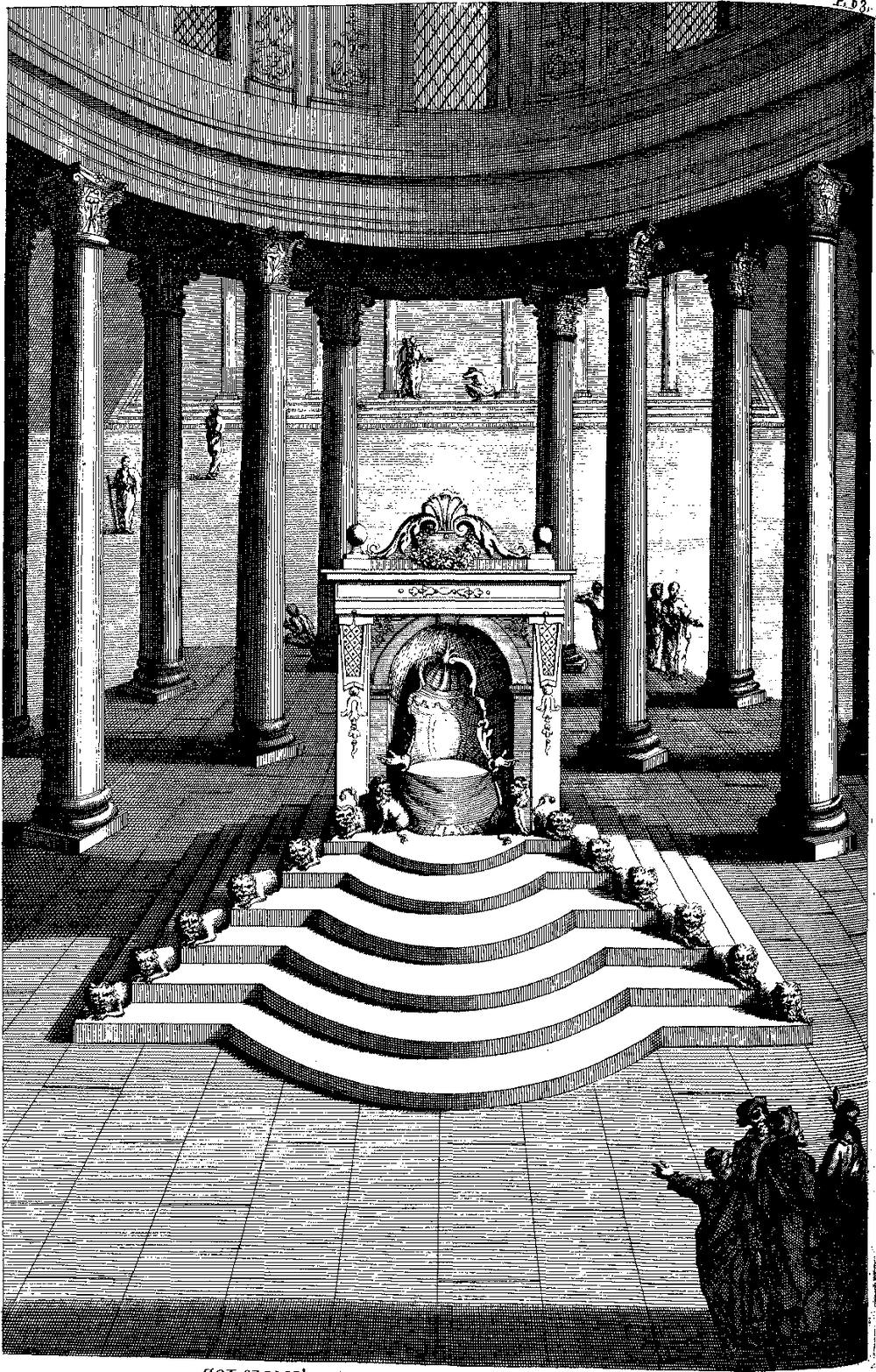
THRONE is used for that magnificent Seat whereon sovereign Princes usually sit, to receive the Homages of their Subjects, or to give Audience to Ambassadors; where they appear with Pomp and Ceremony, from whence they dispense Justice; in a word, the Throne, the Sceptre, the Crown, are the ordinary Symbols of Royalty and Regal Authority. The Scripture commonly represents the Lord as sitting upon a Throne: Sometimes it is said, that the Heaven is his Throne, and the Earth his Isai. lxvi. 1.Footstool: Cælum sedes mea; terra autem scabellum pedum meorum. The Psalmist says, in more places than one, that God had confirmed his Throne in Heaven, from all Psal. cii. 19.Eternity. Dominus in cælo paravit sedem suam: And elsewhere, Parata sedes tua ex xcii. 2. xliv. 7.tunc: And Sedes tua Deus in sæculum sæculi. This Throne was supported by Justice xcvi. 2.and Equity. The Throne of the Lord which was shewn to Ezekiel, was at the Ezek. i. 2, 3.same time the most terrible thing, and yet the most magnificent, that can be imagined. It was an animated Chariot, carried upon four Cherubims of an extraordinary Figure: The Wheels were of an inexplicable Beauty and Magnitude, which were also animated and conducted by a Spirit. The Throne of the Lord, which was upon the Wheels and Cherubims, was like glittering Crystal, with a Seat of Saphire. He that sat upon the Throne was surrounded with Splendor like that of Fire, or of Metal in Fusion; and about him were as it were the Colours of the Rainbow. See also the Description of the Throne of the Lord, as Isaiah vi. 2, 3, 4.given by Isaiah.
The Cherubims that were upon the Ark of the Covenant, were also considered as a kind of Throne of God: From whence it is said in many Places, that God sits between the Cherubims:6 Qui sedes super Cherubim; whether we consider the Cherubims of the Ark now mentioned, or the Cherubims of which Isaiah and Ezekiel give a Description, which are under and about the Throne of the Almighty: And ‘tis probably the same Cherubims Coloss. i. 16.that St. Paul represents by the Name of Thrones; Sive throni, sive dominationes.
The THRONE of Solomon deserves a particular Attention: The Scripture describes it to us as the finest and richest Throne in the Word: Non est factum tale 2 Sam. x. 20.opus in universis regnis. It was all of Ivory, and plated with pure Gold. The Ascent was by seven Steps; the Back was round, and two Arms supported the Seat: Twelve golden Lions, one on each side of every Step, made a principal part of its Ornament.
The Jews sometimes swore by the Throne of God, or by the Heaven. The Matth. v. 34. xxiii. 22.Son of God forbids such sort of Oaths; for, says he, He that swears by Heaven, swears by the Throne of God, and swears also by him that sitteth upon the Throne. There is Exod. xvii. 26.a Passage in Exodus that might be understood in the sense of an Oath made by the Throne of God: Quia manus solii Domini, & bellum Domini, erit contra Amalec; The Lord has lifted up his Hand from his Throne (he has swore by his Throne) that he would make War against Amalek. Thus in Judith, Nebuchadnezzar swears by his Judith i. 12.Throne, that he would make War against all those that had rejected his Ambassadors.
In Scripture the Son of God is represented as sitting upon a Throne, at the Right-hand of his Father. And Jesus Psal.cix. 1. Heb. i. 8. Rev. iii. 21. Luke xxii. 30. Rev. iv. 4. Dan. vii. 9.Christ assures his Apostles, that they should sit upon twelve Thrones, to judge the twelve Tribes of Israel: And in the Revelations, we find the twenty-four Elders to sit upon so many Thrones in the Presence of the Lord: And in Daniel, when God is about to enter into Judgment with Men, Thrones are prepared for the Judges: Throni positi sunt: The Ancient of Days sits down, his Throne is as a Flame of Fire, his Wheels as consuming Fire; a River of Fire proceeds from his Face; Millions of Millions of Angels attend upon him, and Thousands of Thousands are round about him.
THRONES, in the Sense of an Order of the Cœlestial Hierarchy, may signify, as before observed, the Cherubims, which were considered as the Throne of God, sitting upon the Cherubims, above his Ark. Ephes. iii. 10. vi. 12.St. Paul, in the Epistle to the Ephesians, does not make mention of Thrones among the other Cœlestial Spirits that compose the Angelical Hierarchy. Some Moderns pretend, that by the Names Thrones, Principalities, Powers, and Dominions, St. Paul means no more than Temporal Powers, subordinate to one another: Thus Thrones denote Kingly Power, Principalities stand for Governors
of Princes, and Powers signify Judges, and Magistrates of Cities, &c.
THYATIRA, a City which some ascribe to Mysia, and others to Lydia, or to the Lesser Asia, because it is upon the Frontiers of these three Provinces. This is what St. John says in his Revelation to the Bishop or Angel of Thyatira: I know Rev. ii. 18,19,&c.thy works, and charity, and service, and faith, and thy patience, and thy works; and the last to be more than the first: Notwithstanding, I have a few things against thee, because thou sufferest that woman, Jezabel, which calleth herself a prophetess, to teach and to seduce my servants to commit fornication, and to eat things sacrificed unto idols: And I gave her space to repent of her fornication, and she repented not. Behold, I will cast her into a bed, and them that commit adultery with her into great tribulation, except they repent of their deeds: And I will kill her children with death; and all the churches shall know that I am he that searcheth the reins and the hearts: And I will give unto every one of you according to your works: But unto you, I say, and unto the rest in Thyatira, as many as have not this doctrine, and which have not known the depths of Satan, as they speak, I will put upon you none other burden. But that which ye have already, hold fast till I come, &c.
Some think the Angel of Thyatira, or the Bishop of this Church, to whom these Words are directed, to be St. Carpus, or St. Irenæus: But the first is very doubtful, and the latter without any Foundation. It Epiphan. Hæresi 51.is not surely known who this Angel of Thyatira was. Epiphanius says, that some Hereticks doubted of the Authority of the Revelation, because in their time there was no longer any Christian Church at Thyatira; as if that was a Proof that there was none there heretofore. As to Jezabel, who pretended to be a Prophetess, ‘tis believed that Jezabel is only a figurative Expression, to denote some very wicked Woman, but it is not known who she was. Several Greek Manuscripts read, Your Wife Jezabel; and some of the primitive Fathers have thought that it was even the Wife of the Bishop of this City. Others believe it to stand for the Nicolaitans, who corrupted the Manners of the Faithful, and seduced them to their Heresies. But the greater part judge, with good Reason, that under the Name of Jezabel St. John would insinuate some powerful presumptuous Woman, who perverted the People by her vain Pretences to Prophecy.
THYINUM LIGNUM; in Hebrew, Almugim, or Algumim; a kind of Wood of extraordinary Beauty. See what we have said of it before under Algumim, and peruse the Commentators upon 1 Kings x. 11, 12.
THYRSUS. This Name is given by the Latin and Greek Writers to a Rod or Lance twisted round with Ivy, which was put into the Hands of the Soldiers of Bacchus, or of those that celebrated the Festivals of this Deity. Ovid describes them as wound about with Vine Branches.
Ipse racemiferis frontem circundatus Ovid. Metam. iii. v. 666.uvis, Pampineis agitat velatam frondibus hastam.
2 Macc. x. 7.There is mention made of these Thyrsi in the Maccabees, Propter quod Thyrsos, & ramos virides, & palmas, præferebant ei, qui prosperavit mundare locum suum. But these Thyrsi had nothing in common with those of the Feasts of Bacchus, except their Figure; since they were appointed to celebrate the Power of the God of Israel, and to return him Thanks for the Protection he had vouchsafed to his People. The Jews carried them at the Feast of Tabernacles; and they still carry something like them in their Hosanna. They are Branches of Willows, Myrtle, and Palm-tree, tied together, with Citrons or Oranges hanging at them, which they wave in a religious manner towards the four Quarters of the World. See the Feast of Tabernacles, before.
TIARA. This Name is often given to the High-Priest’s Mitre. See what we have observed before, in the Article CIDARIS.
TIBARENIANS, a People bordering upon Cappadocia. See TUBAL.
TIBERIAS, a famous City of Galilee, situated at the Southern Extremity, and upon the Western Shore of the Lake of Genesareth, otherwise called the Sea of Tiberias. ‘Tis thought that its old Name was Cinnereth, or Hammath, or Emath, or Rakkath, or Recchath: But M. Reland shews, that this is very doubtful, and is Reland. l. 2. p. 1037. Josh. xix. 35.only founded upon this, that the Sea of Cinnereth was afterwards called the Sea of Tiberias; which by no means proved that Cinnereth and Tiberias are the same thing. Besides, he observes, that the Portion of Naphthali did not begin towards the South, but at Capernaum,7 which is more to the North than Tiberias; and yet Cinnereth, Hammath, Rakkath, belong to the Portion of Naphthali. Tiberias therefore could not, since it is known that it was quite to the South of the Lake of Tiberias.
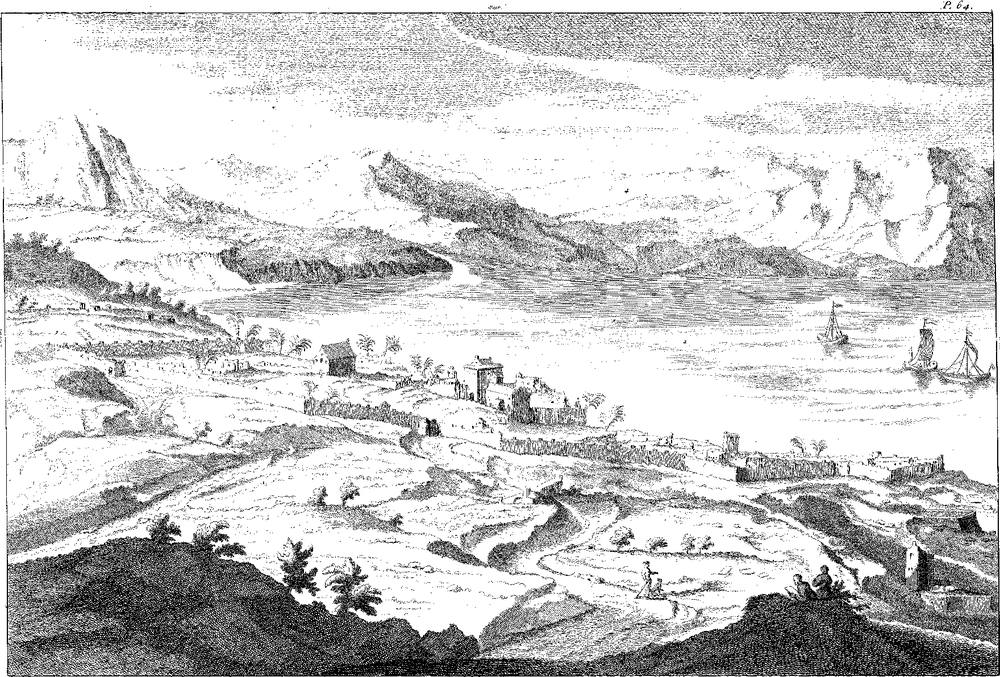
Josephus tells us,a that this City was built in honour to Tiberius by King Herod Agrippa. Pretty near this were Baths of hot Water; and it stood in a Place where were Joseph. Antiq. l. 18. c. 3.many Tombs and dead Bodies; which was very contrary to the Usages and Customs of the Jews. Tiberias was thirty Furlongs Idem. de vitâ suâ. p. 1025. Ibid. p. 1010.from Hippos, sixty from Gadara, and an hundred and twenty from Scythopolis, and thirty from Tarichea.
Herod the Tetrarch, who built this City, endowed it with great Advantages. Its convenient Situation soon made it become a considerable City: It grew up to be the Metropolis of all Galilee. When Agrippa was obliged to leave Rome, he retired thither with his Uncle Herod: The Emperor Claudius afterwards bestowed it on him; for which Reason in Medals it has the Name of Claudia Tiberias. Josephus took possession of it at the time of the Wars of the Jews, and gave the Bastinado to the Officer who came to propose Terms of Peace to it from the Romans. Vespatian intended to put all the Inhabitants to the Edge of the Sword; but Agrippa, to whom it belonged, prevailed with him to satisfy himself with only beating down a Part of its Walls. Tiberias was much frequented by Fishermen and Seamen; whence it is, that we see a Boat on the Reverse of some Medals that were struck in this City. In another Medal, struck under Trajan, we find the Goddess Salus surrounded by a Serpent, and sitting upon a Mountain, from whence proceeds a great quantity of Water; to shew that Tiberias was famous for its Baths of Hot Waters, from whence diseased People received great Benefit.
It was in this City, that some Jews, and some of the most learned of their Priests, after the Destruction of Jerusalem by the Romans, assembled themselves together, and there laid the Foundation of an Academy, which became famous by the Mishna which was composed in it by the cebrated Labours of the Masorites, the Authors of the Pointed Vowels, and by the Reputation of the Doctors which there kept their Schools. In the same City also resided the Patriarch of their whole Nation.
Epiphanius observes,8 that in the Time of Constantine the Great, the Gospel of St. John, and the Acts of the Apostles, translated into Hebrew, were discovered by Count Joseph, in the Archives or Treasury of Tiberias; and that before this time no Christian was permitted to dwell at Tiberias, nor at Capernaum, or Naza-reth, or Diocæsarea; and that Count Joseph, having obtained Leave from Constantine to build a Church there in the Name of Jesus Christ, he made use of a great Temple called Adrianeum, which had never been finished or consecrated. This he compleated, and dedicated it to the use of the Christians. Lampridius informs us, that the Emperors Alexander, Severus, and Adrian, had an Intention of placing Jesus Christ among the Gods, and to consecrate Temples to him: From whence it proceeds, that at this Day, says the Author, Temples without Statues were to be seen in every City, which, for this reason, were called Adrianea.
The Lake, the Pool, the Sea of Tiberias, is the same as the Lake of Genesar, or Genesereth, or the Sea of Cinnereth, or of Galilee. See CINNERETH.
TIBERIUS ALEXANDER LYSIMACHUS, Nephew to Philo the Jew, and Son of Alexander Lysimachus, Alabarcha, or Chief of the Jews of Alexandria, and Brother to Philo the Jew. Tiberius Alexander was therefore a Jew by Nation, and even of the Sacerdotal Race: But he quitted the Religion of his Fore-fathers, and became a Pagan. He was appointed to succeed Cuspius Fadus in the Government of Judæa,9 in the 46th Year of the Vulgar Æra. He made no Innovations in the Province, any more than his Predecessor before him; which kept all things in Tranquility. He caused to be crucified James and Simon, Sons of Judas the Galilean, who had made an Insurrection forty Years before. He govern’d Judæa till the 88th Year of Christ, or of the Vulgar Æra, and had for Successor Ventidius Cumanus. He was given Joseph. Antiq. l. 20. c. 3. p. 694.as an Hostage to the Parthians, when Corbulo engaged Tiridates to come to Rome, to receive the Crown from Tiberius10 in the 63d Year of the Vulgar Æra. He was Prefect of Egypt in the Year 66. He was the first that acknowledged Vespasian as Emperor, on the first of July, in the Year 69, and was Lieutenant-General to Titus at the Siege of Jerusalem,11 in the Year 70. Titus had a great Esteem for him, and Tiberius Alexander was in a manner the principal Man of his Council.
TIBERIUS. The Emperor Tiberius, Son of Livia the Wife of Augustus, and of Tiberius Nero, her former Husband, of the Patrician Family of the Claudii, was adopted by Augustus in the fourth Year of Christ, or of the Vulgar Æra, and succeeded him in the Year of our Lord 14, and reigned twenty-two Years, seven Months, and seven Days. We shall not12
not undertake to give a particular Account of his Life and Government; it shall suffice to set down here what has any regard to the Sacred History, and what may contribute to the Illustration of the Scriptures, which is the principal Object of our Care in this Work. The Jews therefore made application to Tiberius, in the 17th Year of Christ, for some Abatement of the Tacit. Annal. l. 11. c. 4.Taxes, with which they were oppressed. The Emperor referred the matter to Germanicus, who was to proceed this Year on his Expedition into the East. But we are not informed how Germanicus determined the Affair.
Some Years after this, that is, in the Year of Christ 19, and of Tiberius the 6th, the Senate of Rome forbad any Jewish Ceremonies to be exercised in the City; they even decreed, according to Tacitus, that the Jews should be expelled out of Italy, except they changed their Religion in a certain time; and that all that did not conform to this Decree should be reduced to perpetual Slavery. But neither Josephus nor Suetonius tell us that they were Philo Leg. p. 1014, 1015.driven out of Italy. Philo imputes this Persecution to the Intrigues of Sejanus, who had Apprehensions their too great Fidelity might obstruct the ill Designs he Joseph. Antiq. l. 13. c. 5. p. 623.was forming. Josephus says that it took its Rise from four Jews, who professing to teach Judaism at Rome, had persuaded a certain Roman Lady, called Fulvia, to embrace this Religion, and to put rich Presents into their Hands, to be sent (as they said) to the Temple of Jerusalem; though the truth was, they were to be converted to their own use. Tiberius being informed of this by Saturninus, the Husband of Fulvia, had all the Jews driven out of Rome. There were four thousand of them enrolled, Sueton. in Tiber. c. 36.to be sent against the Robbers of Sardinia.
‘Twas towards the Year 26 of the Vulgar Æra, that the Emperor sent Pontius Pilate into Judea, to succeed Gratus. Pilate continued there from the Year 26 to 35. We have already spoke of his Government under his proper Article. This Governor attempted to consecrate to Tiberius Philo Leg. p. 1033.the Golden Bucklers in the Palace of Herod at Jerusalem. The Jews were very much offended at this, and made earnest supplication to Pilate, to take away these Bucklers, or at least to allow them to send a Deputation to the Emperor, or to write to him about it. They wrote to him therefore, and the Emperor gave Command, that they should be removed forthwith. Pilate gave also a new Occasion of Discontent to the Jews, by causing Roman Troops to enter into Jerusalem, with their Ensigns and Colours, upon which were painted the Arms of the Emperor. But the Joseph. Antiq. l. 18. c. 4.Constancy and Intreaties of the Jews at last prevailed with him to carry these Ensigns back to Cæsarea.
Forty Years before the Destruction of Jerusalem, that is, in the Year 30 of Christ, and the 16th and 17th of Tiberius, the Romans took away from the Jews the Power of Life and Death.13 But in the Year following, or the 31st of Christ, Tiberius sent Orders to the Governor, to make no Innovations as to the Customs of the Jews, nor to commit any Violence upon their Persons. When Jesus Christ was dead, in the 33d Year of the Vulgar Æra, Pilate wrote to Tiberius, as they say,14 giving him an Account of his Death, and of the Prodigies that followed thereupon. Thus was the Emperor informed of the Proofs that Jesus Christ had given of his Deity. He wrote to the Senate about it, and laid it before them in such a manner, as shewed plainly he desired they should decree divine Honours to Jesus Christ. But the Senate refused to admit the Worship of our Saviour, to maintain their own Authority, and to hinder others from adoring any God without their Permission; and pretending that no one was to be acknowledged without their Consent. Tiberius did not forbear to shew his good Inclinations towards the Christians, and even threatened those with Death that should accuse them, or give them any Disturbance. In effect, we do not perceive that there was any Persecution of the Church under this Emperor. He died in the Month of March, in the Year of Christ 37.
TIBHATH, or Thebat, a City of Syria, that was taken and plundered by David.15 Stephanus the Geographer speaks of a City of Thebes in Syria. It should seem that Tibhath is called Betah,
TIBNI, or Thebni, Son of Ginath, 2 Kings viii. 7. Competitor with Omri for the Kingdom 2 Kings xvi. 21.of Israel: But the Faction of Omri prevailed over that of Tibni, who thereupon died. The Scripture does not tell us what kind of Death he died; but it should seem that he died in Battel, in the Year of the World 3079, before Christ 921, before the Vulgar Æra 925.
Ezekiel xlvii. 16.TICHON. Ezekiel speaks of the House of Tichon, or of Beth-tichon, which is upon the Confines of Auranitis. Its Situation is unknown; but it could not
be far from Damascus, nor from Trachonitis. Pliny16 mentions the Bœtaceni.
TIDAL, or Thadal, King of Nations, or King of Goim,17 according to the Hebrew. Some think he was King of Galilee, of the Gentiles, which was beyond Jordan. Symmachus translates it, King of Pamphilia; Matth. iv. 15. Josh. xii. 23.the Syriac, King of the Galites; Joshua speaks of a King of the Nations of Gilgal, or of Galilee, according to the Septuagint.
TIGER, a fierce wild Beast. It is mentioned but once in the Latin Text of Scripture. Job says, Tigris periit eò quòd non haberet prædam. But the Hebrew Word Job. iv. 11. Laish.Laish, which is here translated by Tiger, signifies rather an old Lion.18 ‘Tis true indeed, the Tyger is a kind of Lion; and, excepting the Spots with which the Tyger’s Skin is marked, as to every thing else these two Animals are very much alike.19 The Skin of the Tyger is variegated by long Stripes, whereas that of the Panther is spotted, or marked by round Spots. See Bochart, de Animalibus sacris, p. 1. l. 3. c. 8. p. 792.
This Animal has the Shape of a Cat, with Talons, but it is larger. Oppian says, that it is the most beautiful of all Quadrupeds, as the Peacock is the finest of all Birds. It is so nimble and active, that the Poets have fancied it to be conceived by the Wind. In Fable the Chariot of Bacchus is drawn by Tygers, to insinuate that Winetames the fiercest and most savage of Men. In the Mogul’s Court they exhibit Combats of Men against Tygers. Pietro, della Valle, p. 4.
Gen. ii. 14. Chiddekel.TIGRIS, a famous River, which takes its Source in Armenia, and discharges itself in the Persian Gulph. Moses calls it Hiddekel. The Ancients called it Diglito, and to this Day it is called Tegil, or Tigil. Josephus, the Chaldee Paraphrast, the Arabian and Persian Translators, call it Diglat. Pliny says, that at its Fountain, and as far as it Plin. l. 6. c. 27.runs smoothly, ‘tis called Diglito; but when it becomes more rapid, they give it the Name of Tigris, which, in the Language of the Medes, signifies an Arrow. He adds, that it takes its Rise in the greater Armenia, in the midst of a Plain called Elegosine. It enters into the Lake Arethusa, and passes cross it, without so much as mingling its Waters with it. After which it meets with the Mountain Taurus, where it plunges into the Earth, passes under the Mountain, and comes out again on the other side. The Cave at which it enters is called Zoroanda: And, for a Proof that it is the same River, and not any other, that comes out again on the other side, it throws out at its coming forth, what had been cast into it at its plunging into the Cave: Thus says Pliny. Ptolemy also places the Spring of the Tigris in the Middle of Armenia, at thirty-nine Degrees and a half of North Latitude.
Strab. l. 12. p. 359.But Strabo seems to have taken for the Fountain of the Tigris, its coming forth again out of Mount Taurus; since he places it out of Armenia, and says that it springs to the South of Mount Niphates, which makes a Part of Mount Taurus. The Tigris to the East, and the Euphrates to the West, are the Boundaries of Mesopotamia, which lies between these two Rivers. After having passed through a large Tract of Land from North to South, these two famous Rivers discharge themselves into the Persian Gulph. At this Day they unite in one common Channel, but Plin. l. 6. c. 27, 28.formerly they came into it separately, as Pliny observes; and in his time the Footsteps of the ancient Chanels were still to be seen. The Tigris took its Rise in the Land of Eden, and was one of the four Rivers Genesis ii. 14.that watered the Earthly Paradise. The Tigris overflows its Banks at the Beginning of the Spring, occasioned by the melting of Ecclus. xxiv. 25.great quantities of Snow from the Mountains of Armenia.
TIKVATH, or Thecue, Father of Shallum, 2 Chron. xxxiv. 22. Perhaps it may only mean, that Shallum was a Native of Tikvah, or Tekoa.
TILGATH-PILNESER, or Theglat- Phalassar, King of Assyria, Son and Successor of Sardanapalus; he began to reign at Niniveh, in the Year of the World 3257, before Christ 743, before the Vulgar Æra 747. By profane Writers he is generally called Ninus Junior. Ælian calls him 1 Chron. v. 6.Thilgam,20 and the Scripture calls him Tilgath-pilneser, or Tiglath-pileser. ‘Twas he 2 Kings xv. 29. xvi.that restor’d the Kingdom of Assyria, and possessed it, after the dismembring of it by Belesis and Arbaces. See their Articles, and that of SARDANAPALUS.
Ahaz King of Judah, finding himself vigorously attacked by Resin King of Syria, and by Pekah King of Israel, and knowing himself not strong enough to oppose them,21 sent Ambassadors to Tilgath-pilneser, to desire his Assistance against the Kings of Syria and Samaria. At the same time he sent him all the Gold and Silver that was found in the Treasuries of the
T I
the Temple, and in those of his own Palace. Tilgath-pilneser therefore marched against Rezin, killed him, plundered Damascus, and sent away the Inhabitants to other Places upon the River Cyrus. Ahaz went to meet this Prince as far as 2 Chron. xxviii. 20, 21.Damascus; but Tilgath-pilneser was not satisfied with what Ahaz had given him, but entered into Judæa, where he found no Opposition, and ravaged the whole Country. He did the same thing in the Country of Samaria, carried away the Tribes of Reuben and Gad, and the half Tribe of 1 Chron. v. 26.Manasseth, and transplanted them to Halah, Habor, and Hara, upon the River Gezan. He took also the Cities Ijon, Abelbeth-maachah, Janoah, Kedesh, Hazor, Galilee, and the Countries of Gilead, and 2 Kings xv. 29.Napthali, and carried away the Inhabitants into Assyria. After that Tilgath-pilneser had reigned nineteen Years at Nineveh, he died, in the Year of the World 3276, before Christ 724, before the Vulgar Æra 728. He had for Successor his Son Shalmaneser.
TILON, or Thilon, Son of Shimon, a Descendant from Caleb, 1 Chron. iv. 20.
TIME, Tempus. This Term is commonly taken for the Measure of Motion, or for the Duration of any thing, as well in ours as in other Languages. It is also taken for Opportunity, or the favourable Moment for doing or omitting any thing. The Time of any one, signifies the Time of his Coming. Isaiah xiv. 1. propè est ut veniat Tempus ejus, & dies ejus non elongabuntur. Jesus Christ, speaking of his Death, says, John vii. 6, 7.that his Time was not yet come: Tempus meum nondum advenit --- Tempus meum nondum impletum est.
The Time of the Vengeance of God, is Jerem. 1. 27, 31.sometimes called the Time of the Lord, the Time of his visiting: Wo unto them, for their day is come, the Time of their Visitation. Behold, I am against thee, O thou most proud, saith the Lord God of hosts; for thy day is come, the Time that I will visit thee.
To redeem the Time is mentioned in Daniel, ii. 8. I know of certainty that ye would gain the Time, or redeem the Time. And in St. Paul’s Epistle to the Ephesians, v. 16. Redeeming the Time, because the days are evil. These Expressions may signify, to gain Time, to protract an Affair to a great Length, to wait for a more favourable Opportunity. Thus Nebuchadnezzar’s Magicians would have gained Time, requiring a Length of Time from the King to explain his Dream, hoping that his Desire of knowing might have passed away, or that the Dream might have come into his Memory. St. Paul advises the Faithful to redeem the Time, because the Days are evil; that is to say, that they would let the Time of the Anger and Rage of wicked Men pass away, and wait for more favourable Circumstances.
Acts i. 7.King Abasuerus consulted the wise Men which knew the Times.22 That is to say, he advised with his Counsellors that understood the History, the Customs, the Laws, of the Persians. The Knowledge of History is one of the principal Qualifications for a Statesman. For how should he know the Interests of his Country, if he is ignorant of its Times, Revolutions, and remarkable Occurrences? St. Jerome has it in his Translation, He consulted the Sages that were always near his Person, according to the Custom of Kings. The Chaldee Paraphrast will have it, that he consulted the Children of Issachar, who were skilful in the Science of Times and Seasons. Moses says, that those of this Deut. xxxiii. 18, 19.Tribe should invite the People to come to the Mountain: populos vocabunt ad montem. They shall be able Astronomers, and shall know the Festival Days exactly; they shall invite their Neighbours to repair to Jerusalem, to the Holy Mountain.
Jesus Christ says to his Apostles, who asked him if he was soon to restore the Kingdom to Israel? It is not for you to know the Times or the Seasons, which the Father has put in his own power. They still thought that the Kingdom of the Messiah was a Temporal Kingdom. But afterwards they were undeceived, and the Holy Ghost, which they received at Pentecost, instructed them, that the compleat Kingdom of the Messiah, the renewing of all things, was not to take place before the End of the World. St. Peter, speaking to the Jews, calls this Acts iii. 20, 21. 1 Thess. v. 1.Time, Tempus refrigerii, and tempus restitutionis omnium. And St. Paul to the Thessalonians, makes use of almost the same Terms, in which our Saviour expressed himself to his Apostles, concerning his Last Coming. The Apostle says, De temporibus autem & momentis non indigetis ut scribamus vobis: For you know that the Day of the Lord is to come as a Thief in the Night.
Dan. xii. 7. Rev. xii. 14.A Time, Times, and half a Time, in Daniel, and in the Revelations, denotes three Years and an Half, which the Persecutions continued, against the Jews in the Time of Antiochus Epiphanes, and against the Christians in the Time of Dioclesian.
Tempus, a Year, Tempora, two Years, dimidium Temporis, Half a Year. In the Dan. iv. 13.same Prophet Daniel, septem tempora, are taken for seven Years; Donec septem tempora mutentur super eum. This denoted the seven Years that the Metamorphosis of King Nebuchadnezzar was to continue.
In Ezekiel, à tempore usque ad tempus comedes; you shall cut these three hundred and ninety Loaves, in the three hundred and ninety Days, that I have appointed you. From one Time to another Time, is from the Beginning of this Term to the End of the same.
1 Macc. ix. 10.Tempus acceptabile, tempus beneplaciti, tempus placitum, tempus visitationis. The Time of the Favour, of the Goodness, and of the Mercy of God; to which is opposite, Tempus furoris, tempus correctionis, tempus malum, tempus ultionis; the Time of Anger, Vengeance, the Evil Day, &c.
Tempus nostrum, is put for the Time of Death: Si appropiavit tempus nostrum, moriamur in virtute propter fratres nostros. The Devils complained that Jesus Christ Matth. viii. 24.was come to torment them before the Time: That is to say, before the Last Judgment, at which the Devils will be thrown for ever into the Fire prepared for them. The Fulness Galat. iv. 4.of Time, stands for the Time of the Coming of the Messiah: The latter Times also denotes, sometimes the Time of the Messiah, and sometimes the Last Judgment, 2 Tim. i. 9. Tit. i. 2.and the Time of the Persecution of Antichrist: Ante tempora sæcularia, in St. Paul, stands for that Eternity which was before the Creation of the World. Before the World there was properly no Time: The Time that has elapsed from Adam to us, is the Tempora sæcularia, the Times of Ages, opposed to the Time of Eternity which preceded the Creation, and which is Psal. xxx. 16.a Time improperly so called.
We read in the Psalms, in manibus tuis sortes meæ; my Lot is within thy Hands: But the Hebrew is,a in manibus tempora mea, my time, the Duration of my Life, is in thy Hand. Several Latin Copies read it in the same manner; as the Roman Psalters, Psal. cxxxi. 4.of St. Germain des Prez, and that of St. Peter of Chartres.
David says, that he would not give any Rest, Temporibus suis, till he had found a Place fit for the Temple of the Lord. But in this Passage Tempora signifies the Temples of the Head: For he means he could not sleep in Peace, till he had built a House for the Lord.
TIMEUS, Father of the blind Man whom Jesus Christ cured at Jericho, who is called in the Gospel Bar-timeus, or the Son of Timeus, Mark x. 46.
1. TIMNA, or Thamna, Son of Eliphaz, and Grandson of Esau, 1 Chron. i. 36. But we should rather say, that Timna was Mother of Amalek, and Wife of Esau, to reconcile the Chronicles with Gen. xxxvi. 12.
2. TIMNA, Concubine of Esau, and Mother of Amalek, Gen. xxxvi. 12.
a 70 .בידך עתותיοἱ κλῆροι μου. Aq. Sym. Theod. οἱ καιροί μου. Ezek. iv. 10, 11.This is probably the same Timna as that just now mentioned.
3. TIMNA, Duke or Chief of Idumea, after the Death of Hadad, 1 Chron. i. 51. Gen. xxxvi. 40.
Judg. xiv. 1, &c.1. TIMNATH, Timnah, Thamna, or Thamnatha, a City of the Tribe of Judah, Josh. xv. 10, 57. Judah went to the City of Timnath, when he met with Tamar, and committed Incest with her, Gen. xxxviii. 12. This City may well enough be the same as that which is between Jerusalem and Diospolis.
2. TIMNATH, a City of the Philistines, where Samson married his Wife. Perhaps this is the same as the former, which might then belong to the Philistines, for it was very near their Country.
TIMNATH-SARAH, or Thamnat- Saraa, a City of the Tribe of Ephraim, which Joshua chose for his Dwelling and Burying-place, Josh. xix. 50. xxiv. 30.
TIMON, one of the seven first Deacons chosen by the Apostles, Acts vi. 5. Nothing particular is known of him. The Greeks honour four of the first Deacons on July 28.: They say particularly of Timon, that being made Bishop of Bostra in Arabia, he was burnt by the Command of the Infidels. The Latins place the Death of Timon on April 19. at Corinth. They tell us, that he preached for some time at Berea, and then came to Corinth, where the Jews and Pagans threw him into the Fire; and seeing that by a Miracle he escaped from thence, they fixed him upon a Cross. Dorotheus makes him sometimes Bishop of Bostra, and sometime of Tyre and Sidon. See Bollandus, on April 19.
1. TIMOTHY, Timotheus, General of an Army set on foot by Antiochus Epiphanes, together with Bacchides, another General of the same Prince, was twice defeated by Judas Maccabeus. First, in the Year of the World 3840, a little while after the Purification and new Dedication 2 Macc. viii. 30. 1 Macc. v. 6, 7.of the Temple, Judas killing above twenty thousand of his Soldiers, and taking a great Booty. He beat him again the same Year beyond Jordan, giving him Battel several times, in which Timotheus had always 2 Macc. x. 87.the worst. He was killed a little while after, with Chereas his Brother, at Gazara, whither he had fled, after the loss of a great Battel, wherein Judas had slain twenty thousand six hundred of his Men, and six hundred Horses.
1 Macc. v. 11, 12. 2 Macc. xii. 20, 21, &c.2. TIMOTHY, General of the Troops of King Antiochus Epiphanes, and Governor of the Country beyond Jordan, a different Person from the Timothy last mentioned. He got together a great Army beyond Jordan, in the Year 3841,
but was overcome by Judas Maccabeus, and Jonathan his Brother. No sooner had the Army of Timothy perceived the Vanguard of the Jewish Army, but they took to their Heels, and fled away. Judas that Day killed eight thousand of them. Timothy had withdrawn into another Place, and had with him still sixscore thousand Foot, and two thousand five hundred Horse. Judas followed him, though he had but six thousand Men in his Army. As soon as he appeared, the Army of Timothy was seized with a panick Fear, and betook themselves to Flight. Judas pursued them, and killed thirty thousand of them. Timothy falling into the hands of Dositheus and Sosipater, with great Intreaty begged his Life of them, promising to set at liberty many Jews that he had taken Prisoners: He, giving his Word of Honour that he would release the Captives, was set at liberty, and received no Injury. From that time we hear no more of him. See the Account of these Wars, in the Second Book of Maccabees, xii. 1, ----26. and in the First Book of Maccabees, v. 11, ---- 44. All this happened in the Year of the World 3841, before Christ 159, before the Vulgar Æra 163.
3. TIMOTHY, a Disciple of St. Paul’s.
He was of Derbe, or rather of Lystra, both Acts xvi. 1. xiv. 6.Cities of Lycaonia. His Father was a Gentile, but his Mother was a Jewess. Her Name was Eunice, and his Grandmother’s Name was Lois. These Particulars are taken notice of, because St. Paul commends their Piety, and the good Education they had given Timothy. When St. Paul came to Derbe and Lystra, about the Year of Christ 51 or 52, the Brethren gave a very advantageous Testimony of the Merit and good Dispositions of Timothy, and the Apostle would have him along with him. He circumcised him at Lystra, before he received him into his Company. Timothy applied himself to Acts xvi. 3.labour along with him in the Business of the Gospel, and did him very important Services, through the whole Course of his Preaching. ‘Tis not known when he was made Bishop; but it is believed that he received very early the Imposition of the Apostles Hands, and that in consequence of a particular Revelation, or Order from the Holy Ghost. St. Paul names him not only his dearly beloved Son, but also his Brother, 1 Tim. iv. 14. 2 Tim. i. 6.the Companion of his Labours, and a Man of God. He avowed that there was none more united with him in Heart and Mind than St. Timothy.
This holy Disciple accompanied St. Paul to Macedonia, to Philippi, to Thessalonica, to Berea: And when the Apostle went from Berea, he left Timothy and Silas there, to confirm the Converts. When he came to Athens, he sent to Timothy to come thither to him: a And when he was come, and had given him an Account of the Churches of Macedonia, St. Paul sent him back to Thessalonica, from whence he afterwards returned with Silas, and came to St. Paul at Corinth. There he continued with him; and the Apostle names him along with Silas, at the Beginning of the two Epistles he then wrote to the Thessalonians.
Acts xvii. 14, 15, 16, &c. Acts xvi. 5. Acts xix. 21, 22. 1 Cor. iv. 17.Some Years after this, St. Paul sent Timothy and Erastus into Macedonia;23 and gave Timothy Orders to call at Corinth, to refresh the Minds of the Corinthians as to the Truths that he had inculcated to them: And some time after, writing to the same Corinthians, he recommends to them to have care of Timothy, and to send him back in peace. After which Timothy returned to St. Paul into Asia, who there stayed for him. They went together into Macedonia; and the Apostle puts Timothy’s Name with his own, before the Second Epistle to the Corinthians, which he wrote to them from Macedonia, about the middle of the Year of Christ 57; and he sends his Recommendations to the Romans, in the Letter which he Rom. xvi. 21. Acts xx. 4.wrote them from Corinth, the same Year.
Tho’ it does not appear by the Acts, that Timothy was with St. Paul the two Years that he was Prisoner at Cæsarea, nor during his whole Voyage to Rome; yet as Timothy had accompanied him in his Journey to Jerusalem, where he was apprehended, it is likely he followed him also to Cæsarea, and thence to Rome; and it is certain he was in this last named City at the time the Apostle wrote to the Philippians, the Colossians, and to Philemon, because he is named jointly along with him, in the Titles of these three Epistles, which were written in the Years 60, 61, and 62. And the Year following, when St. Paul wrote to the Hebrews,24 he tells them, that Timothy was come out of Prison: But he tells us no Circumstances, either of the Imprisonment, or of the Delivery of this Disciple.
When St. Paul returned from Rome, in 64, he left Timothy at Ephesus,25 to take care of that Church, of which he was the first Bishop, as he is recognized by the Council of Chalcedon.26 St. Paul wrote to him from Macedonia the first of the two27
2 Tim. iv. 10, 11, 12, 13.Letters that are addressed to him. He recommends to him to be more moderate in his Austerities, and to drink a little Wine,28 because of the Weakness of his Stomach, and his frequent Infirmities. And after the Apostle came to Rome, in the Year 65, being now very near his Death, he wrote to him his second Letter, which is full of the Marks of his Kindness and Tenderness for this his dear Disciple, and which is justly looked upon as the Last Will of St. Paul. He desires him to come to Rome to him before Winter, and to bring along with him several things that St. Paul had left at Troas. If Timothy went to Rome, as it is probable he did, he must be a Witness there of the Martyrdom of this Apostle, in the Year of Christ 66.
He return’d to Ephesus, probably in the Year 67, and continued to govern this Church as its Bishop; for St. John the Evangelist, who was there at the same time, had the Care of the Churches of all Asia, by an Authority superior to that of Bishops. The Acts of St. Timothy, of which Photius has transmitted an Abridgment to us,29 import, that on January 22, of the Year 97, the Pagans of Ephesus made a great Feast, in which they carried in Procession the Images of their Gods, being masked and armed with great Clubs; that St. Timothy rushed into the midst of them, to prevent this idolatrous Superstition, but they killed him with Stones and with their Clubs. His Disciples took him from thence, and carried him upon a Mountain near the City, where he was buried. The Greeks, Usuard, and some other Latins, put his Feast on the same Day, the 2230 of January; but Bede, Raban, Adon, and others, place it on the 24th of the same Month. The ancient Martyrologies, which bear the Name of Jerome, mention him on the 27th of September.
If he did not die before the Year 97, we can hardly doubt but that he must be the Angel of the Church of Ephesus, to whom St. John writes in his Revelation: Tho’ the Rev. ii. 1. 2, 3, &c.Reproaches that the Holy Ghost there makes to him, of having left his first Love, do not seem to agree to so holy a Man as Timothy was. Thus he speaks to him: I know thy works, and thy labour, and thy patience, and how thou canst not bear them which are evil; and thou hast tried them which say they are apostles, and are not, and hast found them lyers: And hast born, and hast patience, and for my name sake hast laboured, and hast not fainted. Nevertheless, I have somewhat against thee, because thou hast left thy first love. Remember therefore from whence thou art fallen, and repent, and do thy first works; or else I will come unto thee quickly, and will remove thy candlestick out of his place, except thou repent. The greatest part of Interpreters think, that these Reproaches do not so much concern the Person of St. Timothy, as that of some Member of his Church, whose Zeal was grown cool. But others are persuaded that they may even be imputed to St. Timothy himself, who made ample Attonement by the Martyrdom he suffered, for what the Holy Ghost reproaches him with in this Place. We are not to think that the Saints are in an impeccable State, and that their Zeal never suffers any Diminution. ‘Tis thought that Timothy had Onesimus for his Successor.
TIPHSAH, or Thapsa, a City of the Tribe of Ephraim. Shallum Son of Jabesh having put to death Zechariah King of Israel, Menaham, General of this Prince’s Army, procured himself to be acknowledged as King;31 and the City of Tiphsah having shut their Gates against him, he took it by Force, and exercised the utmost Cruelties against the Inhabitants thereof, even ripping up Women with Child, and destroying their Children. See Joseph. Antiq. l. 9. c. 11.
TIRAS, or Thiras, the seventh Son of Japheth, the Son of Noah.d The Interpreters agree, that he was the Father of the Thracians.
TIRATHITES. The Word is not found in the Vulgate, but only in the Hebrew of the Second Chapter of the Chronicles.32 The Tirathites, in Chaldee signifies Porters. They descended from Hemath, Head of the Family of the Rechabites.
TIRHAKAH, or Tharaca, King of Ethiopia; that is to say, of the Land of Cush, bordering upon Palestine and Egypt. This Prince took the Field, at the Head of a powerful Army, to come to relieve Hezekiah, who was then besieged by Sennacherib.33 Sennacherib was then engaged at the Siege of Lachish; yet he raised the Siege, and went out to meet him. But the Angel of the Lord smote his Army that Night, and killed of them to the number of eighty-five thousand Men. It does not appear that this Prince had given Tirhakah Battel; his Army
was routed before he came up to him. Tirhakah is called Thearchon by Strabo. Strab. l. 1. p. 653.This Geographer quotes Megasthenes, who related, that this Prince had carried his Conquests as far as Europe, and even to the Pillars of Hercules.
TIRIA, or Thiria, Son of Jehaleleel, and descended from Caleb, 1 Chron. iv. 16.
TIRSHATHA, or Athersata, the same as Nehemiah. The Word Tirshatha is the Name of his Employment, and signifies34 The King’s Cup-bearer. See NEHEMIAH.
TIRZAH, or Thersa, the fifth Son of Zelophehad, Numb. xxvi. 33. xxvii. 1. Josh. xvii. 3.
Also a City of the Tribe of Ephraim, that was the Royal Seat of the Kings of Israel, or of the Ten Tribes, from the time of Jeroboam the Son of Nebat, to the Reign of Omri, who purchased the Mountain of Shimron, and there built the City of Samaria, which then became the capital City of this Kingdom. Joshua killed the Josh. xix. 24.King of Tirzah. Menahem, the Son of Gadi of Tirzah, put to death Shallum, the Usurper of the Kingdom of Israel, who reigned at Samaria, and took the Government upon himself. But the City of Tirzah shutting their Gates against him, he was so enraged at it, that he made it feel the most terrible Effects of his Indignation. See 2 Kings xv. 14, 17. Joseph. Antiq. l. 9.. 11.
TISHBITE. Thesbe, or Thishbe, was a City of the Country of Gilead, beyond Jordan, and the Country of the Prophet Elijah, who thence took the Name of the Tishbite.1 Kings xvii. 1. Epiphanius says,35 that Thisbe was in the Country of the Arabians, because in his Time the whole Country beyond Jordan belonged to the Arabians. Josephus calls Joseph. Antiq. l. 8. c. 5.this City Thesbon.
TISRI, or Tizri, the first Hebrew Month of the Civil Year, and the seventh of the Ecclesiastical or Sacred Year. The Hebrews call it Rosh-hashanna,36 that is, the Beginning of the Year. It answered to the Moon of September. On the first Day of this Month was kept the Feast of Trumpets, because the Beginning of the Year was then proclaimed by the Sound of Trumpets. On this Day they refrained from all sorts of servile Business, and offered in Sacrifice a Calf, a Ram, and seven Lambs, Levit. xxiii. 24. Numb. xxix. 1.
‘Tis thought that Joshua died on the first Day of Tisri. The Sabbatical Years, and the Year of Jubilee, began on the same Day.
The Third was a Fast for the Death of 2 Kings xxv. 25. Jerem. xli. 2.Gedaliah the Son of Abikam, who was killed at Mizpah. The Fifth Day was a Fast for the Death of twenty of the chief Jewish Doctors; and particularly for that of Akiba.
The Eighth Day, the Dedication of Solomon’s Temple, which began on this Day, and continued for fourteen Days, to the 22d of the Month, 1 Kings viii. 35. 2 Chron. vii. 9. 10.The Tenth Day, the Feast of solemn Expiation, Levit. xvi. 29. xxiii. 29. See EXPIATION. The Fifteenth of Tisri, the Feast of Tabernacles. It continued seven Days, Levit. xxiii. 34. See TABERNACLE.
The twenty-third Day, the Jews keep the Feast which they call The Rejoicing for the Law. They give Thanks to God for having given it them; they read the Will and History of the Death of Moses, as it is found in Deuteronomy xxxiii, xxxiv.
Judith xvi. 7.At the End of this Dictionary the Reader will find the ancient Calender of the Jews.
TITANS, Giants, famous in History, or rather in Fable, which they make to be the Sons of Heaven and Earth, and are said to have used all their Endeavours to dethrone Jupiter. The Word Titan is found but once in the Latin Text of Scripture. Judith, in her Canticle, says, that Holofernes did not fall by the young men, neither did the sons of the Titans smite him, nor high Giants set upon him; but Judith the daughter of Merari weakened him, with the beauty of her countenance. The Septuagint have rendered 2 Sam. v. 18.the Valley of Rephaim by the Valley of the Titans.
Apollodorus reckons up but six Titans; Oceanus, Cœlus, Hyperion, Crius, Japetus, Saturnus. Hyginus calls them, Briareus, Gyges, Steropes, Atlas, Hyperion, and Ptolus. Hesiod relates, that Cœlus had by the Earth the Cyclops, which were Harpes, Steropes, and Brontes, which he shut up, and chained in the black Tartarus. The Earth, their Mother, was enraged at this Treatment of her Children, and therefore animated the Titans against her Husband and their Father. All, except Oceanus, made War against him, and dethroned him. They put up their Brother Saturn in his Place, who did not act more favourably by them than Cœlus himself; for he laid them in Irons, and cast them into Tartarus.
Afterwards, Jupiter dealt with Saturn as he had dealt by Cœlus. He knock’d off the Chains from the three Giants with an hundred Hands and fifty Heads, whom Saturn had cast into Tartarus; which three Giants, Cottus, Briareus, and Gyges, assisted him much in the War which he made against the Titans. This War continued
tinued for ten Years; but at last the Titans were subdued, Jupiter remained Master of Heaven, and plunged the Titans into Hell, where he overwhelmed them with the Weight of several Mountains that he cast upon them. See Hesiod’s Theogony.
It can hardly be doubted but that this Fable has some ancient History for its Foundation. Among the Names of the Titans, we find Japhet, Gyges, or Gog, Cottus, Chut, or Cush, the Son of Ham. The Name Titan may come from Dodanim, the Son of Japhet. The War of the Giants against Heaven may insinuate the wicked Actions of the first Men before the Deluge, of those ancient and famous Giants mentioned by Moses, who had corrupted their Ways, and who may be said to have declared War against God himself, and who were punished for their Rebellion by the Waters of the Deluge, which destroyed them all. Job represents them to us as groaning under the Waters: The Prophets describe them as banished and confined to the most profound Abyss, in dark Dungeons. The Wars of the Giants against the People of God, are known from Moses, Joshua, and the Books of Samuel and the Kings. There were still some Remains of them in David’s Time; and their Existence in almost all the Countries of the Earth is well attested from History. The ancient Greeks and Phœnicians have disguised all old Histories by the Fictions which they have mingled with them; and the Poets have improved upon them in this, to adorn and embellish their poetical Compositions.
Father Pezron37 has pretended, that the Titans were the ancient Celtæ, or Gauls; that these were the Gomarim, descended from Gomer, the Son of Japheth. They were first called Sacæ, and afterwards took they Name of Titans. They first entered into Armenia, then into Cappadocia, and afterwards into Phrygia. The first of their Princes was Acmon; the second Uranus, a very warlike Prince, who carried his Conquests from Lesser Asia, as far as Spain. The third was Saturn, or Chronus, and the fourth Jupiter. He was the first of the Titans who attempted to take the Diadem upon him, and to give Form to the Empire of the Titans. His Son Tensat, otherwise Mercury, is he that after his Uncle Dis, otherwise called Pluto, settled the Titans in the Provinces of Europe, and especially in Gaul. It was he that introduced Government amongst them,
Vol. III. and gave them Laws. The Empire of the Titans continued about three hundred Years, in the Lesser Asia, in Greece, in Italy, and the rest of Europe. He fixes the Beginning of this Monarchy about the Time of the Patriarch Terah. He derives the Name Titans from the Celtick; Tit is the Earth, and Den signifies a Man; which is as much as to say, Children of the Earth. This Hypothesis may be seen at large in the Author; and tho’ it lies under very great Difficulties, yet we shall not undertake here to confute it.
TITLE, Titulus. This Word is used, 1. Genesis xxviii. 18.For a Monument. For example, Jacob rose up early in the Morning, and took the Stone that had served him for a Pillow, and made a Monument of it: Erexit in Titulum. The same Jacob, together with Laban, erected a Title or Monument of their Covenant, by heaping a Pile of Stones upon Genesis xxxi. 45. Genesis xxxv. 20.Mount Gilead. After the Death of Rachel, Jacob raised her a Monument. Absalom in his Life-time set up himself a Monument, or Title, which he called the Hand of Absalom.2 Sam. xviii. 18. In most of these Places the Hebrew Word is Matzbah,38 which, in general, signifies any thing that is set up as a Memorial, whether it be a Statue, a Pillar, a Stone, a Mound, &c. Moses forbids the erecting of superstitious Monuments, or Titles, through all the Coasts of Israel.39
- Title is taken for whatever is put upon any thing, as a Mark. So the Title of a Psalm, the Title of a Book. Thus we often find in the Inscriptions of the Psalms,40 Psalmus David in tituli inscriptionem. The Hebrew reads, Michtam le-David; which St. Jerome, Aquila, and Symmachus, have thus explained, A Psalm of David, the humble and the simple. Others have explained it, A Golden Psalm of David. We think it only means, A Psalm, inscribed, sealed, or marked, by the Name of David. Isaiah says, that the Time shall Isa. xix. 19.come, wherein shall be seen a Title (or Pillar) to the Lord on the Borders of Egypt; that there shall be an Altar, or Monument, inscribed to his Name. The Evangelists tell us, that that put a Title upon the Cross of our Saviour; that is, the Subject of his Condemnation, which was written in three Languages, in Hebrew, Greek, and Latin; the Purport of which was, Jesus of Nazareth, the King of the Jews; which was as much as to say, that Jesus of Nazareth was condemned for assuming the Quality of King of the Jews.
U 3. Title
3. Title seems also to be put for Epitaphs, or Inscriptions; or, lastly, for Pillars, Tombs, or any other thing, that was put over the Graves of the Dead. We have already observed in this Sense the Titles of Rachel and Absalom. See also 2 Kings xxiii. 17. The Title of the Man of God, who was sent to reprove Jeroboam, and which was preserved by King Josiah; and those Titles (or Signs) mentioned by Ezekiel, xxxix. 15. which were put near the dead Bodies, that they might be buried.
1. TITUS, Son and Successor of the Emperor Vespasian, Brother, and Predecessor of the Emperor Domitian. He was one of the best Princes that the Roman Empire ever had; being liberal, generous, mild, wise, valiant. He thought every Day lost, in which he had not done some Service to Mankind. He was called the Love and Delight of Human Kind. He has no Claim to a Place in this Dictionary, but only as he was made use of by Providence to bring about the Destruction of the City and Temple of Jerusalem; and by that Means to fulfil the Denunciations made by the Son of God against a City, Matth. xxiv. 1, 2, 3, &c.which had murdered the Prophets, and even Jesus Christ himself.
Vespasian was in Achaia with Nero, when this Emperor made choice of him to command in the Jewish War, in the 66th Year of the Vulgar Æra. He did not arrive at Judæa till the Year following, and began to form his Army in the Year 67. His Son Titus, whom he had chosen for one of his Lieutenants, joined him at Ptolemais,41 with two Legions which he brought with him from Alexandria. They began the War first in Galilee, that they might give the People of Jerusalem Time to reflect upon what they were going to do. In this War Titus gave many Proofs of his Bravery; and Vespasian, his Father, being declared Emperor in the Year 69, and being obliged to set out for Italy, he left the whole Care of the Jewish War with his Son Titus. He laid Siege to Jerusalem in the Beginning of April, in the Year 70 of the Vulgar Æra. The first Wall was taken on the 28th of April; the second Wall on the 342, and again on 7th of May. The Tower, Antonia was taken by Storm, on the 5th of July. The Perpetual Sacrifice was discontinued, and entirely ceased, on the 7th or 10th of the same Month. The Temple was burnt, notwithstanding Titus’s Orders to the contrary, on the 10th of August. The Romans carried the third Wall of the City on the 7th of September, and Titus enter’d the Day following, or the 8th of September.
Matth. xxiv. 2.After which, Titus caused the Temple and the whole City to be razed, except the three Towers Hippica, Phasaele, and Mariamne, with the Wall that surrounded the Western part of the City.43 The Jews have a Tradition,44 that he caused a Plough to pass over the City, or at least the Temple, which was the Token of entire Desolation; but it is believed that this happened rather under Adrian. Thus was fulfilled the Prediction of Jesus Christ, who told his Apostles, that the Enemies would not leave one Stone upon another of those Buildings which they so much admired. Titus left at Jerusalem the tenth Legion, under the Command of Terentius Rufus; and as the approaching Winter would not allow him to go to Rome to his Father, he made a Visit to several Cities of Syria, where he often had Games represented at the cost of the Jews, the Slaughter of whom always made a Part of those Entertainments.d
He continued for some time at Berytus, and then went to Antioch, at the Beginning of the 71st Year of the Vulgar Æra. From thence he passed to Zeugma, upon the Euphrates, where he had Conferences with the Ambassadors of Vologesus, King of the Parthians. He then returned to Antioch again, where he declined to meddle with the Privileges of the Jews, or to drive them away from this City, as the Citizens of Antioch earnestly endeavoured to persuade him.45 He then passed through Jerusalem, in his way to Egypt, and could not forbear shedding some Tears, when he saw the Condition to which the City was reduced. He made Imprecations against those that had forced him to come to this Extremity, against his own Inclinations.46 From Alexandria he went to Rome by Sea, where he triumphed over the Jews, with his Father Vespasian. Among the rest of the Plunder was observed the Golden Table, and the Golden Candlestick with seven Branches, with the Roll of the Law of the Jews, which were carried in the Triumph.47 The Book of the Law was kept in the Palace, with the Purple Hangings that had been used in the Temple. The Golden Vessels were placed in the Temple that Vespasian built, under the Name of the Temple of Peace.48
Vespasian died in the 79th Year of the Vulgar Æra: Titus succeeded him, and governed the Roman Empire for two Years, two Months, and twenty Days. His Brother Domitian succeeded him.
2. TITUS, surnamed Justus, a Native of Corinth, and Host to St. Paul in this City. We read in the Acts, that St. Paul went out of the House of Aquila, where he Acts xviii. 7.lodged before, and entered into the House of one Titus Justus, who feared God, and whose House joined to the Synagogue. As if he intended to shew, that if he abandoned the Jews, ‘twas not without Reluctance, and that he was always ready to return to them again, if they would but relinquish their Stubbornness, and the Hardness of their Hearts. Some Greek Manuscripts read only Titus, without Justus: Others read, Titus the Son of Justus. St. Chrysostome49 and Grotius were of opinion, that this Titus was the same as he who was made Bishop of Crete, and to whom St. Paul has addressed one of his Epistles. But the contrary Opinion, which distinguishes these two Persons, has generally prevailed. We know nothing particular concerning Titus Justus.
3. TITUS, a Disciple of St. Paul’s, was Galat. ii. 3. Tit. i. 4. Hieron. Ep. 150. Qu. 11.a Gentile in Religion and Birth, but was converted by St. Paul, who calls him his Son. St. Jerome says, that he was St. Paul’s Interpreter; and that probably, because he might write what St. Paul dictated, or explained in Latin what this Apostle said in Greek; or rendered into Greek, what St. Paul said in Hebrew or Syriac. St. Galat. ii. 1.Paul took him with him to Jerusalem, when he went thither in the Year 51 of the Vulgar Æra, about deciding the Question that was then started, Whether the converted Gentiles ought to be made subject to the Ceremonies of the Law. Some would then have obliged him to circumcise Titus; but neither he nor Titus would consent to it. Titus was sent by the same Apostle to Corinth,50 upon the occasion of some Disputes which then divided that Church. He was very well received by the Corinthians, and much satisfied by their ready Compliance: But would receive nothing from them, thereby imitating the Disinterestedness of his Master.
From thence he went to St. Paul into 2 Cor. vii. 6, 15.Macedonia, and gave him an Account of the State of the Church of Corinth. A little while after the Apostle desired him to return again to Corinth, to set things in order against his own Coming. Titus readily undertook this Journey, and departed immediately, carrying with him St. Paul’s second Letter to the Corinthians. Titus was made Bishop of the Isle of Crete about the 6351 Year of Christ, when St. Paul was obliged to quit this Island, to take care of the other Churches. The following Year he wrote to him, to desire him, that as soon as he should have sent Tychicus or Artemas to him, to supply his Place in Crete, Titus would come to him to Nicopolis in MacedoniaTit. iii. 12., or to Nicopolis in Epirus, upon the Gulph of Ambracia, where the Apostle intended to pass his Winter.
The Subject of this Epistle52 is, to represent to Titus what are the Qualities that a Bishop should be endowed with. As the principal Function that Titus was to exercise in the Isle of Crete, was to ordain Priests and Bishops, it was highly incumbent on him to make a discreet Choice. The Apostle also gives him a Sketch of the Advice and Instructions that he was to give to all sorts of Persons; to the Aged, both Men and Women; to young People of each Sex; to Slaves or Servants. He exhorts him to exercise a strict Authority over the Cretans, and to reprove them with Severity; as being a People addicted to Lying, Wickedness, Idleness, Gluttony. And as there were many converted Jews in the Church of Crete, he exhorts Titus to oppose their vain Traditions, their Jewish Fables, and to shew them that the Observation of the Legal Ceremonies is no longer necessary; that the Distinction of Meats is now abolished, and that every thing is pure and clean to those that are pure. He puts him in mind of exhorting the Faithful to be obedient to Temporal Powers, to avoid Disputes, Quarrels, and Slander; to apply themselves to honest Callings, and to shun the Company of an Heretick, after the first and second Admonition.
The Epistle to Titus has always been acknowledged by the Church. The Marcionites did not receive it,d as also the Basilidians, and some other Hereticks.53 But Tatian, the Chief of the Encratites, received it, and preferred it before all the rest.54 It is not certainly known from whence it was written, nor by whom it was sent.
St. Titus was deputed to preach the Gospel in Dalmatia; and he was still there in the Year 65, when the Apostle wrote his second Epistle to Timothy. He afterwards returned into Crete, from whence, it is said, he propagated the Gospel into the neighbouring Islands. He died at the Age of ninety-four Years, and was buried in the Menæa. p. 259, 277.Island of Crete. We
are assured that the Cathedral of the City of Candia is dedicated to his Name, and that Bolland. 4 Jan. p. 163, 164.his Head is there preserved entire. The Greeks keep his Feast on the 25th of August, and the Latins on the 4th of January.
TIZRI. See TISRI.
TOB, the Country of Tob, of Tubin, or of the Tubenians, lying beyond Jordan, in the most Northren part of the Portion of Manasseh. ‘Twas into the Country of Tob Judg. xi. 3, 5.that Jephthah retired, when he was driven away by his Brethren. This Country is called Tobie, or Tubin, 1 Macc. v. 13. and the Jews of this Canton are called Tubieni, 2 Macc. xii. 17.
TOB-ADONIJAH, or Thob-adonias, a Levite, and Doctor of the Law, who was sent along with others by King Jehoshaphat into the Cities of Judah, to instruct the People in the Principles and Duties of their Religion.55
1. TOBIAH, Tobias, or Tobit, was Son of Tobiel,56 and Grandson of Ananiel, of the Tribe of Naphthali. Others make him Son of Ananiel.57 His Habitation was in the capital City of the Tribe of Naphthali, which was Kadesh. The Greek Text intimates, that he was of Thisbe, which was to the Right Hand of Kadesh of Naphthali. Tobit married a Woman of his own Tribe, called Anna, and had by her one Son, whom, after his own Name, he called Tobiah, or Tobit.58 Though he lived in the midst of Galilee, and in the Kingdom of the Ten Tribes, where the Worship of the Golden Calves had prevailed for a long time; yet he did not omit to go secretly to the Temple of the Lord at Jerusalem, on the Days of the solemn Feasts, and there to offer faithfully his Tythes and First-fruits. And he continued this pious Practice, from his Youth up, till the time that Shalmaneser took Samaria, and led him away Captive to Nineveh, with his Wife and Son.
When he was in this Country, he abstained from the Food of the Gentiles, and preserved his Soul pure from their Defilements. God gave him Favour before King Shalmaneser, who not only gave him the Liberty to go where he pleased, but also made him his Purveyor.59 Going upon a time to Rages in Media, he lent to one Gabriel, a Jew, and his Kinsman, or, according to the Greek,60 committed to his Trust, the Sum of ten Talents, which in our Money comes to about three thousand four hundred and twenty-two Pounds Sterling.
After the Death of Shalmaneser, Tobit fell into Disgrace with King Sennacherib, his Successor. He was turned out of his Employment, and fell to great Poverty, having been forced to conceal himself, to avoid the Death he was threatened with; and the King confiscated his whole Estate.
But after the Death of Sennacherib he returned again to his House, and all his Goods were restored to him again. He continued, as before, in the Exercises of Piety. One Day when he went to bury a dead Body that had been left in the Market-place, at his Return he durst not enter into his House because of the Uncleanness he had contracted by touching the dead Body: He therefore went to sleep under the Wall of his Court. But while he slept there fell into his Eyes the warm Dung of a Sparrow or Swallow, whose Nest happened to be just above him. This presently deprived him of the Use of his Sight. This Misfortune, which God permitted him to fall into by way of Tryal, did not throw him into Repining and Impatience, but he still kept his Integrity, notwithstanding the Insults and Reproaches of his Relations, and of his Wife herself, who asked him, where were the Fruits of all the Works of Charity that he had done.
Seeing then that he could be of no further use to the World, and that he was become a Burden to himself and to others, he Tob. ii. 1, 2, 3, &c. Tob. iii. 1, 2, 3, &c.begged of the Lord to take him out of this Life. But God intended to deliver him out of these Troubles after another manner, which was altogether miraculous. Tobit therefore thinking himself near his Death, sent his Son to Gabriel at Rages, to fetch the Money he had lent him, or left in his Care, as we said before. Tobias went thither, married Sara the Daughter of Raguel, and brought the Money to his Father. And by means of the Gall of a Fish which he caught upon the Banks of the Tigris, he restored his Father to his Sight, as will be said under the Article of young Tobiah.
Tobit intending to reward the Angel Raphael, who had conducted his Son to Tob. xii. 1, 2, 3, &c.Ecbatana, and whom he took to be no other than a mere Man, offered him half of what his Son brought out of Media. But the Angel, taking them into a private Place, thus spoke to them: Bless the great
God of Heaven, who has thus manifested his Mercy towards you: Prayer joined to Fasting and Alms-giving, is better than all the Riches in the World; since it delivers from Death, blots out Sin, and obtains Mercy and Everlasting Life. I am going therefore to discover the real Truth to you: God has heard your Prayers, has seen your Tears, and observed your good Works. And since you were agreeable to him, he has thought fit to make a Trial of your Virtue. I am the Angel Raphael, whom God has sent to relieve you: But I must now return to him that sent me. As for you, do you continue to praise God, and to declare the Wonders he has done for you.
Then the two Toby’s, Father and Son, prostrated themselves on the Earth, worshipping God for three Hours. Then rising up, they proclaimed all the Benefits that God had done them; upon which Occasion Tobit composed a Canticle of Thanksgiving, in which he extolls the Greatness, the Power, Tob. xiii. 1, 2, 3, &c.and the Goodness, of God. He foretells the restoring of Jerusalem, the End of the Captivity, the Magnificence of the Holy City, of its Temple, and the Multitude of its Inhabitants. After Tobit had recovered his Sight, he lived still two and forty Years, and saw the Sons of his Grandchildren. He was fifty six Years old when he became blind, and recovered his Sight again at sixty. When the Hour of his Death was come, he called his Son Tobias, and seven young Grandchildren, and said to them; The Destruction of Nineveh is near; for the Word of the Lord shall not fall to the Ground, and our Brethren, who are now dispersed out of the Land of Israel, shall return to it. All the Land of Israel that has been forsaken shall be peopled again; the House of God that was burnt shall be rebuilt again, and all those that fear God shall return thither: The Nations shall abandon their Idols, and shall come to Jerusalem; they shall dwell there, and all the Kings of the Earth shall rejoice there, adoring the God of Israel. My Children, serve the Lord in Truth; endeavour to do what is agreeable to him; recommend to your Children to do Works of Righteousness, of Alms; to remember the Lord, and to praise him. As for you, my Children, continue not long here; but, as soon as you have buried your Mother near me, in the same Sepulchre, think of leaving this Place as soon as possible: For I perceive that the Wickedness of this Place shall be its Destruction.
All this happened as Tobit had foretold it; and young Tobias, his Son, faithfully performed all he had commanded him.
So that after Tobit had lived an hundred and two Years, he died in peace, and was honourably buried in the City of Nineveh. He became blind in the Year of the World 3317, sent his Son to Ecbatana in 3322, and recovered his Sight in the same Year. He died at the Age of one hundred and two Years, in the Year of the World 3363, before Christ 637, before the Vulgar Æra 641.
Tob. v. 1, 2, 3, &c.2. TOBIAS, Son of Tobiah, or Tobit, now mentioned, and of Anna, his Wife, of the Tribe of Naphthali, was born in the Year of the World 3281, before Christ 719, before the Vulgar Æra 723. He was very young when he was carried away Captive to Nineveh, along with his Father, by King Shalmaneser, in the Year of the World 3283. His Father Tobit educated him in the Fear of the Lord, and in the Practice of their Laws. When his Father was near his Death, he called him to him,61 and gave him many Instructions relating to his Salvation; especially recommended to him Alms-giving, Charity; never doing to another what he would not have done to himself; to avoid Pride, Unfaithfulness in Marriage; always to seek Counsel from a wise Man; to praise God, and to pray frequently and fervently. Lastly, he enjoined him to be industrious in recovering the Sum of ten Talents, which he had heretofore committed to the trust of Gabael, who dwelt at Rages in the Country of Media. He added, “Be not discouraged, my Son; we are poor now, ‘tis true, but we shall be rich enough if we fear God, if we avoid committing Sin, and if we practise good Works.”
Tob. vi. 1, 2, 3, &c.Tobias answered him, that he would carefully perform all that he had commanded; but he neither knew Gabael, nor the Way to Ecbatana. Tobit told him, that he had Gabael’s Bond in his Hands, and as soon as it was shewn him, he would repay the Money. He bid him go and seek a Guide, who could conduct him into the Land of Media. Tobiah went out for this purpose, and soon found a young Man, who appeared willing to undertake the Journey. He brought him to his Father, who agreed with him for his Reward, and they presently set out. This pretended young Man was the Angel Raphael, whom God had sent to undertake the Office of a Guide to young Tobiah. See the Article RAPHAEL, before.
When they were arrived at their Inn, at a Place upon the River Tigris, Tobiah went into the River to wash his Feet, when presently a great Fish leaped out of the Water;
Water, as if it would devour him. Tobiah began to cry out for fear, but the Angel bid him take Courage, and seize it by the Gills, and draw it towards him. He did this, and the Fish began then to pant at his Feet. Then the Angel bid him open the Fish, and take out the Heart, the Gall, and the Liver, because they would be useful to compose some particular Remedies. After which they dressed some part of the Fish, for their present Use, and salted up the rest, to serve them till they came to Rages. When they were now come pretty near to Ecbatana, Tobiah asked the Angel, where they should lodge? He told him, there lived in the City one called Raguel, who has an only Daughter, whose Name is Sara. You are his nearest Kinsman, and all his Estate ought to come you: You must therefore marry her, and go now, and ask her of her Father.
Tobiah answered, I have heard say that she hath already had seven Husbands, but they are all dead, being slain by a Dæmon that haunts her. I am afraid the same Fate should happen to me, by which I should bring the grey Hairs of my Parents to the Grave, who would certainly pine away for Grief at my Death. The Angel replied, I will tell you who the Dæmon has Power over when they marry; ‘tis only upon those that marry for evil Ends, to gratify a brutal Passion. As for you, when you have married this young Woman, live with her in Continence for the three first Nights of your Marriage, and the first Night put upon hot Coals the Liver of the Fish that you have preserved, and it will drive away the evil Spirit.
Therefore entring into the City, they went strait to Raguel, who received them Tob. vii.with much Joy. He observed in young Tobiah a great Resemblance of his Father, and being informed he was his Son, he fell upon his Neck, and embraced him, not without Tears in his Eyes. Having ordered something to be prepared to eat, Tobiah told him, he should not sit down to his Table, before he promised to let him have his Daughter Sara in Marriage. Raguel apprehending the same Misfortune might happen to him as had happened to the other Husbands of Sara, durst not return an Answer, till the Angel said to him; You need not fear to give your Daughter to this young Man, because he fears God; and your Daughter is due to him, as being her nearest Kinsman; for which reason no other could take her to Wife. Raguel upon this promised him his Daughter in Marriage; and taking Sara’s Right Hand, and putting it into that of Tobiah, he said to them, May the God of Abraham, of Isaac, and of Jacob, be with you both, unite you, and pour out his Blessings upon you. Then drawing up the Marriage Contract, they made a great Feast, and praised God.
Tob. viii. 1, 2, 3, &c.After Supper, Tobiah was taken up into the Nuptial Chamber, where having put the Fish upon burning Coals, the Angel Raphael seized the Dæmon, and chained him up in the Desarts of the Upper Egypt. (See the Articles RAPHAEL and ASMODEUS.) Then Tobiah and Sara betook themselves to Prayer, and passed the Night in strict Continence. The Day following, very early, Raguel sent his Maids to see whether Tobiah was alive or dead; and, for fear of the worst, had already provided a Grave to put him in. But when he was told that he was living and in good Health, he filled up the Grave, and gave Praises to God. Then preparing a great Feast, he invited all his Friends and Neighbours to rejoice with him.
Tob. ix. 1, 2, 3, &c.Then Tobiah called the Angel to him, gave him the Bond, and desired him to go to Rages himself, and to take up the Money out of Gabael’s Hands, which was the chief Occasion of their Journey. Raphael went thither, received the Money, and returned back with great Speed to Ecbatana, and brought along with him Gabael himself, who had a desire to see young Tobiah.
Tob. x. 1, 2, 3, &c.In the mean time, Tobit the Father, with his Wife Anna, were in great Trouble about their Son, fearing that some Misfortune had befallen him. Especially Anna was inconsolable, and went every Day that Way by which he was to return, in hopes to meet him. Nor was Tobiah himself in less Impatience to return to his Parents. Raguel would fain have detained him longer, but Tobiah was so urgent with him, that at last he consented to let him depart with his Wife Sara, giving them his Blessing, and wishing them all Prosperity.
Tob. x. 1, 2, 3, &c.Then they set out upon their Journey, and when they came to Charan, or Haran, Raphael said to Tobiah, You know in what Condition you left your Father; if you think well of it, we will go before, and let your Servants and your Wife come slowly after, with the Cattle. This being concluded upon, they went forward, and Anna, Tobiah’s Mother, perceiving him at a distance, ran to carry the News to her Husband. At the same time came in the Dog that had followed Tobiah, as it were, to tell that his Master was hard by. Old Tobit, blind as he was, rose up, and taking a Servant by the Hand, ran to meet his Son, fell upon him, and embraced him: His Mother did the same,
and both began to weeep. Tobiah then taking the Gall of the Fish, he rubbed his Fathers’s Eyes with it, and in about half an Hour afterwards a thin white Film or Skin, like the inward Skin of an Egg, began to fall from his Eyes, upon which he recovered his Sight. Seven Days after arrived Sara, Tobiah’s Wife, with the Servants and Cattle. Tobit, calling his Friends together, made a Feast that continued for seven Days; then being desirous to give Raphael his Reward, whom he still took for a mere Man, the Angel discovered himself to them, as we have said in the foregoing Article of TOBIT.
God blessed this Marriage, and gave Tobiah seven Children. After his Return he lived with his Father about forty-two Years. He then paid him his last Duties; and sometime after, having done the same by his Mother, he quitted the City of NinevehTob. xiv. 12, 13, &c., with his Wife and Children, and returned to his Father and Mother in-law at Ecbatana. He there found them in Health, tho’ now grown old. He took great care of them, and, lastly, closed their Eyes; and lived himself to see his Children’s Children, to the fifth Generation. After having lived to the Age of fourscore and nineteen Years, he died in peace, and was buried by his Children. He was sent to Rages in the Year of the World 3322; he died in 3380, before Christ 620, before the Vulgar Æra 624.
The Book of Tobit contains the History of the Father and Son, which we have now related. It is thought to have been composed by them, or at least that they left the Materials out of which it was composed; for there may be observed some Reflections that seem not to have proceeded immediately from them. It is not doubted but that the Original of this Work was either in Hebrew or Chaldee, though it cannot now be found. St. Jerome having retrieved a Chaldee Copy of it, took a Man that perfectly understood this Language, who rendered it into Hebrew, which at the same time St. Jerome translated into Latin. ‘Tis this Latin Translation we now follow, and which has been declared authentick by the Council of Trent. Before this Translation there was another done from the Greek, the Author of which, and its Age, are equally unknown. It was made from a different Original than that of St. Jerome, and very often disagrees with it pretty much. The ancient Latin Translations which were made from the Greek, were not very consistent with one another; and the Greek Copies we now have are not all alike.
We have the History of Tobit in Hebrew, printed by Fagius and by Munster. Origen had been informed, that the Jews read Tobit in their own Language.62 Huetius has an Hebrew Manuscript of Tobit in his possession. We cannot judge of that which the Jews had, and which Origen mentions, because it is unknown to us; but those of Fagius and Munster are different from both the Greek and the Latin, and can be thought to be only Copies or Translations, and those modern enough, from the Greek or Latin Versions. The Syriac Version has so great a Conformity with the Greek, that it is easily perceived to have been made from it. Lastly, the Latin Version being the most natural, the most perspicuous, and most free from foreign Circumstances, has therefore the greatest Tokens of Truth of any other.
The Book of Tobit not being received into the Canon of the Jews, was not therefore admitted into that of the ancient Christian Authors, who confined themselves to those Books which the Jews acknowledged as Canonical. St. Jerome63 does not register it among the sacred Books. Some of the Moderns have spoke of it with very little Respect; and Paul Fagius has pretended, that it did not contain a true History, but a pious Fiction; wherein is given a Pattern of a good Father and an obedient Son; and to shew in what manner God rewards the Practice of good Works, even in this Life, and especially the Care of burying the Dead.
But, notwithstanding these Reasons, we may be assured that the Jews had always a great Regard for this Book. Origen, in his Epistle to Africanus, says, that they read this Work, but placed it among their Aprocryphal Writings. St. Jerome acknowledges,64 that tho’ they did not receive it into their Canon, yet they admitted it among their Hagiographa: Quem Hebræi de catalogo divinarum scripturarum secantes, his quæ hagiographa memorant manciparunt. Grotius owns,65 that they read this Work, and look upon it as a true History.
As to the Christian Church it is easy to prove that several of the ancient Fathers have admitted this Book as Canonical. St. Cyprian66 quotes it in more Places than one, as a divine Writing, and dictated by the Holy Ghost. Polycarp in his Epistle, Clemens Alexandrinus, Origen,67 the Author of the Apostolical Constitutions,68 St. Basil, St. Ambrose, St. Jerome, St. Austin,
and other of the Fathers, have often quoted it in the same manner as they quote other Canonical Books. Tobit is expressly mentioned in the Catalogues of Holy Books composed by the Council of Hippona,69 in the Third Council of Carthage,70 in the Epistle of Innocent I. to Exuperus, in the Roman Synod, held under Gelasius; in all the more modern Authors, who have compiled Catalogues of the Books of Scripture, as Cassiodorus, Rabanus Maurus, Isidorus of Seville, the Decree of Union between the Greeks and Latins under Eugenius IV. and, lastly, the Council of Trent.c
3. TOBIAS, Brother-in-law to the High-Priest Onias II. Father of Joseph, and Grandfather of Hyrcanus, mentioned by Josephus, Antiq. l. 12. c. 4. p. 401, &c. This Tobias is but little known, but his Son Joseph, and his Grandson Hyrcanus, are very well known in History. The Second 2 Macc. iii. 11.Book of the Maccabees gives Hyrcanus the Surname of Tobias, when it says, that when Heliodorus came to Jerusalem from King Seleucus, to take away the Treasures of the Temple,71 it was represented to him, that the greatest part of this Money belonged to Hyrcanus-Tobias, a Man of great Dignity and Consideration, whom Seleucus had made the Receiver of his Tributes in all the Country beyond Jordan.
4. TOBIAH, an Ammonite, and Enemy to the Jews. He was one of those that strenuously opposed the rebuilding of the Temple, after the Return from the Captivity of Babylon.72 This Tobiah is called the Servant, or Slave, in some Places of Nehemiah; probably because he was of a servile Condition. Yet, however, he was of great Consideration in the Land of the Samaritans, of which he was Governor with Sanballat. This Tobiah married the Daughter of Shechaniah, one of the principal Neh. vi. 18.Jews of Jerusalem, and had a powerful Party in Jerusalem itself, who were opposite to that of Nehemiah. He maintained a Correspondence by Letter with this Party, against the Interests of Nehemiah; but this Neh. vi. 17,18, 19.prudent Governor, by his Wisdom and Moderation, defeated all their Machinations. In the mean time, Nehemiah was obliged to return to Babylon, after he had repaired the Walls of Jerusalem.73 Tobiah took this Opportunity to come and dwell at Jerusalem, and even obtained of Eliashib,
who had the care of the House of the Lord, to have an Apartment in the Temple. But at Nehemiah’s Return from Babylon, some Years after, he drove Tobiah out of the Courts of the Temple, and threw his Goods out of the Holy Place.74 From this time the Scripture makes no farther mention of Tobiah: ‘Tis probable he retired to Sanballat at Samaria.
5. TOBIAH, Son of Nokoda. His Children or Grandchildren returned from the Captivity, Ezra ii. 60.
1. TOBIJAH, or Thob-ias, a Levite, and Doctor of the Law, who was of the Number of those who were sent by King Jehoshaphat through the Cities of Judah, for the Instruction of the People in the Law, 2 Chron. xvii. 8.
2. TOBIJAH, or Tobiah. The Lord commanded the Prophet Zechariah to ask of Tobijah, Heldai, (otherwise Helem) Jedaiah, and Josiah, (otherwise Hen) Son of Zephaniah, who were lately returned from Babylon, a certain quantity of Gold and Silver, which they had intended for an Offering to the Temple, to make Crowns thereof, to place upon the Head of Joshua the Son of Josedech, High-Priest of the Jews. The Rabbins are of opinion, that these four Persons, of whom Zechariah received this Gold and Silver, were the same as Daniel, Ananias, Azariah, and Mishael.
TOCHEN, or Thochen, a City of Simeon, 1 Chron. iv. 32. The Greeks call it Tocca.
TOGARMAH, or Thogorma, the third Son of Gomer. The Learned are divided as to what Country he peopled. Josephus and St. Jerome were of opinion, that Togarmah was the Father of the Phrygians: Eusebius, Theodoret, and Isidorus of Seville, that he peopled Armenia: The Chaldee and the Thalmudists are for Germany. Several Moderns believe that the Children of Togarmah peopled Turcomania in Tartary and Scythia. Bochart is for Cappadocia: He builds upon what is said in Ezekiel, that they of the house of Togarmah traded in thy fairs (that is, at Tyre) with horses and horsemen and mules. He proves that Cappadocia was famous for its excellent Horses and its Asses. He observes also, that certain Gauls, under the Conduct of Trocmus, made a Settlement at Cappadocia, and were called Trocmi, or Throgmi. This Opinion, which places Togarmah in Scythia and Turcomania, seems
Togarmah continues on the next page
Footnotes
-
Bellon, l. 2. Observat. c. 88. Vide Hieron. in Abacuc. 111. Gretzer. l. 1. de Cruce. c. 12. ↩
-
Hugo Cardin. in Joan. Tolet. Perer. alii Durand. l. 6. Divin. Offic. c. 17. ↩
-
See M. Baillet’s Life of the Saints, T. 4. p. 247. Instruments of the Passion of Jesus Christ. ↩
-
Baron. Annal. ad An. 34. n. 86. Casaub. Exercit. 74. Jac. Janson. in vita Coccin. Delrius de passione, Lect. 9. ↩
-
Annals of Trieves of Bronverus, T. 1. p. 583. ↩
-
1 Sam. iv. 4. 2 Sam. vi. 2. 2 Kings xix. 15. Psal. xvii. 10. lxxix. 2. xcviii. 1. Isai. xxxvii. 16. ↩
-
Matth. iv. 13. says, that Capernaum was on the Confines of Zebulun and Naphthali; and Joshua says, xix. 34. that Naphthali passes into Zebulun, towards the South. ↩
-
Epiphan. adverf. Hæres. p. 127, 128. ↩
-
Joseph. Antiq. l. 20. c. 3. De Bell. l. 2. c. 19. p. 793. ↩
-
Tacit. Annal. l. 15. c. 26. 29. Dio. l. 62. ↩
-
Joseph. de Bell. l. 5. c. 6. & l. 6. c. 24. p. 956. & de vitâ, p. 1030. ↩
-
Joseph Antiq. l. 18. c. 3. De Bell. l. 2. c. 8. ↩
-
John xviii. 31. Judæi apud Casaub. exerc. 15. n. 71. Philo Legat. p. 1015. ↩
-
Euseb. Hist. Eccles. l. 11. c. 2. Tertull. Apolog. c. 5. ↩
-
1 Chron. xviii. 8. In the Year of the World 2960, before Christ 1040, before the Vulgar Æra 1044. ↩
-
Plin. l. 5. c. 23. Others read Bœtarreni, instead of Bœtaceni. ↩
-
Gen. xiv. 1. מלך גויםMelech-Goim. ↩
-
Our Translation says, The old Lion perisheth for lack of prey. ↩
-
Varro de Ling. Lat. l. 4. Tigris est ut Leo varius. Vide & Oppian. Cyneget. ↩
-
Ælian. Hist. Animal. l. 12. c. 12. ↩
-
2 Kings xvi. 7, 8, 9, &c. In the Year of the World 3264, before Christ 736, before the Vulgar Æra 740. ↩
-
Esth. i. 13. לחכמים יודעי העתים ↩
-
About the End of the Year 56 of the Vulgar Æra. ↩
-
Heb. xiii. 23. In the 64th Year of the Vulgar Æra. ↩
-
1 Tim. i. 3, 4. ii. 1, 8, 9. iii. 1, 8. v. 7. 20. ↩
-
Chalcedon. Concil. T. 4. p. 699. Vide & Constitut. Apost. l. 7. c. 46. ↩
-
In the Year of Christ 52. ↩
-
1 Tim. v. 23. About the Year 64 or 65. ↩
-
Phot. Cod. 254. See the Bolland. 24. January; M. De Tillemont. T. 2. p. 161, 564. ↩
-
Gen. x. 2. תירשThirash. ↩
-
2 Kings xv. 16. In the Year of the World 3233, before Christ 767, before the Vulgar Æra 771. ↩
-
1 Chron. ii. 55 הרעתיםTirathim. Vulg. Canentes. ↩
-
2 Kings xix. 9. In the Year of World 3291, before Christ 709, before the Vulgar Æra 713. ↩
-
התיר שתהPincerna Regis. Vid. Nehem. i. ult. ↩
-
Epiphan. de Vitis Prophet. ↩
-
תצרי Tizri. ראש־השנהRosh-hashana. Initium vel caput anni. ↩
-
Pezron, Antiquity of the Language of the Celtæ. ↩
-
מצבהMatzbah, Statua, Columna, quicquid statuitur & erigitur in monumentum. ↩
-
Levit. xxvi. 1. Numb. xxxiii. 52. ↩
-
Psal. xv. 1. lvi. lvii. lviii. lix. lx. Heb. 70 .לדוד מכתםΣτηλογραφία τῶ Δαυίδ. Aqu. Ταπεινόφρον καὶ ἄπλυ. Sym. Ταπεινόφρον καὶ ἄμωμυ. Hieron. Humilis & simplicis David. ↩
-
Joseph. de Bell. l. 3. c. 5. p. 834. Sueton. in Vespas. c. 4. ↩
-
Joseph. de Bell. l. 7. c. 6, 8, 13. p. 971, 972, 976. ↩
-
Joseph. de Bell. l. 7. c. 1. p. 970. c. 34. p. 993. ↩
-
Vid. Scalig. Isagog. l. 3. p. 311. ↩
-
Joseph. de Bell. l. 7. c. 14. p. 976, 977. ↩
-
Joseph. de Bell. l. 7. c. 15. 977. ↩
-
Joseph. de Bell. l. 7. c. 17. p. 979. ↩
-
Joseph. de Bell. l. 7. c. 19. p. 980. ↩
-
Chrysost. in Ep. ad Tit. 1. Ita & Grot. ibid. ↩
-
2 Cor. xii. 18. About the End of the Year of Christ 56. ↩
-
Tertull. contr. Marcion. l. 5. c. ult. ↩
-
The Epistle to Titus was written in the 64th Year of the Vulgar Æra. ↩
-
Hieron. Prolog. in Epist. ad Tit. ↩
-
Hieron. ibid. ↩
-
2 Chron. xvii. 8. In the Year of the World 3092, before Christ 906, before the Vulgar Æra 910. ↩
-
Ita Edit. Rom.. 70. Hebræi Munster. ↩
-
Ita Hebr. Fagii & Antiq. Edit. Latin. ↩
-
Tob. i. 1, 2, 3, 4, &c. He was born in the Year of the World 3262; He married Anne about the Year 3281: He had young Tobiah in 3281; He was carried Captive to Nineveh in 3283, before Christ 717, before the Vulgar Æra 721. ↩
-
Tob. i. 13. Ἦμην αὐτὸς ἀγοραστής. ↩
-
Tob. i. 14. Παρεθέμην Γαβαήλῳ. Ambros. de Tob. c. 2. Commendaverat. ↩
-
Tob. iv. 1, 2, 3, &c. In the Year of the World 3322, before Christ 678, before the Vulgar Æra 682. ↩
-
Origen. Ep. ad African. ↩
-
Hieron. Prolog. Galeat. & in cap. 8. Dan. & Præfat. in Jonam. ↩
-
Hieron. Ep. Chromat. & Hesiod. ↩
-
Grot. Præfat. in Tob. Vide & Sixt. Sen. l. 8. Biblioth. ↩
-
Cypr. l. 3. Testim. & lib. de opere & Eleemos. ↩
-
Origen. contra Cels. l. 3. ↩
-
Constitut. Apost. l. 1. c. 1. l. 3. c. 15. ↩
-
Concil. Hippon. An. 393. Can. 98. ↩
-
Concil. Carthag. 3. An. 397. Can. 47. Concil. Trident. Sess. 4. ↩
-
In the Year of the World 3828, before Christ 172, before the Vulgar Æra 176. ↩
-
Nehemiah ii. 10. iv. 3. v. 1, 12, 14. In the Year of the World 3550, before Christ 450, before the Vulgar Æra 454. ↩
-
In the Year of the World 3562, before Christ 438, before the Vulgar Æra 442. ↩
-
Nehem. xiii. 4, 8. The Year uncertain. ↩