Volume III, pages 41–60 of the 1732 edition, from TH to TH: everything printed on these pages, in order.
Continued from Thebes
great Thebes, had an hundred Gates, which is celebrated in Homer, and marked out in Scripture1 by the Name No, or Ammon- No, or No-ammon, and in the Vulgate by that of Alexandria. Nahum describes the Situation of No-Ammon, or of No the populous, the great; No signifies an Habitation, and Hammon a great Flock of People, a multitude of Inhabitants. I cannot say whether that Etymology may be admitted, which derives No-ammon from Ham, as if it were, the Habitation of Ham, or of Hammon. For in the Hebrew it is never wrote with Heth, or Cheth, but with Aleph, or with He.2
Nahum thus describes the Situation of No-Ammon; Art thou better than populous No, that was situate among the rivers, that had the waters round about it, whose rampart was the sea, and her wall was from the sea? Thebes the Capital of Thebais stands upon the Nile. This River is often expressed in the plural Number, because of the multitude of its Arms, Inlets, and Canals. A City so large as Thebes was, having a Circumference of four hundred Stadia3 which make thirteen Leagues, or forty thousand Paces, and an hundred Gates of constant Use, full of innumerable multitudes of People, could not but be well water’d by Canals made by the Industry of Men; since the Waters of the Nile, which ran on the other side, could not of their own accoord penetrate to all its Parts, nor into its Fields. To be convinced of this we need only know Egypt, and the ancient Egyptians.
Nahum adds, that the Sea was the Occasion of its Riches. ‘Tis plain that Thebes was at a good Distance from the Sea; but by means of the Nile it might have a great Trade in the Mediterranean, might send its Merchandises thither in Vessels, and take the advantage of the Riches of all the Coasts of this Sea, by Vessels that could come back thither. But besides, by the Name of Sea the sacred Authors often denote great Rivers, and particularly the Nile and the Euphrates. We have given Proofs of this before, under the Article SEA.
Diodor. l. 1. Bibl.Diodorus Siculus observes, that the Grecians gave to Thebes the Name of Diospolis, that is, the City of Jupiter. The Septuagint do the same in Ezek. xxx. 14, 16. But the Name Diospolis is modern, if compared with the sacred Authors. They were the Greeks after the Conquests of Alexander, who gave it the Name of the City of Jupiter. The ancient Thebes was demolish’d and made desolate, according to the Predictions of the Prophet before quoted. But they built near that the City of Diospolis, or new Thebes, which was destroy’d and sack’d by Cornelius Gallus. See Bibl. Or. p. 274.Strabo l. 17. M. d’Herbelot in his Bibliotheca Orientalis, is of opinion that the City of Coss, situate in the Upper Thebais, and upon the Banks of the Nile, is the ancient and famous Thebes we are now speaking of. Thebais is divided into Upper, Middle, and Lower. The Cities of Asovan, otherwise Siene, that of Asna, of Coos, and of Kiphe, which is the ancient Coptos, and Aksur, are in the Upper Thebais. Abdelmoel, an Arabian Geographer, says, that next to Grand Cairo, Coos is the largest City in Egypt.
THEBET, or Thevet, a Month of the Hebrews. It answers to the Moon of December, and is the tenth Month of the Holy Year, and the fourth of the Civil Year.
THEBEZ, or Thebes, a City of the Tribe of Ephraim, at the Seige of which Abimelech the Son of Gideon was killed; Judg. ix. 50, &c. in the Year of the World 2771, before Christ 1229, before the Vulgar Æra 1233. Eusebius says, there was a Village called Thebes thirteen Miles from Shechem, towards Scythopolis.
THIEF. Among the Hebrews Theft Prov. vi. 30, 31.was not punished with Death: Men do not despise a thief, if he steal to satisfy his soul when he is hungry. But if he be found, he shall restore seven-fold; he shall give all the Substance of his house. The Law allow’d the Exod. xxii. 2. Exod. xxii. 4. Exod. xxii. 1. Exod. xxii. 3. 2 Sam. xii. 6.killing of a Night-Robber, because it was supposed his Intention was to murder as well as to rob: It condemn’d a common Thief to make double Restitution. If he stole an Ox he was to restore it five-fold, if a Sheep, only four-fold: But if the Animal that was stolen was found alive in his House, he only render’d the double of it. If he did not make Restitution, they seized what was in his House, put it up to Sale, and even sold him himself, if he had not wherewithal to make Satisfaction. In the Passage we just now quoted, the Wise-man seems to say, that the Thief was to restore seven-fold the Value of the Thing stolen. But seven-fold is here put for many-fold. Zaccheus declares he would render fourfold whatever he had fraudulently acquired in his Office of a Publican; but it was because Luke xix. 8.the Civil Law condemned the Receivers of the publick Money to a fourfold Restitution M
stitution of all they had unjustly got by Theft or Cheating.
If the Thief was taken, and carried before the Magistrate, he was interrogated in a judicial manner, and adjured in the Name of the Lord to confess the Fact. If he obstinately persisted in denying it, and was afterwards convicted of Perjury, he was condemned to Death, not for the Theft, but the Perjury. The Accomplice, or Receiver of stolen Goods, was subject to the same Penalty, if he did not discover the Truth to the Judges when he was examined and adjured in the Name of the Lord: If a soul sin, and hear the voice of swearing, and is a witness, whether he hath seen or known of it, if he do not utter it, then he shall bear his iniquity, Levit. v. 1.; that is, he shall undergo a capital Punishment. And Solomon says, Prov. xxix. 24. Whoso is partner with a thief, hateth his own soul; he heareth cursing, and betrayeth it not.
Exod. xx. 15.The Law condemns Theft: Non furtum facies. But there is no Penalty annexed, except Restitution, which is to be greater or less, according to the Nature of the Offence: But to steal away a Freeman, or an Hebrew, and to reduce him to the State of Servitude, was punished with Death: Qui furatus fuerit hominem, convictus noxæ, morte moriatur. The Jews do not think that the stealing of a Man of any other Nation deserves Death, but only the theft of a free Hebrew. If it be a Stranger that is stole, they were only condemned to Restitution. They found this Distinction Deut. xxiv. 7.upon a Law in Deuteronomy, which limits the Law we are speaking of; Si furatus fuerit hominem de filiis Israel; an Exception which the Septuagint and Onkelos have even inserted into the Text of Exod. xxi. 16. The Laws of the Athenians punished Xenoph. l. 1. comment.the Plagium with Death, which was the Theft of a Freeman; and the Roman Laws condemned both the Buyer and Seller of a Freeman to the same Punishment, if they knew his Condition.
He that stole an Ox was punished by the Digest. 48. T. 15.Restitution of five Oxen; he that stole a Sheep or a Goat was obliged to restore four. ‘Tis thought that the Theft of an Ox, Exod. xxii. 1.or of any of that kind, was punished the more severely, because this Animal is of more Use than others. The Lawgiver limits this Law a little afterwards, saying, If the theft be certainly found in his hands Exod. xxii. 4.alive, whether it be Ox, or Ass, or Sheep, he shall restore double: Or, according to the Hebrew, If what he has stole be found in his Hands, he shall restore two alive, for every one that he stole.
The Night-Robber, taken in the Fact, might be killed with Impunity: But it was not allowed to kill a Thief that was
Exod. xxii. 2.taken stealing in the Day-time. It was presumed, that he that attempted to break open an House, and to steal by Night, had a Design upon the Life of him that he attacked; and with this Presumption he might be prevented, and killed. But it was not so with him that stole by Day; there was room to defend ones self against such an Attack, and the Thief might be prosecuted before the Judges, and compelled to Restitution.
If the Thief had not where-withal to restore what was stole, as the Law prescribed, he might be sold, and reduced to Bondage: Exod. xxii. 3.Si non habuerit quod pro furto reddat, ipse venundabitur: Even the Children of insolvent Debtors were sold to satisfy the Debts of their Parents. We see an Example of this in the Second Book of Kings: A 2 Kings iv. 1.Widow-Woman came to Elisha, and told him, that her Husband was dead, who feared God, and was a Disciple of the Prophet’s, and that a Creditor of his was coming to take away two of his Children, to make Slaves of them. To relieve her the Prophet so far increased a little Oil that she had in the House, that she sold it, and with the Money paid off the Creditor. And in Matth. xviii. 25.the Gospel, a Debtor that was found to be ten thousand Talents in arrears, was sold, with his Wife and Children, and all that he had besides, to make Payment of his Debts to his Master.
The Rabbins acquaint us, that when a Woman was convicted of Theft she could not be sold: That a Thief was never sold, unless his Theft was greater than all he was worth; that if he was worth twenty Crowns, he was not sold for the Theft of ten Crowns; and that a Thief thus sold was not obliged to continue in Slavery any longer than that his Service should amount to the Value he had stole. This is the Doctrine of the Rabbins: As to the double, treble, or quadruple Restitution, this was only when he was set at liberty.
It is enquired, Whether the Crime of Theft, besides the Penalty of Restitution, was not subject to any corporal Punishment? Some believe that on some Occasions the Thief was put to death, because Jacob Genesis xxxi. 32.says to Laban, With whomsoever thou findest thy Gods, let him not live. Estius thinks, that if he was insolvent, he was corrected with Rods, or even that he was hanged, if he was convicted of Thieving several times. But I cannot be of opinion that mere Theft was ever punished among the Hebrews with Death, or even with corporal Punishment. The Law only inflicts the Punishment of Death upon Plagiarism, or the stealing away of a Freeman.
Solomon says in his Proverbs, Whoso is Proverbs xxix. 24.partner with a thief hateth his own Soul: he exposeth himself to live an uneasy Life; not because all sorts of Theft were punishable by Death, but because there are certain Cases in which Theft was capitally punished, as we have seen before. And besides, because it exposes a Man to the danger of taking a false Oath, and to perjure himself on the account of his Theft, in which Case he would deserve Death: Not so much for his Theft as for his Perjury: Adjurantem audit, & non judicat, says Solomon; and Levit. v. 1.Moses says, If a soul sin, and hear the voice of swearing, and is a witness, whether he hath seen or known of it; if he do not utter it, then he shall bear his iniquity: He shall be punished with the utmost Rigor, because of his Perjury, and Profanation of the Name of God. See also Prov. xxx. 9. Lest I be poor and steal, and take the Name of my God in vain.
It should seem as if mere Theft among the Hebrews had no particular Mark of Infamy annexed to it. The Wise Man, in the Prov. vi. 30.Proverbs, says, Men do not despise a thief if he steal to satisfy his soul when he is hungry: The Law inflicts no peculiar Punishment on him, and he is not made to undergo any shameful or ignominious Penalty. Solomon adds, But if he is found he shall restore seven-fold, he shall give all the substance of his house. This is all the Danger he is exposed to by Stealing.
Many People inhabiting round about Judea, made Robbery a kind of Profession. Genesis xxvii. 40.Isaac foretold to Esau, that he should live by his Sword; that is, that he should maintain himself by Plundering. Ishmael, the Son of Abraham, had no other Trade than War and Rapine; he was ferus homo, and Gen. xvi. 12. Gen. xxi. 20.juvenis sagittarius, and he was always at War with his Neighbours; Manus ejus contra omnes, & manus omnium contra eum. His Posterity the Ishmaelites followed the Example of their Father, and made no Scruple to rob upon the High-way.a They even gloried in it, and took it up as a sort of Trade or Calling. They do no farther Mischief to Travellers, when they submit to ‘em readily, and give up their whole Packets without Resistance, and without giving them the trouble to alight from their Horses. As soon as they perceive any one upon the Road, they cover the lower part of their Faces, as far as their Eyes, with their Turbant or Bustmani, which hangs upon their Shoulders, that they might not be known. They raise their Lances, and ride up to ‘em full speed, saying immediately in their own Language, Deli-
ver, you Rascal, your Aunt is quite naked.
By these Words they mean their own Wives, whom it would be ill Manners to name, according to their Customs. They call them the Aunts of those they attack, as imagining that all Men are Relations. All this time they hold their Lance against the Breast of the poor Traveller, till they have got what they want. Perhaps they may leave him a pair of Drawers, or a Shirt, if he surrenders readily, and intreats earnestly not to be sent away quite naked. Also they may leave him his Furniture besides, because they know not what to do with it, and it may make a Discovery. However, if the Traveller’s Horse have a good Saddle, or good Geers, they change with him for their own. But if the Passenger should stand upon his Defence, and should happen to draw Blood of them, they shew him no Mercy: And if they cannot be revenged on him, they kill all they meet besides: So truly do they fulfil that Prophecy foretold of Ishmael, the Father of the Ishmaelites or Arabians.
The Scripture often speaks of Troops of Robbers of Moab, of Syria, of Chaldea, of Ammon, and other like Nations, who practised their Rapine and Plunder where-ever they could do it with Impunity. Jepthah, who became afterwards the Captain of the People of God, was first at the Head of one of these Troops of Robbers. Judg. xi. 3. 2 Sam. iii. 23.David, and his Followers, had frequent Engagements with these Robbers that were near Palestine. They were such People as these that pillaged Ziklag, and of whom David revenged himself after his Return from his Expedition, in which he accompanied Achish, King of Gath. Ishbosheth, the 1 Sam. xxx. 8, 23. 2 Sam. iv, 2.Son of Saul, had in his Service two Captains of Robbers, who cut off his Head while he was sleeping. Rezin, who afterwards became King of Damascus, was before that a Captain of a Gang of Thieves. The three 1 Kings xi. 23,24. Job. i. 17.Troops of Chaldeans who took away Job’s Camels, were Troops of such Robbers.
Among these People Theft was neither so odious nor so scandalous as it is among us. This appears even from the times of the Heroes, and still afterwards among the Grecians. They did not come clandestinely when they entered a Country to plunder it: It appears from Homer that they made a kind of Glory of it, as if it was to make a lawful Conquest. They enquired cooly of a number of People that came into a Province, or an Island, whether they were come a robbing, or4
upon any other account? “ Our Ancestors, says Josephus, a being content with their own Country, which is very fruitful, did not apply themselves to Commerce, as the Phœnicians, who inhabit upon the Coasts of the Mediterranean, nor to Travelling, nor even to War, in order to make Conquests; nor to Robbery and Plundering, like many others; by this he probably means the Arabians, and even the more ancient Grecians; but they made it their Business to cultivate their Lands, and to breed up their Children to the Study of their Law. Our Saviour was fixed upon the Cross between two Thieves. St. Luke says, One Luke xxiii. 39, 40, &c.of the malefactors which were hanged railed on him, saying, If thou be Christ, save thyself and us: But the other answering, rebuked him, saying, Dost not thou fear God, seeing thou art in the same condemnation? and we indeed justly, for we receive the due reward of our deeds; but this man hath done nothing amiss. And he said unto Jesus, Lord, remember me when thou comest into thy kingdom: And Jesus said unto him, Verily, I say unto thee, to-day shalt thou be with me in Paradise. And this is all that we are informed concerning this penitent Thief.
Matth. xxvii. 44. Mark xv. 32.The other Evangelists, I mean St. Matthew and St. Mark, say, in the plural number, that the two Thieves insulted Jesus Christ. Some5 explain this by a Figure of Speech wherein one is spoke of as if it were many. Others think,6 that the two Thieves at first insulted our Saviour, but that afterwards the good Thief, moved by the Miracles of Jesus Christ, and prevented by his Grace, was converted, and reproved his Companion for his Outrages and Blasphemies.
The false Gospel of the Infancy of Jesus Christ, which is a very ancient Work, gives an Account, that when our Saviour fled into Ægypt, the Child Jesus, the Virgin Mary, and Joseph, fell among a Gang of Thieves, who were all asleep, except two: One of these proposed to murder that holy Company, but the other dissuaded him from it: That then the Child Jesus foretold, that one Day those two Thieves should be fix’d to Crosses near himself: That one should go to Paradise, and the other to Hell. The first was called Titus, and the second Damachus. The false Gospel of Nicodemus names one Demas, and the other Gertas. A Persian History of the Life of Christ gives them the Names of Vicimus and Justinus: The Author of the Flowers or Collections ascribed to Bede, calls them Matha and Joca. The Oriental Christians call the good Thief Laas-al-jemin, the Thief on the Hilar. in Matth.Right-Hand. St. Hilary also places the good Thief on the Right-Hand of our Saviour, and the wicked on his Left-Hand.
Several of the Fathers7 have given the Appellation of Martyr to the good Thief, because of the Testimony that he gave to the Truth at a time when it was almost abandoned by the whole World. He was baptized in his own Blood, and the Death that he suffered in a Spirit of Faith and Charity, procured for him the Faviour of Happiness immediately after Death, as Jesus Christ assures him: Hodie mecum eris in paradiso. Whether by the Word Paradise we are to understand the Place of Rest, where the Souls of the Saints wait for the Coming of the Messiah, or the Earthly Paradise, where they place Enoch and Elias; or Heaven, where the Blessed are in the Enjoyment of Eternal Happiness. Several of the Fathers8 understood it in this latter Sense.
Epiphan. Hæres. Marcion. Origen. in Joan.Marcion, at the Report of Epiphanius, had expunged these Words of the Gospel, Verily I say unto thee, to day shalt thou be with me in paradise: And Origen observes, that some Catholicks out of Simplicity had also obliterated them out of the Copies; imagining it to have been a Contradiction to say, that the good Thief should be to-day in Paradise with Jesus Christ, whilst the Body of our Saviour lay in his Tomb, and that himself descended into Abraham’s Bosom, to fetch from thence the Souls of the Patriarchs. Hesychius of Jerusalem observes, that some put a Stop after to day, in this manner, Verily I say unto thee to day, thou shalt be with me in paradise. But it is needless to make any Change in the Text, seeing it may be conveniently explained without any Alteration.
Biblioth. Orient. p. 512. Laas.The Oriental Churches, the Greek and the Latin, have thought it their Duty to pay a publick Veneration to a Saint so much favoured of God. The Churches of Syria and Mesopotamia mark his Feast in their Kalendar on the ninth Day after the Passion-Friday, or Good-Friday; that is to say, on the Saturday in Easter-Week. Anba Jacoub, Bishop of Sarouge, composed a Sermon for the Festival of the Pe9
nitent Thief, which is in Manuscript in the King’s Library.
The Greek Church places his Festival on the twenty-third of March, and the Latin on the twenty-fifth of the same Month; agreeably to an old Tradition, which affirmed, that Jesus Christ died on that Day. Others have placed his Feast on the Ballit. Life of the Saints. xxv. March.third of April, or on the fifth of May. In some Places Chapels have been erected to him, by the Name of St. Dimas, or Dysmas. The Cross of the Penitent Thief, and that of his Companion, were found, with that of our Saviour, by St. Helena. ‘Tis added, that the Cross of the good Thief was sent to Constantinople, and buried in the Palace of Constantine, and afterwards was transported to Nocosia in Cyprus.
THEFT. When the Israelites were just upon the Point of departing out of Egypt, they borrowed of their Egyptian Neighbours of both Sexes, valuable Garments, Vessels of Gold and Silver, and carried them along with them into the Wilderness. Speak now in the ears of the people, and let every Exod. xi. 2, 3.man borrow of his neighbour, and every woman of her neighbour, jewels of silver, and jewels of gold. And the Lord gave the people favour in the sight of the Egyptians. It is enquired, Whether the Hebrews could lawfully borrow these things of the Egyptians, which they had no Intention to restore to them again? and whether this was not to commit a manifest Theft and Injustice? To this it is answer’d, first, That upon this Occasion God plainly dispensed with that Law, by which he had obliged the Hebrews not to commit any Theft; or rather, that being the absolute Master of every thing, he transferred to the Hebrews that Right that the Egyptians had to these things. The Author of the Book of Wisdom a insinuates another Reason, which is, that God would recompense the Hebrews for the Labours that they suffered in Egypt, and allowed them to pay themselves by their own Hands, by detaining what they borrowed from the Egyptians. This way of paying one’s self cannot be allowed regularly; but in these Circumstances, having no other way of doing themselves justice, and being authorized by the express Command of God, they might have recourse to this Expedient.
Others look upon this, not as a Theft, but as a fair Booty got in a just War. The Egyptians were Enemies to the Hebrews; they had unjustly persecuted them for a long time, and took from them the Means of defending themselves, and of recovering their Liberty: They might therefore lawfully deprive them of their Goods by a Wile, and a kind of Stratagem, by pretending to borrow of them what they never intended to return.
Petr. Lombard. l. 3. Dist. 37.The Master of Sentences here distinguishes between such Israelites who acted in the Simplicity of their Hearts, and sincerely obeyed the Commands of God, and those that followed the Motions of their own covetous Desires. The first are excused from Sin by the Uprightness of their Intentions, but not the second, who were ready enough to rob the Egyptians, if they could do it with Impunity, even though God had not allowed them to borrow any thing from Aug. l. 2. contra Faust. c. 71.them. St. Austin reasons much in the same manner, in his Second Book against Faustus the Manichean.
Iren. l. 4. contra Hæref. c. 49.St. Irenæus observes, that the Egyptians were indebted to the Hebrews, not only for their Goods, but for their Lives also, because of the Benefits they had received from the Patriarch Joseph, when they were under the greatest Necessity. The Israelites were unjustly oppressed by a cruel Slavery in Egypt: The Egyptians exercised all kind of Violences against them, and overwhelmed them with Calamities, even to their rendering their Lives uneasy to them. The Hebrews had built them Cities, and had very much improved the Riches of these inhuman Masters; who, instead of acknowledging these Services, intended even to take away their Lives from them. What Injustice therefore could there be, if the Israelites should take again a small part of that which they had procured for the Egyptians? And if they should receive a small Recompence for so many Services they had done them? They came poor out of Egypt, whereas they ought to have got much Riches together, if they had not been reduced into an unjust Servitude: And, just as a Freeman, who had been stolen away, and sold for a Slave, might, without Injustice, set himself at liberty, and pay himself for his Labour, by taking from his Master a small Reward for his Service: So the Israelites, at their Departure out of Egypt, might receive something as a Recompence, since a great deal was due to them.
The Rabbins inform us,10 that heretofore the Egyptians commenced a Suit against the Israelites before Alexander the Great, to oblige them to restore the Vessels of Gold and Silver, which their Ancestors had formerly borrowed in Egypt. Alexander appointed a Day for the hear-
N11
ing of the Cause, when both Parties urged their Pretensions, and produced their Reasons. The Israelites acknowledged that their Ancestors had borrowed such things, and had not restored them again to the Egyptians; and declared they were ready to make Satisfaction, provided also that the Egyptians, on their part, would pay them for the Labours of many Years, which their Fathers had performed for them in Egypt. When Egyptians heard the Demands of the Hebrews, they durst not attend the Decision of the Judge, but desisted from any farther Pretensions. Tertullian just touches Tertull. contra Marcion. l. 2. c. 20.upon this ancient Tradition of the Hebrews, in his Books against Marcion. Concerning the present Question, the Reader may have recourse to Clemens Alexandrinus, l. 1. of his Stromata; St. Austin against Faustus, and in his Questions upon Exodus; Theodoret, Quest. 23. upon Exodus; and the Commentators upon III. 21, 22. of Exodus.
If any one had stolen away an Israelite, whether free or not, and should have sold him to another, he was punishable with Exod. xxi. 16. Deut. xxiv. 7.Death: Qui furatus fuerit hominem, & vendiderit eum, convictus noxæ, mor-te moriatur. The Hebrew insinuates, that shall steal a Man, and sell him, if he shall be found in his Hands, shall suffer Death. But we may thus understand it, with Glassius: He that shall steal a Man, whether he shall have sold him, or he shall still be in his Hands, he shall be put to death. The Jews are not of opinion, that by this Law they are forbid to steal a Man of another Nation, under the Penalty of Death, but only to steal an Hebrew. The Laws of the Athenians and Romans also punished with Death the stealing away of a Man.
Thieves were sold, who had not wherewithal to make Restitution for their Thefts. Also the Children of insolvent 2 Kings iv. 1.Debtors were sold. The Rabbins tell us, that a Woman might not be sold, though convicted of Theft; and that a Hebrew could never be sold, unless the thing he had stole should exceed the Price of his Person: If he was worth an hundred Crowns, he was not sold for a Theft of fourscore and ten Crowns.
THELLA, a Town upon the JordanJoseph. de bell. l. 3. c. 2., which is at one Extremity of the Jordan, opposite to Meroth.
THEOCRACY. This Word is made use of by Josephus12 to express the Form of Government of the Jews. “ Among the several Nations of the World, says he, some have chosen Monarchial Government, others Democratical, or the Government of the People; but our
“ Legislator establishes a Form of Government very different from all others, which is a Theocracy, if I may be allowed to say so, which gives the whole Power to God, and the Management of all the Affairs of the Nation; inspiring us with this Maxim, that God sees every thing, and that he is the Cause of all the Good that happens to us.”
The Government of the Jews, which Josephus calls a Theocracy, has been subject to several Changes. We have seen in this Nation the Legislator Moses, his Successor Joshua, the Judges, the Kings, and the High-Priests, who governed it successively. In all these Revolutions, God indeed was looked upon as the Monarch of Israel; but he was far from exercising his Authority and Jurisdiction always in the same Manner.
At the time of Moses we may affirm that he govern’d immediately; for he revealed his Will upon all Emergencies to this Legislator, which was accordingly put in execution. He dwelt among his People as a King in his Palace, and in the midst of his Camp; being always ready to give an Answer when consulted, to restrain those that transgressed against his Laws, to instruct those that had any Scruple about the Sense of his Ordinances, to determine those that were in suspence about any important Undertaking. This was, properly, the time of the Theocracy, taken in the strictest sense.
It was much the same under the Government of Joshua: This great Man, full of the Spirit of Moses, would do nothing without first consulting him: At least, he consulted him in all Affairs of consequence; though sometimes indeed he followed the Suggestions of his own Mind, as in the Business of the Gibeonites, and that of Ai; but we find how God resented it, and how he recalled both Captain and People to their Obedience. In those happy Times, when all the Motions of the General and Soldiers were regulated by immediate Orders from God, Victory and good Success attended of course; God rewarded their Fidelity and Obedience by a Succession of Prodigies, which were sure Pledges of his Protection and Good-will.
The Judges that succeeded Joshua were Heroes whom God raised from time to time, for the Deliverance of his People. He endued them with extraordinary Strength and Courage, filled them with his Spirit, and generally worked Miracles by their means in favour of the Hebrews. Sometimes we find a whole Generation to pass away without any Judges at all, as it happened after Joshua’s Time: Some
times these Interruptions were shorter: Sometimes it was an Heroine, as Deborah, that God raised up to judge and deliver his People; sometimes their Valour was limited to the delivering of one Tribe only out of Slavery, and sometimes all Israel was restored to Liberty. The Servitudes that were frequent at that time, did not always extend over the whole Nation. Some were confined to the Country beyond Jordan, as that from which Jephthah delivered his Countrymen; others reached no farther than on this side that River: Others again were more general and extensive; but all of them were but just Punishments of the Iniquities of the People, to whom God shewed the Difference there was between the Mildness of a Father, or of a merciful God that governs, and the cruel Severity of an insulting Conqueror.
The first Step that the Israelites made, when, several Years after the Death of Judg. ii. 7, 10.Joshua, they saw themselves oppressed by the Canaanites, plainly shews what was then Judg. i. 1, 2.the Form of their Goverment. The children of Israel asked the Lord, saying, Who shall go up for us against the Canaanites first to fight against them? And the Lord said, Judah shall go up; behold, I have delivered the land into his hand. Here is still a true Theocracy, and the Exercise of the Power of God, in the Appointment of Leaders who were to govern and command the People in his Name. All the Judges, in like manner, received their Commissions and Authority from him. When the Israelites would have given the chief Command to Gideon, for himself and his Successors, he made answer, I will not rule over you, neither myself, nor my son, but the Lord shall rule over you. Dixerunt omnes viri Israel, Judg. viii. 22, 23.ad Gideon; Dominare nostri tu, & filius tuus, & filius filii tui quia liberasti nos de manu Madian; quibus ille ait: Non dominabor vestri, nec dominabitur in vos filius meus, sed dominabitur vobis Dominus.
When the Israelites urged Samuel to give them a King, as all the other Nations had which were round about them, this Prophet was very much concerned at it, as a kind of Outrage and Contempt put upon the Majesty of God, who was their Head and their King. Samuel prayed to God in the Bitterness of his Soul, and the Lord answered him, Hearken to the Importunities of this People, for it is not you, but me, that they would reject. Non enim te abjecerunt, sed me, ne regnem super eos. God granted them a King in his Indignation, and took him away again in his Fury: Dabo tibi regem in furore meo, & auferam in indignatione mea.
At the same time he bid Samuel to lay before them the Rights and Prerogatives 1 Sam. viii. 11, 12, 13, &c.that their Kings would assume over them. He will take your Sons to make them his Guards, his Messengers, his Officers, his Husbandmen, and his Artificers: He will take your Daughters to make them his Cooks, his Milliners, his Confectioners: He will take possession of your Fields, of your Vineyards, and your Oliveyards, and will give them to his Servants: He will take the Tythes of your Fields, your Vineyards, your Cattle, to give them to his Eunuchs and his Favourites. Then will you cry to me, but I will not hear you, because ‘tis you yourselves that will have a King. In all this we still perceive the Sovereign or Royal Authority of God: ‘Tis he that grants them a King, ‘tis he that settles his Rights; ‘tis he that disposes of him, and he reproves him in his Indignation, as soon as he fails in the Obedience and Submission that is due to him.
Deut. xvii. 14, 15, &c.In Deuteronomy, Moses says to the People, foreseeing that one day they would have a King; When thou art come into the land which the Lord thy God giveth thee, and shalt possess it, and shalt dwell therein, and shalt say, I will set up a king over me, like as all the nations that are about me; thou shalt in any wise set him king over thee whom the Lord thy God shall chuse; one from among thy brethren shalt thou set king over thee; thou mayst not set a stranger over thee, which is not thy brother: But he shall not multiply horses to himself, nor cause the people to return to Egypt, to the end that he should multiply horses; forasmuch as the Lord hath said unto you, Ye shall henceforth return no more that way. Neither shall he multiply wives to himself, that his heart turn not away; neither shall he greatly multiply to himself silver and gold. And it shall be when he sitteth upon the throne of his kingdom, that he shall write him a copy of this law in a book, out of that which is before the Priests and Levites: And it shall be with him, and he shall read therein all the days of his life; that he may learn to fear the Lord his God, to keep all the words of this law, and these statutes, to do them; that his heart be not lifted up above his brethren, and that he turn not aside from the commandment, to the right-hand, or to the left; to the end that he may prolong his days in his kingdom; he, and his children, in the midst of Israel.
Such then was to be the Government of the Hebrews under their Kings. They were to be chosen of God, instructed by his Priests, submissive to his Orders, nor to undertake any thing of consequence without first consulting him; and under such a Dependance upon his Will that he might reject them, as he did Saul, when they became unmindful of their Duty. When God promised David to make the Crown 1 Sam. viii.
Hos. xiii. 11.5, 7.
Crown hereditary in his Family, that was departing from the first Maxims of the Monarchy, which intended that the Kings should be elective, and given to the People by the Hand of God.
It must be acknowledged that after David, the Kings of Judah and Israel took upon themselves to govern according to their own Fancy; and after the Schism that happened under Rehoboam, but few of the Princes kept up to the Rules of the Theocracy we have now been speaking of. They would not be under any Restraint, but endeavoured to cast off that happy Subjection, to which the Judges and the first Kings of Israel willingly submitted. But they found to their cost what a terrible thing it was to rebel against God, and to withdraw themselves from his Power. All kind of Calamities then poured in upon them, and upon their Subjects: They were delivered up as a Prey to their Enemies; they had no Peace or Prosperity either at Home or Abroad: God visited them with a multitude of Troubles, and at last dispersed them into distant Countries.
At the same time, to put them in mind of their Dependance, and to bring them back to their Duty, the Lord caused to appear from time to time a great number of Prophets, full of Zeal, Power, and Courage, who boldly upbraided them with their Prevarications and Impieties; and who opposed themselves, like a Wall of Brass, to whatever they undertook contrary to the Rights of God. These divine Men did not only make their Appearance in the Kingdom of Judah, where the Publick Worship was kept up, but also in the Kingdom of Israel, however schismatick and polluted they might be by the Adoration of the Golden Calf. Therefore we may still affirm, that, notwithstanding the almost general Defection of these two Kingdoms, God still maintained his Theocracy therein, as well by the Vengeance that he executed against wicked Kings, as by that small number of good Princes which were obedient to his Commands, such as Hezekiah and Josiah, and by the Prophets that he raised up from time to time in the Country, till the great Captivity of Babylon.
For the whole time that this Captivity continued, we are not to look for any certain Form of Government in Israel, nor for any regular Polity: ‘Tis in vain that the Jews pretend to find one beyond the Euphrates, either before or since Cyrus’s Time. We do not find any that was well kept up even after the Return from the Captivity, during the time that the Hebrews of Palestine were reduced to the Obedience of the Kings of Persia, and to the Greeks that were Successors to Alexander the Great. If it should be asked, what was then the Form of the Government of the Jewish Nation? the Reply would be, that it was a kind of Aristocracy, subordinate to the Monarchy of the Persians or the Grecians. The High-Priest was at the Head of the Chief of the People, whose Power being limited by the Sovereign Authority, only extended to Matters relating to the Law and Religion: It was a kind of a voluntary Jurisdiction to which the People submitted, so far as they pleased themselves, and were countenanced by the Kings to whom they were in subjection. The High-Priest Jaddus received Alexander at Jerusalem, at the Head of the People; but it was because in this Exigence the City was abandoned by the Governors of the King of Persia; and the prosperous Affairs of Alexander made them connive at such a Proceeding, which, without doubt, they would not have suffered upon another Occasion.
The Asmonean Princes make a fifth Period, which presents a new Face of Government to us. After the Maccabees had stood up for the Religion of their Country, and with great Hazard of their Lives, and with extraordinary Bravery, had withstood the wicked Commands of Antiochus Epiphanes, they at last shook off the Yoke of the Kings of Syria, and asserting their Liberty, they took the Title of Princes of the Jews, and of Kings: And by the Consent of the People, they re-united the High-Priesthood to the Supreme Authority.
Under their Government we still find evident Footsteps of the Theocracy we have been speaking of, as he that was Supreme Governor was invested with the Sacerdotal Character; so that the Kingdom was very properly what Moses calls a kingdom of priests: Eritis mihi in regnum Sacerdotale: Or, as St. Peter speaks Ye are a chosen generation, a royal priesthood: Vos autem genus electum, regale sacerdotium. The Royal Power and the Sacerdotal being united, made a Polity of a singular kind, under Princes that were entirely devoted to the Service of God, instructed in his Laws from their Youth, and interested also, by the Rules of good Politicks, to support them, and to make them observed by the People. They could hardly fail of extirpating out of the State all sorts of Idolatry, Ignorance, Impiety, and those gross Disorders that had prevailed under the Kings. So that the Commonwealth of the Jews was never more in earnest to perform the Laws of God, or more exempt from those Crimes that the Prophets upbraided them with, than under the Asmonean Princes.
It was under their Government that the Romans became Masters of Judea, and fixed their Dominion in it. They did not meddle with their Religion, and even left a good share of Authority with the latter Princes of the Asmonean Race. Herod succeeded them, but he sacrificed every thing to his Ambition and Politicks; and though he made an outward Profession of the Religion of the Jews, yet he gave himself but little trouble about putting it in practice, but violated it upon an hundred Occasions. However, the Priests and People continued firmly attached to it; and when Jesus Christ made his Appearance in Palestine, the Face of Religion was in a flourishing condition. When he began his Preaching he chiefly declared War against the Pharisees, who, by their subtle Distinctions and Refinements upon the Law, had obscured the true Sense of it, and subverted its real Intention. Our Saviour laid open their Hypocrisy, reformed and corrected their Mistakes, restored all things to their primitive Truth, and gave to the Jews the Rules of a pure and sincere Worship, in Mind and in Truth.
THEODOTION. He was, according to some,13 of Synope in Pontus, and according to others,14 of Ephesus. Those that would reconcile those two Opinions tell us, that he was born in the first, and dwelt in the second of those Cities. He lived under Commodus, about the Year of Christ 175. He first made profession of Christianity, and was a Disciple of Tatian; then he fell into the Heresy of Marcion; and afterwards, being at variance with the Marcionites, he became a Jew. Having learned the Hebrew Tongue, he undertook to translate the Old Testament into Greek, and his Translation is the third from that of the Septuagint; that of Aquila is the second, and that of Symmachus the fourth. St. Irenæus quotes Aquila and Theodotion, but says nothing of Symmachus, which gives reason to conclude, that his Version was not extent at that time.
Theodotion undertook his Translation in opposition to the Marcionites, whom he had lately quitted. His Method observes a middle way between those of the Septuagint and Aquila15 He doth not keep servilely to the Words, as Aquila had done, nor take the Latitude of Symmachus, who rather made a Paraphrase than a Translation. He adheres chiefly to the Seventy, says St. Jerome,16 whose simple manner of Translation he imitated. He
Vol. III. studied to express the Sense of the Text in Greek Words answering to those of the Hebrew, as far as the Genius of the two Languages would allow. His Version is preferred by Christians before those of Symmachus and Aquila; but the Jews prefer that of Aquila, so far as they make use of a Greek Version: They preferred it to that of the Septuagint, because it was more literal, and closer to the Words. Hence it is that in the Talmud there is frequent mention of the Version of Aquila, and none at all of that of the Septuagint.
This Esteem which the Hellenistical Jews shewed for this Greek Translation, excited the Jealousy of the Hebraizing Jews, who could not observe without Concern that they departed so much from the ancient Usage of the Synagogues, by reading these Translations into foreign Languages. They pretended that nothing ought to be read there but in the Hebrew Text, and the ancient Chaldee Paraphrases; and that all the Greek Versions ought to be entirely excluded. But as it was not practicable to bring back the Hellenizing Jews to Languages they did not understand, this Affair produced great Divisions among the Jews, so that the Emperors were obliged to take cognizance of them. Justinian17 published an Ordinance, to be seen yet among his Constitutions, giving Permission to the Jews to read the Scripture in their Synagogues in the Greek Version of the Septuagint, in that of Aquila, or in what other Language they should think fit, according to the several Countries they should dwell in. But the Jewish Doctors having determined the Matter otherwise, this Constitution of the Emperor produced but very little Effect: The Greek Versions were entirely excluded, and from that time the Reading of the Holy Scripture has been performed in Hebrew and Chaldee; for even to this Day the use of the Chaldee is still retained in some of their Synagogues, as at Franckfort in Germany.
To return to Theodotion; the ancient Christians had so great a Value for his Translation, that, perceiving the Translation of Daniel by the Septuagint to be very defective, they quite omitted it, and substituted that of Theodotion18 instead of it, which has continued ever since. For the same Reason, when Origen,19 in his Hexapla, was obliged to supply something that was wanting in the Septuagint, he took it from Theodotion, marking it with Asterisks. Theodotion made two
Translations, or rather had revised his former; but they are both lost; none of it remains entire but the Book of Daniel; and the Fragments of the rest have been lately collected in the Hexapla of Origen, published by F. Montfaucon.
From Theodotion it is that the Church has received the History of Susanna, which Hieron. præfat. in Dan.is rejected by the Jews; but is read in all the Books of the Christian Churches, not only among the Greeks and Latins, but also the Syrians and Egyptians. St. Idem in Isaiah iii.Jerome even informs us, that the History of Susanna was placed before the Prophecies of Daniel in the Vulgar Editions; Theodotion having put it in this Place, as belonging to it on account of the Time in which it happened.
THEODOTUS, a Syrian. He was one of the Commissioners sent by Nicanor to treat of Peace with Judas Maccabeus, 2 Mac. xiv. 19. in the Year of the World 3843, before Christ 157, before the Vulgar Æra 161.
Acts i. 3. Luke i. 3.THEOPHILUS. This is he to whom St. Luke addresses the Books of his Gospel and the Acts of the Apostles, which he composed. ‘Tis doubted whether the Name Theophilus be here the Proper Name of a Man, or an appellative or common Name, which, according to its Etymology, may stand for any good Man, or a Lover of God. Some think20 this Name to be generical, and that St. Luke’s Design here is to address his Work to all those that love God: But it is much more probable that this Theophilus was a Christian, to whom the Evangelist has dedicated those two Works. And the Epithet of most excellent, which is given to him, shews him to have been a Man of great Quality. Occumenius concludes from thence that he was Governor or Intendant of some Province, because they had generally the Title of most excellent given to them. Others believe him to have been the Bishop of Antioch; but at that time there was none of that Name in that City. Grotius conjectures he might be a Magistrate of Achaia, converted by St. Luke.
THERAPEUTÆ,21 a Greek Word which signifies a Servant of God. This is also the Name of a kind of Sect among the Hebrews, of whom Philo has described the way of living, in his Book of a Contemplative Life. Many of the ancient Fathers have thought22 that they were Christians, and that Philo, observing their admirable Manner of Life, had a mind that his Nation should have the credit of them. They differed from the Essenians in this, that the Therapeutæ addicted themselves selves to a Contemplative Life, and the Essenians to an Active Life. Here is a short Account of the Way of living of the Therapeutæ, which served for a Model to the ancient Monks, both of the East and West: They relinquished their Estates, their Parents, and sometimes their Country; they fled from Cities and the Concourse of Men, and dwelt in the Country in separate Cells, the better to preserve their Solitude; but not at any great Distance, that they might defend themselves from Thieves, and keep up a Society. Their Houses or Cells were very plain, and had nothing but what was necessary. There was a little Oratory, destin’d to Prayer and Exercises of Piety. There were Therapeutæ in several Parts of the World, but chiefly in Egypt, about the Lake Mæris.
Philo describes them in this manner: “ Philo de vitâ contemplat.They are called Therapeutæ, and such “ Women as adhere to the same Institutions are called Therapeutidæ. This “ Name perfectly agrees with them, in “ both its Significations, of Curing and “ of Worshipping: For they are really “ Physicians, not of the Body, which is “ the Object of the vulgar Medicine, “ but of the Soul, the Distempers of “ which they cure, which are much more “ stubborn and difficult than those of the “ Body. These Distempers of the Soul “ are Love of Pleasure, Concupiscence, “ Discontent, Fear, Covetousness, Profuseness, Injustice, and a multitude of “ other criminal Passions. In the other “ sense of the Word Therapeutæ, they “ are true Worshippers and Servants of “ God: That wonderful Being, better “ than Good itself, simpler than Unity, “ and older than Unity itself: They worship and serve him, according to the “ Rules of Nature, and the holy Constitutions of the sacred Books.
“ Those that embrace this Institution, “ do it not out of Custom, to follow a “ Fashion, or out of Complaisance to “ those that exhort them to it; but by a “ Motive of seraphick and heavenly Love, “ that casts them into a kind of Enthusiasm, like that which seizes the Bacchanals and Corybantes at the Celebration “ of their Mysteries. And this Enthusiasm keeps Possession of them till they “ arrive at the State of Contemplation to “ which they aspire. Then, considering “ themselves as already dead to the “ World, and thinking only upon a happy Immortality, they give up all their “ Goods to their Children or Relations; “ or, if they have none, they make a vo- “
luntary Cession of them to their Friends and Acquaintance. Then, being disingaged from all Incumbrances, they fly without once looking behind them, leaving their Brethren, Children, Wives, Fathers, Mothers, and other Relations. They avoid also their old Friends and Countrymen, that nothing may retain them, or incline them to forsake the way of Life they have chosen. “ If they leave behind a City or Habitation, it is not to seek another, like those Slaves that only change their Masters, but not their Condition. For all Cities and Countries; even those that are governed by the best Laws, to them are full of Tumult and Hurry, which are things that are insupportable to such as have but once tasted the Blessing of true Wisdom. “ The greatest part of the Therapeutæ have their Abode about Alexandria, and the chief of them almost all retire to an Eminence which they have near the Lake Mæris, a very secure and convenient place, and where the Air is very good. Hither they come from all Parts, as to their common Country. The Houses they have here are built with the utmost Simplicity, having regard only to two things, to defend themselves from the Cold in Winter, and from the Heat of the Sun in Summer. They are not so near each other as in Cities; for that would not be agreeable to such as seek only Solitude; nor so far from one another but that they may see one another sometimes, and converse about the Duties of their Condition, and assist one another when Robbers would assault them. “ Every one has his little Oratory, which they call Semneion, or Monasterion, set apart for Meditation and the Exercises of Piety. Nothing enters into this sacred Place that is not of use for the Support of the Body; no Furniture to be seen there, except the Law, the Divine Oracles, Books that contain Hymns and Instructions relating to the Knowledge of God and of Piety. Their Mind is always taken up with the Presence of God; so that even when asleep their Dreams have no other Object but the Perfections and Excellencies of God, and their whole Discourse and Reasoning is upon this Divine Philosophy. “ They constantly pray twice a-day, Morning and Evening. At Sun-rising they implore the Blessing of God for that Day, that he would enlighten them, and warm their Souls with his heavenly Light. At Evening they pray that their Souls may be disengaged from the Senses and sensual things, that by a compleat Recollection of themselves they may be prepared for the Discovery of Truth. They have among them several ancient Writings of the Heads of their Sect, which are the Monuments of that Allegorical Knowledge they make their Study, and which they endeavour to imitate.”
With them Temperance was esteem’d the Foundation of all Virtues. They neither eat nor drank till after the Sun was set: Some of them eat but once in three Days, others once in six Days. Their Food was only Bread, to which those that were more nice added a little Salt and Hyssop. They drank nothing but Water: Their Cloaths were very plain; in Winter they wore a thick Gown, in Summer a thinner Habit. They avoided Vanity in every thing, as being the Daughter of Lying. They prayed twice a-day, Morning and Evening: The rest of their Time they employed in Reading and Meditation. Their Reading was only in holy Books, which they explained in an allegorical manner; in which they followed the Examples of the first Chiefs of their Sect. They composed Hymns and Songs of different Measures: They thought continually on God, and even while they slept they had pious Dreams.
On the Sabbath-day they assembled in a common Oratory, divided into two Parts by a Wall of two or three Cubits high, that the Women might be parted from the Men, and might hear Instruction without being seen. There they sat in Order, according to every one’s Age, with their Hands hid, the Right Hand upon their Breast, and the left below. The eldest, and most knowing, stood up and spoke to them: His Aspect was modest, his Voice moderate, his Discourse solid, but without Ornament: All heard in Silence, and shewed their Sentiments only by some Signs of the Head and Eyes. Their chief Festival was that of Pentecost: Then they assembled, all cloathed in White, to pray and eat together chearfully. The Feast began by a Prayer, after which they sat down at a Table upon Hassocks of Rushes, the Women on the Left Hand, and the Men on the Right. They kept so strict a Silence there, that none of them durst so much as take his Breath with any Vehemence. In the mean time some one proposed a Question out of the Holy Scripture, and explained it at leisure in a plain manner, but mystically and allegorically.
After which they served up their Food, which was levened Bread, with Salt and Hyssop; with cold Water for the young and robust, and warm Water for the tender and aged. After the Repast, they rose up all together in the middle of the
Room, and made two Choirs, one of Men, and the other of Women, and sung several Canticles to the honour of God, sometimes all together, and sometimes alternatively; and in the mean time they danced, and appeared as if transported, complying with the Sense and Words of the Song. Lastly, they unite in one Dance, in Imitation of that of the Israelites at their coming out of the Red-Sea. Thus they passed the whole Night before the Pentecost; and in the Morning at Sun-rising, they lifted up their Hands to Heaven, and intreated the Lord to make known his Truth to them: After which each returned into his own Cell, and began his usual Exercises.
Those that have thought that the Therapeutæ were Christians, were chiefly moved by these following Reasons. The Therapeutæ quitted their Estates, Brothers, Children, Fathers, and all their Relations, to have Leisure for Contemplation, and to unite themselves the more closely to God. They had several Books of the Elders, and the Heads of their Sect, wherein the Scriptures were explained allegorically: They were dispersed over several Parts of the World: They lived in common, had Priests, Deacons, Virgins, Monasteries, or Semneia, a sacred and mystical Table, assembled themselves by Night, for the singing of Hymns, prayed towards the East, read and explained the sacred Books of the Old Testament in an allegorical manner; composed Hymns, and sung them by Night to the honour of God: They assembled on the seventh Day to entertain one another with Discourses of Piety, and to pay their Worship to the Lord in common. Their Churches, or the Places of their Assembling, agree with the Form of the Churches of the ancient Christians: The Women were there apart from the Men, being separated by a Wall of three Cubits: They kept the fifty Days from Easter to Pentecost; their Life was severe, private, retired, humble; they lived in Fasting and Abstinence.
All these Marks agree to the Christians, and the Collection of all these Circumstances can agree to no other Sect, either Jewish or Pagan. Philo, speaking of their Holy Table, expresses himself in an obscure manner, because the primitive Christians were very studious to conceal this Mystery. However, what was served up upon this Table he calls the most holy and the most sacred of all Aliments. He says presently after, that this holy Food was leavened Bread, and Salt mingled with Hyssop: He speaks of the Privilege that the Chief of this Feast possessed to handle and administer these sacred Things; the Deacons brought the Tables; the first Christians used only portable Wooden Tables, for the Celebration of their Holy Mysteries. This Custom was still subsisting in the time of St. Athanasius, and was continued in many Cities and Villages of Egypt down to the Fifth Century, as Sozomen informs us.
Where can we find any other Sect, but that of the Christians, which in Philo’s Time was every where dispersed, as he says of the Therapeutæ? If this Sect was different from that of the Christians, what is become of it? How came it to be unknown to St. Paul and the other Apostles? If the Therapeutæ were an ancient Sect of the Jews, how came it to pass that Philo did not take notice of their Antiquity, and that Josephus has not mentioned them? If Philo, to whom only they were known, has forbore to call them Christians, ‘twas because at that time this Name was not grown familiar in Egypt. The Fathers who have maintained that they were Christians only knew it by Tradition, or by those Characters of Resemblance that they found between the Doctrines and Actions of the Therapeutæ, and those of the first Faithful. The Word Monastery, apply’d from the Beginning to the Habitations of the solitary Christians in Egypt, and also known among the Therapeutæ; those Cells or Monasteries standing upon an Eminence beyond the Lake Mæris; that is to say, upon the Mountain of Nitria, celebrated in the History of our Solitaries, as well as in Vid. Pallad. Lausiac. c. 7.the Description that Philo has given us of the Therapeutæ, supply us still with a further Proof, that the Monks are the Successors of the Therapeutæ, and that the Habitations of these are passed to the other by way of Succession. For is it probable that the Jews would yield them up to the Christians, or that the Christians, who were persecuted down to the fourth Century, should be able to get Possession of them under their Persecutions?
Eusebius, Cassian, and the Patriarch Methodius, have asserted, that St. Mark built Monasteries in Egypt. It must be acknowledg’d that the Name and Profession of Monks, such as we find it at present, was not known at the time of the Apostles: But there is reason to believe that when those ancient Writers spoke of Monasteries, they had nothing else in view but the Habitations of the Therapeutæ, built, or rather set up by the Advice of St. Mark Bishop of Alexandria. If we should refuse to the Therapeutæ the Name of Monks, we cannot, however, avoid owning that they forsook all things, according to the Advice of Jesus Christ, and lived in common, after the Model of the first Faithful at Jerusalem. And certain it is, that the Monastick Life soon followed after this first Institution of living
in common, of which there were Examples already, before the Retirement of St. Anthony, that is, before the Year 271; because this Year, when St. Anthony withdrew into the Desart, he there met with an old Athanas. in vitâ Anton. Euseb. Hist. Eccles. l. 2. c. 17. Hieron. de Scriptoribus Eccles. in Marco. Epiphan. Hæres. 29.Man who made profession of the Monastick Life.
Eusebius was the first among the Fathers who applied to the Christians what Philo had delivered concerning the Therapeutæ. St. Jerome has followed Eusebius: St. Epiphanius went still farther, and thought that all that Philo has said, not only of the Therapeutæ, but also of the Essenians, whom he calls Jesseans, is to be understood of the Christians. Cassion, at the End of his Prologue to the Institutes, and Book II. C. 5. affirms, that the Monasteries of the Christians in Egypt were founded even in the Apostolical Times, and by St. Sozom. l. 2. c. 18.Mark himself. Sozomen believes that the Therapeutæ of Philo were Jews converted to the Faith of Jesus Christ, who gave rise to that Solitary Life which afterwards came to be so much in Vogue in Egypt. Photius acknowledges that the Monasteries Phot. 104. 105.of the Therapeutæ, and the Life they led there, became a Pattern to the Monks. He takes notice that some were of opinion that Philo had embraced Christianity, and that at Rome being acquainted with St. Peter, he made the Elogium of the first Christians of Egypt, the Disciples of St. Mark, the Pupil of this Apostle, and his Successor in the Chair of Alexandria.
Therefore the Christianity of the Therapeutæ is a thing founded upon the Authority and Testimony of several of the ancient Fathers, on the Agreement of Times and Places, and upon the Characters of the Lives of the Therapeutæ, compared with the Manners of the first Christians. It appears to have been a prevailing Opinion in the Church for several Ages, though of late it has been called in question; and these are some of the Reasons that have been advanced to the contrary.
‘Tis said that all the Authors who have spoke of the Christianity of the Therapeutæ have only copied from Eusebius; they have laid this Foundation upon his Testimony and Authority, and have had no other Grounds for what they have advanced, but what we read in Philo. But the whole of what Philo has said will not amount to a Proof, that the Therapeutæ were Christians. This may be very well understood of some Sect of the Jews, that was more zealous and purer as to Opinions and Practices than the generality of that Nation. The Austerities, the Silence, the Retirement, the Contempt of Riches, that Continence that obtained among them, are not indubitable Marks of the Christian Profession. Many of the Heathens have lived in Retirement, disinterested, austere, continent. All the Therapeutæ did not oblige themselves to observe Celebacy and Virginity: It was only those whose Wives and Children would not be prevailed on to follow the same State of Life. The Vespers, the Observation of the Sabbath, and of the Day of Pentecost; the Hymns, and the allegorical Explications, are more of the Character of Jews than Christians. Deacons, or Ministers, are found in the Hebrew Assemblies, and in their Synagogues. The Mystical Repast of leavened Bread, and of Salt mingled with Hyssop, cannot be the Eucharist, in which always Wine, and never Salt or Hyssop, were made use of. And what Philo adds, that this Repast or Table was instituted out of a respectful Distinction for the Holy Table, placed in the Porch of the Temple, upon which only unleavened Bread was placed, with pure Salt; which still proves that this was a mere Jewish Ceremony.
The Word Monastery, or Semneion, cannot easily impose upon any one. The ancient Monks might have borrowed this Term from the Therapeutæ, as well as many other of their Practices, just as the Church has adopted many Jewish Terms and Customs. And yet we are not to conclude that she has adopted their Sentiments also.
To these general Reflections, derived from the Agreement which is found between the Therapeutæ and the Christians, it may be answered that they are not sufficient to prove the Therapeutæ to have been Christians: We must discover some Character among them that is peculiar to Christians, and which cannot agree to those of any other Religion: For example, either the Name of Christians, some Doctrine or Opinion that they can have received only from Jesus Christ, some particular Practice, which cannot be common with those of any other Religion.
As to what is suggested, that all these Marks centring in the Therapeutæ agree only to Christians, this may be disputed. For though this Concurrence of Tokens has something in it that is specious and imposing, yet if each taken in itself is doubtful and equivocal, it is impossible that being even united they can constitute a certain and decisive Proof. Besides, this Conformity between Christianity and Therapeutism becomes insufficient to shew that the Therapeutæ were real Christians, when it is found that they are different in important Articles, which cannot agree to Christians: For example, the Therapeutæ forsook their Country, their Estates,
and Relations, and retired into Solitude: It is certain that this Mark does not agree to all Christians; not even to the primitive Christians, who lived together in Cities, in their own Houses, and with their Kindred, their Wives, and their Children. The Custom of abandoning Cities, and retiring into Wildernesses, did not obtain till a long time after Philo, and when the Therapeutæ were no longer heard of.
Philo owns that the Therapeutæ were dispersed into several Parts of the Earth, but especially that they were very numerous in Egypt. Can this mark out the Christians, who, as every one knows, were in much greater numbers in Palestine, and in Syria, than in Egypt, in the time of Philo? Besides, how could Philo, who was certainly a strict Jew, give such Commendations to the Therapeutæ if they had been Christians, seeing that the Christians were every-where hated by the Jews?
The Therapeutæ studied the Holy Scriptures, and such Writings as their Ancestors had left them, concerning the allegorical manner of explaining them. This agrees better to the Jews of Egypt than to the Christians, who in the time of Philo were but just beginning, and had no ancient Books, or allegorical Writings, and who never much applied themselves to this kind of Study; but, on the contrary, it was much in fashion among the Jews of Egypt, and Philo himself was a great Proficient in this way of explaining the Holy Scriptures. The Dances and Motions, with which the Therapeutæ concluded their Assemblies, hardly seem agreable to that Simplicity and Modesty which was the distinguishing Character of the first Believers.
From what we have said concerning the Therapeutæ, which is the Substance of what has been disputed pro and con, about their Christianity, we may, I think, fairly conclude, that the matter is very doubtful and problematical, and even that their Opinion who take them for Jews is the more probable of the two. The Reader may consult such Authors for his farther Satisfaction, who have expressly treated on this matter. See Philo, in his Book De vitâ Contemplativâ; Eusebius, Hist. Eccles. l. 2. c. 27.; St. Jerome, of Illustrious Men, c. 8.; Epiphan. Hæres. 29. c. 5. Cassion, Instit. l. 2. c. 5. Sozom. l. 1. c. 12. F. Montfaucon, in his Observations upon Philo’s Book of the Comtemplative Life, and those that have wrote against his Opinion, to prove the Therapeutæ were not Christians.
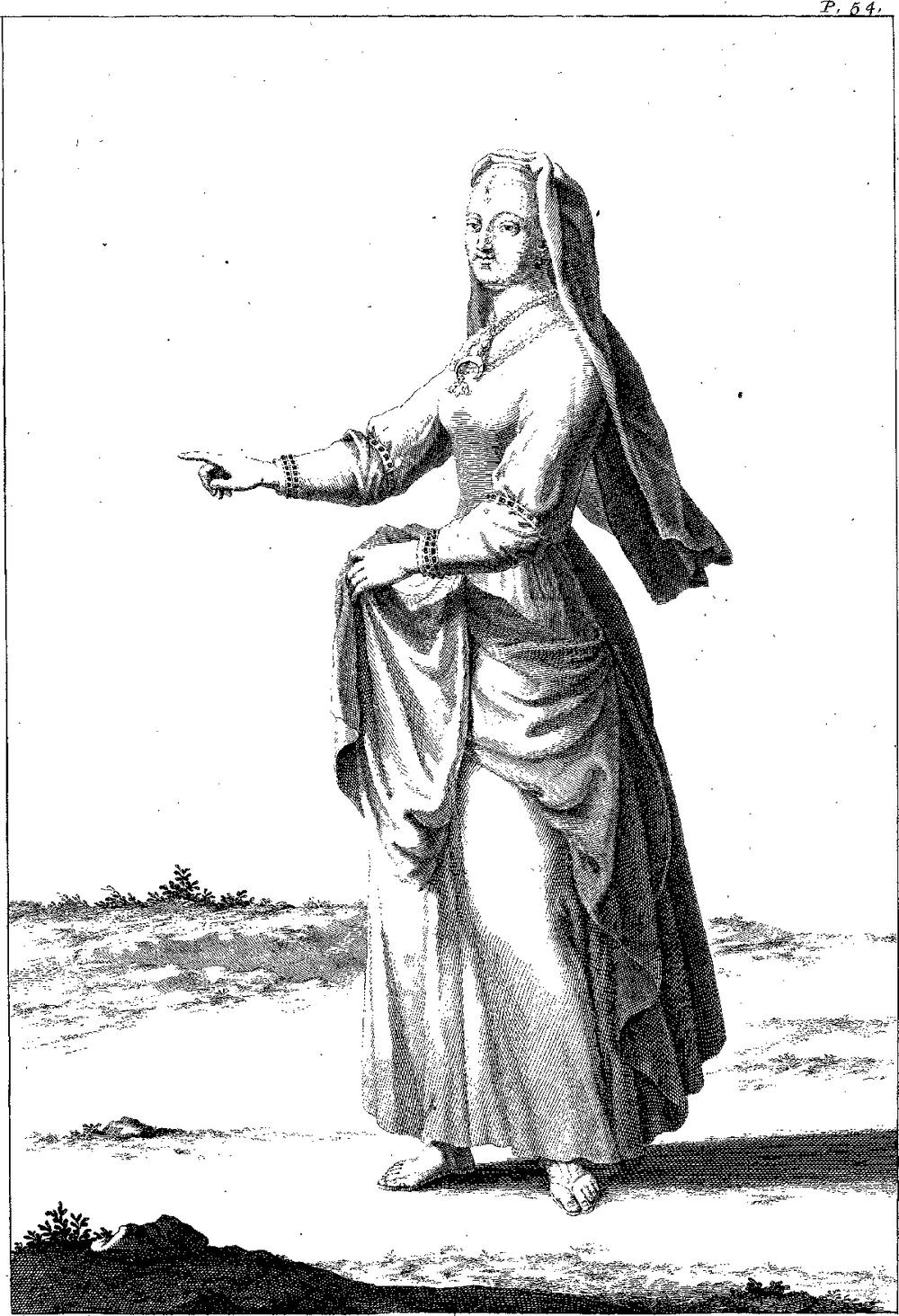
THERISTRUM, a Greek Word, which signifies a Veil or Scarf, with which the Women of Quality covered their Faces in the Summer time, to keep off the Heat of the Sun. St. Jerome uses this Word to express the Veil with which Tamar covered herself, when she had a mind to be in Disguise.23 It answers to the Hebrew Word Tzaiph, which is translated by a Veil, a Scarf, a Mantle, with which the Eastern Women covered their Head and Face. We read the same Term in Gen. xxiv. 65. where the Vulgate insinuates that Rebecca covered herself with her Mantle: Accepit pallium suum. We read also Theristrum in the Latin Text of Isaiah iii. 23.24 But the Hebrew has Hardidim, which the Septuagint render by Veils to sit at Table in. Others render it by very fine Veils, which the Women used in the Summer. They wore their Bracelets upon their Arms and Legs, next to their Skin; and the Veil covered their Face, Neck, Bosom, and Shoulders, when they were at Home: The Girdle was very precious, and their Sandals probably were adorned with Soles of Gold. The Veil was a kind of Crape, so that they could see through it; or at least a Passage was left for the Light to come to their Eyes.
THERMUTHIS. This is the Name that Josephus gives to the Daughter of Pharaoh King of Egypt,25 who took up Moses out of the River Nile, adopted him for her own Son, and had him instructed in all the Learning of the Egyptians. The Scripture does not tell us the Name of this Syncell. Chronol. p. 120.Princess; others call her Pharia.
THESSALONIANS, Christians of Thessalonica. St. Paul being obliged to quit Thessalonica, as will be said in the next Article, retired to Berea, where he left Timothy and Silas, to confirm the Churches of Macedonia. From thence he went to Athens, and from Athens to Corinth, where, after some Months, Silas and Timothy came to him, and informed him of the Condition of the Church of Thessalonica; who persisted in the Faith, notwithstanding the Persecutions and Sufferings to which they were exposed. They told him also, that there were some among them who afflicted themselves too much for the Death of their Relations, and who were not sufficiently instructed as concerning the Coming of our Lord, and the Last Judgment. They informed him also, that some of them were vain, inquisitive, and restless.
Ist Epist. to the Thessalonians, in the Year of Christ 52 or 53.St. Paul therefore wrote to them, about the End of the Year 52, or the Beginning of 53, of the Vulgar Æra; and this first
Epistle to the Thessalonians is the first in order of Time of all St. Paul’s Epistles. The ancient Greek Subscriptions, and the Latin Inscriptions, the Syriac, the Arabick, the Coptick, Theodoret, and St. Athanasius, think it was written from Athens. But our more skilful Criticks maintain, and the Series of the History of St. Paul’s Journies sufficiently shews, that it was sent from Corinth. The Apostle instructs them concerning the Last Judgment, and about the Manner and Measure wherewith Christians should be afflicted for the Death of their Relations. He expresses much Affection and Tenderness for them, and an earnest Desire of coming to see them. He reproves them with much Mildness and Prudence, mixing Strokes of Praise, and Marks of Tenderness, with his Reprehensions.
IId. Epist. to the Thessalonians, in Year 53.The Second Epistle to the Thessalonians was written from Corinth, a little time after the First, about the Beginning of the Year 53 of the Common Æra. In this St. Paul animates the Thessalonians against the Fears that certain Persons had inspired into them upon a false Interpretation of his former Epistle, as if he had said, that the Day of the Lord was at hand; or even by foisting upon him a false Letter, which he had not writ at all. He exhorts them to continue stedfast in the Doctrine and Traditions that he had taught them, and to suffer with Constancy the Persecutions that were raised against them on this account. He reproves more vehemently than he had done before, those that live in Idleness and vain Curiosity: He would have them take notice of these People, and separate from them, that at least they might be ashamed of their trifling, and reform it. He signs the Letter with his own Hand, and desires them to mark it well, that they might not be imposed on by suppostitious Letters written in his Name.
We think Nero and Simon Magus to be the Figure, one of that wicked Person who 2 Thess. ii. 3, 4. 2 Thess. ii. 7.worketh the mystery of iniquity, and the other of that man of sin, the son of perdition, who was to exalt himself above all that is called God; and that the Revolt of the Jews against the Romans, is the Figure or Representation of the last Revolt of the People against the Roman Empire, and the Apostacy of Christians against Jesus Christ, and against his Church. The Mystery of Iniquity already worked under the Government of Claudius, and when St. Paul wrote this Epistle; but it did not break out till under the Empire of Nero, when this Prince displayed all his wicked Inclinations, and supported Simon Magus by his Favour and Protection, who was the most dangerous of all Impostors. But Simon and Nero themselves, were but the Figure of that Antichrist which was to appear at the end of some Ages, to persecute the Church of Christ, and to put a Period to the Roman Empire.
Some Ancients have thought this Epistle to have been sent from Athens; others that it was written from Rome, or from Laodicea; but there are no good Proofs for any of these Opinions. Grotius will have it to have been written a long time before the First to the Thessalonians, and that it was directed to Jason the Jew, Kinsman to Silas and Timothy, and to other Judaizing Christians who had withdrawn out of Syria and Palestine, after the Persecution begun at the Death of St. Stephen, and were come as far as Thessalonica. He fixes the Epoch of this Epistle in the second Year of Caius. The Confutation of this Opinion may be seen in Bochart’s Letter to M. De Sarrau, Tom. 3. p. 1044. Edit. Leid. Henric. Maurus, l. 2. c. 21. and in our Preface to the Second Epistle to the Thessalonians.
Acts xvii. 1, 2, 3, &c.THESSALONICA, a famous City in Macedonia, and Capital of this Kingdom, standing upon the Thesmaick Sea. Stephen of Bizantium says, that it was improved and beautified by Philip King of Macedon, and called Thessalonica, in Memory of the Victory that he obtained over the Thessalians. Its old Name was Thesma: But Strabo, and some others, will have it, that it took its Name from Thessalonica, the Wife of Cassander and Daughter of Philip. There were a good number of Jews there, who were in possession of a Synagogue. St. Paul came thither in the Year 52 of the Vulgar Æra, and entring into the Synagogue, according to his Custom, he preached to the Congregation out of the Scriptures for three Sabbath-Days successively, proving to them that Jesus was the Christ, and that of necessity he was to suffer, and to rise again from the Dead. Some Jews were converted to Jesus Christ, as also a great Multitude of Gentiles that feared God, and many Women of Quality. But the rest of the Jews, being possessed by a false Zeal, raised a great Commotion in the City, and came in a Tumult to the House of Jason, intending to seize Paul and Silas who lodged there, and to take them before the Magistrates. But finding neither Paul nor Silas there, they laid hold of Jason, and others of the Brethren, dragging them before the Magistrates with a great Cry, and saying that these People were Rebels and Traitors against Cæsar, maintaining there was another King, called Jesus, to whom their Allegiance was due. However, Jason and the rest giving in Security, they were set at liberty; and the
same Night the Brethren conducted Paul and Silas out of the City, on their way to Berea.
1. THEUDAS, or Theodas. Gamaliel, in the Acts of the Apostles, says,26 that one Theudas set himself up some time before, and pretended to be some great Person: About four hundred Men joined themselves to him; but he was killed, and all those that believed in him were dispersed, and the matter came to nothing. Usher thinks that Theudas is the same as Judas, who revolted at the Death of Herod, and who is mentioned by Josephus.27
2. THEUDAS, an Impostor, who appeared in Judea28 in the time of Cuspius Fadus, the Governor. This Man gave himself out for a Prophet, and pretended to be inspired. He deceived many Jews, persuading them to forsake all they had, and to follow him to Jordan, where they were to pass over dry-shod, as Joshua had done heretofore. Fadus sent some Troops of Horse after them, who killed and took many of them, and brought Theudas’s Head to Jerusalem. This Theudas is much more modern than he mention’d by Gamaliel, in his Discourse in favour of the Apostles. For that happened Acts v. 36.in the 3329 Year of the Vulgar Æra; whereas the Defeat of the other Theudas by Fadus did not happen till the Year 45. Yet, for all this, several have confounded these two Theudas’s. See the Commentators upon Acts v. 36.
THIGH. When Abraham sent his Servant Eliezer to seek a Wife for his Son Gen. xxiv. 2, 3.Isaac, he said to him, Put, I pray thee, thy hand under my thigh, and I will make thee swear by the Lord, the God of heaven, and the God of the earth, that thou shalt not take a wife unto my son of the daughters of the Canaanites among whom I dwell: Jacob, on his Death-bead, says the same to his Son Gen. xlvii. 29.Joseph; If now I have found grace in thy sight, put, I pray thee, thy hand under my thigh, and deal kindly and truly with me, and bury me not, I pray thee, in Egypt. From that time we do not perceive that upon any Occasion the Jews made use of this Ceremony in their Oaths or Abjurations. We are ignorant of the Motives of this Ceremony, and all the Conjectures of Commentators hereupon are little satisfactory. The Jews thinkd that by this Action the Patriarchs intended to require an Oath by Circumcision, which was then the Symbol of the true Religion. Others, that they were made to swear by the Messiah, who, according to the Language of the Jews, was to proceed out of the Thighs or Joseph. Antiq. l. 1. c. 24.Loins of the Patriarchs. Josephus says, that this Practice was still retained in his time; and we are assured that the modern Jews still keep up the use of this manner of Swearing.
Gen. xlvi. 26.The souls that came out of the loins, or Thighs, of Jacob, is as much as to say, the Persons that proceeded immediately from him, or mediately, by his Sons and Daughters. This way of Expression is very common in Scripture.
Psal. xliv. 4. Cant. iii. 8.The Jews wore their Swords, or Cutlasses, at their Thigh: Accingere gladio tuo super femur tuum. And in the Canticles, Uniuscujusque ensis super femur suum, propter timores nocturnos.
Jerem. xxxi. 19.To strike upon the Thigh was the Mark of a great Consternation, of great Affliction: Postquam ostendisti mihi, percussi femur meum: And Ezekiel, xxi. 12. Clama & ulula ------ quia gladio traditi sunt, idcirco plaude super femur. In the Book of Judg. xv. 8.Judges it is observable, that Samson was the Cause of so many Misfortunes to the Philistines, that they put their Leg upon their Thigh: Ita ut stupentes suram femori imponerent: They remained struck with Astonishment, and lost all Resolution; holding their Legs upon their Thighs, or, bringing the Calf of their Leg against their Thigh, they express their Surprize. The Hebrew has it, He struck their Thigh against their Leg, or their Thigh and Leg together: He beat them Back and Belly, he routed them Horse and Foot, the Runaways as well as those that made resistance: Or, he smote them Hip and Thigh, as we should say in our Language; he cut off both Legs and Arms.
Tob. i. 2. Ex Onom.THISBE, the Country of Tobit. It was to the Right-hand, that is, to the South of the City of Cadesh, the Capital of Naphthali. Some have thought that Elijah the Reland. Palæst. T. 2. p. 1035.Tishbite was a Native of the City of Thisbe in Galilee, but that he had been for a long time an Inhabitant of the Country of 1 Kings xvii. 1.Gilead: Elijah the Tishbite, who was of the Inhabitants of Gilead.
THOMAS, the Apostle, otherwise called Didymus, which in Greek signifies a Twin. The Hebrew Name Thomas signifies Euseb. l. 1. c. 13.also the same thing.e Eusebius seems to say that he was also called Jude, when he relates that Jude, otherwise called Thomas, sent St. Thaddeus the Disciple to Edessa, to King Abgarus. Some Editions of Eusebius call this Thaddeus the Brother of Thomas. No doubt is made but that
St. Thomas was a Galilean, as well as the other Apostles; but the Place of his Birth, and the Circumstances of his Vocation, are unknown. He was appointed an Apostle in the 31st Year of the Vulgar Æra, and continued Luke vi. 13,14,15.to follow our Saviour during the three Years of his Preaching. We know none of the Particulars of his Life till the 3330 Year of the Vulgar Æra, and a little before the Passion of our Saviour; when Jesus Christ, intending to go to Judea to raise up Lazarus, Thomas said to the rest, Let John xi. 16.us also go, that we may die with him: Let us die with Lazarus; or, Let us die with Jesus Christ; for the Interpreters take it in both Senses. St. Thomas meant by that, that by going to Judea they should be exposed to certain Death; for he knew the Hatred and Malice that the Jews and conceived against Jesus Christ. Some explain these Words, as if he intended to encourage the Apostles to this Resolution; but others Chrysost. in Joan. Hom. 61. p. 398.understand them as a Token of the Fear with which he was seized.
John xiv. 5, 6.At the Last Supper St. Thomas asked Jesus Christ whither he was going, and what way he would take? To which our Saviour answered, I am the way, and the truth, and the life. After the Resurrection, when Jesus Christ appeared to his Apostles, in the Absence of St. Thomas, he so far expressed his Diffidence of what they assured John xx. 19. - - 29.him, as to tell them, Except I shall see in his hands the print of the nails, and put my finger into the print of the nails, and thrust my hand into his side, I will not believe. Eight Days after, Jesus appeared again to all the Apostles, and to St. Thomas, who was then among them. Then Thomas having both seen and touched him,a no longer doubted that it was he, and cry’d out, My Lord, and my God. Then Jesus said to him, Thomas, because thou hast seen me, thou hast believed: Blessed are they that have not seen, and yet have believed. A few Days after, when St. John xxi. 1.--- 13.Thomas and some other Disciples went a Fishing, on the Sea of Galilee, Jesus appeared to them, caused them to take a very great Draught of Fishes, manifested himself to them, and dined with them. The ancient Tradition says, that in the Distribution which the Apostles made of the several Parts of the World, wherein they were to preach the Gospel, the Country of the Parthians fell to the share of St. Thomas.31 ‘Tis added, that he preached to the Medes,
Vol. III. to the Persians, the Carmanians, the Hircanians, the Bactrians, and to the Magians, People that then composed the Empire of the Parthians. The Author of the Imperfect Work upon St. Matthew, says,32 that being arrived at the Country wherein the Magi were still living, who came to worship Jesus Christ at Bethlehem, he baptized them, and made use of them in preaching the Gospel. Several of the Fathers inform us,d that he preached in the Indies; others, that he preached in Ethiopia. See T. 6. Chrysost. Append. Homil. 31.
We have no certain History that informs us what St. Thomas did during the Course of his Preaching. ‘Twas read in certain Apocryphal Books, that were in great esteem among the Manichees, that this Saint having received a Blow from a certain Person, he cursed him, upon which the Man was devoured by a Lion. This Story is read in Abdias, and St. Austin speaks of it in several Places,33 but he rejects the Story, and the Books that contain it, as Apocryphal, and of no Authority. Clemens Alexandrinusf reports, out of Heracleon, a Valentinian Heretick, that St. Thomas did not suffer Martyrdom; but the other Fathers expressly mention, that he died by the Hands of the Infidels. And ‘tis thought that he died at Calamine in the Indies, and that from thence his Body was brought to Edessa, where he was always honoured. The Portugueze pretend, that this Saint suffered Martyrdom at Maliapus in the Indies, and that in this City an ancient Inscription is to be seen, that says he was pierced through by a Lance, at the foot of a Cross, near this City; that his Body was there found in these latter Ages, and carried to Goa, where he is still held in veneration.
But to this is opposed the Tradition of the Greeks, the Esteem shewed by the Essenians to the Body of St. Thomas, the Testimonies of the Fathers, and the Martyrologies, which have mentioned the Body and Remains of St. Thomas so many Ages before this pretended Discovery at Maliapus in the Indies: Lastly, it is maintained, that no good Proof can be given that Calamine is the same as Maliapus. But we have no Intention here to enter upon an Examination of these Matters; they may be consulted who have purposely written upon Ecclesiastical History; as Baronius on the Year 44 of Christ, and M. De Tillemont upon the Article St. Thomas,
T. I.34
T. 1. p. 394. where he points out the Authors that have made any mention of this Saint, and the Originals that may be consulted about him. The Martyrologies take notice of the Death of St. Thomas, or his Translation to Edessa, on December 21, upon which the Latin Church celebrates his Feast to this Day. The Greeks make it upon the 6th of October. The Martyrology of St. Jerome sets down a Festival of this Saint on the 3d of June, and one of his Death on the 9th of February. See Florentinius’s Notes upon the Martyrology of St. Jerome.
Several Apocryphal Works have been imputed to St. Thomas; as his Acts, his Voyages, his Gospel, an Apocalypse, which have been condemned by Pope Gelasius. Abdias speaks of a Book which contained the Voyage of St. Thomas into the Indies, and an account of what he did there. We find the Acts of St. Thomas in Greek Manuscripts, in several Libraries.35 The spurious Gospel of St. Thomas was composed by Cyrill. Cathech. 6.Thomas the Disciple of Manes; and this Gospel was probably the same as that false one of the Infancy of Jesus, which M. Fabricius has printed in his Collection of the Apocryphal Writings of the New Testament. We have already mentioned the Story of a Man’s being torn in pieces by a Lion, after having been cursed by St. Thomas: This was probably taken out of the false Acts of St. Thomas, and is found in Abdias. ‘Tis also cited out of his Acts, that he baptized not with Water, but with Oil; which was also imitated by the Manichees.
There are Christians in the East-Indies which go by the Name of St. Thomas, because it is thought that St. Thomas preached the Gospel to them. They dwell in a Peninsula of the Indus, on this side the Gulph. There are also many in the Kingdom of Cranganor, and in the neighbouring Places; as also at Nagapatan, at Melcapar, at Engamar, beyond Cochin, where their Archbishop resides, who is under the Jurisdiction of the Patriarch of Babylon. ‘Tis said that the first Christians of the Indies, converted by St. Thomas, relapsed again into their former Infidelity, and so far forgot the Instructions they had received from this Apostle, that they did not so much as remember there had ever been any Christians in their Country: So that a certain holy Man, called Mar-Thome, or Lord Thomas, a Syrian by Nation, went again to carry the Light of the Gospel into those Parts. He converted a great number of the People, with the Assistance of some Priests of Syria and Egypt, whom he invited thither. The Christians of St. Thomas are infected with several Errors, but chiefly Nestorianism: And I am much inclined to believe, that they derived the Name of Christians of St. Thomas only because of this Mar-Thome, their Apostle, whom we just now mentioned.
St. Thomas is generally represented with a Carpenter’s Rule, and a Square; and in his Life, written by Abdias, ‘tis said that this Saint undertook to build a magnificent Palace for Gondosar King of the Indies; and that he told this Prince he was the Servant of a very skilful Architect, and that he was very knowing in whatever belonged to Works of Wood or Stone, and all sorts of Buildings. But the Edifice he spoke of was that which the Blessed hope for in Heaven, and which they build upon Earth, by the Practice of Virtue and Good-Works. And the Inscription of Malabar intimates that St. Thomas came into that Country, having in his Hand Regulam fabri lignarii, & palum; a Carpenter’s Rule, and a piece of Timber. ‘Tis also told, that when he first came into the Indies, he undertook to draw and move a great Beam or piece of Timber, without any Assistance, which could not be moved out of its Place by all the Labour and Industry of the Inhabitants. He tied his Girdle to it, and drew it after him, like a little Stick: The King of Maliapus was so affected with this Miracle, that he, and all his People were converted. These Facts have no great Credit, but have been sufficient to justify Painters and Sculptors, to represent St. Thomas under the Appearance of a Mason or Carpenter.
Many have affirmed36 that St. Thomas preached in China. This Opinion is founded upon the Breviary of the Syrians, where we read these Words: By St. Thomas the Error of Idolatry was subdued in the Indies: By St. Thomas the Chinese and Æthiopians were converted to the knowledge of the Truth: By St. Thomas the Kingdom of Heaven has taken wing, and penetrated as far as China. Hence they pretend that he went as far as the Indies, where he suffered Martyrdom, according to the Tradition of the Churches of Malabar, in the City of Calamine, a City altogether unknown, and which perhaps never had any Being. It is certain that the Knowledge of the Christian Religion is ancient in China: In a Collection of Canons we find one that speaks of the Metropolitans of China. The two Arabians, whose Travels have been lately published,37 own that the King of China had some Knowledge of Jesus Christ and his Apo
stles. The say, that in their Journey they passed through Bezomna, that is to say, the Church of St. Thomas. Yet Father Couplet has often testified, that the Histories of China make no mention of the Preaching of Christianity in China; not even that wherein we find the Chinese and Syrian Inscription, of which we are going to speak.
This Inscription was found in 1628, in the City of Siganfu, the Capital of the Province of Xensi. It is in Chinese Characters, with several Lines in Syriac, and was made in the Year of Christ 780,a which answers to the Æra of the Greeks, or of the Seleucidæ, 1092. It says that in the Year which answers to the 636th of Jesus Christ, a holy Man, called Olopuen, or Lopuen, guided by the blue Clouds, and observing the Course of the Winds, came from Tacin, or from Syria, or Judea into China, and there taught the Christian Religion. But it is easy to perceive, that all this can have no relation to St. Thomas, who lived six hundred Years before. It was not Olopuen that made the Inscription, but the Christians, his Successors. Besides, we know nothing of this Mission, but by the Words of the Inscription there found, which they have had much Difficulty to decypher. Those that settled this Chinese Church were of the Sect of the Nestorians. The Authors of the Inscription name Hananjubna Patriarch of the Nestorians, who lived at that time; and in the Notitia of the several Metropolis’s of the Nestorian Church, we find a Metropolitan of China. But nothing of all this can persuade us, that St. Thomas the Apostle ever preached in this Country.
Here is the Translation of the famous Chinese Inscription, found in 1625. The Abbot Renaudot has corrected it after those who at first gave the Explication of it, and has printed it in his Notes upon the Account of the Travels of two Arabian Mahometans to China, printed at Paris, in Octavo, by Coignard, 1718.
Of Christ 780.“ In the Year of the Greeks MXCII, “ Mark Isdebuzid, Priest and Bishop of “ Cumdan,b a Royal City of the East, otherwise called Milice, (or Melece) Priest “ of Balth, a City of Turkhestan, set up “ this Table of Stone, in which is described the Mystery of the Life of our “ Saviour, and the Preaching of our Fathers before the Kings of China, in the “ time of the Father of Fathers Hanan- “ jubnah, the Catholick Patriarch.c a Christianity was known in China from the Year 636, and consequently 146 Years before the Erection of the Chinese Monument. b ‘Tis the City of Nanquin which was then the Capital of China. It was known to the Arabians by the Name of Cumdan. c He was Patriarch in 782. “ Adam, Deacon, Son of Isdebuzid, “ Bishop. “ Morsargis, Priest and Bishop. “ Sbar Jesua, (that is, Hope of Jesus) “ Priest. “ Gabriel, Priest and Archdeacon, and “ Head of the City of Cumbdan “ and Disrag. “ Adam-So, Deacon of the Bishop “ Papas of the Chinese.
In the Days of the Father of Fathers, Hananjuhnah, the Catholick Patriarch.
The Names of the Apostolical Men that are inscribed on the Margins of the Stone in Syriac Characters.
First Rank.
Aaron. Peter. Job. Luke, Matthew. John. Sbar-Jesua. Jesu-Adad. Luke. Constance. Noah.
Second Rank.
Atdaspha. John. Anusc. Marsargis. Isaac. Simeon. Isaac. Joel.
Third Rank.
Mar-Jubanon, Bishop. Isaac, Priest. Joel, Priest. Maher, Priest. George, Priest. Mahada Gunnesph, Priest. Maschadad, Priest. Andrew, Priest. Andrew II. Priest. David, Priest. Moses, Priest.
Fourth Rank.
Isaac, Priest. Elias, Priest. Moses, Priest. Abad-Jesua. Simeon, Priest. Gabriel. John. Simeon. Isaac. John.
Fifth Rank.
Jacob, Priest. Marsargis, Priest and Bishop. Haggai, Priest, Archdeacon of the City of Cumbden.
Paul, Priest. Simeon, Priest. Adam, Priest. Elias, Priest. Isaac, Priest. John, Priest. John II. Priest. Simeon, Priest.
Sixth Rank.
Jacob, Priest. Abad-Jesua, Priest. Jesu-Adad, Priest. Jacob. John. Subcholmoran (Praise to our Lord). Mor Joseph. Simeon. Ephraim. Ananias. Cyriacus. Amiun.
At the Top of each of the six Columns which compose the Chinese Monument, is a Chinese Explication of some one of the Mysteries of the Christian Religion. At the Head of the first Column is imitated the Existence of One only God, divided into Three Persons, the Creator of all Things. The Word Eloho is used therein, which in Syriac signifies God.
The second and third Columns continue to explain the Creation of the World, the Fall of the first Man by the Treachery of the Devil, who is there called Satan, a Word foreign to the Chinese Language.
The fourth explains the Coming of Jesus Christ, by his Incarnation, in these Terms: Donec personarum trium una communicavit seipsum clarissimo venerabilissimoque mixio, operiendo, abscondendoque veram Majestatem, simul homo prodiit in sæculum: Words which plainly express the Manner in which the Nestorians explain the Mystery of the Incarnation. It speaks of the Annunciation by the Angel, of the Appearance of the Star, and the Adoration of the Magi.
The fifth Column, the sixth, and the rest, speak of the Sacrament of Baptism, and of the other Ceremonies of the Christian Religion; as, that they sacrifice turning towards the East; that seven times a-day they prefer their Prayers for the Living and for the Dead; that they offer their Sacrifice on the first Day of the Week; that they wear their Beards long; that they shave the top of the Head; that they have no Attendance of Slaves; that they are not studious to gather Riches, that they give Alms liberally; that they fast, &c. Marks which agree well with the Syrian Christians of the East.
THOR, a little City and Sea-port upon the Red Sea, at the foot of Mount Sinai, and to the West of it, from which it is distant about fifty Miles. At half a League from Thor they shew a Garden, wherein there are twelve Fountains, and several Palm-trees: ‘Tis thought that this is the Place that the Scripture calls Elim, where were twelve wells of water, and threescore and ten palm-trees. The twelve Wells are there to be seen still, but they are become bitter; and, instead of threescore and ten Palm-trees, there are now more than two thousand. I do not know that Thor is mentioned in any place in Scripture. ‘Tis in this Place that some have fancy’d to be a Mountain of Loadstone, which, they say, drew towards it such Vessels as had any quantity of Iron, and occasioned them to be shipwreck’d. The Remedy for this was to join the Parts of the Ships together only with Pegs of Wood. Some Arabian Authors ascribe this Faculty to the Mountain of Almandab, upon the Borders of Ethiopia, at the Beginning of the Red Sea, towards the South. But the Moderns find nothing of this attractive Quality, either upon the Coasts of Thor, or at Cape Almandab; and it is very probable, that what has been said of this matter is altogether fabulous. Thor, Al-thor, or Al-tour, is the Name that the Arabians give to Mount Sinai.
THORNS. The Crown of Thorns, with which our Saviour was crowned at his Passion, has given a good deal of Exercise to learned Men. Thomas Bartholine has made a Dissertation upon this Subject, which is printed with his Treatise upon the Cross of our Saviour. All the Evangelists take express notice that our Saviour was crowned with Thorns: But they do
Thorns continues on the next page
Footnotes
-
Nahum iii. 8. No-ammon. Jerem. xlvi. 25. Ammon de No. Ezek. xxx. 14, 16. It is called only No, and Ver. 15. Hammon-No. ↩
-
Ham, or Cham. or No-Hammon, or No-Ammon. ↩
-
Cato apud Stephan. Bizant. Eustachius allows it 420 Stadia. Comment. in Noimum. Diodorus Siculus l. 1. gives it but 140 Stadia; but probably he speaks only of new Thebes, or Diospolis. ↩
-
Manners of the Arabians, by M. d’Atvieux. c. 13. p. ↩
-
Aug. l. 3. c. 15. de consensu Evangelist. Ambros. in Lucam. Hieronym. in Matth. ↩
-
Origen. in Matth. Homil. 35. Chrysost. in Luc. Ambros. in Luc. Hieronym. in Matth. ↩
-
Hilar. de Trinit. l. x. & in Psal. lxvi. Hieronym. Ep. 13. Aug. l. 1. c. 9. de Anima. ↩
-
Aug. Ep. 187. nov. edit. n. 5, 6, 7. Cyril. Hierosol. Cathech. 13. Chrysost. T. 5. Homil. 32. Encisen. Homil. 23, &c. ↩
-
Joseph. l. 1. contr. Appian. p. 1038. Οὐ μὴν οὐδὲ πρὸς λῃστείας ὥσπερ ἄλλοι τινὲς, ἢ τὸ πλέον ἔχειν. ↩
-
Abrah. Zacuth. in Sepher. Inchasim. & Gemar. Babil. ad titul. Sanhedr. c. 11. ↩
-
Sap. x. 17. Reddidit Deus justis mercedem laborum suorum. - - - - Justi tulerunt spolia impiorum. See Melchior Can. de locis Theolog. l. 2. c. 4. ↩
-
Joseph. cont. Appian. l. 2. Θεοκρατίαν ἀπέφηνε τὸ πολίτευμα, Θεῷ μᾶλλον μόνῳ τὴν ἀρχὴν καὶ τὸ κράτος ἀναθείς. ↩
-
Epiphan de ponderib & mensur. ↩
-
Iren. de hæres. l. 3. c. 24. & Synopf. Athanaf. ↩
-
Vide Hieron. præfat. in Job. ↩
-
Hieron. Commentar. in Ecclesiast. c. 2. ↩
-
Justinian. Novell. 146. Photii Nomocan. xii. 3. ↩
-
Hieron. præfat. in Version. Daniel. in præfat. ad Com. in eund. ↩
-
Idem. præfat. in Pent. & præfat. ad lib. Paral. & Epist. ad August. ↩
-
Ita ferè Origen. Homil. 1. in Luc. Ambros. in Luc. Epiphan. hæres. 51. Beda, Camerar. Hammond. in Luc. ↩
-
Θεραπευταὶ. Vid. Philo de vitâ contemplat. ↩
-
Euseb. Hist. Eccles. l. 2. c. 17. Hieron. de Viris illust. c. 8. Epiph. Hæres. 29. c. 5. Cassian. instit. l. 2. c. 5, &c. ↩
-
Gen. xxxviii. 14. 70. ↩
-
Hardidim. 70. ↩
-
Joseph. Antiq. l. 2. c. 5. p. 56. ↩
-
Acts v. 36. Gamaliel said this in the 33d Year of the Vulgar Æra ↩
-
Joseph. Antiq. l. 17. c. 12. In the Year of the World 4001, of Jesus Christ 1, and five before the Vulgar Æra. ↩
-
Joseph. Antiq. l. 20. c. 2. of the Vulgar Æra 45. ↩
-
Chaldæi Interpr. & Hæbræi apud Hieron. qu. Hebr. in Genes. John xx. 24. Θωμᾶς ὁ λεγόμενος Δίδυμος. The Hebrew Word תאוםsignifies also a Twin. a ‘Tis the common Opinion of the Fathers that he touched him; but the Gospel does not mention it directly. St. Austin thinks the matter not to be indubitable. Aug. in Joan. Homil. 121. p. 228. & Serm. 158. p. 762. ↩
-
Greg. Naz. Orat. 25. Hieron. Ep. 148. Ambros. in Psal. xlv. Paulin. carm. 26. alii plures. ↩
-
Origen. apud. Euseb. l. 3. c. 1. Hist. Eccles. Rufin. l. x. c. 9. Recognit. l. 9. c. 29. ↩
-
Opus imperf. in Matth. Homil. 2. ↩
-
Aug. l. 1. c. 20. de Serm. Domini in monte. In Adimant. c. 17. in Faust. l. 22. c. 79. ↩
-
Clem. Alex. Strom. l. 4. p. 502. ↩
-
Vide Fabricii Notas in Abdiam, p. 689, 768, &c. ↩
-
Memoirs of China, T. 2. p. 195. Kircher, Sina illustrata, Trigant, &c. ↩
-
Ancient Accounts of the Indies, translated from the Arabick. Paris, 1718. p. 13. 146. ↩