EXPIATION. The Hebrews had several sorts of expiatory sacrifices, for sins of ignorance committed contrary to the Law, See Levit. iv.and for purifying themselves from certain legal pollutions, which were looked upon as indecencies, or even as faults, which required to be Expiated by certain victims. For example, a woman after lying in, and Levit. xii. 6, 7. Ib.xiv.4,5, & seq.a leper when he was cleansed of his leprosy, were to offer sacrifices, in order to be purified; in like manner as they, who, having touched something impure, had forgotten or neglected to purify themselves at the time and in the manner which the Ib. v. 1, 2, 3.Law prescribes. These Expiatory Sacrifices of themselves did not remit real faults committed against God, they did not take away the deformity of Sin, which is displeasing unto God; but did no more than repair the legal and external fault, and secure the transgressor from the temporal penalty, wherewith God, or the Judges punished those faults, when any one neglected to atone for them in the ways appointed by the Law.
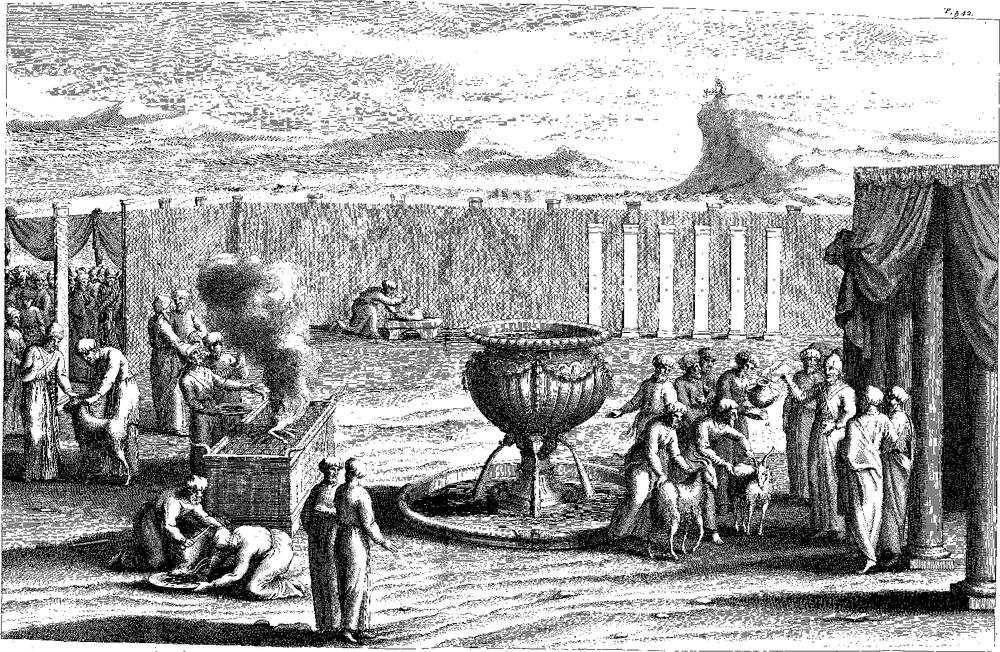
The ceremonies observed when any IsraeliteIb. iv. 27, 28, &c. Ib. iv. 28. offered a sacrifice for sin, were these: He brought his victim to the Tabernacle, put his hand upon the beast’s head, confessed his fault, and slew his victim in the court, at the place where the burnt-offerings were offered, to the North of the Altar. The Priest took the blood of the beast, with some of it upon his fingers he touched the horns of the Altar of burnt-offerings, poured out the remainder of the blood at the foot of the Altar, took away all the fat which covered the intestines and kidneys of the victim, and burnt it upon the Altar. Lastly, the Priest prayed for him, who offered the sacrifice, and his fault was pardoned.
For a sin-offering they might offer a goat, or a ram, a lamb or a kid, or two pigeons; Ib. iv. 32. Ib. v. 15. Ib. vers. 11.or lastly, the poorer part of them an offering of some meal. There were particular ceremonies, when the High Priest, or any Prince of the people, or all the people were fallen into any trespasses. But in the main they were almost always the same. The flesh of such beasts as Ib. vii. 5, 6, 7.were offered for the Expiation of sin, belonged to the Priests. No stranger had a right to taste of it.
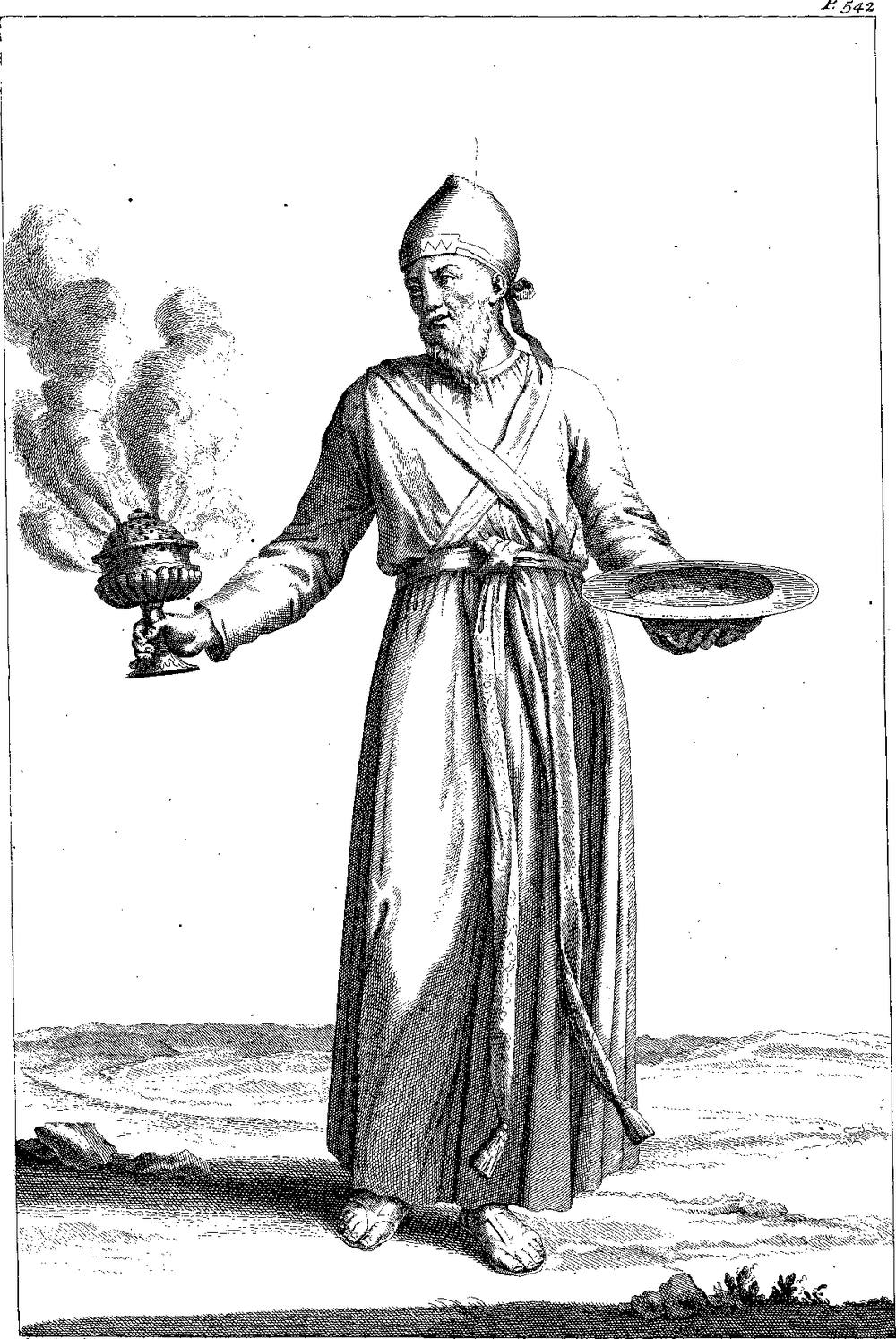
Expiation. The great Day of Expiation. This was kept upon the tenth day of the month Tizri, which answers to our September. The Hebrews call it Kippur or Chippur, that is to say, Pardon or Expiation, because the faults of the whole year were then Expiated. The principal ceremonies at that time observed, were such as follow. The High Priest after he had washed not only his hands and feet, as usual in common sacrifices, but his whole body, dressed himself Ib. xxi. 4.in plain linen like the rest of the Priests. He then neither wore his purple robe, nor the Ephod, nor the Pectoral, because he was going to Expiate his own and the people’s sins. He first of all offered a bullock and a ram for his own sins, and those of all the other Priests. He put his hands upon the heads of these victims, and confessed his own sins, and the sins of his house; then he received from the Princes of the people two goats for a sin-offering, and a ram for a burnt-offering to be offered in the name of all the multitude.
It was determined by lot which of the two goats should be sacrificed, and which set at liberty. After this, he put some of the sacred fire of the Altar of burnt-offerings into a Censer, threw incense upon it, and entred thus into the Sanctuary. After he had perfumed it, he went out, took some of the blood belonging to the young bullock which he had sacrificed, carried it into the Sanctuary, and dipping his finger in it, he sprinkled it seven times between the Ark and the Vail, which separated the Holy of the Sanctuary. Then he came out a second time, and beside the Altar of burnt-offerings killed the goat, upon which the lot was fallen to be sacrificed. The blood of it he carried into the Sanctuary, and sprinkled it seven times between the Ark and the Vail, which separated the Holy of the Sanctuary. From thence he returned into the Court of the Tabernacle, and sprinkled both sides of it with the blood of the goat; while all this was doing, none of the Priests or people were permitted to be in the Tabernacle, or in the Court. After this he came to the Altar of burnt-offerings, moistened the four horns of it with the blood of the goat, and young bullock, and sprinkled it seven times with the same blood.
The Sanctuary, the Court, and the Altar being thus purified, the High Priest directed the goat which was intended to be set at liberty, to be brought to him.
iv. 1, 2, 3. & c. He put his hand upon the goat’s head, confessed his sins, and the sins of the people, and then gave the goat to one prepared for this purpose, who was to carry it into some desart place, and let it loose, or, as others say, throw it down some precipice. See what has been said upon Azazel. This ceremony being over, the High Priest washed himself all over in the Tabernacle, and putting on other clothes, some say his Pontifical dress, that is to say, his Robe of purple, the Ephod, and the Pectoral, he sacrificed two rams for a burnt-offering, one for himself, the other for the people.
The great Day of Expiation was one of the principal solemnities of the Hebrews. It was a day of rest, and strict fasting; they confessed themselves ten times on this day, reckoning from the Eve before supper, in memory of the High Priest’s pronouncing the name of God ten times in this solemnity. The manner wherein this confession is Buxtorf. Synag. Jud. c. 20.performed, is as follows. Two Jews retire to a corner of the Synagogue, he who confesses himself, turns his face to the North, and his back to the South, bends his body very low, lays his back bare, confesses his sins, and strikes his breast, as often as he who receives his confession whips him with a leather strap, wherewith he gives him nine and thirty lashes, and at the same time repeats these words, Psalm lxxviii. 38. But the Lord was merciful, he forgave their misdeeds, and destroyed them not; yea, many a time turned he his wrath away, and would not suffer his whole displeasure to arise.
Upon this day they are reconciled with each other; he who has offended his neighbour goes to him the night before, and asks his pardon; if he, who has been offended, will not forgive him, the former takes three persons with him, comes to him, and again asks forgiveness two or three times: if the other persists obstinately in refusing it, he goes and takes ten men1, with whom he comes once more to him, and in their presence desires him to forgive; and if still refused, he who has taken all these steps, is judged to be absolved, and firmly believes, that he has done enough to merit forgiveness Ibid.in the sight of God. If the person offended is dead, he who desires to make him satisfaction, goes to the place where he is buried, with ten persons in his company, and says before them all, I have sinned against the God of Israel, and against such an one, who is here interred.
Buxtorf says, that they prepare themselves for this solemn day, as soon as the month Tizri begins, which is the first of the civil year ; and that during all the ten days which precede it, they fast, and imploy themselves in acts of penance, and pray to God to divert the evil, which they have deserved. They rise early in the morning, confess themselves three times a day, prosecute no causes, and excommunicate no one. Upon the ninth day of the month, which is that before the day of Expiation, every one takes a white cock, if any of this colour may be found ; if not, then of some other kind of feather, provided it be not red ; repeats some prayers, and striking his head three times with the cock’s head, he says at every blow, This cock shall be for my redemption, shall suffer the death which I have merited, shall be my reconciliation, shall die for me, and I shall go into a life of bliss and immortality with all Israel. After this, he cuts its throat, Buxtorf. Synagog. Jud. c. 20. Ceremonies of the the Jews, part. 3. c. 6.takes out its bowels, picks off the feathers, dresses, and eats it. Leo of Modena says, that this was practised formerly in Italy and in the Levant, but that this custom was suppressed there, because it was acknowledged to be a piece of superstition without any foundation.
Many Jews spend the night which precedes the great day of Expiation, in the Synagogue, and imploy themselves in prayer and penitential exercises. They put on mourning, dress themselves in white or black, and some clothe themselves in that habit, with which they desire to be buried. They go without shoes and stockings, and are at the Synagogue very early. There they go to prayers four times in a solemn manner, in the morning, at noon, in the afternoon, and evening.
You have here some particular ceremonies, and Rabbinical explanations, of what is at this day practised among the Jews2. It was the custom formerly for the High Priest to separate from his wife seven days before this Festival, lest he should contract some pollution with her ; as if it happened that she had the infirmity upon her, which with women is generally periodical. Rabbi Judah maintained, that if the High Priest’s wife died in the interval of these seven days, he immediately married again, that so the Law might be complied with, which appointed him to make Levit. xvi. 17.atonement for himself and for his wife ; or, according to the text, for himself and his *house *: but this determination was not approved by the Sages.
Upon the vigil of the day of Expiation, some of the Elders were presented to the High Priest, who read before him, and exhorted him to read, in order to discover whether he had learned to read, or whether he had not forgotten it. But this precaution was necessary only under the second Temple, when the High Priesthood was sold. These Elders likewise prevented him from eating too much on the night before the festival, lest he should fall asleep. He was after this conducted into the chamber of one Abtinez3, where he was obliged to swear, that he would not change the ancient rites in any particular. It is believed, that this precaution proceeded from the inclination only of the Sadducees, that the High Priest should scatter the perfume before his entrance into the Holy, which was contrary to tradition. We know that Hircanus and Ananus, both High Priests, were Sadducees, and this oath was necessary for people of their stamp. As it seemed injurious to the High Priest, he wept when he took it, the Priests too wept at the consideration of their being obliged to administer it to him.
The night was spent in explaining the Law, or in reading some passages of Job, Esdras, or Daniel. If the Priest was not learned enough to be always discoursing, he had young people on each side of him who played upon the flute, or pushed him in order to awaken him, when he fell asleep, and who continued this exercise till the hour of sacrifice. In the morning they prided themselves in cleaning the Altar, and carrying away the ashes: the very great haste which the Priest made thither, oftentimes occasioned bad accidents ; for while they were pushing one another upon the steps, it sometimes so fell out, that one or other fell down and hurt themselves, which made it necessary to divide the offices. There were generally nine Priests appointed for the morning sacrifice, and eleven for the evening ; but in great solemnities, such as that of the Expiation, ten were ordered for the morning, and twelve for the evening. The Levites were likewise chosen to dress and make ready the victims, four and twenty for a calf, and to each was assigned a part of the beast, which he was to skin or prepare.
Every Priest, before he began his several offices, was to wash himself. The Rabbins say, the High Priest washed himself five times, because he was obliged to change his habit five times ; and as often as he so changed, it was necessary for him to wash himself. These habits were of linnen ; those used in the morning were of linnen of Pelusium, and those wore in the evening of Indian linnen, and cost eight drachms.
Anciently the lots which were drawn for the scape-goat were of wood, but the son of Gamaa made them of Gold. King Mono- Monobasus appointed all the handles of the vessels, which were made use of in the Temple upon the day of expiation, to be made of the same metal.
The High Priest carried into the Sanctuary a Censer of the finest gold, fill’d with perfumes, and begged of God, that the air might be of a good temperature, that the scepter might not be taken out of the hands of Judah that year, that there might be no famine in Israel, and that the prayers of travellers or strangers might not be heard; his prayer was short, lest the people should be frighted if he continued too long in the Sanctuary; for they were persuaded that there was danger continually in going into that place, which God filled with his presence. The High Priest went out of it walking backward, with his eyes directed always towards the ark, or towards the foundation stone, which the Rabbins suppose to have been placed in the middle of the Sanctuary, ever since the Ark was lost under the second Temple. After this he sacrificed a goat, the throat whereof was to be cut in the manner which has been already related.
The Azazel, or scape-goat, was conducted to the precipice by Laymen as well as by the Priests. There was a way or causey prepared purposely on this occasion, and there were tents or ten relays from Jerusalem to the place where he was to be thrown down. This was a dreadful precipice, and so abounding with rocks, that before the goat was faln half way, his limbs were all beat to pieces; and in order to give notice of the execution to the people, who waited for the news of it within the Temple with uneasiness, there were signals raised at proper distances, for the more speedy communication of it. It is affirmed likewise, that at the same time the scarlet ribbon, which was fastned to the Temple-gate, immediately changed colour, and turned white, as a mark that God had accepted the Sacrifice, and that the sins of the people were forgiven. They add, that this miracle ceased forty years before the destruction of the second Temple.
When the ceremony was over, the High Priest read the Law, gave the blessing to the people, changed his dress, and made a great entertainment for joy of his coming unhurt out of the Sanctuary. The people fasted very punctually during all this Holy Day, to which they attributed great effects: for, according to the Jews, repentance, tho’ accompanied with a resolution of living well, does but suspend sins, whereas the feast of Expiation abolishes them entirely, and they who die before this day, expiate them by their death. This is what we learn from the Rabbins, concerning the manner wherein the feast of the Expiation was celebrated of old.
As to the modern Jews, their way of solemnizing it is as follows. They prepare themselves for this great festival the day before by prayer, and by the Sacrifice of a Cock, as has been already observed. After this, they go to the place where they bury the dead, and beg of God to forgive sinners in regard to the memory of the Saints, who are there interred: they plunge into the water, that so the ablution of their sins, thus made, may be entire. They prepare wax candles against the next day; every one carries his own to the Synagogue; the most devout have two, one for the Body, the other for the Soul, by the names whereof they call them.
In the evening when the feast begins, they go to the Synagogue; there every one lights his taper, and all sing with very loud voices. The women at the same time light up candles in their houses, from the brightness whereof, and the consistency of the tallow or wax, they form presages. If the light is clear and bright, they conclude from thence, that their sins are certainly remitted; if it is pale, they are very much disturbed at it; and so likewise if the wax or tallow run, they dread the effects of God’s anger.
The next day, early in the morning, they go to the Synagogue: the whole day is spent in strict fasting, without exception of age or sex; they suffer no one to eat, unless children under twelve years of age. They read a long prayer, wherein they declare, that all the oaths and promises which have been unperformed throughout the course of the whole year, are made void, because the atonement is made for sin. We read in Leviticus what relates to this feast, and the goat Azazel. They continue their prayers all day, and sometimes all the following night. At the conclusion of the festival, the Rabbi gives the blessing to the people with his hands lifted up; and the people out of respect to the Priest’s hand, or rather to the majesty of God whom he represents, put their hands before their eyes, and cover their faces. They found the horn in memory of the Jubilee, and believe that God causes his voice to be heard, declaring his forgiveness of Sins, and that every one may return home with this confidence, that his iniquities are pardoned. Whereupon they go to their respective homes, put on clean, white clothes, sit down to table, and break their fast; for before they had neither eat nor drank all day. After this manner the Jews at present celebrate this Holy Day.
Maimon. de Pœnitent. c. 10. p. 99.They believe, that Adam repented and began his penance on the day of solemn Expiation; that on the same day Abraham was circumcised, and Isaac bound in order to be sacrificed; for which reason they pray to God to forgive them, because of Isaac’s binding. Moreover, they teach, that upon this day Moses descended from mount Sinai with the new tables of the Law. Some change their name, as an indication of their inward change, and that they may address themselves to God, saying, I am another person, it is not I who have committed this sin.
Read this article in its place on the printed pages
Footnotes
-
Translators’ note. Maimonides requires but three on the second day, as well as on the first; after which, he who refuses to be reconciled, incurs the guilt of sin. Tract. de Pœnitentiâ, Cap. II. pag. 52. ↩
-
Basnage hist. des Juifs. t. 5. l. 7. c. 15. art. 5. Misna, Ordo Festorum, &c. ↩
-
This Abtinez formerly presided over those who prepared the perfume, and gave his name to this apartment, built over the water-gate. And without doubt it was for the same reason appointed by the Council of Trent, that people should come to confession at least once a year, that so their sins might not increase to too great a number, or be forgotten by them, and the pardon of them not obtained so easily. ↩