TABERNACLE; in Latin, Tabernaculum; in Greek, Scene; in Hebrew, Obel; which אהלO-hel. Σκήνη. Tabernaculum.Word properly signifies a Tent. The Patriarchs of old lived in Tents or Tabernacles. In the Camp of Israel in Moses’s Time were two Taberna- T.
Exod. xxvi, xxvii.cles, of which frequent mention is made in Scripture. The first was call’d Tabernaculum Conventûs, the Tent of the Congregation, wherein the People assembled for the Dispatch of their ordinary secular Affairs. The other was Tabernaculum Testimonii, the Tent of Testimony, or the Tabernacle of the Lord, or simply the Tabernacle. This was the Place wherein the Israelites, during their Journeyings in the Wilderness, perform’d the chief of their religious Exercises, offer’d their Sacrifices, and worshipp’d the Lord.
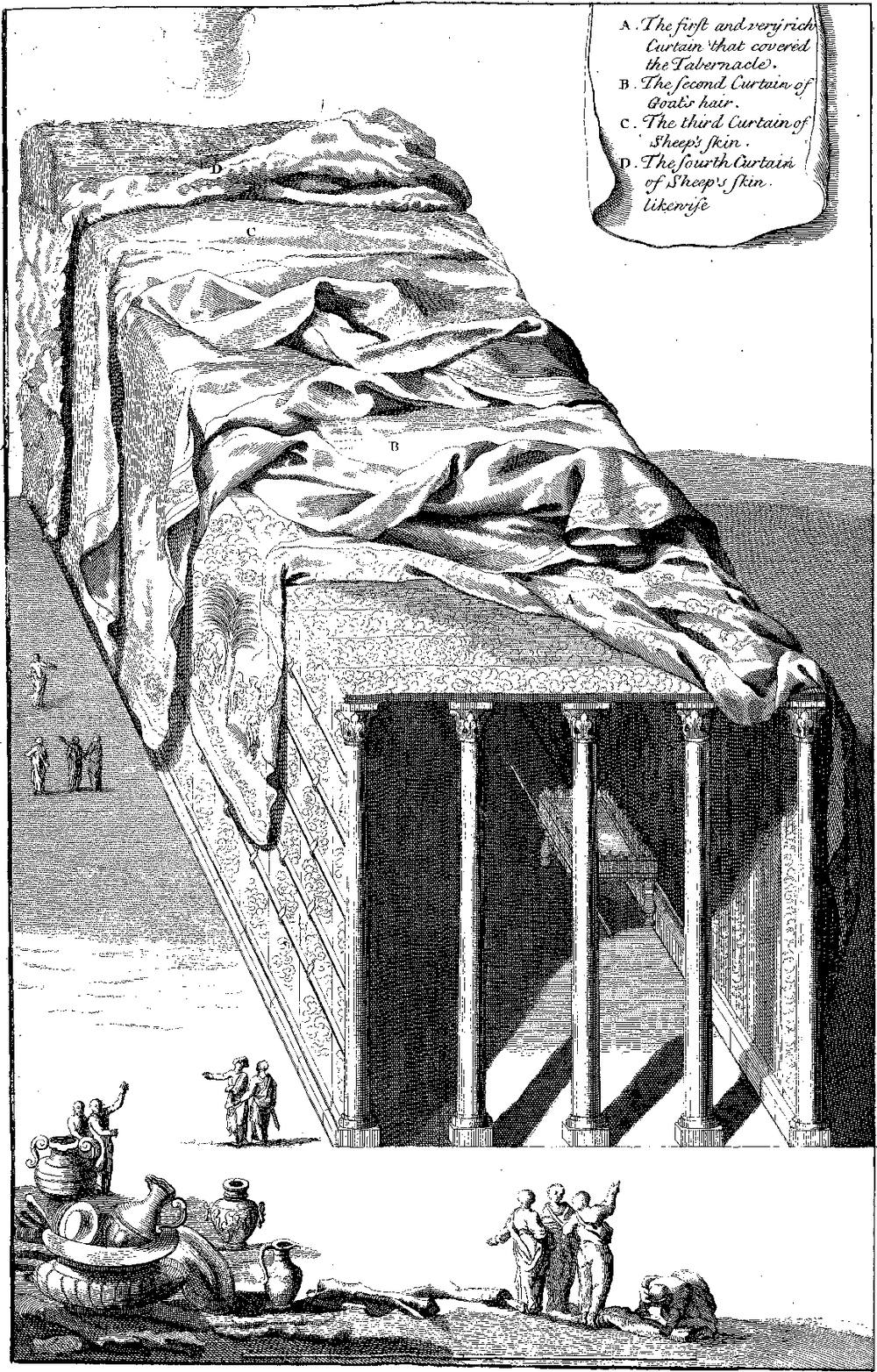
Here is the Description of this Tabernacle: It was an oblong Square, thirty Cubits in length, and ten in breadth and in height. It was divided into two Partitions. The first was call’d the Sanctum, or holy Place, which was twenty Cubits long, and ten wide. Here were placed the Table of Shew-bread, the golden Candlestick with seven Branches, and the golden Altar of Incense. The second Part was the Sanctuary, or Sanctum Sanctorum, whose Length was ten Cubits, and Breadth also ten Cubits. ‘Twas here that the Ark of the Covenant was placed. The Sanctuary was divided from the Sanctum by a Curtain or Veil of very rich Cloth, which hung upon four Pillars of Shittim Wood, that were cover’d with Plates of Gold. And the Sanctum was also inclosed before by a Veil, hung upon five Pillars of Shittim Wood overlaid with Plates of Gold, having their Bases of Brass.
On the West, North and South Sides, the Tabernacle was inclosed by Boards or Planks of Shittim-wood, overlaid with Plates of Gold, having their Bases of Brass. These Boards were eight in Number on the West Side, but on the North and South Sides there were twenty of them. They were all of an equal Height, which was ten Cubits, and the Breadth of each was a Cubit and half. They were let into each other by two Tenons above and below. And as the whole Machine of the Tabernacle was to be moveable, and was to be often taken down, these Boards were carry’d by two Bases, wherein were two Mortice-holes, by which they were joined together. And to support them, each had five golden Rings, at proper Distances; through which they put five Poles of Shittim-wood, cover’d with Plates of Gold, which supported the whole Machine.
Ex. xxvi. 1, 2, 3, &c.The Tabernacle had no Window. It was cover’d with several Curtains; of which the first on the Inside was of the Colour of Hyacinth, striped with Purple, Scarlet, and Crimson. Over these Curtains there were others of Goats Hair, which hinder’d the Rain from soaking through, and preserv’d the rich Curtains from the wet. There were none of these Curtains before, but only on the Sides and behind; so that at the Entrance of the Tabernacle might be seen the first rich Curtain aforemention’d, which inclosed the whole Front. Over these Veils of Goats Hair there were two others; one was made of Sheep-skins dy’d red, the other of Sheep-skins dy’d of the Colour of Hyacinth, or Azure-blue.
Round about the Tabernacle was a large Ex. xxvii. 9, 10, 11, 12, &c.oblong Court, of the Length of an hundred Cubits, and fifty in Breadth. All this Space was encompass’d with Pillars overlaid with Plates of Silver, with Capitals of the same Metal; but their Bases were of Brass. There were ten Pillars towards the West, six to the East, twenty towards the North, and twenty to the South. On these Pillars hung Curtains made of twined Linen-thread, in manner of Net-work, which surrounded the Tabernacle on all Sides; except at the Entrance of the Court, which was shut by another Curtain of richer Materials, having embroider’d Work of the Colour of Hyacinth, Purple, and Scarlet. This Entrance was twenty Cubits wide, and the Curtain was of the same length, and was sustain’d by four Pillars overlaid with Plates of Silver, with their Capitals and Bases of Brass.
‘Twas in this Court, and opposite to the Entrance of the Tabernacle or the Sanctum, that the Altar of Burnt-offerings Ex. xxvii. 1, 2, 3, &c.was placed, upon which were burnt all the Sacrifices that were offer’d to the Lord. There was also a Pond and a Fountain for the Use of the Priests. It was allow’d the Laity to bring their Victims as far as the Altar: There they were kill’d, flea’d, and offer’d to the Lord, according to the several Rites and Ceremonies express’d in Leviticus. See before the Articles, ALTAR OF BURNT-OFFERINGS, PRIESTS, SACRIFICES, &c.
The Tabernacle was placed in such manner, that the Entrance look’d towards the East, and the Sanctuary to the West, and the two Sides to the North and South. This Tent was, as it were, the Palace of the Most High, the Dwelling of the God of Israel, who was consider’d as being in the midst of the Camp of his People. Round about him were encamp’d all the Numb. ii. 1, 2, 3, &c.Tribes in their several Stations. Judah, Zebulun and Issachar were to the East; Ephraim, Benjamin and Manasseh were to the West; Dan, Asher and Napthali were to the North; Reuben, Simeon and Gad were to the South. The Tribe of Levi, as being entirely employ’d in the Service of the Lord, were spread all round the Tabernacle; so that Moses and Aaron were to the East, the Family of Gershon to the West, that of Merari to the North, and that of Kohath to the South.
The Priests enter’d into the Sanctum every Morning to offer the Incense, and to put out the Lamps; and every Evening they went in to light them again. Every Morning they offer’d a Lamb for a Burntsacrifice upon the brazen Altar, and every Evening they offer’d another upon the same Altar.
The Tabernacle of the Covenant was erected and consecrated at the Foot of Mount Sinai, the first Day of the first Month of the second Year after the coming forth out of Egypt, in the Year of the World 2514, before Christ 1486, before the Vulgar Æra 1490. Spencer de legib. Hebr. Ritual. Dissert. 1. l. 3.Spencer has endeavour’d to prove, that the Tabernacle of the Covenant, in which Moses placed the Ark, the golden Candlestick, the Altars of Shew-bread, of Burnt-offerings, and of Incense, and where he says the Israelites paid their publick Worship and Adoration to the Lord; I say, that this Tabernacle, the Ark, the Cherubims, and all the rest, were only an Imitation of that Worship that the Egyptians and other idolatrous People paid to their Gods; and that the Lord appointed them to his People out of pure Complaisance and Condescension, with a Design of putting a stop to that strong Inclination they had for Idolatry, by sanctifying these Customs, and correcting them; by cutting off all such Practices from them, as were impious, superstitious, or idolatrous, with which the Pagans had polluted them.
He undertakes to prove this Opinion by the Comparison he makes between these and the portative Temples of the Heathen, and of the Tents in which they inclosed what was most sacred and venerable rable in their Religion. It is easy to shew, that the Gentiles carry’d their Gods along with them in their Voyages, and in their Processions, upon the Shoulders of their Apulæi Metam. l. xi. Virgil. Æneid.Priests. Apuleius describes the Pomp, or the Procession of the Goddess Isis. Virgil speaks of the Trojan Deities carry’d by Æneas in his Travels:
Errantesq; deos, agitataq; numina Trojæ.
He founds this Opinion upon that famous Amos v. 25, 26. Acts vii. 42.Passage of Amos; Have ye offer’d unto me sacrifices and offerings in the wilderness forty Years, O house of Israel? But ye have born the tabernacle of your Moloch, and Chiun your images, the star of your God, which ye made to yourselves. Here, says he, is the Tabernacle of Moloch and of Remphan, which the Israelites carry’d along with them in the Desart, even under the very Nose of Moses. Therefore to obviate that violent Prepossession they were under towards visible Gods and their Worship, Moses himself gives them a Tabernacle, an Ark, with Sacrifices and Rites like to those of Idolaters, but purged from all Idolatry and Superstition. This is the Opinion of this learned Man.