Volume II, pages 434–453 of the 1732 edition, from PRE to PRO: everything printed on these pages, in order.
Continued from Prayer
were so, here is an express Instance of Prayers for the Dead, by St. Paul himself.
PRE-ADAMITES, or Men that are supposed to have lived before Adam. Those that think the World to have been eternal, and that it has been several times renew’d, pretend, that there were formerly Men before Adam, and this Opinion is to be found among several of the Antients. Clemens Alexandrinus, for Example, in his Book call’d Hypotyposes, held the Eternity of Matter, the Metempsychosis, and that there were several Clem. Alex. apud Phot. Cod. 83.Worlds before Adam. Julian the Apostate was of Opinion, that there were many Men created at the Beginning ; and this is also the Sentiment of many of the Mahometans.Simon, Lettres choisies, t. 3. p. 36. The Author of the Book Cozai speaks of some ancient Records, wherein mention is made of Janbuzar, Zagrit, and Roane, who lived before Adam. ‘Tis said there, that Janbuzar was Adam’s Master. The Rabbi Abrar assures us, that Jafar Jonan of the Turks, who lived about the Year 770, was a Pre-Adamite; since he maintain’d, that there had been three Adams before him who is mention’d by Moses; and there should be still seven others, since the World was to undergo so many Renovations.
The Jews, at least some of them, are suspected to maintain the Opinion of the Pre- Adamites. Some pretend, a That Moses himself, has taught, that there had been two Worlds ; because he began the Book of Genesis by the Letter Beth,1 which is the second Letter of the Alphabet, and stands for two. An ancient and famous Rabbin holds,2 That God created seven Things before the Universe ; the Law, Hell, Paradise, the Throne of his Glory, the Sanctuary, the Name of Messiah, and Repentance ; all which is founded upon some Passages of Scripture, which ascribe Eternity to those Things. Maimonides suspected this Rabbin to fall in with the Opinion of Plato, who held the Eternity of the World. La Peirere pretended, That his System of the Pre-Adamites Systém. Theolog. part. 1. l. 3. c. 3.was taught by the Rabbins, and he quotes several of them in his Favour. But it must be acknowledged, that the Generality of the Jews are against him, and maintain the Creation as an Article of Faith.
The Opinion, That there were Men before Adam, is common among the Orientals. Bibl. Orient. p. 56. col. 2.Giafar Sadick, one of the twelve Imans, being asked if there was any other Adam before ours ; made answer, That there had been three before him, and that there will be still seventeen after him. And when he was asked, If God would create other Men, after the End of the World ; he replied, Wou’d you have the Kingdom of God remain empty, and his Power idle ? That God has been Creating through his whole Eternity, is a pretty general Idem p. 311. col. 1.Opinion among the Musulmen ; That the Pyramids of Egypt were rais’d before Adam, by Gian-ben-Gian, Universal Monarch of the World, in those Ages that were before this first Man. They assure us, Idem. p. 820, col. 1, 2.That there have been forty Solymans, or Universal Monarchs of the Earth, who reigned successively for the Course of a great many Ages before the Creation of Adam. All these pretended Monarchs govern’d each over Creatures of their own Species, who were different from those of Adam’s Posterity, tho’ they were rational, as Men are ; some of ‘em had several Heads, others many Arms, and some were composed of many Bodies : Their Heads were still more extraordinary, some resembling those of an Elephant, others those of a Buffalo, or a Boar, or other Animals more monstrous. Such are the Dreams of the Oriental Mythologists.
In the last Age, La Peirere revived this Opinion of the Pre-Adamites : He says,3 That God created Men in great Numbers, in all Parts of the World, long before the Creation of Adam. According to him, the first Men are those from whence proceeded the Gentiles ; and Adam was Father of the chosen Race, or of the Jewish Nation ; That Moses had no Design to trace the Original of Mankind in general, but only of the Hebrews, from whence he derived his Birth ; and speaks of other Nations, but only as they have some Relation to the Jewish Affairs. He likewise asserts, That Noah’s Deluge was not Universal, and that it only extended to such Countries as were inhabited by the Race of Adam : That Adam having transgressed the Commandments of God, introduced Sin into the World, and infected all his Posterity with it ; but that the Gentiles, being descended from the Pre-Adamites, and not having received the Law, or any Commandment from God, did not fall into Prevarication, tho’ their Lives were not exempt from Crimes ; but these Crimes were not imputed to them : These might be called the Faults of Matter, with which God was not offended, because of the Ignorance of those who committed them.
We would not here be at much Pains to refute so wild and monstrous an Hypothesis : The Reader may see what we have said upon Genesis ii. 7. and such Writers as have expresly written against this Author. He renounced his Error, and lived in Retirement with the Fathers of the Oratory at Notre-dame des Virtus,4
near Paris, where he died. His Treatise of the Pre-Adamites was first printed in Holland in 1652; and since that, has been reprinted several times.
PRECEPTS of the Noachidæ; or, Rules given to Noah, for his Children. These, according to the Jews, are the Precepts of the Law of Nature. See NOACHIDÆ.
PRECIOUS. The Life of Saul was precious in the Eyes of David, when having 1 Sam. xxvi. 21.found him alone, and at a Distance from his Company, he did not think fit to lay his Hands upon him; that is to say, he look’d upon it with Reverence, and as a Thing of great Value, which it was not allow’d him to Psal. cxvi. 15. Psal. lxxii. 14. 1 Sam. iii. 1take away. Precious in the Sight of the Lord is the Death of his Saints, says the Psalmist: God has too great an Esteem for it, to give it up to the Wicked. And elsewhere; Precious shall their Blood be in his Sight. The Septuagint and Vulgate read, Honorabile nomen eorum coram illo. And Isai. xiii. 12.Isaiah; Pretiosior erit vir auro; The Enemy shall be more desirous of killing the Men, than of obtaining the Booty.
Precious is also us’d for rare, or scarce: Thus in the Days of Eli the High-Priest; The Word of the Lord was precious in those Days; and God did not frequently communicate himself, or there were but few Prophets. And Job, speaking of Men, says, Job xxviii. 10.Omne pretiosum vidit oculus ejus; There is nothing so rare or precious, but he desires to see, and to enjoy it. And Solomon; He that Prov. xviii. 17.moderates his Words, is wise and prudent; and he that opens not his Mouth, often has Understanding. Pretiosi spiritus, vir eruditus. The Hebrew has; Pretiosus spiritus, or qui rarò spiritum emittit est vir intelligentiæ.
Si separaveris pretiosum à vili, quasi os Jer. xv. 19.meum eris; If you know how to distinguish that which is precious or valuable, from that which is vile, you shall be as the Mouth of God. ‘Tis God that thus speaks to Jeremiah; If you know how to value the Gift of Prophecy as you ought, and that Function to which I appoint you, you shall be my Mouth, my Ambassador, the Interpreter of my Will and Pleasure.
PREDESTINATION, to Predestinate. This Word is taken from the Latin, Predestinare, which sometimes barely signifies a Designation or Appointment of any particular Thing to a particular Use, or of any Person to some particular Office or Employment. But, in the Language of the Church, and of Divines, Predestination is taken for the Design that God has formed from all Eternity, of bringing by his Grace, to Faith and eternal Salvation, some certain Persons; whilst he leaves others to continue in their Infidelity, or in their Corruptions. Those that are so left are the Reprobate, and the others are the Predestinated.
Rom. viii. 30.Predestination is distinguished into two Kinds; one to Grace, and the other to Glory. All that are predestinated to Grace, are not therefore predestinated to Glory; because that several of those may forfeit that Grace, and may not persevere in doing good: Whereas, the others receive from God the Gift of Calling to the Faith, of Justification, and of Perseverance; and, finally, of Glory. ‘Tis of these last that St. Paul speaks; Moreover, whom he did predestinate, them he also called; and whom he called, them he also justified; and whom he justified, them he also glorified.
Aug. de Dono Perseverantiæ, c. 14. n. 35. Idem de Dono Perseverantiæ, c. 23. Idem de Dono Perseverantiæ, c. 19. n. 48.All Divines agree, and ‘tis an Article of our Faith, That Predestination to Grace is of meer Favour; otherwise, Grace would not be Grace; which is an Absurdity. But Opinions are divided concerning Predestination: Some will have it to be meerly gratuitous; and others believe that God has formed his Decree of Predestination upon a View of the future Merits of the Elect. St. Austin, the Fathers that have succeeded him, Thomas Aquinas, and the most celebrated Schools of the Latin Church, hold Predestination to be of meer Favour. Some Greek Fathers, and some Latin Divines, adhere to that Predestination that is made upon a Foreknowledge of the future Behaviour of the Elect. St. Austin thus defines Predestination; he says, It is a Foreknowledge and Preparation of efficacious Means; in Virtue of which, the Elect are most certainly saved: Hæc est prædestinatio sanctorum nihil aliud, præscientiæ, & præscientia scilicet, & præparatio beneficiorum, quibus certissimè liberantur quicumque liberantur. And this great Doctor was so fully persuaded of the Gratuitousness of Predestination, consider’d in its full Extent, that is to say, taken as an absolute Decree of God, who determines the Glory of his Elect, by certain effectual Means that he has prepared to bring them to it; that he makes no Scruple to give this Opinion, as the Belief of the Church; and to maintain, that no one can oppose it, without being guilty of an Error: Hoc scio, neminem contra istam prædestinationem, quam secundùm scripturas sanctas defendimus, nisi errando, disputare potuisse.
The ancient Hebrews were persuaded, as well as we, that God had a Foreknowledge of what each of us should be, do, and become, both as to Good and Evil. This is included in the very Notion of God, of his Providence, and infinite Knowledge. God Jer. i. 5.says to Jeremiah, Before I formed thee in the Belly, I knew thee; and before thou camest forth out of the Womb, I sanctified thee, and I ordained thee a Prophet unto the Nations. But when we endeavour to form a just Idea of their System of Predestination and Reprobation, and how they reconreconciled
Grace and Free-Will, the Matter is not very easy. These Things were not then so much enquired into as they have been since; and Men had not taken so much Pains to form Systems of Theology, for the Explaining of these Mysteries, which are still so profound and so obscure, after all our Discoveries.
Philo5, Josephus6, and the Rabbins7 are of Opinion, That in the Beginning God created all the Souls that exist, and all the Matter that composes the Universe: So that when a new Body is formed, it is not animated by a Soul newly created, but by one that was created at the Beginning of the World. Philo thinks that Angels, Demons, and the Souls of Men, are of the same Nature, and differ only in the Name: That as there are good and bad Genii, so there are good and bad Souls: That Souls, as well as Angels, have their Abode in the highest Region of the Air; from whence they descend to animate Bodies, and bring with them their good or bad Qualities: That they enjoy a perfect Liberty; and, according to the good or bad Use they make of it, they are punished or rewarded, to all Eternity.
Joseph. l. 18. Antiq. c. 2. & de Bello, l. 2. c. 12, &c.Josephus acknowledges, that the Pharisees stand up for Fate, yet without excluding the Free-will of Man, and the Sovereign Power of God over his Creatures. That Souls that have lived well, at their Departure out of the Body, return to the Place from whence they came, with a Power of returning afterwards to animate some other Body; whereas the Souls of the Wicked are condemned to everlasting Punishment. The Essenians think, That Souls are attracted, by I know not what Inclination, to inclose themselves in Bodies; that such as live an innocent Life therein, depart, after the Death of the Body, to certain delightful Places beyond the Ocean; and those of the Wicked, to dark Places, where they live in Torment.
Wisd. vii. 19, 20.The Author of the Book of Wisdom, whom several have thought to be Philo, makes Solomon thus speak; I was a witty Child, and had a good Spirit: yea, rather, being good, I came into a Body undefiled. Where we see the same Principles as we John ix. 2.have observ’d in Philo. The Apostles, in the Gospel, propos’d a Question to Jesus Christ, when they saw a Man that was born blind, Whether it was for the Punishment of his own Sins, or for those of his Parents, that this Man was born blind? They therefore had a Notion, that his Soul had an Existence before, and had offended God, before he animated the present Body.
Origen,8 who believed the Pre-existence of Souls, as well as the Hebrews, had also, probably, received from them his System of the Predestination and Reprobation of Men; according to which, he affirm’d, that God forms his Decree of Saving or Damning, of Rewarding or Punishing Men, upon the Knowledge he has of the good or bad Qualities with which their Souls are endued, before their Infusion into the Body; and of the good or bad Use they have made of their Liberty, before their Birth, and of the Use they will make of it when they shall live upon the Earth. He was persuaded, that before the Soul animates the Body, it is in full Liberty of doing Good or Evil; and that all the Good or Evil, the Prosperity or Adversity, that happens to it in this Life, are either Rewards or Punishments for what it has perform’d well or ill in a former State: That it was for this, that Jacob was preferr’d before Esau; that one is beloved, and the other hated; one appointed to Dominion, and the other to Subjection.
Thus, according to Origen,9 we are not predestinated by the Prescience of God, but from a Consideration of our previous Merits. Jacob deserved to be predestinated, for the Care he took of purifying his Soul; whereas Esau, having not used the same Diligence to make himself worthy of God’s Favours, deserved to become a Vessel of Dishonour: That St. Paul also furnished from himself the Cause of his Election, to Him who knows all Things before they happen, God foreseeing that he would labour more abundantly in the Vineyard of the Church. ‘Twas from this System of Origen, that Pelagius form’d his Sentiments concerning Predestination and Reprobation. Which gave Occasion to St. Jerom to say, That the Pelagian Heresy is only a Branch of the Errors of Origen, and that Origen was the Predecessor of Pelagius: Doctrina tua Originis ramuscula est.
Chrysost. in Epist. ad Rom. ix. p. 325.St. Chrysostom, who may be consider’d as the Oracle and the Mouth of the Greek Church, kept at a Distance from the Opinions of Origen, by maintaining, That God does not reject nor predestinate Men on Account of their past good or bad Actions, but only upon the Knowledge of their future Merits or Demerits: Whence is it, (says he) that Jacob is beloved, and Esau hated? ‘Tis because one is good, and the other is bad. And whence is it, that, before their Birth, God determined, that the Elder should be in Subjection to the Younger? ‘Tis because God has no need to stay for the Event of Things, as we must do,
to judge whether a Man shall be good or bad; he sees that even before he is born. ‘Twas by the Effect of his Prescience, that he chose Jacob and rejected Esau. He knew before their Birth what they would one Day prove. When he chose St. Matthew, there were several Persons who appear’d better than he; but by his infinite Penetration, he knew how to discover the Value of that Jewel, that then lay upon a Dunghill.
He adds, speaking of Pharaoh, that this hardened Prince became a Vessel of Wrath, only by his own Iniquity: That the Hebrews were Vessels of Mercy, for nothing but their Integrity and Simplicity. In another Chrysost. Homil. lxxx. in Matt. xxv. p. 837. 2.Place he says, that the Kingdom of Heaven was prepared for the Elect from the Beginning of the World, and before they were born, because God foreknew what Ps.cxxxix. they would afterwards be. And writing upon those Words of the Psalmist; Thou understandest my Thought afar off, he thus reasons: Some People are absurd enough to say, such an one is a good Man, because God has chosen him and loved him; and such another is wicked, because God hated him. But the Prophet here tells us, on the contrary, that God proves us by our Works. He knows whether we will be vertuous or no, even before our Birth. And by that he gives us Proofs of his Prescience, he confirms it by our Works, for fear it should be imagin’d, that his Prescience was the Cause of our Vertue.
The Greek Fathers that came after St. Chrysostome have express’d themselves much in the same manner, and the modern Greeks have follow’d the Sentiments of the Fathers before them. In the several Projects that have been form’d, for the Reunion of the Greek Church with the Latin, there were no Difficulties started about the Doctrine of Predestination and Reprobation. There was an Agreement, as to the Substance of this Article, though there was a Difference among the Greeks and Latins, as to their Way of expressing themselves. Both of them condemned Pelagius and Celestius, and maintain’d that Man was unable to do any good, without the Supernatural Assistance of God’s Grace: Whereas Pelagius pretended, that Man might make use of his Liberty without the Assistance of Grace, and that Grace itself was conferr’d upon him only in proportion to his Merits. The Reader may see our Dissertation upon Predestination and Reprobation, which we have prefix’d to the Epistle of St. Paul to the Romans.
PRIEST. This Word comes from the Greek Word Presbyteros, which properly signifies an Elder, or an old Man. The Hebrew Word made use of in Scripture for a Priest, is Cohen;10 the Greek, Hiereus, and the Latin, Sacerdos or Presbyter. But this last Word, in the Latin Text of Scripture, does not always stand for a Priest. For Example, Judith sent to call to her House Ozias, and Chabris and Charmis, the Elders of Judith viii. 9. Ecclus. iv. 7.the City; Presbyteros civitatis. Jesus the Son of Sirach advises the Poor to humble themselves before the Antients, and to appear with a respectful Air before the Great. Presbytero humilia animam tuam. And elsewhere, Ecclus. vi. 35.be present in the Assembly of the Elders; In multitudine Presbyterorum prudentium sta. The Name of Presbyteri, or Elders, is given also to the two Judges of Israel that Dan. xiii. 28.were Susanna’s Accusers. But in the Latin of the New Testament, the Word Presbyter is always appropriated to the Priests.
In the Old Testament, the Priesthood was not annex’d to a certain Family, till after the Promulgation of the Law of Moses. Before that Time the First-born of every Family, the Fathers, the Princes, the Kings were Priests, born in their City and in their House. Cain and Abel, Noah, Abraham, and Job, Abimelech and Laban, Isaac and Jacob, offer’d themselves their own Sacrifices. In the Solemnity of the Covenant that the Lord made with his People, at the Foot of Mount Sinai, Moses perform’d the Office Exod. xxiv. 5, 6.of Mediator, and young Men were chosen from among the Children of Israel, to perform the Office of Priests.
But after that the Lord had chosen the Tribe of Levi to serve him in his Tabernacle, and that the Priesthood was annex’d to the Family of Aaron, then the Right of offering Sacrifices to God was reserved to the Priests alone of this Family. The Lord says, That no Stranger, which is not of the Seed of Aaron, come near to offer Incense before the Lord; that he be not as Korah, and as his Company. The Punishment of Uzziah King of Judah is well known, who having presumed to offer Incense to the Lord, was suddenly smote with a Leprosy, put out of his Palace, and excluded from the Administration of Affairs to the Day of his Death. However it seems, that on certain Occasions the Judges and Kings of the Hebrews have offer’d Sacrifices to the Lord, especially before a constant Place of Worship was fix’d at Jerusalem. See 1 Sam. vii. 9. where Samuel, who was no Priest, offer’d a Lamb for a Burnt-sacrifice to the Lord. See also 1 Sam. ix. 13. where it is said, that this Prophet was to bless the Offering of the People, which should seem to be a Function appropriated to the Priests. Lastly, 1 Sam.
xvi. 5. he goes to Bethlehem, where he offers a Sacrifice at the Inauguration or Anointing of David. Ad immolandum Domino veni: Sanctificamini & venite mecum ut immolem.
Saul himself offers a Burnt-offering to the Lord, perhaps as being King of Israel. 1 Kings xiii. 9, 10. 2 Kings xviii. 33.Afferte mihi holocaustum & pacifica; & obtulit holocaustum. Elijah also offer’d a Burnt-offering upon Mount Carmel. David himself sacrificed, at least the Text expresses it so, at the Ceremony of the bringing the Ark to Jerusalem, and at the Floor of Araunah. Solomon went up to the brazen Altar that was at Gibeon, and there offer’d 2 Sam. xxvi. 24.Sacrifices. I know that these Passages are commonly explain’d, by supposing that these Princes offer’d these Sacrifices by the Hands of the Priests; but the Sacred Text will by no means favour such Explications; and it is very natural to imagine, that in the Quality of Kings and Heads of the People, they had the Privilege of performing some Sacerdotal Functions upon some extraordinary Occasions. So we see David consulted the Lord, being cloathed with the Priestly Ephod, and upon another Occasion he gave a solemn Benediction to the People. His Son Solomon also did the same.
2 Sam. vi. 18. 1 Kings viii. 55, 56. Numb. iii. 41.The Lord having reserved to himself the First-born of all Israel, because he had preserved them from the Hand of the destroying Angel in Egypt, by way of exchange and as a kind of Compensation, accepted of the Tribe of Levi for the Service of his Tabernacle. Thus the whole Tribe of Levi was appointed to the sacred Ministry, but not all in the same manner: For of the three Sons of Levi, which were Gershon, Kohath, and Merari, and which are the Heads of the three great Families, the Lord chose the Family of Kohath, and out of this the House of Aaron, to exercise the Functions of the Priesthood. All the rest of the Family of Kohath, even the Children of Moses and their Descendants, remain’d of the Order of mere Levites. But having already mention’d, under the Article LEVITES, all that concerns them, I shall not repeat it here, but confine myself to what belongs to the Priests only.
The High-priest was at the Head of all religious Affairs, and was the ordinary Judge of all Difficulties that belong’d thereto, and even of all Matters that concern’d the Justice and Judgments of the Jewish Nation. If there arise a Matter too hard for thee in Judgment, between Blood and Blood, between Plea and Plea, and between Stroke and Stroke, being Matters of Controversy between thy Gates; then shalt thou arise, and get thee up into the Place which the Lord thy God shall choose. And thou shalt come unto the Priests the Levites, and unto the Judge that shall be in those Days, a and enquire; and they shall shew thee the Sentence of Judgment. And thou shalt do according to the Sentence, which they of that Place (which the Lord shall choose,) shall shew thee, and thou shalt observe to do according to all that they inform thee. According to the Sentence of the Law which they shall teach thee, and according to the Judgment which they shall tell thee thou shalt do; thou shalt not decline from the Sentence which they shall shew thee, to the right Hand nor to the left. And the Man that will do presumptuously, and will not hearken unto the Priest (that standeth to minister there before the Lord thy God,) or unto the Judge, even that Man shall dye, and thou shalt put away the Evil from Israel. See also Deut. xix. 17. xxi. 5. xxiii. 9, 10. Ezek. xliv. 24. Joseph. Antiq. l. x. c. ult. & contra Appion. l. 2. c. 6. where this Discipline is well explain’d. Lastly, the Reader may consult our Dissertation upon the Polity of the Hebrews, prefix’d to our Commentary upon the Book of Numbers; and the great Work of Selden, De Synedriis veterum Hebræorum.
The High-priest only had the Privilege of entering into the Sanctuary once a Year, which was the Day of solemn Expiation, to make Atonement for the Sins of the whole People. See the Article EXPIATION. He ought to be born of one of his own Tribe, whom his Father had married a Virgin, and was to be exempt from all those corporal Defects mentioned in Leviticus. Non accedet ad ministerium si cœcus fuerit, si claudus, si parvo vel grandi vel torto naso; si fracto pede, si manu; si gibbus, si lippus, si albuginem habens in oculo, si jugem scabiem, si impetiginem in corpore, vel herniosus. In general, no Priest that had any corporal Defects could either offer Sacrifices, or enter into the Holy Place, to present the Shew-bread there. All that was allow’d him was this, to be maintain’d by the Sacrifices that were offer’d at the Tabernacle. Levit. xxi. 21, 22, 23.
God had appropriated to the Person of the High-priest the Oracle of his Truth; so that when he was habited with the proper Ornaments of his Dignity, and with the Urim and Thummim, he gave Answers to the Questions made to him, and God discover’d to him secret and future Things. It was forbidden him to mourn for any of his Relations, even for his Father or Mother, or to enter into any Place where a dead Body lay, that he might not contract any Uncleanness. He could not marry a Widow, nor a Woman that had been divorced, nor a Harlot, but a Virgin only of his own Race. He was to observe a strict11
Vid. Exod. xxxix. 1,2, 3, &c. Vid. Josep. l. 17. c 8. de Matthia Pontifice.Continence during the whole Time of his Service.
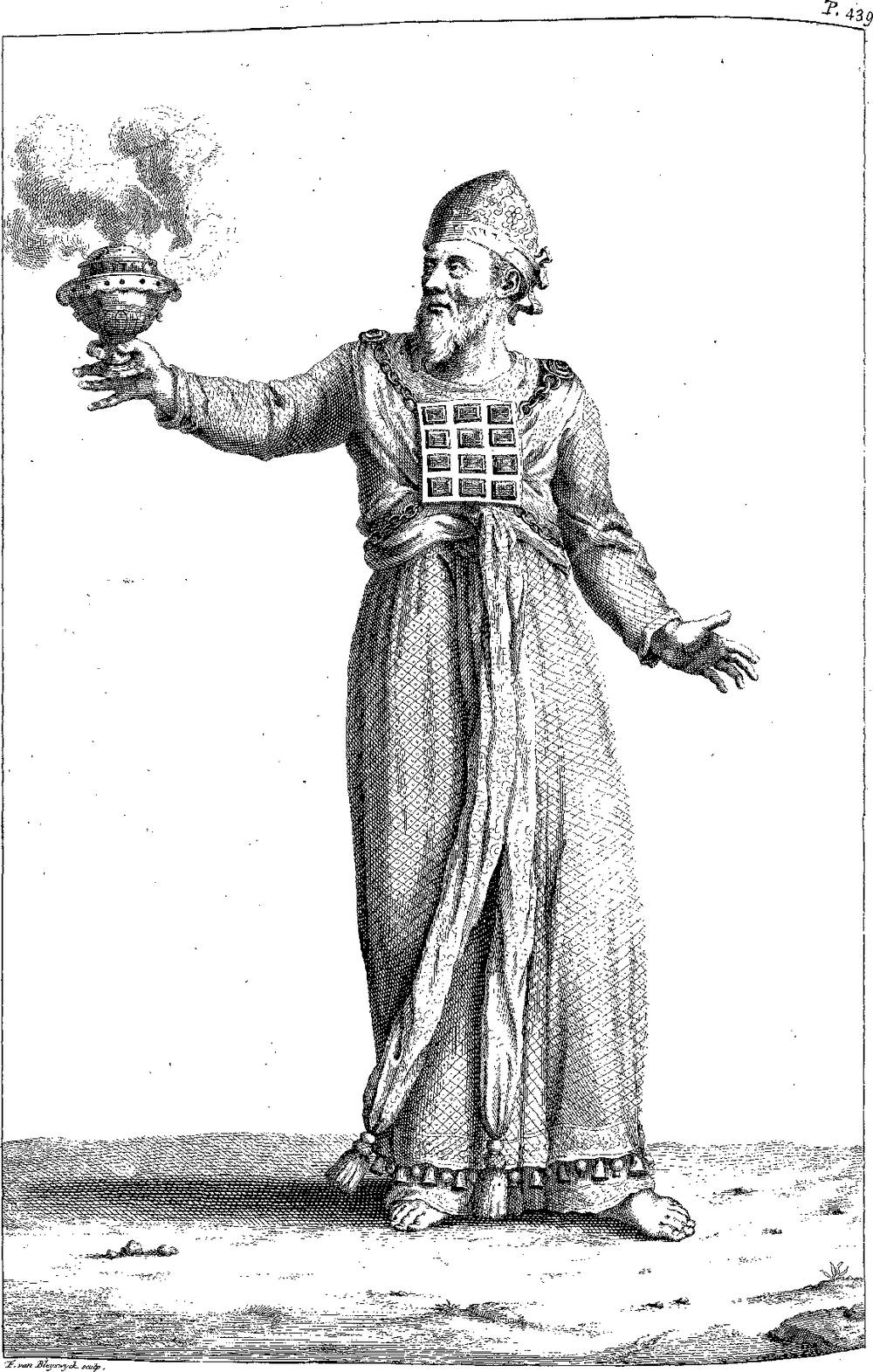
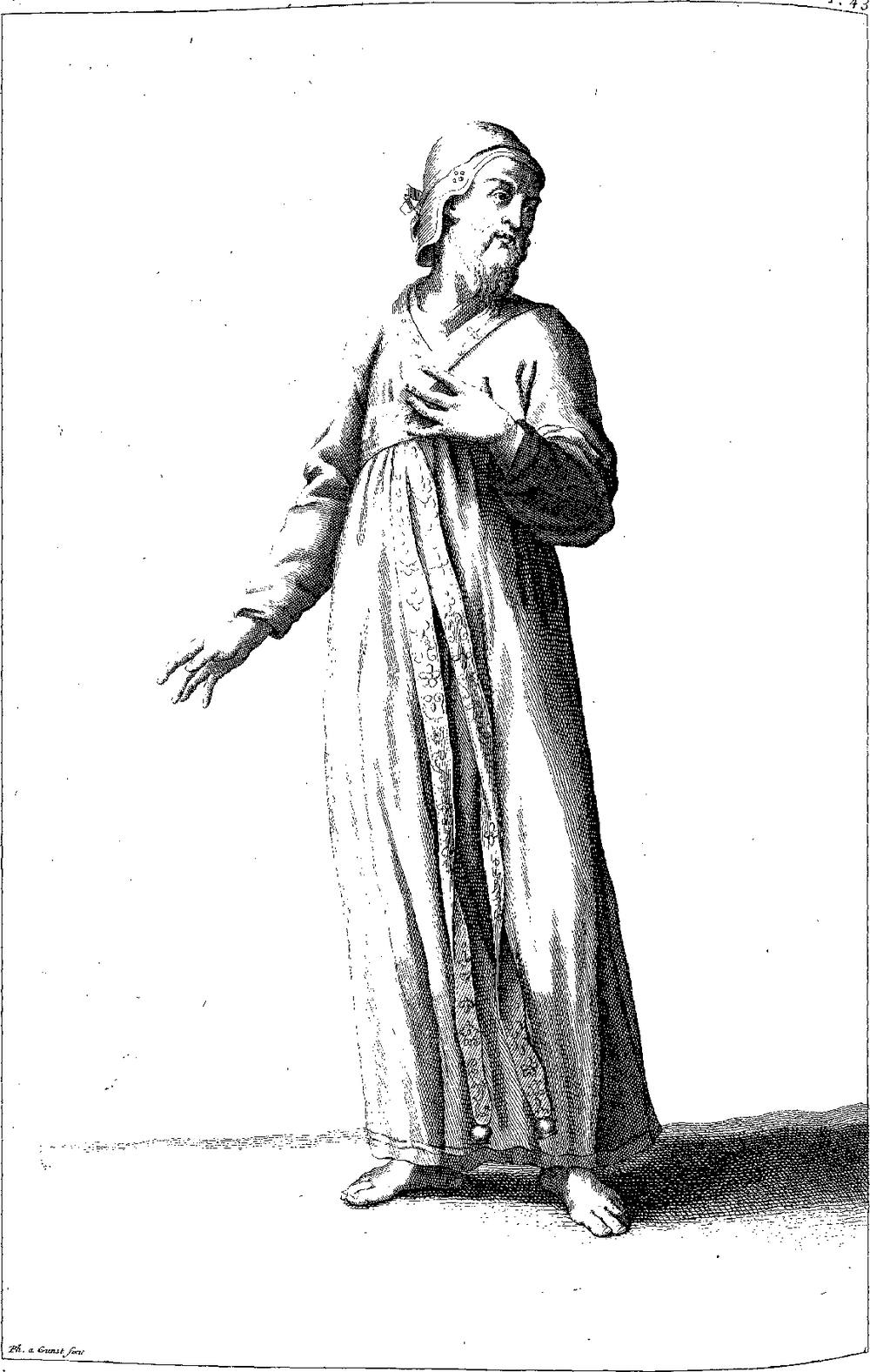
The Habit of the High-priest was much more magnificent than that of the other Priests. He had about his Waist a Pair of Drawers of fine Linen, and next his Skin a Linen Tunique of a particular Make. Over this Tunique he wore a long Robe of an Azure Colour, or of Hyacinth, at the Bottom of which was a Border adorn’d with little golden Bells and Pomegranates, made of Wool of different Colours, and ranged alternately at equal Distances. This Robe was girded about him with a broad embroider’d Sash, which in Scripture is call’d the Ephod. It consisted of two costly Ribbons, which going round the Neck and coming over the Shoulders, cross’d each other at the Breast; then turning behind, it served as a Sash to gird up the Robe afore-mentioned. Upon the Shoulders the Ephod had two large precious Stones, upon each of which were engraven Six of the Names of the Tribes of Israel; and before upon the Breast, at the Place where the Ribbons cross’d each other, was fix’d the Pectoral or Rational of Judgment, which was a square Piece of a very precious and solid Work, six Inches wide, in which were set twelve precious Stones, upon each of which was engraved the Name of one of the Tribes of Israel. Some think the Rational was double, like a Pocket or Bag, in which was included the Urim and Thummim. Others believe the Urim and Thummim were two Hieroglyphical Figures, which hung at the Bottom of the Pectoral.
2 Chron. xxix. 34. xxxv. 11.The High-priests Tiara or Bonnet was more adorn’d and more costly than that of any other Priest, but it is not distinctly known what Form it was of. See what we have said before under the Article CIDARIS. That which chiefly distinguish’d the Tiara of the High-priest, was a Plate of Gold that hung down from the Bonnet upon his Forehead, upon which was written or engraven, Holiness to the Lord. This Plate was ty’d behind his Head with two Ribbons fasten’d at its two Ends. The ordinary Priests served immediately at the Altar, offer’d the Sacrifices, kill’d and flea’d them, and pour’d their Blood at the Foot of the Altar. They kept up a perpetual Fire upon the Altar of Burnt-sacrifices, and in the Lamps of the golden Candlestick that was in the Sanctuary; they kneaded the Loaves of Shew-bread, baked them, offer’d them upon the golden Altar in the Sanctuary, and changed them every Sabbath-day. Every Day, Night, and Morning, a Priest appointed by casting of Lots at the Beginning of the Week, brought into the Sanctuary a smoaking Censer, and set it upon the golden Table, otherwise call’d the Altar of Perfumes.
Cidaris. See Luke i. 9.The common Habit of the Priests was a Surplice or Tunique of Linen without Seam, with a Sash of several Colours, hollow like the Skin of a Serpent, of loose Work, about three Fingers Breadth. ‘Tis thus describ’d by Josephus. He adds, that the Priests wore it upon their Breasts, under their Arms; that a kind of Flower-work was there represented, with Threads of Scarlet, Purple, and Hyacinth; that it went twice round the Body, was tied before, and the Ends hung down to the Feet, to render the Priests more venerable. When they were in the Act of Sacrificing, they threw this Girdle over the Left Shoulder, that they might perform their Office with the greater Freedom. The Rabbins make this Sash to be two and thirty Cubits or Elns long.
‘Tis thought the High-priest’s Sash was of a more precious Work, for Moses says it was made by the Art of the Embroiderer; Ex. xxviii. 4. Antiq. l. 3. c. 8. Ex. xxviii. 39. xxxix. 3, 5.and it is believed, that besides the Threads of Purple, Crimson, and Hyacinth, there were also Threads of Gold. Others maintain, that it differ’d in nothing from those of the other Priests. The Reader may see Braunius, who has carefully examin’d all these Particulars, in his Treatise concerning the Habits of the Hebrew Priests. The High-priest had two Sashes or Girdles, one to gird up his Linen Tunique, which he wore under, and the other to gird up his Robe of Azure, and which is call’d Chescheb ephudath, Levit. viii. 7. which we have now describ’d by the Name of Ephod.
Antiq. l. 3. c. 8.The Cap or Bonnet of the Priests a is call’d in Hebrew, Migbaoth, and that of the High-priest is call’d Miznepheth. But the Rabbins assure us, that these two Words signify but one and the same thing, and that the Bonnet of the Priests, as well as that of the High-priest, was a Cap made of a Border of Linen sixteen Elns long, which went round the Head several times, and made a Cap not unlike a Head-piece, as the Hebrew Word Migbaoth insinuates, which has the same Signification. Josephus thus describes it: “ It is composed “ of several Folds of a linen Border, “ folded back and sewed, so that it appears like a thick Crown worked up of “ Linen. Over this Cap there is a Cloth “ that covers it quite, and comes down to “ the Forehead, to hide all the Plaits and “ Seams.”
Hieronym ad Fabiol.Lastly, St. Jerome gives us a Description of it, that agrees neither with that of the Rabbins nor of Josephus. This Bonnet, says he, is round, and like to that which is represented upon the Head of Ulysses, as if a Sphere was cut into two equal Parts, and one of the Parts was taken for a Bonnet. There is no Point at the12
Top, and it does not cover all the Hair, but leaves a third Part to be seen before; and that it may not fall off, it is ty’d behind with a Ribbon. Its Matter is of fine Linen, and it is cover’d with a Cloth, to hide the Foldings and the Seams. Moses insinuates to us,13 that they were indeed tied on with a Ribbon, when he says, that at the Consecration of the Priests their Bonnets were tied on.
As to the High-priest’s Tiara, the Rabbins hardly make any Difference between it and the Bonnet of the other Priests, except that the High-priest’s is flatter, and more approaching to the Form of a Turbant; whereas that of the other Priests more resembles a Night-cap, rising a little to a Point at the Top. Josephus gives us a magnificent Description of it, probably taken from what he had seen in his own Time, at Antiq. l. 3. c. 5.the Temple of Jerusalem. He says it was a Cap of the Colour of Hyacinth, or of an Azure Blue, which was put over the other Cap of the Shape of a Turbant, of which a Description is given before. It covers the hinder Part of the Head, and the two Temples, and is incompass’d by a treble Crown of Gold, where there are little Buds of the Flowers of the Plant Henbane. The Circuit of these Flowers is interrupted on the forepart of the Tiara, to make Room for the Plate of Gold, on which the Name of God was engraven.
The Priests did not wear their Hair long Ezek. xliv. 20. See Levit. x. 6. xxi. 5.in the Temple, yet they did not shave their Heads, but only clipt their Hair with Scissars. Caput suum non radent, neque comam nutrient; sed tondentes attondent capita sua. They did not appear with their Heads bare during their Ceremonies. To appear bare-headed and uncover’d before any one, was look’d upon as a want of Respect, as it is still among some Nations. They wore linen Drawers as well as the High-priest, when they went up to the Altar, that they might not shew any thing indecent Exodus xxviii. 42. xxxix. 27.there. The Levites had no peculiar Habit in the Ceremonies of Religion; but about the sixty-second Year of Christ they obtain’d from King Agrippa, that they might wear a linen Tunique as well as the Joseph. Antiq. l. 20. c. 8. p. 699.Priests: Which Josephus says, was look’d upon as an evil Presage, Experience having always shewn, that Innovations in the antient Practices of religious Worship are always attended with some Disaster.
The Priests were not suffer’d to offer Incense Levit. x. 1, 2.to the Lord with strange Fire, that is, with any other Fire but what should be taken from the Altar of Burnt-sacrifices. ‘Tis known with what Severity God chastised Nadab and Abihu for having fail’d herein. The Priests and Levites waited by the Week and by the Quarter in the Temple. They began their Week on the Sabbath-day, and ended it on the next. 2 Kings xi. 1, 7. Numb. viii. 24. iv. 3.Moses had fix’d the Age at which they were to enter on the sacred Ministry, at twenty-five or thirty Years, and they were to end it at fifty: But in David’s Time this Order was changed, and they were obliged to attend the Service of the Temple as soon as they were twenty Years of Age.14 Those that would dedicate themselves to perpetual Service in the Temple, were well received, and were maintain’d Deut. xviii. 6. Deut. xviii. 3. Deut. xviii. 4.by the constant and daily Offerings.
The Lord had given no Lands of Inheritance to the Tribe of Levi, in the Distribution of the Land of Promise. He intended that they should be supported by the Tythes, the First-fruits, the Offerings that were made in the Temple, by their Share of the Sin-offerings and Thanksgivingofferings that were sacrificed in the Temple, of which certain Parts were appropriated to the Priests. In the Peace-offerings the Priests had the Shoulder and the Levit. vii. 33, 34. Levit. vii. 6, 7.Breast. In the Sin-offerings they burnt upon the Altar the Fat that covers the Bowels, the Skin of the Liver, and the Kidnies. The rest belong’d to the Priest. The Skin or Fleece of every Sacrifice also belong’d to him; and this Article alone was no mean Allowance. When an IsraelitePhilo de præmiis Sacerdotum. kill’d any Animal for his own Use, he was to give the Priest the Shoulder, the Stomach, and the Jaws. He had also a Share in the Wool when the Sheep were shorne. All the First-born, both of Man and Beast, belong’d to the Lord, that is to say, to his Priests. The Men were redeem’d Numb. xviii. 15, 16.for the Sum of five Shekels. The First-born of impure Animals were redeem’d or exchang’d, but the clean Animals were not redeem’d. They were sacrificed to the Lord; their Blood was sprinkled about the Altar, and all the rest belong’d to the Numb. xviii. 17. Lev. xix. 23, 24.Priest. See the Article FIRST-BORN. The First-fruits of Trees, that is, those that came on the fourth Year, belong’d also to the Priest.
They offer’d at the Temple the first of all the Fruits of the Earth, and the Quantity was fix’d by Custom, which was between the fortieth and the sixtieth Part. Besides this, they offer’d whatever any one had vow’d to the Lord. See the Article FIRST-FRUITS before. They gave also to the Priests and Levites an Allowance out of the Dough that they kneaded. They had the Tythe of all the Fruits of the Land, and of all the Animals which Lev. xxvii. 31, 32.were fed under the Shepherd’s Crook. And when the Levites had collected all the Tythes and all the First-fruits, they set Numb. xviii. 26.apart the Tythe of that for the Priests. Thus
Josh. xxi. 19, 20. Hos. iv. 6.Thus though the Priests had no Lands or Inheritance in the Country, they lived however in great Plenty, and were abundantly supplied with what was necessary for their Subsistance. God had also provided them with Houses and Accommodations, by appointing them eight and forty Cities for Numb. xxxv. 1, 2, 3.their Habitation. In the Precincts of these Cities they possess’d only as far as a thousand Cubits beyond the Walls. Of these forty-eight Cities, six were appointed to be Cities of Refuge, for the Sake of those that should commit any casual and involuntary Manslaughter. The Priests had thirteen of these for their Share, and all the others belong’d to the Levites.
Deut. xx. 3, 4.One of the chief Imployments of the Priests, next to attending upon the Sacrifices and the Service of the Temple, was the Instruction of the People, and the deciding Controversies; the distinguishing the several Mal. ii. 7, &c. Levit. xiii. 14. Numb. v. 14, 15.Sorts of Leprosie, the Causes of Divorce, the Waters of Jealousy, Vows, all Causes relating to the Law, the Uncleannesses that were contracted several Ways; all these Things were brought before the Priests. For the Priests Lips should keep Knowledge, and they should seek the Law at his Mouth; for he is the Messenger of the Lord of Hosts. Malac. ii. 7.They publickly bless’d the People in the Name of the Lord. In the Times of War Numb. vi. 23, 24, 25.their Business was to carry the Ark of the Covenant, to consult the Lord, to sound the holy Trumpets, and to pronounce these Numb. x. 8, 9.Words at the Head of the Army; “ Hear, O “ Israel, you are now going to fight with “ your Enemies, but fear not, for the “ Lord is in the midst of you; he will “ fight for you, and defend you from all “ Danger.”
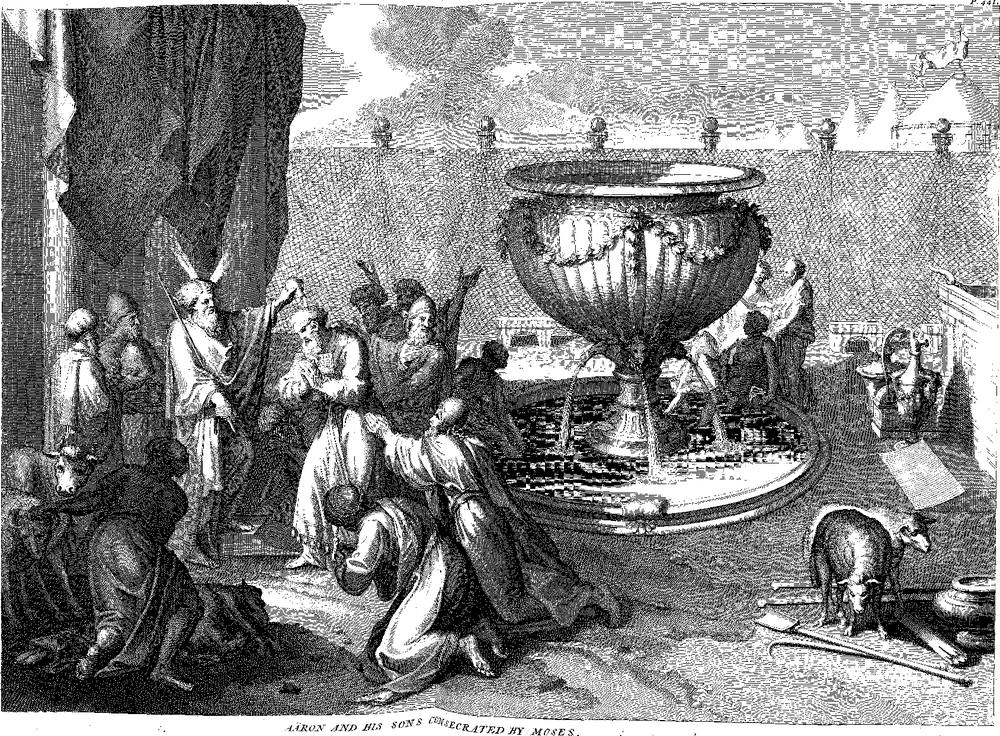
The Consecration of Aaron and of his Sons was perform’d by Moses in the Desart with great Solemnity, and this is what pass’d Exod. xl. 12. Lev. viii. 1, 2, &c.upon that Occasion. Aaron and his Sons wash’d themselves all over in Water, and presenting themselves to Moses at the Tabernacle of the Covenant, with the Sacrifices that were to be offer’d for them, Moses first dress’d them with all the Ornaments mention’d before, then with the Oyl of the sacred Unction he anointed Aaron by pouring it upon his Head. Afterwards he offer’d up a Calf for a Sin-offering, and Aaron and his Sons having laid their Hands on this Sacrifice, Moses kill’d it, put some of its Blood with his Finger upon the Horns of the Altar, burnt the Fat upon the Fire of the Altar, and sent the Flesh, the Skin, and the Dung to be burnt without the Camp. After which he offer’d a Ram for a Burnt-offering. Aaron and his Sons laid their Hands upon the Head of the Victim, and Moses kill’d it, sprinkling the Blood about the Altar, and burning the Flesh and the Bowels upon the Altar of Burnt-sacrifices.
Lastly, they presented the Ram which was to serve for the Consecration of the Priests. Aaron and his Sons laid their Hands upon its Head, Moses kill’d it, and taking of the Blood of this Ram, he touch’d with it the Tip of the right Ear of each, the Thumbs of their right Hands, and the great Toes of their right Foot, and sprinkled the rest of the Blood upon the Altar. Then taking the Fat of the Kidneys and Bowels, the Rump, the Kidneys, and the right Shoulder of the Victim, with a Leaf of unleaven’d Bread, a Cake and a Wafer, he put them successively into the Hands of Aaron and of his Sons, who lifted them up before the Lord, with a waving Motion, Moses at the same time supporting and guiding the Hands of each. After which Moses received these Things again, and burnt them upon the Altar of Burnt-sacrifices, because it was the Sacrifice of the Consecration of Aaron and of his Sons. Then taking the Oyl of Unction, and the Blood that was upon the Altar, with these he sprinkled Aaron and his Sons, habited as they were in all their sacred Ornaments. This Ceremony was continued for seven Days successively, beginning it every Day in the same Manner, at least as to the offering of Sacrifices, the Unctions, and Aspersions; for it does not appear that Aaron and his Sons were dress’d every Day in their sacerdotal Habits. For these whole seven Days the Priests continued in the Court of the Tabernacle, without going out of it.
In this whole Ceremony Moses perform’d the Office of consecrating a Priest. It is much to be doubted, whether at every new Consecration of a High-priest all these Ceremonies were repeated. It is very probable they contented themselves with cloathing the new High-priest in the Habit of his Predecessor, as was put in Practice at the Death of Aaron. Others think they gave them the Unction also, Numb. xx. 25, 26, &c.which perhaps might be in use to the Babylonish Captivity, though there is no Proof of this Fact. We know on the contrary, that Jonathan the Asmonean contented 1 Macc. x. 21. Joseph. Antiq. l. 13. c. 5. Antiq. l. 19. c. 6. p. 676. d.himself with putting on the High-priest’s Habit at the Feast of Tabernacles, in order to take Possession of this Dignity; and Agrippa King of the Jews having offer’d to Jonathan Son of Ananus the High-priesthood, a second Time, Jonathan thank’d him for it, saying, It was enough for him to have once received the Ornaments of this supream Dignity, which he would willingly resign to some other that should be more worthy of it.
As to the ordinary Priests, we do not see that any particular Ceremony was us’d for their Consecration; they were admitted to the Exercise of their Functions by filling their Hands, as the Scripture speaks, or by making them perform the Functions of their Order. But when the Priests had fallen away from the Lord, or had been a long Time without performing their Office, as it sometimes happen’d under the Reigns of some of the later Kings of Judah; for Example, under Ahaz, Ammon, and Manasseh, they thought it necessary to sanctify anew such Priests, who had been absent from the Holy Place, who for a long Time had interrupted the Exercise of their Ministry, or who had never yet exercis’d 2 Chron. xxix. 34. 2 Chron. xxxv. 12.it; as it happen’d under Hezekiah and Josiah, when the Number of the Priests that were sanctify’d not being found sufficient for the great Number of Sacrifices that were to be offer’d, they were forced to employ the Levites in fleaing the Sacrifices; for the Levites were much sooner sanctify’d than the Priests. a Levitæ quippe faciliori ritu sanctificabantur quam Sacerdotes.
However, we must acknowledge, that we do not know what was done upon these Occasions, for the Consecration, or rather for the Sanctification of the Priests. Nor is it certain, whether any thing else was requir’d than the ordinary Sanctification, which was, the Exemption from legal Defilements and Uncleanneffes, which was necessary for the approaching to holy Things. The Hebrew Text of the Passage now quoted reads only, ” For the Levites ” were upright of Heart, to sanctify themselves, rather than the Priests.” The Levites shew’d more Zeal and Readiness than the Priests, to assist in this Ceremony.
As to the Priests of the new Covenant, their Dignity is vastly more exalted than that of the Hebrew Priests, because their Functions are more noble, and their Object more sacred and divine. They consecrate the Body and Blood of Jesus Christ upon the Altar; they have the Power to bind and to loose, to remit or to retain Sins, they bear a sacred and inviolable Character. The Christian Priesthood is the Substance and the Truth, of which that of the Jews was but the Shadow and the Figure. Jesus Christ the everlasting Priest, according to the Order of Melchisedeck, abides for ever, as St. Paul observes; whereas the Priests, Hebr. vii. 23, 24, &c.according to the Order of Aaron, were mortal, and therefore could not continue long. The Priesthood of Jesus Christ is one, divided among many Priests, who partake of his Power, and who exercise in his Name the Functions of his Ministry. The Consecration given by Moses to Aaron and his Sons, was not again to be repeated to their Successors, because the Priesthood was always to continue in the same Family; whereas the Christian Priesthood not being continued to any particular Family, was to be conferr’d on every one of the Priests with distinct Ceremonies.
Lastly, the corporal Defects, which excluded from the legal Priesthood, and from the Privileges that attended it, ought in Proportion to be understood in an exalted and spiritual Sense, in respect of the Christian Priesthood. We have elsewhere spoke of the Superiority of the Bishops above Priests, and of the Primacy of the Pope, the Bishop of Rome, which we believe to be of Divine Right. The Qualities that St. Paul requires in a Bishop, may be seen 1 Tim. iii. Tit. i. 7, &c.15
A Chronological LIST of the High-priests of the Hebrews.
| 1. Succession, taken from several Places of the Holy Scriptures. | 2. Succession, taken from 1 Chron. vi. 3, 4, 5, 6, 7, &c. | 3. Succession, taken from Josephus Antiq. l. 5. c. 15. l. 10. c. 11. | 4. Succession, taken from the Jewish Chronicle, call'd Seder Olam. |
|---|---|---|---|
| 1. Aaron, the Brother of Moses, created High-priest in the Year of the World 2514, and died in the Year 2552, before Christ 1448, before the vulgar Era 1452. | 1. Aaron. | 1. Aaron. | 1. Aaron. |
| 2. Eleazar, created in 2552, died about the Year 2571, before Christ 1429, before the vulgar Era 1433. | 2. Eleazar. | 2. Eleazar. | 2. Eleazar. |
| 3. Phinehas, made about the Year 2571, died about 2590, before Christ 1410, before the vulgar Era 1414. | 3. Phinehas. | 3. Phinehas. | 3. Phinehas. |
| 4. Abiezer, or Abishua, under the Judges. | 4. Abishua. | 4. Abiezer. | 4. Eli. |
| 5. Bukki, under the Judges. | 5. Bukki. | 5. Bukki. | 5. Abitub. |
| 6. Uzzi, under the Judges. | 6. Uzzi. | 6. Uzzi. | 6. Abiathar. |
| 7. Eli, of the Race of Ithamar, created in 2848, died in 2888, before Christ 1112, before the vulgar Era 1116. | 7. Zerahiah. | 7. Eli. | 7. Zadok. |
| 8. Abitub I. | 8. Meraioth. | 8. Abitub. | 8. Ahimah, under Rehoboam. |
| 9. Abiah. He lived in 2911, or 2912. | 9. Amariah. | 9. Abimelech. | 9. Azariah, under Abiah. |
| 10. Ahimelech, or Abiathar. He was put to death by Saul in 2944, before Christ 1056, before the vulgar Era 1060. | 10. Abitub I. | 10. Abiathar. | 10. Jehoachash, under Jehoshaphat. |
| 11. Abiathar, Ahimelech, or Abimelech, under David, from 2944, to 2989, before Christ 1011, before the vulgar Era 1015. | 11. Zadok I. | 11. Zadok. | 11. Jehoiarib, under Jehoram. |
| 12. Zadok I. under Saul, David, and Solomon, from 2944, 'till about 3000, before Christ 1000, before the vulgar Era 1004. | 12. Ahimaaz. | 12. Ahimaaz. | 12. Jehoshaphat, under Ahaziah. |
| 13. Ahimaaz, under Rehoboam, about the Year 3030, before Christ 970, before the vulgar Era 974. | 13. Azariah. | 13. Azariah. | 13. Jehoiadah, under Joash. |
| 14. Azariah, under Jehoshaphat; probably the same as Amariah, 2 Chron. xix. 11. About the Year 3092, before Christ 908, before the vulgar Era 912. | 14. Johanan. 1 Chron. vi. 9, 10. | 14. Joram. | 14. Phadaiah, under Joash. |
| 15. Johanan, perhaps Jehoiada, in the Reign of Joash. 2 Chron. xxiv. 15. in 3126. He died at the Age of 130 Years. | 15. Azariah. | 15. Issus. | 15. Zedekiah, under Amaziah. |
| 16. Azariah, perhaps the same as Zechariah the Son of Jehoiada, who was kill'd in 3164, before Christ 836, before the vulgar Era 840. | 16. Amariah. | 16. Axiora. | 16. Joel, under Uzziah. |
| 17. Amariah, perhaps Azariah, under Uzziah, in 3221, before Christ 779, before the vulgar Era 783. | 17. Abitub II. | 17. Phideas. | 17. Jothan, under Jotham. |
| 18. Abitub II. under Jotham K. of Judah. | 18. Zadok II. | 18. Sudeas. | 18. Uriah, under Ahaz. |
| 19. Zadok II. under Jotham K. of Judah. | 19. Shallum. | 19. Julus. | 19. Neriah, under Hezekiah. |
| 20. Uriah, under Ahaz; he lived in 3265, before Christ 735, before the vulgar Era 739. | 20. Hilkiah. | 20. Jotham. | 20. Hosaiah, under Manasseh. |
| 21. Shallum, the Father of Azariah, and Grandfather of Hilkiah. | 21. Azariah. | 21. Uriah. | 21. Shallum, under Amon. |
| 22. Azariah, who liv'd in the Time of Hezekiah, 2 Chron. xxxi. 10. about the Year 3278, before Christ 722, before the vulgar Era 726. | 22. Seraiah. | 22. Neriah. | 22. Hilkiah, under Josiah. |
| 23. Hilkiah, under Hezekiah. | 23. Jehozadak. | 23. Odeas. | 23. Azariah, under Jehoiakim and Zedekiah. |
| 24. Eliakim, or Joakim under Manasseh, and at the Time of the Siege of Bethulia, in 3348. He continued to live under Josiah to 3380, and longer. He is also call'd Hilkiah. See Baruch i. 7. | 24. Joshua. | 24. Saldum. | 24. Jehozadak, after the taking of Jerusalem. |
| 25. Azariah, perhaps Neriah, the Father of Seraiah and of Baruch. | 25. Hilkiah. | 25. Jesus, Son of Jehozadak, after the Captivity. | |
| 26. Seraiah, the last High-priest before the Captivity, put to death in 3414, before Christ 586, before the vulgar Era 590. | 26. Seraiah. | ||
| 27. Jehozadak, during the Captivity of Babylon, from 3414 to 3469, before Christ 531, before the vulgar Era 535. | 27. Jehozadak. | ||
| 28. Joshua or Jesus the Son of Jehozadak; he return'd from Babylon in 3468, before Christ 532, before the vulgar Era 536. | 28. Jesus, or Joshua. |
What follows is collected from Ezra, Nehemiah, and Josephus.
-
Joachim, under the Reign of Xerxes. Joseph. Antiq. l. 11. c. 5.
-
Eliasib, Joasib, or Chasib, under Nehemiah, in 3550, before Christ 450, before the vulgar Era 454.
-
Joiada, or Juda; see Nehem. xii. 10.
-
Jonathan, or John.
-
Jeddoa, or Jaddus, who received Alexander the Great at Jerusalem, in 3673, and died in 3682, before Christ 318, before the vulgar Era 322.
Onias
34. Onias I. made High-priest in 3681, govern’d 21 Years, and died in 3702, before Christ 298, before the vulgar Era 302.
-
Simon I. call’d the Just, made in 3702, or 3703, and died in 3711, before Christ 289, before the vulgar Era 293.
-
Eleazar, made in 3712. ‘Twas under this Pontiff, as they tell us, that the Translation of the Septuagint was made, about the Year 3727; he died in 3744, before Christ 256, before the vulgar Era 260.
-
Manasseh, made in 3745, died in 3771, before Christ 229, before the vulgar Era 260.
-
Onias II. made in 3771, died in 3785, before Christ 215, before the vulgar Era 219.
-
Simon II. made in 3785, died in 3805, before Christ 195, before the vulgar Era 199.
-
Onias III. made in 3805, depos’d in 3829, died in 3834, before Christ 166, before the vulgar Era 170.
-
Jesus, or Jason, made in 3830, depos’d in 3831, before Christ 169, before the vulgar Era 173.
-
Onias IV. otherwise call’d Menelaus, made in 3832, died in 3842, before Christ 158, before the vulgar Era 162.
-
Lysimachus, Vicegerent to Menelaus, kill’d in 3834, before Christ 166, before the vulgar Era 170.
-
Alcimus, or Jacimus, or Joachim, made in 3842, died in 3844, before Christ 156, before the vulgar Era 160.
-
Onias V. He did not exercise his Pontificate at Jerusalem, but retired into Egypt, where he built the Temple Onion, in 3854, before Christ 146, before the vulgar Era 150.
-
Judas Maccabeus restor’d the Altar and the Sacrifices in 3840, died in 3843, before Christ 157, before the vulgar Era 161.
-
Jonathan the Asmonean, Brother to Judas Maccabeus, created High-priest in 3843, died in 3860, before Christ 140, before the vulgar Era 144.
-
Simon Maccabeus, made in 3860, died in 3869, before Christ 131, before the vulgar Era 135.
-
John Hircanus, made in 3869, died in 3898, before Christ 102, before the vulgar Era 106.
-
Aristobulus, King and Pontiff of the Jews, died in 3899, before Christ 101, before the vulgar Era 105.
-
Alexander Jannæus, also King and Pontiff for 27 Years, from 3899 to 3926, before Christ 74, before the vulgar Era 78.
-
Hircanus was High-priest for 32 Years in all, from 3926 to 3958, before Christ 42, before the vulgar Era 46.
-
Aristobulus, Brother to Hircanus, usurped the High-priesthood, and enjoy’d it 3 Years and 3 Months, from 3935 to 3940, before Christ 60, before the vulgar Era 64.
-
Antigonus his Son also usurp’d the Priesthood, in Prejudice to the Rights of Hircanus, and possess’d it for 3 Years and 7 Months, from 3964 to 3967, when he was taken by Sosius, before Christ 33, before the vulgar Era 37.
-
Ananeel of Babylon, made High-priest by Herod in 3968 ‘till 3970, before Christ 30, before the vulgar Era 34.
-
Aristobulus, the last of the Asmoneans; he did not enjoy the Pontificate a whole Year. He died in 3970, before Christ 30, before the vulgar Era 34. Ananeel was made High-priest a second Time in 3971, before Christ 29, before the vulgar Era 33. 57. Jesus the Son of Phabis, depos’d in 3981, before Christ 19, before the vulgar Era 23.
-
Simon Son of Boethus, made in 3981, depos’d in 3999, before Christ 1, before the vulgar Era 4.
-
Matthias Son of Theophilus, made in 3999. Ellem was substituted in his Place for a Day, because of an Accident that had happen’d to Matthias, which hinder’d him from performing his Office for that Day; before Christ 1, before the vulgar Era 4.
-
Joazar Son of Simon, Son of Boethus, made in 4000, the Year of the Birth of Jesus Christ, 4 Years before the Beginning of the vulgar Era.
-
Eleazar Brother to Joazar, made in 4004, of Christ 4, of the vulgar Era 1.
-
Jesus Son of Siah, made in 4009, of Christ 9, of the vulgar Era 6. Joazar was made a second Time in 4010, deprived in 4016, of the vulgar Era 13.
-
Ananus Son of Seth, for 11 Years, from 4016 to 4027, of the vulgar Era 24.
-
Ishmael Son of Phabi, made in 4027, of the vulgar Era 24.
-
Eleazar Son of Ananus, made in 4027, of the vulgar Era 24.
-
Simon Son of Camithus, made in 4028, of the vulgar Era 25.
-
Joseph, surnamed Caiaphas, made in 4029, ‘till 4038, of the vulgar Era 35.
-
Jonathan Son of Ananus, made in 4038, ‘till 4040, of the vulgar Era 37.
-
Theophilus Son of Jonathan, made in 4040, depos’d in 4044, of the vulgar Era 41.
-
Simon surnamed Cantharus, and Son of Simon Boethus, was made in 4044, of the vulgar Era 41.
-
Matthias Son of Ananus, made in 4045, of the vulgar Era 42.
-
Elioneus, made in 4047, ‘till 4048, of the vulgar Era 45. Simon Son of Cantharus was a second Time made High-priest
in 4048, and depos’d the same Year, of the vulgar Era 45.
-
Joseph Son of Caneus, made in 4048, ‘till 4050, of the vulgar 47.
-
Ananias Son of Nebedeus, made in 4050, ‘till 4066, of the vulgar Era 63.
-
Ismael Son of Phabeus, made in 4066, of the vulgar Era 63.
-
Joseph surnam’d Cabei, the same Year 4066.
-
Ananus Son of Ananus, the same Year.
-
Jesus Son of Ananus, made in 4067, of the vulgar Era 64.
-
Jesus Son of Gamaliel, the same Year.
-
Matthias Son of Theophilus, made in 4068, ‘till 4073, of the vulgar Era 70.
-
Phannias Son of Samuel, made in 4073, of the vulgar Era 70, which is the Year of the Destruction of the Temple of Jerusalem by the Romans, and of the entire Abolition of the Jewish Priesthood.
PRIESTHOOD, Sacerdotium. We may distinguish four Kinds of Priesthood. 1. That which belongs to Kings, to Princes, to the Heads of a Family, to the First-born. This may be called a natural Priesthood, because Nature and Reason teach us, that the Honour of offering Sacrifices to God should belong to the Greatest in Dignity. 2. The Priesthood according to the Order of Melchisedech, which does not differ from that now mentioned, but in its Dignity; because Melchisedech was raised up of God, to represent the Priesthood of Jesus Christ. 3. The Priesthood of Aaron and his Family, which subsisted as long as the Religion of the Jews was a true Religion. 4. Lastly, the Priesthood of Jesus Christ, and of the new Law. We have spoken of Melchisedech in a particular Article. As to the Priesthood of Aaron, See AARON before, and PRIEST.
The Priesthood passed from the Family of Ithamar into that of Eleazar, according to 1 Sam. ii. 30, 31, 32, &c.what the Lord had declared to the High-priest Eli. But this was not done presently. The Family of Eli still possess’d the Priesthood for a good while. This High-priest had for Successor his third Son Ahitub, or according to others, Abijah, to whom succeeded Ahimelech, who was put to death by Saul, with the other Priests at Nob. a This Prince then gave the High-priesthood to Zadoc. But Abiathar Son of Ahimelech having adhered to the Interests of David, was continued in the Possession of the High-priesthood in the Kingdom of Judah. So that for a good Part of David’s Reign, we find the High-priesthood to be exercised by the two High-priests Zadoc and Abiathar, the first of the Family of Eleazar, and the second of that of Ithamar. Lastly, towards the End of David’s Reign, Abiathar having adhered to the Party of Adonijah against Solomon, he was disgraced,16 and Zadoc alone acknowledg’d as High-priest. He then began to exercise his High-priesthood at Jerusalem, whereas before he had only perform’d the Functions of 1 Kings ii. 26, 27. 1 Chron. xvi. 39.it upon the Altar of Gibeon.
Some have pretended, that the High-priesthood was exercised, even after the Law took place, by others besides the Family of Aaron. For this are produced the Examples of Moses, Joshua, Samuel, and Saul, who sacrificed on some Occasions. But granting these Facts to be indisputable, yet nobody denies, first, that a Prophet may not extraordinarily, and by a particular Revelation, offer up Sacrifices. Secondly, that this Liberty was not of much greater Extent before the building of the Temple, than after the publick Worship of God was fix’d at Jerusalem. Thirdly, that it is not certain but that Joshua, Samuel, and Saul might offer their Sacrifices by the Hands of Priests; for often the Scripture affirms that to be done by a Man’s self, which is only done by his Orders. See PRIESTS before.
Ex. ii. 16.The Hebrew Word Cohen, which signifies Priest, is sometimes put for a Prince. For Example, it is said that Jethro the Father-in-Law of Moses, was Priest of Midian, that is, according to some Interpreters, that he was Prince or Governor of his City. In the second Book of Samuel it is said,17 That the Sons of David were Priests, that is to say, Princes, and consider’d in the Country as Priests. Filii autem David sacerdotes erant. The Septuagint say, they were principal Courtiers, the Chief of the Court. The Author of the first Book of Chronicles18 explains this, saying, they were the nearest at the King’s Hand. They had the chief Employments at Court.
As to the Priesthood of Jesus Christ, which is infinitely superior to all the other, as to its Duration, its Dignity, its Prerogatives, its Object, and the Power which is annexed to it; the Priests of the New Law partake of the Royal Priesthood of Jesus Christ; they exercise his Priesthood and his Power. ‘Tis properly Jesus Christ that baptizes, that gives the Holy Ghost in Confirmation, that binds and looses in the Sacrament of Penance, that offers his own Body and his own Blood upon the Altar; in a Word, that performs all the19
Functions of the sacred Ministry by the Hands of the Priests his Ministers. The Priesthood of Aaron was to have an End, but that of Jesus Christ is everlasting. That of Aaron was limited to his own Family, was exercised only in the Temple, and among only one People; its Object was nothing but bloody Sacrifices and Purifications, which were only external, and could not remit Sins; but the Priesthood of Jesus Christ is extended to the whole Christian Church, spread over the Face of the whole Earth, and among all the Nations of the World. It exercises the Power of Jesus Christ even over Souls, in forgiving or restraining Sins; it opens the Channels of supernatural Graces, it offers the Host as an Expiation for all the Sins of the World. The Epistle of St. Paul to the Hebrews should be consider’d by those, that would comprehend the Excellence of the Priesthood of the New Law, above that of the Law of Moses. Hebrews iv. 14, 15, &c. also v. vi. vii. viii. ix. See also 1 Peter ii. 5, 6, 7, 8, 9.
Among all Nations the Priesthood was so honourable and elevated a Station, and at the same time so commodious, that it was look’d upon by the People with some sort of Jealousy; so that the Lord, to express to the Hebrews what great Favours he would confer upon them, says, that he would make them Kings and Priests. Eritis mihi Ex. xix. 6.in regnum sacerdotale. And St. Peter makes the same Promise to the Christians, or rather he tells them, that they are in earnest what Moses promised to the Israelites. Vos autem genus electum, regale sacerdotium, gens sancta. And St. John in the Revelations says, that the Son of God has made us Priests and Kings to God his Father. Fecit nos regnum & sacerdotes Deo Patri suo. The Priesthood of Christians does not allow indifferently to all, the Liberty of offering the Sacrifice of the New Law; but it consists in the Participation of the Priesthood of Jesus Christ, which is exercised in the Church by Priests legally ordain’d and consecrated. Any one of the Faithful may offer up to the Lord, in an Union with the Sacrifice of Jesus Christ, his own Body, his Inclinations, his Pleasures, his temporal Goods. He may offer up the divine Sacrifice of the Altar in an Union of Heart and Intention with the Priest; lastly, he may every Moment offer up to the Father the Merits of that Sacrifice which Jesus Christ has once offered upon the Cross. And this is that in which the Exercise of the Priesthood of mere Laicks consists. Besides, as the Priesthood of the New Law is not successive, nor confin’d to one Family; all Christians may aspire at the Glory of the Priesthood, and endeavour by their Virtue and good Lives, by their Innocence and acquired Abilities, to become worthy of this Honour.
We have already enlarged upon the Rights, Prerogatives, Functions, Ornaments, and Revenues of the Priests of the Old Law, under the foregoing Article. We cannot do the same thing here in respect of the Priests of the New Law, because neither Christ in the Gospel, nor his Apostles in any of their Writings which they have left us, have express’d all the Ceremonies that are to be used in the Administration of the Sacraments, nor all the Circumstances that are to accompany them. The Apostles have left some of these things to be regulated by the Wisdom and Discretion of the Heads of the Church, though they taught the greatest Part of them to the Faithful of their own Times, vivâ voce, from whom we have received them by the Canal of Tradition.
PREPARE. The Word Præparare, or Parare, is often us’d for founding, fixing, establishing. It answers to the Hebrew Word Kun, which bears the same Signification. Præparans montes in virtute sua. He founds, he fixes the Mountains by his Power. Parata sedes tua ex tunc. Thy Seat, thy Throne is established from all Eternity. Super flumina præparavit orbem terræ. He has fix’d the Earth upon the Rivers, or upon the Waters.
1 Sam. i. 11, &c.PRESENTATION. By this Word is generally understood the Presentation made by the Parents, of their First-born Children to the Lord in the Temple; or that which they made of their Children, or of any other thing, that they had vowed to present to the Lord. Thus Samuel the Son of Elkanah, and of Hannah, was presented to the Lord on these two Accounts, both as the First-born of Hannah, and as vow’d by her to the Lord. As the First-born, he might have been redeem’d and restor’d to Lev. xxvii. 6.his Parents for the Sum of five Shekels: But having been vow’d to the Lord, to be employ’d in his Service all the Days of his Life, he continued at the Tabernacle from the Age of three Years, where he perform’d all the Services he was capable of.
The Holy Virgin presented our Saviour at the Temple, on the Day of her Purification, Luke ii. 22, &c.because he was her First-born; and she redeem’d him, according to the Law, for the Sum of five Shekels. The same obtain’d as to all the First-born in Israel.
Lastly, there is an antient Tradition in the Church, delivered in very antient Monuments, Protevang. Jacobi n. 7, 8, 9, 10.though but little credited because of some Circumstances found therein which are false and uncertain, that the Virgin Mary was devoted to the Temple by her Parents; that she was presented there at the Age of two Years; that she abode there, and was fed by the Hand of an Angel, till she was twelve Years old. Then the Priests said to the High-Priest Zachariah, ‘Tis time to place out Mary, for fear the Temple of the Lord should be defiled. Betake yourself therefore to Prayer, and we will perform whatever the Lord shall reveal to you. Zachariah having put on the sacred Habit, enter’d into the Sanctuary; and as he was at Prayer, the Angel of the Lord said to him; Assemble the Elders of the People, and let each of them bring a Wand, and he shall be appointed for Mary’s Husband, by whose Wand God shall perform a Miracle. All the Elders of Israel met therefore at the Temple, and each of them gave in his Wand, which they received again the next Day, without any thing extraordinary appearing. But when the High-priest gave Joseph his Wand again, a Dove arose from it, and lighted upon Joseph’s Head. Then the High-priest gave him to Wife Mary, the Daughter of Joachim and Ann.
Evangel. de Nativ. Mariæ. n. 6, 7, 8.The Gospel of the Birth of the Virgin, says much the same thing; That Mary was offer’d at the Temple by her Parents, to be bred up there with the Girls that were there kept. That having arrived to the Age of fourteen Years, the High-priest said to all the Girls of that Age, that they might return to their Parents to be disposed of in Matrimony. But Mary answer’d, that she had been offer’d for ever to the Service of the Lord, and that she had taken a Vow of Virginity. Then the High-priest not knowing what Resolution to take in a Case so extraordinary, betook himself to Prayer with all the People that were then assembled in the Temple, being then a great Festival. The High-priest then heard a Voice from the midst of the Sanctuary, that he should assemble all those that were unmarried of the Family of David, and that Mary should be given to him whose Wand should flourish, and upon whom the Holy Ghost should alight in the Shape of a Dove.
Joseph was therefore convened among the rest, who was now very old. And as at first he did not present his Wand, God did not cause any extraordinary Sign to appear; but the second time having brought his Wand with the others, it flourished and the Holy Ghost alighted upon it in Form of a Dove. So Mary was given to him, that he might be the Guardian of her Virginity. I know that these Legends are of no Authority in the Church; but the principal Fact, to which these Circumstances have been added, is however certain. That is, that the Holy Virgin was presented at the Temple, that she had made a Vow of Virginity, and that she marry’d Joseph, who was to be only the Guardian and the Witness of her Virginity. In the antient Greek Fathers we find some Allusions to these Histories; but these Circumstances in general are not more to be trusted in the Fathers themselves, than in those Originals from whence they have taken them.
Luke ii. 36 Lev. xxvii. 6. Ex. xxxviii. 8. 1 Kings ii. 22.There is no Law in the Old Testament, by which the Parents were obliged to offer their First-born Daughters to the Lord; and we have no Evidence that it was the Custom to breed up young Girls in the Temple. Moses ordains, That if a Girl had been vow’d to the Lord, from the Age of a Month to five Years old, she was redeem’d by giving to the Temple, or to the Priests, the Sum of three Shekels. It is true, there is Mention made in two Places of the Scripture, of devout Women that waited at the Door of the Tabernacle; and St. Luke speaks of the Daughter of Phanuel, who did not stir from the Temple. But there is no Probability that these Persons were dedicated to the Lord from their Infancy, or that they continued always in the Temple, without the Power of quitting it and marrying themselves. On the contrary, it is very probable, that these Persons were under no other Obligation of continuing there, than what their own Devotion or Resolutions had laid upon them.
PRESEPE, or Præsepium, a Manger, for Beasts to eat out of. The Holy Virgin was compell’d to put the new-born Infant Jesus in a Manger, belonging to the Stable in which she lay, because she had no Cradle, or other Place wherein to put him. The antient Fathers tell us, a That the Stable wherein Joseph and Mary were obliged to take up their Quarters, was a Cave made in a Rock. The Manger might also be hollow’d in the Rock; but within the Manger of Stone, there might be also a wooden Trough, wherein the Child Jesus lay. The Manger preserv’d at Rome is a wooden Manger. A Latin Author quoted by Baronius,20 under the Name of St. Chrysostom, says, That the Manger wherein Jesus Christ lay was made of Earth, but that it was taken away to have a Silver one put in its Room.
The Painters have been used to represent near the Manger of our Saviour, an Ox and an Ass. To justify which they quote this Passage21
Isai. i. 3.Passage of Isaiah, The Ox knoweth his Owner, and the Ass his Master’s Crib; and Habak. iii. 2.that other of Habakkuk, Thou shalt be known between two Animals. And several of the Fathers say,22 That Christ was known in his Manger by the Ox and the Ass. The Author of the Poem under the Name of Lactantius is directly for his Opinion, as also the Author of the Book of Promises, cited under the Name of St. Prosper. But notwithstanding these Authorities, several of the Criticks doubt whether the Ox and the Ass were then in the Stable of Bethlehem, neither the Gospel, nor the more antient Fathers having taken any Notice of it. And the Passages of Isaiah and Habakkuk brought to prove this, do not shew it fully and expresly.
PRESIDENT, Præses. This Term is given in general to all those that preside over others in any Affair or Business. As to those that are chief of a Band of Musick, over the Affairs of the Country, of the City, or Temple. Particularly it is given to the Governors of Judea, after this Nation was reduced to a Province by the Romans. See Matthew xxvii. 2, 11, 14. xxviii. 14. Luke ii. 2. xx. 20. xxi. 12. Acts xxiii. 24, &c. See also the Article GOVERNOR.
,גתGath. Torcular. Græc. Ληνός.PRESS, Torcular; in Hebrew, Gath. Mention is often made in Scripture of a Press. But this Word is used, not only for the Machine by which the Grapes are squeezed, but also for the Vessel, or Vat, wherein the Wine runs from the Press, in which it is received and preserved, and which, in Hebrew, is call’d Jekeb; and in ,יקב Jekeb. Græc. Λάκκος, or Λῆνος. Isai. v. 2. Mat. xxi. 33. Joel iii. 18. Prov. iii. 10. Hag. ii. 16. Judges vii. 25.Greek, Laccos. Whence proceed these Expressions: He digged a Wine-press in his Vineyard; Your Presses shall run over with Wine; Thy Presses shall burst out with new Wine; To draw out of the Press; Zeeb they slew at the Wine-press of Zeeb. It was a kind of subterraneous Cistern, in which the Wine was received and kept, ‘till it was put into Jars or Vessels of Earth or Wood. See Plin. l. 14. c. 21. Columel. l. 12. c. 18. Cato de re Rust. c. 113. where they speak of these Cisterns under-ground, wherein the Wine was put. We have spoken at large of the Presses, and of all that belongs to the Manner of Keeping the Wine, in the Commentary upon Jeremiah, chap. xlviii. 11.
In the Psalter, we read several Titles of the Psalms, which intimate, Pro Torcularibus, For the Presses, which is differently explain’d. Some think,23 that the Psalms are Songs of Rejoycing for the Vintage, which were chiefly sung at the Feast of Tabernacles, after the Harvest and the Vintage. Others think,24 that Gittith, which is the Hebrew Word translated by Presses, signifies an Instrument of Musick. The Fathers25 explain them in a spiritual Sense, of the Church of Jesus Christ, who is the mystical Vine in which the Press is built, according to the Description of our Saviour in the Gospel. We think that we may translate the Hebrew by, A Psalm addressed to the Master of Musick, who presided over the Band of Gittites. In the Temple were several Bands of Singers, of which some might be of the City of Gath.
PRETORIUM. The Name of Prætorium, is given, in the Gospel, to the House wherein dwelt the Roman Governor of Jerusalem:e ‘Twas there that the Governor sate in his Judicial Capacity, and where Jesus Christ was brought before him. Notwithstanding all the Revolutions that happen’d to Jerusalem, especially during the Siege of Titus; and notwithstanding the Ruine and Desolation of the whole City, after it was taken by the Romans, they pretended to shew Travellers the Prætorium, or the Palace of Pilate, where, afterwards (as they say) a Church was built.
St. Paul speaks also of the Prætorium (or Palace), wherein, being at Rome, he gave Testimony to Jesus Christ: Ita ut vincula mea manifesta fierent in Christo, in omni Prætorio, & in cæteris omnibus. Some think,f that by this Name, he means the Palace of the Emperor Nero. Others will have it to be the Place where the Roman Prætor sate to do Justice, and where he had his Tribunal. It is certain that the Emperor’s Palace did not bear the Name of Tribunal; but St. Paul being accustom’d to call by this Name the Governor’s Palace at Jerusalem, might also give this Name to the Emperor’s Palace at Rome. Others have maintain’d, that under the Name of the Prætorium at Rome, St. Paul would express the Camp of the Pretorian Soldiers, whither this Apostle might have been carry’d by the Soldier that always accompany’d him, and who was fasten’d to him by a Chain, as the Manner was among the Romans.
PRIAPUS, a false God of the ancient Pagans, whom the Gentiles pretended to be the Son of Bacchus and Venus. Venus brought him into the World at Lampsacus upon the Hellespont, where he was in great Honour. They sacrificed to him an Ass; and he was honoured as the God of Gardens and Orchards. He was represented with his obscene Parts of a monstrous Bigness. In some Places of Scripture there is
mention made of the God Priapus; and ‘tis said that the Ladies of Jerusalem offer’d Sacrifices to him, and that Maachah the Mother of Asa King of Judah was his High -Priestess. But this Prince caus’d his Temple to be demolish’d, or the Cave wherein Abominations were committed in Honour of Priapus; he burnt the Statue of this infamous Deity, and oblig’d the Queen his Mother to renounce his Worship.
1 Kings xv. 13. 1 Chron. xvi. 16. מפלצת .לאשרהThe Hebrew says, that Maachah had made a Miphlezeth for Asherah; that he destroy’d her Miphlezeth, and burnt it by the Brook Kidron; that he took away from his Mother the Sovereign Authority, because she had done this. It is not agreed on, that Miphlezeth signifies the God Priapus. Several Moderns translate this Word by a Scare -crow; and, perhaps, ‘tis this that St. Jerom understands by the Word Priapus, which served as a Scare-crow to defend the Gardens.
Hor. l. i. Sat. 8.——— Inde ego furum aviumque Maxima formido.
Vide Seld. de Diis Syris. Syntag. 2. c. 5.But there is still more Likelihood, that she made some of those obscene Figures that the Pagans call’d Phallus, and Ithyphallus, in Honour of Adonis the Spouse of Venus, or of Astarta. Phallus is plainly deriv’d from the Hebrew Word Phalaz, which is the Root of Miphlezeth; and Asherah, in Honour of whom Maachah made the Miphlezeths, was the same as Astarta, or Venus.
PRIDE. This is a Sin very odious to God and Man, and which the Scripture condemns in a Multitude of Places. For what is to be seen in the whole Sacred History, but the Pride, the Presumption, the Vanity of Men overthrown? What else can can be seen, but the Humility, the Meekness, the Acknowledgment of Human Weakness, to be exalted, 1 Pet. v. 5. Jam. iv. 6. Prov. xxix. 23. Prov. xvi. 18, 19.supported, recompensed? God resisteth the Proud, and giveth Grace to the Humble. A Man’s Pride shall bring him low; but Honour shall uphold the humble in Spirit. Pride goeth before Destruction; and a haughty Spirit before a Fall. Better is it to be of an humble Spirit with the Lowly, than to divide the Spoil with the Proud.
Pride is also put for the Hardness and Insolence Numb. xv. 30.of a Sinner, in Opposition to Sins of Infirmity or Ignorance: But the Soul that doth ought presumptuously, the same reproacheth the Lord; and that Soul shall be cut Deut. xvii. 12.off from among his People. And elsewhere, And the Man that will do presumptuously, and will not hearken unto the Priest, or unto the Judge, even that Man shall die. The Lord treated the Egyptians with the strictest Rigour, because they acted with Exodus xviii. 11.Pride and Insolence towards the Hebrews: Eò quid superbè egerint contra illos. Job and the Psalmist have mark’d out Pharaoh by the Name of the Proud: Prudentia ejus percussit superbum, says Job; Humiliasti sicut vulneratum superbum, says the Psalmist. Isaiah makes use of the same Expression, to mark out the Destruction of Pharaoh; Numquid non tu percussisti superbumEzekiel xxxii. 12. And Ezekiel; Vastabunt superbiam Ægypti. The Chaldeans shall destroy the Pride, the Insolence, the Cruelty of Egypt. See also Nehem. ix. 16, 29.
The Scripture also often reproaches the Moabites with their Pride: It points them out, under the Name of Children of Haughtiness, or Pride; for so we translate what is said in the Book of Numbers; And destroy all the Children of Sheth. The Hebrew may signify, He shall destroy all the Children of Pride, or Haughtiness; which is confirm’d by this Passage of Jeremiah, which alludes to this in Numbers: Jeremiah says, We have heard the Pride of Moab, (he is exceeding proud), his Loftiness and his Arrogancy, and his Pride and the Haughtiness of his Heart. Compare Numb. xxi. 28. with Jeremiah xlviii. 45. in the Hebrew. See also Isai. xvi. 6.
The Pride of Jordan, is known in the Prophets, to express the Inundations of that River. See Jer. xii. 5. & xiii. 9. & xlix. 19. Zech. xi. 3. and what we have observed upon this in the Article JORDAN.
The Pride and the Proud, Superbia & Superbus, often represent Babylon and the Babylonians. In Isaiah, Inclyta superbia Chaldæorum, expresses Babylon: And Babylon the Glory of Kingdoms, the Beauty of the Chaldees Excellency, shall be as when God overthrew Sodom and Gomorrha. Jeremiah, speaking of the King of Babylon, says, Behold, I am against thee, O thou most Proud, saith the Lord of Hosts; for the Day is come, the Time that I will visit thee. And the most Proud shall stumble and fall, and none shall raise him up: And I will kindle a Fire in his Cities, and it shall devour all round about him. See also Psal. cxviii. 21, 51, 69, 78, 85, 122.
PRINCE, Princeps. This Name is sometimes taken for the Chief, the Principal. Thus we say, The Princes of the Families, of the Tribes, of the Houses of Israel; the Princes of the Levites, of the People, of the Priests; the Princes of the Synagogue, or Assembly; the Princes of the Children of Reuben, of Judah, &c. Also, it is often taken for the King, the Sovereign of the Country, and for his principal Officers. Thus we say, the Princes of the Army of Pharaoh, Phichol Prince of the Army of Abimelech. Potiphar was Prince or Chief of the Butchers, or of the Guards of the Kings of Egypt; and Joseph was in Prison with the Prince of the Bakers. And so of others.
Prince
Prince of the Priests, sometimes expresses the High-Priest actually in Office26, or he that had formerly possess’d this Dignity. And sometimes, he that was at the Head of the Priests, waiting in the Temple27, or an Intendant of the Temple, or the Head of the Sacerdotal Families. Whence it comes, that often in the Gospel28 mention is made of the Princes of the Priests, in the Plural Number.
Prince of the City, Princeps Civitatis;29 he had in the City the same Authority as the Intendant of the Temple had in the Temple: He took Care of the Preservation of the Peace, and to keep good Order.
Prince of the Synagogue. In the Old Testament,30 this Term signifies, those that presided over the Assemblies of the People, the Chief of the Tribes and Families of Israel. But in the New Testament, the Prince of the Synagogue, is he that presides over the Religious Assemblies Luke viii. 41. Acts xiii. 15. & xviii. 17.held in the Synagogues. This is he that the Jews call Nasi of the Synagogue. He had several Associates, which were also call’d Princes or Chiefs of the Synagogue. Acts xiii. 8.
Prince of this World. St. John often gives this Name to the Devil, who boasts of having all the Kingdoms of the Earth John xii. 31. & xiv. 30. & xvi. 11.at his Disposal. Matth. iv. 9.
Prince of the Captivity. This is the Name that the Oriental Jews give to him, whom they acknowledge as their Chief, and whom they obey in the Provinces beyond the Euphrates, under the Dominion of the Persians. See Basnage, in his History of the Jews, t. 2. l. 4. c. 3.
Here is the Succession of the Princes of the Captivity, from the Destruction of the first Temple, taken out of the lesser Chronicon of the Jews, call’d Seder-clam- Zutha.
-
Jechoniah, carry’d away by King Nebuchadnezzar.
-
Salathiel his Son, under King Belteshazzar.
-
Zerubbabel Son of Salathiel, who brought the People back into Judea, under the Reign of Cyrus.
-
Meshullam Son of Zerubbabel. Prophecy ceased in his Time. He dy’d, as the Jews say, under Alexander the Great.
-
Hananiah, under the Reign of Salmon, Alascan, and Mapparis, Kings of the Grecians, Successors of Alexander the Great. (Salmon is Ptolemy Son of Lagus, Alascan is Seleucus, and Mapparis is Cassander.) Hananiah died in the Year 140 of the Greeks, or of the Seleucidæ.
-
Barachiah Son of Hananiah, under Ptolemy, who caus’d the Law to be translated into Greek; and under Antiochus, Acts iv. 6.who built Antioch. He died in the Year of the Greeks 170.
-
Hasadiah his Son, in the Year 175. The Jews being ill treated by Nicanor, made an Insurrection, and slew him, with his whole Army.
-
Esaiah his Son. 9. Abdiah his Son, who died under Herod the Great.
-
Shemaiah his Son, who makes the Tenth Generation of the House of David from the Captivity.
-
Shecaniah his Son, who died in the Year 166 from the Destruction of the Temple, or the 236th Year of the Christian Era.
-
Hezekiah his Son, who was buried at Arbeel.
-
Nathan, Posthumous. 14. Hana his Son. These four Heads or 15. Akob his Son. Princes had but one Chief or Master of the 16. Nahum his Son. Academy, whose 17. Jochanan his Son. Name was Nahaneel. 18. Shaphet his Son. 19. Anam, or Hona his Son. Samuel the Lunatick was his Counsel. Nahardea was taken in his Time. He procured himself to be buried in Judea, near Chaia.
-
Nathan his Son, with Ezekiel his Counsel. The Persians resolved to persecute the Jews, in the Year 245 from the Destruction of the Temple.
-
Nathan his Son, with the Doctor Sazbi.
-
Akabiah his Son, with the Rabbi Ada. He was buried in Judea. The King of Persia subdued Syria.
-
Marhona his Brother, with the Doctors Abal, and Joseph Son of Hama. Sapor took Nisibe.
-
Ocba his Brother, with the Doctor A. Henanel.
-
Aba his Nephew, with Rabba and Rabbena. The World was without a King in the Year 416 from the Destruction of Jerusalem.
-
Chana his Brother.
poteus.
-
Cahana his Son, with Rabbena.
-
Hona his Nephew. 30. Hona Unkle of the former. He marry’d the Daughter of Hanina Head of the Academy.
-
His Son was the Destruction of the House of David: For having abused Hanina, the Plague destroy’d the whole Family, except,
-
Zutra, Posthumous. Isaac Head of the Academy was kill’d under his Government. Mir the Great appear’d; he saw a Column of Fire; he rebell’d against the Persians, acted as a King for seven Years; was kill’d. Zutra also was hang’d.
33. Zutra his Son was forced to withdraw into Judea, and there to ask for the Presidence of some School. He was made President of the Senate 452 Years after the Destruction of Jerusalem, in the 522d Year of the Christian Era.
-
Guria his Son.
-
Zutra his Son.
-
Jacob his Son.
-
Migus his Son. 38. Nehemiah his Son. 39. Abdim his Son, who compleated 87 Generations.
-
Jacob Phinehas his Son, Master of Hatsab.
-
Azariah his Son, who made the 89th Generation.
This is a pompous Succession of the Princes of the Captivity; but those that have enquir’d nearly into it, find many Basnage’s Hist. of the Jews, t. 2. l. iv. c. 11.Errors and Anachronisms in it. They pretend, That the Princes of the Captivity were not establish’d in Babylonia ‘till the Beginning of the Third Century from Jesus Christ, in 220; That the Succession exhibited by the Author of the lesser Chronicle, which we have here given, is not supported by the Authority of any ancient Author; That neither Josephus, nor Justin Martyr, in his Dialogue against Tryphon, have known any thing of these pretended Princes of the Captivity beyond the Euphrates; That the Tradition of the Sages, upon which it is founded, is of very slender Authority in Matter of History. If Nathan, whom the Chronicon affirms to retire into Palestine, while Simeon, Father of Judas the Holy, was Patriarch there, had been Prince of his Nation beyond the Euphrates, he would hardly have quitted that Dignity, to accept of that of Father of the House of Judgment, in a small City of Palestine, such as Tiberias was. He return’d beyond the Euphrates, after he had continued a good while in Judea; and as he had there seen a Patriarch the Head of his Nation, he entertain’d an Ambition of doing the same at Babylon. He set up, therefore, his Son Huna, who may be reckon’d the first who had borne this Title beyond the Euphrates.
As to the Title of Prince, the Reader is not to be led into any Mistake by it. In Scripture and in Jewish Authors, it often means no more than a meer Head of a Family, or he that is appointed to preside over his Equals. The Heads of the Synagogues of Germany, and of some Provinces of Italy, take the Title of Duke, or of Princes of the Jews. This makes ‘em never the greater Men, nor gives them the greater Liberty. Gen. xxi. 33.Principes exercitus, in Genesis, signifies Generals of an Army, which might not be very numerous; or even the Captains of a Prince’s Guards. Abraham is call’d, Gen. xxiii. 6. & xl. 20.by those of Hebron, Princeps Dei, a great Prince. The Prince of the Bakers, was Pharaoh’s Chief Baker. The Princes of the Families of the Levites, were the Heads and the Chief of those Families. The Prince of the Priests, is the High-Priest. Nicodemus is John iii. 1. Vulg.call’d a Prince of the Jews; that is to say, he was of great Consideration among the Jews. A Prince of the Pharisees, is one that is much distinguish’d in that Sect; &c.
PRINCIPIUM, Beginning. This is the most general Acceptation of this Word: In Gen. i. 1.principio creavit Deus coelum & terram; At the Beginning of Time, God created the Heaven and the Earth. In principio, sometimes also signifies, from Eternity. In principio John i. 1.erat Verbum; The Word was from the Beginning. And Wisdom says of herself, Ab initio & ante saecula creata sum: And elsewhere, Eccles. 24. 14. Prov. viii. 22, 23.The Lord possess’d me in the Beginning of his Way, before his Works of Old: I was set up from Everlasting, from the Beginning, or ever the Earth was.
Principium also denotes the Eastern Coast; as in this Passage; God created the Gen. ii. 8.Garden of Eden at the Beginning, in Principio. The Hebrew says, Eastward.
Psal. cix. 3.Principium filiorum; The Eldest of the Children. Principium gentium Amalec; Amalek is the first, the most ancient, the most formidable of the Nations. Principium filiorum Ammon; The Chief, the Choice, the Principal of the Children of Ammon. Principium viarum Domini. The Behemoth, or Elephant, is the noblest of Animals that God hath made; ‘tis by that, as we may say, he began to display his infinite Power; it is the Master-piece of his Ways. He only speaks of Terrestrial Animals. Tecum principium in die virtutis tuae. In this Passage, Principium may be taken two ways; either for Eternity, from which the Word was begot by the Father; or for the Power, the Command, the Authority of the Son, which must especially shine forth, in the Day of his Power, or at the Day of Judgment: The Greek Fathers readily understand it in this Sense. The Hebrew Text is differently translated. The Jews read; Thy People is devoted to Thee in the Day of thy Might; They freely expose themselves to the greatest Dangers, to follow Thee in the Day of Battle. The Septuagint have read otherwise; Liberality, Principality is with Thee. The Hebrew Word Nadab, which signifies, to be liberal, to offer voluntarily and freely, is also put sometimes for a Prince: For Liberality is a Quality that Ps. cxviii. 160.chiefly belongs to Princes. Principium Verborum tuorum veritas; The Word of God is essentially founded upon Truth. Truth, Fidelity, and Certainty, are the Characteristicks of his Words and
Promises. The Hebrew has literally; The Head of thy Word is Truth.
Isai. 41. 26.A Principio, expresses a Time at a great Distance. God challenges Idols and Idol-worshippers to discover those Things which have passed à principio, in ancient Time, from the Beginning of the World. Isai. lii. 4.He says, That his People went down into Egypt, à principio, a very long Time ago. The Jews complain to the Lord, That they are forsaken of him, and delivered up Isai. lxiii. 19.to the Nations, as at the Beginning, before he had declared himself their God, and they were admitted as his People. Elsewhere, Jer. vii. 12.God says, That his Name has remain’d to his Son in the Beginning; that is, for a long Time. And Jeremiah; Renew Lam. v. 21.your Days, as in the Beginning, as Heretofore; Shew thy Mercy towards us, as in ancient Times.
Principium peccati est filiæ Sion, quia in te inventa sunt scelera Israel; The Beginning Mich. i. 13.of the Crimes and the Misfortunes of Sion, and of Judah, was, when they follow’d the Transgressions of the Kingdom of Israel. This is the Source of of all their Calamities.
Johan. viii. 25.Principium qui & loquor vobis; I am the Beginning, I that speak to you. ‘Twas thus that Jesus Christ answer’d the Jews, when they asked him, Who art thou? I am the Beginning; This is the Name that agrees to me best of all; ‘Tis by Me that all Things were first created, and still subsist. This is the Name that St. Paul gives Col. i. 18.him; Qui est principium primogenitus ex mortuis. And St. John, in his Revelations; Ego sum Alpha & Omega, principium & finis. The Words before mention’d, Principium qui & loquor vobis, by others are otherwise explain’d. Before I tell you who I am, hear first what I have to say to you. The Greek Text favours this Explication; it does not read it in the Nominative, but in the Accusative: Principium quod & dico vobis; Before all things, hear what I have to say to you. Otherwise; I am what I have told you from the Beginning, and frequently ever since.
PRINUS, a Sort of green Oak, otherwise call’d Holm-Oak. ‘Tis call’d green Oak, because it preserves its Leaves in the Winter. These Leaves are like to those of Lawrel, but whitish, rough without, and with Teeth that seem to be as Thorns. One of the Elders that accused Susanna, said he had seen her with a young Man under a Susan. 59. Πείσαι σε μέσον.Holm-Oak, sub prino; and Daniel making an Allusion to the Word Prinus, answer’d him; The Angel of God waiteth with the Sword to cut thee in two, that he may destroy you. The Greek reads Prisai, which is, to saw. The Commentators may be seen concerning this Allusion in the Greek, which seem to prove, that this Part of Daniel was never in Hebrew.
PRISCILLA, or Prisca, a a Christian Woman, very well known in the Acts, and in St. Paul’s Epistles. She is sometimes taken Notice of there before her Husband Aquila. They were at Corinth31 when St. Paul come thither, and had the Happiness of entertaining him at their House, where he lodg’d a good while, because St. Paul and Aquila work’d at the same Business, which was that of making Tents of Leather, for the Use of the Army. Aquila and Priscilla left Corinth with St. Paul, and came along with him to Ephesus.32 Here they dwelt for some Time, and preach’d the Gospel. Their House was so well regulated, that St. Paul calls it a Rom. xvi. 5. 2 Tim. iv. 19. In the Year of Christ 65.Church. From thence they went to Rome, where they were when St. Paul writ his Epistle to the Romans, in the Year of Christ 58, and he salutes them first of all, and with great Commendations. They return’d into Asia some time afterwards, and St. Paul writing to Timothy, desires him to salute them on his Account. ‘Tis thought they died here, and the Latin Martyrologies observe their Memory on the eighth of July. The Greeks celebrate the Feast of Aquila on the fourteenth of the same Month.
Acts vi. 5.PROCHORUS, or Procorus, one of the seven first Deacons. He was chosen soon after our Saviour’s Ascension, in the Year 33 or 34 of the common Era. The Greeks think he was the first Bishop of Nicomedia. Ado says he suffer’d Martyrdom at Antioch the 9th of August, after having made himself very famous by his Miracles. We have an History of St. John the Evangelist, under the Name of Prochorus; but it is modern, and full of idle Stories, unworthy of the holy Deacon here mention’d.
Evangel. Nicodem. c. 2. Nicephor. l. i. c. 30.PROCULA, or Proscula, or Claudia Procula: This is said to be the Name of Pilate’s Wife. Vincent of Beauvais33 quotes the false-Gospel of Nicodemus, which assigns her this Name of Procula: But the Copy of this Gospel, printed by Fabricius, has not this Name; it has only Matrona ipsius Pilati procul posita: Yet Malehas in his Chronicon, Nicephorus, the false Lucius Dexter, call her Procula. Some of the Fathers34 seem to think, that she fear’d God, and that she was saved. Others35 will have it, that she embraced the Faith of Jesus Christ, and that she was of the Number of the Saints. As to the Dream she had on Acount of our Saviour, some think36 that it was suggested to her by37
Procula continues on the next page
Footnotes
-
Gen. i. 1. ,בראשיתBereshith, in Principio. ↩
-
Rabbi Eliezer in Pirke Abot. c. 3. ↩
-
Præadamitæ, seu exercitatio in Rom. v. 12, 13, 14. quibus inducuntur primi Homines ante Adamum conditi. Ann. 1655. ↩
-
See Basnage’s History of the Jews, t. 4. l. 6. c. 6. ↩
-
Philo de Gigant. 285,286. & de Confus. Ling. p. 331. de Plant. Noë, p. 216. & de Somniis, p. 586. ↩
-
Joseph. de Bello, l. 2. c. 12. p. 787. ↩
-
Menasse Ben Israel, Conciliat. in Genes. qu. 6. p. 12. & de Creatione, prob. 17. Vide Grot. in Sap. viii. 20. & in Johan. ix. 2. ↩
-
Origen. apud Hieronym. in Ephes. iv. 2. & Origen. in Matth. tract. 35. p. 123. & lib. 2. peri Archon. & in Johan. i. 5. ↩
-
Origen. apud Hieronym. in Ephes. i. 4. & iv. 2. & in Epist. ad Rom. i. 9. ↩
-
כהןCohen. Gr. Ἱερεύς, or Πρεσβύτερος, Presbyter. Lat. Sacerdos. ↩
-
Josephus, Philo, the Rabbins, and many Commentators, think that this Judge is no other than the High-priest then actually in Office. ↩
-
Exodus xxviii. 11, 4. מגבעותMigbaoth. Lat. ↩
-
Exod. xxix. 9. Levit. viii. 13. Hebr. Circumposuit Mitras. Ezek. xliv. 18. Vittæ lineæ erunt in capitibus eorum. ↩
-
1 Chron. xxiii. 24. 2. Chron. xxxi. 17. Ezra iii. 8. ↩
-
2 Chron. xxix. 34. .כי הלוים ישרו לבב להתקרש מהכהנים ↩
-
In the Year of the World 2989, before Christ 1011, before the vulgar Era 1014. ↩
-
2 Sam. viii. 18. ובני דוד כהניםLXX. Αυλάρχαι ἦσαν. ↩
-
1 Chron. xviii. 17. ↩
-
1 Sam. xxii. 16. 1 Chron. vi. 53. In the Year of the World 2944, before Christ 1056, before the vulgar Era 1059. ↩
-
Baron, an. Ch. 1. §. 5. ex Chrysost. in Luc. c. 2. Nunc nos Christiani quasi pro honore tulimus lateritium, & posuimus argenteum. ↩
-
Ambros. in Luc. p. 27. Justin. Dialog. cum Tryph. p. 304. Vid. Baron. & Casaub. Vide & Euseb. vit. Constant. l. 3. c. 41. Hieronym. Ep. 17. Origen. in Cels. l. 1 ↩
-
Nazianz. Orat. de Christ. Nativ. Nyssen. de Christi Generat. Prudent. in Cath. die 8. Cal. Janu. Vide & lxxx. 1. & lxxxiii. 1. Athanas. Didym. Theodoret. Hesych. Nicephor. Aug. Hieronym. in Psalmos. John xviii. 28, 33. Chrysost. Theodoret. Theoph. Est. Erasm. Menoch. Huber. Dissert. in hunc locum. ↩
-
Psalm viii. 1. ↩
-
Ita Rab. Quid. Grot. Bosuet. ↩
-
Ita Euseb. Matth. xxvii. 27. Mark. 15, 16. 27. Saphira his Brother, with Atta Mar- a 2 Mac. iii. 4. Matth. xxvi. 57. xvi. 21. & xxi. 15, 23. & passim. Vulgat. & xxxi. 13. ↩
-
2 Mac. iii. 4. Matth. xxvi. 57. ↩
-
Jer. xx. 1. & xxix. 25, 26, 27. 2 Chron. xxxv. 8. ↩
-
Matth. ii. 4. & ↩
-
2 Chron. xviii. 25. & xxxiv. 8. ↩
-
Exod. xxxiv. 51. Numb. iv. 34. ↩
-
Acts xviii. 2, 3, 18. In the Year of Christ 52. ↩
-
Acts xvii. 18. In the Year of Jesus Christ, or of the Vulgar Era 54. c. 41. speculi historic. à Lapide. ↩
-
Vincent. Bellovac. l. 7. c. 41. speculi historic. ↩
-
Origen. in Matth. Chrysost. in Matth. Hilar. Can. 33. ↩
-
Menolog. Græc. apud Cornel. ↩
-
Evang. Nicod. Cyprian. seu alius Serm. de Passione. Athanas. tract. ad Maxim. l. 1. p. 163. Beda Anselm Hist. Scholast. ↩
-
She is generally call’d Priscilla; yet she is call’d Prisca, 2 Tim. iv. 19. ↩