Ex. vi. 20.AARON, the Son of Amram and Jochebed, of the Tribe of Levi, was born in the Year of the World 24301. He was Ch. vii. 7.three Years older than Moses, being born the Year before Pharaoh’s Edict, which enjoined the Hebrews to drown all their male Children as soon as they came into the Ch. i. 22.World. God having revealed himself to Moses in the burning Bush, and declared the Resolution he had taken to deliver the Israelites, thro’ his Means, from the Oppression of the Egyptians, Moses excused himself, representing the Difficulty of the Undertaking, and the natural Impediment Ch. iv. 16. xiv. 15.of his Speech. But God, in Reply to this, told him that his Brother Aaron should be his Prophet and Interpreter, and in their Addresses to Pharaoh should deliver what they had to say. At the same time the Lord inspired Aaron with the Design of meeting Moses, who left Arabia, or the Country of Midian, in order to return into Egypt. Aaron advanced as far as the Holy Ch. iv. 27. In the Year of the World 2513. before J. C. 1487. before the Vulg. Æra 1491.Mountain, where Moses related to him all that God had said to him; after which both perform’d their Journey together into Egypt.
Soon after they assembled the Elders of the Children of Israel, and communicated to them the good Pleasure of God, to free them from the Bondage which they groan’d under. At the same time they presented themselves before Pharaoh, declared to him the Orders they had received, and wrought several Miracles in his View, according to the Commission which God had Ch. iv. 29, 30, 31. Ch. v. 1, 2, &c.given them to this Purpose. But this Prince’s Heart was hardened; he obliged them therefore to retire from his Presence, Ver. 6, 7.and commanded his Officers to supply the Hebrews with no more Straw while they were employed in making Bricks. The Hebrews, upon this, overwhelmed with Despair, made bitter Complaints to Moses and Aaron; but God encouraged them, and assured them, that he would overcome the Opposition of the Egyptians, and the Obstinacy of Pharaoh, with so many Plagues and Prodigies as should at last compel them to dismiss the Hebrews; which in effect so happened. See the Article Moses.
During their Journey thro’ the Wilderness, Aaron and his Sons for ever were appointed by God to exercise the Office of Ch. xxix. 9. Vid. & Ch. xix. 22, 24.Priests in the Tabernacle. He was always respected in the Army of Israel as next in Dignity to Moses. When the Amalekites attacked the Israelites, Moses went up an Hill, with Aaron and Hur in his Company, and while Joshua was engaging the Enemy in the Plain, and Moses on the Hill was Ch. xvii. 10, 11, & seq.lifting up his Hands, Aaron and Hur supported his Arms, to prevent their being tired.
Moses being gone up the Mountain to receive the Law of God, after the Ratification of the Covenant which he had made Ch. xxiv. 1.with Israel, Aaron, his Sons, and the Seventy Elders, followed him, not indeed so far as to the Top, and there saw the Place where the Lord was present, without receiving any Prejudice: But during the forty Days of Moses’s Continuance there, the People, grown impatient at his long Absence, in a tumultuous Manner addres’s’d themselves to Aaron, saying, Make Ch. xxxii. 1, & seq. In the Year of the World 2513. before J. C. 1487. before the Vulg. Æra 1491.us Gods, which shall go before us: for as for this Moses, who brought us up out of the Land of Egypt, we wot not what is become of him. Aaron, disturb’d in all probability at the Resolution of the People, bid them bring their Pendants, and the Ear-rings of their Wives and Children; and when they were brought, he melted them down, and made a golden Calf of them, in Imitation of the Ox Apis, adored by the Egyptians, and by the Generality of the Hebrews, while they dwelt in Egypt. They placed it, when they had thus formed it, on a Pedestal, danced and diverted themselves about this Idol, saying, These be thy Gods, O Israel, which brought thee up out of the Land of Egypt.
Ch. xxxii. 7.The Lord informed Moses of the Sin which the Israelites had committed; Moses hereupon immediately descended, having in his Hands the Tables of the Law, engraved by God himself; which, as he came near the Camp, and observ’d what pass’d there, he threw upon the Ground, and broke in pieces, reproaching the People with their Transgression, and Aaron with his Weakness. Aaron excused himself after the best Manner that he could, humbled himself for his Fault, and God continued to him the Priesthood. After the Tabernacle was built, Moses consecrated him with the Holy Oil, Levit. viii. 1, 2, & seq.and invested him with the Sacred Ornaments of his Dignity. First of all he put on him a kind of small linen Drawers, wove very close; over these a Tunick of fine Linen doubled; over the Tunick a long Robe of azure Colour, at the Bottom whereof was a Border adorned with golden Bells, and Pomgranates wrought with Threads of various Colours; and these placed alter nately, a Bell and a Pomgranate. Over this Robe he wore a Girdle of different Colours exquisitely embroidered, which the Scripture Ex. xxv. 7. אפודE -phod.calls the Ephod.
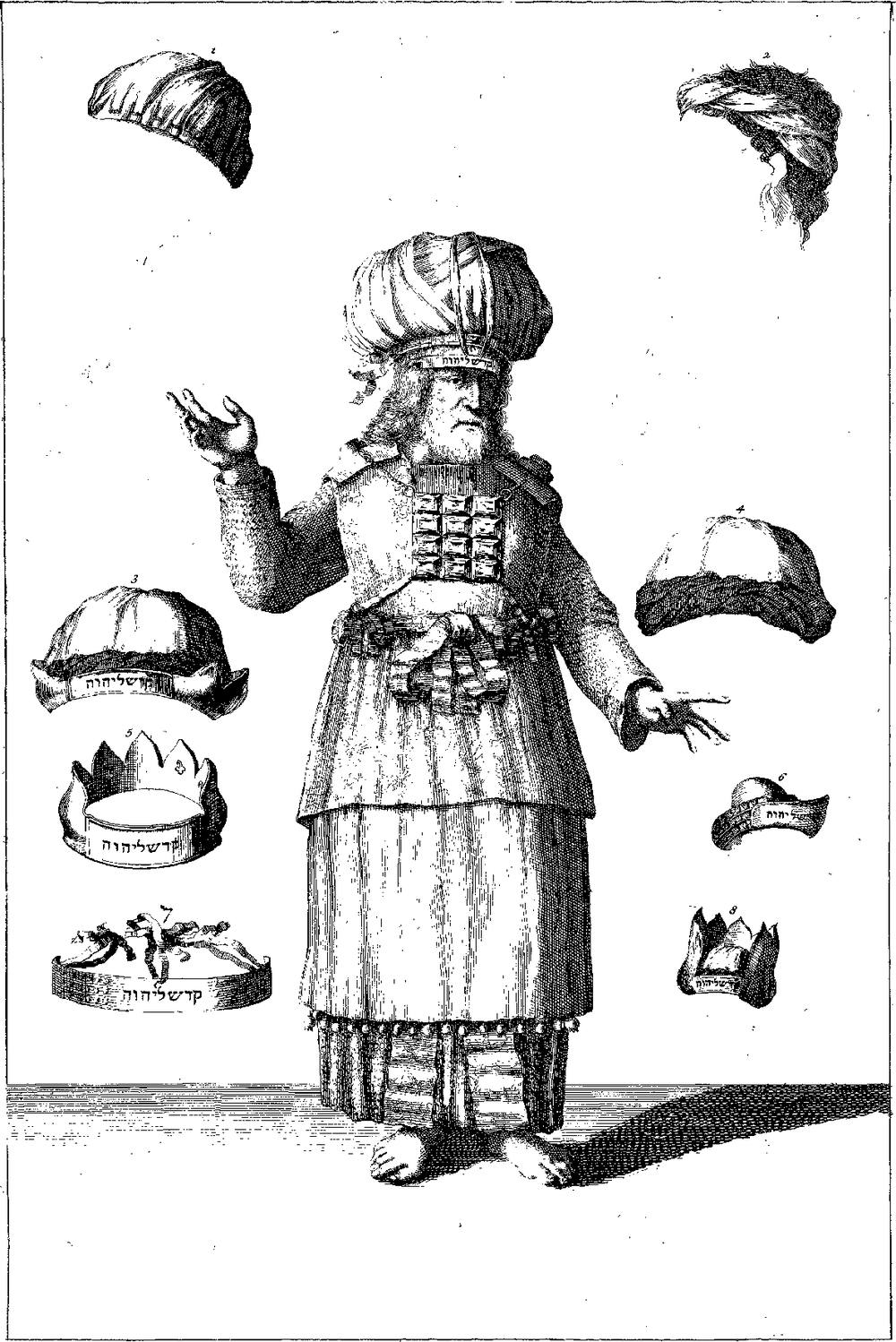
This Ephod, or Girdle2 consisted of two Ribbons of the most delicate Work, which descending from the Shoulders cross’d each other on the Stomach, and then being brought round the Body, served as a Girdle to the High Priest’s Robe. At the Place where the Ribbons of the Ephod met upon the Breast, was seen what the Scripture calls the Rational3, or Pectoral, or Breast-plate; which was a square Piece of about ten Inches wide, substantially embroidered, wherein were set twelve precious Stones, on each whereof the Name of one of the Tribes of Israel was engraved.
Upon the High Priest’s two Shoulders were two precious Stones, on each whereof Ex. xxviii. 9, 10, & seq.the Names of six Tribes were engraved. The Covering for the High Priest’s Head was a sort of Miter, fastened below upon his Forehead with a Crown, the fore-part whereof was composed of a thin Plate of Gold, on which these Words were written, Holiness to the Lord; and it was tied behind with a Ribbon. He wore likewise the Urim and Thummim on his Breast, which were either the Stones themselves of the Rational, or some hieroglyphical Figures, or some other Ornaments fixed to the Rational, by means whereof God promised to discover his Will to the High Priest.
Aaron and his Sister Miriam having one day murmured against Moses, on the Score Num. xii. 1. & seq. about the Year of the World 2514. before Jesus Christ 1586. before the vulgar Æra 1490.of Zipporah their Brother’s Wife, who was an Æthiopian, or rather a Midianite, a Native of the Land of Cush, in Arabia Petræa, on the Red Sea; Miriam was immediately struck with a Leprosy; which Punishment having opened Aaron’s Eyes, he acknowledged his Fault, and ask’d Forgiveness of Moses both for himself and Sister. Some time after Corah, Dathan and Abiram rose Ch. xvi. about the Year of the World 2015. before Jesus Christ 1585. before the vulg. Æra 1489.up against Moses and Aaron: Corah pretended that the Priesthood belonged to him as much as Aaron, both being of the Tribe of Levi; and Dathan and Abiram being of the Tribe of Reuben, had a mind to share with Moses in the Sovereign Authority and Government of the People. God discovered his Indignation against these Rebels in a remarkable Manner, and the Earth opening swallowed them up, and others of their Faction. Immediately a Fire issuing from the Tabernacle destroyed 250 Levites, the Accomplices of Corah, who attempted insolently of their own Head to offer Incense to the Lord. Moses commanded the 250 Censers belonging to these Conspirators to be got together, and reduced into Plates, which were fastened to the Altar of Burnt-offerings, there to remain as a Monument of what had happened.
The next Day the People murmuring against Moses and Aaron, the Lord caused a Plague to break out among them, which seized on the Camp, and consumed part of Num. xvi. 41.the People. But Aaron running with his Censer, placed himself between the living and the dead, and so the Plague was stayed. Another new Miracle God wrought in order to secure the Priesthood to him. For Moses Num. xvii.having taken twelve Rods from the Princes of the twelve Tribes, and Aaron’s separately, he placed them in the Tabernacle of Witness, having first written upon each the Name of that Tribe whereunto it belonged, and upon Aaron’s the Name of this High Priest. The next Day, when the Rods were taken out, Aaron’s, which was made out of an Almond Tree, appeared to be all covered with Leaves, and in full Blossom; but the rest were all in the Condition wherein they were seen to be the Day before. This Rod therefore was placed either within the Ark, or on the Side of it, to perpetuate the Remembrance of this Prodigy.
He married Elisheba the Daughter of Ex. vi. 23.Amminadab, of the Tribe of Judah, by whom he had four Sons, Nadab and Abihu, Eleazar and Ithamar. The two first were Lev. x. 1, 2.killed by Fire sent from God, as a Punishment upon them for presuming to offer Incense with strange Fire in their Censers. From the two others the Race of the High Priests was continued in Israel. Aaron and Moses not expressing sufficiently their Confidence in God, when he commanded them to Num. xx. 8, 12.strike the Rock at Kadesh, he in his Wrath declared to them that they should not enter into the Promised Land; and soon after the Lord ordered Aaron to ascend Mount Hor, Num. xx. 26, 26.at the Foot whereof the Hebrews were encamp’d, there to be gathered to his Fathers. As soon as he had got thither he strip’d himself of his Pontifical Ornaments in the view of all the People, and put them on Eleazar his eldest Son and Successor in the High Priesthood; this being done, he In the Year of the World 2522. before J. C. 1448. before the Vulg. Æra 1452. Ecclus. xlv.7, &c.died at the Age of an hundred and twenty three Years, and was buried by Moses and his Sons in a Cave of this Mountain. All Israel mourned thirty Days for him.
The Author of Ecclesiasticus gives us an Encomium of Aaron, in these Terms: “ The Lord exalted Aaron the Brother of “ Moses, of the Tribe of Levi. An everlasting Covenant he made with him, “ and gave him the Priesthood among the “ People; he beautified him with comely “ Ornaments, and cloathed him with a “ Robe of Glory. He put upon him perfect Glory, and strengthened him with “ rich Garments, with Breeches, with a “ long Robe and the Ephod. And he “ compassed him with Pomgranates, and “ with many golden Bells round about, “ that as he went there might be a Sound “ and a Noise made, that it might be “ heard in the Temple, for a Memorial “ to the Children of his People; with an “ holy Garment, with Gold, and blue “ Silk and Purple, the Work of the Embroiderer, with a Breast-plate of Judgment, and with Urim and Thummim. “ With twisted Scarlet, the Work of the “ cunning Workman; with precious “ Stones graven like Seals, and set in “ Gold, the Work of the Jeweller; with “ a Writing engraved for a Memorial, after the Number of the Tribes of Israel. “ He set a Crown of Gold upon the “ Mitre, wherein was engraved Holiness, “ an Ornament of Honour, a costly Work, “ the Desire of the Eyes, costly and beautiful. Before him there was none such, “ neither did ever any Stranger put them “ on, but only his Children, and his Childrens Children perpetually. Their Sacrifices shall be wholly consumed every “ Day twice continually. Moses consecrated him, and anointed him with Holy Oil. This was appointed unto him “ by an everlasting Covenant, and to his “ Seed, so long as the Heavens should “ remain, that they should minister unto “ him, and exercise the Order of Priesthood, and bless the People in his Name. “ He chose him out of all Men living to “ offer Sacrifices to the Lord, Incense and “ a sweet Savour, for a Memorial, to “ make Reconciliation for his People. He “ gave unto him his Commandments and “ Authority in the Statutes of Judgments, that he should teach Jacob the “ Testimonies, and inform Israel in his “ Laws. Strangers conspired together against him, and maligned him in the “ Wilderness, even the Men that were on “ Dathan’s and Abiram’s Side, and the “ Congregation of Core, with Fury and “ Wrath. This the Lord saw, and it “ displeased him, and in his wrathful Indignation were they consumed: He did “ Wonders upon them to consume them with the fiery Flame. But he made Aaron more honourable, and gave him an Heritage, and divided unto him the First-fruits of the Increase, especially he prepared Bread in Abundance; for he did eat of the Sacrifices of the Lord, which he gave unto him and his Seed. Howbeit in the Land of the People he had no Inheritance, neither had he any Portion among the People; for the Lord himself is his Portion and Inheritance.
St. Paul, in the Epistle to the Hebrews, Chap. v, vi, vii, viii, ix, x. compares the Priesthood of Aaron with that of Jesus Christ and the New Law; and shews the Superiority of the New Priesthood, above that instituted of Old. We shall give a Catalogue of the High Priests who succeeded Aaron, and shall say something of the Rights, Privileges and Functions of the Hebrew Priests, under the Word PRIEST. As to the Life of Aaron, the Reader may consult Exodus, Leviticus, and the Book of Numbers, as far as the twentieth Chapter, and twenty fourth Verse of this last Book, wherein we have a Relation of his Death.
The Hebrews settle the Day of his Death, and the Feast which they observe upon this Occasion, on the first Day of their fifth Month, which they call Ab, and which answers pretty nearly to our July, supposing the Year to begin at Easter. In Imitation of them, the Christian Church has fixed the Festival of this Patriarch to the first of July, with a Persuasion that by his Repentance he had made Atonement for the Fault committed by him, in permitting the Israelites to adore the golden Calf; and for the Diffidence expressed by him at the Waters of Strife. This religious Respect paid to Aaron is no new thing; for we find his Death on Mount Hor taken notice of in the first Martyrologies which go under St. Jerom’s Name, and in those of Ado, Usuardus, and others of a more modern Date.
Aaron’s Sepulcher has hitherto continued unknown to the World. The Scripture Deut. x. 6. And the Children of Israel took their Journey from Beeroth of the Children of Jaakan to Mazera, there Aaron died, and there he was buried. * Numb. xxxiii. 38. Deut. xxxii. 50.tells us in a particular Place, that Aaron died at Mosera; and elsewhere , that he died upon Mount Hor; because, in all Probability, Mount Hor was near the Place of their Encampment at Mosera, where the People had their Station when God called to himself the High Priest Aaron. He died in the Arms of Moses his Brother, and of Eleazar his Son and Successor in the High Priesthood. They buried him in some Cave belonging to this Mountain, and kept the Place of his Interment from the Knowledge of the Israelites; perhaps from an Apprehension that in After-Ages they might pay some superstitious Worship to him; or that the Arabians, in the midst of whom they then were, might some time after violate the Sanctity of his Grave.
They who have most diligently enquired into the several Marks of Resemblance between sacred and fabulous History compared together, observe several Instances of Conformity between Aaron and Mercury. This false Deity was, say they, an Egyptian, born of Nile, a Shepherd, the God of Shepherds, Travellers and Merchants, the Messenger and Intepreter of the Gods. They describe him with a miraculous Rod in his Hand, wreathed about with Serpents; they ascribe to him an extraordinary Degree of Knowledge, the Gift of foretelling Things future, and interpreting Dreams. He is adored as the God of the High-ways, of Houses, Thieves, and Musicians; the Invention of the Harp is attributed to him.
Aaron was born in Egypt, had been, like his Ancestors before him, by Trade a Shepherd, was with Moses his Brother at the Head of the People of Israel, who were a Nation of Travellers in the Wilderness. He was appointed by God himself to be Moses’s Interpreter, and the Messenger of God to Pharaoh and the Egyptians. Mercury’sExod. vii. 1, 2. Wand, with the Snakes twisted about it, represents the Wonder-working Rod which Aaron cast before Pharaoh on the Ground, and which thereupon was changed into a Serpent. The Caduceus, the miraculous Instrument of a thousand Prodigies, describes but imperfectly the many wrought in Egypt by the Means of Moses’s Rod, which this Legislator put into his Brother’s Hands. The Gifts of Prophecy and Knowledge attributed to Mercury are the Symbol of those Favours which God vouchsafed to Aaron, and communicated even to his Successors in the Pontifical Dignity, to whom he granted the Privilege of wearing the Urim and Thummim, which was as it were an Oracle at all times present in Israel. The Harp, the Flute, the Instruments of Musick, and the Sacred Trumpets, were peculiarly in the Care and Management of the Priests and Levites. To them only it belonged to make Use of them in the Temple, and in religious Assemblies. The pretended Robbery committed by the Hebrews, when on the point of their Departure, upon the Egyptians, of whom they borrowed what they had which was most valuable, might have contributed something towards the confounding Aaron with Mercury the God of Thieves and the High-ways. Mercury conducts the dead to Hell, and when the Gods please delivers them from thence. Aaron and Moses led the Hebrews into the Channel of the Red Sea, and miraculously brought them out of it, as it were Ch. iv. 14, 15, 16.from the Grave. Korah, Dathan and Abiram, who were swallowed up in the Earth, together with all their Faction, for rebelling against Aaron, may have been another Occasion of what we are told of Mercury. Lastly, Mercury the God of Eloquence is represented by Aaron, of whom it is said, I know that Aaron thy Brother can speak well: and also behold he cometh forth to meet thee. Thou shalt speak unto him, and put Words into his Mouth: And I will be with thy Mouth and with his Mouth: He shall be thy Spokesman unto the People, and he shall be to thee instead of a Mouth, or thy Interpreter.
Read this article in its place on the printed pages
Footnotes
-
1570 Years before Christ, and 1574 before the Vulgar Æra, which begins four Years after the true Year of Jesus Christ’s Birth. This Remark may serve for the whole Sequel of this Work. ↩
-
See a more particular Description of this Ornament in the Article Ephod, in Braunius de Vestit. Hebræor. Cunæus de Repub. Hebr. and others. ↩
-
Translators’ note. So our Author terms it from the Vulgate, and Greek λόγιον. The Hebrew Word for it is .חשןThe Stones here mentioned engraven and disposed as God appointed, Ex. xxviii. 15. are by some conceived to be the Urim and Thummim in Ver. 30. the Doctrina and Veritas, as the Latin; the Φωτισμοὶ καὶ τελειώσεις, as Aquila; the ἀλήθεια καὶ δήλωσις, as the Septuagint: All which signify no more than Truth and Manifestation, or the Manifestation of Truth, by those Stones. ↩