PRIEST. This Word comes from the Greek Word Presbyteros, which properly signifies an Elder, or an old Man. The Hebrew Word made use of in Scripture for a Priest, is Cohen;1 the Greek, Hiereus, and the Latin, Sacerdos or Presbyter. But this last Word, in the Latin Text of Scripture, does not always stand for a Priest. For Example, Judith sent to call to her House Ozias, and Chabris and Charmis, the Elders of Judith viii. 9. Ecclus. iv. 7.the City; Presbyteros civitatis. Jesus the Son of Sirach advises the Poor to humble themselves before the Antients, and to appear with a respectful Air before the Great. Presbytero humilia animam tuam. And elsewhere, Ecclus. vi. 35.be present in the Assembly of the Elders; In multitudine Presbyterorum prudentium sta. The Name of Presbyteri, or Elders, is given also to the two Judges of Israel that Dan. xiii. 28.were Susanna’s Accusers. But in the Latin of the New Testament, the Word Presbyter is always appropriated to the Priests.
In the Old Testament, the Priesthood was not annex’d to a certain Family, till after the Promulgation of the Law of Moses. Before that Time the First-born of every Family, the Fathers, the Princes, the Kings were Priests, born in their City and in their House. Cain and Abel, Noah, Abraham, and Job, Abimelech and Laban, Isaac and Jacob, offer’d themselves their own Sacrifices. In the Solemnity of the Covenant that the Lord made with his People, at the Foot of Mount Sinai, Moses perform’d the Office Exod. xxiv. 5, 6.of Mediator, and young Men were chosen from among the Children of Israel, to perform the Office of Priests.
But after that the Lord had chosen the Tribe of Levi to serve him in his Tabernacle, and that the Priesthood was annex’d to the Family of Aaron, then the Right of offering Sacrifices to God was reserved to the Priests alone of this Family. The Lord says, That no Stranger, which is not of the Seed of Aaron, come near to offer Incense before the Lord; that he be not as Korah, and as his Company. The Punishment of Uzziah King of Judah is well known, who having presumed to offer Incense to the Lord, was suddenly smote with a Leprosy, put out of his Palace, and excluded from the Administration of Affairs to the Day of his Death. However it seems, that on certain Occasions the Judges and Kings of the Hebrews have offer’d Sacrifices to the Lord, especially before a constant Place of Worship was fix’d at Jerusalem. See 1 Sam. vii. 9. where Samuel, who was no Priest, offer’d a Lamb for a Burnt-sacrifice to the Lord. See also 1 Sam. ix. 13. where it is said, that this Prophet was to bless the Offering of the People, which should seem to be a Function appropriated to the Priests. Lastly, 1 Sam. xvi. 5. he goes to Bethlehem, where he offers a Sacrifice at the Inauguration or Anointing of David. Ad immolandum Domino veni: Sanctificamini & venite mecum ut immolem.
Saul himself offers a Burnt-offering to the Lord, perhaps as being King of Israel. 1 Kings xiii. 9, 10. 2 Kings xviii. 33.Afferte mihi holocaustum & pacifica; & obtulit holocaustum. Elijah also offer’d a Burnt-offering upon Mount Carmel. David himself sacrificed, at least the Text expresses it so, at the Ceremony of the bringing the Ark to Jerusalem, and at the Floor of Araunah. Solomon went up to the brazen Altar that was at Gibeon, and there offer’d 2 Sam. xxvi. 24.Sacrifices. I know that these Passages are commonly explain’d, by supposing that these Princes offer’d these Sacrifices by the Hands of the Priests; but the Sacred Text will by no means favour such Explications; and it is very natural to imagine, that in the Quality of Kings and Heads of the People, they had the Privilege of performing some Sacerdotal Functions upon some extraordinary Occasions. So we see David consulted the Lord, being cloathed with the Priestly Ephod, and upon another Occasion he gave a solemn Benediction to the People. His Son Solomon also did the same.
2 Sam. vi. 18. 1 Kings viii. 55, 56. Numb. iii. 41.The Lord having reserved to himself the First-born of all Israel, because he had preserved them from the Hand of the destroying Angel in Egypt, by way of exchange and as a kind of Compensation, accepted of the Tribe of Levi for the Service of his Tabernacle. Thus the whole Tribe of Levi was appointed to the sacred Ministry, but not all in the same manner: For of the three Sons of Levi, which were Gershon, Kohath, and Merari, and which are the Heads of the three great Families, the Lord chose the Family of Kohath, and out of this the House of Aaron, to exercise the Functions of the Priesthood. All the rest of the Family of Kohath, even the Children of Moses and their Descendants, remain’d of the Order of mere Levites. But having already mention’d, under the Article LEVITES, all that concerns them, I shall not repeat it here, but confine myself to what belongs to the Priests only.
The High-priest was at the Head of all religious Affairs, and was the ordinary Judge of all Difficulties that belong’d thereto, and even of all Matters that concern’d the Justice and Judgments of the Jewish Nation. If there arise a Matter too hard for thee in Judgment, between Blood and Blood, between Plea and Plea, and between Stroke and Stroke, being Matters of Controversy between thy Gates; then shalt thou arise, and get thee up into the Place which the Lord thy God shall choose. And thou shalt come unto the Priests the Levites, and unto the Judge that shall be in those Days, a and enquire; and they shall shew thee the Sentence of Judgment. And thou shalt do according to the Sentence, which they of that Place (which the Lord shall choose,) shall shew thee, and thou shalt observe to do according to all that they inform thee. According to the Sentence of the Law which they shall teach thee, and according to the Judgment which they shall tell thee thou shalt do; thou shalt not decline from the Sentence which they shall shew thee, to the right Hand nor to the left. And the Man that will do presumptuously, and will not hearken unto the Priest (that standeth to minister there before the Lord thy God,) or unto the Judge, even that Man shall dye, and thou shalt put away the Evil from Israel. See also Deut. xix. 17. xxi. 5. xxiii. 9, 10. Ezek. xliv. 24. Joseph. Antiq. l. x. c. ult. & contra Appion. l. 2. c. 6. where this Discipline is well explain’d. Lastly, the Reader may consult our Dissertation upon the Polity of the Hebrews, prefix’d to our Commentary upon the Book of Numbers; and the great Work of Selden, De Synedriis veterum Hebræorum.
The High-priest only had the Privilege of entering into the Sanctuary once a Year, which was the Day of solemn Expiation, to make Atonement for the Sins of the whole People. See the Article EXPIATION. He ought to be born of one of his own Tribe, whom his Father had married a Virgin, and was to be exempt from all those corporal Defects mentioned in Leviticus. Non accedet ad ministerium si cœcus fuerit, si claudus, si parvo vel grandi vel torto naso; si fracto pede, si manu; si gibbus, si lippus, si albuginem habens in oculo, si jugem scabiem, si impetiginem in corpore, vel herniosus. In general, no Priest that had any corporal Defects could either offer Sacrifices, or enter into the Holy Place, to present the Shew-bread there. All that was allow’d him was this, to be maintain’d by the Sacrifices that were offer’d at the Tabernacle. Levit. xxi. 21, 22, 23.
God had appropriated to the Person of the High-priest the Oracle of his Truth; so that when he was habited with the proper Ornaments of his Dignity, and with the Urim and Thummim, he gave Answers to the Questions made to him, and God discover’d to him secret and future Things. It was forbidden him to mourn for any of his Relations, even for his Father or Mother, or to enter into any Place where a dead Body lay, that he might not contract any Uncleanness. He could not marry a Widow, nor a Woman that had been divorced, nor a Harlot, but a Virgin only of his own Race. He was to observe a strict2 Vid. Exod. xxxix. 1,2, 3, &c. Vid. Josep. l. 17. c 8. de Matthia Pontifice.Continence during the whole Time of his Service.
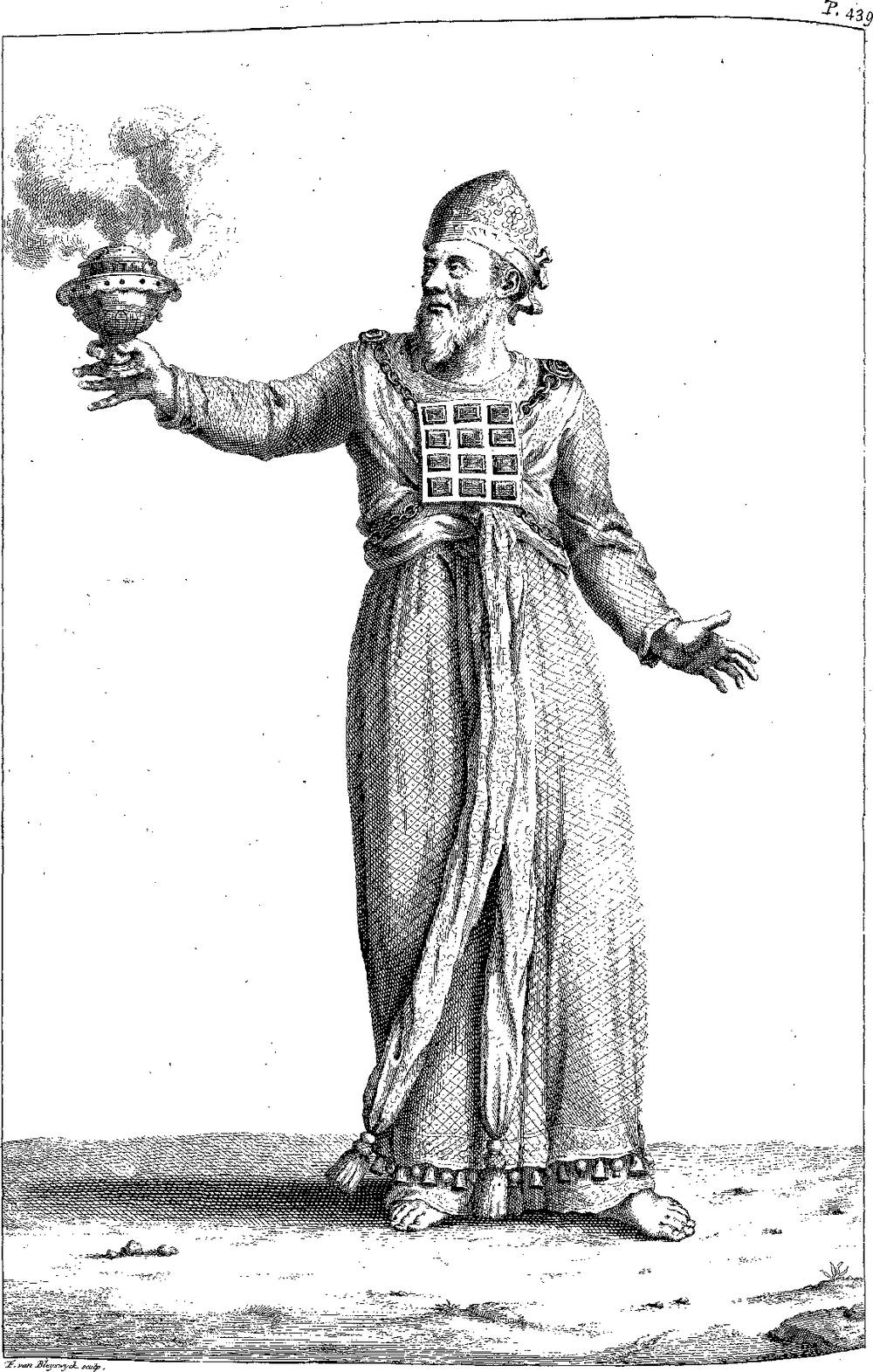
The Habit of the High-priest was much more magnificent than that of the other Priests. He had about his Waist a Pair of Drawers of fine Linen, and next his Skin a Linen Tunique of a particular Make. Over this Tunique he wore a long Robe of an Azure Colour, or of Hyacinth, at the Bottom of which was a Border adorn’d with little golden Bells and Pomegranates, made of Wool of different Colours, and ranged alternately at equal Distances. This Robe was girded about him with a broad embroider’d Sash, which in Scripture is call’d the Ephod. It consisted of two costly Ribbons, which going round the Neck and coming over the Shoulders, cross’d each other at the Breast; then turning behind, it served as a Sash to gird up the Robe afore-mentioned. Upon the Shoulders the Ephod had two large precious Stones, upon each of which were engraven Six of the Names of the Tribes of Israel; and before upon the Breast, at the Place where the Ribbons cross’d each other, was fix’d the Pectoral or Rational of Judgment, which was a square Piece of a very precious and solid Work, six Inches wide, in which were set twelve precious Stones, upon each of which was engraved the Name of one of the Tribes of Israel. Some think the Rational was double, like a Pocket or Bag, in which was included the Urim and Thummim. Others believe the Urim and Thummim were two Hieroglyphical Figures, which hung at the Bottom of the Pectoral.
2 Chron. xxix. 34. xxxv. 11.The High-priests Tiara or Bonnet was more adorn’d and more costly than that of any other Priest, but it is not distinctly known what Form it was of. See what we have said before under the Article CIDARIS. That which chiefly distinguish’d the Tiara of the High-priest, was a Plate of Gold that hung down from the Bonnet upon his Forehead, upon which was written or engraven, Holiness to the Lord. This Plate was ty’d behind his Head with two Ribbons fasten’d at its two Ends. The ordinary Priests served immediately at the Altar, offer’d the Sacrifices, kill’d and flea’d them, and pour’d their Blood at the Foot of the Altar. They kept up a perpetual Fire upon the Altar of Burnt-sacrifices, and in the Lamps of the golden Candlestick that was in the Sanctuary; they kneaded the Loaves of Shew-bread, baked them, offer’d them upon the golden Altar in the Sanctuary, and changed them every Sabbath-day. Every Day, Night, and Morning, a Priest appointed by casting of Lots at the Beginning of the Week, brought into the Sanctuary a smoaking Censer, and set it upon the golden Table, otherwise call’d the Altar of Perfumes.
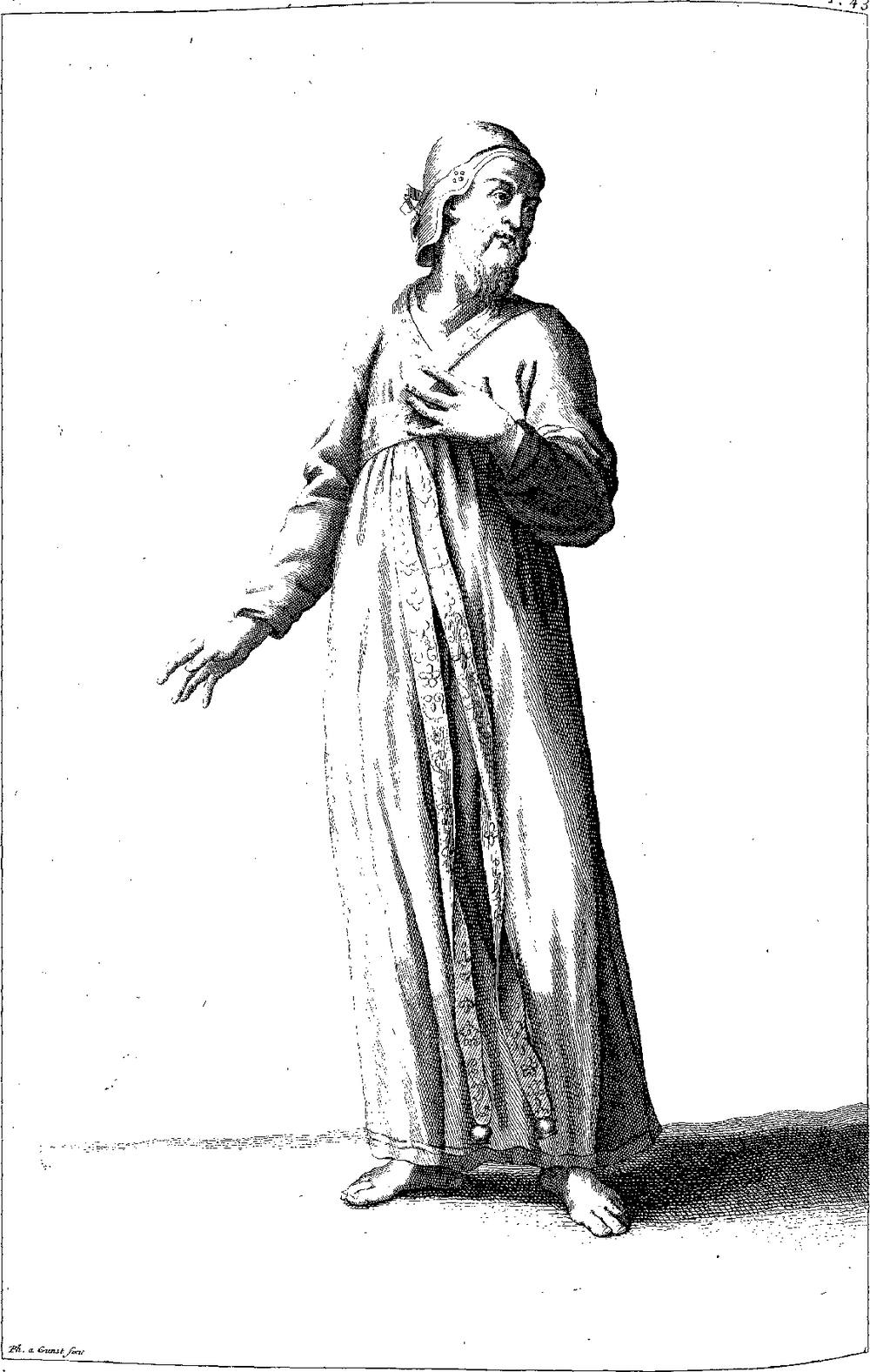
Cidaris. See Luke i. 9.The common Habit of the Priests was a Surplice or Tunique of Linen without Seam, with a Sash of several Colours, hollow like the Skin of a Serpent, of loose Work, about three Fingers Breadth. ‘Tis thus describ’d by Josephus. He adds, that the Priests wore it upon their Breasts, under their Arms; that a kind of Flower-work was there represented, with Threads of Scarlet, Purple, and Hyacinth; that it went twice round the Body, was tied before, and the Ends hung down to the Feet, to render the Priests more venerable. When they were in the Act of Sacrificing, they threw this Girdle over the Left Shoulder, that they might perform their Office with the greater Freedom. The Rabbins make this Sash to be two and thirty Cubits or Elns long.
‘Tis thought the High-priest’s Sash was of a more precious Work, for Moses says it was made by the Art of the Embroiderer; Ex. xxviii. 4. Antiq. l. 3. c. 8. Ex. xxviii. 39. xxxix. 3, 5.and it is believed, that besides the Threads of Purple, Crimson, and Hyacinth, there were also Threads of Gold. Others maintain, that it differ’d in nothing from those of the other Priests. The Reader may see Braunius, who has carefully examin’d all these Particulars, in his Treatise concerning the Habits of the Hebrew Priests. The High-priest had two Sashes or Girdles, one to gird up his Linen Tunique, which he wore under, and the other to gird up his Robe of Azure, and which is call’d Chescheb ephudath, Levit. viii. 7. which we have now describ’d by the Name of Ephod.
Antiq. l. 3. c. 8.The Cap or Bonnet of the Priests a is call’d in Hebrew, Migbaoth, and that of the High-priest is call’d Miznepheth. But the Rabbins assure us, that these two Words signify but one and the same thing, and that the Bonnet of the Priests, as well as that of the High-priest, was a Cap made of a Border of Linen sixteen Elns long, which went round the Head several times, and made a Cap not unlike a Head-piece, as the Hebrew Word Migbaoth insinuates, which has the same Signification. Josephus thus describes it: “ It is composed “ of several Folds of a linen Border, “ folded back and sewed, so that it appears like a thick Crown worked up of “ Linen. Over this Cap there is a Cloth “ that covers it quite, and comes down to “ the Forehead, to hide all the Plaits and “ Seams.”
Hieronym ad Fabiol.Lastly, St. Jerome gives us a Description of it, that agrees neither with that of the Rabbins nor of Josephus. This Bonnet, says he, is round, and like to that which is represented upon the Head of Ulysses, as if a Sphere was cut into two equal Parts, and one of the Parts was taken for a Bonnet. There is no Point at the3 Top, and it does not cover all the Hair, but leaves a third Part to be seen before; and that it may not fall off, it is ty’d behind with a Ribbon. Its Matter is of fine Linen, and it is cover’d with a Cloth, to hide the Foldings and the Seams. Moses insinuates to us,4 that they were indeed tied on with a Ribbon, when he says, that at the Consecration of the Priests their Bonnets were tied on.
As to the High-priest’s Tiara, the Rabbins hardly make any Difference between it and the Bonnet of the other Priests, except that the High-priest’s is flatter, and more approaching to the Form of a Turbant; whereas that of the other Priests more resembles a Night-cap, rising a little to a Point at the Top. Josephus gives us a magnificent Description of it, probably taken from what he had seen in his own Time, at Antiq. l. 3. c. 5.the Temple of Jerusalem. He says it was a Cap of the Colour of Hyacinth, or of an Azure Blue, which was put over the other Cap of the Shape of a Turbant, of which a Description is given before. It covers the hinder Part of the Head, and the two Temples, and is incompass’d by a treble Crown of Gold, where there are little Buds of the Flowers of the Plant Henbane. The Circuit of these Flowers is interrupted on the forepart of the Tiara, to make Room for the Plate of Gold, on which the Name of God was engraven.
The Priests did not wear their Hair long Ezek. xliv. 20. See Levit. x. 6. xxi. 5.in the Temple, yet they did not shave their Heads, but only clipt their Hair with Scissars. Caput suum non radent, neque comam nutrient; sed tondentes attondent capita sua. They did not appear with their Heads bare during their Ceremonies. To appear bare-headed and uncover’d before any one, was look’d upon as a want of Respect, as it is still among some Nations. They wore linen Drawers as well as the High-priest, when they went up to the Altar, that they might not shew any thing indecent Exodus xxviii. 42. xxxix. 27.there. The Levites had no peculiar Habit in the Ceremonies of Religion; but about the sixty-second Year of Christ they obtain’d from King Agrippa, that they might wear a linen Tunique as well as the Joseph. Antiq. l. 20. c. 8. p. 699.Priests: Which Josephus says, was look’d upon as an evil Presage, Experience having always shewn, that Innovations in the antient Practices of religious Worship are always attended with some Disaster.
The Priests were not suffer’d to offer Incense Levit. x. 1, 2.to the Lord with strange Fire, that is, with any other Fire but what should be taken from the Altar of Burnt-sacrifices. ‘Tis known with what Severity God chastised Nadab and Abihu for having fail’d herein. The Priests and Levites waited by the Week and by the Quarter in the Temple. They began their Week on the Sabbath-day, and ended it on the next. 2 Kings xi. 1, 7. Numb. viii. 24. iv. 3.Moses had fix’d the Age at which they were to enter on the sacred Ministry, at twenty-five or thirty Years, and they were to end it at fifty: But in David’s Time this Order was changed, and they were obliged to attend the Service of the Temple as soon as they were twenty Years of Age.5 Those that would dedicate themselves to perpetual Service in the Temple, were well received, and were maintain’d Deut. xviii. 6. Deut. xviii. 3. Deut. xviii. 4.by the constant and daily Offerings.
The Lord had given no Lands of Inheritance to the Tribe of Levi, in the Distribution of the Land of Promise. He intended that they should be supported by the Tythes, the First-fruits, the Offerings that were made in the Temple, by their Share of the Sin-offerings and Thanksgivingofferings that were sacrificed in the Temple, of which certain Parts were appropriated to the Priests. In the Peace-offerings the Priests had the Shoulder and the Levit. vii. 33, 34. Levit. vii. 6, 7.Breast. In the Sin-offerings they burnt upon the Altar the Fat that covers the Bowels, the Skin of the Liver, and the Kidnies. The rest belong’d to the Priest. The Skin or Fleece of every Sacrifice also belong’d to him; and this Article alone was no mean Allowance. When an IsraelitePhilo de præmiis Sacerdotum. kill’d any Animal for his own Use, he was to give the Priest the Shoulder, the Stomach, and the Jaws. He had also a Share in the Wool when the Sheep were shorne. All the First-born, both of Man and Beast, belong’d to the Lord, that is to say, to his Priests. The Men were redeem’d Numb. xviii. 15, 16.for the Sum of five Shekels. The First-born of impure Animals were redeem’d or exchang’d, but the clean Animals were not redeem’d. They were sacrificed to the Lord; their Blood was sprinkled about the Altar, and all the rest belong’d to the Numb. xviii. 17. Lev. xix. 23, 24.Priest. See the Article FIRST-BORN. The First-fruits of Trees, that is, those that came on the fourth Year, belong’d also to the Priest.
They offer’d at the Temple the first of all the Fruits of the Earth, and the Quantity was fix’d by Custom, which was between the fortieth and the sixtieth Part. Besides this, they offer’d whatever any one had vow’d to the Lord. See the Article FIRST-FRUITS before. They gave also to the Priests and Levites an Allowance out of the Dough that they kneaded. They had the Tythe of all the Fruits of the Land, and of all the Animals which Lev. xxvii. 31, 32.were fed under the Shepherd’s Crook. And when the Levites had collected all the Tythes and all the First-fruits, they set Numb. xviii. 26.apart the Tythe of that for the Priests. Thus Josh. xxi. 19, 20. Hos. iv. 6.Thus though the Priests had no Lands or Inheritance in the Country, they lived however in great Plenty, and were abundantly supplied with what was necessary for their Subsistance. God had also provided them with Houses and Accommodations, by appointing them eight and forty Cities for Numb. xxxv. 1, 2, 3.their Habitation. In the Precincts of these Cities they possess’d only as far as a thousand Cubits beyond the Walls. Of these forty-eight Cities, six were appointed to be Cities of Refuge, for the Sake of those that should commit any casual and involuntary Manslaughter. The Priests had thirteen of these for their Share, and all the others belong’d to the Levites.
Deut. xx. 3, 4.One of the chief Imployments of the Priests, next to attending upon the Sacrifices and the Service of the Temple, was the Instruction of the People, and the deciding Controversies; the distinguishing the several Mal. ii. 7, &c. Levit. xiii. 14. Numb. v. 14, 15.Sorts of Leprosie, the Causes of Divorce, the Waters of Jealousy, Vows, all Causes relating to the Law, the Uncleannesses that were contracted several Ways; all these Things were brought before the Priests. For the Priests Lips should keep Knowledge, and they should seek the Law at his Mouth; for he is the Messenger of the Lord of Hosts. Malac. ii. 7.They publickly bless’d the People in the Name of the Lord. In the Times of War Numb. vi. 23, 24, 25.their Business was to carry the Ark of the Covenant, to consult the Lord, to sound the holy Trumpets, and to pronounce these Numb. x. 8, 9.Words at the Head of the Army; “ Hear, O “ Israel, you are now going to fight with “ your Enemies, but fear not, for the “ Lord is in the midst of you; he will “ fight for you, and defend you from all “ Danger.”
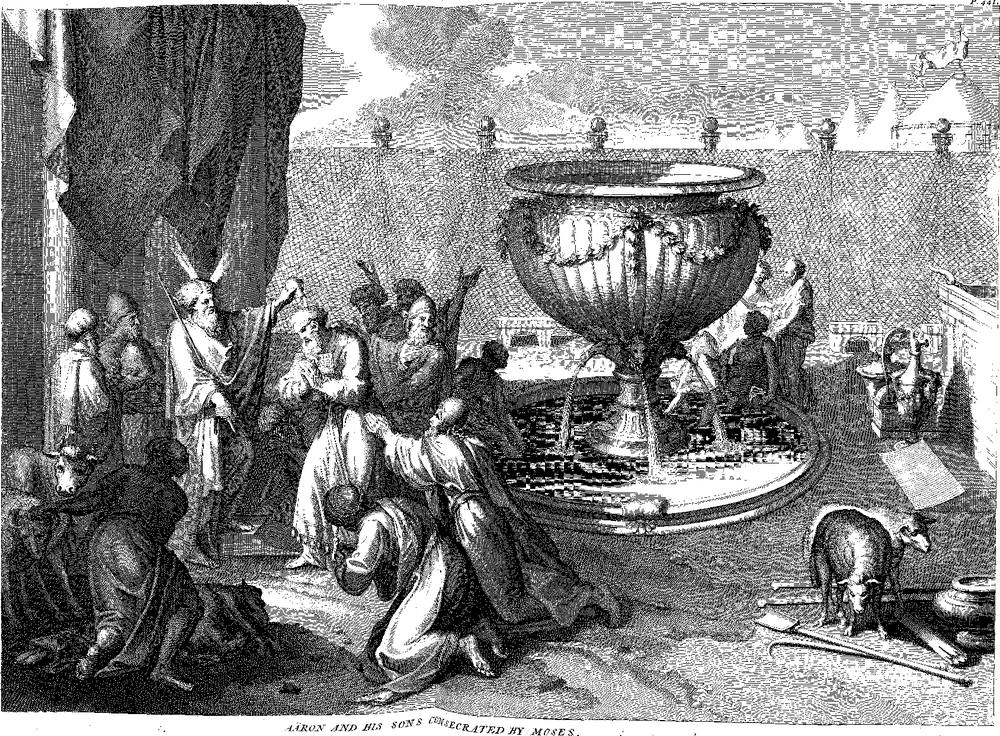
The Consecration of Aaron and of his Sons was perform’d by Moses in the Desart with great Solemnity, and this is what pass’d Exod. xl. 12. Lev. viii. 1, 2, &c.upon that Occasion. Aaron and his Sons wash’d themselves all over in Water, and presenting themselves to Moses at the Tabernacle of the Covenant, with the Sacrifices that were to be offer’d for them, Moses first dress’d them with all the Ornaments mention’d before, then with the Oyl of the sacred Unction he anointed Aaron by pouring it upon his Head. Afterwards he offer’d up a Calf for a Sin-offering, and Aaron and his Sons having laid their Hands on this Sacrifice, Moses kill’d it, put some of its Blood with his Finger upon the Horns of the Altar, burnt the Fat upon the Fire of the Altar, and sent the Flesh, the Skin, and the Dung to be burnt without the Camp. After which he offer’d a Ram for a Burnt-offering. Aaron and his Sons laid their Hands upon the Head of the Victim, and Moses kill’d it, sprinkling the Blood about the Altar, and burning the Flesh and the Bowels upon the Altar of Burnt-sacrifices.
Lastly, they presented the Ram which was to serve for the Consecration of the Priests. Aaron and his Sons laid their Hands upon its Head, Moses kill’d it, and taking of the Blood of this Ram, he touch’d with it the Tip of the right Ear of each, the Thumbs of their right Hands, and the great Toes of their right Foot, and sprinkled the rest of the Blood upon the Altar. Then taking the Fat of the Kidneys and Bowels, the Rump, the Kidneys, and the right Shoulder of the Victim, with a Leaf of unleaven’d Bread, a Cake and a Wafer, he put them successively into the Hands of Aaron and of his Sons, who lifted them up before the Lord, with a waving Motion, Moses at the same time supporting and guiding the Hands of each. After which Moses received these Things again, and burnt them upon the Altar of Burnt-sacrifices, because it was the Sacrifice of the Consecration of Aaron and of his Sons. Then taking the Oyl of Unction, and the Blood that was upon the Altar, with these he sprinkled Aaron and his Sons, habited as they were in all their sacred Ornaments. This Ceremony was continued for seven Days successively, beginning it every Day in the same Manner, at least as to the offering of Sacrifices, the Unctions, and Aspersions; for it does not appear that Aaron and his Sons were dress’d every Day in their sacerdotal Habits. For these whole seven Days the Priests continued in the Court of the Tabernacle, without going out of it.
In this whole Ceremony Moses perform’d the Office of consecrating a Priest. It is much to be doubted, whether at every new Consecration of a High-priest all these Ceremonies were repeated. It is very probable they contented themselves with cloathing the new High-priest in the Habit of his Predecessor, as was put in Practice at the Death of Aaron. Others think they gave them the Unction also, Numb. xx. 25, 26, &c.which perhaps might be in use to the Babylonish Captivity, though there is no Proof of this Fact. We know on the contrary, that Jonathan the Asmonean contented 1 Macc. x. 21. Joseph. Antiq. l. 13. c. 5. Antiq. l. 19. c. 6. p. 676. d.himself with putting on the High-priest’s Habit at the Feast of Tabernacles, in order to take Possession of this Dignity; and Agrippa King of the Jews having offer’d to Jonathan Son of Ananus the High-priesthood, a second Time, Jonathan thank’d him for it, saying, It was enough for him to have once received the Ornaments of this supream Dignity, which he would willingly resign to some other that should be more worthy of it.
As to the ordinary Priests, we do not see that any particular Ceremony was us’d for their Consecration; they were admitted to the Exercise of their Functions by filling their Hands, as the Scripture speaks, or by making them perform the Functions of their Order. But when the Priests had fallen away from the Lord, or had been a long Time without performing their Office, as it sometimes happen’d under the Reigns of some of the later Kings of Judah; for Example, under Ahaz, Ammon, and Manasseh, they thought it necessary to sanctify anew such Priests, who had been absent from the Holy Place, who for a long Time had interrupted the Exercise of their Ministry, or who had never yet exercis’d 2 Chron. xxix. 34. 2 Chron. xxxv. 12.it; as it happen’d under Hezekiah and Josiah, when the Number of the Priests that were sanctify’d not being found sufficient for the great Number of Sacrifices that were to be offer’d, they were forced to employ the Levites in fleaing the Sacrifices; for the Levites were much sooner sanctify’d than the Priests. a Levitæ quippe faciliori ritu sanctificabantur quam Sacerdotes.
However, we must acknowledge, that we do not know what was done upon these Occasions, for the Consecration, or rather for the Sanctification of the Priests. Nor is it certain, whether any thing else was requir’d than the ordinary Sanctification, which was, the Exemption from legal Defilements and Uncleanneffes, which was necessary for the approaching to holy Things. The Hebrew Text of the Passage now quoted reads only, ” For the Levites ” were upright of Heart, to sanctify themselves, rather than the Priests.” The Levites shew’d more Zeal and Readiness than the Priests, to assist in this Ceremony.
As to the Priests of the new Covenant, their Dignity is vastly more exalted than that of the Hebrew Priests, because their Functions are more noble, and their Object more sacred and divine. They consecrate the Body and Blood of Jesus Christ upon the Altar; they have the Power to bind and to loose, to remit or to retain Sins, they bear a sacred and inviolable Character. The Christian Priesthood is the Substance and the Truth, of which that of the Jews was but the Shadow and the Figure. Jesus Christ the everlasting Priest, according to the Order of Melchisedeck, abides for ever, as St. Paul observes; whereas the Priests, Hebr. vii. 23, 24, &c.according to the Order of Aaron, were mortal, and therefore could not continue long. The Priesthood of Jesus Christ is one, divided among many Priests, who partake of his Power, and who exercise in his Name the Functions of his Ministry. The Consecration given by Moses to Aaron and his Sons, was not again to be repeated to their Successors, because the Priesthood was always to continue in the same Family; whereas the Christian Priesthood not being continued to any particular Family, was to be conferr’d on every one of the Priests with distinct Ceremonies.
Lastly, the corporal Defects, which excluded from the legal Priesthood, and from the Privileges that attended it, ought in Proportion to be understood in an exalted and spiritual Sense, in respect of the Christian Priesthood. We have elsewhere spoke of the Superiority of the Bishops above Priests, and of the Primacy of the Pope, the Bishop of Rome, which we believe to be of Divine Right. The Qualities that St. Paul requires in a Bishop, may be seen 1 Tim. iii. Tit. i. 7, &c.6
A Chronological LIST of the High-priests of the Hebrews.
| 1. Succession, taken from several Places of the Holy Scriptures. | 2. Succession, taken from 1 Chron. vi. 3, 4, 5, 6, 7, &c. | 3. Succession, taken from Josephus Antiq. l. 5. c. 15. l. 10. c. 11. | 4. Succession, taken from the Jewish Chronicle, call'd Seder Olam. |
|---|---|---|---|
| 1. Aaron, the Brother of Moses, created High-priest in the Year of the World 2514, and died in the Year 2552, before Christ 1448, before the vulgar Era 1452. | 1. Aaron. | 1. Aaron. | 1. Aaron. |
| 2. Eleazar, created in 2552, died about the Year 2571, before Christ 1429, before the vulgar Era 1433. | 2. Eleazar. | 2. Eleazar. | 2. Eleazar. |
| 3. Phinehas, made about the Year 2571, died about 2590, before Christ 1410, before the vulgar Era 1414. | 3. Phinehas. | 3. Phinehas. | 3. Phinehas. |
| 4. Abiezer, or Abishua, under the Judges. | 4. Abishua. | 4. Abiezer. | 4. Eli. |
| 5. Bukki, under the Judges. | 5. Bukki. | 5. Bukki. | 5. Abitub. |
| 6. Uzzi, under the Judges. | 6. Uzzi. | 6. Uzzi. | 6. Abiathar. |
| 7. Eli, of the Race of Ithamar, created in 2848, died in 2888, before Christ 1112, before the vulgar Era 1116. | 7. Zerahiah. | 7. Eli. | 7. Zadok. |
| 8. Abitub I. | 8. Meraioth. | 8. Abitub. | 8. Ahimah, under Rehoboam. |
| 9. Abiah. He lived in 2911, or 2912. | 9. Amariah. | 9. Abimelech. | 9. Azariah, under Abiah. |
| 10. Ahimelech, or Abiathar. He was put to death by Saul in 2944, before Christ 1056, before the vulgar Era 1060. | 10. Abitub I. | 10. Abiathar. | 10. Jehoachash, under Jehoshaphat. |
| 11. Abiathar, Ahimelech, or Abimelech, under David, from 2944, to 2989, before Christ 1011, before the vulgar Era 1015. | 11. Zadok I. | 11. Zadok. | 11. Jehoiarib, under Jehoram. |
| 12. Zadok I. under Saul, David, and Solomon, from 2944, 'till about 3000, before Christ 1000, before the vulgar Era 1004. | 12. Ahimaaz. | 12. Ahimaaz. | 12. Jehoshaphat, under Ahaziah. |
| 13. Ahimaaz, under Rehoboam, about the Year 3030, before Christ 970, before the vulgar Era 974. | 13. Azariah. | 13. Azariah. | 13. Jehoiadah, under Joash. |
| 14. Azariah, under Jehoshaphat; probably the same as Amariah, 2 Chron. xix. 11. About the Year 3092, before Christ 908, before the vulgar Era 912. | 14. Johanan. 1 Chron. vi. 9, 10. | 14. Joram. | 14. Phadaiah, under Joash. |
| 15. Johanan, perhaps Jehoiada, in the Reign of Joash. 2 Chron. xxiv. 15. in 3126. He died at the Age of 130 Years. | 15. Azariah. | 15. Issus. | 15. Zedekiah, under Amaziah. |
| 16. Azariah, perhaps the same as Zechariah the Son of Jehoiada, who was kill'd in 3164, before Christ 836, before the vulgar Era 840. | 16. Amariah. | 16. Axiora. | 16. Joel, under Uzziah. |
| 17. Amariah, perhaps Azariah, under Uzziah, in 3221, before Christ 779, before the vulgar Era 783. | 17. Abitub II. | 17. Phideas. | 17. Jothan, under Jotham. |
| 18. Abitub II. under Jotham K. of Judah. | 18. Zadok II. | 18. Sudeas. | 18. Uriah, under Ahaz. |
| 19. Zadok II. under Jotham K. of Judah. | 19. Shallum. | 19. Julus. | 19. Neriah, under Hezekiah. |
| 20. Uriah, under Ahaz; he lived in 3265, before Christ 735, before the vulgar Era 739. | 20. Hilkiah. | 20. Jotham. | 20. Hosaiah, under Manasseh. |
| 21. Shallum, the Father of Azariah, and Grandfather of Hilkiah. | 21. Azariah. | 21. Uriah. | 21. Shallum, under Amon. |
| 22. Azariah, who liv'd in the Time of Hezekiah, 2 Chron. xxxi. 10. about the Year 3278, before Christ 722, before the vulgar Era 726. | 22. Seraiah. | 22. Neriah. | 22. Hilkiah, under Josiah. |
| 23. Hilkiah, under Hezekiah. | 23. Jehozadak. | 23. Odeas. | 23. Azariah, under Jehoiakim and Zedekiah. |
| 24. Eliakim, or Joakim under Manasseh, and at the Time of the Siege of Bethulia, in 3348. He continued to live under Josiah to 3380, and longer. He is also call'd Hilkiah. See Baruch i. 7. | 24. Joshua. | 24. Saldum. | 24. Jehozadak, after the taking of Jerusalem. |
| 25. Azariah, perhaps Neriah, the Father of Seraiah and of Baruch. | 25. Hilkiah. | 25. Jesus, Son of Jehozadak, after the Captivity. | |
| 26. Seraiah, the last High-priest before the Captivity, put to death in 3414, before Christ 586, before the vulgar Era 590. | 26. Seraiah. | ||
| 27. Jehozadak, during the Captivity of Babylon, from 3414 to 3469, before Christ 531, before the vulgar Era 535. | 27. Jehozadak. | ||
| 28. Joshua or Jesus the Son of Jehozadak; he return'd from Babylon in 3468, before Christ 532, before the vulgar Era 536. | 28. Jesus, or Joshua. |
What follows is collected from Ezra, Nehemiah, and Josephus.
-
Joachim, under the Reign of Xerxes. Joseph. Antiq. l. 11. c. 5.
-
Eliasib, Joasib, or Chasib, under Nehemiah, in 3550, before Christ 450, before the vulgar Era 454.
-
Joiada, or Juda; see Nehem. xii. 10.
-
Jonathan, or John.
-
Jeddoa, or Jaddus, who received Alexander the Great at Jerusalem, in 3673, and died in 3682, before Christ 318, before the vulgar Era 322.
Onias 34. Onias I. made High-priest in 3681, govern’d 21 Years, and died in 3702, before Christ 298, before the vulgar Era 302.
-
Simon I. call’d the Just, made in 3702, or 3703, and died in 3711, before Christ 289, before the vulgar Era 293.
-
Eleazar, made in 3712. ‘Twas under this Pontiff, as they tell us, that the Translation of the Septuagint was made, about the Year 3727; he died in 3744, before Christ 256, before the vulgar Era 260.
-
Manasseh, made in 3745, died in 3771, before Christ 229, before the vulgar Era 260.
-
Onias II. made in 3771, died in 3785, before Christ 215, before the vulgar Era 219.
-
Simon II. made in 3785, died in 3805, before Christ 195, before the vulgar Era 199.
-
Onias III. made in 3805, depos’d in 3829, died in 3834, before Christ 166, before the vulgar Era 170.
-
Jesus, or Jason, made in 3830, depos’d in 3831, before Christ 169, before the vulgar Era 173.
-
Onias IV. otherwise call’d Menelaus, made in 3832, died in 3842, before Christ 158, before the vulgar Era 162.
-
Lysimachus, Vicegerent to Menelaus, kill’d in 3834, before Christ 166, before the vulgar Era 170.
-
Alcimus, or Jacimus, or Joachim, made in 3842, died in 3844, before Christ 156, before the vulgar Era 160.
-
Onias V. He did not exercise his Pontificate at Jerusalem, but retired into Egypt, where he built the Temple Onion, in 3854, before Christ 146, before the vulgar Era 150.
-
Judas Maccabeus restor’d the Altar and the Sacrifices in 3840, died in 3843, before Christ 157, before the vulgar Era 161.
-
Jonathan the Asmonean, Brother to Judas Maccabeus, created High-priest in 3843, died in 3860, before Christ 140, before the vulgar Era 144.
-
Simon Maccabeus, made in 3860, died in 3869, before Christ 131, before the vulgar Era 135.
-
John Hircanus, made in 3869, died in 3898, before Christ 102, before the vulgar Era 106.
-
Aristobulus, King and Pontiff of the Jews, died in 3899, before Christ 101, before the vulgar Era 105.
-
Alexander Jannæus, also King and Pontiff for 27 Years, from 3899 to 3926, before Christ 74, before the vulgar Era 78.
-
Hircanus was High-priest for 32 Years in all, from 3926 to 3958, before Christ 42, before the vulgar Era 46.
-
Aristobulus, Brother to Hircanus, usurped the High-priesthood, and enjoy’d it 3 Years and 3 Months, from 3935 to 3940, before Christ 60, before the vulgar Era 64.
-
Antigonus his Son also usurp’d the Priesthood, in Prejudice to the Rights of Hircanus, and possess’d it for 3 Years and 7 Months, from 3964 to 3967, when he was taken by Sosius, before Christ 33, before the vulgar Era 37.
-
Ananeel of Babylon, made High-priest by Herod in 3968 ‘till 3970, before Christ 30, before the vulgar Era 34.
-
Aristobulus, the last of the Asmoneans; he did not enjoy the Pontificate a whole Year. He died in 3970, before Christ 30, before the vulgar Era 34. Ananeel was made High-priest a second Time in 3971, before Christ 29, before the vulgar Era 33. 57. Jesus the Son of Phabis, depos’d in 3981, before Christ 19, before the vulgar Era 23.
-
Simon Son of Boethus, made in 3981, depos’d in 3999, before Christ 1, before the vulgar Era 4.
-
Matthias Son of Theophilus, made in 3999. Ellem was substituted in his Place for a Day, because of an Accident that had happen’d to Matthias, which hinder’d him from performing his Office for that Day; before Christ 1, before the vulgar Era 4.
-
Joazar Son of Simon, Son of Boethus, made in 4000, the Year of the Birth of Jesus Christ, 4 Years before the Beginning of the vulgar Era.
-
Eleazar Brother to Joazar, made in 4004, of Christ 4, of the vulgar Era 1.
-
Jesus Son of Siah, made in 4009, of Christ 9, of the vulgar Era 6. Joazar was made a second Time in 4010, deprived in 4016, of the vulgar Era 13.
-
Ananus Son of Seth, for 11 Years, from 4016 to 4027, of the vulgar Era 24.
-
Ishmael Son of Phabi, made in 4027, of the vulgar Era 24.
-
Eleazar Son of Ananus, made in 4027, of the vulgar Era 24.
-
Simon Son of Camithus, made in 4028, of the vulgar Era 25.
-
Joseph, surnamed Caiaphas, made in 4029, ‘till 4038, of the vulgar Era 35.
-
Jonathan Son of Ananus, made in 4038, ‘till 4040, of the vulgar Era 37.
-
Theophilus Son of Jonathan, made in 4040, depos’d in 4044, of the vulgar Era 41.
-
Simon surnamed Cantharus, and Son of Simon Boethus, was made in 4044, of the vulgar Era 41.
-
Matthias Son of Ananus, made in 4045, of the vulgar Era 42.
-
Elioneus, made in 4047, ‘till 4048, of the vulgar Era 45. Simon Son of Cantharus was a second Time made High-priest in 4048, and depos’d the same Year, of the vulgar Era 45.
-
Joseph Son of Caneus, made in 4048, ‘till 4050, of the vulgar 47.
-
Ananias Son of Nebedeus, made in 4050, ‘till 4066, of the vulgar Era 63.
-
Ismael Son of Phabeus, made in 4066, of the vulgar Era 63.
-
Joseph surnam’d Cabei, the same Year 4066.
-
Ananus Son of Ananus, the same Year.
-
Jesus Son of Ananus, made in 4067, of the vulgar Era 64.
-
Jesus Son of Gamaliel, the same Year.
-
Matthias Son of Theophilus, made in 4068, ‘till 4073, of the vulgar Era 70.
-
Phannias Son of Samuel, made in 4073, of the vulgar Era 70, which is the Year of the Destruction of the Temple of Jerusalem by the Romans, and of the entire Abolition of the Jewish Priesthood.
Read this article in its place on the printed pages
Footnotes
-
כהןCohen. Gr. Ἱερεύς, or Πρεσβύτερος, Presbyter. Lat. Sacerdos. ↩
-
Josephus, Philo, the Rabbins, and many Commentators, think that this Judge is no other than the High-priest then actually in Office. ↩
-
Exodus xxviii. 11, 4. מגבעותMigbaoth. Lat. ↩
-
Exod. xxix. 9. Levit. viii. 13. Hebr. Circumposuit Mitras. Ezek. xliv. 18. Vittæ lineæ erunt in capitibus eorum. ↩
-
1 Chron. xxiii. 24. 2. Chron. xxxi. 17. Ezra iii. 8. ↩
-
2 Chron. xxix. 34. .כי הלוים ישרו לבב להתקרש מהכהנים ↩